ECU Acura RL 2000 3.5 User Guide
[x] Cancel search | Manufacturer: ACURA, Model Year: 2000, Model line: RL, Model: Acura RL 2000Pages: 330, PDF Size: 4.53 MB
Page 36 of 330
Protectin
g Childre n
Child Seat Installation
The lap/shoulder belts in the back and front passenger seating positions
have a locking mechanism that must
be activated to secure a child seat.
The following pages provide instructions on how to secure a
forward-facing child seat with this
type of seat belt.
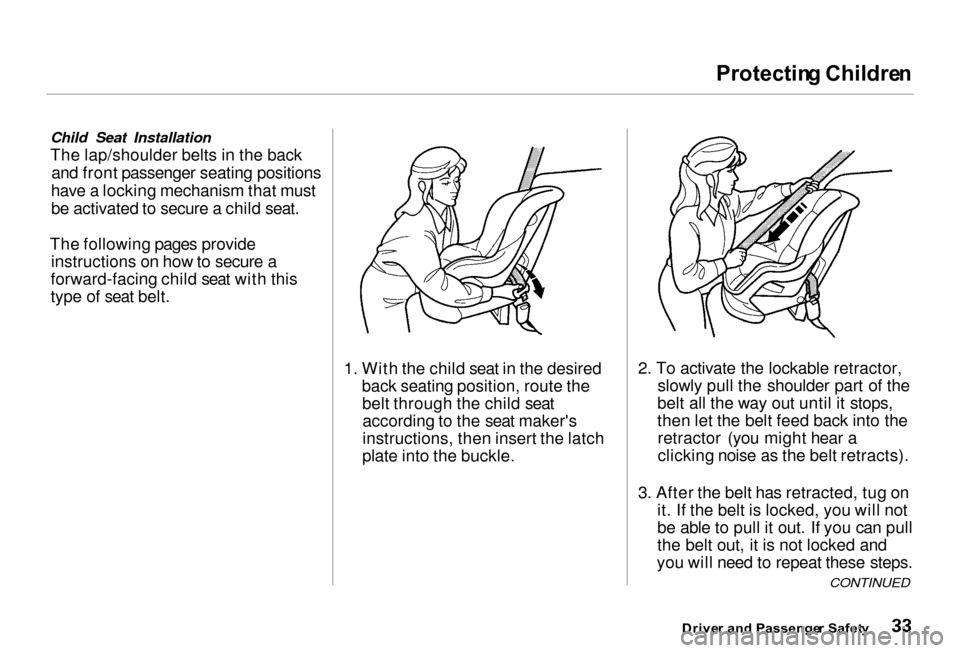
1. With the child seat in the desiredback seating position, route thebelt through the child seataccording to the seat maker's
instructions, then insert the latch
plate into the buckle. 2. To activate the lockable retractor,
slowly pull the shoulder part of the
belt all the way out until it stops,
then let the belt feed back into the retractor (you might hear a
clicking noise as the belt retracts).
3. After the belt has retracted, tug on it. If the belt is locked, you will not
be able to pull it out. If you can pull
the belt out, it is not locked and
you will need to repeat these steps.
Drive r an d Passenge r Safet y
CONTINUED
Page 37 of 330
Protectin
g Childre n
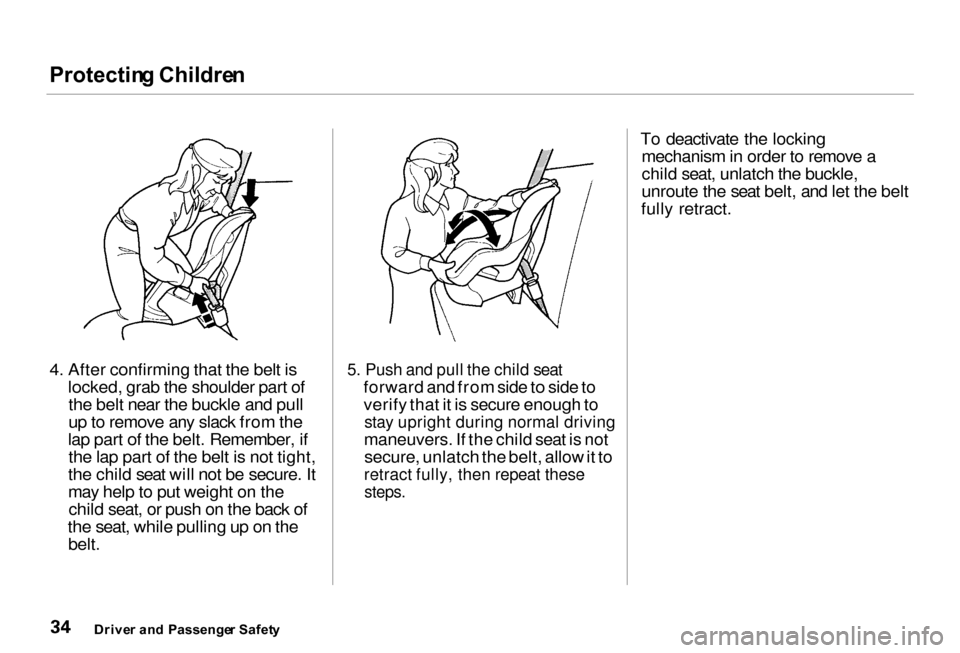
4. After confirming that the belt is locked, grab the shoulder part ofthe belt near the buckle and pull
up to remove any slack from the
lap part of the belt. Remember, if the lap part of the belt is not tight,
the child seat will not be secure. It
may help to put weight on the child seat, or push on the back of
the seat, while pulling up on the belt.
5. Push and pull the child seat
forward and from side to side to
verify that it is secure enough to
stay upright during normal driving
maneuvers. If the child seat is not secure, unlatch the belt, allow it to
retract fully, then repeat these
steps.
To deactivate the locking
mechanism in order to remove a
child seat, unlatch the buckle,
unroute the seat belt, and let the belt
fully retract.
Drive r an d Passenge r Safet y
Page 41 of 330
Protectin
g Childre n
Of course, children vary widely. And
while age may be one indicator of when a child can safely ride in the
front, there are other important
factors you should consider. Physical Size
Physically, a child must be large
enough for the lap/shoulder belt to
properly fit over the hips, chest, and shoulder (see pages 15 and 35). If
the seat belt does not fit properly, the child should not sit in the front.
Maturity
To safely ride in front, a child must be able to follow the rules, includingsitting properly and wearing the seat
belt properly throughout a ride. If you decide that a child can safely
ride up front, be sure to: Carefully read the owner's manual
and make sure you understand all seat belt instructions and all safety
information. Move the vehicle seat to the rear-
most position. Have the child sit up straight, back
against the seat, and feet on or
near the floor.
Check that the child's seat belt is
properly positioned and secured.
Supervise the child. Even mature
children sometimes need to be
reminded to fasten the seat belts
or sit properly.
Drive r an d Passenge r Safet y
Page 42 of 330
Protectin
g Childre n
Usin g Chil d Seat s wit h Tether s
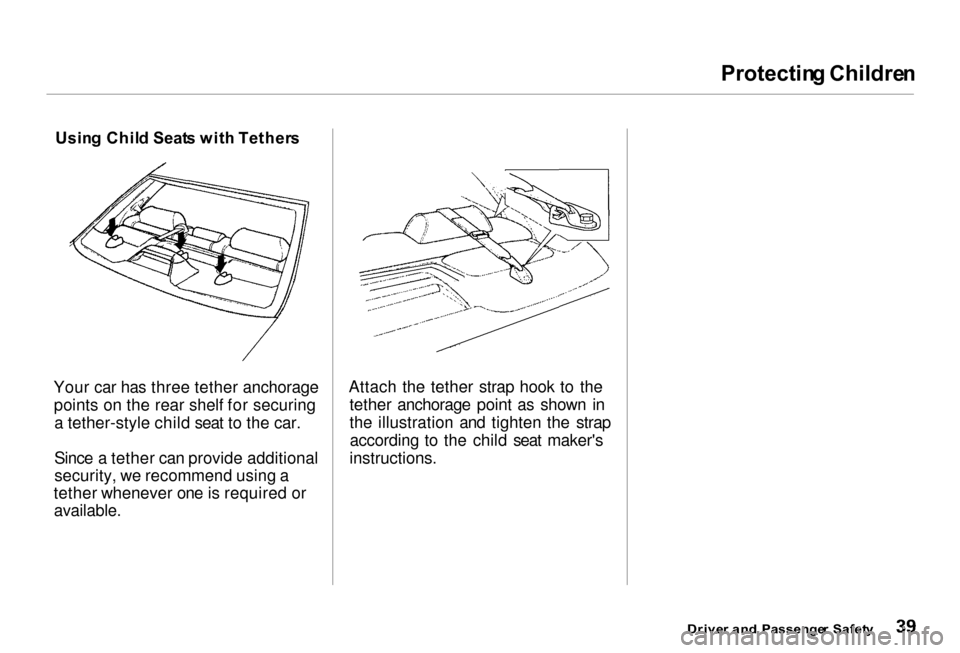
Your car has three tether anchorage points on the rear shelf for securinga tether-style child seat to the car.
Since a tether can provide additional
security, we recommend using a
tether whenever one is required or
available.
Attach the tether strap hook to the
tether anchorage point as shown in
the illustration and tighten the strapaccording to the child seat maker's
instructions.
Driver an d Passenge r Safet y
Page 43 of 330
Additiona
l Informatio n Abou t You r Sea t Belt s
Sea t Bel t Syste m Component s
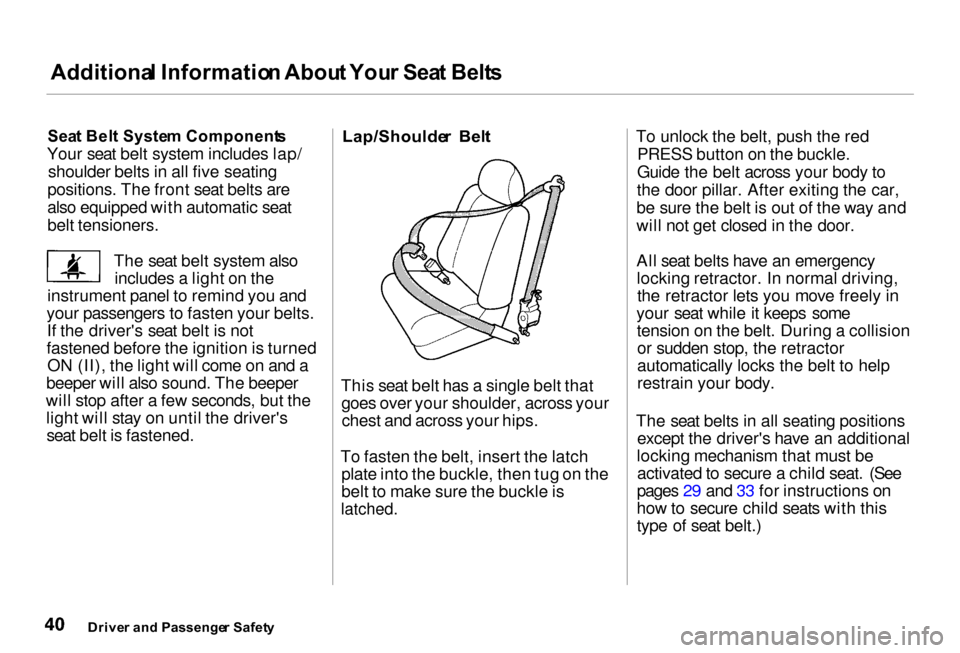
Your seat belt system includes lap/ shoulder belts in all five seating
positions. The front seat belts are
also equipped with automatic seat
belt tensioners.
The seat belt system alsoincludes a light on the
instrument panel to remind you and
your passengers to fasten your belts. If the driver's seat belt is not
fastened before the ignition is turned ON (II), the light will come on and a
beeper will also sound. The beeper
will stop after a few seconds, but the light will stay on until the driver'sseat belt is fastened. Lap/Shoulde
r Bel t
This seat belt has a single belt that goes over your shoulder, across yourchest and across your hips.
To fasten the belt, insert the latch plate into the buckle, then tug on the
belt to make sure the buckle is
latched.
To unlock the belt, push the red
PRESS button on the buckle.
Guide the belt across your body to
the door pillar. After exiting the car,
be sure the belt is out of the way and
will not get closed in the door.
All seat belts have an emergency locking retractor. In normal driving,the retractor lets you move freely in
your seat while it keeps some tension on the belt. During a collisionor sudden stop, the retractor
automatically locks the belt to help
restrain your body.
The seat belts in all seating positions except the driver's have an additional
locking mechanism that must be activated to secure a child seat. (See
pages 29 and 33 for instructions on
how to secure child seats with this
type of seat belt.)
Drive r an d Passenge r Safet y
Page 86 of 330
Key
s an d Lock s
If you unlock the doors with the
remote transmitter, but do not open
any of the doors within 30 seconds,
the doors automatically relock and
the security system sets.
You cannot lock any of the doors with the remote transmitter if any door is not fully closed or the key is
in the ignition switch. You cannot
unlock any of the doors with the key
in the ignition switch.
To open the trunk, push the Trunk Release button for approximately
one second.
You can open the trunk with the remote transmitter regardless of the
position of the main switch in the
glove box. The trunk will not open if
the key is in the ignition switch.
Turning the Beep Off and On
You can program the keyless entry system so it does not beep when you
lock and unlock the doors. This
procedure only turns off the beep;
the exterior lights will still flash.
To turn this feature off, stand near the car with the remote transmitter.Press and hold the Trunk Release
button, then press the Lock button
within one second. You should see the LED on the remote transmittercome on for one second. Release the
buttons after the LED goes out.
To turn this feature on, repeat the above procedure. You should see the
LED blink twice.
After you program the remote transmitter, make sure the trunk lidis closed.
Panic Mode
Panic mode allows you to remotely activate your car's security system to
attract attention. When activated, the
horn will sound, and the exterior
lights will flash, for about 30 seconds.
To activate panic mode, press and hold the PANIC button for about two
seconds.
To cancel Panic mode before 30 seconds, press any button on the
remote transmitter. You can also
turn the ignition switch to ON (II).
Panic mode will not activate if the
ignition switch is in ON (II).
CONTINUED
Instrument s an d Control s
Page 91 of 330
HomeLin
k Universa l Transmitte r
The HomeLink Universal Transmit- ter built into your car can be
programmed to operate remotely-controlled devices around your home,
such as garage doors, lighting, or
home security systems. It can replace up to three remote
transmitters.
Custome r Assistanc e
If you have problems with training
the HomeLink Universal
Transmitter, or would like information on home products thatcan be operated by the transmitter,
call (800) 355-3515. Importan
t Safet y Precaution s
Always refer to the operating instruc- tions and safety information that
came with your garage door opener
or other equipment you intend tooperate with the HomeLink
Universal Transmitter. If you do not
have this information, you should contact the manufacturer of the
equipment.
While training or using the transmitter, make sure you have aclear view of the garage door or gate,
and that no one will be injured by its
movement. If your garage door opener was
manufactured before April 1982, you
may not be able to program the
HomeLink Universal Transmitter to
operate it. Garage door openers
manufactured before that date do
not have a safety feature that causes
them to stop and reverse if an obstacle is detected during closing,
increasing the risk of injury. If you
have questions, call (800) 355-3515.
Instrument s an d Control s
Page 92 of 330
HomeLin
k Universa l Transmitte r
Trainin g th e Transmitte r
Before you can use the HomeLink
Universal Transmitter to operate
devices around your home, it must
"learn" the proper codes. For
example, to train the transmitter to
open and close the garage door:
1. This step erases all previously learned
codes. Perform this step before
training the transmitter for the very
first time. Press and hold the two
outside buttons until the red light
in the transmitter flashes (approximately 20 seconds).
Release the buttons.
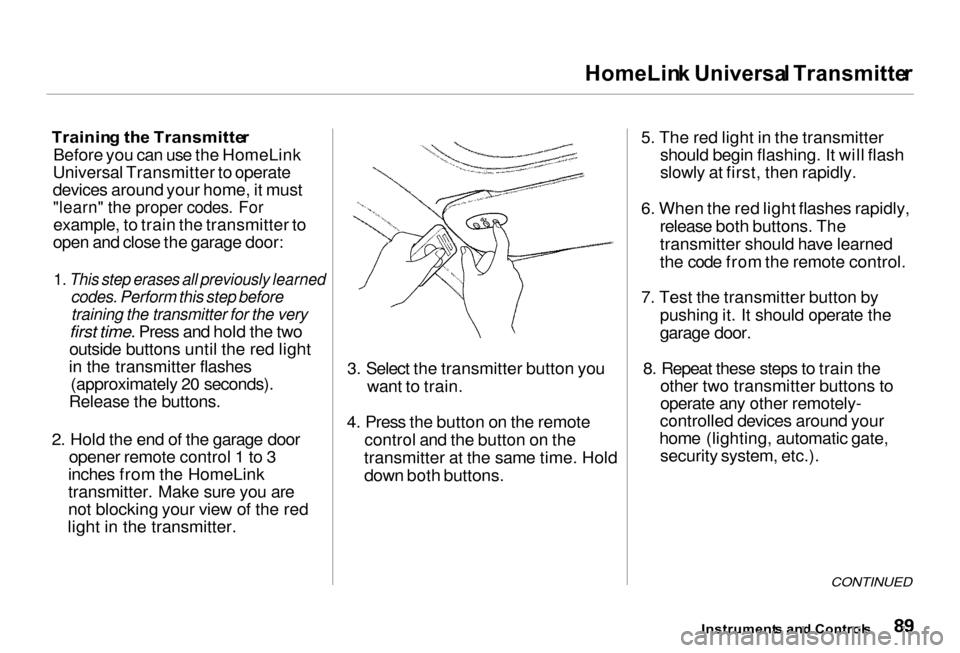
2. Hold the end of the garage door opener remote control 1 to 3
inches from the HomeLink
transmitter. Make sure you are
not blocking your view of the red
light in the transmitter. 3. Select the transmitter button you
want to train.
4. Press the button on the remote control and the button on the
transmitter at the same time. Hold down both buttons. 5. The red light in the transmitter
should begin flashing. It will flash
slowly at first, then rapidly.
6. When the red light flashes rapidly, release both buttons. The
transmitter should have learned
the code from the remote control.
7. Test the transmitter button by pushing it. It should operate the
garage door.
8. Repeat these steps to train the other two transmitter buttons to
operate any other remotely-
controlled devices around your
home (lighting, automatic gate, security system, etc.).
CONTINUED
Instrument s an d Control s
Page 94 of 330
HomeLin
k Universa l Transmitte r
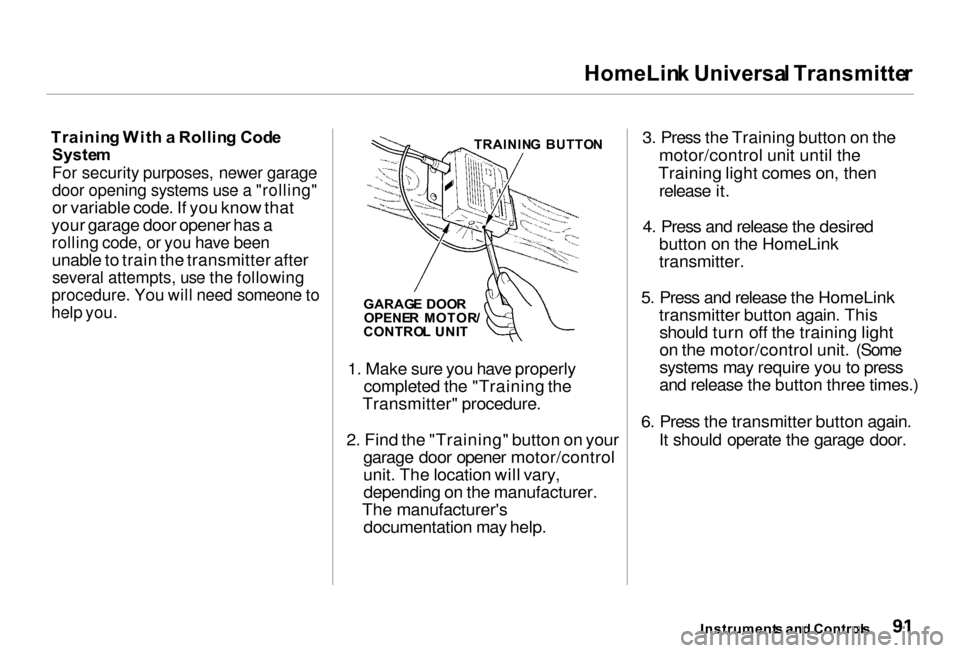
Trainin g Wit h a Rollin g Cod e
Syste m
For security purposes, newer garage
door opening systems use a "rolling"
or variable code. If you know that
your garage door opener has a
rolling code, or you have been
unable to train the transmitter after
several attempts, use the following
procedure. You will need someone to
help you.
1. Make sure you have properlycompleted the "Training the
Transmitter" procedure.
2. Find the "Training" button on your garage door opener motor/control
unit. The location will vary,depending on the manufacturer.
The manufacturer's documentation may help. 3. Press the Training button on the
motor/control unit until the
Training light comes on, then release it.
4. Press and release the desired button on the HomeLink
transmitter.
5. Press and release the HomeLink transmitter button again. Thisshould turn off the training light
on the motor/control unit. (Some
systems may require you to press
and release the button three times.)
6. Press the transmitter button again. It should operate the garage door.
Instrument s an d Control s
TRAININ
G BUTTO N
GARAG E DOO R
OPENE R MOTOR /
CONTRO L UNI T
Page 99 of 330

Sea
t Adjustments , Armres t
The head restraints adjust for height and tilt. You need both hands toadjust the restraint. Do not attempt
to adjust it while driving. To raise it,
pull upward. To lower the restraint,
push the release button sideways and push the restraint down. To
adjust the tilt, pivot the head
restraint to the desired position. To remove a head restraint for
cleaning or repair, pull it up as far as
it will go. Push the release button and pull the restraint out of the seat-
back.
The lid of the console compartmentcan be used as an armrest at the
high or low position. To raise the armrest, push the button on the lid.
Make sure the armrest is securely
latched. To lower it, press the button and push the armrest down until it
latches.
Make sure the passengers' hands or
fingers are away from the armrest
before pushing it down.
Instrument s an d Control s
RELEAS
E BUTTO N
Armres
t
Pus h