engine ACURA TL 1995 Service Repair Manual
[x] Cancel search | Manufacturer: ACURA, Model Year: 1995, Model line: TL, Model: ACURA TL 1995Pages: 1771, PDF Size: 62.49 MB
Page 929 of 1771
Positive Crankcase Ventilation (PCV) System
Description
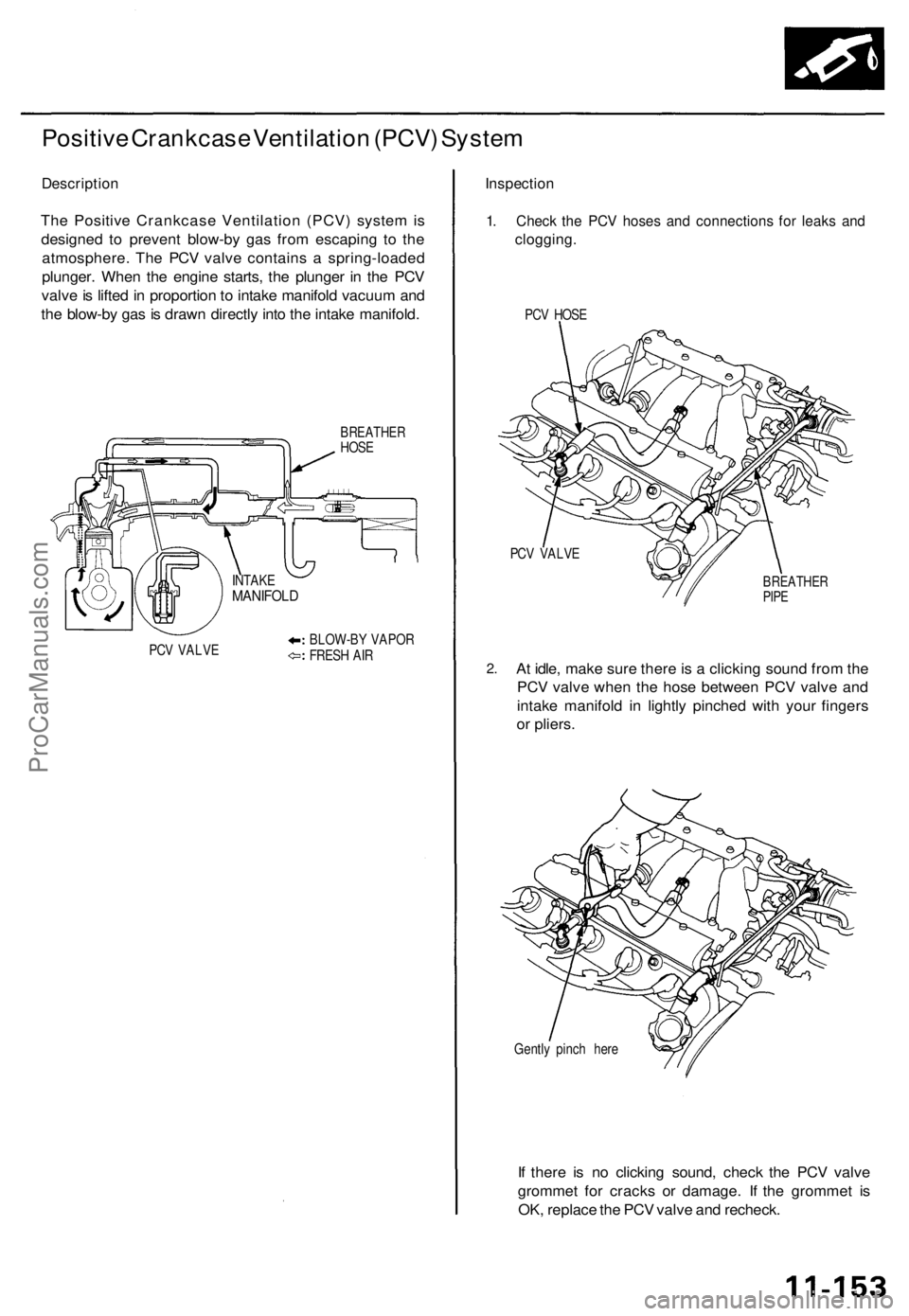
The Positive Crankcase Ventilation (PCV) system is
designed to prevent blow-by gas from escaping to the
atmosphere. The PCV valve contains a spring-loaded
plunger. When the engine starts, the plunger in the PCV
valve is lifted in proportion to intake manifold vacuum and
the blow-by gas is drawn directly into the intake manifold.
BREATHER
HOSE
PCV VALVE
BLOW-BY VAPOR
FRESH AIR
Inspection
1. Check the PCV hoses and connections for leaks and
clogging.
PCV HOSE
PCV VALVE
2.
BREATHER
PIPE
At idle, make sure there is a clicking sound from the
PCV valve when the hose between PCV valve and
intake manifold in lightly pinched with your fingers
or pliers.
Gently pinch here
If there is no clicking sound, check the PCV valve
grommet for cracks or damage. If the grommet is
OK, replace the PCV valve and recheck.
INTAKE
MANIFOLDProCarManuals.com
Page 930 of 1771
Emission Control System
Evaporative Emission (EVAP) Controls
Description
The evaporative emission controls are designed to minimize the amount of fuel vapor escaping to the atmosphere. The
system consists of the following components:
A. Evaporative Emission (EVAP) Control Canister
An EVAP control canister is used for the temporary storage of fuel vapor until the fuel vapor can be purged from the
EVAP control canister into the engine and burned.
B. Vapor Purge Control System
EVAP control canister purging is accomplished by drawing fresh air through the EVAP control canister and into a port
on the throttle body. The purging vacuum is controlled by the EVAP purge control solenoid valve.
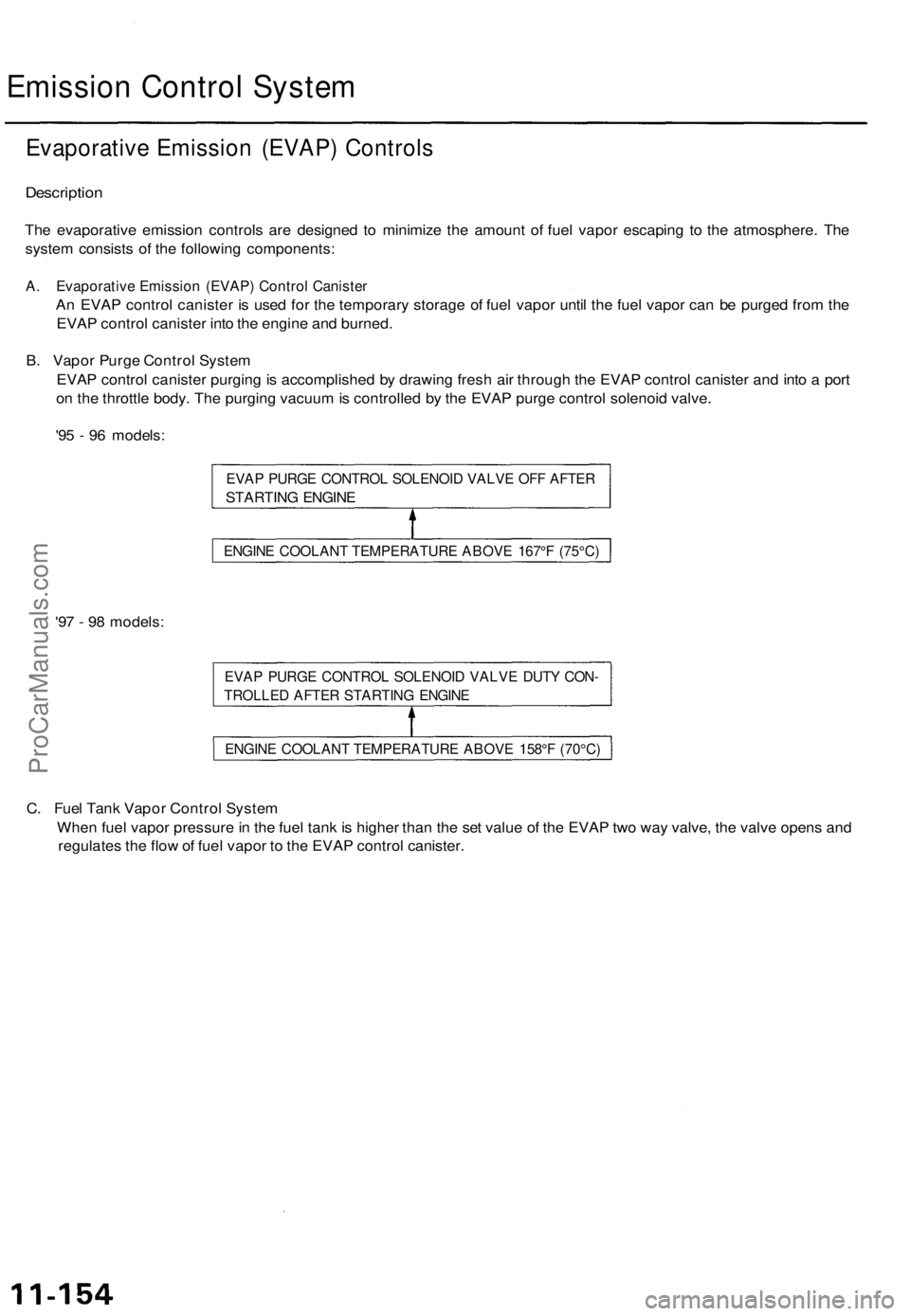
'95 - 96 models:
EVAP PURGE CONTROL SOLENOID VALVE OFF AFTER
STARTING ENGINE
'97 - 98 models:
EVAP PURGE CONTROL SOLENOID VALVE DUTY CON-
TROLLED AFTER STARTING ENGINE
C. Fuel Tank Vapor Control System
When fuel vapor pressure in the fuel tank is higher than the set value of the EVAP two way valve, the valve opens and
regulates the flow of fuel vapor to the EVAP control canister.
ENGINE COOLANT TEMPERATURE ABOVE 167°F (75°C)
ENGINE COOLANT TEMPERATURE ABOVE 158°F (70°C)ProCarManuals.com
Page 936 of 1771
Description
The automatic transmission is a combination of a 3-element torque converter and a dual-shaft electronically controlled
automatic transmission which provides 4 speeds forward and 1 reverse. The entire unit is positioned in line with the engine.
Torque Converter, Gears and Clutches
The torque converter consists of a pump, turbine and stator, assembled in a single unit.
They are connected to the engine crankshaft so they turn together as a unit as the engine turns.
Around the outside of the drive plate is a ring gear which meshes with the starter pinion when the engine is being started.
The entire torque converter assembly serves as a flywheel while transmitting power to the transmission mainshaft.
The transmission has two parallel shafts: the mainshaft and the countershaft. The mainshaft is in line with the engine
crankshaft.
The mainshaft includes the 1st, 2nd and 4th clutches, and gears for 4th, 2nd, 1st and reverse (3rd gear is integral with the
mainshaft, while the reverse gear is integral with 4th gear).
The countershaft includes the 3rd, and 1st-hold clutches, and gears for 3rd, 4th, 1st, 2nd, reverse, and parking. The sec-
ondary drive gear is integrated with the countershaft.
The gears on the mainshaft are in constant mesh with those on the countershaft.
When certain combinations of gears in the transmission are engaged by clutches, power is transmitted from the mainshaft
to the countershaft to provide and positions.
Electronic Control
The electronic control system consists of the Transmission Control Module (TCM), sensors, a linear solenoid and four
solenoid valves. Shifting and lock-up are electronically controlled for comfortable driving under all conditions.
The TCM is located below the dashboard, behind the glove box on the passenger's side.
Hydraulic Control
The lower valve body assembly includes the main valve body, the servo body and the shift control solenoid valves. They
are bolted on the lower part of the transmission housing.
Other valve bodies, the regulator valve body, the ATF pump body, the 2nd accumulator body, and the throttle valve body,
are bolted to the torque converter housing.
The main valve body contains the manual valve, the 1 - 2 shift valve, the 2 - 3 shift valve, the 3 - 4 shift valve, the 4th kick-
down valve, the 2 - 3 orifice control valve, the 3 - 4 orifice control valve, the 4th exhaust valve, the servo control valve,
and the main orifice control valve.
The servo body contains the servo valve, 3rd and 4th accumulator pistons.
The regulator valve body contains the regulator valve, the lock-up shift valve, and the cooler relief valve.
Fluid from the regulator passes through the manual valve to the various control valves.
The throttle valve body includes the throttle valve which is bolted onto the 2nd accumulator body. The 2nd accumulator
piston is assembled in the 2nd accumulator body.
The linear solenoid is joined with the throttle valve body.
The ATF pump body contains the modulator valve, the lock-up control valve, the lock-up timing valve, and the relief valve.
The torque converter check valve is located in the torque converter housing under the ATF pump body.
The 1st and 1st-hold accumulator pistons are assembled in the rear cover.
The clutches receive fluid from their respective feed pipes or internal hydraulic circuit.
Shift Control Mechanism
Input from various sensors located throughout the vehicle determines which shift control solenoid valve the TCM will acti-
vate. Activating a shift control solenoid valve changes modulator pressure, causing a shift valve to move. This pressurizes
a line to one of the clutches, engaging that clutch and its corresponding gear.
Lock-up Mechanism
In position, in 2nd, 3rd and 4th, and in position in 3rd, pressurized fluid is drained from the back of the torque con-
verter through a fluid passage, causing the lock-up piston to be held against the torque converter cover. As this takes place,
the mainshaft rotates at the same speed as the engine crankshaft. Together with hydraulic control, the TCM optimizes the
timing of the lock-up mechanism. The lock-up valves control the range of lock-up according to lock-up control solenoid
valves A and B, and throttle valve. When lock-up control solenoid valves A and B activate, the modulator pressure changes.
The lock-up control solenoid valves A and B are mounted on the torque converter housing, and are controlled by the TCM.ProCarManuals.com
Page 944 of 1771
Position
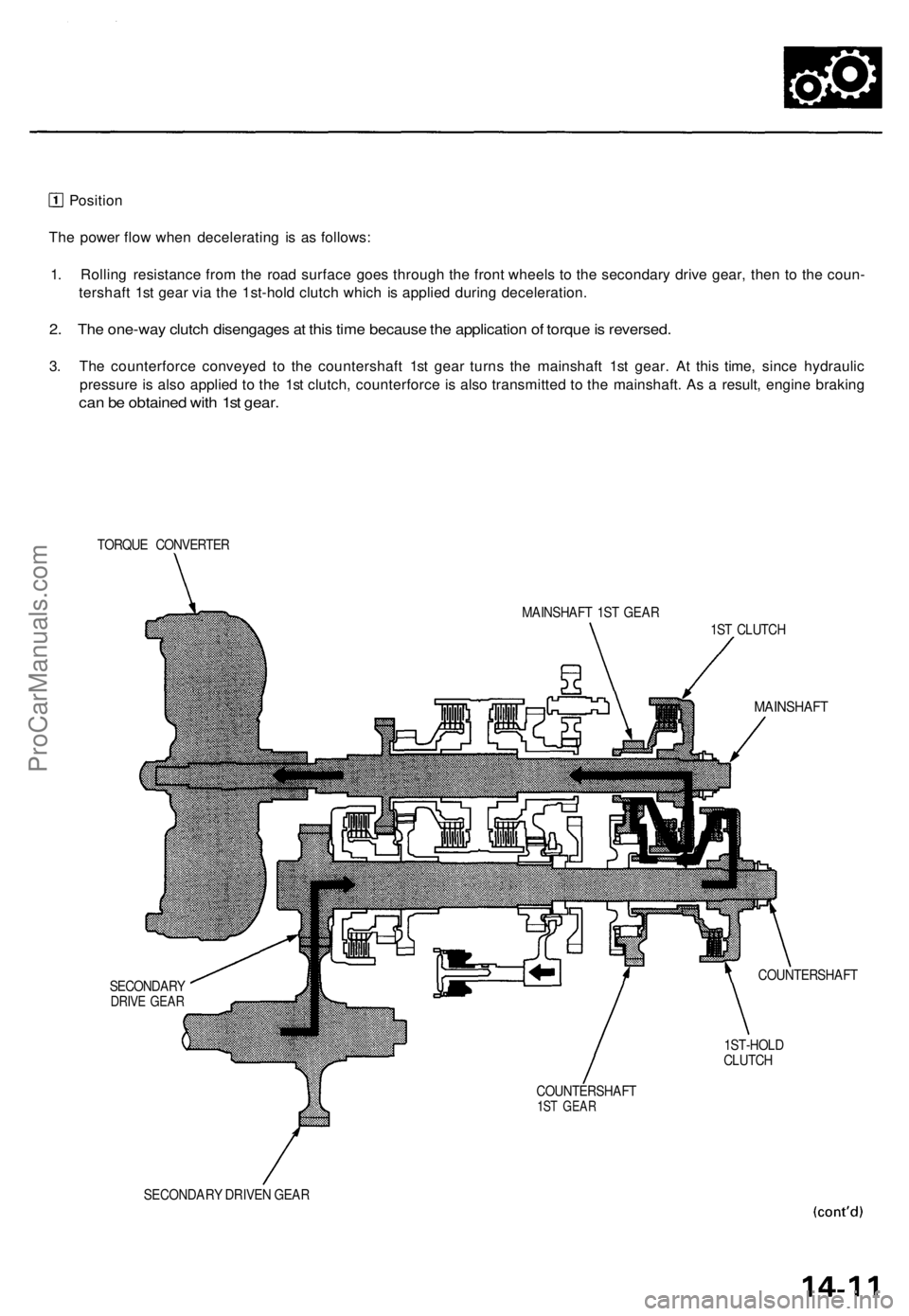
The power flow when decelerating is as follows:
1. Rolling resistance from the road surface goes through the front wheels to the secondary drive gear, then to the coun-
tershaft 1st gear via the 1st-hold clutch which is applied during deceleration.
2. The one-way clutch disengages at this time because the application of torque is reversed.
3. The counterforce conveyed to the countershaft 1st gear turns the mainshaft 1st gear. At this time, since hydraulic
pressure is also applied to the 1st clutch, counterforce is also transmitted to the mainshaft. As a result, engine braking
can be obtained with 1st gear.
TORQUE CONVERTER
MAINSHAFT 1ST GEAR
1ST CLUTCH
MAINSHAFT
SECONDARY
DRIVE GEAR
COUNTERSHAFT
1ST-HOLD
CLUTCH
COUNTERSHAFT
1ST GEAR
SECONDARY DRIVEN GEARProCarManuals.com
Page 946 of 1771
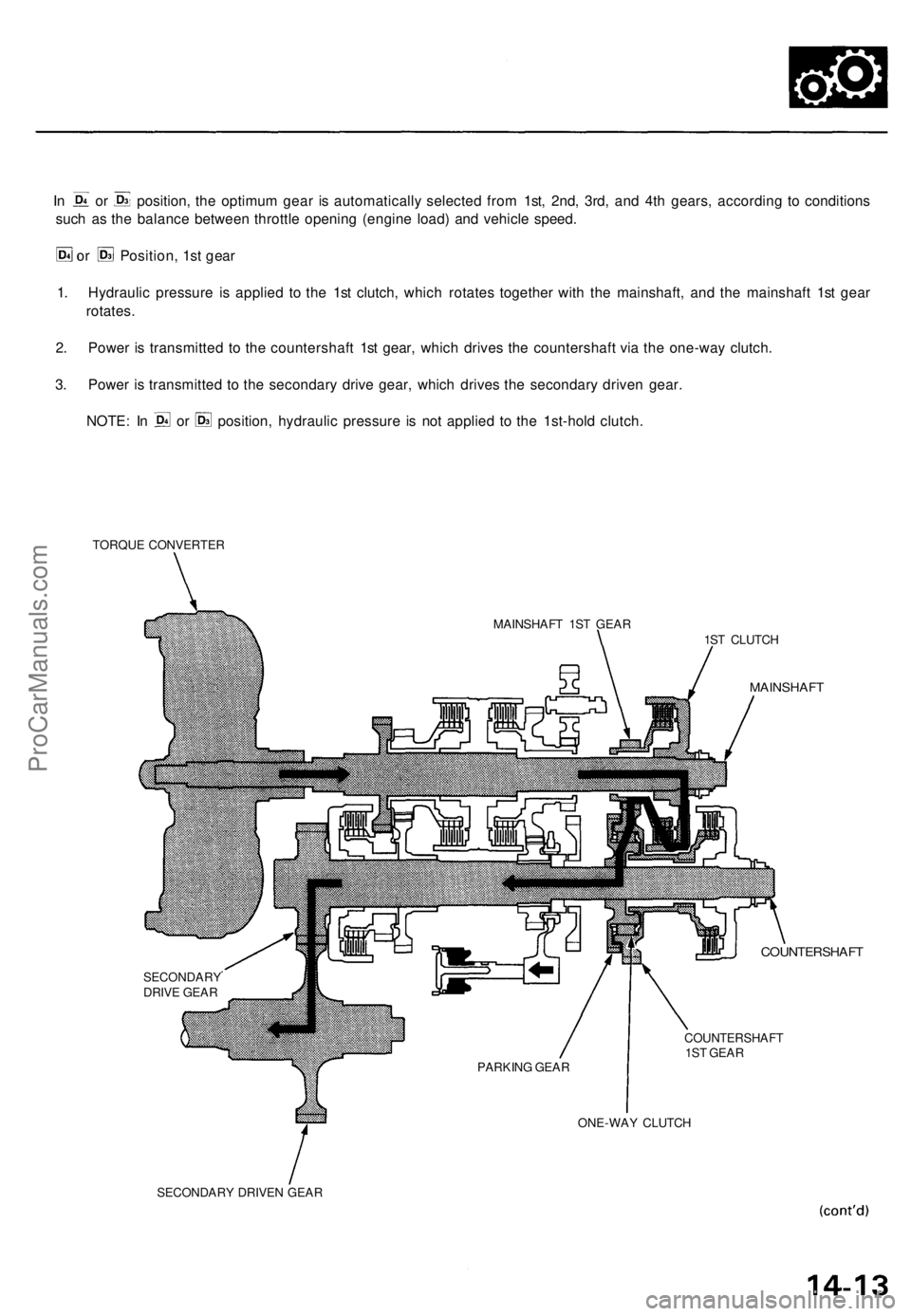
In or position, the optimum gear is automatically selected from 1st, 2nd, 3rd, and 4th gears, according to conditions
such as the balance between throttle opening (engine load) and vehicle speed.
or Position, 1st gear
1. Hydraulic pressure is applied to the 1st clutch, which rotates together with the mainshaft, and the mainshaft 1st gear
rotates.
2. Power is transmitted to the countershaft 1st gear, which drives the countershaft via the one-way clutch.
3. Power is transmitted to the secondary drive gear, which drives the secondary driven gear.
NOTE: In or position, hydraulic pressure is not applied to the 1st-hold clutch.
TORQUE CONVERTER
MAINSHAFT 1ST GEAR
1ST CLUTCH
MAINSHAFT
COUNTERSHAFT
COUNTERSHAFT
1ST GEAR
ONE-WAY CLUTCH
SECONDARY DRIVEN GEAR
PARKING GEAR
SECONDARY
DRIVE GEARProCarManuals.com
Page 951 of 1771
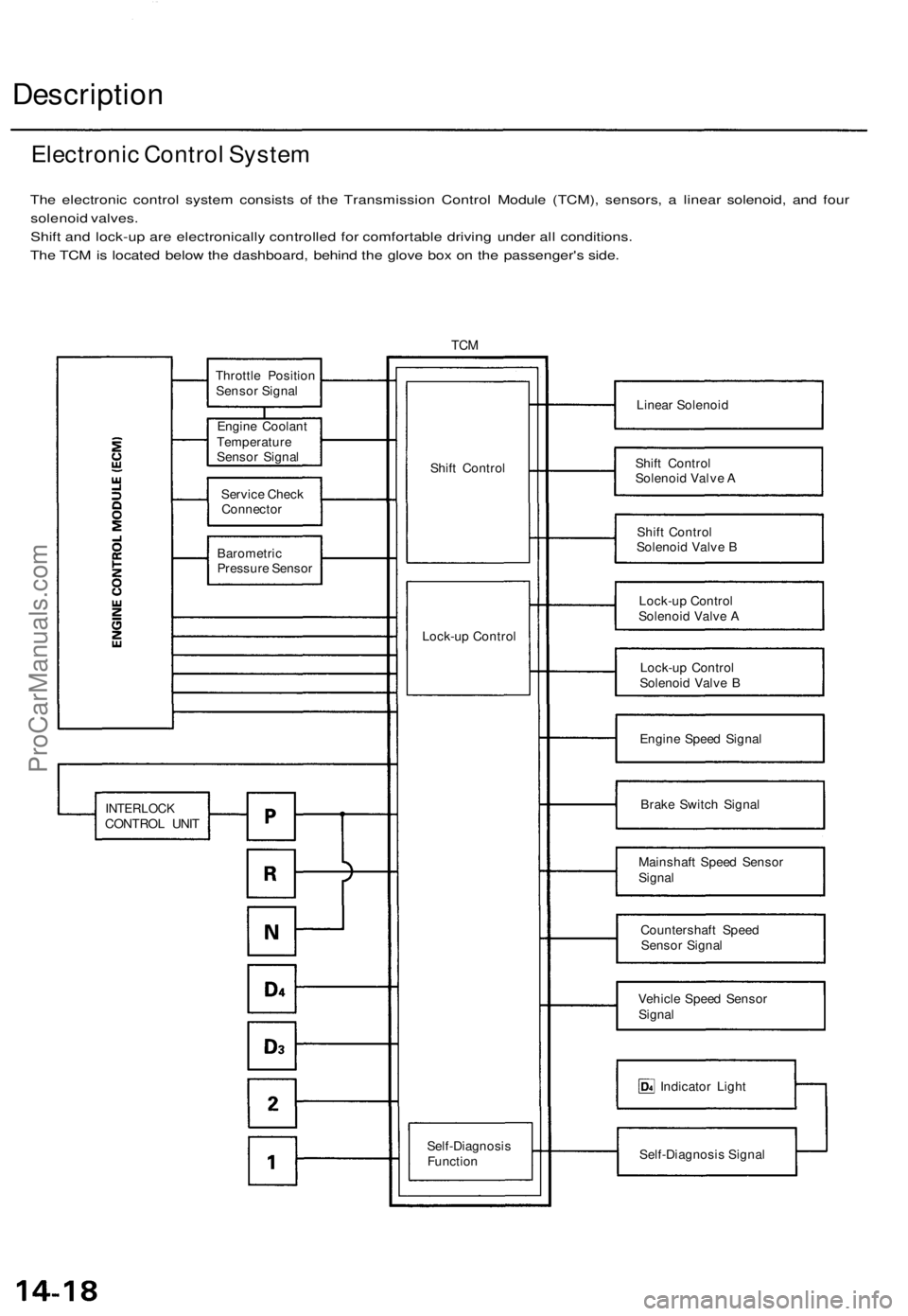
Description
The electronic control system consists of the Transmission Control Module (TCM), sensors, a linear solenoid, and four
solenoid valves.
Shift and lock-up are electronically controlled for comfortable driving under all conditions.
The TCM is located below the dashboard, behind the glove box on the passenger's side.
TCM
Linear Solenoid
Shift Control
Solenoid Valve A
Shift Control
Solenoid Valve B
Lock-up Control
Solenoid Valve A
Lock-up Control
Solenoid Valve B
Engine Speed Signal
Brake Switch Signal
Mainshaft Speed Sensor
Signal
Countershaft Speed
Sensor Signal
Vehicle Speed Sensor
Signal
Indicator Light
Self-Diagnosis Signal
Electronic Control System
Shift Control
Lock-up Control
Throttle Position
Sensor Signal
Engine Coolant
Temperature
Sensor Signal
Service Check
Connector
Barometric
Pressure Sensor
INTERLOCK
CONTROL UNIT
Self-Diagnosis
FunctionProCarManuals.com
Page 953 of 1771
Description
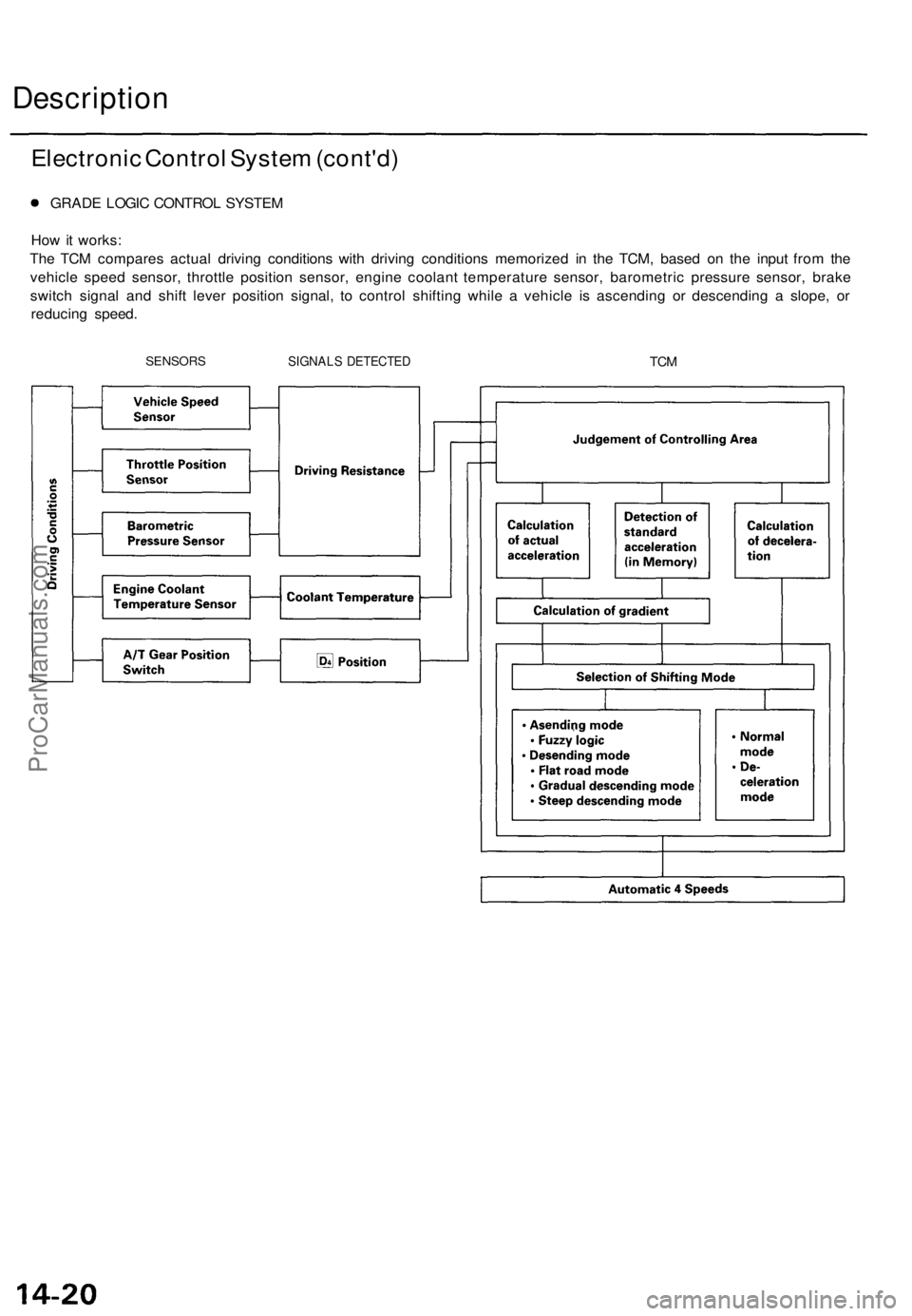
GRADE LOGIC CONTROL SYSTEM
How it works:
The TCM compares actual driving conditions with driving conditions memorized in the TCM, based on the input from the
vehicle speed sensor, throttle position sensor, engine coolant temperature sensor, barometric pressure sensor, brake
switch signal and shift lever position signal, to control shifting while a vehicle is ascending or descending a slope, or
reducing speed.
SENSORS
SIGNALS DETECTED
TCM
Electronic Control System (cont'd)ProCarManuals.com
Page 954 of 1771
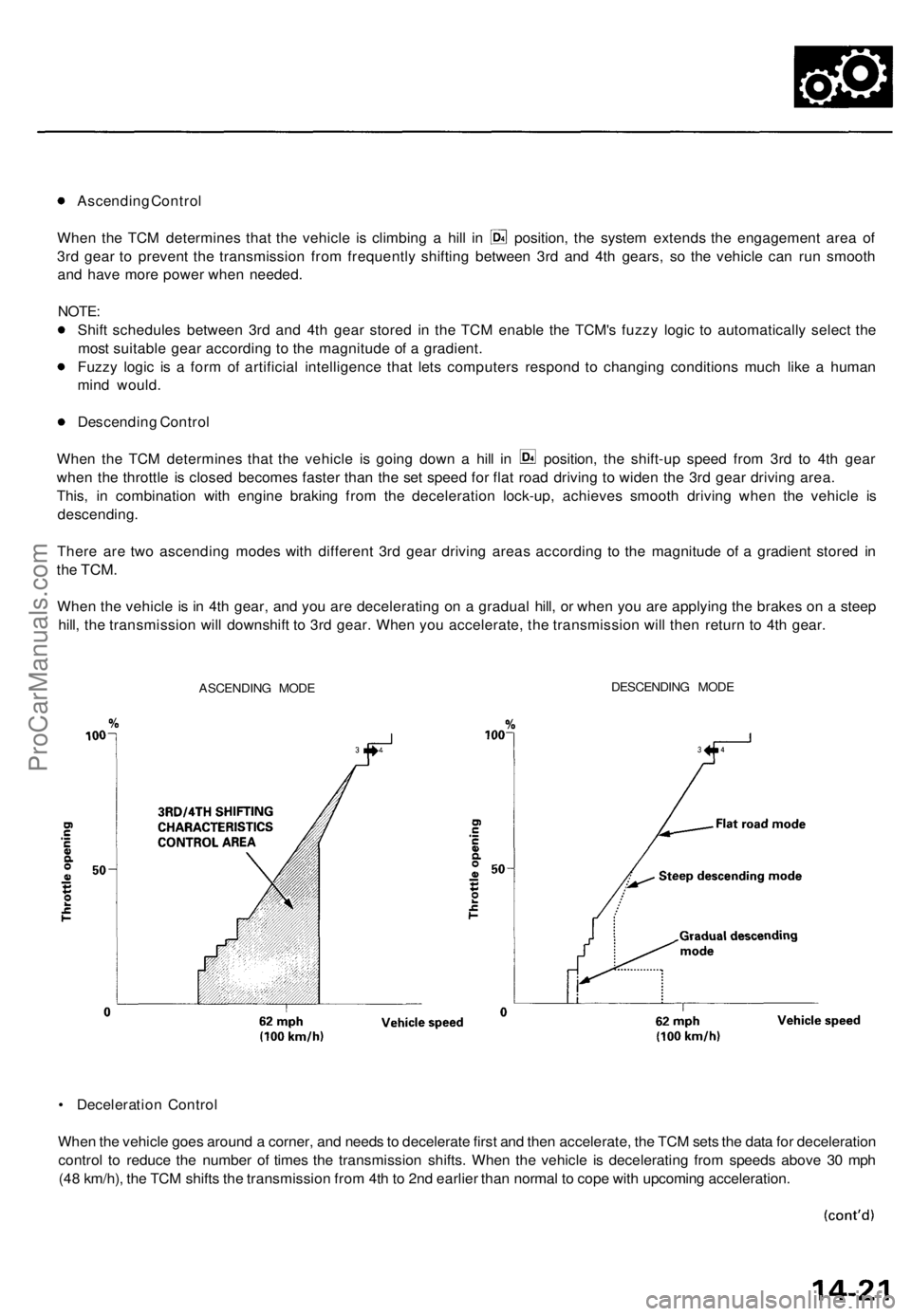
Ascending Control
When the TCM determines that the vehicle is climbing a hill in position, the system extends the engagement area of
3rd gear to prevent the transmission from frequently shifting between 3rd and 4th gears, so the vehicle can run smooth
and have more power when needed.
NOTE:
Shift schedules between 3rd and 4th gear stored in the TCM enable the TCM's fuzzy logic to automatically select the
most suitable gear according to the magnitude of a gradient.
Fuzzy logic is a form of artificial intelligence that lets computers respond to changing conditions much like a human
mind would.
Descending Control
When the TCM determines that the vehicle is going down a hill in position, the shift-up speed from 3rd to 4th gear
when the throttle is closed becomes faster than the set speed for flat road driving to widen the 3rd gear driving area.
This, in combination with engine braking from the deceleration lock-up, achieves smooth driving when the vehicle is
descending.
There are two ascending modes with different 3rd gear driving areas according to the magnitude of a gradient stored in
the
TCM.
When the vehicle is in 4th gear, and you are decelerating on a gradual hill, or when you are applying the brakes on a steep
hill, the transmission will downshift to 3rd gear. When you accelerate, the transmission will then return to 4th gear.
ASCENDING MODE
DESCENDING MODE
• Deceleration Control
When the vehicle goes around a corner, and needs to decelerate first and then accelerate, the TCM sets the data for deceleration
control to reduce the number of times the transmission shifts. When the vehicle is decelerating from speeds above 30 mph
(48 km/h), the TCM shifts the transmission from 4th to 2nd earlier than normal to cope with upcoming acceleration.ProCarManuals.com
Page 955 of 1771
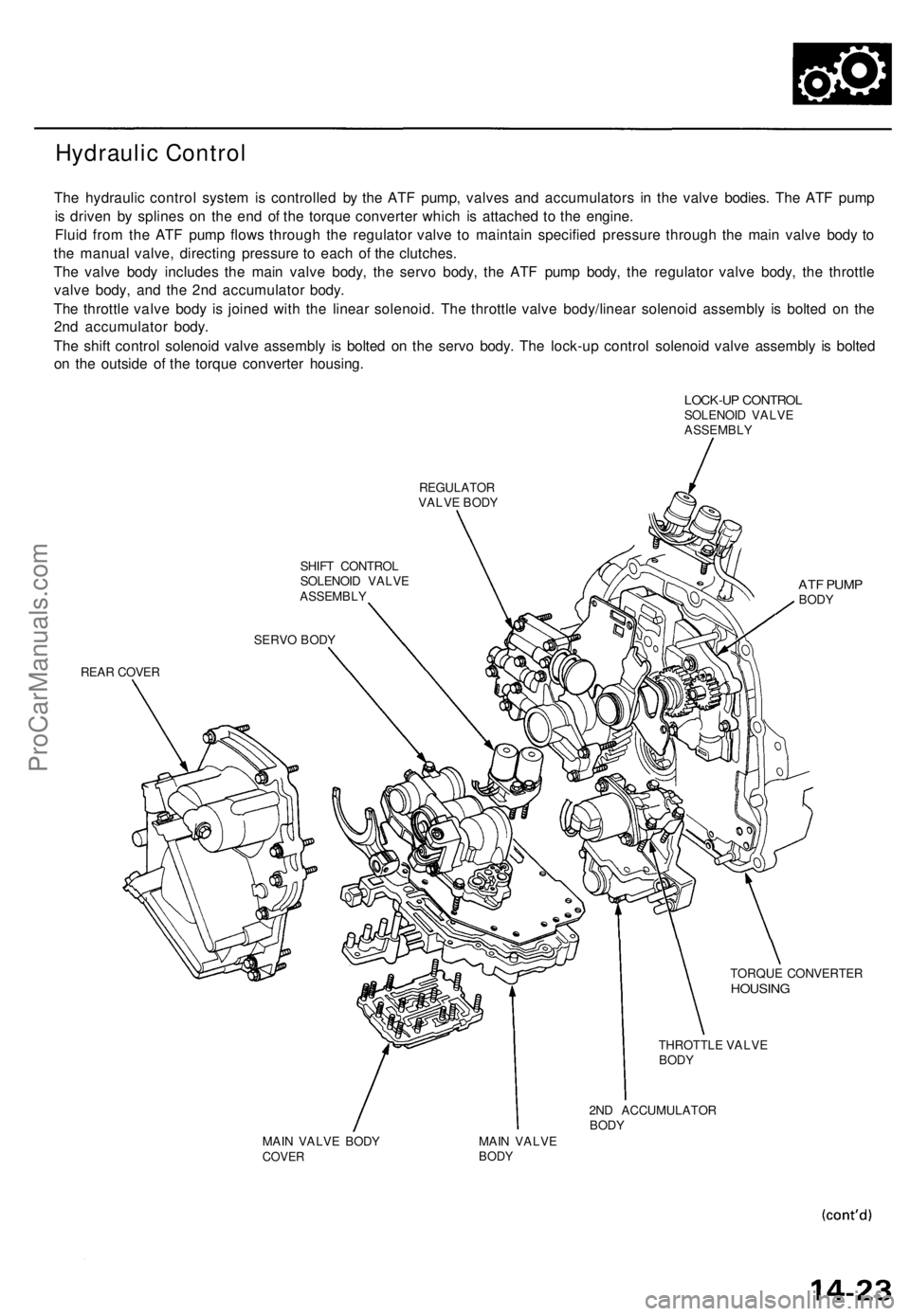
Hydraulic Control
The hydrauli c contro l syste m is controlle d b y th e AT F pump , valve s an d accumulator s i n th e valv e bodies . Th e AT F pum p
i s drive n b y spline s o n th e en d o f th e torqu e converte r whic h i s attache d t o th e engine .
Flui d fro m th e AT F pum p flow s throug h th e regulato r valv e t o maintai n specifie d pressur e throug h th e mai n valv e bod y t o
th e manua l valve , directin g pressur e t o eac h o f th e clutches .
Th e valv e bod y include s th e mai n valv e body , th e serv o body , th e AT F pum p body , th e regulato r valv e body , th e throttl e
valv e body , an d th e 2n d accumulato r body .
Th e throttl e valv e bod y i s joine d wit h th e linea r solenoid . Th e throttl e valv e body/linea r solenoi d assembl y i s bolte d o n th e
2n d accumulato r body .
Th e shif t contro l solenoi d valv e assembl y i s bolte d o n th e serv o body . Th e lock-u p contro l solenoi d valv e assembl y i s bolte d
o n th e outsid e o f th e torqu e converte r housing .
LOCK-UP CONTRO LSOLENOI D VALV E
ASSEMBL Y
REGULATO RVALVE BOD Y
SHIF T CONTRO L
SOLENOI D VALV E
ASSEMBL Y
REA R COVE R
ATF PUM PBODY
TORQU E CONVERTE RHOUSING
THROTTL E VALV EBODY
2ND ACCUMULATO RBODYMAIN VALV E BOD YCOVE RMAIN VALV EBODY
SERV O BOD Y
ProCarManuals.com
Page 959 of 1771
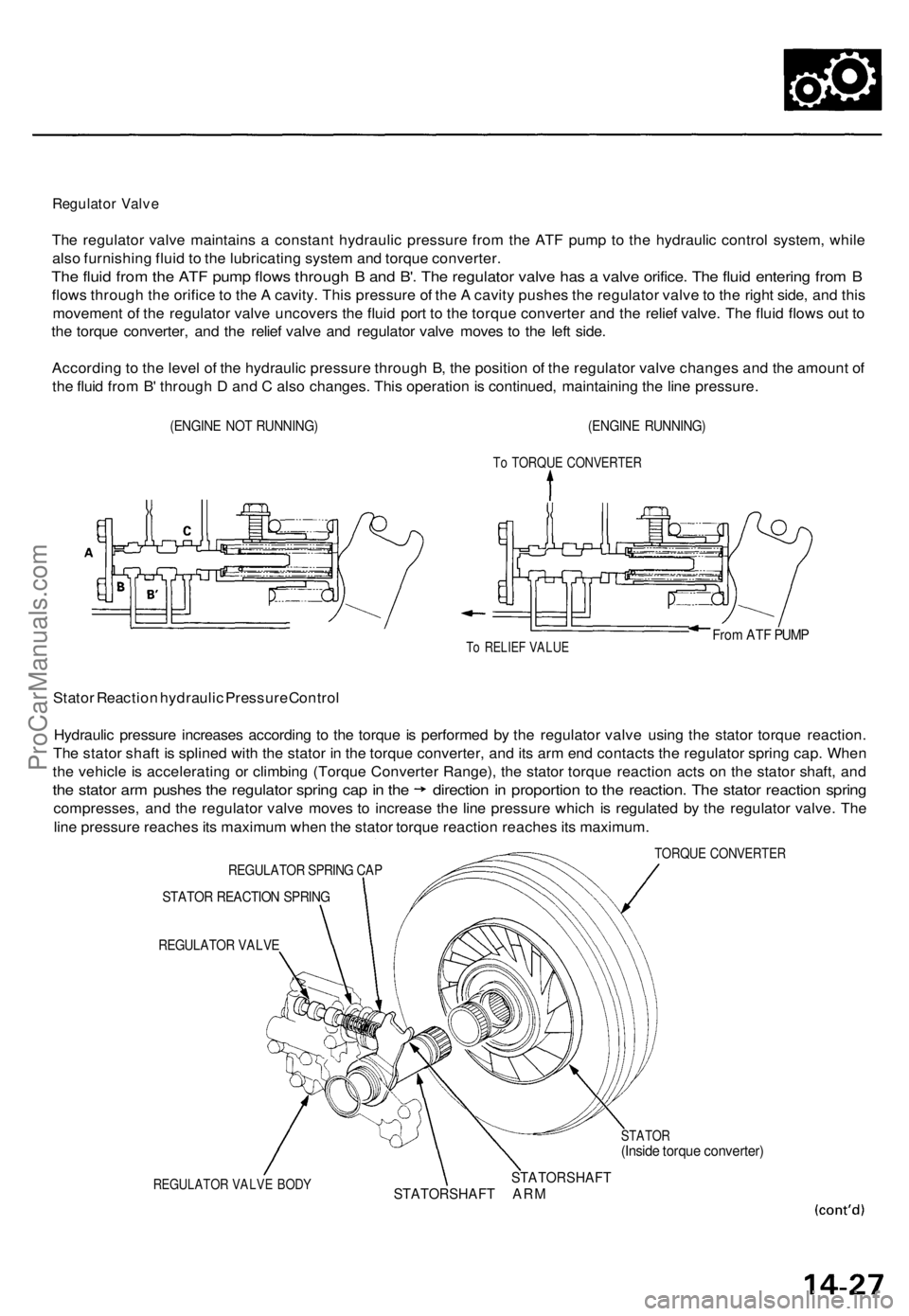
Regulator Valv e
The regulato r valv e maintain s a constan t hydrauli c pressur e fro m th e AT F pum p t o th e hydrauli c contro l system , whil e
als o furnishin g flui d to th e lubricatin g syste m an d torqu e converter .
The flui d fro m th e AT F pum p flow s throug h B an d B' . Th e regulato r valv e ha s a valv e orifice . Th e flui d enterin g fro m B
flow s throug h th e orific e to th e A cavity . Thi s pressur e o f th e A cavit y pushe s th e regulato r valv e to th e righ t side , an d thi s
movemen t o f th e regulato r valv e uncover s th e flui d por t t o th e torqu e converte r an d th e relie f valve . Th e flui d flow s ou t t o
th e torqu e converter , an d th e relie f valv e an d regulato r valv e move s t o th e lef t side .
Accordin g to th e leve l o f th e hydrauli c pressur e throug h B , th e positio n o f th e regulato r valv e change s an d th e amoun t o f
th e flui d fro m B ' throug h D an d C als o changes . Thi s operatio n is continued , maintainin g th e lin e pressure .
(ENGINE NO T RUNNING )(ENGINE RUNNING )
To TORQU E CONVERTE R
To RELIE F VALU EFrom AT F PUM P
Stato r Reactio n hydrauli c Pressur e Contro l
Hydrauli c pressur e increase s accordin g t o th e torqu e is performe d b y th e regulato r valv e usin g th e stato r torqu e reaction .
Th e stato r shaf t i s spline d wit h th e stato r i n th e torqu e converter , an d it s ar m en d contact s th e regulato r sprin g cap . Whe n
th e vehicl e is acceleratin g o r climbin g (Torqu e Converte r Range) , th e stato r torqu e reactio n act s o n th e stato r shaft , an d
the stato r ar m pushe s th e regulato r sprin g ca p in th e directio n in proportio n t o th e reaction . Th e stato r reactio n sprin g
compresses , an d th e regulato r valv e move s t o increas e th e lin e pressur e whic h i s regulate d b y th e regulato r valve . Th e
lin e pressur e reache s it s maximu m whe n th e stato r torqu e reactio n reache s it s maximum .
REGULATO R SPRIN G CA P
STATO R REACTIO N SPRIN G
REGULATO R VALV E
REGULATO R VALV E BOD Y
TORQU E CONVERTE R
STATOR(Inside torqu e converter )
STATOR SHAF TSTATO R SHAF T AR M
ProCarManuals.com