lights Acura TL 2000 3.2 Owner's Guide
[x] Cancel search | Manufacturer: ACURA, Model Year: 2000, Model line: TL, Model: Acura TL 2000Pages: 311, PDF Size: 3.05 MB
Page 197 of 311
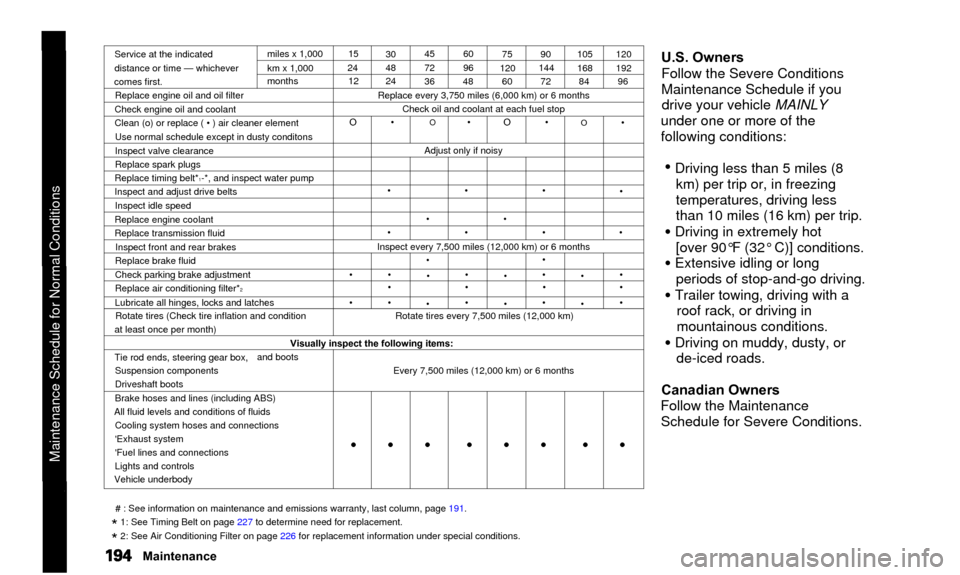
Service at the indicated
distance or time — whichever
comes first. miles x 1,000
km x 1,000
months
Replace engine oil and oil filter
Check engine oil and coolant
Clean (o) or replace ( • ) air cleaner element Use normal schedule except in dusty conditons
Inspect valve clearance
Replace spark plugs
Replace timing belt*
1-*, and inspect water pump
Inspect and adjust drive belts
Inspect idle speed
Replace engine coolant
Replace transmission fluid Inspect front and rear brakes
Replace brake fluid
Check parking brake adjustment
Replace air conditioning filter*
2Lubricate all hinges, locks and latches Rotate tires (Check tire inflation and condition
at least once per month) 15
24 12 30
48
24 45
72
3660
96
48 75
120 60 90
144
72 105
168
84 120
192
96
Replace every 3,750 miles (6,000 km) or 6 months Check oil and coolant at each fuel stop
O •
O • O •
Adjust only if noisy
•
•
•
•
•
•
•
•
O •
•
•
Inspect every 7,500 miles (12,000 km) or 6 months
•
• •
•
•
•
•
••
•
••
•
•
• •
•
•
••
•
•
Rotate tires every 7,500 miles (12,000 km)
Visually inspect the following items:
Tie rod ends, steering gear box, Suspension components
Driveshaft boots and boots
Brake hoses and lines (including ABS)
All fluid levels and conditions of fluids Cooling system hoses and connections
'Exhaust system
'Fuel lines and connections
Lights and controls
Vehicle underbody Every 7,500 miles (12,000 km) or 6 months
U.S. Owners
Follow the Severe Conditions
Maintenance Schedule if you
drive your vehicle MAINLY
under one or more of the
following conditions:
• Driving less than 5 miles (8 km) per trip or, in freezing
temperatures, driving less
than 10 miles (16 km) per trip.
• Driving in extremely hot[over 90°F (32° C)] conditions.
• Extensive idling or long periods of stop-and-go driving.
• Trailer towing, driving with a roof rack, or driving in
mountainous conditions.
• Driving on muddy, dusty, orde-iced roads.
Canadian Owners
Follow the Maintenance Schedule for Severe Conditions.
# : See information on maintenance and emissions warranty, last column, \
page 191.
* 1: See Timing Belt on page 227 to determine need for replacement.
* 2: See Air Conditioning Filter on page 226 for replacement information under special conditions.
Maintenance
Maintenance Schedule for Normal Conditions• • • • • • • \
•
Page 199 of 311
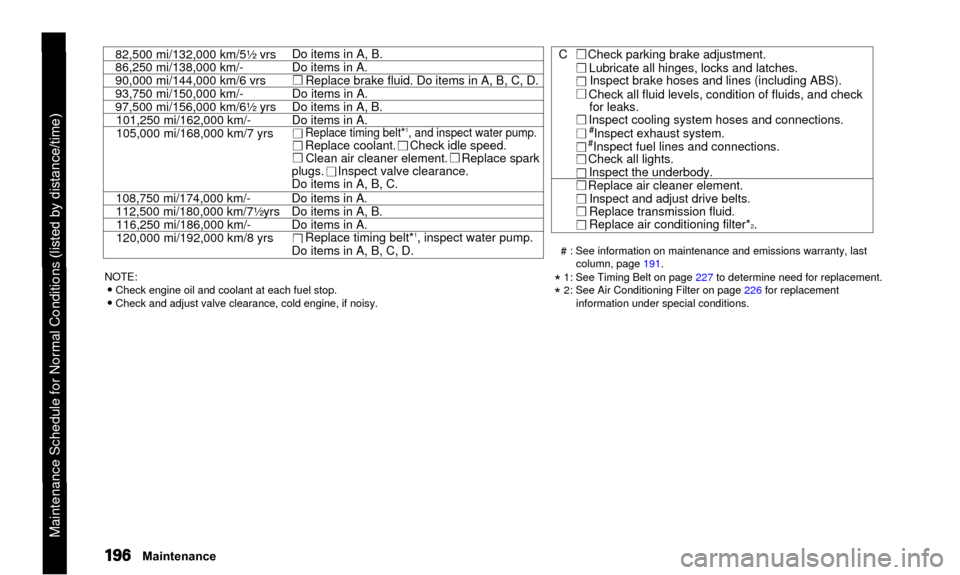
NOTE:• Check engine oil and coolant at each fuel stop.• Check and adjust valve clearance, cold engine, if noisy.# : See information on maintenance and emissions warranty, last
column, page 191.
* 1: See Timing Belt on page 227 to determine need for replacement.
* 2: See Air Conditioning Filter on page 226 for replacement
information under special conditions.
Maintenance
82,500 mi/132,000 km/5½ vrs
86,250 mi/138,000 km/-
90,000 mi/144,000 km/6 vrs
93,750 mi/150,000 km/-
97,500 mi/156,000 km/6½ yrs101,250 mi/162,000 km/-
105,000 mi/168,000 km/7 yrs
108,750 mi/174,000 km/-
112,500 mi/180,000 km/7½yrs 116,250 mi/186,000 km/-
120,000 mi/192,000 km/8 yrs Do items in A, B.
Do items in A.
Replace brake fluid. Do items in A, B, C, D. Do items in A.
Do items in A, B.
Do items in A.
Replace timing belt*1, and inspect water pump. Replace coolant. Check idle speed. Clean air cleaner element. Replace spark
plugs. Inspect valve clearance.
Do items in A, B, C.
Do items in A.
Do items in A, B.
Do items in A.
Replace timing belt*
1, inspect water pump.
Do items in A, B, C, D.
C Check parking brake adjustment.
Lubricate all hinges, locks and latches.• Inspect brake hoses and lines (including ABS).
Check all fluid levels, condition of fluids, and check for leaks.
Inspect cooling system hoses and connections.
#Inspect exhaust system.
•' #Inspect fuel lines and connections.
Check all lights.
Inspect the underbody. Replace air cleaner element.
• Inspect and adjust drive belts.
• Replace transmission fluid.
• Replace air conditioning filter*
2.
Maintenance Schedule for Normal Conditions (listed by distance/time)
Page 202 of 311
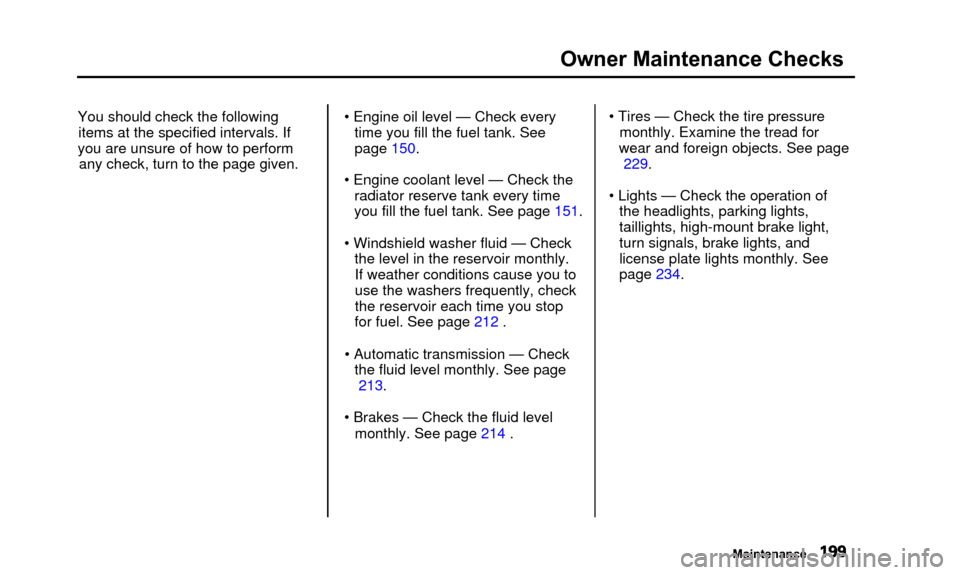
Owner Maintenance Checks
You should check the followingitems at the specified intervals. If
you are unsure of how to perform any check, turn to the page given. • Engine oil level — Check every
time you fill the fuel tank. See
page 150.
• Engine coolant level — Check the radiator reserve tank every time
you fill the fuel tank. See page 151.
• Windshield washer fluid — Check the level in the reservoir monthly.If weather conditions cause you to
use the washers frequently, check
the reservoir each time you stop
for fuel. See page 212 .
• Automatic transmission — Check the fluid level monthly. See page213.
• Brakes — Check the fluid level monthly. See page 214 . • Tires — Check the tire pressure
monthly. Examine the tread for
wear and foreign objects. See page
229.
• Lights — Check the operation of the headlights, parking lights,
taillights, high-mount brake light,
turn signals, brake lights, and
license plate lights monthly. See
page 234.
Maintenance
Page 237 of 311
Lights
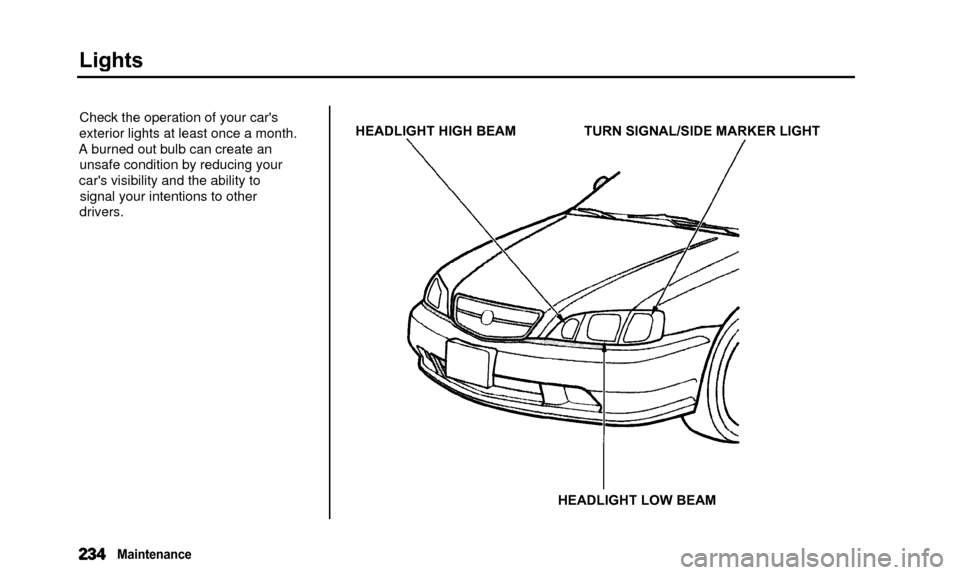
Check the operation of your car's
exterior lights at least once a month.
A burned out bulb can create an unsafe condition by reducing your
car's visibility and the ability to signal your intentions to other
drivers. HEADLIGHT HIGH BEAM TURN SIGNAL/SIDE MARKER LIGHT
HEADLIGHT LOW BEAM
Maintenance
Page 238 of 311
Lights
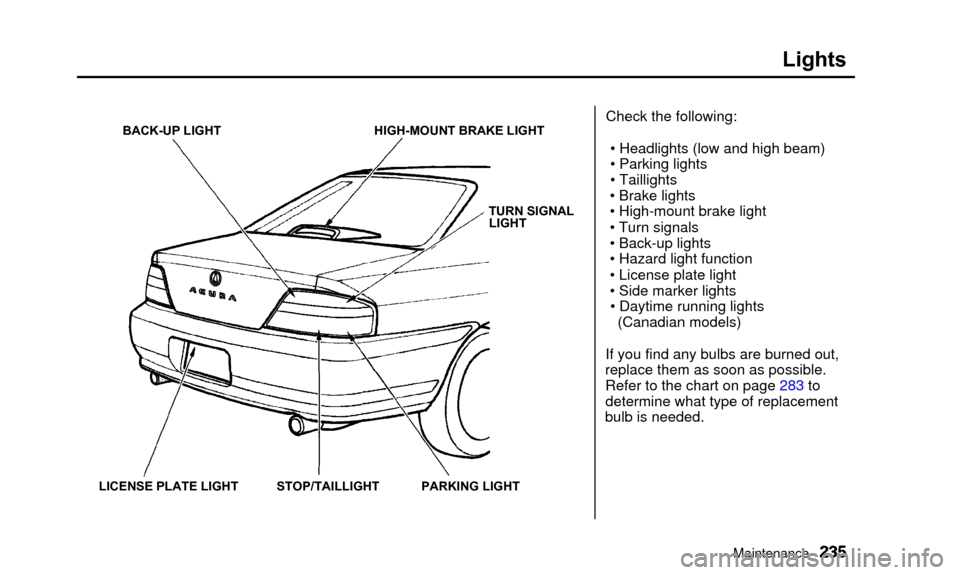
BACK-UP LIGHT HIGH-MOUNT BRAKE LIGHTTURN SIGNALLIGHT
LICENSE PLATE LIGHT STOP/TAILLIGHT PARKING LIGHTCheck the following: • Headlights (low and high beam)
• Parking lights
• Taillights
• Brake lights
• High-mount brake light
• Turn signals
• Back-up lights
• Hazard light function
• License plate light
• Side marker lights • Daytime running lights (Canadian models)
If you find any bulbs are burned out,
replace them as soon as possible. Refer to the chart on page 283 to
determine what type of replacement
bulb is needed.
Maintenance
Page 239 of 311
Lights
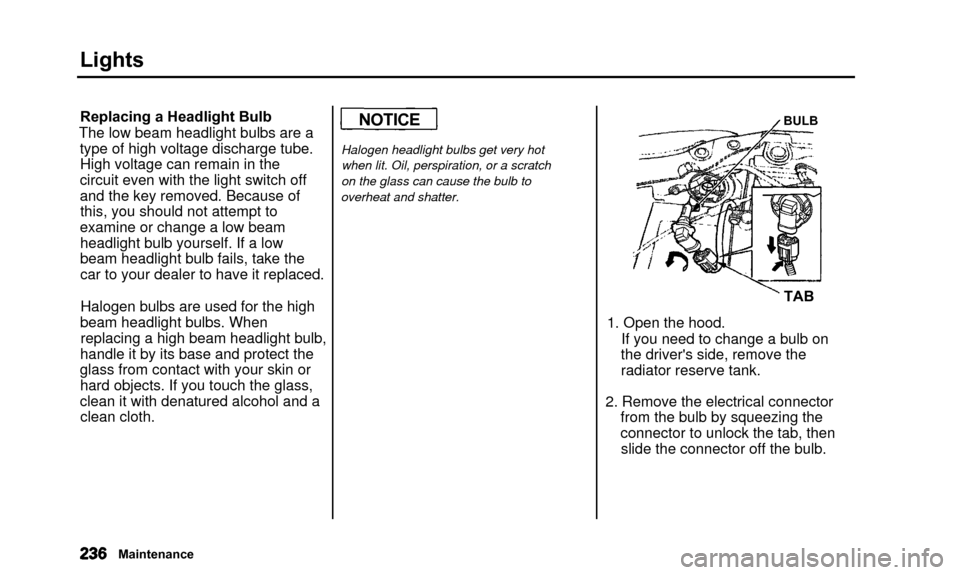
Replacing a Headlight Bulb
The low beam headlight bulbs are a type of high voltage discharge tube.High voltage can remain in the
circuit even with the light switch off
and the key removed. Because of this, you should not attempt to
examine or change a low beam headlight bulb yourself. If a low
beam headlight bulb fails, take the
car to your dealer to have it replaced.
Halogen bulbs are used for the high
beam headlight bulbs. When replacing a high beam headlight bulb,
handle it by its base and protect the
glass from contact with your skin or hard objects. If you touch the glass,
clean it with denatured alcohol and a clean cloth.
Halogen headlight bulbs get very hot
when lit. Oil, perspiration, or a scratch
on the glass can cause the bulb to
overheat and shatter. BULB
TAB
1. Open the hood. If you need to change a bulb on
the driver's side, remove the
radiator reserve tank.
2. Remove the electrical connector from the bulb by squeezing the
connector to unlock the tab, thenslide the connector off the bulb.
Maintenance
NOTICE
Page 240 of 311
Lights
3. Remove the bulb by turning itapproximately one-quarter turn
counterclockwise.
4. Insert the new bulb into the hole and turn it one-quarter turn clock-
wise to lock it in place.
5. Push the electrical connector back onto the bulb. Make sure it is onall the way.
6. Turn on the headlights to test the new bulb.
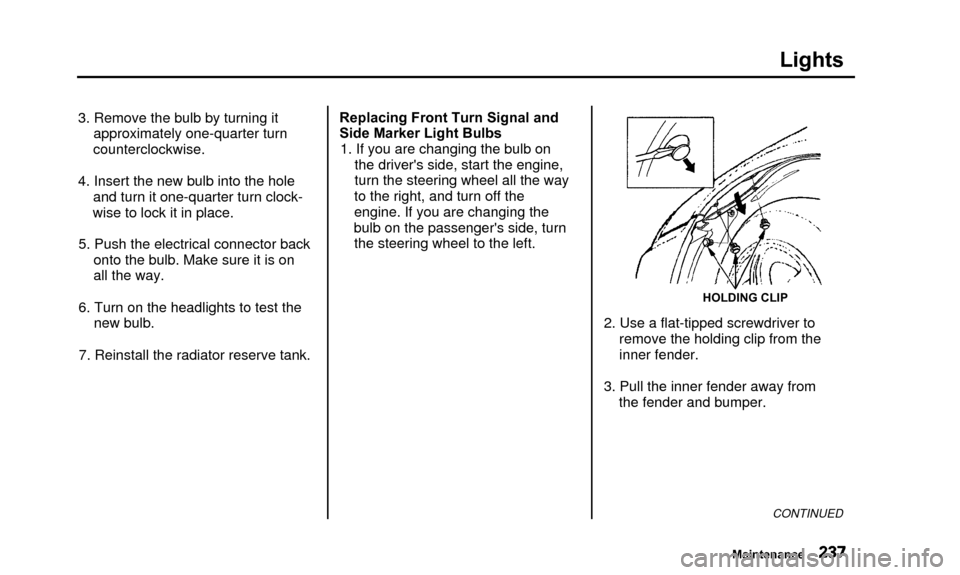
7. Reinstall the radiator reserve tank. Replacing Front Turn Signal and
Side Marker Light Bulbs
1. If you are changing the bulb on the driver's side, start the engine,
turn the steering wheel all the way
to the right, and turn off the
engine. If you are changing the
bulb on the passenger's side, turn the steering wheel to the left.
HOLDING CLIP
2. Use a flat-tipped screwdriver to remove the holding clip from the
inner fender.
3. Pull the inner fender away from the fender and bumper.
CONTINUED
Maintenance
Page 241 of 311
Lights
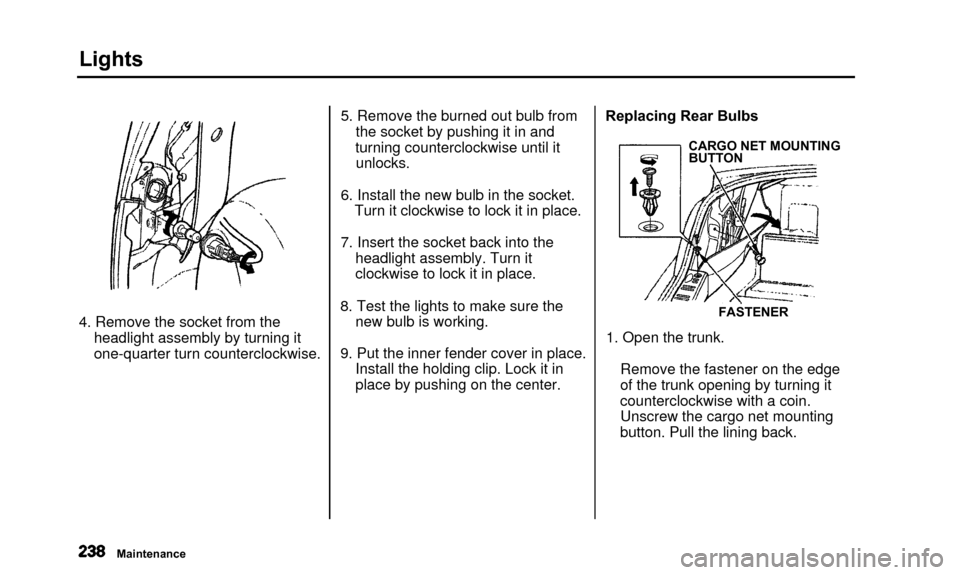
4. Remove the socket from theheadlight assembly by turning it
one-quarter turn counterclockwise. 5. Remove the burned out bulb from
the socket by pushing it in and
turning counterclockwise until it unlocks.
6. Install the new bulb in the socket. Turn it clockwise to lock it in place.
7. Insert the socket back into the headlight assembly. Turn it
clockwise to lock it in place.
8. Test the lights to make sure the new bulb is working.
9. Put the inner fender cover in place. Install the holding clip. Lock it in
place by pushing on the center. Replacing Rear Bulbs
CARGO NET MOUNTING
BUTTON
FASTENER
1. Open the trunk.Remove the fastener on the edge
of the trunk opening by turning it
counterclockwise with a coin. Unscrew the cargo net mounting
button. Pull the lining back.
Maintenance
Page 242 of 311

Lights
2. Determine which of the four bulbsis burned out: stop/taillight or turn
signal light, back-up light
3. Remove the socket by turning it one-quarter turn counterclockwise. 4. Pull the bulb straight out of its
socket
Push the new bulb straight into
the socket until it bottoms.
5. Reinstall the socket into the light assembly by turning it clockwise
until it locks.
6. Test the lights to make sure the new bulb is working.
7. Reinstall the trunk lining. Make sure it is installed under the edge
of the trunk seal 8. Put the fastener in the hole on the
side of the trunk lining and push
on the center until it locks (the
center is flush with the head).
9. Screw the cargo net mounting button back into the hole.
Maintenance
Page 243 of 311

Lights
Replacing a High-mount BrakeLight Bulb
1. Open the trunk and remove the socket from the light assembly byturning it one-quarter turn counter-
clockwise.
2. Remove the burned-out bulb by pulling it straight out of the socket
3. Install the new bulb and reinstall the socket Make sure the newbulb is working. Replacing a Rear License Bulb
1. Use a small phillips screwdriver to remove the lens from the license
plate light assembly.
2. Remove the bulb by pulling it straight out Push the new bulbinto the socket
3. Reinstall the lens. Replacing Bulbs in the Interior
Lights
The ceiling light, door light and vanity mirror light come apart thesame way, but they do not use the
same type of bulb.
Maintenance