trans Acura TLX 2015 Manual PDF
[x] Cancel search | Manufacturer: ACURA, Model Year: 2015, Model line: TLX, Model: Acura TLX 2015Pages: 545, PDF Size: 19.64 MB
Page 469 of 545

uuRemote Transmitter Care uReplacing the Button Battery
468Maintenance
If the indicator does not come on when the button is pressed, replace the battery.
1.Remove the built-in key.
u As a convenience, lightly place masking
tape over the remote buttons to hold
them in place.
2. Remove the upper half by carefully prying
on the edge with a coin.
u Wrap a coin with a cloth to prevent
scratching the transmitter.
3. Press down on the center of the assembly
and remove the battery.
u When removing the button battery, be
careful not to touch parts around it.
4. Make sure to replace the battery with the
correct polarity.Models with remote control engine start system
1Replacing the Button BatteryNOTICEThe Remote transmitter is equipped with two
batteries: A standard replaceable CR2032 coin
button battery and an integral non-replaceable
rechargeable battery. To prevent permanent damage
to the rechargeable battery, replace the CR2032
battery every three to four years.Models with remote cont rol engine start system
Battery type: CR2032
Battery
Page 473 of 545
472
uuCleaning uExterior Care
Maintenance
Exterior CareDust off the vehicle body after you drive.
Regularly inspect your vehicle for scratches on painted surfaces. A scratch on a
painted surface can result in body rust. If you find a scratch, promptly repair it.
Wash the vehicle regularly. Wash more frequently when driving in the following
conditions:
• If driving on roads with road salt.
• If driving in coastal areas.
• If tar, soot, bird droppings, insects, or tree sap are stuck to painted surfaces.
• Make sure to follow the instructions indicated on the automated car wash.
• Fold in the door mirrors.
• Turn off the automatic intermittent wipers
*.
• Keep sufficient distance between the cleaning nozzle and the vehicle body.
• Take particular care around the windows. Standing too close may cause water to
enter the vehicle interior.
• Do not spray high pressure water directly into the engine compartment. Instead,
use low pressure water and a mild detergent.
■
Washing the Vehicle
■
Using an Automated Car Wash
■
Using High Pressure Cleaners
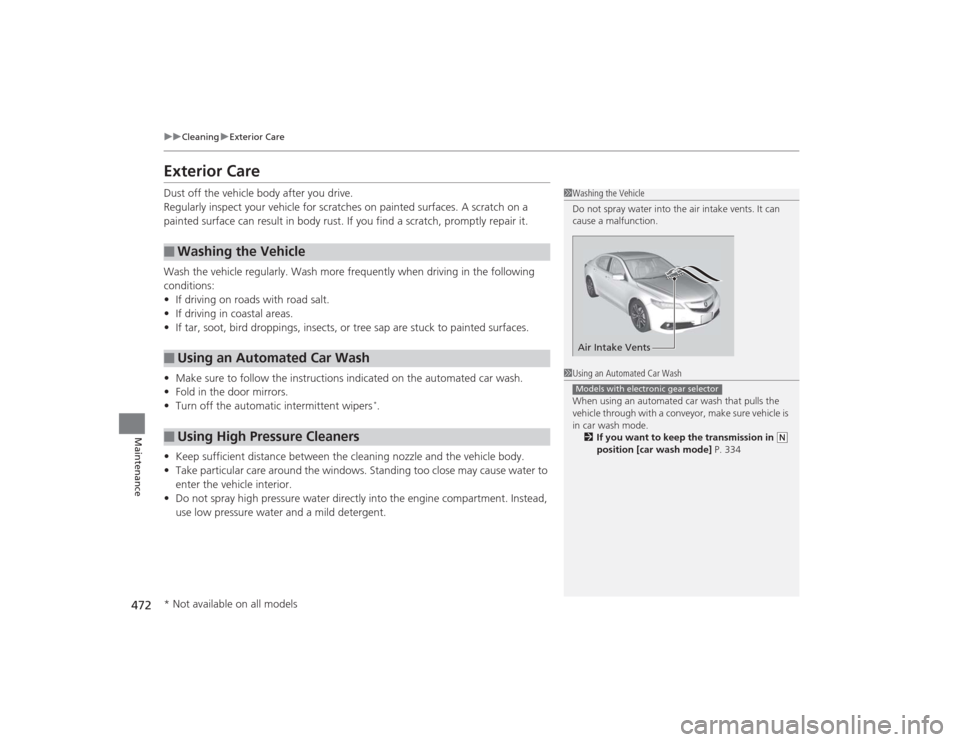
1Washing the Vehicle
Do not spray water into the air intake vents. It can
cause a malfunction.
Air Intake Vents
1Using an Automated Car Wash
When using an automated car wash that pulls the
vehicle through with a conveyor, make sure vehicle is
in car wash mode.
2 If you want to keep the transmission in
(N
position [car wash mode] P. 334
Models with electronic gear selector
* Not available on all models
Page 476 of 545
475
Handling the Unexpected
This chapter explains how to handle unexpected troubles.
Tools
Types of Tools .................................. 476
If a Tire Goes Flat Temporarily Repairing a Flat Tire....... 477
Changing a Flat Tire ......................... 489
Engine Does Not Start Checking the Engine ........................ 495
If the Keyless Access Remote Battery is Weak ............................................. 496
Emergency Engine Stop ................... 497
Jump Starting .................................... 498
Shift Lever Does Not Move .............. 502Overheating
How to Handle Overheating............. 503
Indicator, Coming On/Blinking
If the Low Oil Pressure Indicator Comes On .. 505If the Charging System Indicator Comes On ................................................. 505
If the Malfunction Indicator Lamp Comes On or Blinks ................................... 506If the Brake System Indicator (Red) Comes On .. 506If the Electric Power Steering (EPS) System Indicator Comes On ........................... 507
If the Electric Parking Brake System Indicator Comes On ....................... 507 If the Low Tire Pressure/TPMS Indicator
Comes On or Blinks ....................... 508
If the Transmission Indicator Blinks along with the Warning Message.............. 509
Fuses Fuse Locations ................................. 510
Inspecting and Changing Fuses ........ 514
Emergency Towing ........................... 515
When You Cannot Unlock the Fuel Fill Door ................................................. 516
When You Cannot Open the Trunk ..... 517RefuelingRefueling From a Portable Fuel Container ... 518
Page 507 of 545

506
uuIndicator, Coming On/Blinking uIf the Malfunction Indicator Lamp Comes On or Blinks
Handling the Unexpected
If the Malfunction Indicator Lamp Comes On or Blinks
■Reasons for the indicator lamp to come on or blink
• Comes on if there is a problem with the engine emissions control
system.
• Blinks when engine misfiring is detected.■What to do when the indicator lamp comes on
Avoid high speeds and immediately get your vehicle inspected at a
dealer.■What to do when the indicator lamp blinks
Park the vehicle in a safe place with no flammable items and wait at least
10 minutes or more with the engine stopped until it cools.
If the Brake System Indicator (Red) Comes On
■Reasons for the indicator to come on
• The brake fluid is low.
• There is a malfunction in the brake system.■What to do when the indicator comes on while driving
Press the brake pedal lightly to check pedal pressure.
• If normal, check the brake fluid level the next time you stop.
• If abnormal, take immediate action. If necessary, downshift the
transmission to slow the vehicle using engine braking.
1If the Malfunction Indicator Lamp Comes On or BlinksNOTICEIf you drive with the malfunction indicator lamp on,
the emissions control system and the engine could be
damaged.
If the malfunction indicator lamp blinks again when
restarting the engine, drive to the nearest dealer at
31 mph (50 km/h) or less. Have your vehicle
inspected.1If the Brake System Indicator (Red) Comes On
Have your vehicle repaired immediately.
It is dangerous to drive with low brake fluid. If there
is no resistance from the brake pedal, stop
immediately in a safe place. If necessary downshift
the gears.
If the brake system indicator and ABS indicator come
on simultaneously, the electronic brake distribution
system is not working. This can result in vehicle
instability under sudden braking.
Have your vehicle inspected by a dealer immediately.
U.S.
Canada
Page 510 of 545

509
uuIndicator, Coming On/Blinking uIf the Transmission Indicator Blinks along with the Warning Message
Handling the Unexpected
If the Transmission Indicator Blinks along with the Warning Message
■Reasons for the indicator to blink
There is a problem with the transmission.■What to do when the indicator blinks
• Immediately have your vehicle inspected by a dealer.
• Select
(N
after starting the engine.
u Check if the
(N
position in the instrument panel and the indicator
on the
(N
button light/blink.
u The engine cannot be turned on unless the parking brake is set.
2 Starting the Engine P. 322
*1: Models with navigation system
*2: Models without navigation systemModels with electronic gear selector
1If the Transmission Indicator Blinks along with the Warning Message
You may not be able to start the engine.
Make sure to set the parking brake when parking
your vehicle.
Call a professional towing service if you need to tow
your vehicle.
2 Emergency Towing P. 515
*1
*1
*2
*2
Page 516 of 545
515Handling the Unexpected
Emergency TowingCall a professional towing service if you need to tow your vehicle.■Flat bed equipment
The operator loads your vehicle on the back of a truck.
This is the only way you can safely transport your vehicle.
Any other towing method will damage the vehicle’s drive system.
1 Emergency TowingNOTICETrying to lift or tow your vehicle by the bumpers will
cause serious damage. The bumpers are not designed
to support the vehicle's weight.NOTICEImproper towing such as towing behind a
motorhome or other motor vehicle can damage the
transmission.
Never tow your vehicle with just a rope or chain.
It is very dangerous since ropes or chains may shift
from side to side or break.
Page 520 of 545
519
Information
This chapter includes your vehicle’s specifications, locations of identification numbers, and other
information required by regulation.
Specifications .................................... 520
Identification Numbers Vehicle Identification Number (VIN), Engine Number and Transmission
Number ......................................... 524
Devices that Emit Radio Waves ....... 525
Reporting Safety Defects ................. 526Emissions Testing
Testing of Readiness Codes.............. 527
Warranty Coverages ........................ 529
Authorized Manuals ......................... 531
Client Service Information ............... 532
Page 522 of 545
521
uuSpecifications u
Continued
Information
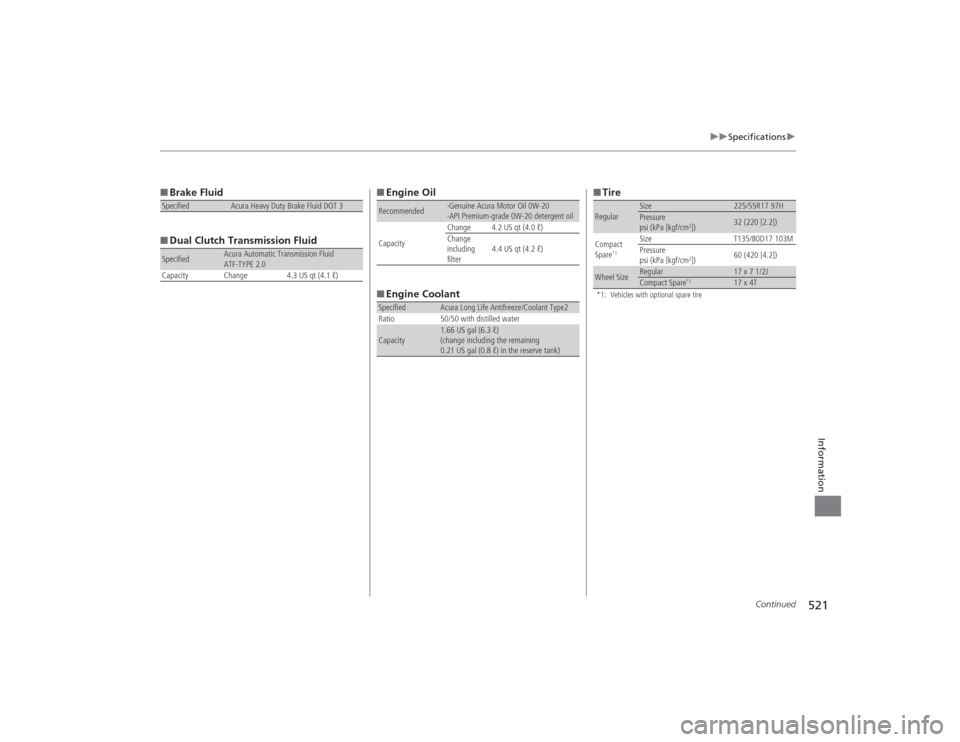
■Brake Fluid
■ Dual Clutch Transmission FluidSpecified
Acura Heavy Duty Brake Fluid DOT 3
Specified
Acura Automatic Transmission Fluid
ATF-TYPE 2.0
Capacity Change 4.3 US qt (4.1 ℓ)
■ Engine Oil
■ Engine CoolantRecommended
·Genuine Acura Motor Oil 0W-20
·API Premium-grade 0W-20 detergent oil
Capacity Change 4.2 US qt (4.0 ℓ)
Change
including
filter
4.4 US qt (4.2 ℓ)
Specified
Acura Long Life Antifreeze/Coolant Type2
Ratio 50/50 with distilled water
Capacity
1.66 US gal (6.3 ℓ)
(change including the remaining
0.21 US gal (0.8 ℓ) in the reserve tank)
■ Tire*1: Vehicles with optional spare tireRegular
Size
225/55R17 97H
Pressure
psi (kPa [kgf/cm
2])
32 (220 [2.2])
Compact
Spare
*1
Size
T135/80D17 103M
Pressure
psi (kPa [kgf/cm
2]) 60 (420 [4.2])
Wheel Size
Regular
17 x 7 1/2J
Compact Spare
*1
17 x 4T
Page 524 of 545
523
uuSpecifications u
Information
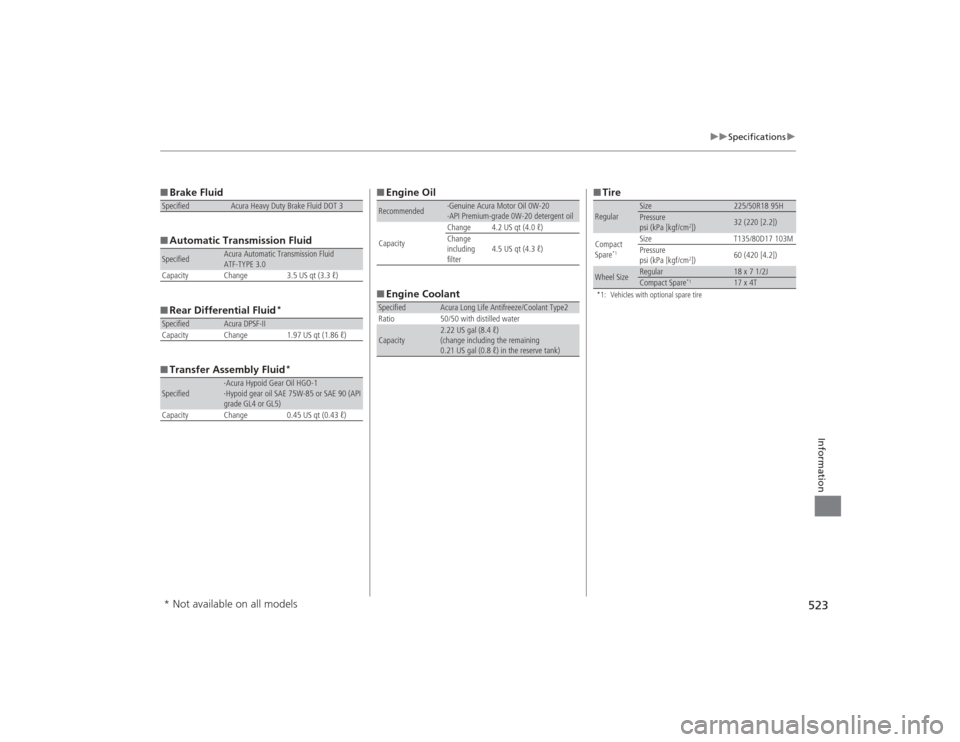
■Brake Fluid
■ Automatic Transmission Fluid
■ Rear Differential Fluid
*
■Transfer Assembly Fluid
*
Specified
Acura Heavy Duty Brake Fluid DOT 3
Specified
Acura Automatic Transmission Fluid
ATF-TYPE 3.0
Capacity Change 3.5 US qt (3.3 ℓ)
Specified
Acura DPSF-II
Capacity Change 1.97 US qt (1.86 ℓ)
Specified
·Acura Hypoid Gear Oil HGO-1
·Hypoid gear oil SAE 75W-85 or SAE 90 (API
grade GL4 or GL5)
Capacity Change 0.45 US qt (0.43 ℓ)
■ Engine Oil
■ Engine CoolantRecommended
·Genuine Acura Motor Oil 0W-20
·API Premium-grade 0W-20 detergent oil
Capacity Change 4.2 US qt (4.0 ℓ)
Change
including
filter
4.5 US qt (4.3 ℓ)
Specified
Acura Long Life Antifreeze/Coolant Type2
Ratio 50/50 with distilled water
Capacity
2.22 US gal (8.4 ℓ)
(change including the remaining
0.21 US gal (0.8 ℓ) in the reserve tank)
■ Tire*1: Vehicles with optional spare tireRegular
Size
225/50R18 95H
Pressure
psi (kPa [kgf/cm
2])
32 (220 [2.2])
Compact
Spare
*1
Size
T135/80D17 103M
Pressure
psi (kPa [kgf/cm
2]) 60 (420 [4.2])
Wheel Size
Regular
18 x 7 1/2J
Compact Spare
*1
17 x 4T
* Not available on all models
Page 525 of 545
524Information
Identification NumbersVehicle Identification Number (VIN), Engine Number and Transmission NumberYour vehicle has a 17-digit vehicle identification number (VIN) used to register your
vehicle for warranty purposes, and for licensing and insuring your vehicle.
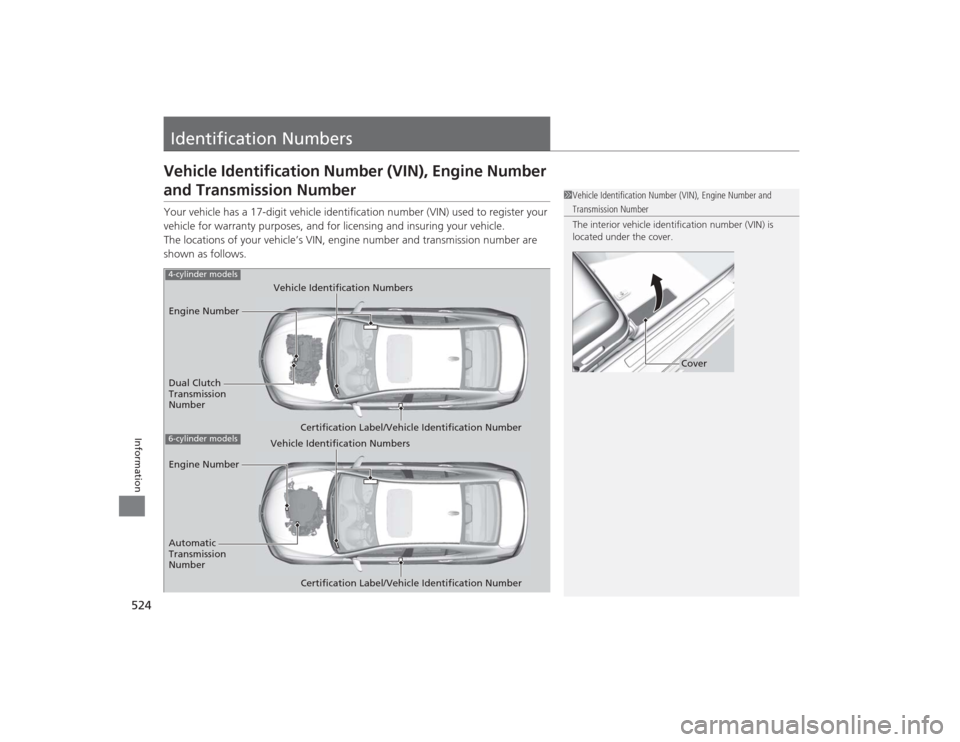
The locations of your vehicle’s VIN, engine number and transmission number are
shown as follows.
1Vehicle Identification Number (VIN), Engine Number and Transmission Number
The interior vehicle iden tification number (VIN) is
located under the cover.
Cover
Vehicle Identification Numbers
Engine Number
Dual Clutch
Transmission
Number Certification Label/Vehicle Identification Number
Vehicle Identification Numbers
Engine Number
Automatic
Transmission
Number Certification Label/Vehicle Identification Number
4-cylinder models6-cylinder models