ECO mode ACURA ZDX 2010 Owners Manual
[x] Cancel search | Manufacturer: ACURA, Model Year: 2010, Model line: ZDX, Model: ACURA ZDX 2010Pages: 645, PDF Size: 17.13 MB
Page 26 of 645
●Do not attach or place objects onthe front airbag covers.
Objects on
the covers marked ‘‘SRS AIRBAG ’’
could interfere with the proper
operation of the airbags or be
propelled inside the vehicle and
hurt someone if the airbags inflate.
●Do not attach hard objects on or
near a door.
If a side airbag or a
side curtain airbag inflates, a cup
holder or other hard object
attached on or near the door could
be propelled inside the vehicle and
hurt someone.
●Do not cover or replace front seat- back covers without consulting
your dealer.
Improperly replacing
or covering front seat-back covers
can prevent your side airbags from
inflating during a side impact. Seat Belt System Components
Your seat belt system includes lap/
shoulder belts in all seating
positions. The front seat belts are
also equipped with automatic seat
belt tensioners, and on models with
collision mitigation braking system
(CMBS), seat belt e-pretensioners.
The seat belt system
includes an indicator on the
instrument panel and a beeper to
remind you and your passengers to
fasten your seat belts.
This system monitors the front seat
belts. If you turn the ignition switch
ꭧ
to the ON (II) position before your
seat belt is fastened, the beeper will
sound and the indicator will flash. If
your seat belt is not fastened before
the beeper stops, the indicator will
stop flashing but remain on.
If a front passenger does not fasten
their seat belt, the indicator will
come on about 6 seconds after the
ignition switch is turned to the ON
(II) position.
CONTINUED
Protecting Adults and Teens, Additional Information About Your Seat Belts
21
Driver and Passenger Safety
09/10/28 17:15:37 10 ACURA ZDX KA KC New North America Own 50 31SZN600 enu
ProCarManuals.com
Page 31 of 645
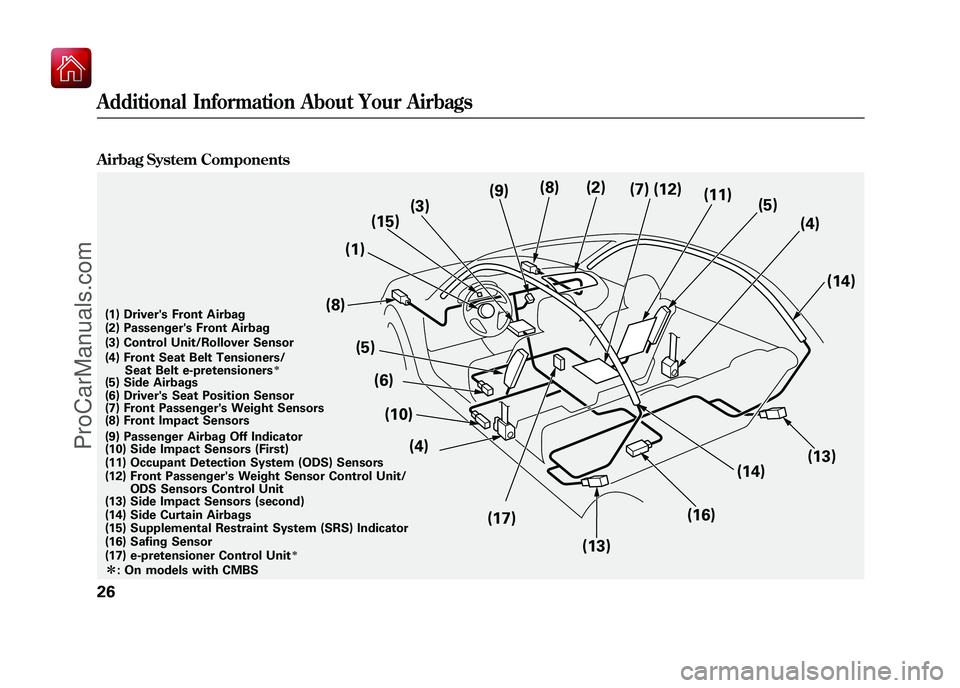
Airbag System Components
(2)
(3)
(6)
(1)
(9)
(5)
(10) (11)
(12)
(14)
(13)
(15)
(16)
(17) (8)
(7)
(4)
(14)
(13)
(4)
(5)
(17) e-pretensioner Control Unit
ꭧ
(16) Safing Sensor (15) Supplemental Restraint System (SRS) Indicator
(14) Side Curtain Airbags
(13) Side Impact Sensors (second) (12) Front Passenger's Weight Sensor Control Unit/ (11) Occupant Detection System (ODS) Sensors (10) Side Impact Sensors (First) (9) Passenger Airbag Off Indicator (8) Front Impact Sensors (7) Front Passenger's Weight Sensors (6) Driver's Seat Position Sensor (5) Side Airbags (4) Front Seat Belt Tensioners/ (3) Control Unit/Rollover Sensor (2) Passenger's Front Airbag (1) Driver's Front Airbag
(8)
ꭧ
: On models with CMBS ODS Sensors Control Unit
Seat Belt e-pretensioners
ꭧ
Additional Information About Your Airbags2609/10/28 17:15:37 10 ACURA ZDX KA KC New North America Own 50 31SZN600 enu
ProCarManuals.com
Page 33 of 645
●A sophisticated electronic system
that continually monitors and
records information about the
sensors, the control unit, the airbag
activators, the seat belt tensioners,
and driver and front passenger seat
belt use when the ignition switch is
in the ON (II) position.
Models equipped with the keyless
access system have an engine start/
stop button instead of an ignition
switch. ON mode is the equivalent of
ON (II). For more information, see
pages 194 and 196.●An indicator on the instrument panel
that alerts you to a possible problem
with your airbag system components
(see page 34).●An indicator on the instrument panel
that alerts you that the passenger's
side airbag has been turned off (see
page 35).
●An indicator on the dashboard that
alerts you that the passenger's front
airbag has been turned off (see page
36).●Emergency backup power in case
your vehicle's electrical system is
disconnected in a crash.
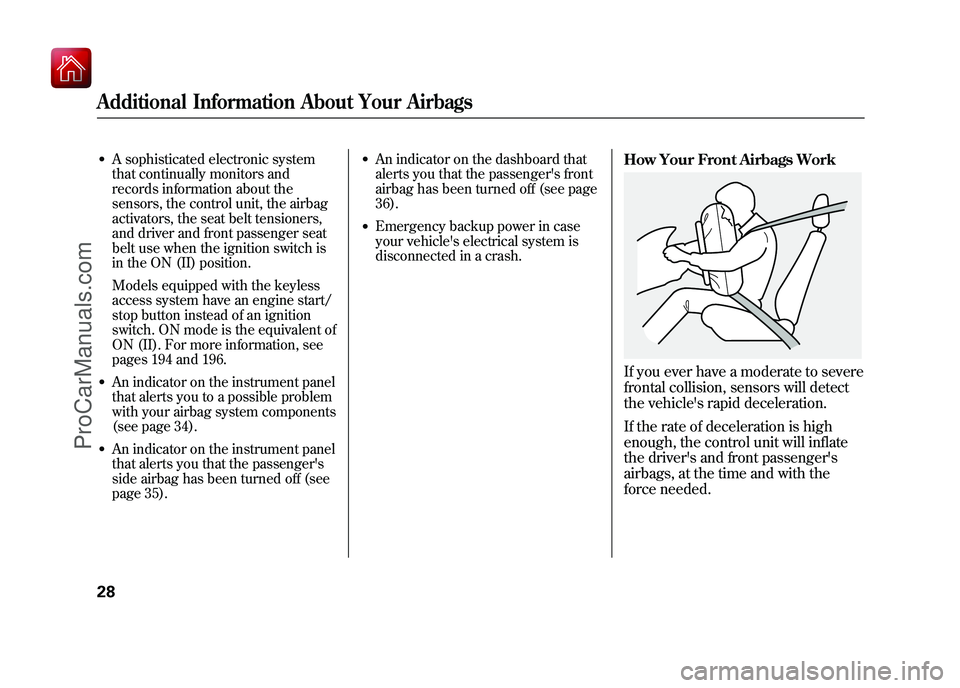
How Your Front Airbags WorkIf you ever have a moderate to severe
frontal collision, sensors will detect
the vehicle's rapid deceleration.
If the rate of deceleration is high
enough, the control unit will inflate
the driver's and front passenger's
airbags, at the time and with the
force needed.
Additional Information About Your Airbags2809/10/28 17:15:37 10 ACURA ZDX KA KC New North America Own 50 31SZN600 enu
ProCarManuals.com
Page 45 of 645
All Children Should Sit in a Back
Seat
According to statistics, children of all
ages and sizes are safer when they
are restrained in a back seat.
The National Highway Traffic Safety
Administration and Transport
Canada recommend that all children
aged 12 and under be properly
restrained in a back seat. Some
states, Canadian provinces, and
territories have laws restricting
where children may ride.
Children who ride in the back are
less likely to be injured by striking
interior vehicle parts during a
collision or hard braking. Also,
children cannot be injured by an
inflating front airbag when they ride
in the back.The Passenger's Front Airbag Can
Pose Serious Risks
Front airbags have been designed to
help protect adults in a moderate to
severe frontal collision. To do this,
the passenger's front airbag is quite
large, and it can inflate with enough
force to cause very serious injuries.
Even though your vehicle has an
advanced front airbag system that
automatically turns the passenger's
front airbag off under certain
circumstances (see page 36), please
follow these guidelines:
Infants
Never put a rear-facing child seat inthe front seat of a vehicle equipped
with a passenger's front airbag.
If the
airbag inflates, it can hit the back of
the child seat with enough force to
kill or very seriously injure an infant.
Small Children
Placing a forward-facing child seat inthe front seat of a vehicle equipped
with a passenger's front airbag can be
hazardous.
If the vehicle seat is too
far forward, or the child's head is
thrown forward during a collision, an
inflating front airbag can strike the
child with enough force to kill or
very seriously injure a small child.
Larger Children
Children who have outgrown childseats are also at risk of being injuredor killed by an inflating passenger's
front airbag.
Whenever possible,
larger children should sit in the back
seat, on a booster seat if needed, and
be properly restrained with a seat
belt. (See page 54 for important
information about protecting larger
children.)
Protecting Children -General Guidelines4009/10/28 17:15:37 10 ACURA ZDX KA KC New North America Own 50 31SZN600 enu
ProCarManuals.com
Page 49 of 645
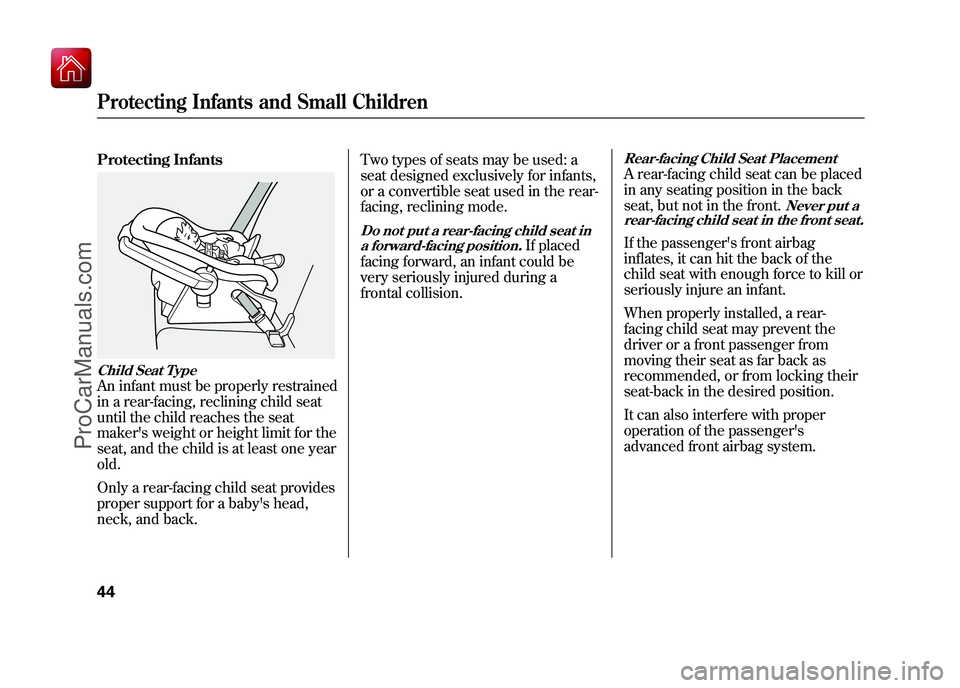
Protecting InfantsChild Seat TypeAn infant must be properly restrained
in a rear-facing, reclining child seat
until the child reaches the seat
maker's weight or height limit for the
seat, and the child is at least one year
old.
Only a rear-facing child seat provides
proper support for a baby's head,
neck, and back.Two types of seats may be used: a
seat designed exclusively for infants,
or a convertible seat used in the rear-
facing, reclining mode.
Do not put a rear-facing child seat in
a forward-facing position.
If placed
facing forward, an infant could be
very seriously injured during a
frontal collision.
Rear-facing Child Seat PlacementA rear-facing child seat can be placed
in any seating position in the back
seat, but not in the front.
Never put a
rear-facing child seat in the front seat.
If the passenger's front airbag
inflates, it can hit the back of the
child seat with enough force to kill or
seriously injure an infant.
When properly installed, a rear-
facing child seat may prevent the
driver or a front passenger from
moving their seat as far back as
recommended, or from locking their
seat-back in the desired position.
It can also interfere with proper
operation of the passenger's
advanced front airbag system.
Protecting Infants and Small Children4409/10/28 17:15:37 10 ACURA ZDX KA KC New North America Own 50 31SZN600 enu
ProCarManuals.com
Page 61 of 645
If a child who uses a booster seat
must ride in front, move the vehicle
seat as far back as possible and be
sure the child is wearing the seat belt
properly.
A child may continue using a booster
seat until the tops of their ears are
even with the top of the vehicle's or
booster's seat-back. A child of this
height should be tall enough to use
the lap/shoulder belt without a
booster seat.When Can a Larger Child Sit in
Front
The National Highway Traffic Safety
Administration and Transport
Canada recommend that all children
age 12 and under be properly
restrained in a back seat.
If the passenger's front airbag
inflates in a moderate to severe
frontal collision, the airbag can cause
serious injuries to a child who is
unrestrained, improperly restrained,
sitting too close to the airbag, or out
of position.
A side airbag also poses risks. If any
part of a larger child's body is in the
path of a deploying side airbag, the
child could receive possibly serious
injuries.Of course, children vary widely. And
while age may be one indicator of
when a child can safely ride in front,
there are other important factors you
should consider.
Physical SizePhysically, a child must be large
enough for the lap/shoulder belt to
properly fit (see pages 16 and 54). If
the seat belt does not fit properly,
with or without the child sitting on a
booster seat, the child should not sit
in front.MaturityTo safely ride in front, a child must
be able to follow the rules, including
sitting properly, and wearing the seat
belt properly throughout a ride.
Protecting Larger Children5609/10/28 17:15:37 10 ACURA ZDX KA KC New North America Own 50 31SZN600 enu
ProCarManuals.com
Page 64 of 645
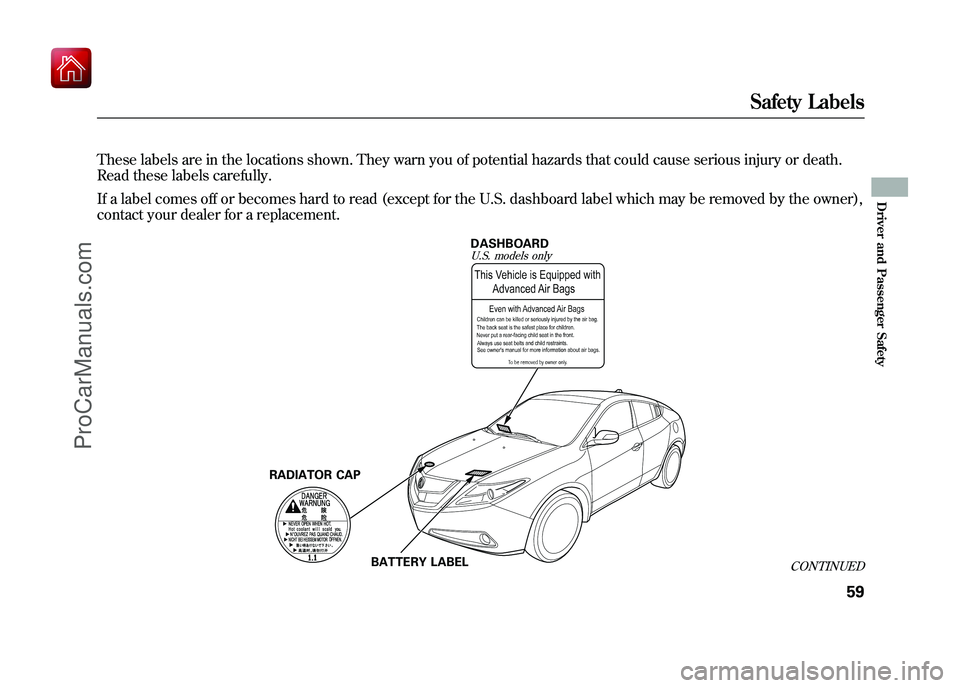
These labels are in the locations shown. They warn you of potential hazards that could cause serious injury or death.
Read these labels carefully.
If a label comes off or becomes hard to read (except for the U.S. dashboard label which may be removed by the owner),
contact your dealer for a replacement.
BATTERY LABEL
RADIATOR CAP DASHBOARD
U.S. models only
CONTINUED
Safety Labels
59
Driver and Passenger Safety
09/10/28 17:15:37 10 ACURA ZDX KA KC New North America Own 50 31SZN600 enu
ProCarManuals.com
Page 69 of 645
The instrument panel has many
indicators to give you important
information about your vehicle.
Seat Belt Reminder
Indicator
This indicator comes on when you
turn the ignition switch to the ON
(II) position. It reminds you and your
passengers to fasten your seat belts.
A beeper also sounds if you have not
fastened your seat belt.
If you turn the ignition switch to the
ON (II) position before fastening
your seat belts, the beeper sounds,
and the indicator flashes. If you do
not fasten your seat belts before the
beeper stops, the indicator stops
flashing but remains on.
If your front passenger does not
fasten their seat belt, the indicator
comes on about 6 seconds after the
ignition switch is turned to the ON
(II) position. If either of you do not fasten your
seat belt while driving, the beeper
will sound and the indicator will flash
again at regular intervals, and you
will also see a
‘‘FASTEN SEAT
BELT ’’or ‘‘FASTEN PASSENGER
SEAT BELT ’’message on the multi-
information display (see page 90).
For more information, see page 21.
Models equipped with the keyless
access system have an engine start/
stop button instead of an ignition
switch. ON mode is the equivalent of
ON (II). For more information, see
pages 194 and 196.
Instrument Panel Indicators6409/10/28 17:15:37 10 ACURA ZDX KA KC New North America Own 50 31SZN600 enu
ProCarManuals.com
Page 72 of 645
U.S. Canada
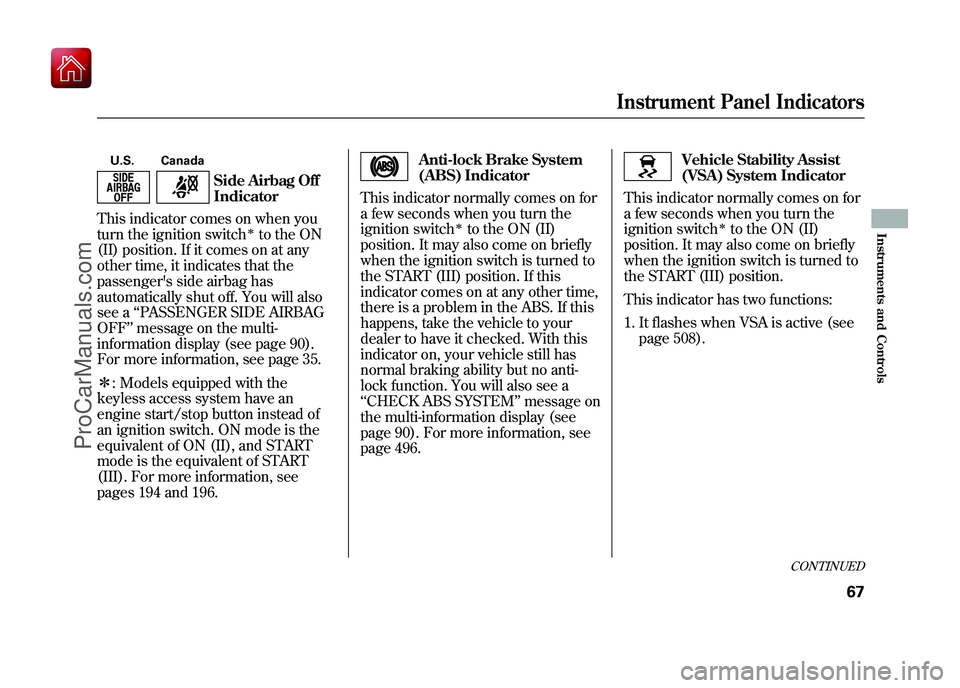
Side Airbag Off
Indicator
This indicator comes on when you
turn the ignition switch
ꭧto the ON
(II) position. If it comes on at any
other time, it indicates that the
passenger's side airbag has
automatically shut off. You will also
see a ‘‘PASSENGER SIDE AIRBAG
OFF ’’message on the multi-
information display (see page 90).
For more information, see page 35.
ꭧ : Models equipped with the
keyless access system have an
engine start/stop button instead of
an ignition switch. ON mode is the
equivalent of ON (II), and START
mode is the equivalent of START
(III). For more information, see
pages 194 and 196.
Anti-lock Brake System
(ABS) Indicator
This indicator normally comes on for
a few seconds when you turn the
ignition switch
ꭧto the ON (II)
position. It may also come on briefly
when the ignition switch is turned to
the START (III) position. If this
indicator comes on at any other time,
there is a problem in the ABS. If this
happens, take the vehicle to your
dealer to have it checked. With this
indicator on, your vehicle still has
normal braking ability but no anti-
lock function. You will also see a
‘‘ CHECK ABS SYSTEM ’’message on
the multi-information display (see
page 90). For more information, see
page 496.
Vehicle Stability Assist
(VSA) System Indicator
This indicator normally comes on for
a few seconds when you turn the
ignition switch
ꭧto the ON (II)
position. It may also come on briefly
when the ignition switch is turned to
the START (III) position.
This indicator has two functions:
1. It flashes when VSA is active (see page 508).
CONTINUED
Instrument Panel Indicators
67
Instruments and Controls
09/10/28 17:15:37 10 ACURA ZDX KA KC New North America Own 50 31SZN600 enu
ProCarManuals.com
Page 73 of 645
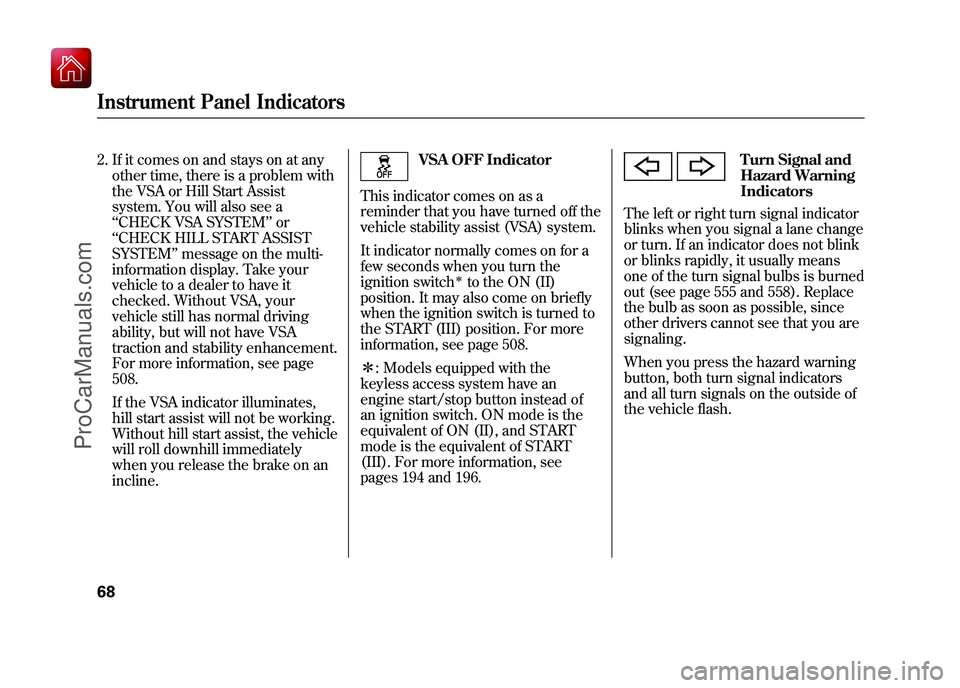
2. If it comes on and stays on at anyother time, there is a problem with
the VSA or Hill Start Assist
system. You will also see a
‘‘CHECK VSA SYSTEM ’’or
‘‘ CHECK HILL START ASSIST
SYSTEM ’’message on the multi-
information display. Take your
vehicle to a dealer to have it
checked. Without VSA, your
vehicle still has normal driving
ability, but will not have VSA
traction and stability enhancement.
For more information, see page
508.
If the VSA indicator illuminates,
hill start assist will not be working.
Without hill start assist, the vehicle
will roll downhill immediately
when you release the brake on an
incline.
VSA OFF Indicator
This indicator comes on as a
reminder that you have turned off the
vehicle stability assist (VSA) system.
It indicator normally comes on for a
few seconds when you turn the
ignition switch
ꭧto the ON (II)
position. It may also come on briefly
when the ignition switch is turned to
the START (III) position. For more
information, see page 508.
ꭧ : Models equipped with the
keyless access system have an
engine start/stop button instead of
an ignition switch. ON mode is the
equivalent of ON (II), and START
mode is the equivalent of START
(III). For more information, see
pages 194 and 196.
Turn Signal and
Hazard Warning
Indicators
The left or right turn signal indicator
blinks when you signal a lane change
or turn. If an indicator does not blink
or blinks rapidly, it usually means
one of the turn signal bulbs is burned
out (see page 555 and 558). Replace
the bulb as soon as possible, since
other drivers cannot see that you are
signaling.
When you press the hazard warning
button, both turn signal indicators
and all turn signals on the outside of
the vehicle flash.
Instrument Panel Indicators6809/10/28 17:15:37 10 ACURA ZDX KA KC New North America Own 50 31SZN600 enu
ProCarManuals.com