belt Acura ZDX 2012 Owner's Guide
[x] Cancel search | Manufacturer: ACURA, Model Year: 2012, Model line: ZDX, Model: Acura ZDX 2012Pages: 645, PDF Size: 16.36 MB
Page 31 of 645
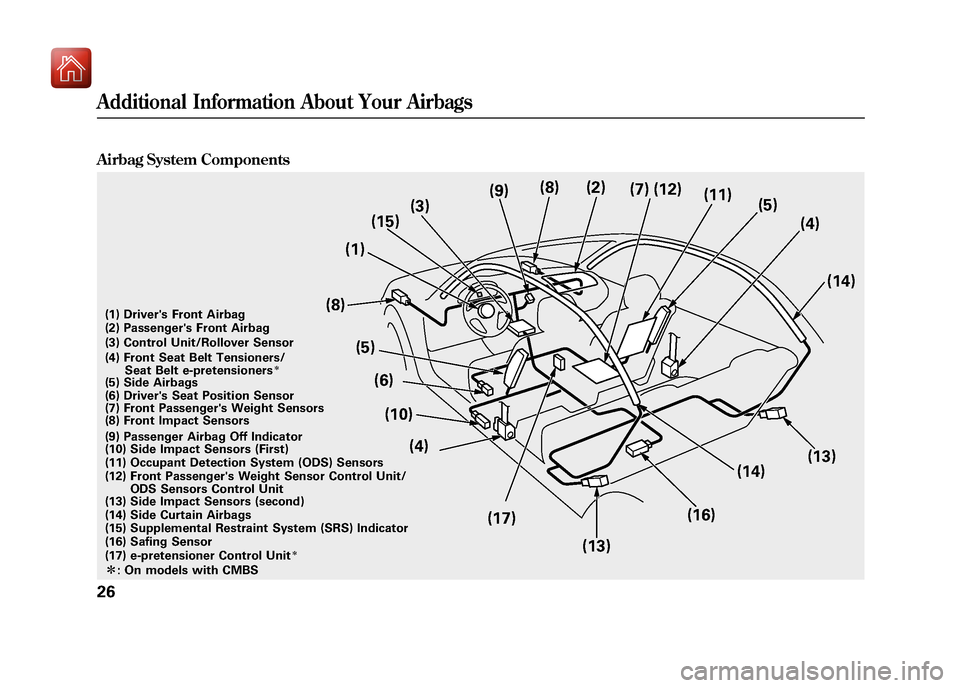
Airbag System Components
(2)
(3)
(6)
(1)
(9)
(5)
(10) (11)
(12)
(14)
(13)
(15)
(16)
(17) (8)
(7)
(4)
(14)
(13)
(4)
(5)
(17) e-pretensioner Control Unit
ꭧ
(16) Safing Sensor (15) Supplemental Restraint System (SRS) Indicator
(14) Side Curtain Airbags
(13) Side Impact Sensors (second) (12) Front Passenger's Weight Sensor Control Unit/ (11) Occupant Detection System (ODS) Sensors (10) Side Impact Sensors (First) (9) Passenger Airbag Off Indicator (8) Front Impact Sensors (7) Front Passenger's Weight Sensors (6) Driver's Seat Position Sensor (5) Side Airbags (4) Front Seat Belt Tensioners/ (3) Control Unit/Rollover Sensor (2) Passenger's Front Airbag (1) Driver's Front Airbag
(8)
ꭧ
: On models with CMBS ODS Sensors Control Unit
Seat Belt e-pretensioners
ꭧ
Additional Information About Your Airbags2609/10/28 17:15:37 10 ACURA ZDX KA KC New North America Own 50 31SZN600 enu
Page 32 of 645
Your Airbag System (SRS) includes:●Two SRS (Supplemental Restraint
System) front airbags. The driver's
airbag is stored in the center of the
steering wheel; the front passenger's
airbag is stored in the dashboard.
Both are marked‘‘SRS AIRBAG ’’
(see page 28).●Two side airbags, one for the driver
and one for a front passenger. The
airbags are stored in the outer edges
of the seat-backs. Both are marked
‘‘ SIDE AIRBAG ’’(see page 32).●Two side curtain airbags, one for
each side of the vehicle. The airbags
are stored in the roof above the side
windows. The front and rear pillars
are marked ‘‘SIDE CURTAIN
AIRBAG ’’(see page 33).
●On models with CMBS, front seat
belt e-pretensioners (see page 24).●Automatic front seat belt tensioners
(see page 23).●Sensors that can detect a moderate
to severe front impact, side impact,
or if your vehicle is about to rollover.●Sensors that can detect whether a
child is in the passenger's side
airbag path and signal the control
unit to turn the airbag off (see page
33).●Sensors that can detect whether the
driver's seat belt and the front
passenger's seat belt are latched or
unlatched (see page 21).●A driver's seat position sensor that
monitors the distance of the seat
from the front airbag. If the seat is
too far forward, the airbag will inflate
with less force (see page 31).
●Weight sensors that monitor the
weight on the front passenger's seat.
If the weight is about 65 lbs (29 kg)
or less (the weight of an infant or
small child), the passenger's front
airbag will be turned off (see page
31).●A rollover sensor that can detect if
your vehicle is about to roll over and
signal the control unit to deploy both
side curtain airbags (see page 34).
CONTINUED
Additional Information About Your Airbags
27
Driver and Passenger Safety
09/10/28 17:15:37 10 ACURA ZDX KA KC New North America Own 50 31SZN600 enu
Page 33 of 645
●A sophisticated electronic system
that continually monitors and
records information about the
sensors, the control unit, the airbag
activators, the seat belt tensioners,
and driver and front passenger seat
belt use when the ignition switch is
in the ON (II) position.
Models equipped with the keyless
access system have an engine start/
stop button instead of an ignition
switch. ON mode is the equivalent of
ON (II). For more information, see
pages 194 and 196.●An indicator on the instrument panel
that alerts you to a possible problem
with your airbag system components
(see page 34).●An indicator on the instrument panel
that alerts you that the passenger's
side airbag has been turned off (see
page 35).
●An indicator on the dashboard that
alerts you that the passenger's front
airbag has been turned off (see page
36).●Emergency backup power in case
your vehicle's electrical system is
disconnected in a crash.
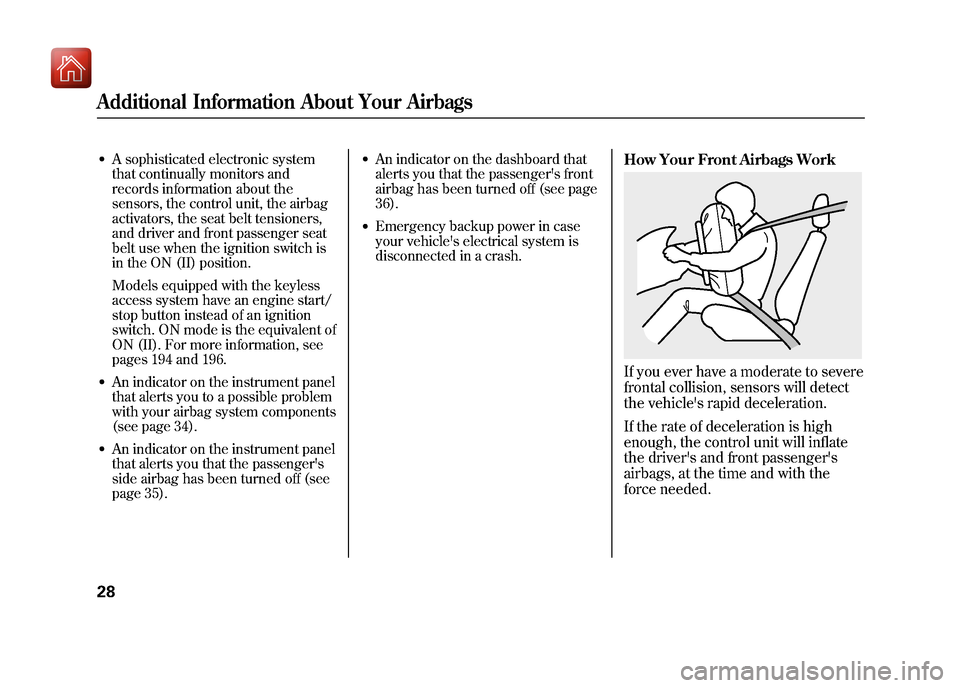
How Your Front Airbags WorkIf you ever have a moderate to severe
frontal collision, sensors will detect
the vehicle's rapid deceleration.
If the rate of deceleration is high
enough, the control unit will inflate
the driver's and front passenger's
airbags, at the time and with the
force needed.
Additional Information About Your Airbags2809/10/28 17:15:37 10 ACURA ZDX KA KC New North America Own 50 31SZN600 enu
Page 34 of 645
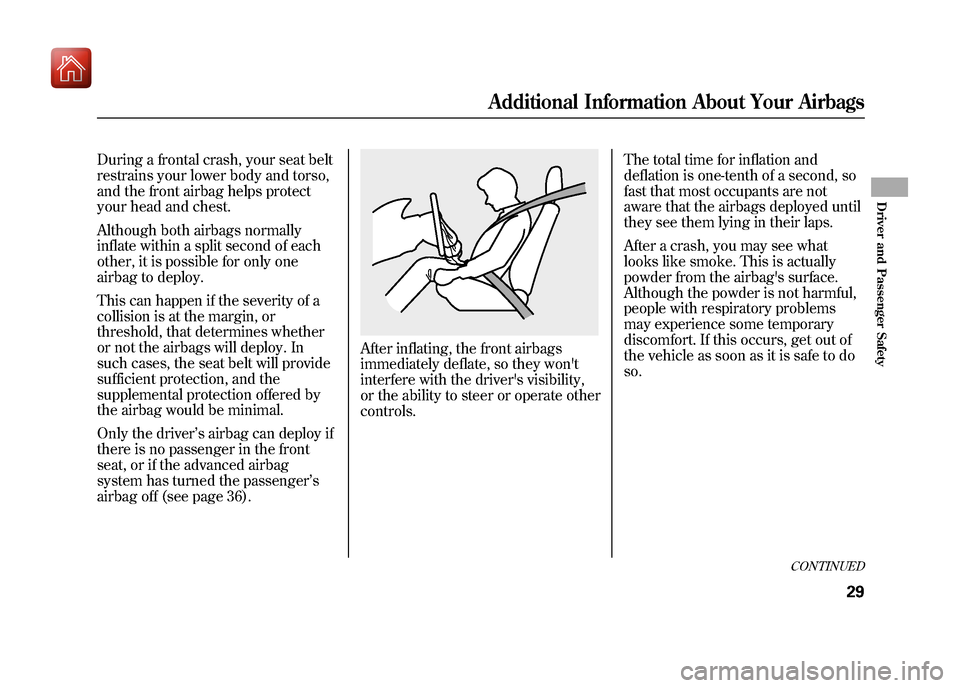
During a frontal crash, your seat belt
restrains your lower body and torso,
and the front airbag helps protect
your head and chest.
Although both airbags normally
inflate within a split second of each
other, it is possible for only one
airbag to deploy.
This can happen if the severity of a
collision is at the margin, or
threshold, that determines whether
or not the airbags will deploy. In
such cases, the seat belt will provide
sufficient protection, and the
supplemental protection offered by
the airbag would be minimal.
Only the driver’s airbag can deploy if
there is no passenger in the front
seat, or if the advanced airbag
system has turned the passenger ’s
airbag off (see page 36).
After inflating, the front airbags
immediately deflate, so they won't
interfere with the driver's visibility,
or the ability to steer or operate other
controls. The total time for inflation and
deflation is one-tenth of a second, so
fast that most occupants are not
aware that the airbags deployed until
they see them lying in their laps.
After a crash, you may see what
looks like smoke. This is actually
powder from the airbag's surface.
Although the powder is not harmful,
people with respiratory problems
may experience some temporary
discomfort. If this occurs, get out of
the vehicle as soon as it is safe to do
so.
CONTINUED
Additional Information About Your Airbags
29
Driver and Passenger Safety
09/10/28 17:15:37 10 ACURA ZDX KA KC New North America Own 50 31SZN600 enu
Page 35 of 645
Dual-Stage AirbagsYour front airbags are dual-stage
airbags. This means they have two
inflation stages that can be ignited
sequentially or simultaneously,
depending on crash severity.
In a
more severe
crash, both stages
will ignite simultaneously to provide
the quickest and greatest protection.
In a
less severe
crash, one stage will
ignite first, then the second stage will
ignite a split second later. This
provides longer airbag inflation time
with a little less force.
Dual-Threshold AirbagsYour front airbags are also dual-
threshold airbags. Airbags with this
feature have two deployment
thresholds that depend on whether
sensors detect the occupant is
wearing a seat belt or not.
If the occupant's belt is
not latched,
the airbag will deploy at a slightly
lower threshold, because the
occupant would need extra
protection.
If the occupant's belt is
latched,
the
airbag will inflate at a slightly higher
threshold, when the airbag would be
needed to supplement the protection
provided by the seat belt.
Advanced AirbagsYour front airbags are also advanced
airbags. The main purpose of this
feature is to help prevent airbag-
caused injuries to short drivers and
children or small statured adults who
ride in front.
For both advanced airbags to work
properly:●Occupants must sit upright and
wear their seat belts properly.●Do not spill any liquids on or
under the seats, cover the sensors,
or put any objects or metal items
under the front seats.
Failure to follow these instructions
could damage the sensors or prevent
them from working properly.
Additional Information About Your Airbags3009/10/28 17:15:37 10 ACURA ZDX KA KC New North America Own 50 31SZN600 enu
Page 37 of 645
●Moving the front seat forcibly back
against cargo on the seat or floor
behind it.●Hanging heavy items on the front
passenger seat, or placing heavy
items in the seat-back pocket.●Moving the front passenger's seat
or seat-back forcibly back against
the folded rear seat.●Back seat passengers should not
wedge objects or intentionally
force their feet under the front
passenger seat.
Also, make sure the floor mat behind
the front passenger's seat is hooked
to the floor mat anchor (see page
563). If it is not, the mat may
interfere with the proper operation of
the sensors and operation of the seat. How Your Side Airbags Work
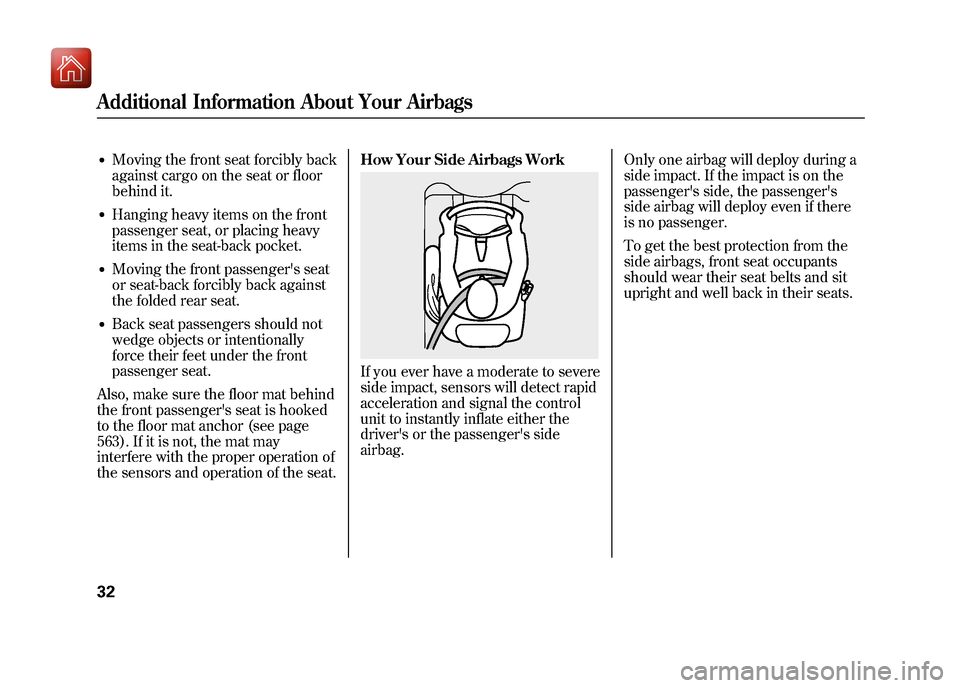
If you ever have a moderate to severe
side impact, sensors will detect rapid
acceleration and signal the control
unit to instantly inflate either the
driver's or the passenger's side
airbag.
Only one airbag will deploy during a
side impact. If the impact is on the
passenger's side, the passenger's
side airbag will deploy even if there
is no passenger.
To get the best protection from the
side airbags, front seat occupants
should wear their seat belts and sit
upright and well back in their seats.
Additional Information About Your Airbags3209/10/28 17:15:37 10 ACURA ZDX KA KC New North America Own 50 31SZN600 enu
Page 39 of 645
In a RolloverIf the SRS control unit senses that
your vehicle is about to rollover, it
immediately deploys both side
curtain airbags and activates both
front seat belt tensioners.
The airbag on the passenger's side
will deploy, and the seat belt
tensioner will activate, even if there
are no passengers on that side of the
vehicle.
To get the best protection from the
side curtain airbags, occupants
should wear their seat belts and sit
upright and well back in their seats.How the SRS Indicator Works
The SRS indicator alerts
you to a potential problem
with your airbag system components.
When you turn the ignition switch
ꭧ
to the ON (II) position, this indicator
comes on briefly then goes off. This
tells you the system is working
properly.
ꭧ : Models equipped with the
keyless access system have an
engine start/stop button instead of
an ignition switch. ON mode is the
equivalent of ON (II). For more
information, see pages 194 and 196. If the indicator comes on at any other
time, or does not come on at all, you
should have the system checked by
your dealer. For example:
●If the SRS indicator does not come
on after you turn the ignition
switch to the ON (II) position.●If the indicator stays on after the
engine starts.●If the indicator comes on or flashes
on and off while you drive.
You will also see a ‘‘CHECK AIRBAG
SYSTEM ’’message on the multi-
information display (see page 90).
If you see any of these indications,
the airbag system components may
not work properly when you need
them.
Additional Information About Your Airbags3409/10/28 17:15:37 10 ACURA ZDX KA KC New North America Own 50 31SZN600 enu
Page 41 of 645
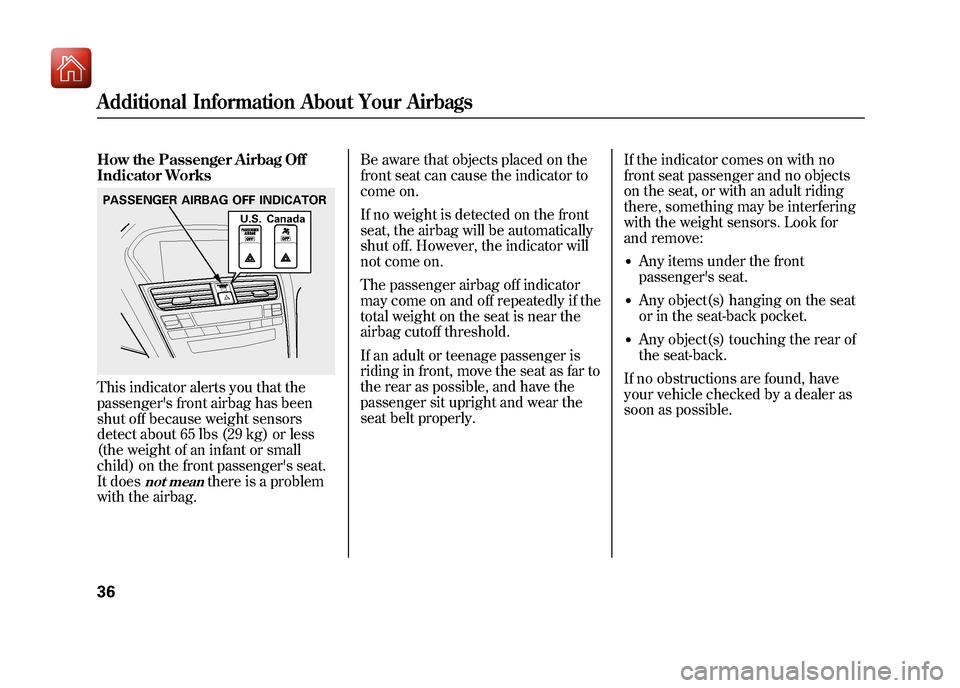
How the Passenger Airbag Off
Indicator WorksThis indicator alerts you that the
passenger's front airbag has been
shut off because weight sensors
detect about 65 lbs (29 kg) or less
(the weight of an infant or small
child) on the front passenger's seat.
It does
not mean
there is a problem
with the airbag. Be aware that objects placed on the
front seat can cause the indicator to
come on.
If no weight is detected on the front
seat, the airbag will be automatically
shut off. However, the indicator will
not come on.
The passenger airbag off indicator
may come on and off repeatedly if the
total weight on the seat is near the
airbag cutoff threshold.
If an adult or teenage passenger is
riding in front, move the seat as far to
the rear as possible, and have the
passenger sit upright and wear the
seat belt properly.
If the indicator comes on with no
front seat passenger and no objects
on the seat, or with an adult riding
there, something may be interfering
with the weight sensors. Look for
and remove:
●Any items under the front
passenger's seat.●Any object(s) hanging on the seat
or in the seat-back pocket.●Any object(s) touching the rear of
the seat-back.
If no obstructions are found, have
your vehicle checked by a dealer as
soon as possible.
PASSENGER AIRBAG OFF INDICATOR
U.S. Canada
Additional Information About Your Airbags3609/10/28 17:15:37 10 ACURA ZDX KA KC New North America Own 50 31SZN600 enu
Page 42 of 645
Airbag Service
Your airbag systems are virtually
maintenance free, and there are no
parts you can safely service.
However, you must have your
vehicle serviced if:●An airbag ever inflates.
Any airbag
that has deployed must be
replaced along with the control
unit and other related parts. Any
seat belt tensioner that activates
must also be replaced.
Do not try to remove or replace
any airbag by yourself. This must
be done by an authorized dealer or
a knowledgeable body shop.
●The SRS indicator alerts you to a
problem.
Take your vehicle to an
authorized dealer as soon as
possible. If you ignore this
indication, your airbags may not
operate properly.
●If your vehicle has a moderate to
severe impact.
Even if your airbags
do not inflate, your dealer should
inspect the driver's seat position
sensor, the front passenger's
weight sensors, the front seat belt
tensioners, and all seat belts and
their anchors worn during a crash
to make sure they are operating
properly. Additional Safety Precautions
●Do not attempt to deactivate your
airbags.
Together, airbags and seat
belts provide the best protection.
●Do not tamper with airbag components or wiring for any
reason.
Tampering could cause
the airbags to deploy, possibly
causing very serious injury.
●Do not expose the front
passenger's seat-back to liquid.
If
water or another liquid soaks into
a seat-back, it can prevent the side
airbag cutoff system from working
properly.
CONTINUED
Additional Information About Your Airbags
37
Driver and Passenger Safety
09/10/28 17:15:37 10 ACURA ZDX KA KC New North America Own 50 31SZN600 enu
Page 44 of 645
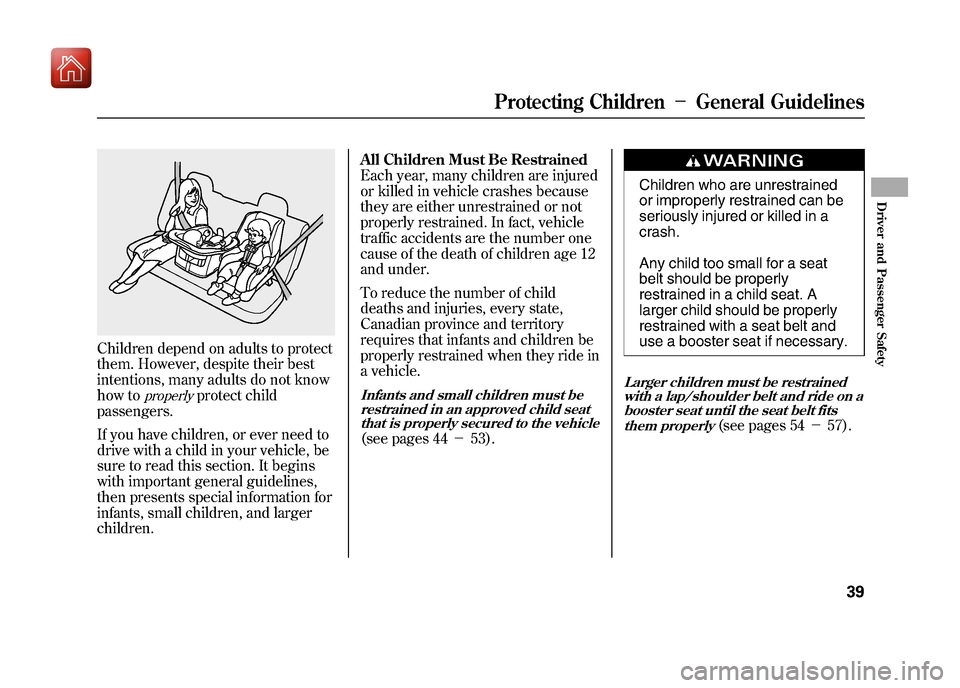
Children depend on adults to protect
them. However, despite their best
intentions, many adults do not know
how to
properly
protect child
passengers.
If you have children, or ever need to
drive with a child in your vehicle, be
sure to read this section. It begins
with important general guidelines,
then presents special information for
infants, small children, and larger
children. All Children Must Be Restrained
Each year, many children are injured
or killed in vehicle crashes because
they are either unrestrained or not
properly restrained. In fact, vehicle
traffic accidents are the number one
cause of the death of children age 12
and under.
To reduce the number of child
deaths and injuries, every state,
Canadian province and territory
requires that infants and children be
properly restrained when they ride in
a vehicle.
Infants and small children must be
restrained in an approved child seatthat is properly secured to the vehicle(see pages 44 -53).
Children who are unrestrained
or improperly restrained can be
seriously injured or killed in a
crash.
Any child too small for a seat
belt should be properly
restrained in a child seat. A
larger child should be properly
restrained with a seat belt and
use a booster seat if necessary.
Larger children must be restrained
with a lap/shoulder belt and ride on a
booster seat until the seat belt fits
them properly
(see pages 54 -57).
Protecting Children -General Guidelines
39
Driver and Passenger Safety
09/10/28 17:15:37 10 ACURA ZDX KA KC New North America Own 50 31SZN600 enu