vin Alfa Romeo 159 2007 Owner handbook (in English)
[x] Cancel search | Manufacturer: ALFA ROMEO, Model Year: 2007, Model line: 159, Model: Alfa Romeo 159 2007Pages: 303, PDF Size: 5.2 MB
Page 195 of 303

193
SAFETY
DEVICES
WARNING
LIGHTS AND
MESSAGES
CAR
MAINTENANCE
TECHNICAL
SPECIFICATIONS
INDEX
CORRECT USE
OF THE CAR
DASHBOARD
AND
CONTROLS
IN AN
EMERGENCY
❒after reaching the tyre pressure spec-
ified in paragraph “Wheels” in sec-
tion “Technical Specifications”, start
driving immediately;
❒if after 5 minutes it is still impossi-
ble to reach at least 1.5 bar, disen-
gage compressor from valve and cur-
rent outlet, then move the car forth
for approx. 10 metres in order to dis-
tribute the sealing fluid inside the tyre
evenly, then repeat the inflation op-
eration;
❒If after this operation it is still im-
possible after 5 minutes to reach at
least 1.8 bar, do start driving since
the tyre is excessively damaged and
the quick tyre repair kit cannot guar-
antee suitable sealing, contact Alfa
Romeo Authorized Services;
❒make sure the compressor switch A-
fig. 19is set to 0(off), start the
engine and fit plug A-fig. 20into
the outlet/cigar lighter on the front
console and then turn on the com-
pressor by setting switch A-fig. 19
toI(on);
❒Inflate the tyre to the pressure speci-
fied in paragraph “Wheels” in section
“Technical Specifications”. Check tyre
pressure on gauge B-fig. 19 with
compressor off to obtain precise read-
ing;
A0E0213mfig. 19A0E0217mfig. 20Apply the sticker in a
visible position for the
driver to indicate that the tyre
has been treated with the
quick tyre repair kit. Drive
carefully especially when cor-
nering and do not exceed 80
km/h. Avoid heavy braking
and accelerating.
WARNING
Page 196 of 303

194
SAFETY
DEVICES
WARNING
LIGHTS AND
MESSAGES
CAR
MAINTENANCE
TECHNICAL
SPECIFICATIONS
INDEX
CORRECT USE
OF THE CAR
DASHBOARD
AND
CONTROLS
IN AN
EMERGENCY
You shall absolutely
communicate that the
tyre has been repaired with
the quick tyre repair kit. Hand
the instruction brochure to the
personnel charged with treat-
ing the tyre repaired with the
kit.
WARNING
A0E0215mfig. 21
A0E0216mfig. 22
CHECKING AND RESTORING
PRESSURE ONLY
The compressor can be also used just for
restoring pressure. Disconnect the quick
connectionA-fig. 21and connect it
directly to the tyre valve fig. 22; in this
way the cylinder is not connected to
compressor and the sealing fluid will not
flow into the tyre.
If pressure falls below
1.8 bar, stop the car
since the tyre is excessively
damaged and the quick tyre
repair kit Fix & Go automatic
cannot guarantee suitable
sealing, contact Alfa Romeo
Authorized Services.
WARNING
❒after driving for about 10 minutes
stop and check again the tyre pres-
sure;pull up the handbrake;❒if at least 1.8 bar pressure is read, re-
store proper pressure (with engine
running and handbrake on) and
restart;
❒drive with the utmost care to the
nearest Alfa Romeo Authorized
Service.
Page 197 of 303

195
SAFETY
DEVICES
WARNING
LIGHTS AND
MESSAGES
CAR
MAINTENANCE
TECHNICAL
SPECIFICATIONS
INDEX
CORRECT USE
OF THE CAR
DASHBOARD
AND
CONTROLS
IN AN
EMERGENCY
CYLINDER REPLACEMENT
PROCEDURE
To replace the cylinder proceed as fol-
lows:
❒disconnect connection A-fig. 23
and hose B;
❒turn counter-clockwise the cylinder to
replace and raise it;
❒fit the new cylinder and turn it clock-
wise;
❒refit connection Aor connect hose
Binto its seat.
A0E0047mfig. 23
Inform other people
driving the car that the
tyre has been repaired using
the quick tyre kit. Hand the
sticker to the personnel that
will carry out restoring oper-
ations.
WARNING
Page 221 of 303

219
SAFETY
DEVICES
WARNING
LIGHTS AND
MESSAGES
CAR
MAINTENANCE
TECHNICAL
SPECIFICATIONS
INDEX
CORRECT USE
OF THE CAR
DASHBOARD
AND
CONTROLS
IN AN
EMERGENCY
IF THE BATTERY
IS FLAT
IMPORTANTThe description of the
battery charging procedure is described
only for informative purposes. This op-
eration should be carried out by Alfa
Romeo Authorized Services.
Charging should be slow at a low amp
rating for 24 hours. Charging for a
longer time may damage the battery.Charge the battery as follows:
❒disconnect battery negative terminal
(–);
❒connect the charger cables to the bat-
tery terminals, observing the poles;
❒ turn on the charger;
❒when you have finished, turn the
charger off before disconnecting the
battery;
❒reconnect battery negative terminal
(–).
The liquid in the battery
is poisonous and corro-
sive. Do not let it touch the
skin or eyes. Recharging the
battery should be done in a
well ventilated area away
from naked flames or possible
sources of sparks: explosion
and fire risk.
WARNING
Do not attempt to
recharge a frozen bat-
tery. Thaw it first, otherwise
it could explode. If the battery
froze, make sure the internal
elements are not broken and
that the casing is not cracked:
risk of spilling the poisonous
and corrosive fluid.
WARNING
Page 228 of 303
226
SAFETY
DEVICES
WARNING
LIGHTS AND
MESSAGES
IN AN
EMERGENCY
TECHNICAL
SPECIFICATIONS
INDEX
CORRECT USE
OF THE CAR
DASHBOARD
AND
CONTROLS
CAR
MAINTENANCE
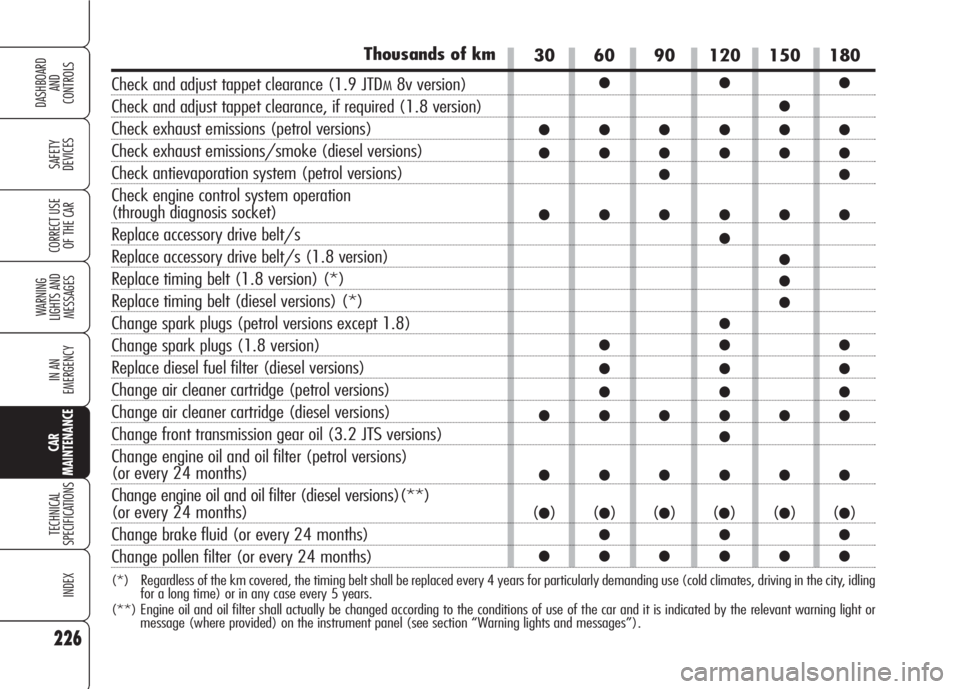
Thousands of km
Check and adjust tappet clearance (1.9 JTDM8v version)
Check and adjust tappet clearance, if required (1.8 version)
Check exhaust emissions (petrol versions)
Check exhaust emissions/smoke (diesel versions)
Check antievaporation system (petrol versions)
Check engine control system operation
(through diagnosis socket)
Replace accessory drive belt/s
Replace accessory drive belt/s (1.8 version)
Replace timing belt (1.8 version) (*)
Replace timing belt (diesel versions) (*)
Change spark plugs (petrol versions except 1.8)
Change spark plugs (1.8 version)
Replace diesel fuel filter (diesel versions)
Change air cleaner cartridge (petrol versions)
Change air cleaner cartridge (diesel versions)
Change front transmission gear oil (3.2 JTS versions)
Change engine oil and oil filter (petrol versions)
(or every 24 months)
Change engine oil and oil filter (diesel versions)(**)
(or every 24 months)
Change brake fluid (or every 24 months)
Change pollen filter (or every 24 months)
(*) Regardless of the km covered, the timing belt shall be replaced every 4 years for particularly demanding use (cold climates, driving in the city, idling
for a long time) or in any case every 5 years.
(**) Engine oil and oil filter shall actually be changed according to the conditions of use of the car and it is indicated by the relevant warning light or
message (where provided) on the instrument panel (see section “Warning lights and messages”).
30 60 90 120 150 180
●●●
●
●●●●●●
●●●●●●
●●
●●●●●●
●
●
●
●
●
●●●
●●●
●●●
●●●●●●
●
●●●●●●
(●)(●)(●)(●)(●)(●)
●●●
●●●●●●
Page 229 of 303
227
SAFETY
DEVICES
WARNING
LIGHTS AND
MESSAGES
IN AN
EMERGENCY
TECHNICAL
SPECIFICATIONS
INDEX
CORRECT USE
OF THE CAR
DASHBOARD
AND
CONTROLS
CAR
MAINTENANCE
USE OF THE CAR
UNDER HEAVY
CONDITIONS
Should prevailing use of the car be un-
der one of the following specially heavy
conditions:
❒ trailer or caravan towing;
❒ dusty roads;
❒ short distances (less than 7-8 km)
and repeated with external temper-
atures below zero;
❒ frequently idling engines or long dis-
tance low speed driving (e.g.: door-
to-door deliveries) or in case of a long
term inactivity;
❒ urban routes;
carry out checks more frequently than
required on Service Schedule:
❒ check front disk brake pad conditions
and wear;
❒ check cleanness of bonnet and boot
locks and lever cleanness and lubri-
cation;
❒ sight inspect the conditions of: en-
gine, gearbox, transmission, pipes
and hoses (exhaust - fuel - brakes),
rubber parts (boots, sleeves, bushes,
etc.);
❒ check battery charge and fluid level
(electrolyte);
❒ visual check on various drive belt con-
ditions;
❒ change engine oil and oil filter, if re-
quired;
❒ check and replace pollen filter, if re-
quired;
❒ check and replace air cleaner, if re-
quired.
PERIODICAL CHECKS
Every 1,000 km or before long jour-
neys, check and top up if required:
❒engine coolant fluid level;
❒brake fluid level;
❒windscreen washer fluid level;
❒ tyre pressure and conditions.
❒ check light system operation (head-
lights, direction indicators, hazard
lights, etc.);
❒ check windscreen wiper/washer op-
eration and windscreen/rear window
blade position/wear;
Every 3,000 km check and top up if re-
quired: engine oil level.
You are recommended to use FL Se-
leniaproducts, designed and produced
specifically for Alfa Romeo cars (see
table “Capacities” in section “Techni-
cal specifications”).
Page 234 of 303

232
SAFETY
DEVICES
WARNING
LIGHTS AND
MESSAGES
IN AN
EMERGENCY
TECHNICAL
SPECIFICATIONS
INDEX
CORRECT USE
OF THE CAR
DASHBOARD
AND
CONTROLS
CAR
MAINTENANCE
Engine oil consumption
Max engine oil consumption is usually
400 grams every 1000 km.
When the car is new, the engine needs
to run in, therefore the engine oil con-
sumption can only be considered sta-
bilised after the first 5000 - 6000 km.
IMPORTANTThe oil consumption de-
pends on driving style and the conditions
under which the car is used.
IMPORTANTDo not add oil with
specifications other than that already
in the engine. Topping up engine oil
If the oil level is near or even below the
MINmark, add oil through the filler
neckB, until reaching the MAXmark.
Oil level shall never exceed the MAX
mark.
IMPORTANT If a routine check re-
veals that the oil level is above the
MAXmark, contact Alfa Romeo Au-
thorized Services to have the correct lev-
el restored.
IMPORTANT After adding or changing
the oil, let the engine turn over for a few
seconds and wait a few minutes after
turning it off before you check the level.
When the engine is hot,
take care when work-
ing inside the engine compart-
ment to avoid burns. Remem-
ber that when the engine is
hot, the fan may cut in: danger
of injury. Scarves, ties and
other loose clothing might be
pulled by moving parts.
WARNING
Used engine oil and fil-
ter contain harmful sub-
stances for the environ-
ment. Contact Alfa Romeo Au-
thorized Services to have the oil
and filter changed.
Page 236 of 303

234
SAFETY
DEVICES
WARNING
LIGHTS AND
MESSAGES
IN AN
EMERGENCY
TECHNICAL
SPECIFICATIONS
INDEX
CORRECT USE
OF THE CAR
DASHBOARD
AND
CONTROLS
CAR
MAINTENANCE
Do not travel with the
windscreen washer
reservoir empty. The wind-
screen washer is fundamental
for improving visibility.
WARNING
Certain commercial ad-
ditives for windscreen
washers are inflammable. The
engine compartment contains
hot components which may set
it on fire.
WARNINGPOWER STEERING FLUID
fig. 13-14
Check that the fluid level in the reservoir
is at maximum level: this operation shall
be carried out with the car on level sur-
face, engine not running and cold.
Check that the fluid level is at the MAX
mark on the reservoir or at the top mark
(maximum level) shown on the dipstick
under the reservoir cap.
A0E0027mfig. 13 1.8 - 1.9 JTS - 2.2 JTS -
2.4 JTDMversions
A0E0234mfig. 14 3.2 JTS - 1.9 JTDM8V-
1.9 JTDM16Vversions
If the fluid level in the reservoir is below
the specified level, top up as follows:
❒start the engine and wait until the flu-
id level in the reservoir has stabilized;
❒with the engine started, turn repeat-
edly the steering wheel fully right-
wards and leftwards;
❒top up until reaching the MAXmark
then refit the cap.
Page 240 of 303

238
SAFETY
DEVICES
WARNING
LIGHTS AND
MESSAGES
IN AN
EMERGENCY
TECHNICAL
SPECIFICATIONS
INDEX
CORRECT USE
OF THE CAR
DASHBOARD
AND
CONTROLS
CAR
MAINTENANCE
REPLACING THE BATTERY
If required, replace the battery with a
genuine spare part having the same
specifications.
If a battery with different specifications
is fitted, the service intervals given in
the Service schedule in this section will
no longer be valid.
Refer therefore to the instructions pro-
vided by the battery manufacturer.
Incorrect fitting of elec-
trical and electronic ac-
cessories can seriously
damage the car. If after buying
the car, you want to install elec-
tric accessories which require per-
manent electric supply (alarm,
free-hand phone kit, etc.) contact
Alfa Romeo Authorized Services
whose qualified personnel, in ad-
dition to suggesting the most
suitable devices, will evaluate the
overall electric absorption, check-
ing whether the car’s electric sys-
tem is capable of withstanding
the load required, or whether it
should be integrated with a more
powerful battery.
Batteries contain sub-
stances that are very
harmful for the environ-
ment. You are advised to have
the battery changed at Alfa
Romeo Authorized Services,
which is properly equipped for
disposing of used batteries re-
specting nature and the law.
The liquid in the bat-
tery is poisonous and
corrosive. Avoid contact with
eyes and skin. Do not bring
naked flames or possible
sources of sparks near to the
battery: risk of fire and ex-
plosion.
WARNING
Running the battery
with low fluid level can
damage the battery beyond
repair and could also cause its
explosion.
WARNING
After connecting/dis-
connecting the battery,
wait for 3 minutes at
least before fitting the electronic
key into the ignition device in
order to allow the climate con-
trol system control unit to reset
the positions of the electric ac-
tuators that adjust air temper-
ature and distribution.
Page 243 of 303

241
SAFETY
DEVICES
WARNING
LIGHTS AND
MESSAGES
IN AN
EMERGENCY
TECHNICAL
SPECIFICATIONS
INDEX
CORRECT USE
OF THE CAR
DASHBOARD
AND
CONTROLS
CAR
MAINTENANCE
Incorrect pressure causes abnormal tyre
wearfig. 17:
Anormal pressure: tread evenly worn.
Blow pressure: tread particularly worn
at the edges.
Chigh pressure: tread particularly worn
in the centre.
Tyres must be replaced when the tread
wears down to 1.6 mm. In any case,
comply with the laws in the country
where the car is being driven.
IMPORTANT NOTES
As far as possible, avoid sharp braking
and screech starts, etc. Be careful not to
hit the kerb, potholes or other obstacles
hard. Driving for long stretches over
bumpy roads can damage the tyres.
Periodically check that the tyres have no
cuts in the side wall, abnormal swelling
or irregular tyre wear. If any of these oc-
cur, have the car seen to at Alfa Romeo
Authorized Services.
Avoid overloading the car when travel-
ling: this may cause serious damage to
the wheels and tyres; if a tyre is punc-
tured, stop immediately and change it
to avoid damage to the tyre, the rim,
suspensions and steering system.
WHEELS AND TYRES
Check the pressure of each tyre, includ-
ing the space-saver spare wheel, every
four weeks and before long journeys:
pressure should be checked with the tyre
rested and cold.
For the correct tyre inflation pressure,
see “Wheels” in “Technical specifica-
tions” section.
A0E0120mfig. 17