roof Alfa Romeo 166 2007 Owner handbook (in English)
[x] Cancel search | Manufacturer: ALFA ROMEO, Model Year: 2007, Model line: 166, Model: Alfa Romeo 166 2007Pages: 272, PDF Size: 4.17 MB
Page 150 of 272
149
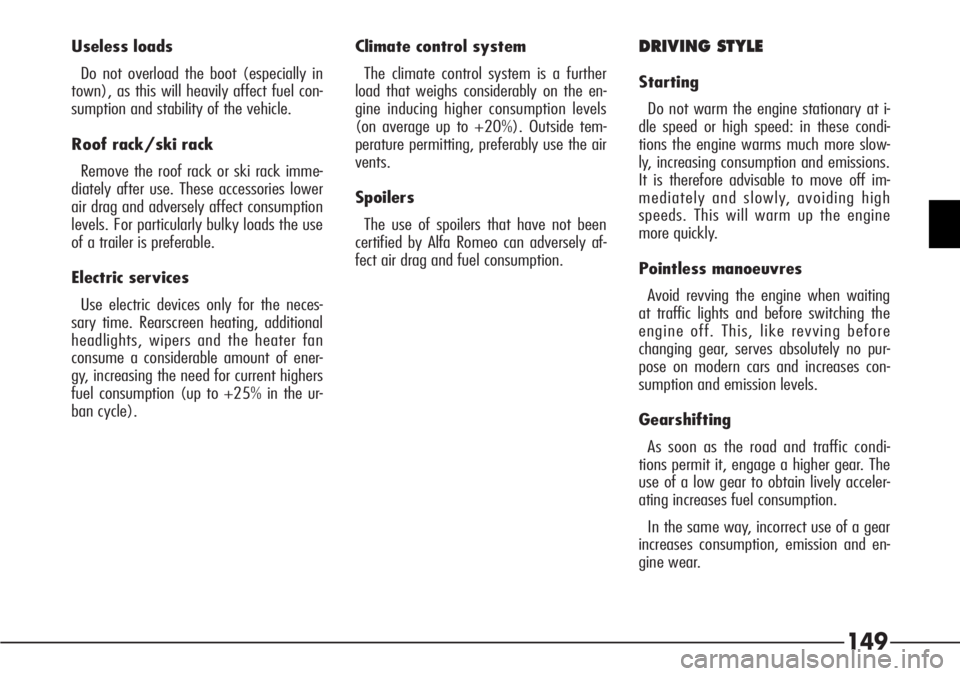
Useless loads
Do not overload the boot (especially in
town), as this will heavily affect fuel con-
sumption and stability of the vehicle.
Roof rack/ski rack
Remove the roof rack or ski rack imme-
diately after use. These accessories lower
air drag and adversely affect consumption
levels. For particularly bulky loads the use
of a trailer is preferable.
Electric services
Use electric devices only for the neces-
sary time. Rearscreen heating, additional
headlights, wipers and the heater fan
consume a considerable amount of ener-
gy, increasing the need for current highers
fuel consumption (up to +25% in the ur-
ban cycle).Climate control system
The climate control system is a further
load that weighs considerably on the en-
gine inducing higher consumption levels
(on average up to +20%). Outside tem-
perature permitting, preferably use the air
vents.
Spoilers
The use of spoilers that have not been
certified by Alfa Romeo can adversely af-
fect air drag and fuel consumption.DRIVING STYLE
Starting
Do not warm the engine stationary at i-
dle speed or high speed: in these condi-
tions the engine warms much more slow-
ly, increasing consumption and emissions.
It is therefore advisable to move off im-
mediately and slowly, avoiding high
speeds. This will warm up the engine
more quickly.
Pointless manoeuvres
Avoid revving the engine when waiting
at traffic lights and before switching the
engine off. This, like revving before
changing gear, serves absolutely no pur-
pose on modern cars and increases con-
sumption and emission levels.
Gearshifting
As soon as the road and traffic condi-
tions permit it, engage a higher gear. The
use of a low gear to obtain lively acceler-
ating increases fuel consumption.
In the same way, incorrect use of a gear
increases consumption, emission and en-
gine wear.
Page 167 of 272
166
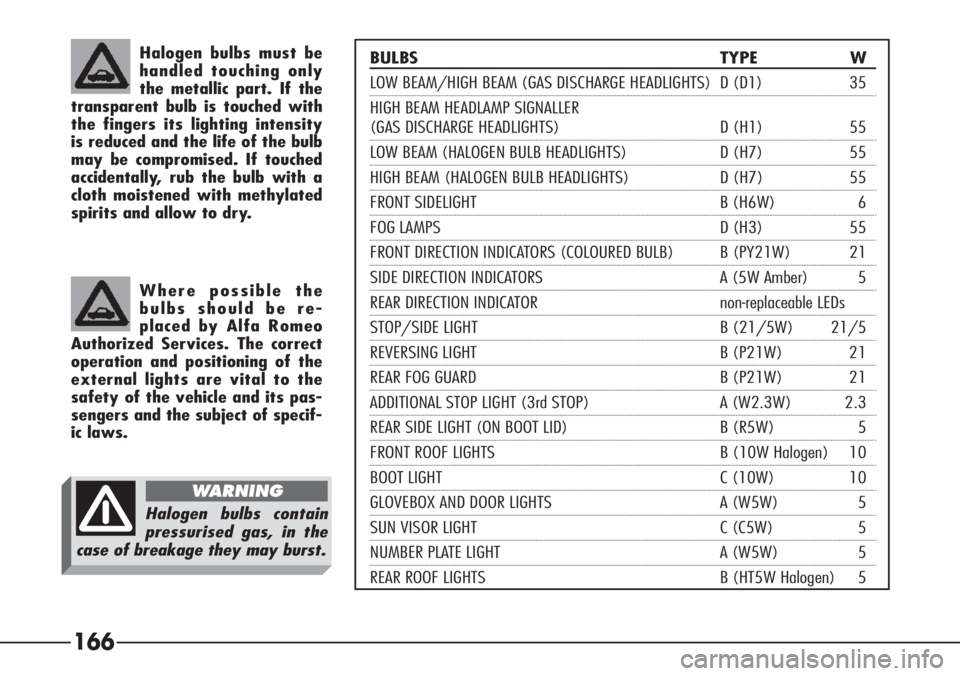
BULBS TYPE W
LOW BEAM/HIGH BEAM (GAS DISCHARGE HEADLIGHTS) D (D1) 35
HIGH BEAM HEADLAMP SIGNALLER
(GAS DISCHARGE HEADLIGHTS) D (H1) 55
LOW BEAM (HALOGEN BULB HEADLIGHTS) D (H7) 55
HIGH BEAM (HALOGEN BULB HEADLIGHTS) D (H7) 55
FRONT SIDELIGHT B (H6W) 6
FOG LAMPS D (H3) 55
FRONT DIRECTION INDICATORS (COLOURED BULB) B (PY21W) 21
SIDE DIRECTION INDICATORS A (5W Amber) 5
REAR DIRECTION INDICATOR non-replaceable LEDs
STOP/SIDE LIGHT B (21/5W) 21/5
REVERSING LIGHT B (P21W) 21
REAR FOG GUARD B (P21W) 21
ADDITIONAL STOP LIGHT (3rd STOP) A (W2.3W) 2.3
REAR SIDE LIGHT (ON BOOT LID) B (R5W) 5
FRONT ROOF LIGHTS B (10W Halogen) 10
BOOT LIGHT C (10W) 10
GLOVEBOX AND DOOR LIGHTS A (W5W) 5
SUN VISOR LIGHT C (C5W) 5
NUMBER PLATE LIGHT A (W5W) 5
REAR ROOF LIGHTS B (HT5W Halogen) 5
Halogen bulbs must be
handled touching only
the metallic part. If the
transparent bulb is touched with
the fingers its lighting intensity
is reduced and the life of the bulb
may be compromised. If touched
accidentally, rub the bulb with a
cloth moistened with methylated
spirits and allow to dry.
Where possible the
bulbs should be re-
placed by Alfa Romeo
Authorized Services. The correct
operation and positioning of the
external lights are vital to the
safety of the vehicle and its pas-
sengers and the subject of specif-
ic laws.
Halogen bulbs contain
pressurised gas, in the
case of breakage they may burst.
WARNING
Page 182 of 272

181
IF ONE OF THE
INTERNAL LIGHTS
GOES OUT
FRONT ROOF LIGHT
To replace the bulbs (Type B, 10W Halo-
gen):
– Remove the roof light (A-fig. 68)
levering in the point illustrated.
– Remove the screen (B-fig. 69)
firstly releasing it from the catch (C) on
the right and then from the two stoppers
on the left.
– Remove and replace the bulb con-
cerned (D-fig. 70) (tubular with bayo-
net coupling), pushing gently and turning
counter-clockwise.When refitting the roof
light ensure that the
electrical wiring is cor-
rectly arranged and does not in-
terfere with the edges of the
light or retaining clips.
– Refit the screen (B-fig. 69), firstly
inserting the left side under the two stop-
pers then on the right side until the catch
clicks. (C-fig. 69).
– Refit the roof light firstly inserting the
front part, then pressing in the rear part
to fit it in place.
631PGSm632PGSm
fig. 69 fig. 68 fig. 70
607PGSm
Page 183 of 272

182
– Remove and replace the bulb (B-fig.
72) (tubular with bayonet coupling)
pushing gently and turning counter-clock-
wise.
– Refit the roof light firstly hooking the
catch (C-fig. 72) and pressing on the
other side until the catch clicks into place
(D-fig. 72).COURTESY LIGHTS
To replace the bulb (Type C, 5W):
– Remove the light (A-fig. 73) lever-
ing in the point illustrated.
REAR ROOF LIGHTS
To replace the bulbs (Type B, 5W):
– Remove the roof light (A-fig. 71)
levering in the point illustrated.
fig. 73fig. 71
492PGSm494PGSm493PGSm
fig. 72
Page 191 of 272
190
FUSES AND RELAYS IN THE
BOOT
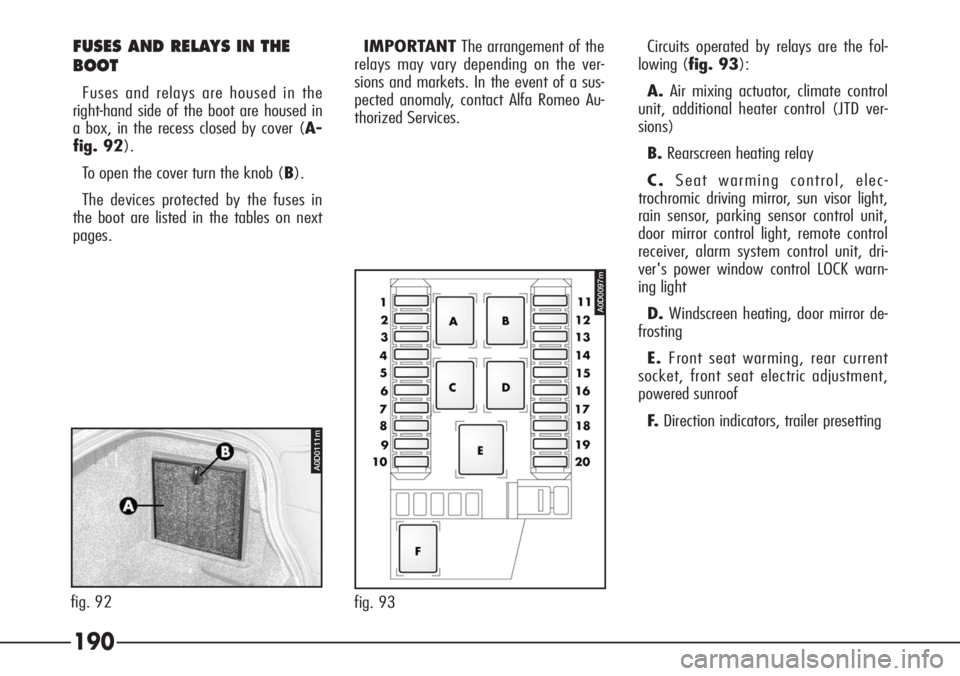
Fuses and relays are housed in the
right-hand side of the boot are housed in
a box, in the recess closed by cover (A-
fig. 92).
To open the cover turn the knob (B).
The devices protected by the fuses in
the boot are listed in the tables on next
pages.IMPORTANTThe arrangement of the
relays may vary depending on the ver-
sions and markets. In the event of a sus-
pected anomaly, contact Alfa Romeo Au-
thorized Services.Circuits operated by relays are the fol-
lowing (fig. 93):
A.Air mixing actuator, climate control
unit, additional heater control (JTD ver-
sions)
B.Rearscreen heating relay
C.Seat warming control, elec-
trochromic driving mirror, sun visor light,
rain sensor, parking sensor control unit,
door mirror control light, remote control
receiver, alarm system control unit, dri-
ver's power window control LOCK warn-
ing light
D.Windscreen heating, door mirror de-
frosting
E.Front seat warming, rear current
socket, front seat electric adjustment,
powered sunroof
F.Direction indicators, trailer presetting
518PGS
fig. 93
A0D0097m
A0D0111m
fig. 92
Page 194 of 272

193
System/Component Fuse no. Ampere Location
Rearscreen heating 1 30A fig. 93
Relay coil T21, T22, T23 (boot box) 3 5A fig. 86
Relay coil T24 (boot box) 5 10A fig. 86
Remote control receiver 15 10A fig. 93
Sound amplifier 20 25A fig. 93
Sound system 4 15A fig. 86
Sound system controls on steering wheel 5 10Afig. 86
Starter motor 1 30A fig. 89
Trailer presetting 12 10A fig. 93
Windscreen heating 7 15A fig. 93
Windscreen wiper 14 25A fig. 86
System/Component Fuse no. Ampere Location
Navigator 18 5A fig. 86
Parking sensors (control unit) 15 10A fig. 93
Power windows (driver's control
LOCK warning light) 15 10A fig. 93
Powered sunroof 10 20A fig. 93
Presetting 4 – fig. 93
11 – fig. 93
Rain sensor 15 10A fig. 93
Rear current socket 16 20A fig. 93
Rear LH power window (ABI control unit) 14 20Afig. 93
Rear RH power window (ABI control unit) 17 20Afig. 93
Page 238 of 272
237
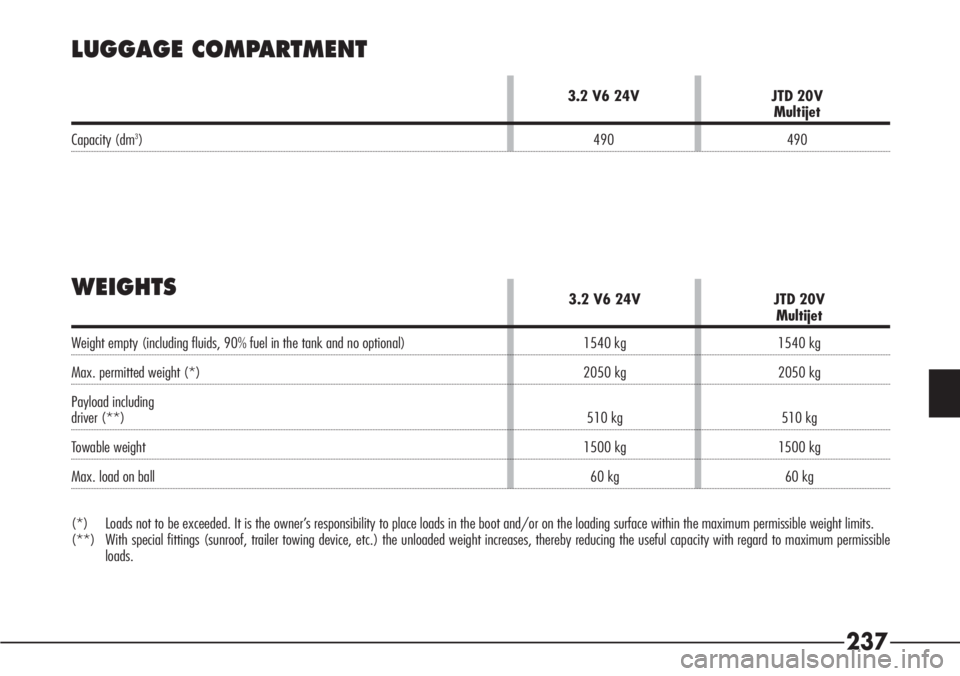
LUGGAGE COMPARTMENT
WEIGHTS
(*) Loads not to be exceeded. It is the owner’s responsibility to place loads in the boot and/or on the loading surface within the maximum permissible weight limits.
(**) With special fittings (sunroof, trailer towing device, etc.) the unloaded weight increases, thereby reducing the useful capacity with regard to maximum permissible
loads.
3.2 V6 24V JTD 20VMultijet
Capacity (dm3) 490 490
3.2 V6 24V JTD 20V
Multijet
Weight empty (including fluids, 90% fuel in the tank and no optional) 1540 kg 1540 kg
Max. permitted weight (*) 2050 kg 2050 kg
Payload including
driver (**) 510 kg 510 kg
Towable weight 1500 kg 1500 kg
Max. load on ball 60 kg 60 kg
Page 241 of 272
240
FUEL CONSUMPTION
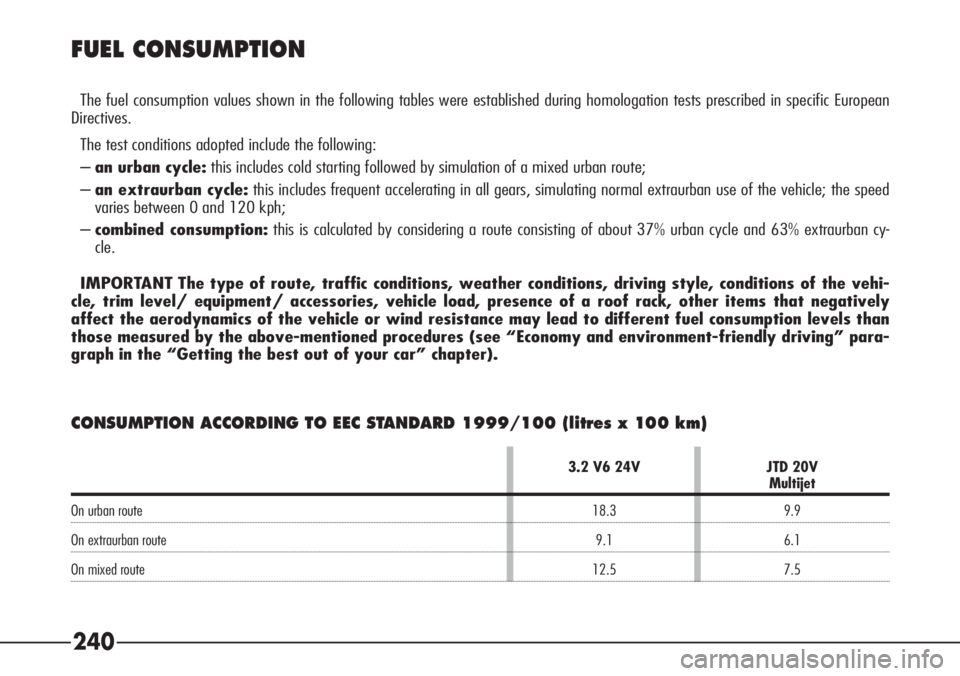
The fuel consumption values shown in the following tables were established during homologation tests prescribed in specific European
Directives.
The test conditions adopted include the following:
–an urban cycle:this includes cold starting followed by simulation of a mixed urban route;
–an extraurban cycle:this includes frequent accelerating in all gears, simulating normal extraurban use of the vehicle; the speed
varies between 0 and 120 kph;
–combined consumption:this is calculated by considering a route consisting of about 37% urban cycle and 63% extraurban cy-
cle.
IMPORTANT The type of route, traffic conditions, weather conditions, driving style, conditions of the vehi-
cle, trim level/ equipment/ accessories, vehicle load, presence of a roof rack, other items that negatively
affect the aerodynamics of the vehicle or wind resistance may lead to different fuel consumption levels than
those measured by the above-mentioned procedures (see “Economy and environment-friendly driving” para-
graph in the “Getting the best out of your car” chapter).
CONSUMPTION ACCORDING TO EEC STANDARD 1999/100 (litres x 100 km)
3.2 V6 24V JTD 20VMultijet
On urban route 18.3 9.9
On extraurban route 9.1 6.1
On mixed route 12.5 7.5
Page 265 of 272
264
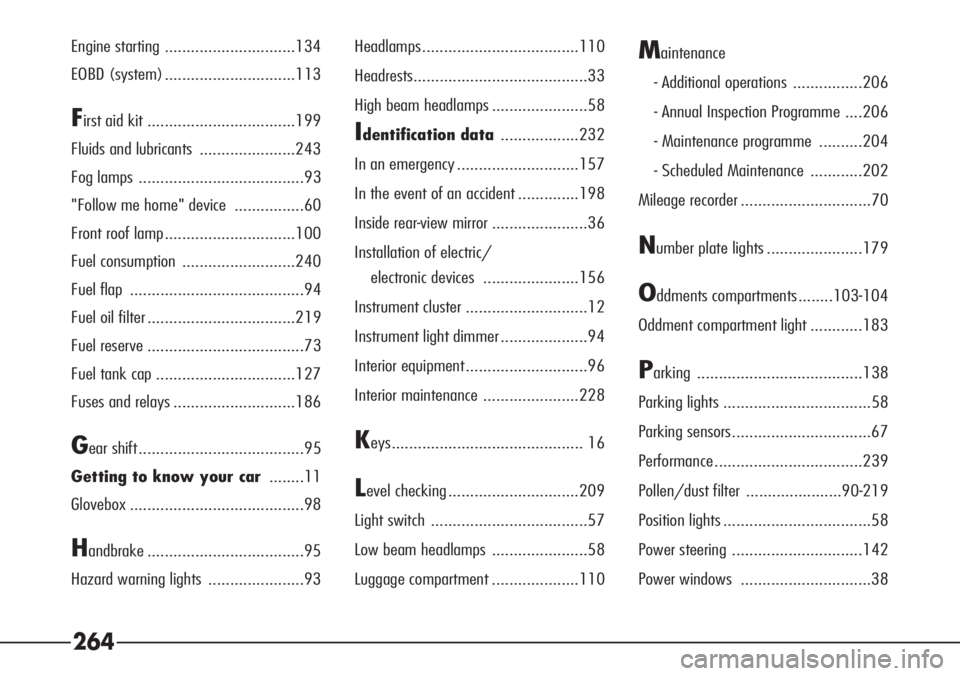
Engine starting ..............................134
EOBD (system) ..............................113
First aid kit ..................................199
Fluids and lubricants ......................243
Fog lamps ......................................93
"Follow me home" device ................60
Front roof lamp..............................100
Fuel consumption ..........................240
Fuel flap ........................................94
Fuel oil filter ..................................219
Fuel reserve ....................................73
Fuel tank cap ................................127
Fuses and relays ............................186
Gear shift ......................................95
Getting to know your car........11
Glovebox ........................................98
Handbrake ....................................95
Hazard warning lights ......................93Headlamps ....................................110
Headrests........................................33
High beam headlamps ......................58
Identification data..................232
In an emergency ............................157
In the event of an accident ..............198
Inside rear-view mirror ......................36
Installation of electric/
electronic devices ......................156
Instrument cluster ............................12
Instrument light dimmer ....................94
Interior equipment ............................96
Interior maintenance ......................228
Keys............................................ 16
Level checking ..............................209
Light switch ....................................57
Low beam headlamps ......................58
Luggage compartment ....................110
Maintenance
- Additional operations ................206
- Annual Inspection Programme ....206
- Maintenance programme ..........204
- Scheduled Maintenance ............202
Mileage recorder ..............................70
Number plate lights ......................179
Oddments compartments........103-104
Oddment compartment light ............183
Parking ......................................138
Parking lights ..................................58
Parking sensors................................67
Performance ..................................239
Pollen/dust filter ......................90-219
Position lights ..................................58
Power steering ..............................142
Power windows ..............................38
Page 266 of 272
265
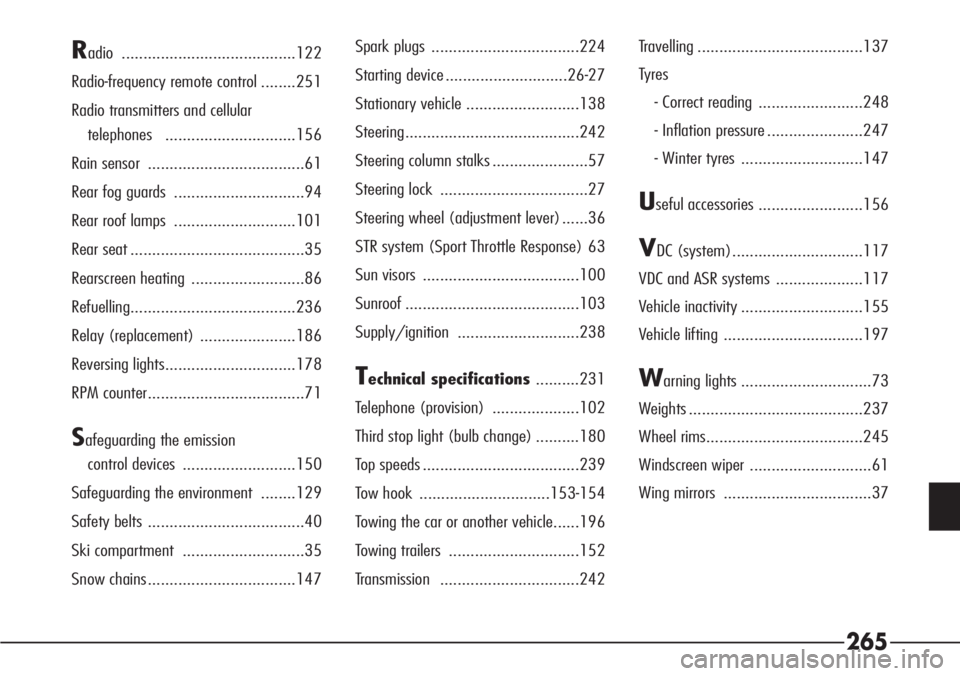
Radio ........................................122
Radio-frequency remote control ........251
Radio transmitters and cellular
telephones ..............................156
Rain sensor ....................................61
Rear fog guards ..............................94
Rear roof lamps ............................101
Rear seat ........................................35
Rearscreen heating ..........................86
Refuelling......................................236
Relay (replacement) ......................186
Reversing lights..............................178
RPM counter....................................71
Safeguarding the emission
control devices ..........................150
Safeguarding the environment ........129
Safety belts ....................................40
Ski compartment ............................35
Snow chains..................................147Spark plugs ..................................224
Starting device ............................26-27
Stationary vehicle ..........................138
Steering........................................242
Steering column stalks ......................57
Steering lock ..................................27
Steering wheel (adjustment lever) ......36
STR system (Sport Throttle Response) 63
Sun visors ....................................100
Sunroof ........................................103
Supply/ignition ............................238
Technical specifications..........231
Telephone (provision) ....................102
Third stop light (bulb change) ..........180
Top speeds ....................................239
Tow hook ..............................153-154
Towing the car or another vehicle......196
Towing trailers ..............................152
Transmission ................................242Travelling ......................................137
Tyres
- Correct reading ........................248
- Inflation pressure ......................247
- Winter tyres ............................147
Useful accessories ........................156
VDC (system)..............................117
VDC and ASR systems ....................117
Vehicle inactivity ............................155
Vehicle lifting ................................197
Warning lights ..............................73
Weights ........................................237
Wheel rims....................................245
Windscreen wiper ............................61
Wing mirrors ..................................37