steering Alfa Romeo 166 2007 Owner handbook (in English)
[x] Cancel search | Manufacturer: ALFA ROMEO, Model Year: 2007, Model line: 166, Model: Alfa Romeo 166 2007Pages: 272, PDF Size: 4.17 MB
Page 149 of 272
148ECONOMY AND
ENVIRONMENT-
FRIENDLY DRIVING
How you use and how you drive your
vehicle directly influence fuel consump-
tion and environmental impact.
By following a few simple guidelines
and without incising on the “liveliness”
of the vehicle, it is possible to avoid dam-
aging the environment and often, at the
same time, to limit fuel consumption.
The following helpful suggestions will al-
low you to save in running costs and re-
duce harmful emissions.
GENERAL CONSIDERATIONS
Vehicle maintenance
The conditions of the vehicle are an im-
portant factor which affects fuel consump-
tion as well as driving tranquillity and the
life of the car itself. For this reason, care
should be given to maintenance, having
the checks and adjustments given in the
scheduled maintenance programme car-
ried out (see ... spark plugs, idle speed,
air/fuel oil filter, timing).
Tyres
Check the tyre pressure at least every 4
weeks: if the pressure is too low, consump-
tion increases as resistance to rolling is
higher. It should also be underlined that in
these conditions, tyre wear increases re-
sulting in poor handling and lower safety. Drive at a moderate
speed when snow chains
have been fitted to the
wheels. Avoid potholes, steps and
pavements, and do not drive for
long stretches on snow-free roads,
otherwise you risk damaging the
tyres, suspension and steering.
Snow chains can be fit-
ted only on wheels with
6.5J x 16” rims and
215/55 R16 tyres or 7.5J x 17”
rims and 225/45 R17 tyres.
(*) Pour versions/marchè lorsqu’il
est prèvu pneus 205/55 R16.
Page 188 of 272
187
FUSES AND RELAYS IN THE
CONTROL UNIT
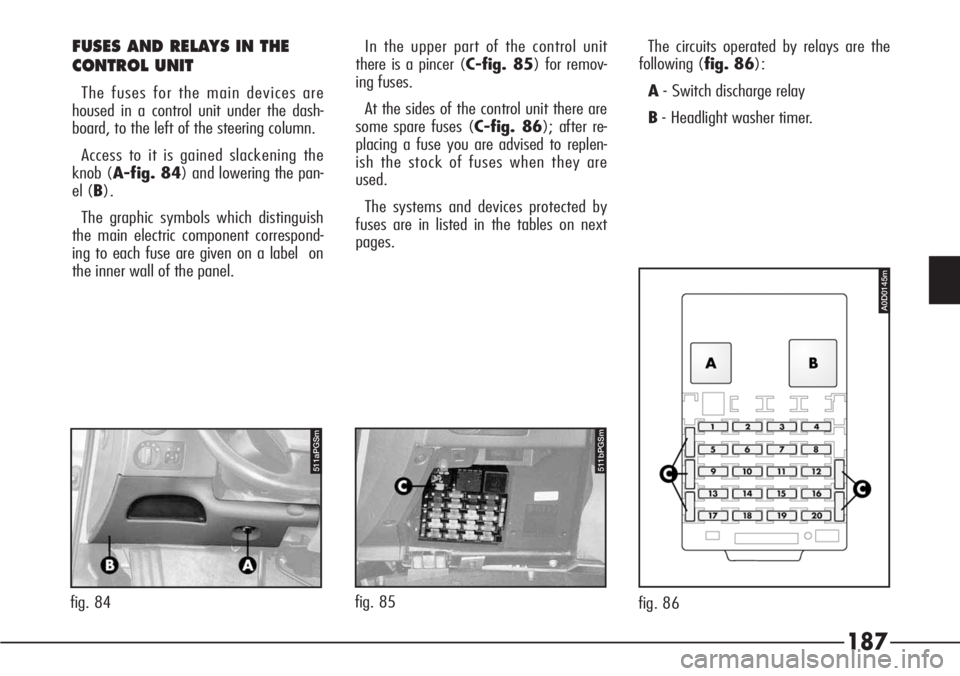
The fuses for the main devices are
housed in a control unit under the dash-
board, to the left of the steering column.
Access to it is gained slackening the
knob (A-fig. 84) and lowering the pan-
el (B).
The graphic symbols which distinguish
the main electric component correspond-
ing to each fuse are given on a label on
the inner wall of the panel.In the upper part of the control unit
there is a pincer (C-fig. 85) for remov-
ing fuses.
At the sides of the control unit there are
some spare fuses (C-fig. 86); after re-
placing a fuse you are advised to replen-
ish the stock of fuses when they are
used.
The systems and devices protected by
fuses are in listed in the tables on next
pages.The circuits operated by relays are the
following (fig. 86):
A- Switch discharge relay
B- Headlight washer timer.
511bPGSm
fig. 85
511aPGSm
fig. 84
A0D0145m
fig. 86
Page 194 of 272

193
System/Component Fuse no. Ampere Location
Rearscreen heating 1 30A fig. 93
Relay coil T21, T22, T23 (boot box) 3 5A fig. 86
Relay coil T24 (boot box) 5 10A fig. 86
Remote control receiver 15 10A fig. 93
Sound amplifier 20 25A fig. 93
Sound system 4 15A fig. 86
Sound system controls on steering wheel 5 10Afig. 86
Starter motor 1 30A fig. 89
Trailer presetting 12 10A fig. 93
Windscreen heating 7 15A fig. 93
Windscreen wiper 14 25A fig. 86
System/Component Fuse no. Ampere Location
Navigator 18 5A fig. 86
Parking sensors (control unit) 15 10A fig. 93
Power windows (driver's control
LOCK warning light) 15 10A fig. 93
Powered sunroof 10 20A fig. 93
Presetting 4 – fig. 93
11 – fig. 93
Rain sensor 15 10A fig. 93
Rear current socket 16 20A fig. 93
Rear LH power window (ABI control unit) 14 20Afig. 93
Rear RH power window (ABI control unit) 17 20Afig. 93
Page 198 of 272

197 IF THE VEHICLE
IS TO BE LIFTED
USING THE JACK
See paragraph “In the event of a punc-
ture” of this chapter.
You are informed that.
– the jack mass is 2.100 kg;
– the jack requires no adjustment;
– the jack cannot be repaired and in
case of breakage it must be replaced by
another original one.
– no tool other than its cranking lever
may be installed on the jack.
Before beginning to tow
the car, turn the ignition
key to MAR and then to STOP, do
not remove it. Removing the key
automatically engages the steering
lock resulting in the impossibility
to steer the wheels. When towing
remember that without the help of
the servobrake and power steer-
ing, it is necessary to exert more
effort on the brake pedal and for
steering. Do not use flexible cables
for towing and avoid jerks. During
towing operations make sure that
fastening the joint to the car does
not damage the components in
contact with it. When towing the
car it is compulsory to comply with
the specific traffic regulations con-
cerning both the towing device and
behaviour on the road.
WARNING
The car may fall if the
jack is not positioned cor-
rectly. Never use the jack for
higher capacities than the one
stated on its label.
The purpose of the jack is
only for replacing wheels
on the car with which it is provided
or on cars of the same model. It
must never be used for other pur-
poses such as for example raising
cars of other models. In no case
must it be used for repairs under
the car.
WARNING
WARNING
Page 206 of 272
205
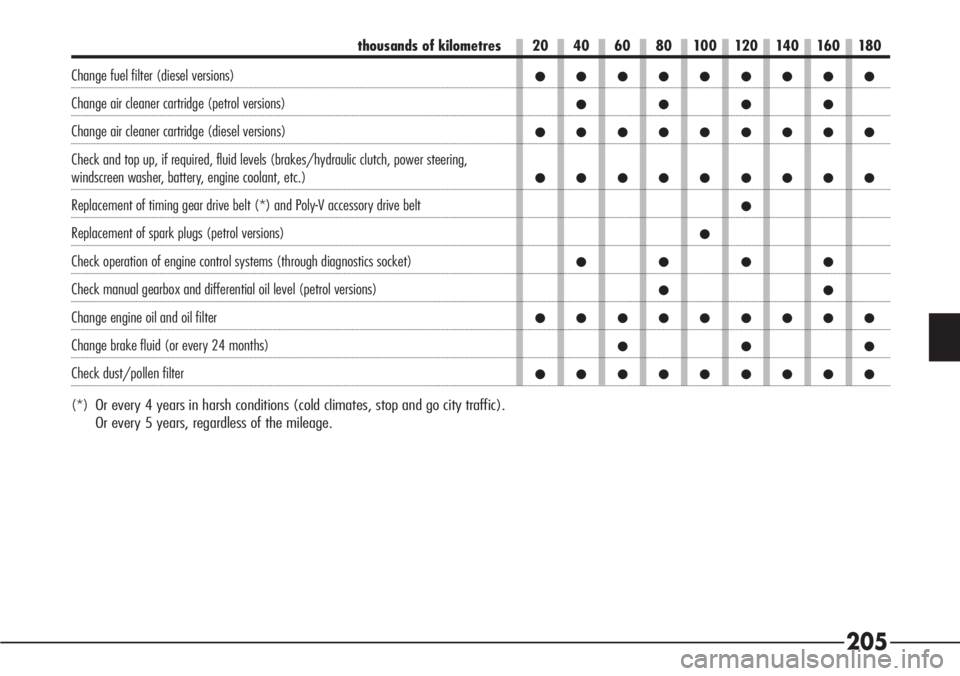
thousands of kilometres 20 40 60 80 100 120 140 160 180
Change fuel filter (diesel versions)•••••••••
Change air cleaner cartridge (petrol versions)••••
Change air cleaner cartridge (diesel versions)•••••••••
Check and top up, if required, fluid levels (brakes/hydraulic clutch, power steering,
windscreen washer, battery, engine coolant, etc.)•••••••••
Replacement of timing gear drive belt (*) and Poly-V accessory drive belt•
Replacement of spark plugs (petrol versions)•
Check operation of engine control systems (through diagnostics socket)••••
Check manual gearbox and differential oil level (petrol versions)••
Change engine oil and oil filter •••••••••
Change brake fluid (or every 24 months)•••
Check dust/pollen filter•••••••••
(*)Or every 4 years in harsh conditions (cold climates, stop and go city traffic).
Or every 5 years, regardless of the mileage.
Page 207 of 272
206 ANNUAL INSPECTION
PLAN
An annual inspection plan has
been established for cars that cov-
er less than 20,000 km a year
(e.g. 10,000 km). It consists of
the following:
– Checking the condition/wear of tyres,
and adjusting pressure (including the com-
pact spare wheel, where applicable).
– Checking the lighting system (head-
lights, turn indicators, hazard warning
lights, boot light, passenger compart-
ment, warning lights of instrument panel,
etc.).
– Checking the working order of the
windscreen wiper-washer and adjusting
the nozzles.
– Checking the positioning/wear of the
windscreen wipers.
– Checking the condition and wear of
the front brake pad.– Sight inspect the conditions of: en-
gine, gearbox, transmission, pipes and
hoses (exhaust - fuel - brakes), rubber
parts (boots, sleeves, bushes, etc.).
– Check for bonnet and boot lock clean-
ness, lever cleanness and lubrication.
– Check battery charge and fluid level
(electrolyte).
– Visually checking the condition of the
belts and various controls.
– Checking and topping up, if neces-
sary, the level of liquids (coolant, brake
fluid, windscreen washer fluid, battery
etc.).
– Change engine oil and oil filter, if re-
quired.
– Check and replace pollen filter, if re-
quired.
– Check and replace air cleaner, if re-
quired.
ADDITIONAL OPERATIONS
Every 1000 kmor before long jour-
neys check and if necessary top up:
– the engine coolant fluid level
– brake fluid/hydraulic clutch control
fluid level
– power steering fluid level
– windscreen washer and headlamp
washer fluid level
– tyre pressure and conditions.
– check light system operation (head-
lights, direction indicators, hazard lights,
etc.).
– check windscreen wiper/washer op-
eration and windscreen/rear window
blade position/wear.
Every 3000 kmcheck the level of
the engine oil and top up if necessary.
Every 5000 km(only for fuel oil en-
gines): drain the condensation water
from the filter. You are recommended to
use products of the FL Selenia, de-
signed and developed expressly for Alfa
Romeo cars (see the table “Fluids and lu-
bricants” in the Technical specifications”
chapter).
Page 210 of 272
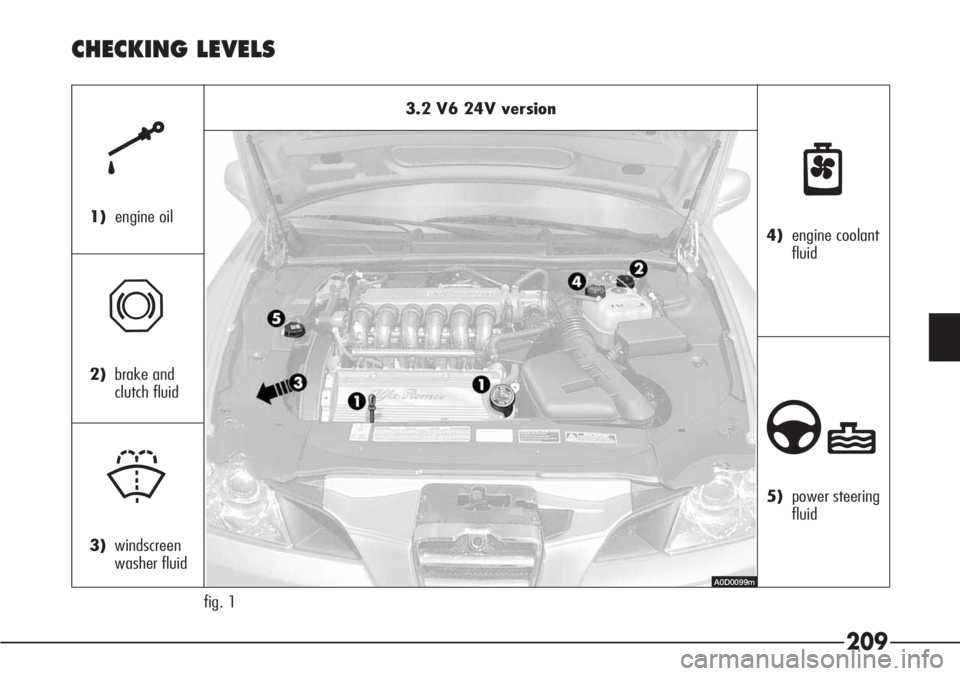
209
3.2 V6 24V version
fig. 1
k
1)engine oil
π
2)brake and
clutch fluid
+
3)windscreen
washer fluid
n
4)engine coolant
fluid
∂
5)power steering
fluid
A0D0099m
CHECKING LEVELS
Page 211 of 272

210
JTD 20V Multijet version
fig. 2
k
1)engine oil
π
2)brake and
clutch fluid
+
3)windscreen
washer fluid
n
4)engine coolant
fluid
∂
5)power steering
fluid
A0D0112m
Page 216 of 272
215
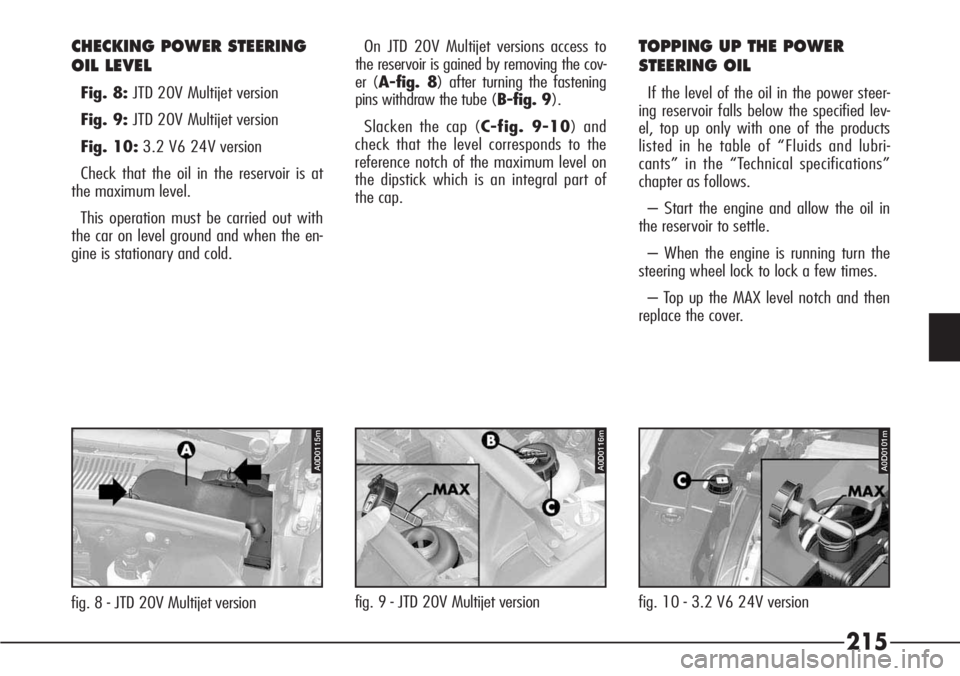
CHECKING POWER STEERING
OIL LEVEL
Fig. 8:JTD 20V Multijet version
Fig. 9:JTD 20V Multijet version
Fig. 10:3.2 V6 24V version
Check that the oil in the reservoir is at
the maximum level.
This operation must be carried out with
the car on level ground and when the en-
gine is stationary and cold.
fig. 8 - JTD 20V Multijet versionfig. 9 - JTD 20V Multijet versionfig. 10 - 3.2 V6 24V version On JTD 20V Multijet versions access to
the reservoir is gained by removing the cov-
er (A-fig. 8) after turning the fastening
pins withdraw the tube (B-fig. 9).
Slacken the cap (C-fig. 9-10) and
check that the level corresponds to the
reference notch of the maximum level on
the dipstick which is an integral part of
the cap.
TOPPING UP THE POWER
STEERING OIL
If the level of the oil in the power steer-
ing reservoir falls below the specified lev-
el, top up only with one of the products
listed in he table of “Fluids and lubri-
cants” in the “Technical specifications”
chapter as follows.
– Start the engine and allow the oil in
the reservoir to settle.
– When the engine is running turn the
steering wheel lock to lock a few times.
– Top up the MAX level notch and then
replace the cover.
A0D0115mA0D0101mA0D0116m
Page 217 of 272
When the cap (B) is
screwed off the reser-
voir ensure that the
electrical connections are not dis-
connected. Make sure that the
highly corrosive brake fluid
does not drip onto the paint-
work. If it does, wash it off
immediately with water.
IMPORTANT Contact Alfa Romeo Au-
thorized Services for maintenance and re-
pair operations.Oil consumption is very
low; if topping up again
is needed shortly after-
wards, have the system checked
for possible leaks by Alfa Romeo
Authorized services.
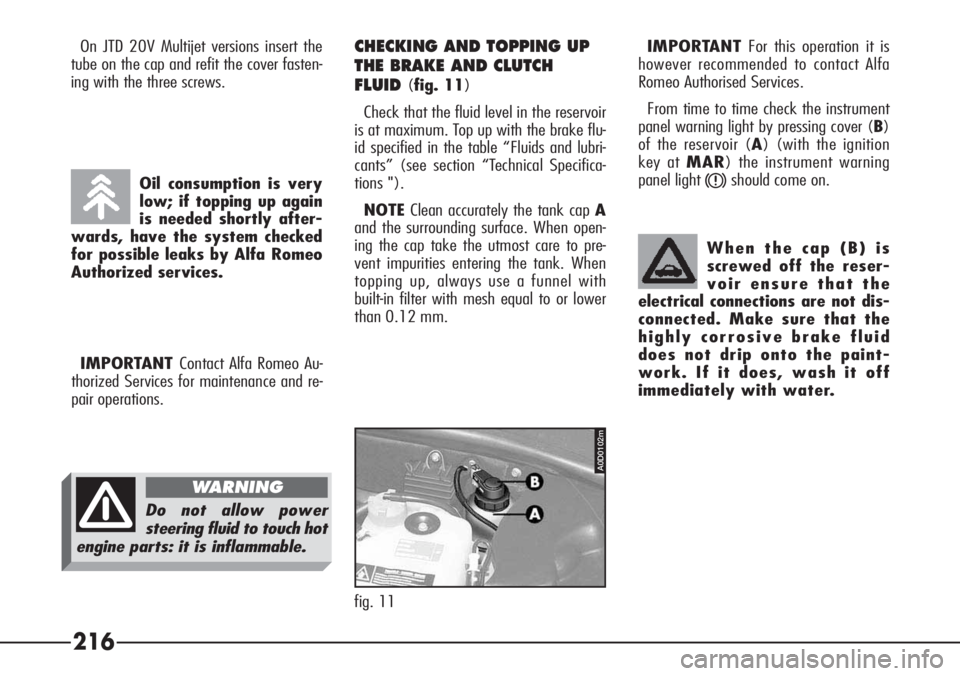
CHECKING AND TOPPING UP
THE BRAKE AND CLUTCH
FLUID
(fig. 11)
Check that the fluid level in the reservoir
is at maximum. Top up with the brake flu-
id specified in the table “Fluids and lubri-
cants” (see section “Technical Specifica-
tions ").
NOTEClean accurately the tank cap A
and the surrounding surface. When open-
ing the cap take the utmost care to pre-
vent impurities entering the tank. When
topping up, always use a funnel with
built-in filter with mesh equal to or lower
than 0.12 mm. On JTD 20V Multijet versions insert the
tube on the cap and refit the cover fasten-
ing with the three screws.
Do not allow power
steering fluid to touch hot
engine parts: it is inflammable.
WARNING
A0D0102m
fig. 11
216
IMPORTANTFor this operation it is
however recommended to contact Alfa
Romeo Authorised Services.
From time to time check the instrument
panel warning light by pressing cover (B)
of the reservoir (A) (with the ignition
key at MAR) the instrument warning
panel light
xshould come on.