lock Alfa Romeo 4C Spider 2019 Service Manual
[x] Cancel search | Manufacturer: ALFA ROMEO, Model Year: 2019, Model line: 4C Spider, Model: Alfa Romeo 4C Spider 2019Pages: 292, PDF Size: 3.25 MB
Page 110 of 292
WARNING!
•The seat belt assembly must be replaced if the
switchable Automatic Locking Retractor (ALR)
feature or any other seat belt function is not
working properly when checked according to the
procedures in the Service Manual.
• Failure to replace the seat belt assembly could
increase the risk of injury in collisions.
• Do not use the Automatic Locking Mode to re-
strain occupants who are wearing the seat belt or
children who are using booster seats. The locked
mode is only used to install rear-facing or
forward-facing child restraints that have a har-
ness for restraining the child.
Supplemental Restraint Systems (SRS)
Some of the safety features described in this section
may be standard equipment on some models, or may be
optional equipment on others. If you are not sure, ask
an authorized dealer.
The air bag system must be ready to protect you in a
collision. The Occupant Restraint Controller (ORC) monitors the internal circuits and interconnecting wir-
ing associated with the electrical Air Bag System Com-
ponents. Your vehicle may be equipped with the fol-
lowing Air Bag System Components:
Air Bag System Components
•
Occupant Restraint Controller (ORC)
• Air Bag Warning Light
•Steering Wheel and Column
• Instrument Panel
• Knee Impact Bolsters
• Driver and Front Passenger Air Bags
• Seat Belt Buckle Switch
• Supplemental Side Air Bags
• Supplemental Knee Air Bags
• Front and Side Impact Sensors
• Seat Belt Pretensioners
• Seat Track Position Sensors
108 SAFETY
Page 111 of 292
Air Bag Warning Light
The ORC monitors the readiness of the electronic partsof the air bag system whenever the ignition
switch is in the AVV/START or MAR/ACC/
ON/RUN position. If the ignition switch is in
the STOP/OFF/LOCK position the air bag
system is not on and the air bags will not inflate.
The ORC contains a backup power supply system that
may deploy the air bag system even if the battery loses
power or it becomes disconnected prior to deployment.
The ORC turns on the Air Bag Warning Light in the
instrument panel for approximately four to eight sec-
onds for a self-check when the ignition switch is in the
MAR/ACC/ON/RUN position. After the self-check,
the Air Bag Warning Light will turn off. If the ORC
detects a malfunction in any part of the system, it turns
on the Air Bag Warning Light, either momentarily or
continuously. A single chime will sound to alert you if
the light comes on again after initial startup.
The ORC also includes diagnostics that will illuminate
the instrument panel Air Bag Warning Light if a mal-
function is detected that could affect the air bag system. The diagnostics also record the nature of the malfunc-
tion. While the air bag system is designed to be main-
tenance free, if any of the following occurs, have an
authorized dealer service the air bag system
immediately.
•
The Air Bag Warning Light does not come on during
the four to eight seconds when the ignition switch is
first in the MAR/ACC/ON/RUN position.
• The Air Bag Warning Light remains on after the four
to eight-second interval.
• The Air Bag Warning Light comes on intermittently
or remains on while driving.
NOTE: If the speedometer, tachometer, or any engine
related gauges are not working, the Occupant Restraint
Controller (ORC) may also be disabled. In this condi-
tion the air bags may not be ready to inflate for your
protection. Have an authorized dealer service the air
bag system immediately.
5
SAFETY 109
Page 116 of 292
WARNING!
Do not mount equipment, or stack luggage or other
cargo up high enough to block the deployment of
the SABICs. The door trim below the side windows
where the SABIC and its deployment path are
located should remain free from any obstructions.
Side Impacts
The Side Air Bags are designed to activate in certain
side impacts. The Occupant Restraint Controller (ORC) determines whether the deployment of the Side Air
Bags in a particular impact event is appropriate, based
on the severity and type of collision. The side impact
sensors aid the ORC in determining the appropriate
response to impact events. The system is calibrated to
deploy the Side Air Bags on the impact side of the
vehicle during impacts that require Side Air Bag occu-
pant protection. In side impacts, the Side Air Bags
deploy independently; a left side impact deploys the
left Side Air Bags only and a right-side impact deploys
the right Side Air Bags only. Vehicle damage by itself is
not a good indicator of whether or not Side Air Bags
should have deployed.
The Side Air Bags will not deploy in all side collisions,
including some collisions at certain angles, or some side
collisions that do not impact the area of the passenger
compartment. The Side Air Bags may deploy during
angled or offset frontal collisions where the front air
bags deploy.
Side Air Bags are a supplement to the seat belt restraint
system. Side Air Bags deploy in less time than it takes to
blink your eyes.
Supplemental Door-Integrated Side Air Bag Inflatable
Curtains (SABICs) Location
114 SAFETY
Page 119 of 292
WARNING!
Deployed air bags and seat belt pretensioners can-
not protect you in another collision. Have the air
bags, seat belt pretensioners, and the seat belt
retractor assemblies replaced by an authorized
dealer immediately. Also, have the Occupant Re-
straint Controller System serviced as well.
NOTE:
• Air bag covers may not be obvious in the interior
trim, but they will open during air bag deployment.
• After any collision, the vehicle should be taken to an
authorized dealer immediately.
Enhanced Accident Response System
In the event of an impact, if the communication net-
work remains intact, and the power remains intact,
depending on the nature of the event, the ORC will
determine whether to have the Enhanced Accident
Response System perform the following functions:
• Cut off fuel to the engine (If Equipped)
• Cut off battery power to the electric motor (If
Equipped) •
Flash hazard lights as long as the battery has power
• Turn on the interior lights, which remain on as long
as the battery has power or for 15 minutes from the
intervention of the Enhanced Accident Response
System.
• Unlock the power door locks.
Your vehicle may also be designed to perform any of
these other functions in response to the Enhanced
Accident Response System:
• Turn off the Fuel Filter Heater, Turn off the HVAC
Blower Motor, Close the HVAC Circulation Door
• Cut off battery power to the:
• Engine
• Electric Motor (if equipped)
• Electric power steering
• Brake booster
• Electric park brake
• Automatic transmission gear selector
• Horn
• Front wiper
• Headlamp washer pump
5
SAFETY 117
Page 120 of 292
NOTE:After an accident, remember to cycle the igni-
tion to the STOP (OFF/LOCK) position and remove the
key from the ignition switch to avoid draining the
battery. Carefully check the vehicle for fuel leaks in the
engine compartment and on the ground near the engine
compartment and fuel tank before resetting the system
and starting the engine. If there are no fuel leaks or
damage to the vehicle electrical devices (e.g. headlights)
after an accident, reset the system by following the
procedure described below. If you have any doubt,
contact an authorized dealer.
Enhanced Accident Response System Reset
Procedure
After the event occurs, when the system is active, a
message regarding fuel cutoff is displayed. Turn the
ignition switch from ignition AVV/START or MAR/
ACC/ON/RUN to ignition STOP/OFF/LOCK. Care-
fully check the vehicle for fuel leaks in the engine
compartment and on the ground near the engine com-
partment and fuel tank before resetting the system and
starting the engine.
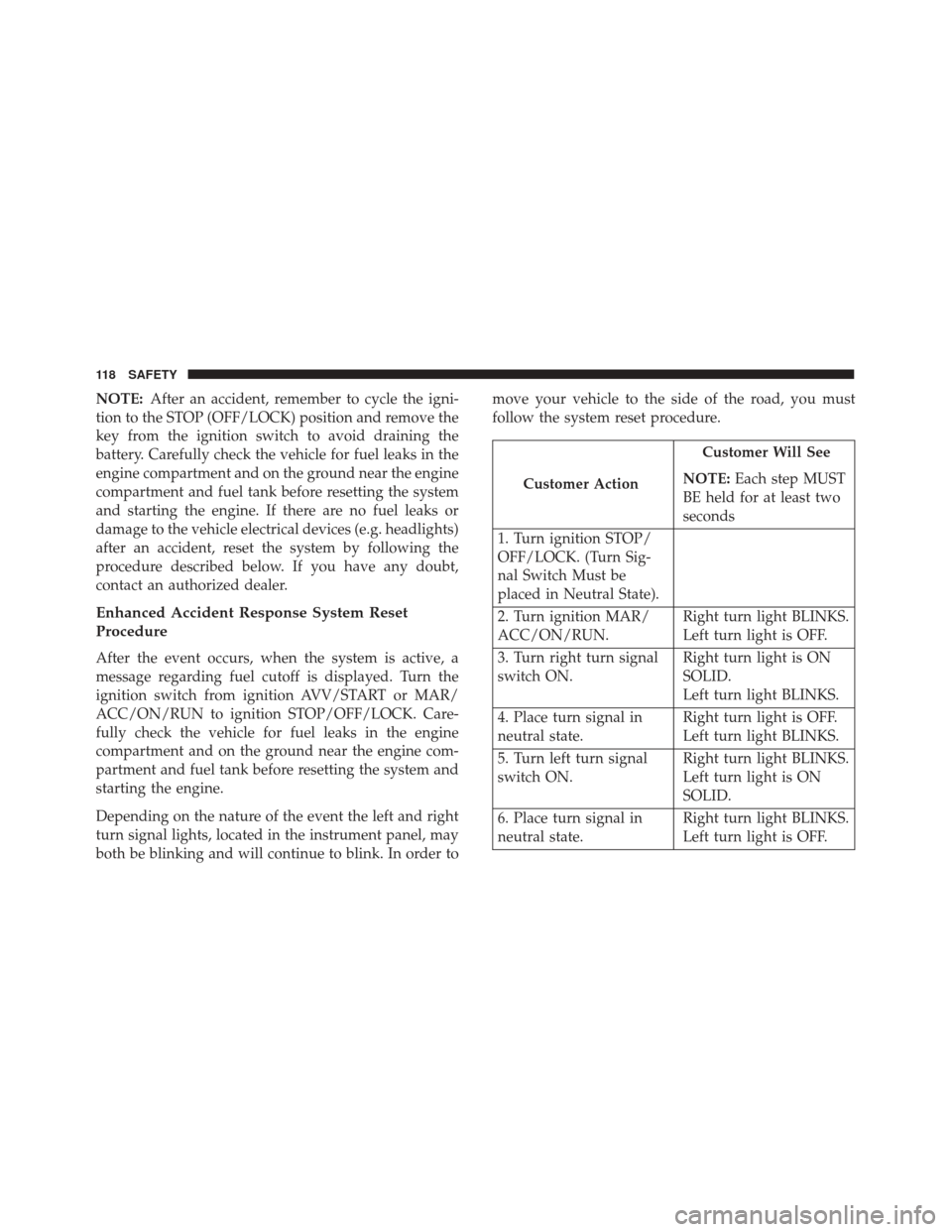
Depending on the nature of the event the left and right
turn signal lights, located in the instrument panel, may
both be blinking and will continue to blink. In order to move your vehicle to the side of the road, you must
follow the system reset procedure.
Customer Action
Customer Will See
NOTE: Each step MUST
BE held for at least two
seconds
1. Turn ignition STOP/
OFF/LOCK. (Turn Sig-
nal Switch Must be
placed in Neutral State).
2. Turn ignition MAR/
ACC/ON/RUN. Right turn light BLINKS.
Left turn light is OFF.
3. Turn right turn signal
switch ON. Right turn light is ON
SOLID.
Left turn light BLINKS.
4. Place turn signal in
neutral state. Right turn light is OFF.
Left turn light BLINKS.
5. Turn left turn signal
switch ON. Right turn light BLINKS.
Left turn light is ON
SOLID.
6. Place turn signal in
neutral state. Right turn light BLINKS.
Left turn light is OFF.
118 SAFETY
Page 121 of 292
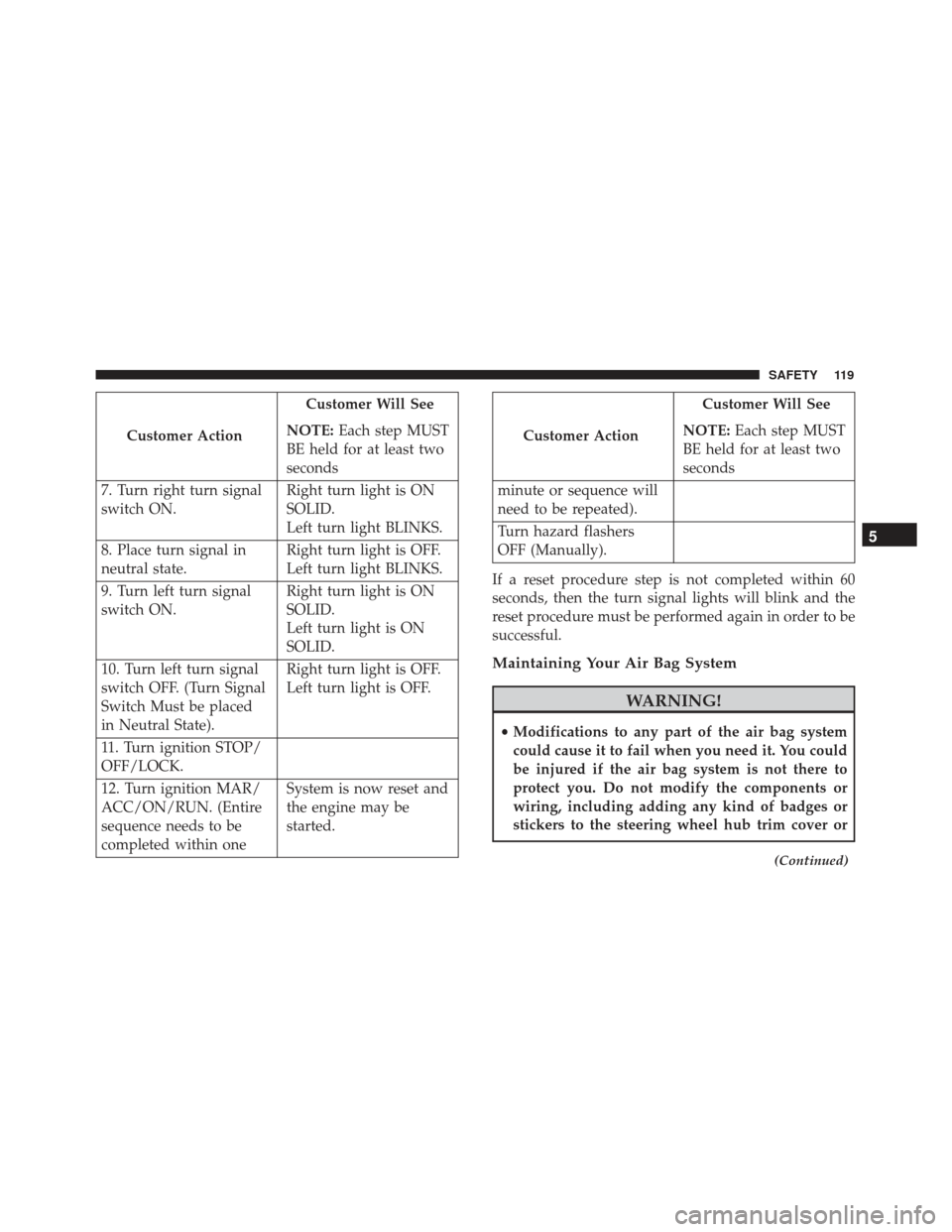
Customer ActionCustomer Will See
NOTE: Each step MUST
BE held for at least two
seconds
7. Turn right turn signal
switch ON. Right turn light is ON
SOLID.
Left turn light BLINKS.
8. Place turn signal in
neutral state. Right turn light is OFF.
Left turn light BLINKS.
9. Turn left turn signal
switch ON. Right turn light is ON
SOLID.
Left turn light is ON
SOLID.
10. Turn left turn signal
switch OFF. (Turn Signal
Switch Must be placed
in Neutral State). Right turn light is OFF.
Left turn light is OFF.
11. Turn ignition STOP/
OFF/LOCK.
12. Turn ignition MAR/
ACC/ON/RUN. (Entire
sequence needs to be
completed within one System is now reset and
the engine may be
started.Customer Action
Customer Will See
NOTE: Each step MUST
BE held for at least two
seconds
minute or sequence will
need to be repeated).
Turn hazard flashers
OFF (Manually).
If a reset procedure step is not completed within 60
seconds, then the turn signal lights will blink and the
reset procedure must be performed again in order to be
successful.
Maintaining Your Air Bag System
WARNING!
• Modifications to any part of the air bag system
could cause it to fail when you need it. You could
be injured if the air bag system is not there to
protect you. Do not modify the components or
wiring, including adding any kind of badges or
stickers to the steering wheel hub trim cover or
(Continued)
5
SAFETY 119
Page 128 of 292
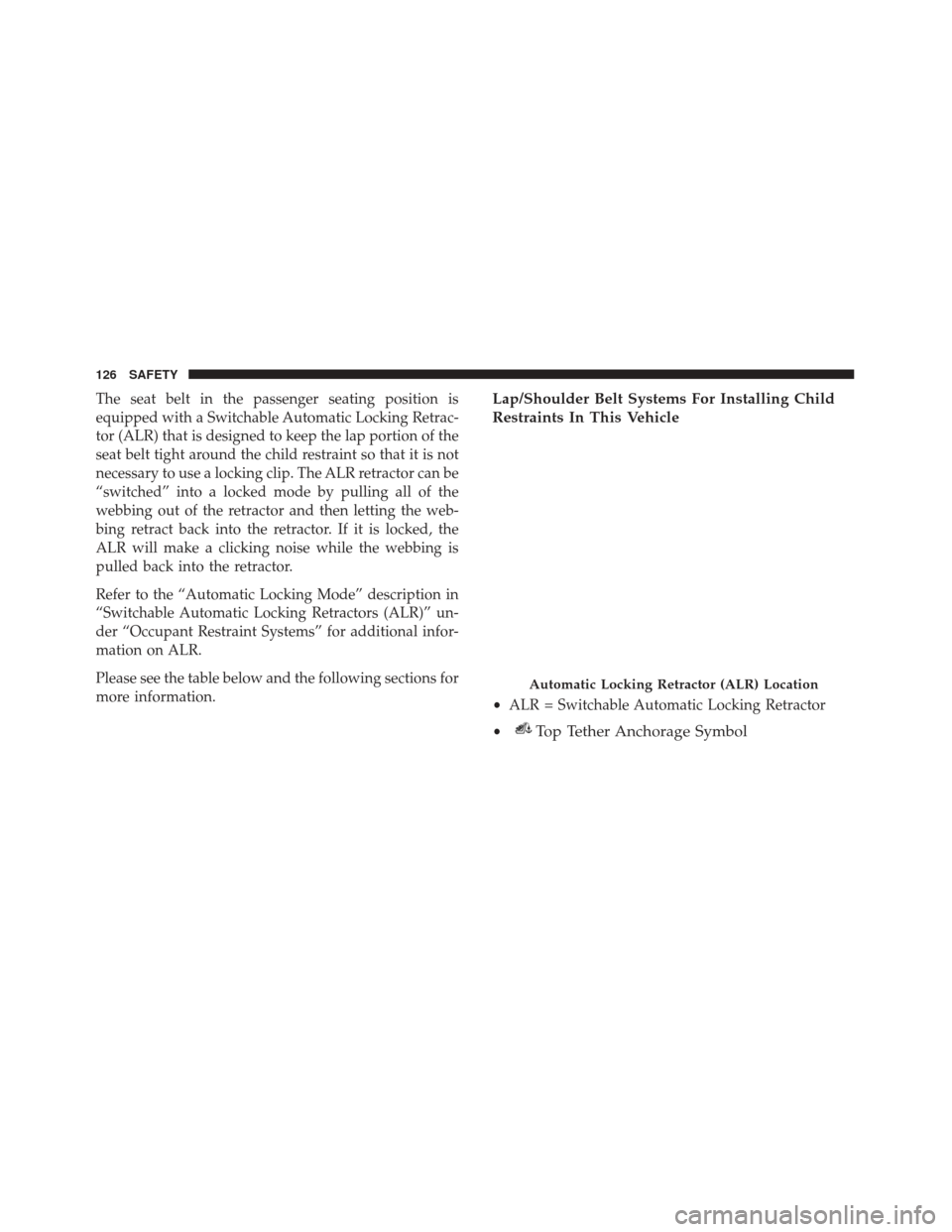
The seat belt in the passenger seating position is
equipped with a Switchable Automatic Locking Retrac-
tor (ALR) that is designed to keep the lap portion of the
seat belt tight around the child restraint so that it is not
necessary to use a locking clip. The ALR retractor can be
“switched” into a locked mode by pulling all of the
webbing out of the retractor and then letting the web-
bing retract back into the retractor. If it is locked, the
ALR will make a clicking noise while the webbing is
pulled back into the retractor.
Refer to the “Automatic Locking Mode” description in
“Switchable Automatic Locking Retractors (ALR)” un-
der “Occupant Restraint Systems” for additional infor-
mation on ALR.
Please see the table below and the following sections for
more information.Lap/Shoulder Belt Systems For Installing Child
Restraints In This Vehicle
Automatic Locking Retractor (ALR) Location
•ALR = Switchable Automatic Locking Retractor
•
Top Tether Anchorage Symbol
126 SAFETY
Page 129 of 292
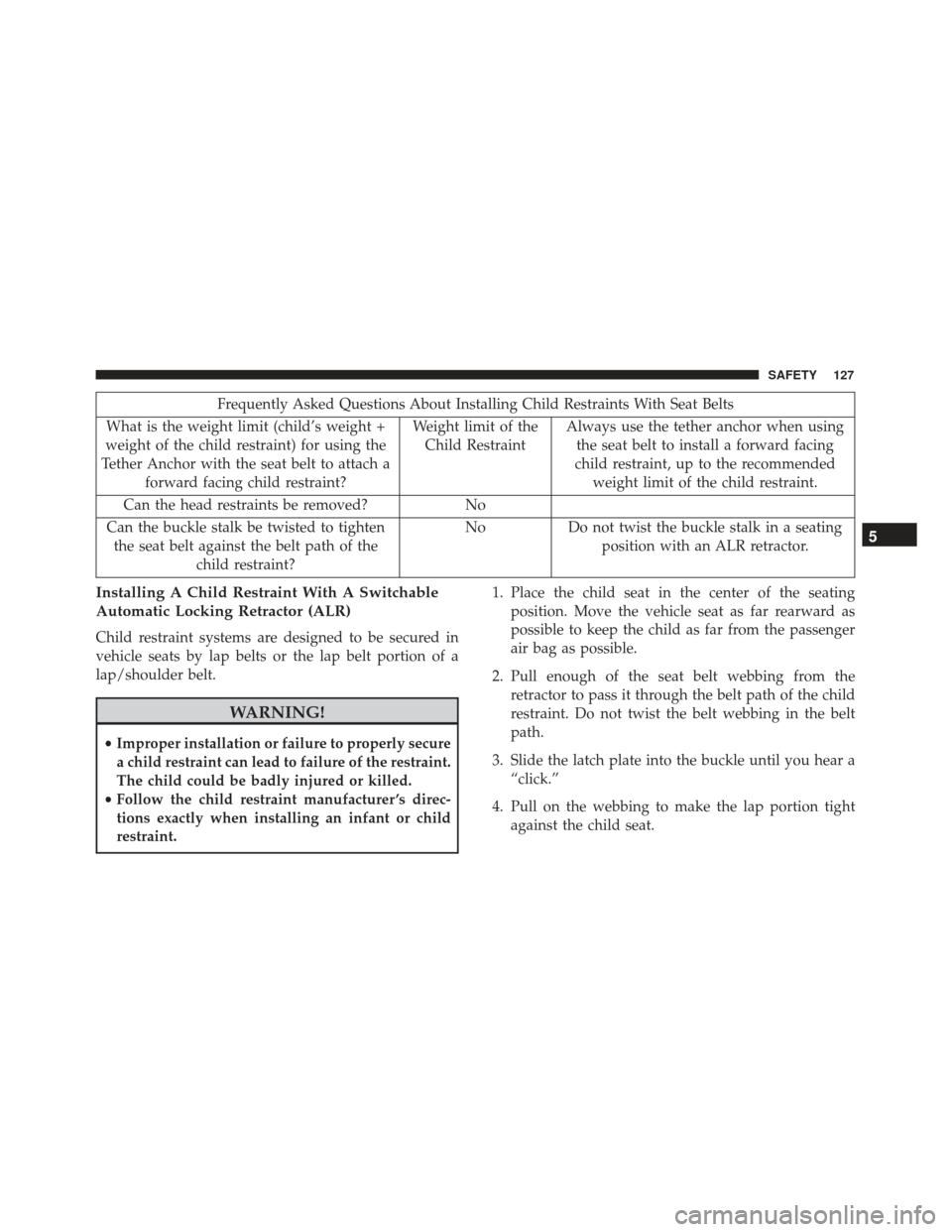
Frequently Asked Questions About Installing Child Restraints With Seat Belts
What is the weight limit (child’s weight +
weight of the child restraint) for using the
Tether Anchor with the seat belt to attach a forward facing child restraint? Weight limit of the
Child Restraint Always use the tether anchor when using
the seat belt to install a forward facing
child restraint, up to the recommended weight limit of the child restraint.
Can the head restraints be removed? No
Can the buckle stalk be twisted to tighten the seat belt against the belt path of the child restraint? No
Do not twist the buckle stalk in a seating
position with an ALR retractor.
Installing A Child Restraint With A Switchable
Automatic Locking Retractor (ALR)
Child restraint systems are designed to be secured in
vehicle seats by lap belts or the lap belt portion of a
lap/shoulder belt.
WARNING!
•Improper installation or failure to properly secure
a child restraint can lead to failure of the restraint.
The child could be badly injured or killed.
• Follow the child restraint manufacturer ’s direc-
tions exactly when installing an infant or child
restraint. 1. Place the child seat in the center of the seating
position. Move the vehicle seat as far rearward as
possible to keep the child as far from the passenger
air bag as possible.
2. Pull enough of the seat belt webbing from the retractor to pass it through the belt path of the child
restraint. Do not twist the belt webbing in the belt
path.
3. Slide the latch plate into the buckle until you hear a “click.”
4. Pull on the webbing to make the lap portion tight against the child seat.
5
SAFETY 127
Page 130 of 292
5. To lock the seat belt, pull down on the shoulder partof the belt until you have pulled all the seat belt
webbing out of the retractor. Then, allow the web-
bing to retract back into the retractor. As the webbing
retracts, you will hear a clicking sound. This means
the seat belt is now in the Automatic Locking mode.
6. Try to pull the webbing out of the retractor. If it is locked, you should not be able to pull out any
webbing. If the retractor is not locked, repeat step 5.
7. Finally, pull up on any excess webbing to tighten the lap portion around the child restraint while you push
the child restraint rearward and downward into the
vehicle seat.
8. If the child restraint has a top tether strap and the seating position has a top tether anchorage, connect
the tether strap to the anchorage and tighten the
tether strap. See the section “Installing Child Re-
straints Using the Top Tether Anchorage” for direc-
tions to attach a tether anchor.
9. Test that the child restraint is installed tightly by pulling back and forth on the child seat at the belt
path. It should not move more than 1 inch (25.4 mm)
in any direction. Any seat belt system will loosen with time, so check the
belt occasionally, and pull it tight if necessary.
Installing Child Restraints Using The Top Tether
Anchorage:
Always use the tether anchor when using the seat belt
to install a forward facing child restraint, up to the
recommended weight limit of the child restraint. This
vehicle is equipped with a tether anchorage, located
behind the front passenger seat, near the floor.
1. Look behind the seating position where you plan to
install the child restraint to find the tether anchorage.
You may need to move the seat forward to provide
Upper Tether Anchorage
128 SAFETY
Page 135 of 292
Periodic Safety Checks You Should Make
Outside The Vehicle
Tires
Examine tires for excessive tread wear and uneven wear
patterns. Check for stones, nails, glass, or other objects
lodged in the tread or sidewall. Inspect the tread for
cuts and cracks. Inspect sidewalls for cuts, cracks, and
bulges. Check the wheel nuts for tightness. Check the
tires (including spare) for proper cold inflation pres-
sure.
Lights
Have someone observe the operation of brake lights
and exterior lights while you work the controls. Check
turn signal and high beam indicator lights on the
instrument panel.
Door Latches
Check for proper closing, latching, and locking.
Fluid Leaks
Check area under the vehicle after overnight parking
for fuel, coolant, oil, or other fluid leaks. Also, if
gasoline fumes are detected or if fuel, or brake fluid
leaks are suspected. The cause should be located and
corrected immediately.
5
SAFETY 133