maintenance Alfa Romeo Giulia 2017 Owner's Guide
[x] Cancel search | Manufacturer: ALFA ROMEO, Model Year: 2017, Model line: Giulia, Model: Alfa Romeo Giulia 2017Pages: 268, PDF Size: 18.64 MB
Page 228 of 268
Spare Tires — If
Equipped
Note:
For vehicles equipped with Tire Repair
Kit instead of a spare tire, please refer
to “Tire Repair Kit” in “In Case Of
Emergency” for further information.
Caution!
Because of the reduced ground clearance,
do not take your vehicle through an
automatic car wash with a compact or
limited use temporary spare installed.
Damage to the vehicle may result.
Spare Tire Matching Original
Equipped Tire And Wheel — If
Equipped
Your vehicle may be equipped with a
spare tire and wheel equivalent in look
and function to the original equipment
tire and wheel found on the front or rear
axle of your vehicle. This spare tire may
be used in the tire rotation for your
vehicle. If your vehicle has this option,
refer to an authorized tire dealer for the
recommended tire rotation pattern.
Compact Spare Tire — If
Equipped
The compact spare is for temporary
emergency use only. You can identify if
your vehicle is equipped with a
compact spare by looking at the spare
tire description on the Tire and Loading
Information Placard located on the
driver’s side door opening or on the
sidewall of the tire. Compact spare tire
descriptions begin with the letter “T” or
“S” preceding the size designation.
Example: T145/80D18 103M.
T,S=Temporary Spare Tire
Since this tire has limited tread life, the
original equipment tire should be
repaired (or replaced) and reinstalled on
your vehicle at the first opportunity.
Do not install a wheel cover or attempt
to mount a conventional tire on the
compact spare wheel, since the wheel
is designed specifically for the compact
spare tire. Do not install more than one
compact spare tire and wheel on the
vehicle at any given time.
Warning!
Compact and collapsible spares are for
temporary emergency use only. With these
spares, do not drive more than 50 mph
(80 km/h). Temporary use spares have
limited tread life. When the tread is worn to
the tread wear indicators, the temporary
use spare tire needs to be replaced. Be
sure to follow the warnings, which apply to
your spare. Failure to do so could result in
spare tire failure and loss of vehicle control.
Full Size Spare — If Equipped
The full size spare is for temporary
emergency use only. This tire may look
like the originally equipped tire on the
front or rear axle of your vehicle, but it is
not. This spare tire may have limited
tread life. When the tread is worn to the
tread wear indicators, the temporary
use full size spare tire needs to be
replaced. Since it is not the same as
your original equipment tire, replace (or
repair) the original equipment tire and
reinstall on the vehicle at the first
opportunity.
226
SERVICING AND MAINTENANCE
Page 230 of 268
Caution!
Do not use scouring pads, steel wool, a
bristle brush, metal polishes or oven cleaner.
These products may damage the wheel's
protective finish. Such damage is not covered
by the New Vehicle Limited Warranty. Only
car wash soap, MOPAR Wheel Cleaner or
equivalent is recommended.
Note:
If you intend parking or storing your
vehicle for an extended period after
cleaning the wheels with wheel cleaner,
drive your vehicle for a few minutes
before doing so. Driving the vehicle and
applying the brakes when stopping will
reduce the risk of brake rotor corrosion.
Dark Vapor Or Black Satin Chrome
Wheels
Caution!
If your vehicle is equipped with Dark Vapor
or Black Satin Chrome wheels DO NOT USE
wheel cleaners, abrasives or polishing
compounds. They will permanently damage
this finish and such damage is not covered
by the New Vehicle Limited Warranty. USE
ONLY MILD SOAP AND WATER WITH A
SOFT CLOTH. Used on a regular basis; this
is all that is required to maintain this finish.
Tire Types
All Season Tires — If Equipped
All Season tires provide traction for all
seasons (Spring, Summer, Fall, and
Winter). Traction levels may vary
between different all season tires. All
season tires can be identified by the
M+S, M&S, M/S or MS designation on
the tire sidewall. Use all season tires
only in sets of four; failure to do so may
adversely affect the safety and handling
of your vehicle.
Summer Or Three Season Tires
— If Equipped
Summer tires provide traction in both
wet and dry conditions, and are not
intended to be driven in snow or on ice.
If your vehicle is equipped with Summer
tires, be aware these tires are not
designed for Winter or cold driving
conditions. Install Winter tires on your
vehicle when ambient temperatures are
less than 40°F (5°C) or if roads are
covered with ice or snow. For more
information, contact an authorized
dealer.
Summer tires do not contain the all
season designation or mountain/
snowflake symbol on the tire sidewall.
Use Summer tires only in sets of four;
failure to do so may adversely affect the
safety and handling of your vehicle.
Warning!
Do not use Summer tires in snow/ice
conditions. You could lose vehicle control,
resulting in severe injury or death. Driving
too fast for conditions also creates the
possibility of loss of vehicle control.
Snow Tires
Some areas of the country require the
use of snow tires during the Winter.
Snow tires can be identified by a
“mountain/snowflake” symbol on the
tire sidewall.If you need snow tires,
select tires equivalent
in size and type to the
original equipment
tires. Use snow tires
only in sets of four;
failure to do so may
adversely affect the safety and handling
of your vehicle.
Snow tires generally have lower speed
ratings than what was originally
equipped with your vehicle and should
not be operated at sustained speeds
over 75 mph (120 km/h). For speeds
above 75 mph (120 km/h) refer to
original equipment or an authorized tire
dealer for recommended safe operating
speeds, loading and cold tire inflation
pressures.
228
SERVICING AND MAINTENANCE
Page 232 of 268
Unequal tire pressures from one side of
the vehicle to the other can cause the
vehicle to drift to the right or left.
Always drive with each tire inflated to
the recommended cold tire inflation
pressure.
Both under-inflation and over-inflation
affect the stability of the vehicle and can
produce a feeling of sluggish response
or over responsiveness in the steering.
Note:
Unequal tire pressures from side to
side may cause erratic and
unpredictable steering response.
Unequal tire pressure from side to
side may cause the vehicle to drift left
or right.
Fuel Economy
Underinflated tires will increase tire
rolling resistance resulting in higher fuel
consumption.
Tread Wear
Improper cold tire inflation pressures
can cause abnormal wear patterns and
reduced tread life, resulting in the need
for earlier tire replacement.
Ride Comfort And Vehicle Stability
Proper tire inflation contributes to a
comfortable ride. Over-inflation
produces a jarring and uncomfortable
ride.
Tire Inflation Pressures
The proper cold tire inflation pressure is
listed on the driver's side B-Pillar or rear
edge of the driver's side door.
At least once a month:
Check and adjust tire pressure with a
good quality pocket-type pressure
gauge. Do not make a visual judgement
when determining proper inflation. Tires
may look properly inflated even when
they are under-inflated.
Inspect tires for signs of tire wear or
visible damage.
Caution!
After inspecting or adjusting the tire
pressure, always reinstall the valve stem
cap. This will prevent moisture and dirt
from entering the valve stem, which could
damage the valve stem.
Inflation pressures specified on the
placard are always “cold tire inflation
pressure”. Cold tire inflation pressure is
defined as the tire pressure after the
vehicle has not been driven for at least
three hours, or driven less than 1 mile
(1.6 km) after sitting for a minimum of
three hours. The cold tire inflation
pressure must not exceed the
maximum inflation pressure molded
into the tire sidewall. Check tire pressures more often if
subject to a wide range of outdoor
temperatures, as tire pressures vary
with temperature changes.
Tire pressures change by approximately
1 psi (7 kPa) per 12°F (7°C) of air
temperature change. Keep this in mind
when checking tire pressure inside a
garage, especially in the Winter.
Example: If garage temperature = 68°F
(20°C) and the outside temperature =
32°F (0°C) then the cold tire inflation
pressure should be increased by 3 psi
(21 kPa), which equals 1 psi (7 kPa) for
every 12°F (7°C) for this outside
temperature condition.
Tire pressure may increase from 2 to
6 psi (13 to 40 kPa) during operation.
DO NOT reduce this normal pressure
build up or your tire pressure will be too
low.
Tire Pressures For High Speed
Operation
The manufacturer advocates driving at
safe speeds and within posted speed
limits. Where speed limits or conditions
are such that the vehicle can be driven
at high speeds, maintaining correct tire
inflation pressure is very important.
Increased tire pressure and reduced
vehicle loading may be required for
high-speed vehicle operation. Refer to
your authorized tire dealer or original
equipment vehicle dealer for
230
SERVICING AND MAINTENANCE
Page 234 of 268
These indicators are molded into the
bottom of the tread grooves. They will
appear as bands when the tread depth
becomes a 1/16 of an inch (1.6 mm).
When the tread is worn to the tread
wear indicators, the tire should be
replaced. Refer to “Replacement Tires”
in this section for further information.
Life Of Tire
The service life of a tire is dependent
upon varying factors including, but not
limited to:
Driving style.
Tire pressure - Improper cold tire
inflation pressures can cause uneven
wear patterns to develop across the tire
tread. These abnormal wear patterns
will reduce tread life, resulting in the
need for earlier tire replacement.
Distance driven.
Performance tires, tires with a speed
rating of V or higher, and Summer tires
typically have a reduced tread life.
Rotation of these tires per the vehicle
maintenance schedule is highly
recommended.
Warning!
Tires and the spare tire should be replaced
after six years, regardless of the remaining
tread. Failure to follow this warning can
result in sudden tire failure. You could lose
control and have a collision resulting in
serious injury or death.
Keep dismounted tires in a cool, dry
place with as little exposure to light as
possible. Protect tires from contact with
oil, grease, and gasoline.
Replacement Tires
The tires on your new vehicle provide a
balance of many characteristics. They
should be inspected regularly for wear
and correct cold tire inflation pressures.
The manufacturer strongly recommends
that you use tires equivalent to the
originals in size, quality and
performance when replacement is
needed. Refer to the paragraph on
“Tread Wear Indicators” in this section.
Refer to the Tire and Loading
Information placard or the Vehicle
Certification Label for the size
designation of your tire. The Load Index
and Speed Symbol for your tire will be
found on the original equipment tire
sidewall. See the Tire Sizing Chart example
found in the “Tire Safety Information”
section of this manual for more
information relating to the Load Index
and Speed Symbol of a tire.
It is recommended to replace the two
front tires or two rear tires as a pair.
Replacing just one tire can seriously
affect your vehicle’s handling. If you
ever replace a wheel, make sure that
the wheel’s specifications match those
of the original wheels.
It is recommended you contact your
authorized tire dealer or original
equipment dealer with any questions
you may have on tire specifications or
capability. Failure to use equivalent
replacement tires may adversely affect
the safety, handling, and ride of your
vehicle.
232
SERVICING AND MAINTENANCE
Page 236 of 268
Temperature Grades
The temperature grades are A (the
highest), B, and C, representing the
tire's resistance to the generation of
heat and its ability to dissipate heat,
when tested under controlled
conditions on a specified indoor
laboratory test wheel. Sustained high
temperature can cause the material of
the tire to degenerate and reduce tire
life, and excessive temperature can
lead to sudden tire failure. The grade C
corresponds to a level of performance,
which all passenger vehicle tires must
meet under the Federal Motor Vehicle
Safety Standard No. 109. Grades B
and A represent higher levels of
performance on the laboratory test
wheel, than the minimum required by
law.
Warning!
The temperature grade for this tire is
established for a tire that is properly
inflated and not overloaded. Excessive
speed, under-inflation, or excessive
loading, either separately or in
combination, can cause heat buildup and
possible tire failure.
STORING THE
VEHICLE
If the vehicle is left inactive for longer
than a month, the following precautions
should be observed:
Park the car in an area that is
covered and dry, and well-ventilated if
possible. Slightly open the windows.
Check that the electric park brake is
not activated.
Carry out the procedure: “manual
trunk opening device” procedure
described in this paragraph.
Disconnect the negative battery
terminal and check the battery charge.
Repeat this check once every three
months during storage.
If the battery is not disconnected
from the electrical system, check its
state of charge every thirty days.
Clean and protect the painted parts
using protective wax.
Clean and protect the shiny metal
parts using special compounds
available commercially.
Sprinkle talcum powder on the
windshield wiper rubber blades, and lift
them off the glass.
Cover the vehicle with a fabric or
perforated plastic sheet, paying
particular care not to damage the
painted surface by dragging any dust
that may have accumulated on it. Do
not use compact plastic sheets, as they do not allow humidity to evaporate from
the surface of the vehicle.
Inflate tires to +7.25 psi (+0.5 bar)
above the standard prescribed pressure
and check it periodically.
Do not drain the engine cooling
system.
Any time the car is left inactive for
two weeks or more, operate the air
conditioning system with engine idling
for at least five minutes, setting external
air and with fan set to maximum speed.
This operation will ensure appropriate
lubrication for the system, thus
minimizing the possibility of damage to
the compressor when the system is
operated again.
Note:
After cycling the ignition to STOP and
having closed the driver side door, wait
at least one minute before
disconnecting the electrical supply from
the battery. When reconnecting the
electrical supply to the battery, make
sure that the ignition is in the STOP
position and the driver side door is
closed.
Manual Trunk Opening Device
Proceed as follows if the battery needs
to be disconnected:
1. From the trunk interior covering,
rotate the plug to the left of the lock
and extract the strap connected to it.
234
SERVICING AND MAINTENANCE
Page 237 of 268
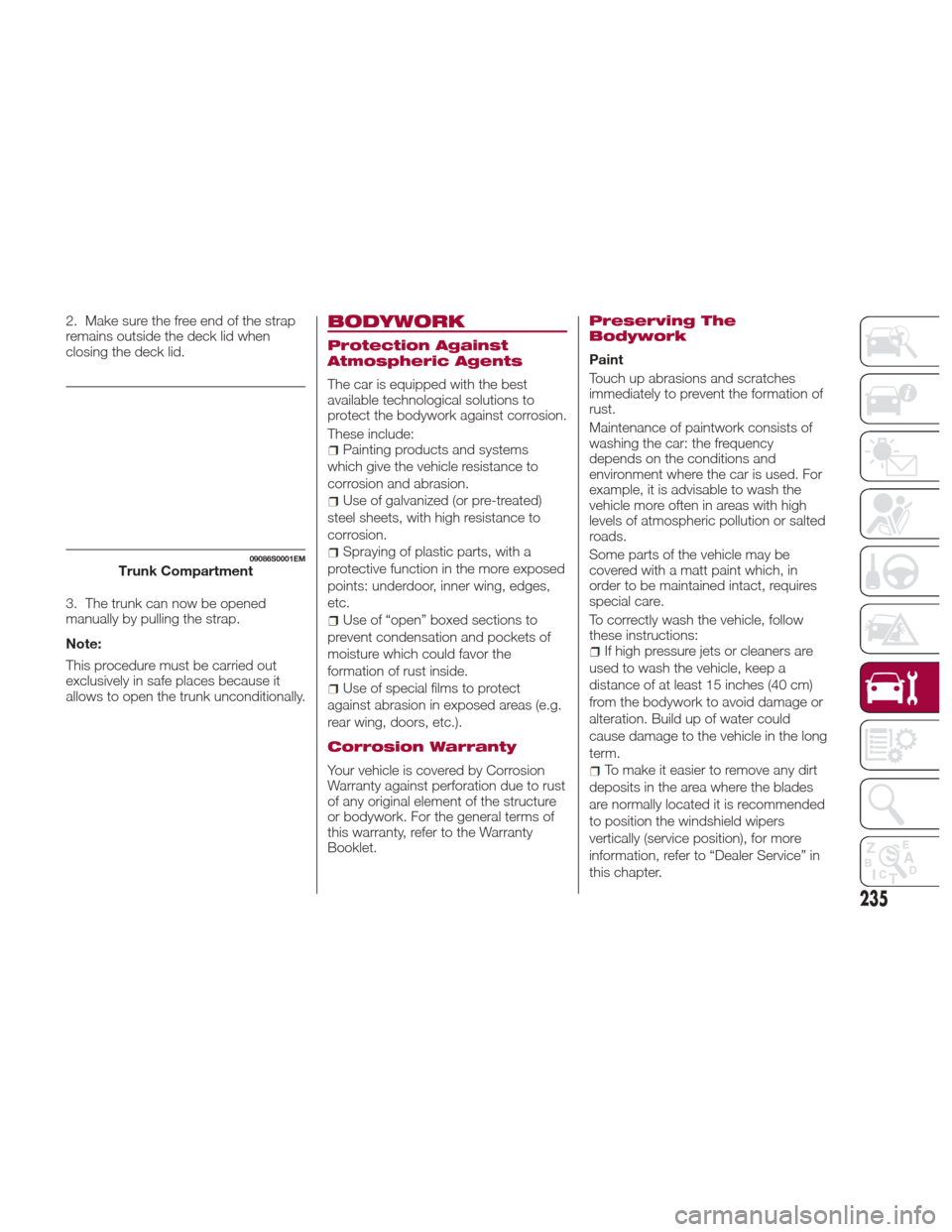
2. Make sure the free end of the strap
remains outside the deck lid when
closing the deck lid.
3. The trunk can now be opened
manually by pulling the strap.
Note:
This procedure must be carried out
exclusively in safe places because it
allows to open the trunk unconditionally.BODYWORK
Protection Against
Atmospheric Agents
The car is equipped with the best
available technological solutions to
protect the bodywork against corrosion.
These include:
Painting products and systems
which give the vehicle resistance to
corrosion and abrasion.
Use of galvanized (or pre-treated)
steel sheets, with high resistance to
corrosion.
Spraying of plastic parts, with a
protective function in the more exposed
points: underdoor, inner wing, edges,
etc.
Use of “open” boxed sections to
prevent condensation and pockets of
moisture which could favor the
formation of rust inside.
Use of special films to protect
against abrasion in exposed areas (e.g.
rear wing, doors, etc.).
Corrosion Warranty
Your vehicle is covered by Corrosion
Warranty against perforation due to rust
of any original element of the structure
or bodywork. For the general terms of
this warranty, refer to the Warranty
Booklet.
Preserving The
Bodywork
Paint
Touch up abrasions and scratches
immediately to prevent the formation of
rust.
Maintenance of paintwork consists of
washing the car: the frequency
depends on the conditions and
environment where the car is used. For
example, it is advisable to wash the
vehicle more often in areas with high
levels of atmospheric pollution or salted
roads.
Some parts of the vehicle may be
covered with a matt paint which, in
order to be maintained intact, requires
special care.
To correctly wash the vehicle, follow
these instructions:
If high pressure jets or cleaners are
used to wash the vehicle, keep a
distance of at least 15 inches (40 cm)
from the bodywork to avoid damage or
alteration. Build up of water could
cause damage to the vehicle in the long
term.
To make it easier to remove any dirt
deposits in the area where the blades
are normally located it is recommended
to position the windshield wipers
vertically (service position), for more
information, refer to “Dealer Service” in
this chapter.
09086S0001EMTrunk Compartment
235
Page 238 of 268
Wash the bodywork using a low
pressure jet of water if possible.
Wipe a sponge with a slightly soapy
solution over the bodywork, frequently
rinsing the sponge.
Rinse well with water and dry with a
leather chamois.
Dry the less visible parts (e.g. door
frames, hood, headlight frames, etc.)
with special care, as water may
stagnate more easily in these areas. Do
not wash the car after it has been left in
the sun or with the hood hot: this may
alter the shine of the paintwork.
Exterior plastic parts must be cleaned
in the same way as the rest of the
vehicle.
If washing the car in a service that
moves the car, for cars with automatic
transmissions, PARK (P) must be cut
out. You have to shut off the engine in
the following conditions: car stopped,
transmission in NEUTRAL (N), press the
starter button for at least three
seconds.
Note:
Avoid parking under trees; the resin
dropped by trees makes the paintwork
go opaque and increases the possibility
of corrosion. Windows
Use specific detergents and clean
cloths to prevent scratching or altering
the transparency.Caution!
Wipe the rear window inside gently with a
cloth following the direction of the filaments
to avoid damaging the heating device.
Front headlights
Use a soft cloth soaked in water and
detergent for washing cars.
Note:
Never use aromatic substances
(e.g. gasoline) or ketones (e.g.
acetone) for cleaning the plastic lenses
of the headlights.
When cleaning with a pressure
washer, keep the pressure washer at
least eight inches (20 cm) away from
the headlights. Engine compartment
At the end of every winter, wash the
engine compartment thoroughly, taking
care not to aim the jet of water directly
at the electronic control units or at the
windshield wiper motors. Have this
operation performed at specializeded
workshop.
Note:
The washing should take place with the
engine cold and the ignition device in
the STOP position. After the washing
operation, make sure that the various
protections (e.g. rubber caps and
guards) have not been removed or
damaged.
236
SERVICING AND MAINTENANCE
Page 254 of 268
FLUIDS AND LUBRICANTS
Your vehicle is equipped with an engine oil that has been thoroughly developed and tested in order to meet the requirements of
the Scheduled Servicing Plan. Constant use of the prescribed lubricants guarantees the fuel consumption and emission
specifications. Lubricant quality is crucial for engine operation and duration.
2.9L V6 — Engine Lubrication
FeaturesSpecificationReplacement interval
SAE 0W-40
Pennzoil
Ultra
API SN FPT 9.55535-Z2
MS-12991 According to the Maintenance Plan
If lubricants conforming to the specific request are not available, products that meet the indicated specifications can be used to
top up; in this case optimal performance of the engine is not guaranteed.
252
TECHNICAL SPECIFICATIONS
Page 258 of 268
SUGGESTIONS FOR
OBTAINING SERVICE
FOR YOUR VEHICLE
Prepare For The
Appointment
If you are having warranty work done,
be sure to bring the right papers with
you, as well as your warranty folder. All
work to be performed may not be
covered by the warranty. Discuss
additional charges with the service
manager. Keep a maintenance log of
your vehicle's service history, as this
can often provide a clue to the current
problem.
Prepare A List
Make a written list of your vehicle's
problems or the specific work you want
done. If you've had an accident or work
done that is not on your maintenance
log, let the service advisor know.
Be Reasonable With
Requests
If you list a number of items and you
must have your vehicle by the end of
the day, discuss the situation with the
service advisor and list the items in
order of priority. At many authorized
dealers, you may obtain a rental vehicle
at a minimal daily charge. If you need a
rental, it is advisable to make these
arrangements when you call for an
appointment.
IF YOU NEED
ASSISTANCE
The manufacturer and its authorized
dealer are vitally interested in your
satisfaction. We want you to be happy
with our products and services.
Warranty service must be done by an
authorized dealer. We strongly
recommend that you take the vehicle to
an authorized dealer. They know your
vehicle the best, and are most
concerned that you get prompt and
high quality service. The manufacturer's
authorized dealer have the facilities,
factory-trained technicians, special
tools, and the latest information to
ensure the vehicle is fixed correctly and
in a timely manner.
This is why you should always talk to an
authorized dealer service manager first.
Most matters can be resolved with this
process.
If for some reason you are still not
satisfied, talk to the general manager or
owner of the authorized dealer. They
want to know if you need assistance.
If an authorized dealer is unable to
resolve the concern, you may contact
the manufacturer's customer center. Any communication to the
manufacturer's customer center should
include the following information:
Owner's name and address
Owner's telephone number (home
and office)
Authorized dealer name
Vehicle Identification Number (VIN)
Vehicle delivery date and mileage
Alfa Customer Center
P.O. Box 21–8004 Auburn Hills, MI
48321–8004 Phone: 1-844-Alfa-USA
(1-844-253-2872)
Alfa Customer Center
(Canada)
P.O. Box 1621 Windsor, Ontario N9A
4H6 Phone: 1-800-465-2001 (English)
Phone: 1-800-387-9983 (French)
256
CUSTOMER ASSISTANCE
Page 261 of 268
PUBLICATION
ORDER FORMS
To order the following manuals, you
may use either the website or the
phone numbers listed below. Visa,
Mastercard, American Express, and
Discover orders are accepted. If you
prefer mailing your payment, please call
for an order form.
Note:
A street address is required when
ordering manuals (no P.O. Boxes).
Service Manuals
These comprehensive Service Manuals
provide the information that students
and professional technicians need in
diagnosing/troubleshooting, problem
solving, maintaining, servicing, and
repairing FCA US LLC vehicles. A
complete working knowledge of the
vehicle, system, and/or components is
written in straightforward language with
illustrations, diagrams, and charts.Diagnostic Procedure Manuals
Diagnostic Procedure Manuals are filled
with diagrams, charts and detailed
illustrations. These practical manuals
make it easy for students and
technicians to find and fix problems on
computer-controlled vehicle systems
and features. They show exactly how to
find and correct problems the first time,
using step-by-step troubleshooting and
drivability procedures, proven
diagnostic tests, and a complete list of
all tools and equipment.
Owner's Manuals
These Owner's Manuals have been
prepared with the assistance of service
and engineering specialists to acquaint
you with specific FCA US LLC vehicles.
Included are starting, operating,
emergency and maintenance
procedures as well as specifications,
capabilities and safety tips.
Call toll free at:
1-800-890-4038 (U.S.)
1-800-387-1143 (Canada)
Or
Visit us on the Worldwide Web at:
www.techauthority.com
259