brake Alfa Romeo Giulia 2017 Repair Manual
[x] Cancel search | Manufacturer: ALFA ROMEO, Model Year: 2017, Model line: Giulia, Model: Alfa Romeo Giulia 2017Pages: 268, PDF Size: 18.64 MB
Page 213 of 268
Engine Coolant Fluid
If the level is too low, unscrew the cap
of reservoir and add the fluid described
in the "Technical Specifications"
chapter.
Washer Fluid For
Windshield/Headlights
The windshield and headlights washer
fluid reservoir (if equipped) has a
telescopic filler.
If the level is too low, remove reservoir
cap and lift the filler. Then, add the fluid
described in the "Technical
Specifications" chapter.
Note:
The headlight washing system will not
work if the liquid level is low (situation
indicated by the symbol on the
instrument panel display). The
windshield washer will keep working.
On vehicles equipped with headlight
washers, if equipped, there is a
reference notch on the dipstick: ONLY
the windshield/rear window washer
operates with the level below this
reference.
Brake Fluid
Check that the fluid is at the maximum
level. If the fluid level in the tank is low,
contact your authorized dealer to have
the system checked.
Automatic Transmission
Activation System Oil
The transmission control oil level should
only be checked at your authorized
dealer.
Useful Advice For
Extending The Life Of
Your Battery
To avoid draining your battery and
make it last longer, observe the
following instructions:
When you park the car, ensure that
the doors and trunk are closed properly
to prevent any lights from remaining on
inside the passenger's compartment.
Do not keep accessories (e.g. radio,
hazard warning lights, etc.) switched on
for a long time when the engine is not
running.
Before performing any operation on
the electrical system, disconnect the
negative battery cable.
If, after purchasing the car, you wish to
install electrical accessories that require
permanent electrical supply (e.g. alarm,
etc.), or accessories which influence the
electrical supply requirements, contact
your authorized dealer, whose qualified
staff will evaluate the overall electrical
consumption.
Caution!
If the charge level remains under 50% for a
long time, the battery may be damaged by
sulphation, reducing its capacity and
efficiency at start the vehicle. The battery is
also more prone to the risk of freezing (at
temperatures as high as 14°F (-10°C).
Note:
After the battery is disconnected, the
steering must be initialized. The
warning light on the instrument
panel switches on to indicate this. To
carry out this procedure, simply turn the
steering wheel all the way from one end
to the other, and then turn it back to the
central position.
211
Page 221 of 268
With engine and system cold, do
not top up with coolant beyond the
maximum level indicated on the
reservoir in the engine compartment.
Braking System
In order to guarantee the efficiency of
the braking system, periodically check
its components; for this operation,
contact an authorized dealer.
See the "Maintenance Plan" for the
correct servicing intervals.
Note: Driving with your foot resting on
the brake pedal may compromise its
efficiency, increasing the risk of
accidents. When driving, never keep
your foot on the brake pedal and don’t
put unnecessary strain on it to prevent
the brakes from overheating: excess
pad wear may cause damage to the
braking system.
When an insufficient oil level is
detected, contact an authorized dealer
to have the system checked.
Always keep the cap of the brake
fluid reservoir (in the engine
compartment) completely closed.
Warning!
Use only manufacturer's recommended
brake fluid. Refer to “Fluids And Lubricants”
in “Technical Specifications” for further
information. Using the wrong type of brake
fluid can severely damage your brake
system and/or impair its performance. The
proper type of brake fluid for your vehicle is
also identified on the original factory
installed hydraulic master cylinder reservoir.
To avoid contamination from foreign
matter or moisture, use only new brake
fluid or fluid that has been in a tightly
closed container. Keep the master cylinder
reservoir cap secured at all times. Brake
fluid in a open container absorbs moisture
from the air resulting in a lower boiling
point. This may cause it to boil
unexpectedly during hard or prolonged
braking, resulting in sudden brake failure.
This could result in a collision.
Overfilling the brake fluid reservoir can
result in spilling brake fluid on hot engine
parts, causing the brake fluid to catch fire.
Brake fluid can also damage painted and
vinyl surfaces, care should be taken to
avoid its contact with these surfaces.
Do not allow petroleum based fluid to
contaminate the brake fluid. Brake seal
components could be damaged, causing
partial or complete brake failure. This could
result in a collision.
Automatic Transmission
Use only a transmission oil with the
same characteristics as those indicated
in the "Fluids and Lubricants" table (see
"Technical Specifications" chapter).
Special Additives
Do not use any type of additive with the
automatic transmission oil. The
automatic transmission oil is a product
designed specially for this vehicle and
its performance may be compromised
through the use of further additives.
Caution!
Do not use chemical flushes in your
transmission as the chemicals can damage
your transmission components. Such
damage is not covered by the New Vehicle
Limited Warranty.
219
Page 229 of 268
Limited Use Spare — If
Equipped
The limited use spare tire is for
temporary emergency use only. This tire
is identified by a label located on the
limited use spare wheel. This label
contains the driving limitations for this
spare. This tire may look like the original
equipped tire on the front or rear axle of
your vehicle, but it is not. Installation of
this limited use spare tire affects vehicle
handling. Since it is not the same as
your original equipment tire, replace (or
repair) the original equipment tire and
reinstall on the vehicle at the first
opportunity.
Warning!
Limited use spares are for emergency use
only. Installation of this limited use spare
tire affects vehicle handling. With this tire,
do not drive more than the speed listed on
the limited use spare wheel. Keep inflated
to the cold tire inflation pressures listed on
your Tire and Loading Information Placard
located on the driver’s side B-Pillar or the
rear edge of the driver’s side door. Replace
(or repair) the original equipment tire at the
first opportunity and reinstall it on your
vehicle. Failure to do so could result in loss
of vehicle control.
Wheel And Wheel Trim
Care
All wheels and wheel trim, especially
aluminum and chrome plated wheels,
should be cleaned regularly using mild
(neutral Ph) soap and water to maintain
their luster and to prevent corrosion.
Wash wheels with the same soap
solution recommended for the body of
the vehicle.
Your wheels are susceptible to
deterioration caused by salt, sodium
chloride, magnesium chloride, calcium
chloride, etc., and other road chemicals
used to melt ice or control dust on dirt
roads. Use a soft cloth or sponge and
mild soap to wipe away promptly. Do
not use harsh chemicals or a stiff brush.
They can damage the wheel’s
protective coating that helps keep them
from corroding and tarnishing.
Note:
Many aftermarket wheel cleaners
contain strong acids or strong alkaline
additives that can harm the wheel
surface.
Caution!
Avoid products or automatic car washes
that use acidic solutions or strong alkaline
additives or harsh brushes. These products
and automatic car washes may damage
the wheel's protective finish. Such damage
is not covered by the New Vehicle Limited
Warranty. Only car wash soap, MOPAR
Wheel Cleaner or equivalent is
recommended.
When cleaning extremely dirty wheels
including excessive brake dust, care
must be taken in the selection of tire
and wheel cleaning chemicals and
equipment to prevent damage to the
wheels. Mopar Wheel Treatment or
Mopar Chrome Cleaner or their
equivalent is recommended or select a
non-abrasive, non-acidic cleaner for
aluminum or chrome wheels. Do not
use any products on Dark Vapor or
Black Satin Chrome Wheels. They will
permanently damage this finish and
such damage is not covered by the
New Vehicle Limited Warranty.
227
Page 230 of 268
Caution!
Do not use scouring pads, steel wool, a
bristle brush, metal polishes or oven cleaner.
These products may damage the wheel's
protective finish. Such damage is not covered
by the New Vehicle Limited Warranty. Only
car wash soap, MOPAR Wheel Cleaner or
equivalent is recommended.
Note:
If you intend parking or storing your
vehicle for an extended period after
cleaning the wheels with wheel cleaner,
drive your vehicle for a few minutes
before doing so. Driving the vehicle and
applying the brakes when stopping will
reduce the risk of brake rotor corrosion.
Dark Vapor Or Black Satin Chrome
Wheels
Caution!
If your vehicle is equipped with Dark Vapor
or Black Satin Chrome wheels DO NOT USE
wheel cleaners, abrasives or polishing
compounds. They will permanently damage
this finish and such damage is not covered
by the New Vehicle Limited Warranty. USE
ONLY MILD SOAP AND WATER WITH A
SOFT CLOTH. Used on a regular basis; this
is all that is required to maintain this finish.
Tire Types
All Season Tires — If Equipped
All Season tires provide traction for all
seasons (Spring, Summer, Fall, and
Winter). Traction levels may vary
between different all season tires. All
season tires can be identified by the
M+S, M&S, M/S or MS designation on
the tire sidewall. Use all season tires
only in sets of four; failure to do so may
adversely affect the safety and handling
of your vehicle.
Summer Or Three Season Tires
— If Equipped
Summer tires provide traction in both
wet and dry conditions, and are not
intended to be driven in snow or on ice.
If your vehicle is equipped with Summer
tires, be aware these tires are not
designed for Winter or cold driving
conditions. Install Winter tires on your
vehicle when ambient temperatures are
less than 40°F (5°C) or if roads are
covered with ice or snow. For more
information, contact an authorized
dealer.
Summer tires do not contain the all
season designation or mountain/
snowflake symbol on the tire sidewall.
Use Summer tires only in sets of four;
failure to do so may adversely affect the
safety and handling of your vehicle.
Warning!
Do not use Summer tires in snow/ice
conditions. You could lose vehicle control,
resulting in severe injury or death. Driving
too fast for conditions also creates the
possibility of loss of vehicle control.
Snow Tires
Some areas of the country require the
use of snow tires during the Winter.
Snow tires can be identified by a
“mountain/snowflake” symbol on the
tire sidewall.If you need snow tires,
select tires equivalent
in size and type to the
original equipment
tires. Use snow tires
only in sets of four;
failure to do so may
adversely affect the safety and handling
of your vehicle.
Snow tires generally have lower speed
ratings than what was originally
equipped with your vehicle and should
not be operated at sustained speeds
over 75 mph (120 km/h). For speeds
above 75 mph (120 km/h) refer to
original equipment or an authorized tire
dealer for recommended safe operating
speeds, loading and cold tire inflation
pressures.
228
SERVICING AND MAINTENANCE
Page 236 of 268
Temperature Grades
The temperature grades are A (the
highest), B, and C, representing the
tire's resistance to the generation of
heat and its ability to dissipate heat,
when tested under controlled
conditions on a specified indoor
laboratory test wheel. Sustained high
temperature can cause the material of
the tire to degenerate and reduce tire
life, and excessive temperature can
lead to sudden tire failure. The grade C
corresponds to a level of performance,
which all passenger vehicle tires must
meet under the Federal Motor Vehicle
Safety Standard No. 109. Grades B
and A represent higher levels of
performance on the laboratory test
wheel, than the minimum required by
law.
Warning!
The temperature grade for this tire is
established for a tire that is properly
inflated and not overloaded. Excessive
speed, under-inflation, or excessive
loading, either separately or in
combination, can cause heat buildup and
possible tire failure.
STORING THE
VEHICLE
If the vehicle is left inactive for longer
than a month, the following precautions
should be observed:
Park the car in an area that is
covered and dry, and well-ventilated if
possible. Slightly open the windows.
Check that the electric park brake is
not activated.
Carry out the procedure: “manual
trunk opening device” procedure
described in this paragraph.
Disconnect the negative battery
terminal and check the battery charge.
Repeat this check once every three
months during storage.
If the battery is not disconnected
from the electrical system, check its
state of charge every thirty days.
Clean and protect the painted parts
using protective wax.
Clean and protect the shiny metal
parts using special compounds
available commercially.
Sprinkle talcum powder on the
windshield wiper rubber blades, and lift
them off the glass.
Cover the vehicle with a fabric or
perforated plastic sheet, paying
particular care not to damage the
painted surface by dragging any dust
that may have accumulated on it. Do
not use compact plastic sheets, as they do not allow humidity to evaporate from
the surface of the vehicle.
Inflate tires to +7.25 psi (+0.5 bar)
above the standard prescribed pressure
and check it periodically.
Do not drain the engine cooling
system.
Any time the car is left inactive for
two weeks or more, operate the air
conditioning system with engine idling
for at least five minutes, setting external
air and with fan set to maximum speed.
This operation will ensure appropriate
lubrication for the system, thus
minimizing the possibility of damage to
the compressor when the system is
operated again.
Note:
After cycling the ignition to STOP and
having closed the driver side door, wait
at least one minute before
disconnecting the electrical supply from
the battery. When reconnecting the
electrical supply to the battery, make
sure that the ignition is in the STOP
position and the driver side door is
closed.
Manual Trunk Opening Device
Proceed as follows if the battery needs
to be disconnected:
1. From the trunk interior covering,
rotate the plug to the left of the lock
and extract the strap connected to it.
234
SERVICING AND MAINTENANCE
Page 240 of 268
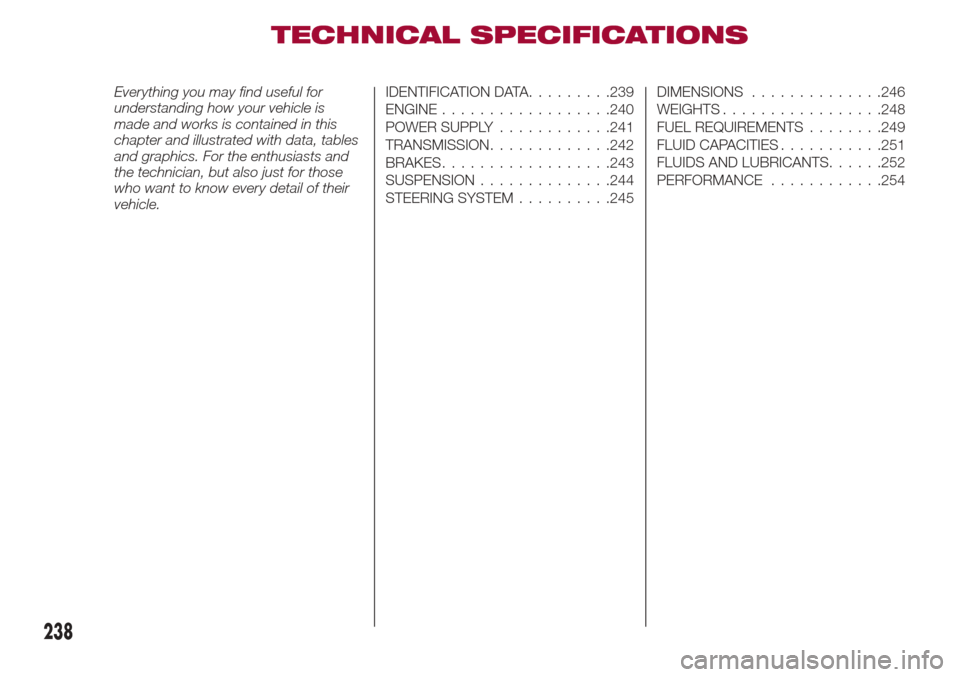
TECHNICAL SPECIFICATIONS
Everything you may find useful for
understanding how your vehicle is
made and works is contained in this
chapter and illustrated with data, tables
and graphics. For the enthusiasts and
the technician, but also just for those
who want to know every detail of their
vehicle.IDENTIFICATION DATA.........239
ENGINE..................240
POWERSUPPLY ............241
TRANSMISSION .............242
BRAKES ................. .243
SUSPENSION ..............244
STEERING SYSTEM ..........245 DIMENSIONS ..............246
WEIGHTS................
.248
FUEL REQUIREMENTS ........249
FLUID CAPACITIES ...........251
FLUIDS AND LUBRICANTS ......252
PERFORMANCE ............254
238
Page 245 of 268
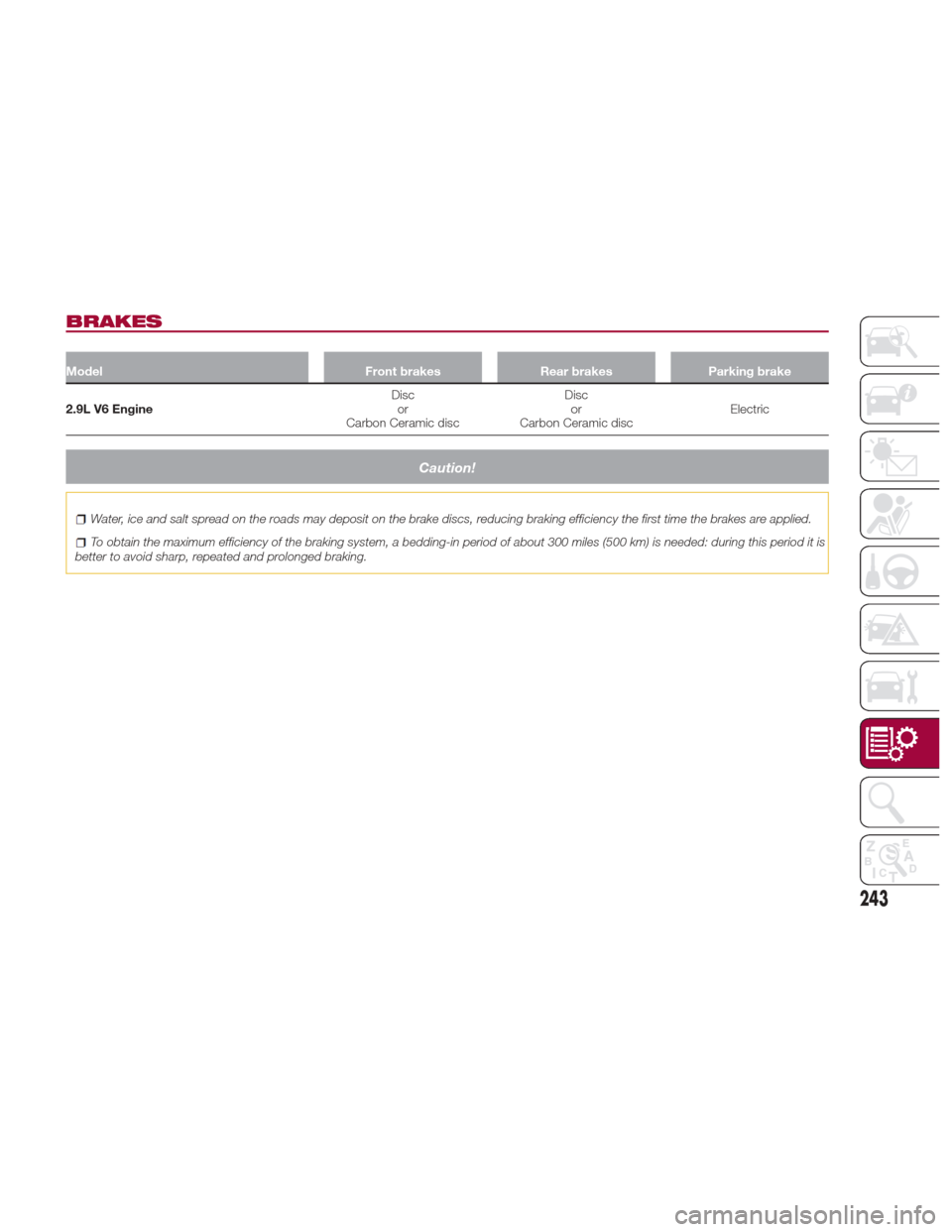
BRAKES
ModelFront brakesRear brakesParking brake
2.9L V6 Engine Disc
or
Carbon
Ceramic discDisc
or
Carbon Ceramic disc Electric
Caution!
Water, ice and salt spread on the roads may deposit on the brake discs, reducing braking efficiency the first time the brakes are applied.
To obtain the maximum efficiency of the braking system, a bedding-in period of about 300 miles (500 km) is needed: during this period it is
better to avoid sharp, repeated and prolonged braking.
243
Page 253 of 268
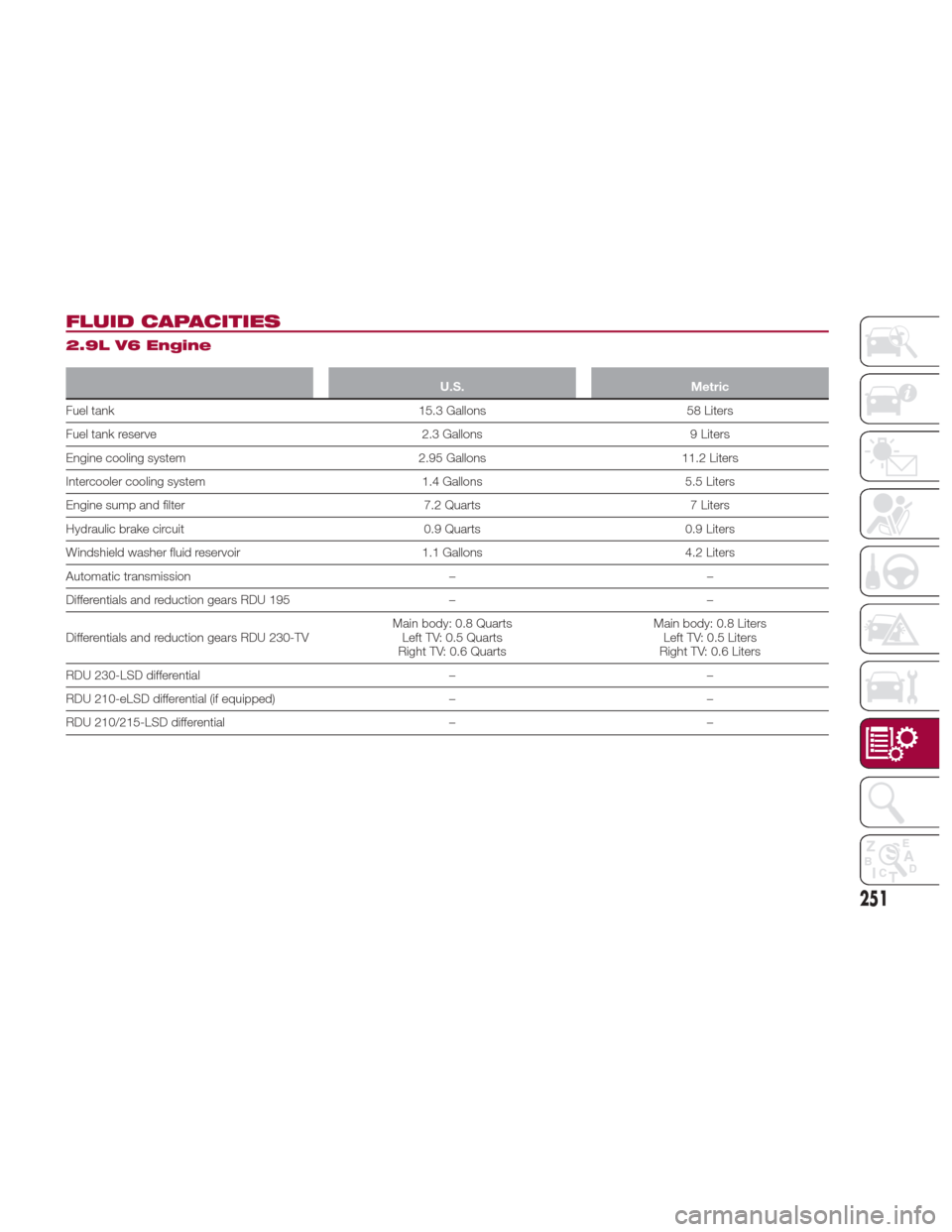
FLUID CAPACITIES
2.9L V6 Engine
U.S.Metric
Fuel tank 15.3 Gallons58 Liters
Fuel
tank reserve 2.3 Gallons9 Liters
Engine cooling system 2.95 Gallons11.2 Liters
Intercooler cooling system 1.4 Gallons5.5 Liters
Engine sump and filter 7.2 Quarts7 Liters
Hydraulic brake circuit 0.9 Quarts0.9 Liters
Windshield washer fluid reservoir 1.1 Gallons4.2 Liters
Automatic transmission ––
Differentials and reduction gears RDU 195 ––
Differentials and reduction gears RDU 230-TV Main body: 0.8 Quarts
Left TV: 0.5 Quarts
Right TV: 0.6 Quarts Main body: 0.8 Liters
Left TV: 0.5 Liters
Right TV: 0.6 Liters
RDU 230-LSD differential ––
RDU 210-eLSD differential (if equipped) ––
RDU 210/215-LSD differential ––
251
Page 255 of 268
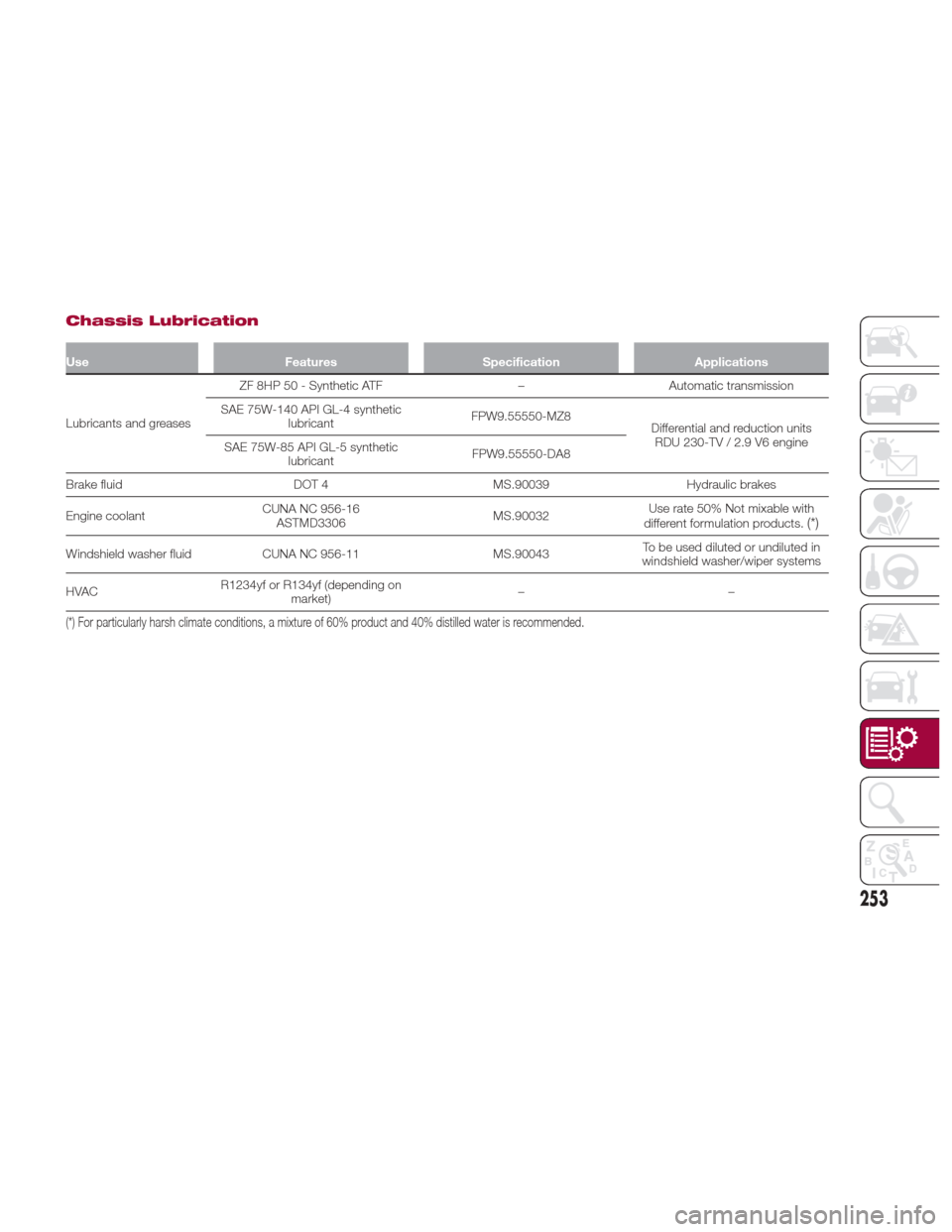
Chassis Lubrication
UseFeaturesSpecification Applications
Lubricants and greases ZF
8HP 50 - Synthetic ATF
–Automatic transmission
SAE 75W-140 API GL-4 synthetic lubricant FPW9.55550-MZ8
Differential and reduction units
RDU 230-TV / 2.9 V6 engine
SAE 75W-85 API GL-5 synthetic
lubricant FPW9.55550-DA8
Brake fluid DOT 4MS.90039Hydraulic brakes
Engine coolant CUNA NC 956-16
ASTMD3306 MS.90032Use rate 50% Not mixable with
different formulation products.
(*)
Windshield washer fluid CUNA NC 956-11 MS.90043To be used diluted or undiluted in
windshield washer/wiper systems
HVAC R1234yf or R134yf (depending on
market) ––
(*) For particularly harsh climate conditions, a mixture of 60% product and 40% distilled water is recommended.
253
Page 262 of 268
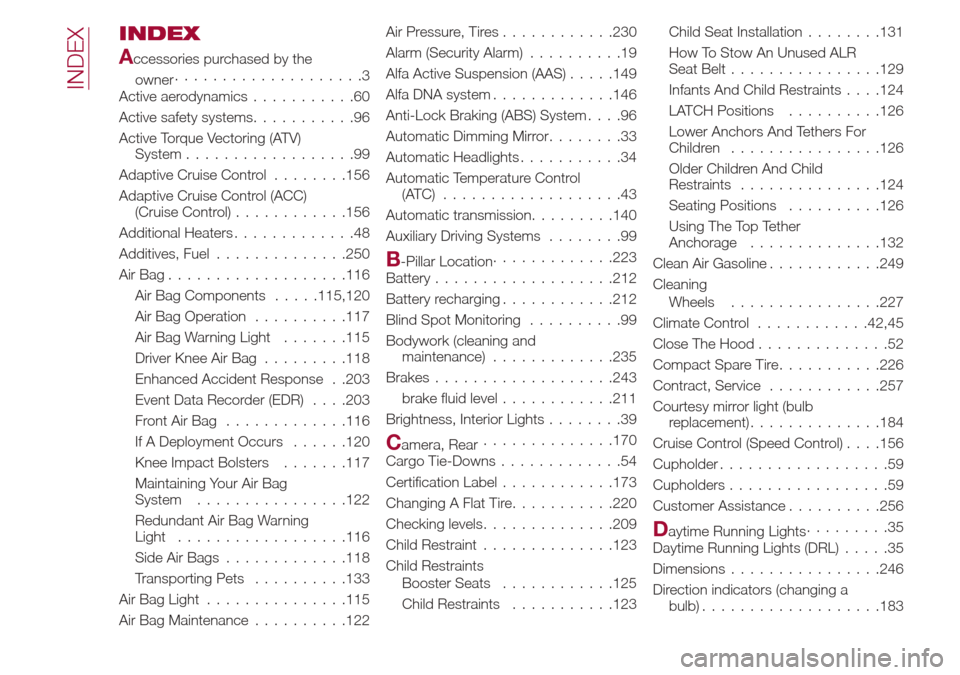
INDEX
Accessories purchased by theowner ....................3
Active aerodynamics ...........60
Active safety systems ...........96
Active Torque Vectoring (ATV) System ..................99
Adaptive Cruise Control ........156
Adaptive Cruise Control (ACC) (Cruise Control) ............156
Additional Heaters .............48
Additives, Fuel ..............250
AirBag.................. .116
Air Bag Components .....115,120
Air Bag Operation ..........117
Air Bag Warning Light .......115
Driver Knee Air Bag .........118
Enhanced Accident Response . .203
Event Data Recorder (EDR) . . . .203
FrontAirBag ............ .116
If A Deployment Occurs ......120
Knee Impact Bolsters .......117
Maintaining Your Air Bag
System ............... .122
Redundant Air Bag Warning
Light ................. .116
Side Air Bags .............118
Transporting Pets ..........133
Air Bag Light ...............115
Air Bag Maintenance ..........122Air Pressure, Tires
............230
Alarm (Security Alarm) ..........19
Alfa Active Suspension (AAS) .....149
Alfa DNA system .............146
Anti-Lock Braking (ABS) System ....96
Automatic Dimming Mirror ........33
Automatic Headlights ...........34
Automatic Temperature Control (ATC) ...................43
Automatic transmission.........140
Auxiliary Driving Systems ........99
B-Pillar Location.............223
Battery .................. .212
Battery recharging ............212
Blind Spot Monitoring ..........99
Bodywork (cleaning and maintenance) .............235
Brakes .................. .243
brake fluid level ............211
Brightness, Interior Lights ........39
Camera, Rear..............170
Cargo Tie-Downs .............54
Certification Label ............173
Changing A Flat Tire ...........220
Checking levels ..............209
Child Restraint ..............123
Child Restraints Booster Seats ............125
Child Restraints ...........123 Child Seat Installation
........131
How To Stow An Unused ALR
Seat Belt ............... .129
Infants And Child Restraints . . . .124
LATCH Positions ..........126
Lower Anchors And Tethers For
Children ............... .126
Older Children And Child
Restraints ...............124
Seating Positions ..........126
Using The Top Tether
Anchorage ..............132
Clean Air Gasoline ............249
Cleaning Wheels ............... .227
Climate Control ............42,45
Close The Hood ..............52
Compact Spare Tire ...........226
Contract, Service ............257
Courtesy mirror light (bulb replacement) ..............184
Cruise Control (Speed Control) . . . .156
Cupholder ..................59
Cupholders .................59
Customer Assistance ..........256
Daytime Running Lights .........35
Daytime Running Lights (DRL) .....35
Dimensions ............... .246
Direction indicators (changing a bulb) .................. .183
INDEX