overheating Alfa Romeo Giulia 2017 Owner's Manual
[x] Cancel search | Manufacturer: ALFA ROMEO, Model Year: 2017, Model line: Giulia, Model: Alfa Romeo Giulia 2017Pages: 268, PDF Size: 18.64 MB
Page 64 of 268
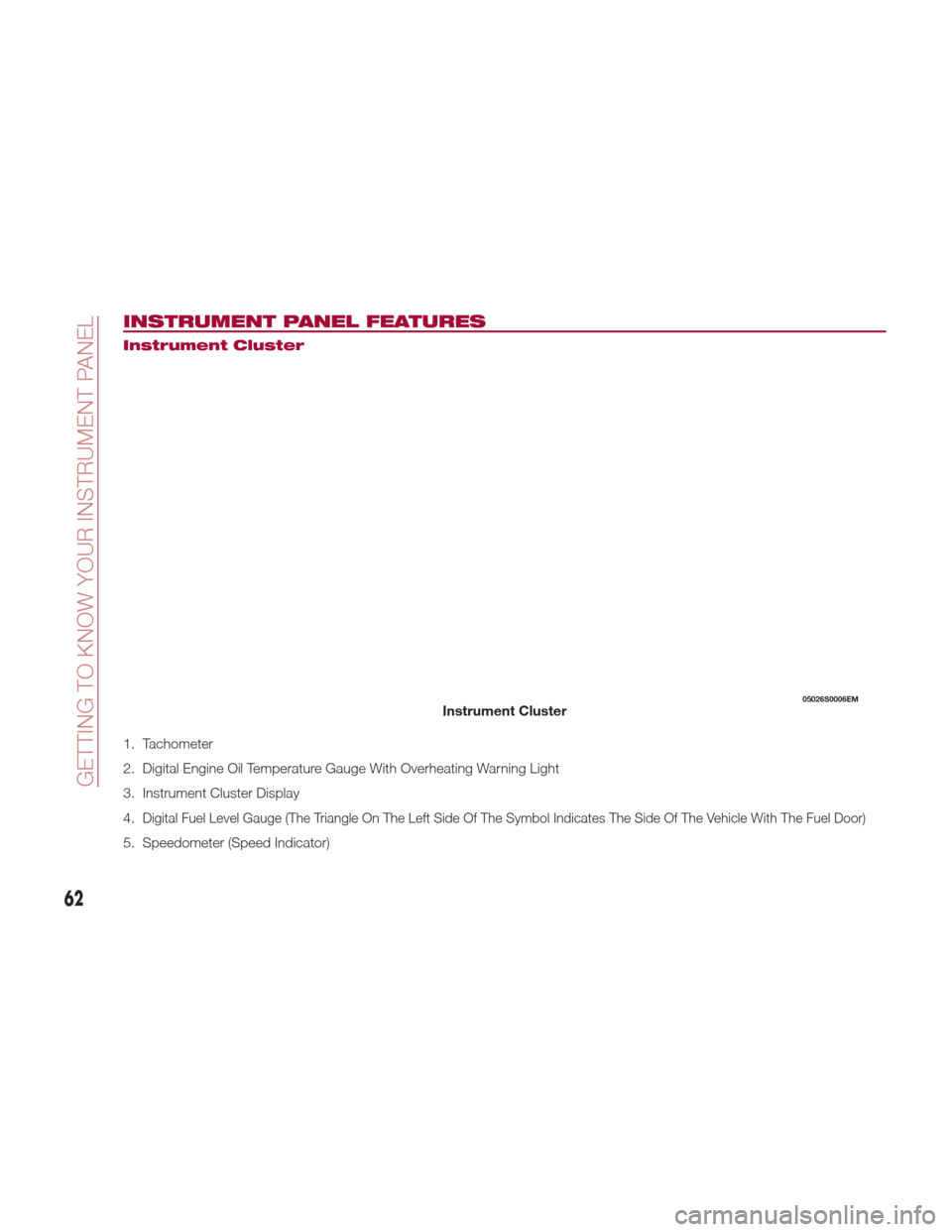
INSTRUMENT PANEL FEATURES
Instrument Cluster
1. Tachometer
2. Digital Engine Oil Temperature Gauge With Overheating Warning Light
3. Instrument Cluster Display
4.
Digital Fuel Level Gauge (The Triangle On The Left Side Of The Symbol Indicates The Side Of The Vehicle With The Fuel Door)
5. Speedometer (Speed Indicator)
05026S0006EMInstrument Cluster
62
GETTING TO KNOW YOUR INSTRUMENT PANEL
Page 74 of 268
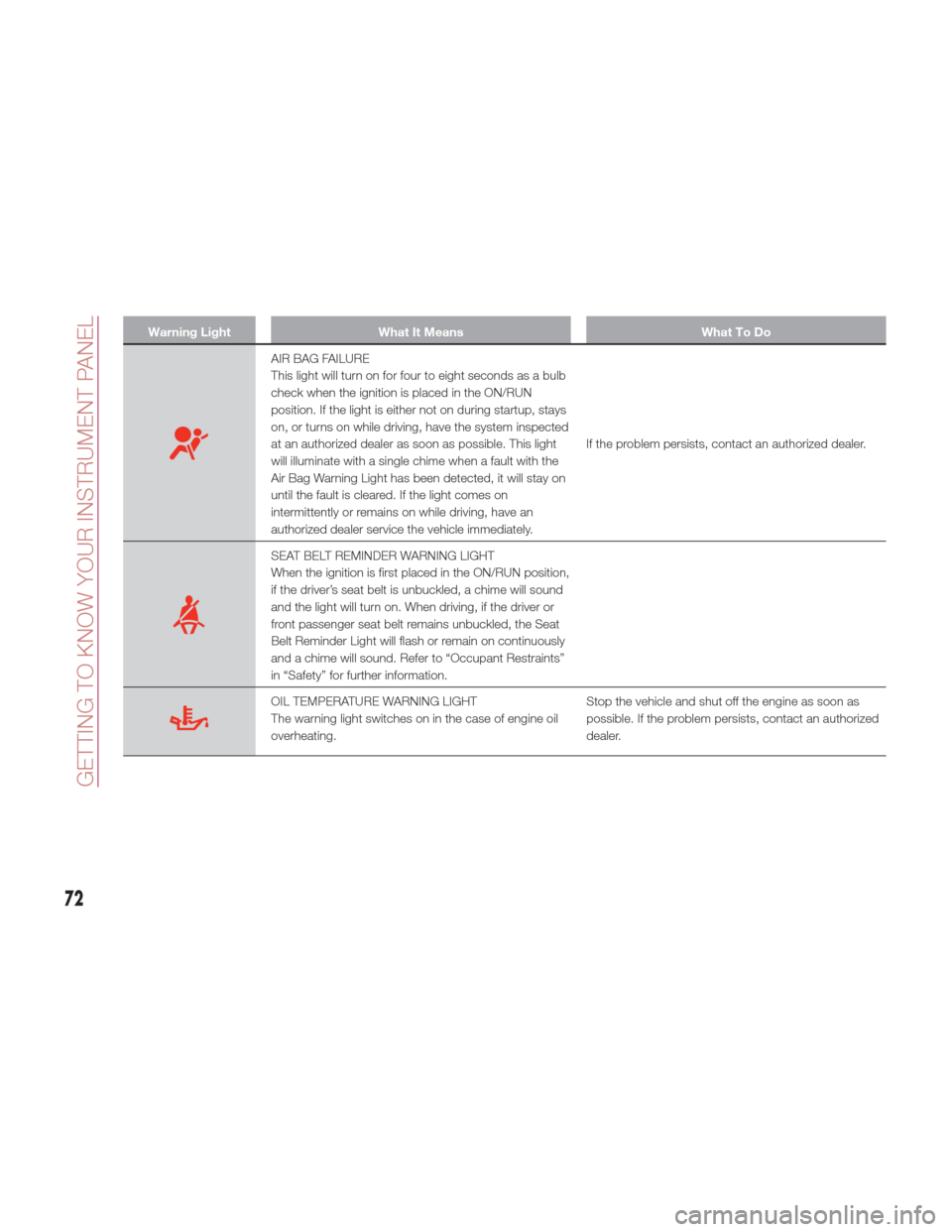
Warning LightWhat It Means What To Do
AIR BAG FAILURE
This light will turn on for four to eight seconds as a bulb
check when the ignition is placed in the ON/RUN
position. If the light is either not on during startup, stays
on, or turns on while driving, have the system inspected
at an authorized dealer as soon as possible. This light
will illuminate with a single chime when a fault with the
Air Bag Warning Light has been detected, it will stay on
until the fault is cleared. If the light comes on
intermittently or remains on while driving, have an
authorized dealer service the vehicle immediately.If the problem persists, contact an authorized dealer.
SEAT BELT REMINDER WARNING LIGHT
When the ignition is first placed in the ON/RUN position,
if the driver’s seat belt is unbuckled, a chime will sound
and the light will turn on. When driving, if the driver or
front passenger seat belt remains unbuckled, the Seat
Belt Reminder Light will flash or remain on continuously
and a chime will sound. Refer to “Occupant Restraints”
in “Safety” for further information.
OIL TEMPERATURE WARNING LIGHT
The warning light switches on in the case of engine oil
overheating.
Stop the vehicle and shut off the engine as soon as
possible. If the problem persists, contact an authorized
dealer.
72
GETTING TO KNOW YOUR INSTRUMENT PANEL
Page 92 of 268
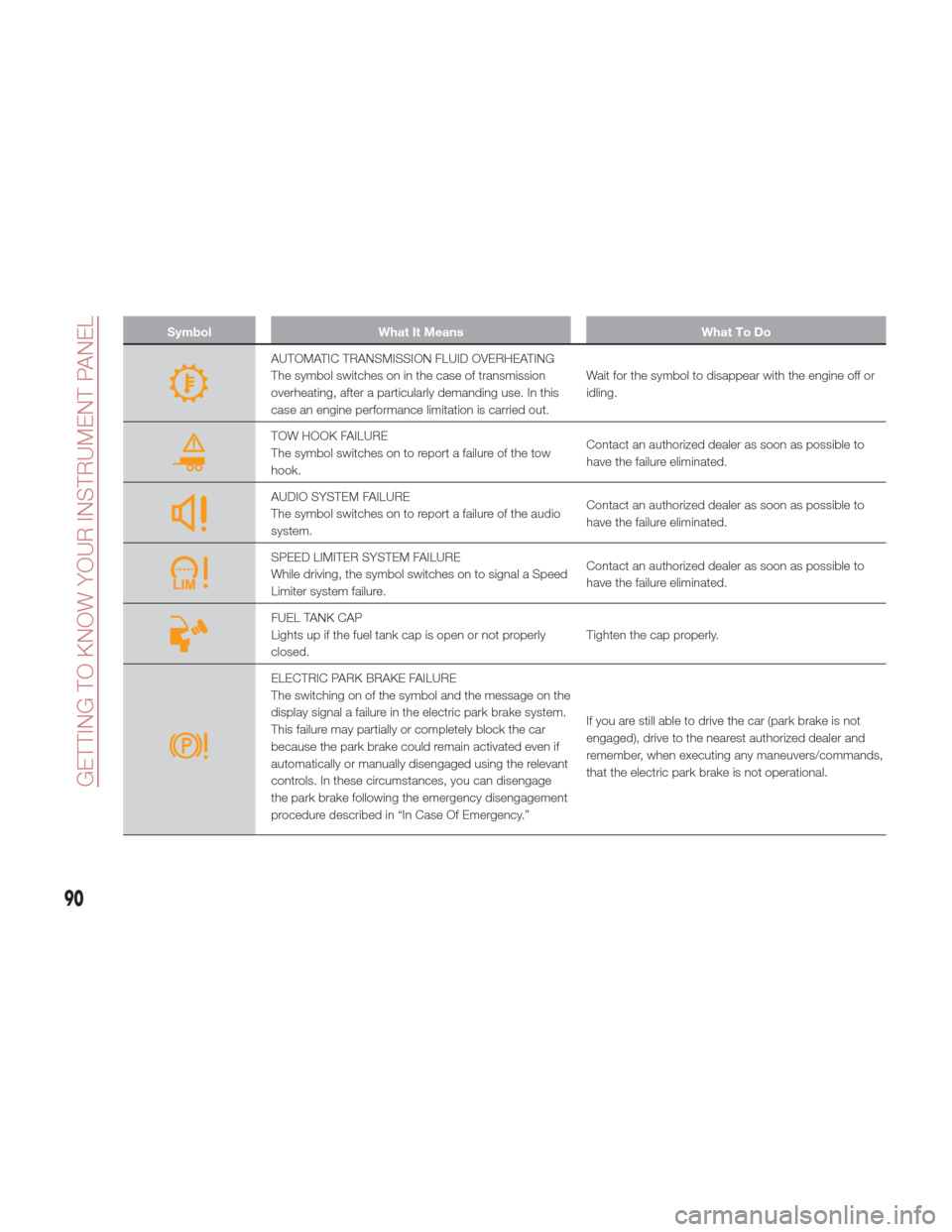
SymbolWhat It Means What To Do
AUTOMATIC TRANSMISSION FLUID OVERHEATING
The symbol switches on in the case of transmission
overheating, after a particularly demanding use. In this
case an engine performance limitation is carried out.Wait for the symbol to disappear with the engine off or
idling.
TOW HOOK FAILURE
The symbol switches on to report a failure of the tow
hook.
Contact an authorized dealer as soon as possible to
have the failure eliminated.
AUDIO SYSTEM FAILURE
The symbol switches on to report a failure of the audio
system.Contact an authorized dealer as soon as possible to
have the failure eliminated.
SPEED LIMITER SYSTEM FAILURE
While driving, the symbol switches on to signal a Speed
Limiter system failure.Contact an authorized dealer as soon as possible to
have the failure eliminated.
FUEL TANK CAP
Lights up if the fuel tank cap is open or not properly
closed.
Tighten the cap properly.
ELECTRIC PARK BRAKE FAILURE
The switching on of the symbol and the message on the
display signal a failure in the electric park brake system.
This failure may partially or completely block the car
because the park brake could remain activated even if
automatically or manually disengaged using the relevant
controls. In these circumstances, you can disengage
the park brake following the emergency disengagement
procedure described in “In Case Of Emergency.”If you are still able to drive the car (park brake is not
engaged), drive to the nearest authorized dealer and
remember, when executing any maneuvers/commands,
that the electric park brake is not operational.
90
GETTING TO KNOW YOUR INSTRUMENT PANEL
Page 145 of 268
When leaving the vehicle, always make
sure the ignition is in the STOP/OFF mode,
remove the key fob from the vehicle, and
lock the vehicle.
Never leave children alone in a vehicle,
or with access to an unlocked vehicle.
Allowing children to be in a vehicle
unattended is dangerous for a number of
reasons. A child or others could be
seriously or fatally injured. Children should
be warned not to touch the park brake,
brake pedal or the transmission gear
selector.
Do not leave the key fob in or near the
vehicle (or in a location accessible to
children), and do not leave the ignition in
the ON mode. A child could operate power
windows, other controls, or move the
vehicle.
Caution!
Before moving the transmission gear
selector out of PARK, you must press the
ignition button to cycle from STOP/OFF
mode to the ON mode, and also press the
brake pedal. Otherwise, damage to the
gear selector could result.
DO NOT race the engine when shifting
from PARK or NEUTRAL into another gear
range, as this can damage the drivetrain.
REVERSE (R)
Select this mode only with the vehicle at
a standstill.
NEUTRAL (N)
Use this range when the vehicle is
standing for prolonged periods with the
engine running. The engine may be
started in this range. Apply the electric
park brake and shift the transmission
into PARK (P) if you must leave the
vehicle.
Warning!
Do not coast in NEUTRAL and never turn
off the ignition to coast down a hill. These
are unsafe practices that limit your
response to changing traffic or road
conditions. You might lose control of the
vehicle and have a collision.
DRIVE (D)
Use this mode in normal driving
conditions.
Shifting from DRIVE (D) to PARK (P) or
REVERSE (R) modes must take place
only after releasing the accelerator
pedal, with vehicle at a standstill and
brake pedal pressed.
This mode ensures automatic
engagement of the most suitable gears
for driving needs and maximum fuel
economy in terms of consumption. In this position, the transmission shifts
the gears automatically, selecting the
most suitable for forward driving among
those available as you go. In this way
the vehicle's optimal driving
characteristics are provided for all
conditions.
AutoStick
In the case of frequent shifting (e.g. for
sport driving, when the vehicle is driven
with a heavy load, on slopes, when
towing heavy trailers), it is
recommended to use the Autostick
(sequential shifting) mode to select and
keep a lower fixed ratio.
In these conditions, the use of a lower
gear improves vehicle performance,
preventing overheating.
It is possible to shift from DRIVE (D)
mode to sequential mode regardless of
vehicle speed.
Activation
Starting from DRIVE (D) mode, to
activate the sequential drive mode,
move the selector to the left (– and +
indication of the trim). The gear
engaged will be shown on the display.
Shifting is made by moving the gear
selector forwards, towards symbol – or
backwards, towards symbol +.
143
Page 181 of 268
IN CASE OF EMERGENCY
Have a flat tire or a burnt-out bulb?
At times, a problem such as these may
interfere with your driving experience.
The pages on emergencies can help
you to deal with critical situations
independently and with calm.
In an emergency, we recommend that
you call the phone number found in the
Warranty Book.
You may also consider contacting your
nearest authorized dealer.HAZARD WARNING LIGHTS . . . .180
BULB REPLACEMENT.........180
FUSES .................. .186
TIRE REPAIR KIT —
IF EQUIPPED ..............192
EMERGENCYSTARTING ......196
REFUELING IN EMERGENCY . . . .198
ENGINE OVERHEATING .......199
TOWING A DISABLED VEHICLE . .200
TOW HOOKS ..............201
ENHANCED ACCIDENT
RESPONSE SYSTEM (EARS) . . . .203
EVENT DATA RECORDER (EDR) . .203
179
Page 201 of 268
ENGINE
OVERHEATING
Engine overheating may occur in
situations of extreme environmental
temperatures, frequent engine
stops/starts, or driving in heavy traffic. If
the engine becomes overheated, the
Engine Temperature Warning Light in
the instrument cluster will illuminate
along with a dedicated message. Refer
to "Warning Lights And Messages" in
the "Getting To Know Your Instrument
Panel" for more information.
In any of the following situations, you
can reduce the potential for overheating
by taking the appropriate action.
On the highways — slow down.
In city traffic — while stopped, place
the transmission in NEUTRAL, but do
not increase engine idle speed.
Note:
There are steps that you can take to
slow down an impending overheat
condition:
If your air conditioner (A/C) is on,
turn it off. The A/C system adds heat
to the engine cooling system and
turning the A/C off can help remove
this heat.
You can also turn the temperature
control to maximum heat, the mode
control to floor and the blower control
to high. This allows the heater core to
act as a supplement to the radiator
and aids in removing heat from the
engine cooling system.
Warning!
You or others can be badly burned by hot
engine coolant (antifreeze) or steam from
your radiator. If you see or hear steam
coming from under the hood, do not open
the hood until the radiator has had time to
cool. Never try to open a cooling system
pressure cap when the radiator or coolant
bottle is hot.
Caution!
Driving with a hot cooling system could
damage your vehicle. If temperature gauge
reads “H”, pull over and stop the vehicle.
Idle the vehicle with the air conditioner
turned off until the pointer drops back into
the normal range. If the pointer remains on
the “H”, turn the engine off immediately,
and call for service.
If Steam Is Coming From The
Engine Compartment
Do not go near the front of the vehicle.
Stop the engine. Wait until the steam
dissipates. Then, open the hood and
start the engine.
If Neither Coolant Nor Steam Is
Escaping
Open the hood and idle the engine until
it cools.
Note:
If the cooling fan does not operate
while the engine is running, the engine
temperature will increase. Stop the
engine and contact your authorized
dealer.
If the engine continues to overheat
or frequently overheats, have the
cooling system inspected. The engine
could be seriously damaged unless
repairs are made. Contact your
authorized dealer.
199
Page 221 of 268
With engine and system cold, do
not top up with coolant beyond the
maximum level indicated on the
reservoir in the engine compartment.
Braking System
In order to guarantee the efficiency of
the braking system, periodically check
its components; for this operation,
contact an authorized dealer.
See the "Maintenance Plan" for the
correct servicing intervals.
Note: Driving with your foot resting on
the brake pedal may compromise its
efficiency, increasing the risk of
accidents. When driving, never keep
your foot on the brake pedal and don’t
put unnecessary strain on it to prevent
the brakes from overheating: excess
pad wear may cause damage to the
braking system.
When an insufficient oil level is
detected, contact an authorized dealer
to have the system checked.
Always keep the cap of the brake
fluid reservoir (in the engine
compartment) completely closed.
Warning!
Use only manufacturer's recommended
brake fluid. Refer to “Fluids And Lubricants”
in “Technical Specifications” for further
information. Using the wrong type of brake
fluid can severely damage your brake
system and/or impair its performance. The
proper type of brake fluid for your vehicle is
also identified on the original factory
installed hydraulic master cylinder reservoir.
To avoid contamination from foreign
matter or moisture, use only new brake
fluid or fluid that has been in a tightly
closed container. Keep the master cylinder
reservoir cap secured at all times. Brake
fluid in a open container absorbs moisture
from the air resulting in a lower boiling
point. This may cause it to boil
unexpectedly during hard or prolonged
braking, resulting in sudden brake failure.
This could result in a collision.
Overfilling the brake fluid reservoir can
result in spilling brake fluid on hot engine
parts, causing the brake fluid to catch fire.
Brake fluid can also damage painted and
vinyl surfaces, care should be taken to
avoid its contact with these surfaces.
Do not allow petroleum based fluid to
contaminate the brake fluid. Brake seal
components could be damaged, causing
partial or complete brake failure. This could
result in a collision.
Automatic Transmission
Use only a transmission oil with the
same characteristics as those indicated
in the "Fluids and Lubricants" table (see
"Technical Specifications" chapter).
Special Additives
Do not use any type of additive with the
automatic transmission oil. The
automatic transmission oil is a product
designed specially for this vehicle and
its performance may be compromised
through the use of further additives.
Caution!
Do not use chemical flushes in your
transmission as the chemicals can damage
your transmission components. Such
damage is not covered by the New Vehicle
Limited Warranty.
219
Page 231 of 268
While studded tires improve
performance on ice, skid and traction
capability on wet or dry surfaces may
be poorer than that of non-studded
tires. Some states prohibit studded
tires; therefore, local laws should be
checked before using these tire types.
Snow Chains
It is only possible to put chains on the
rear 265/35 R19 tire (winter tire size).
Avoid using traditional chains as they
can damage the braking system if not
installed correctly, thereby
compromising the vehicles safety.
We strongly advise using
zero-clearance chains and to use
equipment proposed by an authorized
dealer.
Suggestions About The
Rotation Of The Tires
The front and rear tires are subject to
different loads and stress due to
steering, maneuver and braking. For
this reason they are subject to uneven
wear.
To resolve this problem, tires should be
rotated at each service interval
(approximately every 10,000 miles
[16,000km]). Inverting the tires means
moving them to different positions on
the same side of the car (front to back
and vice versa).Note:
Crossing the tires is not advised, so
placing a tire on a different axle on the
other side of the car is impossible.
On cars equipped with
differentiated tires (tire size different
between front and rear axles, ex.
Quadrifoglio models and other Giulia
vehicles equipped with 19”
performance tires) rotation of any of
the tires is not advised.
Tire rotation contributes to the
preservation of the grip and traction
performance on wet, muddy or snowy
roads, guaranteeing optimal driveability
of the vehicle.
In the case of irregular wear of the tires
identify the cause and correct it as soon
as possible, by contacting an
authorized dealer.
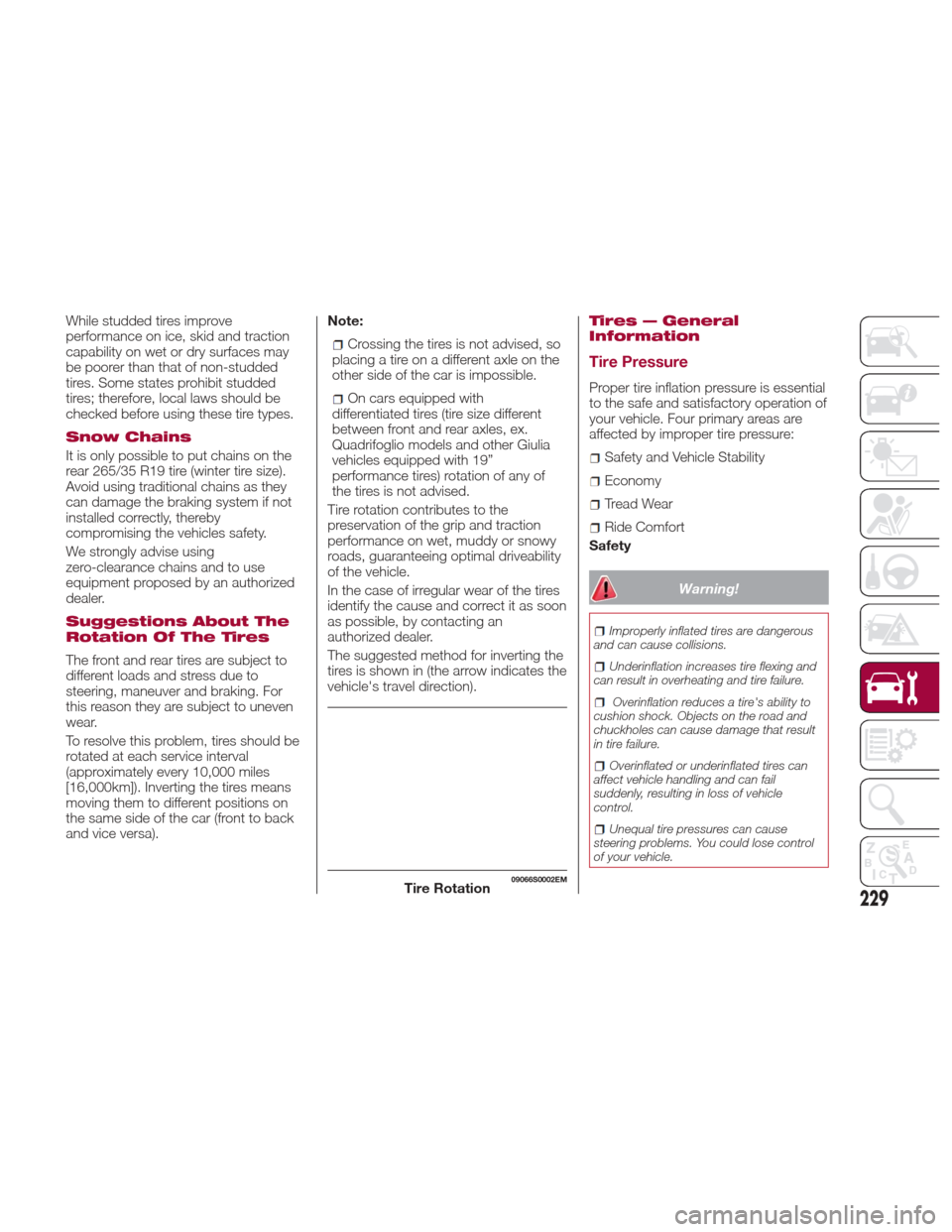
The suggested method for inverting the
tires is shown in (the arrow indicates the
vehicle's travel direction).
Tires — General
Information
Tire Pressure
Proper tire inflation pressure is essential
to the safe and satisfactory operation of
your vehicle. Four primary areas are
affected by improper tire pressure:
Safety and Vehicle Stability
Economy
Tread Wear
Ride Comfort
Safety
Warning!
Improperly inflated tires are dangerous
and can cause collisions.
Underinflation increases tire flexing and
can result in overheating and tire failure.
Overinflation reduces a tire's ability to
cushion shock. Objects on the road and
chuckholes can cause damage that result
in tire failure.
Overinflated or underinflated tires can
affect vehicle handling and can fail
suddenly, resulting in loss of vehicle
control.
Unequal tire pressures can cause
steering problems. You could lose control
of your vehicle.
09066S0002EMTire Rotation229
Page 263 of 268
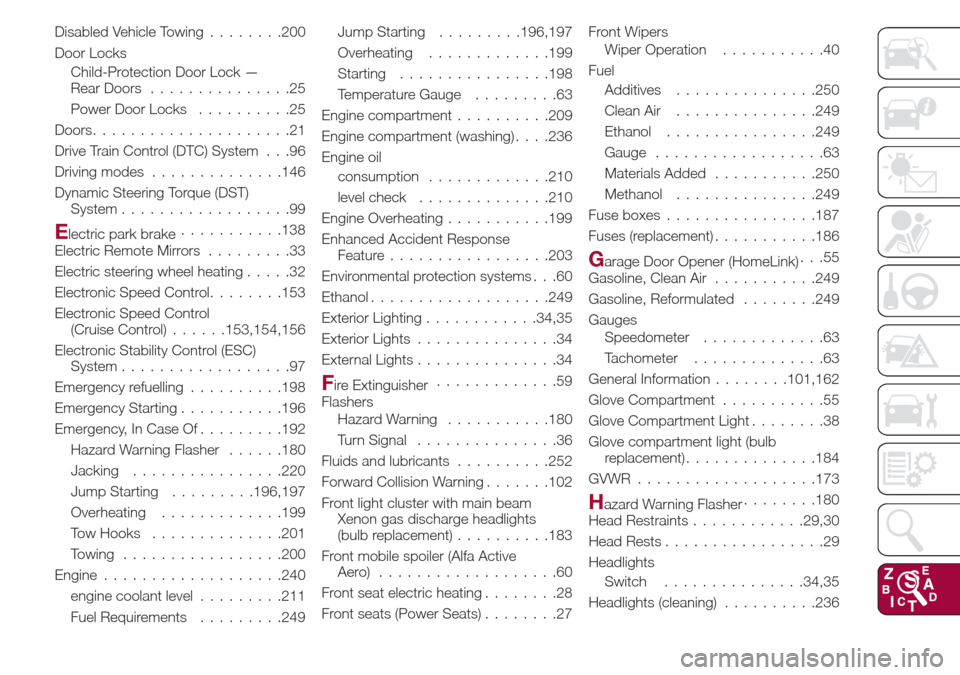
Disabled Vehicle Towing........200
Door Locks Child-Protection Door Lock —
Rear Doors ...............25
Power Door Locks ..........25
Doors .....................21
Drive Train Control (DTC) System . . .96
Driving modes ..............146
Dynamic Steering Torque (DST) System ..................99
Electric park brake ...........138
Electric Remote Mirrors .........33
Electric steering wheel heating .....32
Electronic Speed Control ........153
Electronic Speed Control (Cruise Control) ......153,154,156
Electronic Stability Control (ESC) System ..................97
Emergency refuelling ..........198
Emergency Starting ...........196
Emergency, In Case Of .........192
Hazard Warning Flasher ......180
Jacking ............... .220
Jump Starting .........196,197
Overheating .............199
Tow Hooks ..............201
Towing ................ .200
Engine .................. .240
engine coolant level .........211
Fuel Requirements .........249 Jump Starting
.........196,197
Overheating .............199
Starting ............... .198
Temperature Gauge .........63
Engine compartment ..........209
Engine compartment (washing) . . . .236
Engine oil consumption .............210
level check ..............210
Engine Overheating ...........199
Enhanced Accident Response Feature ................ .203
Environmental protection systems . . .60
Ethanol .................. .249
Exterior Lighting ............34,35
Exterior Lights ...............34
External Lights ...............34
Fire Extinguisher .............59
Flashers Hazard Warning ...........180
Turn Signal ...............36
Fluids and lubricants ..........252
Forward Collision Warning .......102
Front light cluster with main beam Xenon gas discharge headlights
(bulb replacement) ..........183
Front mobile spoiler (Alfa Active Aero) ...................60
Front seat electric heating ........28
Front seats (Power Seats) ........27Front Wipers
Wiper Operation ...........40
Fuel Additives ...............250
Clean Air ...............249
Ethanol ............... .249
Gauge ..................63
Materials Added ...........250
Methanol ...............249
Fuse boxes ............... .187
Fuses (replacement) ...........186
Garage Door Opener (HomeLink) . . .55
Gasoline, Clean Air ...........249
Gasoline, Reformulated ........249
Gauges Speedometer .............63
Tachometer ..............63
General Information ........101,162
Glove Compartment ...........55
Glove Compartment Light ........38
Glove compartment light (bulb replacement) ..............184
GVWR .................. .173
Hazard Warning Flasher........180
Head Restraints ............29,30
Head Rests .................29
Headlights Switch ...............34,35
Headlights (cleaning) ..........236
Page 264 of 268
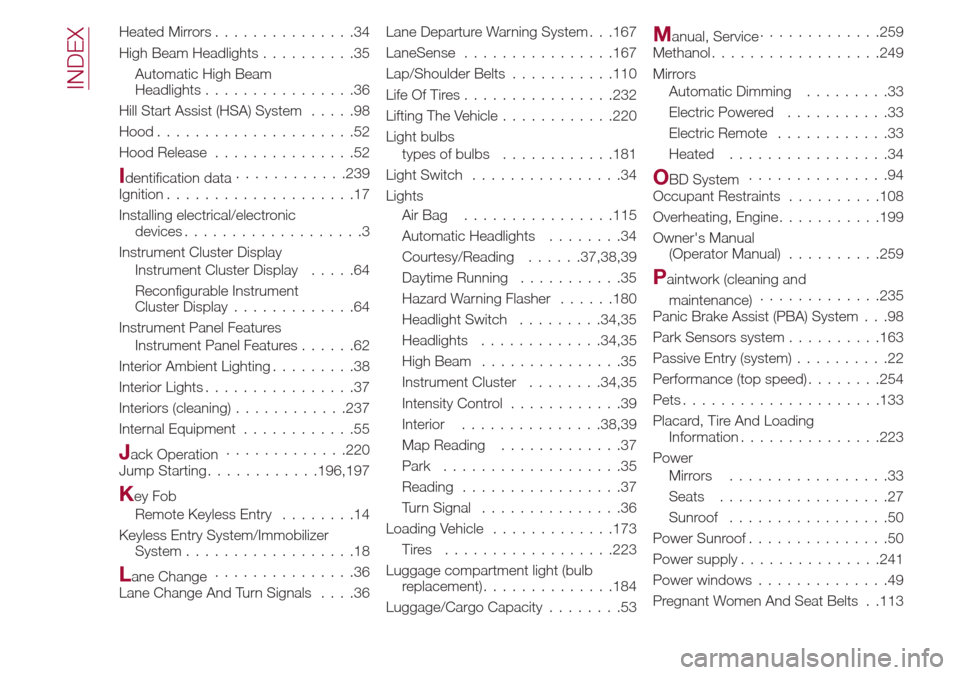
Heated Mirrors...............34
High Beam Headlights ..........35
Automatic High Beam
Headlights ................36
Hill Start Assist (HSA) System .....98
Hood.....................52
Hood Release ...............52
Identification data ............239
Ignition ....................17
Installing electrical/electronic devices ...................3
Instrument Cluster Display Instrument Cluster Display .....64
Reconfigurable Instrument
Cluster Display .............64
Instrument Panel Features Instrument Panel Features ......62
Interior Ambient Lighting .........38
Interior Lights ................37
Interiors (cleaning) ............237
Internal Equipment ............55
Jack Operation.............220
Jump Starting ............196,197
Key Fob
Remote Keyless Entry ........14
Keyless Entry System/Immobilizer System ..................18
Lane Change ...............36
Lane Change And Turn Signals ....36Lane Departure Warning System . . .167
LaneSense
............... .167
Lap/Shoulder Belts ...........110
Life Of Tires ............... .232
Lifting The Vehicle ............220
Light bulbs types of bulbs ............181
Light Switch ................34
Lights AirBag ............... .115
Automatic Headlights ........34
Courtesy/Reading ......37,38,39
Daytime Running ...........35
Hazard Warning Flasher ......180
Headlight Switch .........34,35
Headlights .............34,35
High Beam ...............35
Instrument Cluster ........34,35
Intensity Control ............39
Interior ...............38,39
Map Reading .............37
Park ...................35
Reading .................37
Turn Signal ...............36
Loading Vehicle .............173
Tires ................. .223
Luggage compartment light (bulb replacement) ..............184
Luggage/Cargo Capacity ........53
Manual, Service.............259
Methanol ................. .249
Mirrors Automatic Dimming .........33
Electric Powered ...........33
Electric Remote ............33
Heated .................34
OBD System ...............94
Occupant Restraints ..........108
Overheating, Engine ...........199
Owner's Manual (Operator Manual) ..........259
Paintwork (cleaning and
maintenance) .............235
Panic Brake Assist (PBA) System . . .98
Park Sensors system ..........163
Passive Entry (system) ..........22
Performance (top speed) ........254
Pets .................... .133
Placard, Tire And Loading Information ...............223
Power Mirrors .................33
Seats ..................27
Sunroof .................50
Power Sunroof ...............50
Power supply ...............241
Power windows ..............49
Pregnant Women And Seat Belts . .113
INDEX