stop start Alfa Romeo Giulia 2019 User Guide
[x] Cancel search | Manufacturer: ALFA ROMEO, Model Year: 2019, Model line: Giulia, Model: Alfa Romeo Giulia 2019Pages: 232, PDF Size: 4.87 MB
Page 57 of 232
Warning
lightWhat it means
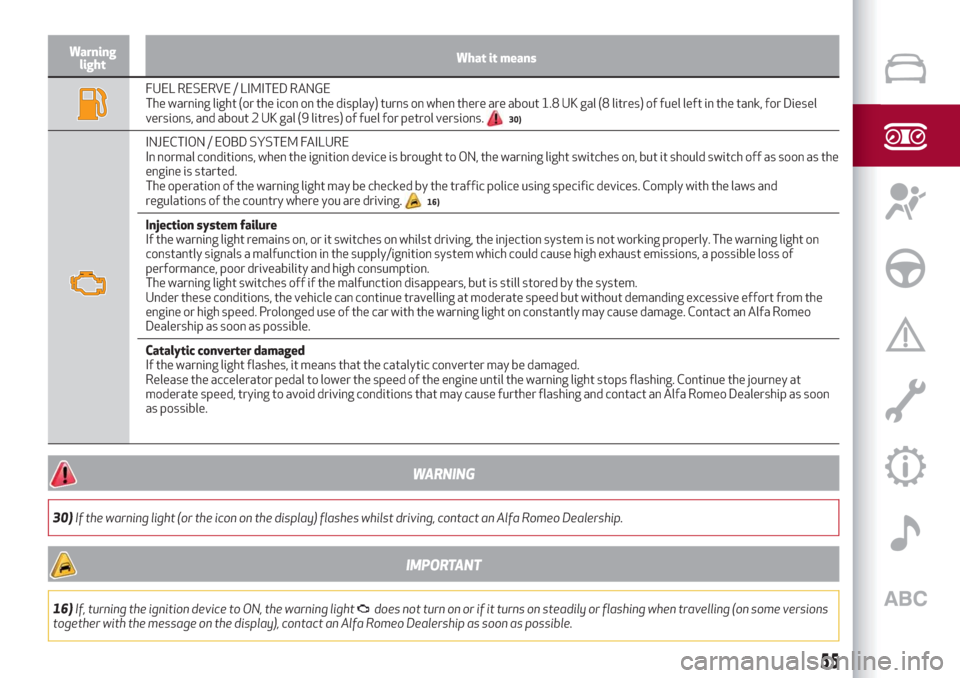
FUEL RESERVE / LIMITED RANGE
The warning light (or the icon on the display) turns on when there are about 1.8 UK gal (8 litres) of fuel left in the tank, for Diesel
versions, and about 2 UK gal (9 litres) of fuel for petrol versions.
30)
INJECTION / EOBD SYSTEM FAILURE
In normal conditions, when the ignition device is brought to ON, the warning light switches on, but it should switch off as soon as the
engine is started.
The operation of the warning light may be checked by the traffic police using specific devices. Comply with the laws and
regulations of the country where you are driving.
16)
Injection system failure
If the warning light remains on, or it switches on whilst driving, the injection system is not working properly. The warning light on
constantly signals a malfunction in the supply/ignition system which could cause high exhaust emissions, a possible loss of
performance, poor driveability and high consumption.
The warning light switches off if the malfunction disappears, but is still stored by the system.
Under these conditions, the vehicle can continue travelling at moderate speed but without demanding excessive effort from the
engine or high speed. Prolonged use of the car with the warning light on constantly may cause damage. Contact an Alfa Romeo
Dealership as soon as possible.
Catalytic converter damaged
If the warning light flashes, it means that the catalytic converter may be damaged.
Release the accelerator pedal to lower the speed of the engine until the warning light stops flashing. Continue the journey at
moderate speed, trying to avoid driving conditions that may cause further flashing and contact an Alfa Romeo Dealership as soon
as possible.
WARNING
30)If the warning light (or the icon on the display) flashes whilst driving, contact an Alfa Romeo Dealership.
IMPORTANT
16)If, turning the ignition device to ON, the warning lightdoes not turn on or if it turns on steadily or flashing when travelling (on some versions
together with the message on the display), contact an Alfa Romeo Dealership as soon as possible.
55
Page 58 of 232
Warning
lightWhat it means
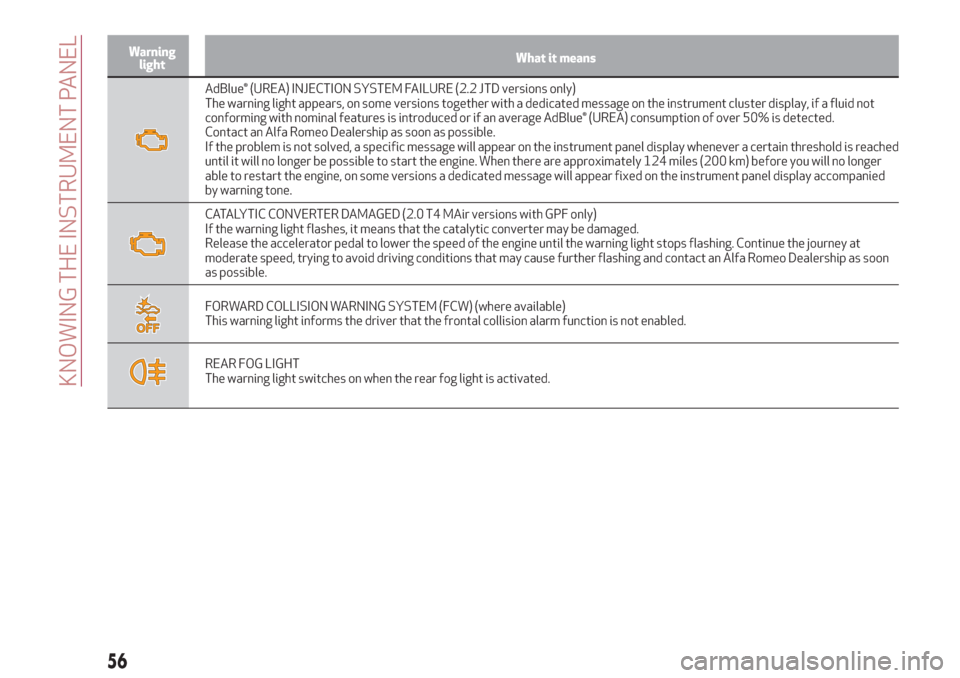
AdBlue® (UREA) INJECTION SYSTEM FAILURE (2.2 JTD versions only)
The warning light appears, on some versions together with a dedicated message on the instrument cluster display, if a fluid not
conforming with nominal features is introduced or if an average AdBlue® (UREA) consumption of over 50% is detected.
Contact an Alfa Romeo Dealership as soon as possible.
If the problem is not solved, a specific message will appear on the instrument panel display whenever a certain threshold is reached
until it will no longer be possible to start the engine. When there are approximately 124 miles (200 km) before you will no longer
able to restart the engine, on some versions a dedicated message will appear fixed on the instrument panel display accompanied
by warning tone.
CATALYTIC CONVERTER DAMAGED (2.0 T4 MAir versions with GPF only)
If the warning light flashes, it means that the catalytic converter may be damaged.
Release the accelerator pedal to lower the speed of the engine until the warning light stops flashing. Continue the journey at
moderate speed, trying to avoid driving conditions that may cause further flashing and contact an Alfa Romeo Dealership as soon
as possible.
FORWARD COLLISION WARNING SYSTEM (FCW) (where available)
This warning light informs the driver that the frontal collision alarm function is not enabled.
REAR FOG LIGHT
The warning light switches on when the rear fog light is activated.
56
KNOWING THE INSTRUMENT PANEL
Page 61 of 232
Symbol What it means
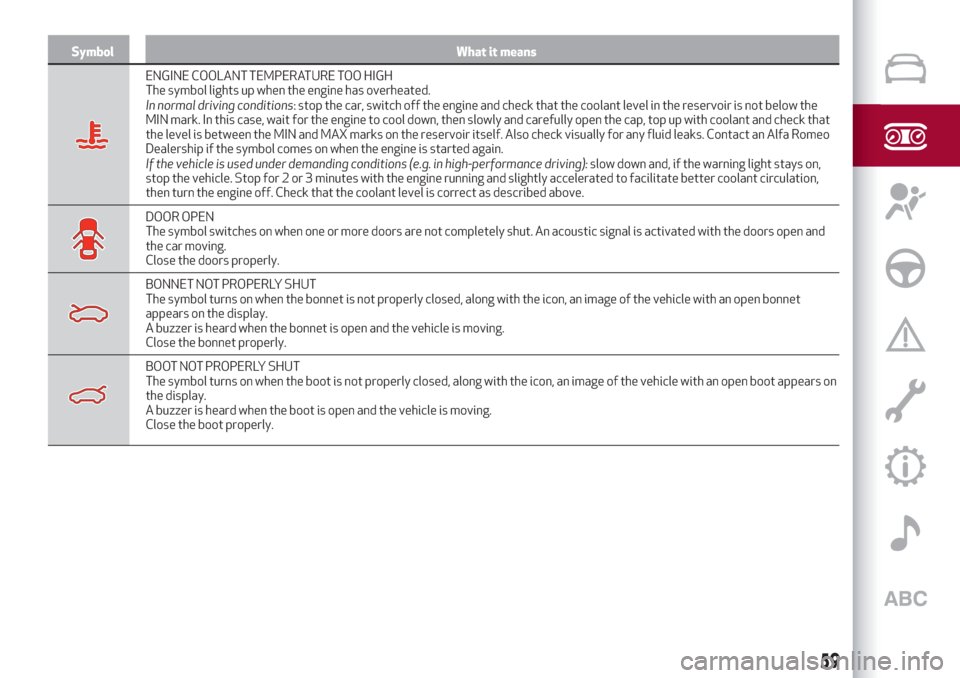
ENGINE COOLANT TEMPERATURE TOO HIGH
The symbol lights up when the engine has overheated.
In normal driving conditions: stop the car, switch off the engine and check that the coolant level in the reservoir is not below the
MIN mark. In this case, wait for the engine to cool down, then slowly and carefully open the cap, top up with coolant and check that
the level is between the MIN and MAX marks on the reservoir itself. Also check visually for any fluid leaks. Contact an Alfa Romeo
Dealership if the symbol comes on when the engine is started again.
If the vehicle is used under demanding conditions (e.g. in high-performance driving):slow down and, if the warning light stays on,
stop the vehicle. Stop for 2 or 3 minutes with the engine running and slightly accelerated to facilitate better coolant circulation,
then turn the engine off. Check that the coolant level is correct as described above.
DOOR OPEN
The symbol switches on when one or more doors are not completely shut. An acoustic signal is activated with the doors open and
the car moving.
Close the doors properly.
BONNET NOT PROPERLY SHUT
The symbol turns on when the bonnet is not properly closed, along with the icon, an image of the vehicle with an open bonnet
appears on the display.
A buzzer is heard when the bonnet is open and the vehicle is moving.
Close the bonnet properly.
BOOT NOT PROPERLY SHUT
The symbol turns on when the boot is not properly closed, along with the icon, an image of the vehicle with an open boot appears on
the display.
A buzzer is heard when the boot is open and the vehicle is moving.
Close the boot properly.
59
Page 64 of 232
Symbol What it means
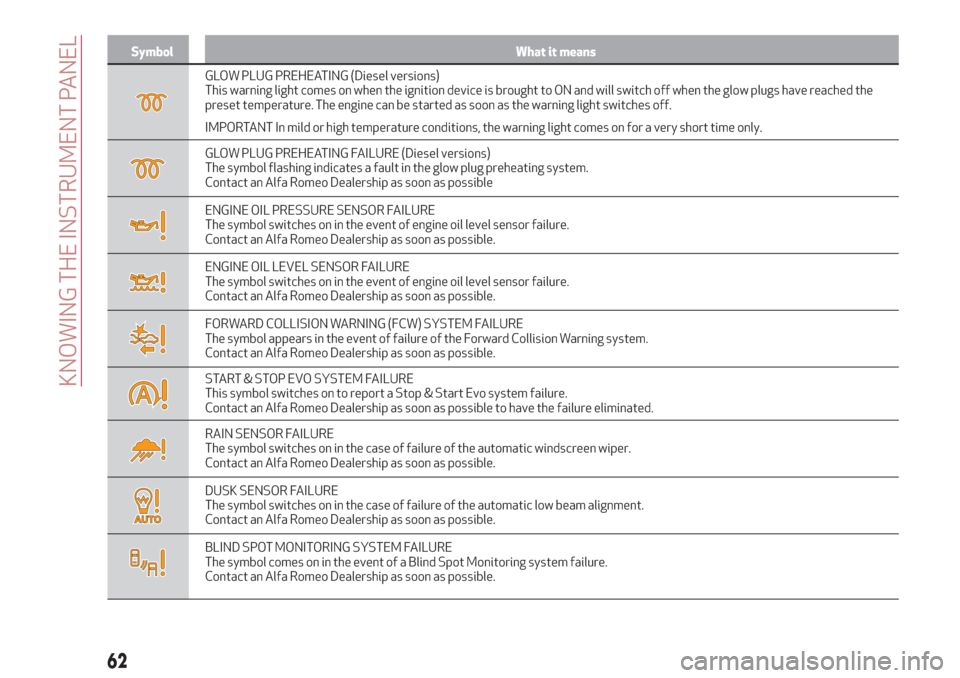
GLOW PLUG PREHEATING (Diesel versions)
This warning light comes on when the ignition device is brought to ON and will switch off when the glow plugs have reached the
preset temperature. The engine can be started as soon as the warning light switches off.
IMPORTANT In mild or high temperature conditions, the warning light comes on for a very short time only.
GLOW PLUG PREHEATING FAILURE (Diesel versions)
The symbol flashing indicates a fault in the glow plug preheating system.
Contact an Alfa Romeo Dealership as soon as possible
ENGINE OIL PRESSURE SENSOR FAILURE
The symbol switches on in the event of engine oil level sensor failure.
Contact an Alfa Romeo Dealership as soon as possible.
ENGINE OIL LEVEL SENSOR FAILURE
The symbol switches on in the event of engine oil level sensor failure.
Contact an Alfa Romeo Dealership as soon as possible.
FORWARD COLLISION WARNING (FCW) SYSTEM FAILURE
The symbol appears in the event of failure of the Forward Collision Warning system.
Contact an Alfa Romeo Dealership as soon as possible.
START & STOP EVO SYSTEM FAILURE
This symbol switches on to report a Stop & Start Evo system failure.
Contact an Alfa Romeo Dealership as soon as possible to have the failure eliminated.
RAIN SENSOR FAILURE
The symbol switches on in the case of failure of the automatic windscreen wiper.
Contact an Alfa Romeo Dealership as soon as possible.
DUSK SENSOR FAILURE
The symbol switches on in the case of failure of the automatic low beam alignment.
Contact an Alfa Romeo Dealership as soon as possible.
BLIND SPOT MONITORING SYSTEM FAILURE
The symbol comes on in the event of a Blind Spot Monitoring system failure.
Contact an Alfa Romeo Dealership as soon as possible.
62
KNOWING THE INSTRUMENT PANEL
Page 67 of 232
Symbol What it means
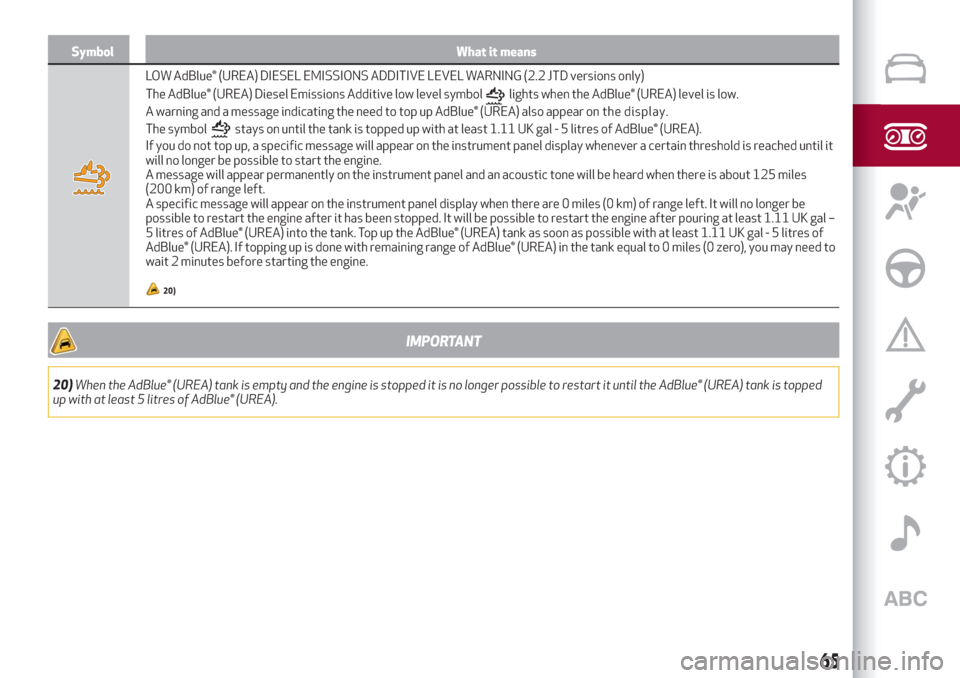
LOW AdBlue® (UREA) DIESEL EMISSIONS ADDITIVE LEVEL WARNING (2.2 JTD versions only)
The AdBlue® (UREA) Diesel Emissions Additive low level symbol
A warning and a message indicating the need to top up AdBlue® (UREA) also appear on the display.
The symbol
stays on until the tank is topped up with at least 1.11 UK gal - 5 litres of AdBlue® (UREA).
If you do not top up, a specific message will appear on the instrument panel display whenever a certain threshold is reached until it
will no longer be possible to start the engine.
A message will appear permanently on the instrument panel and an acoustic tone will be heard when there is about 125 miles
(200 km) of range left.
A specific message will appear on the instrument panel display when there are 0 miles (0 km) of range left. It will no longer be
possible to restart the engine after it has been stopped. It will be possible to restart the engine after pouring at least 1.11 UK gal –
5 litres of AdBlue® (UREA) into the tank. Top up the AdBlue® (UREA) tank as soon as possible with at least 1.11 UK gal - 5 litres of
AdBlue® (UREA). If topping up is done with remaining range of AdBlue® (UREA) in the tank equal to 0 miles (0 zero), you may need to
wait 2 minutes before starting the engine.
20)
IMPORTANT
20)When the AdBlue® (UREA) tank is empty and the engine is stopped it is no longer possible to restart it until the AdBlue® (UREA) tank is topped
up with at least 5 litres of AdBlue® (UREA).
65
lights when the AdBlue® (UREA) level is low.
Page 72 of 232
Green symbols
Symbol What it means
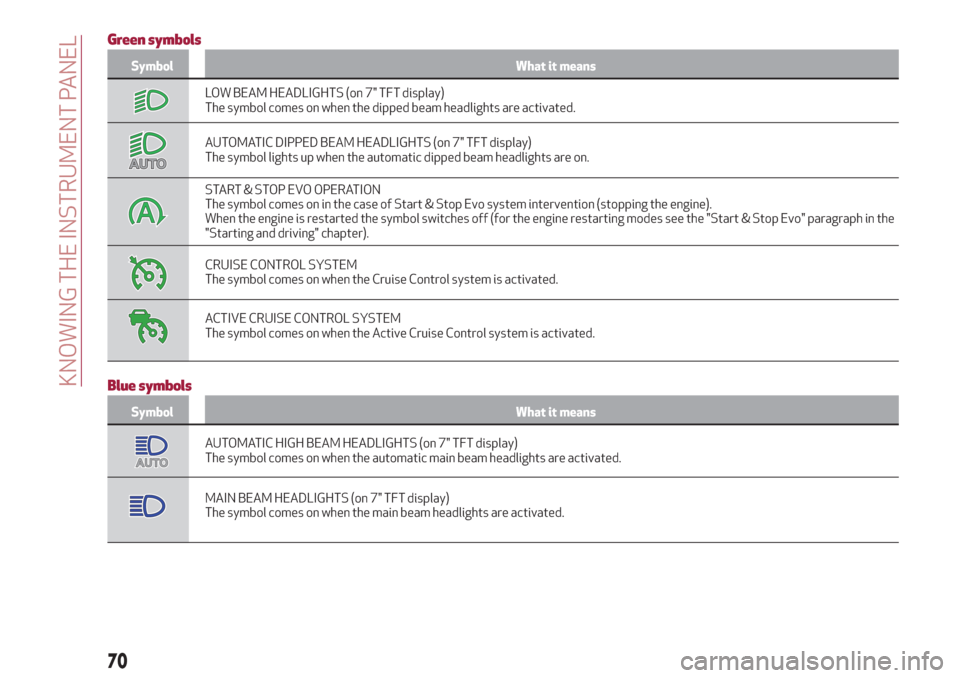
LOW BEAM HEADLIGHTS (on 7" TFT display)
The symbol comes on when the dipped beam headlights are activated.
AUTOMATIC DIPPED BEAM HEADLIGHTS (on 7" TFT display)
The symbol lights up when the automatic dipped beam headlights are on.
START & STOP EVO OPERATION
The symbol comes on in the case of Start & Stop Evo system intervention (stopping the engine).
When the engine is restarted the symbol switches off (for the engine restarting modes see the "Start & Stop Evo" paragraph in the
"Starting and driving" chapter).
CRUISE CONTROL SYSTEM
The symbol comes on when the Cruise Control system is activated.
ACTIVE CRUISE CONTROL SYSTEM
The symbol comes on when the Active Cruise Control system is activated.
Blue symbols
Symbol What it means
AUTOMATIC HIGH BEAM HEADLIGHTS (on 7" TFT display)
The symbol comes on when the automatic main beam headlights are activated.
MAIN BEAM HEADLIGHTS (on 7" TFT display)
The symbol comes on when the main beam headlights are activated.
70
KNOWING THE INSTRUMENT PANEL
Page 74 of 232
ACTIVE SAFETYSYSTEMS
The vehicle may be equipped with the
following active safety devices:
ABS (Anti-Lock Brakes);
DTC (Drive Train Control);
ESC (Electronic Stability Control);
TC (Traction Control);
PBA (Panic Brake Assist);
HSA (Hill Start Assist);
AST (Alfa™ Steering Torque);
ATV (Alfa™ Active Torque Vectoring).
For the operation of the systems, see the
following pages.
ABS (Anti-lock Braking System)
This system, which is an integral part of
the braking system, prevents one or more
wheels from locking and slipping in all
road surface conditions, irrespective of
the intensity of the braking action,
ensuring that the vehicle can be
controlled even during emergency
braking and optimising stopping
distances.
The system intervenes during braking
when the wheels are about to lock,
typically in emergency braking or
low-grip conditions, when locking may be
more frequent.
The system also improves control and
stability of the vehicle when braking on a
surface where the grip of the left and
right wheels varies, or on corners.The Electronic Braking Force Distribution
(EBD) system completes the system
allowing the brake force to be distributed
between the front and rear wheels.
System intervention
The ABS equipped on this vehicle is
provided with the "Brake by wire"
(Integrated Brake System - IBS) function.
With this system, the brake pedal
command given by pressing the brake
pedal is not transmitted hydraulically but
electronically, therefore, the light
pulsation that could be felt on the pedal
with the traditional system is no longer
perceptible.33) 34) 35) 36) 37) 38)
DTC (Drive Train Control)SYSTEM(where provided)
Some versions of this vehicle are
equipped with an automatically
activated/deactivated four-wheel drive
system (AWD), which offers an optimal
drive for countless driving conditions and
road surfaces. The system reduces the
slipping of the tyres to a minimum,
automatically redistributing the torque
to the front and rear wheels, as needed.
To maximize fuel savings, the car with
AWD automatically passes to rear-wheel
drive (RWD) when the road and
environmental conditions are such that
they would not cause the tyres to slip.When the road and environmental
conditions require better traction, the
vehicle automatically goes to AWD mode.
39)
IMPORTANT If the system failure symbol
switches on, after starting the engine or
while driving, it means that the AWD
system is not working properly. If the
warning message activates frequently, it
is recommended to carry out the
maintenance operations.
40)
ESC (Electronic Stability Control)
SYSTEM
The ESC system improves the directional
control and stability of the car in various
driving conditions.
The ESC system corrects the car’s
understeer and oversteer, distributing
the brake force on the appropriate
wheels. The torque supplied by the
engine can also be reduced in order to
maintain control of the vehicle.
The ESC system uses sensors installed
on the car to determine the trajectory
that the driver intends to follow and
compares it with the car’s effective
trajectory. When the real trajectory
deviates from the desired trajectory, the
ESC system intervenes to counter the
vehicle’s understeer or oversteer.
Oversteer: occurs when the car is
72
SAFETY
Page 79 of 232
RCP (Rear Cross Path detection) system
This system helps the driver during
reverse manoeuvres in the case of
reduced visibility.
The RCP system monitors the rear
detection areas on both sides of the car,
to detect objects moving towards the
sides of the car at a minimum speed
between about 0.6 mph and 2 mph
(1 km/h and 3 km/h) and objects moving
at a maximum speed of 22 mph
(35 km/h), as generally happens in
parking areas.
The system activation is signalled to the
driver by means of a visual and acoustic
warning.
IMPORTANT If the sensors are covered
by objects or vehicles, the system will not
warn the driver.
Operating mode
The system may be activated/
deactivated via the Connect system. To
access the function, on the main menu
select the following items in sequence:
"Settings", "Safety" and "Blind Spot
Alert"."Blind spot alert", "Visual" mode
When the system is enabled, a visual
warning is sent to the door mirror on the
side of the detected object.
The visual warning on the mirror will blink
if the driver switches on the direction
indicators, thus indicating the intention
to change lane.
The warning will be fixed if the driver
stays on the same lane.
"Blind spot alert" function deactivation
When the system is deactivated ("Blind
Spot Alert" mode at "OFF"), the BSM or
RCP systems will not emit neither
acoustic warnings.
The BSM system will store the operating
mode running when the engine was
stopped. Each time the engine is started,
the operating mode stored previously will
be recalled and used.
FORWARD COLLISION WARNING (FCW)
SYSTEM
57) 58) 59) 60) 61) 62)
22) 23) 24) 25) 26) 27) 28) 29) 30)
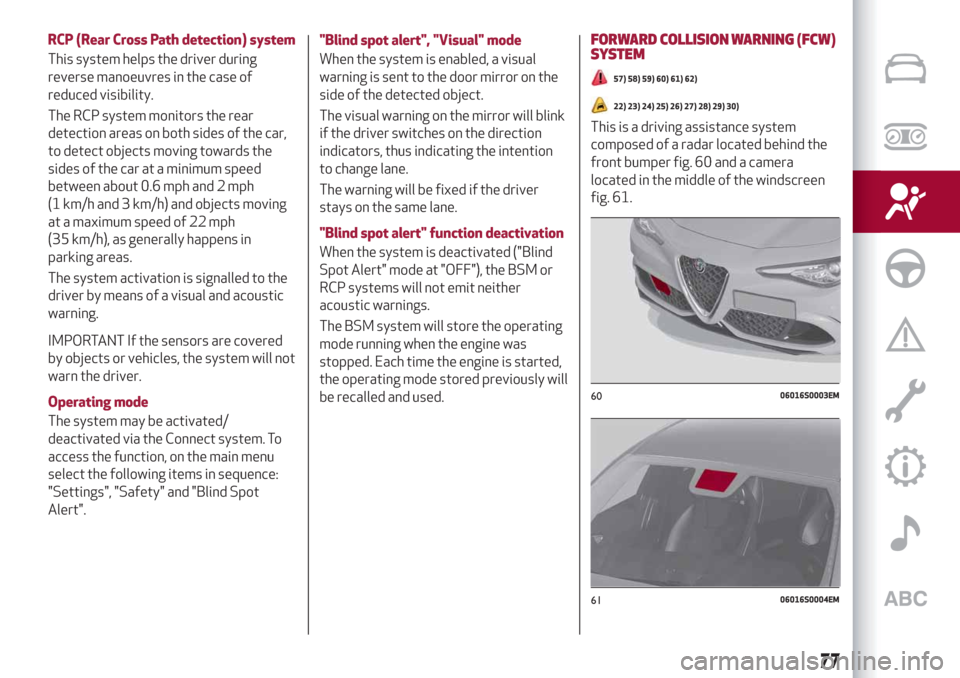
This is a driving assistance system
composed of a radar located behind the
front bumper fig. 60 and a camera
located in the middle of the windscreen
fig. 61.
6006016S0003EM
6106016S0004EM
77
Page 80 of 232
In the event of an imminent collision the
system intervenes by automatically
braking the car to prevent the impact or
reduce its effects.
The system provides the driver with
acoustic and visual signals through
specific messages on the instrument
panel display.
The acoustic and visual signals before the
system cuts in depend on the car speed.
No acoustic/visual signal is generated at
speeds slower than 30 km/h.
Acoustic/visual signal is generated at
speeds faster than 30 km/h, instead.
The system may lightly brake to warn the
driver if a possible frontal accident is
detected (limited braking). Signals and
limited braking are intended to allow the
driver to react promptly, in order to
prevent or reduce the effects of a
potential accident.
In situations with the risk of collision, if
the system detects no intervention by
the driver, it provides automatic braking
to help slow the car and mitigate the
potential frontal accident (automatic
braking). If intervention by the driver on
the brake pedal is detected but not
deemed sufficient, the system may
intervene in order to improve the
reaction of the braking system, therefore
reducing vehicle speed further
(additional assistance in braking stage).The system will intervene automatically
in case of imminent collision or impact
against a pedestrian crossing the road
(speed under 31 mph (50 km/h)).
IMPORTANT For safety reasons, when
the car has stopped, the brake callipers
may remain blocked for about 2 seconds.
Make sure you press the brake pedal if
the vehicle moves slightly forwards.
Engagement/disengagement
The Forward Collision Warning system
can be deactivated (and then reactivated)
via the Connect system. To access the
function, on the main menu select the
following items in sequence: "Settings",
"Safety", "Forward Collision Warning" and
"Status".
The system can be deactivated even with
the ignition device ON.
IMPORTANT The system status can be
changed with vehicle at a standstill only.
Activation/deactivation
The Forward Collision Warning system is
activated whenever the engine is started
regardless of the Connect system
setting.
After deactivation, the system will not
warn the driver about a possible collision
with the vehicle ahead, regardless of the
setting selected with the Connect
system.
IMPORTANT Each time the engine is
started, the system is activated
regardless of where was when it was
previously switched off.
This function is not active at a speed
lower than 4.3 mph (7 km/h) or higher
than 124 mph (200 km/h).
The system is active when:
each time the engine is started;
is active (ON) in the Connect system;
the ignition device is at ON;
- the vehicle speed is between 4.3 and
124 mph (7 and 200 km/h);
the front seat belts are fastened;
the "Alfa DNA™ Pro" selector is not in
RACE position (where present).
Changing the system sensitivity
The sensitivity of the system can be
changed through the Connect system
menu, choosing from one of the following
three options: "Near", "Med" or "Far". See
the description in the Connect system
supplement for how to change the
settings.
The default option is "Med". With this
setting, the system warns the driver of a
possible collision with the vehicle in front
when that vehicle is at a standard
distance, between that of the other two
settings.
With the system sensitivity set to "Far",
the system will warn the driver of a
possible accident with the vehicle in front
78
SAFETY
Page 85 of 232
the sensors. Using aftermarket tyre
sealants may damage the Tyre Pressure
Monitoring System (TPMS) sensor. If
aftermarket tyre sealant is used it is
recommended to go to an Alfa Romeo
Dealership to have the sensors checked.
After checking or adjusting the tyre
inflation pressure, always refit the valve
cap to prevent humidity and dirt from
entering, these may damage the Tyre
Pressure Monitoring System sensor.
LOW TYRE PRESSURE WARNING
If an insufficient pressure value is
detected on one or more tyres, the
warning light on the instrument panel
switches on and the dedicated messages
are shown on the display. The system also
highlights the tyre or tyres with
insufficient pressure graphically. An
acoustic warning is also emitted.
In this case, stop the car, check the
inflation pressure of each tyre and inflate
them to the correct cold inflation
pressure value, shown on the display or in
the dedicated TPMS menu.TPMS TEMPORARILY DISABLED
TPMS check message
If a system failure is present, the
warning light flashes for about
75 seconds and then stays on solid. An
acoustic warning is also emitted.
A dedicated message and dashes "– –"
instead of the pressure value are shown
on the display, to indicate that detection
is impossible.
When the ignition device is set to STOP
and then back to ON, the indication
sequence repeats provided that the
failure is still resent.
The
warning light switches off when
the failure condition disappears and the
pressure value is displayed again in place
of the dashes.
A fault in the system could occur in the
following cases:
intense radio-frequency interference
may prevent the correct operation of the
TPMS. This condition will be indicated by
a dedicated message on the display. The
warning will disappear automatically as
soon as the radio-frequency interference
ceases to affect the system;
aftermarket application of coloured
films on the windows that interfere with
the radio waves emitted by the TPMS;
accumulation of layers of snow or ice
on the wheels or the wheel arches;
using snow chains;
using a rim/tyre assembly without
sensors for the TPMS system.
After the punctured tyre has been
repaired with the original tyre sealant
contained in the TireKit, the previous
condition must be restored, so that the
warning light is off during normal
driving.
Deactivating TPMS messages
(for markets where provided)
When replacing the standard wheels with
others that do not have TPMS sensors
(for example when substituting the
rim/tyre assembly for the winter season)
and depending on the country of sale, the
messages only can be disabled
automatically at the next start-up after
the fault.
The TPMS will emit an acoustic warning,
the
warning light will flash for about
75 seconds, then it will stay on
continuously and the instrument panel
will display the "TPMS check" message
with dashes (– –) instead of the pressure
values on the Connect system display.
From the following ignition cycle, the
TPMS will not emit any acoustic warning
and the display will not show the
message "TPMS check", but the dashes
will be still displayed instead of the
pressure value.
The system will only resume normal
83