ignition ALFA ROMEO GIULIA 2021 Repair Manual
[x] Cancel search | Manufacturer: ALFA ROMEO, Model Year: 2021, Model line: GIULIA, Model: ALFA ROMEO GIULIA 2021Pages: 284, PDF Size: 8.87 MB
Page 221 of 284
219
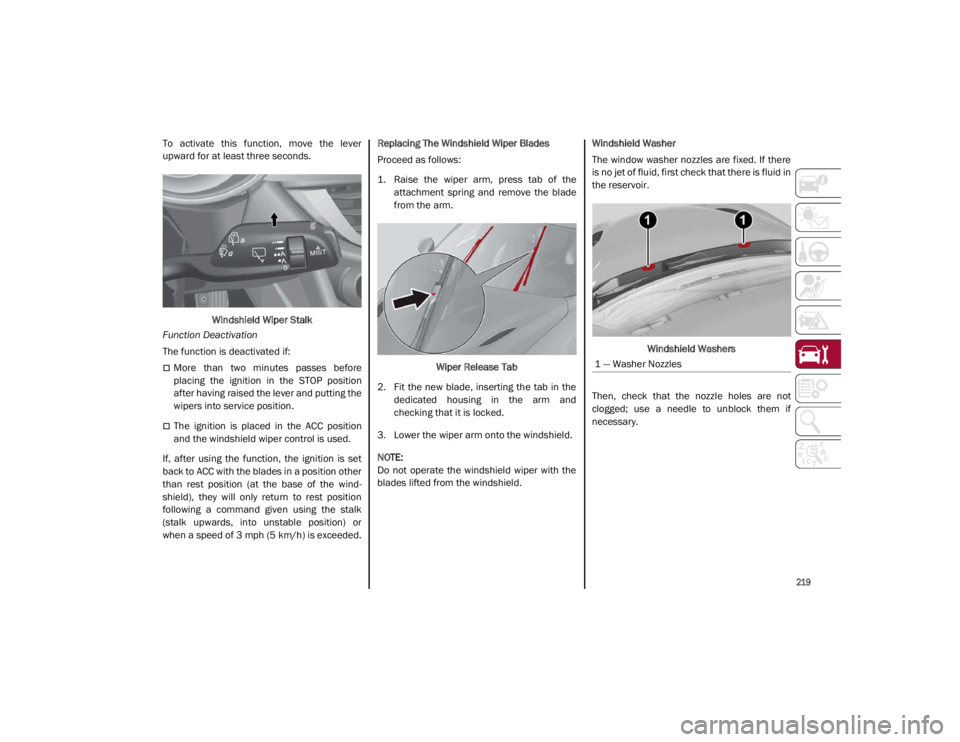
To activate this function, move the lever
upward for at least three seconds.Windshield Wiper Stalk
Function Deactivation
The function is deactivated if:
More than two minutes passes before
placing the ignition in the STOP position
after having raised the lever and putting the
wipers into service position.
The ignition is placed in the ACC position
and the windshield wiper control is used.
If, after using the function, the ignition is set
back to ACC with the blades in a position other
than rest position (at the base of the wind -
shield), they will only return to rest position
following a command given using the stalk
(stalk upwards, into unstable position) or
when a speed of 3 mph (5 km/h) is exceeded. Replacing The Windshield Wiper Blades
Proceed as follows:
1. Raise the wiper arm, press tab of the attachment spring and remove the blade
from the arm.
Wiper Release Tab
2. Fit the new blade, inserting the tab in the dedicated housing in the arm and
checking that it is locked.
3. Lower the wiper arm onto the windshield.
NOTE:
Do not operate the windshield wiper with the
blades lifted from the windshield. Windshield Washer
The window washer nozzles are fixed. If there
is no jet of fluid, first check that there is fluid in
the reservoir.
Windshield Washers
Then, check that the nozzle holes are not
clogged; use a needle to unblock them if
necessary.
1 — Washer Nozzles
21_GA_OM_EN_USC_t.book Page 219
Page 222 of 284
SERVICING AND MAINTENANCE
220
Exhaust System
Adequate maintenance of the engine exhaust
system represents the best protection against
leaks of carbon monoxide into the passenger
compartment.
If an unusual noise from the exhaust or the
presence of smoke in the passenger compart-
ment is identified, or if the underbody or rear
section of the vehicle have been damaged,
have the entire exhaust system and adjoining
bodywork areas checked at an authorized
dealer to identify any components which are
broken, damaged, worn or have moved from
their correct fitting position.
Open welding or loose connections may permit
exhaust gas to enter the passenger compart -
ment.
Have the exhaust system checked every time
the vehicle is raised. Replace the components
where necessary (for these operations,
contact an authorized dealer).
In normal operating conditions, the catalytic
converter does not require maintenance. To
ensure that it operates correctly, however, and
prevent it from getting damaged, it is
extremely important that the engine operates
perfectly. To minimize the risk of damaging the catalytic
converter, proceed as follows:Do not stop the engine or deactivate the
ignition with gear engaged and vehicle in
motion.
Do not attempt to start the engine by bump
starting.
Do not persist in using the vehicle if idling is
very irregular or the operating conditions
are very notably irregular.
Engine Cooling System
Coolant Check
Your vehicle has two cooling systems and they
both need to be checked to ensure they are at
proper fill levels.
Check the engine coolant and intercooler
coolant level every oil change or before long
trips.
If there are impurities in the engine coolant,
the system must be drained, flushed and
refilled: contact an authorized dealer.
WARNING!
Exhaust gases can injure or kill. They
contain carbon monoxide (CO), which is
colorless and odorless. Breathing it can
make you unconscious and can eventually
poison you.
A hot exhaust system can start a fire if you
park over materials that can burn. Such
materials might be grass or leaves coming
into contact with your exhaust system. Do
not park or operate your vehicle in areas
where your exhaust system can contact
anything that can burn.
WARNING!
You or others can be badly burned by hot
engine coolant (antifreeze) or steam from
your radiator. If you see or hear steam
coming from under the hood, do not open
the hood until the radiator has had time to
cool. Never open a cooling system pres
-
sure cap when the radiator or coolant
bottle is hot.
Keep hands, tools, clothing, and jewelry
away from the radiator cooling fan when
the hood is raised. The fan starts automat -
ically and may start at any time, whether
the engine is running or not.
When working near the radiator cooling
fan, disconnect the fan motor lead or turn
the ignition to the OFF mode. The fan is
temperature controlled and can start at
any time the ignition is in the ON mode.
21_GA_OM_EN_USC_t.book Page 220
Page 225 of 284
223
(Continued)
Replacing The Battery
If necessary, replace the battery with another
battery with the same specifications. It is
advised to contact an authorized dealer for
replacement.
Follow the battery manufacturer's instructions
for maintenance.
NOTE:
It will not be possible to open the trunk with a
key or by pressing the button in the passenger
compartment when the battery is discon-
nected. So, always position the manual trunk
opening strap on the trunk lock before discon -
necting the battery
Ú
page 250.
FUSES
General Information
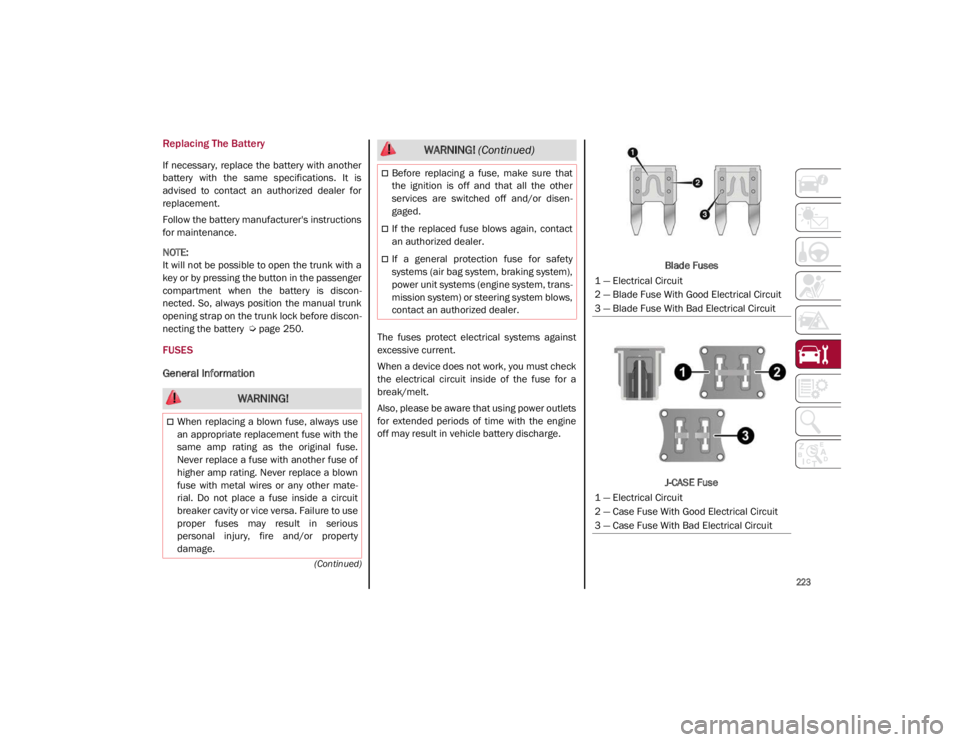
The fuses protect electrical systems against
excessive current.
When a device does not work, you must check
the electrical circuit inside of the fuse for a
break/melt.
Also, please be aware that using power outlets
for extended periods of time with the engine
off may result in vehicle battery discharge. Blade Fuses
J-CASE Fuse
WARNING!
When replacing a blown fuse, always use
an appropriate replacement fuse with the
same amp rating as the original fuse.
Never replace a fuse with another fuse of
higher amp rating. Never replace a blown
fuse with metal wires or any other mate -
rial. Do not place a fuse inside a circuit
breaker cavity or vice versa. Failure to use
proper fuses may result in serious
personal injury, fire and/or property
damage.
Before replacing a fuse, make sure that
the ignition is off and that all the other
services are switched off and/or disen -
gaged.
If the replaced fuse blows again, contact
an authorized dealer.
If a general protection fuse for safety
systems (air bag system, braking system),
power unit systems (engine system, trans -
mission system) or steering system blows,
contact an authorized dealer.
WARNING! (Continued)
1 — Electrical Circuit
2 — Blade Fuse With Good Electrical Circuit
3 — Blade Fuse With Bad Electrical Circuit
1 — Electrical Circuit
2 — Case Fuse With Good Electrical Circuit
3 — Case Fuse With Bad Electrical Circuit
21_GA_OM_EN_USC_t.book Page 223
Page 253 of 284
251
If the battery is not disconnected from the
electrical system, check its state of charge
every 30 days.
Clean and protect the painted parts using
protective wax.
Clean and protect the shiny metal parts
using special compounds available
commercially.
Sprinkle talcum powder on the windshield
wiper rubber blades, and lift them off the
glass.
Cover the vehicle with a fabric or perforated
plastic sheet, paying particular care not to
damage the painted surface by dragging
any dust that may have accumulated on it.
Do not use compact plastic sheets, as they
do not allow humidity to evaporate from the
surface of the vehicle.
Inflate tires to +7.25 psi (+0.5 bar) above
the standard prescribed pressure and
check it periodically.
Do not drain the engine cooling system.
Any time the vehicle is left inactive for two
weeks or more, operate the air conditioning
system with engine idling for at least five
minutes, setting external air and with fan
set to maximum speed. This operation will
ensure appropriate lubrication for the
system, thus minimizing the possibility of
damage to the compressor when the
system is operated again.
NOTE:
After placing the ignition in STOP and having
closed the driver side door, wait at least one
minute before disconnecting the electrical
supply from the battery. When reconnecting
the electrical supply to the battery, make sure
that the ignition is in the STOP position and the
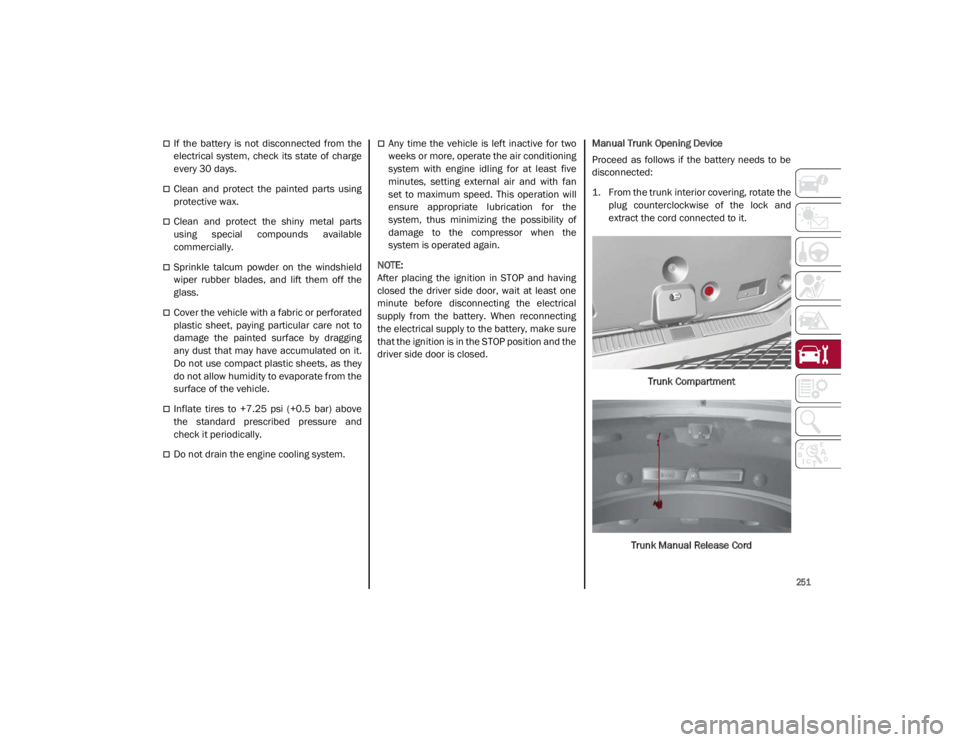
driver side door is closed. Manual Trunk Opening Device
Proceed as follows if the battery needs to be
disconnected:
1. From the trunk interior covering, rotate the
plug counterclockwise of the lock and
extract the cord connected to it.
Trunk Compartment
Trunk Manual Release Cord
21_GA_OM_EN_USC_t.book Page 251
Page 255 of 284
253
Dry the less visible parts (e.g. door frames,
hood, headlight frames, etc.) with special care,
as water may stagnate more easily in these
areas. Do not wash the car after it has been
left in the sun or with the hood hot: this may
alter the shine of the paintwork.
Exterior plastic parts must be cleaned in the
same way as the rest of the vehicle.
If washing the car in a service that moves the
car, for cars with automatic transmissions,
PARK (P) must be cut out. You have to shut off
the engine in the following conditions: car
stopped, transmission in NEUTRAL (N), push
the starter button for at least three seconds.
NOTE:
Avoid parking under trees; the resin dropped
by trees makes the paintwork go opaque and
increases the possibility of corrosion.
Windows
Use specific detergents and clean cloths to
prevent scratching or altering the transpar -
ency. Front Headlights
Use a soft cloth soaked in water and detergent
for washing cars.
NOTE:
Never use aromatic substances (e.g. gaso -
line) or ketones (e.g. acetone) for cleaning
the plastic lenses of the headlights.
When cleaning with a pressure washer,
keep the pressure washer at least eight
inches (20 cm) away from the headlights.
Engine Compartment
At the end of every Winter, wash the engine
compartment thoroughly, taking care not to
aim the jet of water directly at the electronic
control units or at the windshield wiper
motors. Have this operation performed at a
specialized workshop. For further information
Ú
page 215.
NOTE:
The washing should take place with the engine
cold and the ignition device in the STOP posi -
tion. After the washing operation, make sure
that the various protections (e.g. rubber caps
and guards) have not been removed or
damaged.
INTERIORS
Periodically check the cleanliness of the inte -
rior, beneath the mats, which could cause
oxidation of the sheet metal.
Seats And Fabric Parts
Remove dust with a soft brush or a vacuum
cleaner. Rub the seats with a sponge moist -
ened with a solution of water and neutral
detergent.
Cleaning heat press images on seats — if
equipped:
Due to the color, opacity and wear-resistant
protection with which the heat press images
on some seats are made, they may be subject
to temporary scratching if they are touched by
finger nails, keys, or other hard objects. In
such cases, the visible signs do not impair the
profiled images, and can easily be removed by
wiping the affected area with a microfiber
cloth moistened with water (not dry) to restore
the seat to its original condition. The micro -
fiber cloth must not have been previously
soaked in other substances or detergents.
CAUTION!
Wipe the rear window inside gently with a
cloth following the direction of the filaments
to avoid damaging the heating device.
21_GA_OM_EN_USC_t.book Page 253
Page 266 of 284
TECHNICAL SPECIFICATIONS
264
(Continued)
Materials Added To Fuel
Besides using unleaded gasoline with the
proper octane rating, gasolines that contain
detergents, corrosion and stability additives
are recommended. Using gasolines that have
these additives will help improve fuel
economy, reduce emissions, and maintain
vehicle performance.Designated TOP TIER Detergent
Gasoline contains a higher level of
detergents to further aide in mini -
mizing engine and fuel system
deposits. When available, the usage of TOP
TIER Detergent Gasoline is recommended.
Visit
www.toptiergas.com
for a list of TOP TIER
Detergent Gasoline Retailers.
Indiscriminate use of fuel system cleaning
agents should be avoided. Many of these
materials intended for gum and varnish
removal may contain active solvents or similar
ingredients. These can harm fuel system
gasket and diaphragm materials.
Fuel System Cautions
NOTE:
Intentional tampering with the emissions
control system can result in civil penalties
being assessed against you.
CAUTION!
Follow these guidelines to maintain your
vehicle’s performance:
The use of leaded gasoline is prohibited by
Federal law. Using leaded gasoline can
impair engine performance and damage
the emissions control system.
An out-of-tune engine or certain fuel or
ignition malfunctions can cause the cata -
lytic converter to overheat. If you notice a
pungent burning odor or some light
smoke, your engine may be out of tune or
malfunctioning and may require imme -
diate service. Contact an authorized
dealer for service assistance.
The use of fuel additives, which are now
being sold as octane enhancers, is not
recommended. Most of these products
contain high concentrations of methanol.
Fuel system damage or vehicle perfor -
mance problems resulting from the use of
such fuels or additives is not the responsi -
bility of FCA US LLC and may void or not be
covered under the New Vehicle Limited
Warranty.
CAUTION! (Continued)
21_GA_OM_EN_USC_t.book Page 264
Page 277 of 284

275
Door Ajar ................................................ 78, 79
Door Ajar Light ....................................... 78, 79
Door LocksAutomatic ................................................. 26
Door Opener, Garage ................................... 38
Drive Train Control (DTC) System ..............142
Driving Modes .............................................. 99
Dynamic Steering Torque (DST) System ... 142
E
Electric Park Brake....................................... 90
Electronic Speed Control
(Cruise Control) ..........................................105
Electronic Stability Control (ESC)
System ........................................................142
Electronic Throttle Control Warning
Light .............................................................. 78
Emergency In Case Of ......................................190, 194
SOS Emergency Call .............................. 190
Emergency, In Case Of Jump Starting .........................................198
Overheating ............................................ 200
Tow Hooks ..............................................202
Towing.....................................................201
Emission Control System Maintenance...... 85
Engine ......................................................... 256 Block Heater............................................. 89
Engine Coolant Level .............................214
Exhaust Gas Caution .............................189
Fuel Requirements ................................ 263Jump Starting .........................................199
Overheating ............................................ 200
Engine Compartment .................................211
Engine Compartment (Washing) ...............253 Engine Oil
Level Check............................................ 213
Enhanced Accident Response
Feature .............................................. 172, 203
Ethanol ....................................................... 263
Exhaust Gas Cautions ............................... 189
Exhaust System ......................................... 189
Exterior Lights ............................ 42, 188, 231
F
Flashers Turn Signals .................................... 77, 188
Fluid Leaks ................................................. 188
Fog Lights, Rear ........................................... 44
Forward Collision Warning ........................ 151
Fuel Additives................................................. 264
Clean Air ................................................. 263
Ethanol ................................................... 263
Light .......................................................... 79
Materials Added .................................... 264
Methanol ................................................ 263
Fuses ................................................. 223, 224
G
Garage Door Opener (HomeLink) ............... 38
Gasoline, Clean Air .................................... 263
Gasoline, Reformulated ............................ 263
Gauges Engine Oil Temperature .......................... 67
Fuel ........................................................... 68
Speedometer ........................................... 68
Tachometer .............................................. 67 Glove Compartment Storage .......................55
GVWR ......................................................... 137
H
Hazard Warning Flashers.......................... 190
Head Restraints............................................35
Head Rests ...................................................35
Headlights .....................................................42 Automatic..................................................42
Delay .........................................................43
High Beam ................................................42
Switch .......................................................42
Headlights (Cleaning) ................................ 253
Heated Mirrors..............................................38
Heated Seats ......................................... 33, 34
Heated Steering Wheel ................................27
Heater, Engine Block.................................... 89
Hill Start Assist (HSA) System ................... 143
HomeLink (Garage Door Opener) ................38
Hood Closing ......................................................62Opening.....................................................62
Hood Release ...............................................62
I
Ignition ..........................................................19 Switch .......................................................19
Immobilizer (Sentry Key) ..............................18
In Case Of Emergency ............................... 190
Installing Electrical/Electronic Devices......... 3
Instrument Cluster Descriptions..............................................77
Display ......................................................68
21_GA_OM_EN_USC_t.book Page 275