pad Alfa Romeo Giulietta 2013 Owner handbook (in English)
[x] Cancel search | Manufacturer: ALFA ROMEO, Model Year: 2013, Model line: Giulietta, Model: Alfa Romeo Giulietta 2013Pages: 292, PDF Size: 13.06 MB
Page 11 of 292
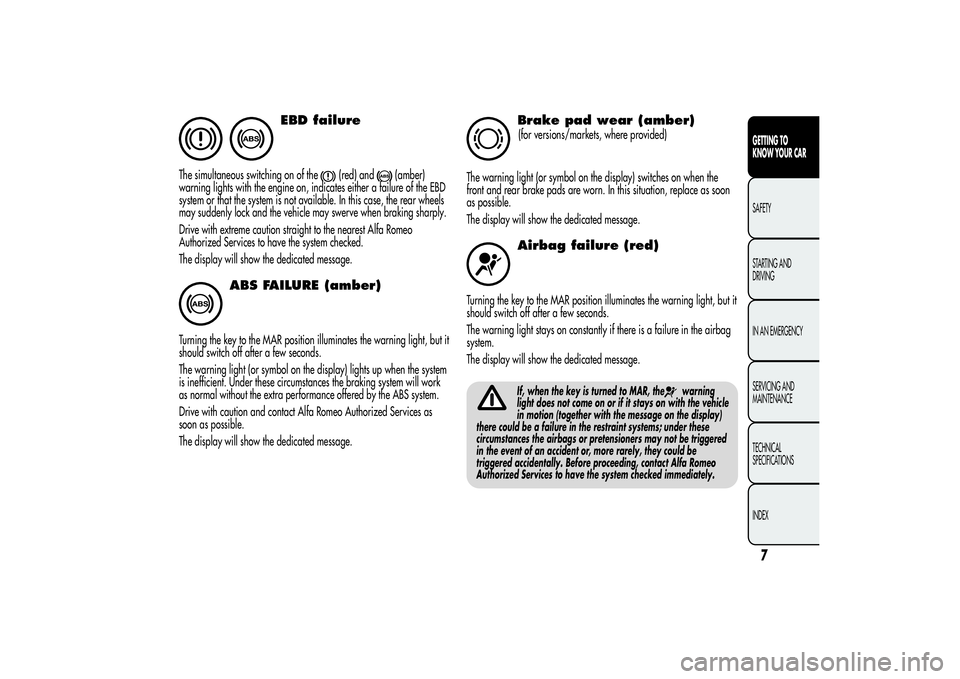
EBD failure
The simultaneous switching on of the
(red) and
(amber)
warning lights with the engine on, indicates either a failure of the EBD
system or that the system is not available. In this case, the rear wheels
may suddenly lock and the vehicle may swerve when braking sharply.
Drive with extreme caution straight to the nearest Alfa Romeo
Authorized Services to have the system checked.
The display will show the dedicated message.
ABS FAILURE (amber)
Turning the key to the MAR position illuminates the warning light, but it
should switch off after a few seconds.
The warning light (or symbol on the display) lights up when the system
is inefficient. Under these circumstances the braking system will work
as normal without the extra performance offered by the ABS system.
Drive with caution and contact Alfa Romeo Authorized Services as
soon as possible.
The display will show the dedicated message.
Brake pad wear (amber)(for versions/markets, where provided)
The warning light (or symbol on the display) switches on when the
front and rear brake pads are worn. In this situation, replace as soon
as possible.
The display will show the dedicated message.Airbag failure (red)
Turning the key to the MAR position illuminates the warning light, but it
should switch off after a few seconds.
The warning light stays on constantly if there is a failure in the airbag
system.
The display will show the dedicated message.
If, when the key is turned to MAR, the
warning
light does not come on or if it stays on with the vehicle
in motion (together with the message on the display)
there could be a failure in the restraint systems; under these
circumstances the airbags or pretensioners may not be triggered
in the event of an accident or, more rarely, they could be
triggered accidentally. Before proceeding, contact Alfa Romeo
Authorized Services to have the system checked immediately.
7GETTING TO
KNOW YOUR CARSAFETY
STARTING AND
DRIVING
IN AN EMERGENCY
SERVICING AND
MAINTENANCE
TECHNICAL
SPECIFICATIONS
INDEX
Page 103 of 292
DST SYSTEM
(Dynamic Steering Torque)This function integrates Dual Pinion active steering into the operation of
ESC. For particular manoeuvres, the ESC system controls the steering
to actuate a steering torque and assist the driver in the best possible
way.
The system operates the brakes and steering in a coordinated manner
to increase the suspension and safety level of the car as a whole.
The steering provides additional torque on the steering wheel.RAB SYSTEM (Ready Alert Brakes)
(only with “Dynamic” mode
engaged)It is a function that achieves a pre-positioning of the brake pads (front
and rear) following a rapid release of the accelerator pedal to reduce
braking times, shortening stopping distances.
“Alfa DNA” SYSTEM
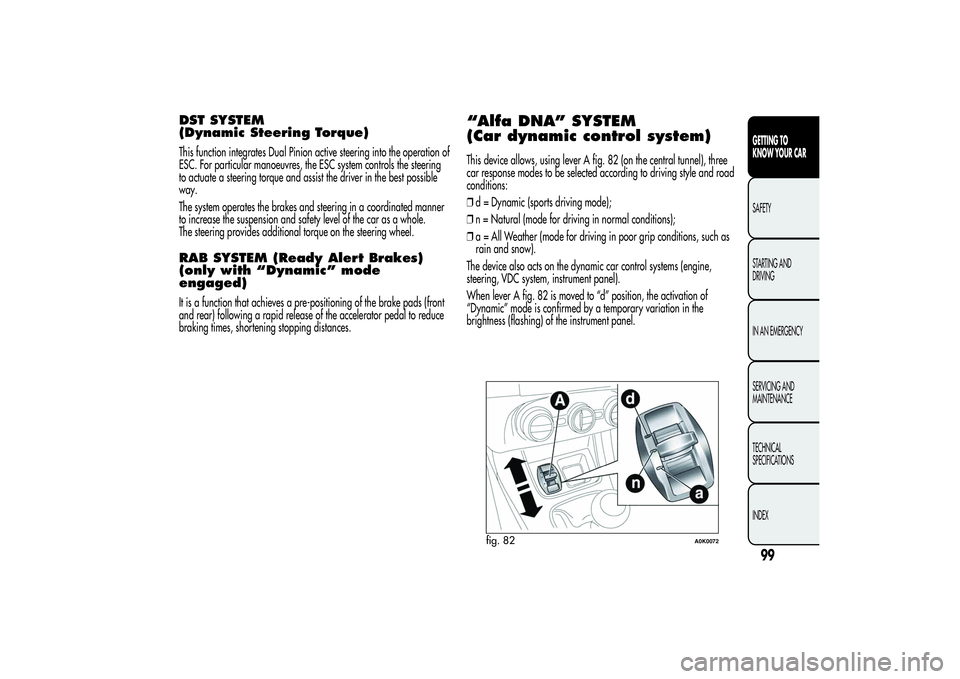
(Car dynamic control system)This device allows, using lever A fig. 82 (on the central tunnel), three
car response modes to be selected according to driving style and road
conditions:
❒d = Dynamic (sports driving mode);
❒n = Natural (mode for driving in normal conditions);
❒a = All Weather (mode for driving in poor grip conditions, such as
rain and snow).
The device also acts on the dynamic car control systems (engine,
steering, VDC system, instrument panel).
When lever A fig. 82 is moved to “d” position, the activation of
“Dynamic” mode is confirmed by a temporary variation in the
brightness (flashing) of the instrument panel.
fig. 82
A0K0072
99GETTING TO
KNOW YOUR CARSAFETY
STARTING AND
DRIVING
IN AN EMERGENCY
SERVICING AND
MAINTENANCE
TECHNICAL
SPECIFICATIONS
INDEX
Page 105 of 292
DST:braking standard control coordinated with ABS/ESC. Standard
control over lateral acceleration. Oversteering compensation
depending on the ESC/ASR intervention thresholds: a slight movement
on the steering wheel encourages the driver to carry out the most
appropriate manoeuvre.
Engine:prompter response + Overboost to maximise torque (for
versions/markets, where provided).
Electronic Q2:improves traction and reduces understeer in
acceleration while exiting curves.
RAB:by pre-positioning of the brake pads (front and rear) following a
rapid release of the accelerator pedal to reduce braking times, shorten
stopping distances and improve the brake pedal feeling.
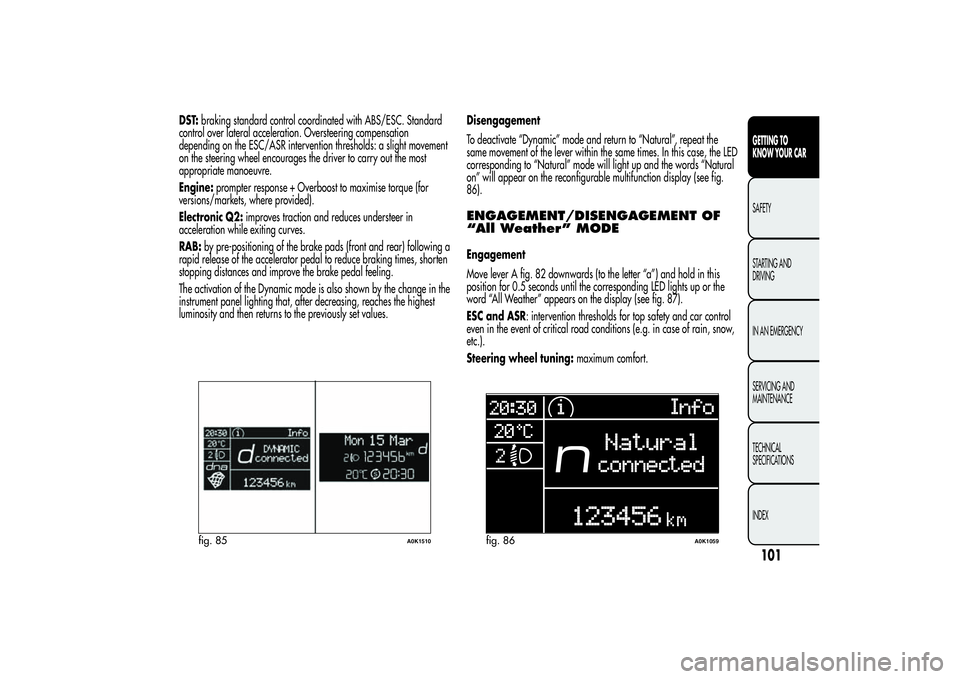
The activation of the Dynamic mode is also shown by the change in the
instrument panel lighting that, after decreasing, reaches the highest
luminosity and then returns to the previously set values.Disengagement
To deactivate “Dynamic” mode and return to “Natural”, repeat the
same movement of the lever within the same times. In this case, the LED
corresponding to “Natural” mode will light up and the words “Natural
on” will appear on the reconfigurable multifunction display (see fig.
86).
ENGAGEMENT/DISENGAGEMENT OF
“All Weather” MODEEngagement
Move lever A fig. 82 downwards (to the letter “a”) and hold in this
position for 0.5 seconds until the corresponding LED lights up or the
word “All Weather” appears on the display (see fig. 87).
ESC and ASR: intervention thresholds for top safety and car control
even in the event of critical road conditions (e.g. in case of rain, snow,
etc.).
Steering wheel tuning:maximum comfort.
fig. 85
A0K1510
fig. 86
A0K1059
101GETTING TO
KNOW YOUR CARSAFETY
STARTING AND
DRIVING
IN AN EMERGENCY
SERVICING AND
MAINTENANCE
TECHNICAL
SPECIFICATIONS
INDEX
Page 182 of 292
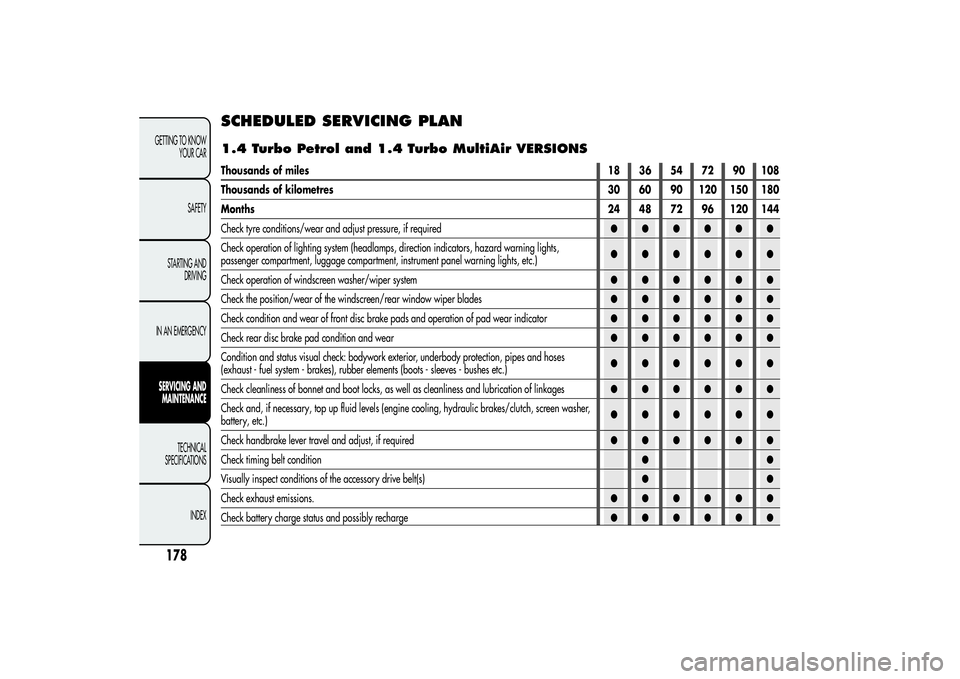
SCHEDULED SERVICING PLAN1.4 Turbo Petrol and 1.4 Turbo MultiAir VERSIONSThousands of miles18 36 54 72 90 108
Thousands of kilometres 30 60 90 120 150 180
Months24 48 72 96 120 144
Check tyre conditions/wear and adjust pressure, if required●●●●●●
Check operation of lighting system (headlamps, direction indicators, hazard warning lights,
passenger compartment, luggage compartment, instrument panel warning lights, etc.)●●●●●●
Check operation of windscreen washer/wiper system●●●●●●
Check the position/wear of the windscreen/rear window wiper blades●●●●●●
Check condition and wear of front disc brake pads and operation of pad wear indicator●●●●●●
Check rear disc brake pad condition and wear●●●●●●
Condition and status visual check: bodywork exterior, underbody protection, pipes and hoses
(exhaust - fuel system - brakes), rubber elements (boots - sleeves - bushes etc.)●●●●●●
Check cleanliness of bonnet and boot locks, as well as cleanliness and lubrication of linkages●●●●●●
Check and, if necessary, top up fluid levels (engine cooling, hydraulic brakes/clutch, screen washer,
battery, etc.)●●●●●●
Check handbrake lever travel and adjust, if required●●●●●●
Check timing belt condition●●
Visually inspect conditions of the accessory drive belt(s)●●
Check exhaust emissions.●●●●●●
Check battery charge status and possibly recharge●●●●●●
178GETTING TO KNOW
YOUR CAR
SAFETY
STARTING AND
DRIVING
IN AN EMERGENCYSERVICING AND
MAINTENANCE
TECHNICAL
SPECIFICATIONS
INDEX
Page 184 of 292
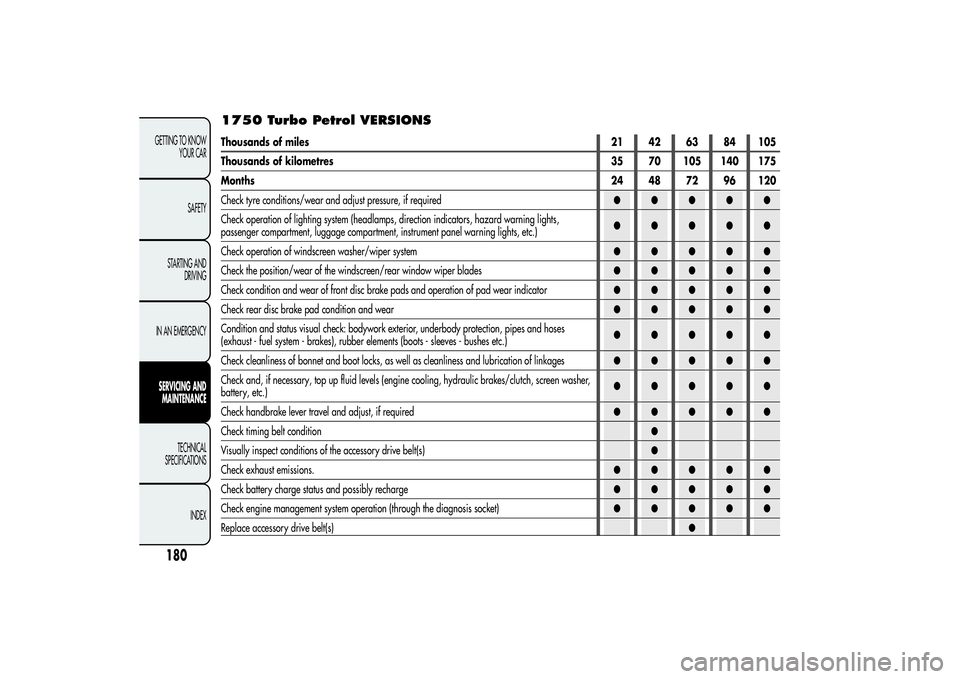
1750 Turbo Petrol VERSIONSThousands of miles21 42 63 84 105
Thousands of kilometres 35 70 105 140 175
Months24 48 72 96 120
Check tyre conditions/wear and adjust pressure, if required●●●●●
Check operation of lighting system (headlamps, direction indicators, hazard warning lights,
passenger compartment, luggage compartment, instrument panel warning lights, etc.)●●●●●
Check operation of windscreen washer/wiper system●●●●●
Check the position/wear of the windscreen/rear window wiper blades●●●●●
Check condition and wear of front disc brake pads and operation of pad wear indicator●●●●●
Check rear disc brake pad condition and wear●●●●●
Condition and status visual check: bodywork exterior, underbody protection, pipes and hoses
(exhaust - fuel system - brakes), rubber elements (boots - sleeves - bushes etc.)●●●●●
Check cleanliness of bonnet and boot locks, as well as cleanliness and lubrication of linkages●●●●●
Check and, if necessary, top up fluid levels (engine cooling, hydraulic brakes/clutch, screen washer,
battery, etc.)●●●●●
Check handbrake lever travel and adjust, if required●●●●●
Check timing belt condition●
Visually inspect conditions of the accessory drive belt(s)●
Check exhaust emissions.●●●●●
Check battery charge status and possibly recharge●●●●●
Check engine management system operation (through the diagnosis socket)●●●●●
Replace accessory drive belt(s)●
180GETTING TO KNOW
YOUR CAR
SAFETY
STARTING AND
DRIVING
IN AN EMERGENCYSERVICING AND
MAINTENANCE
TECHNICAL
SPECIFICATIONS
INDEX
Page 186 of 292
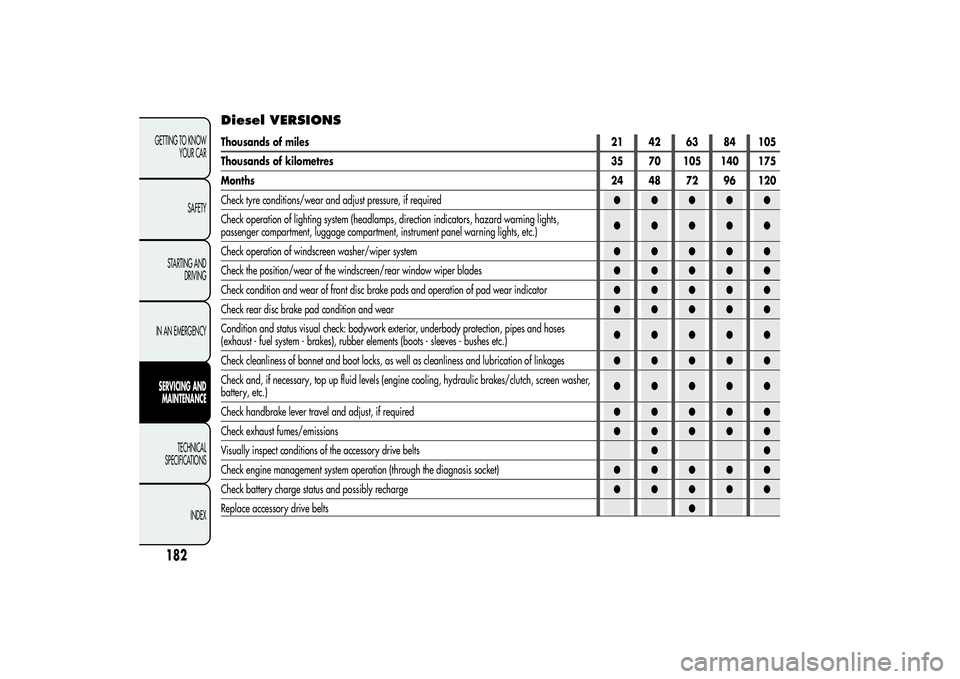
Diesel VERSIONSThousands of miles21 42 63 84 105
Thousands of kilometres 35 70 105 140 175
Months24 48 72 96 120
Check tyre conditions/wear and adjust pressure, if required●●●●●
Check operation of lighting system (headlamps, direction indicators, hazard warning lights,
passenger compartment, luggage compartment, instrument panel warning lights, etc.)●●●●●
Check operation of windscreen washer/wiper system●●●●●
Check the position/wear of the windscreen/rear window wiper blades●●●●●
Check condition and wear of front disc brake pads and operation of pad wear indicator●●●●●
Check rear disc brake pad condition and wear●●●●●
Condition and status visual check: bodywork exterior, underbody protection, pipes and hoses
(exhaust - fuel system - brakes), rubber elements (boots - sleeves - bushes etc.)●●●●●
Check cleanliness of bonnet and boot locks, as well as cleanliness and lubrication of linkages●●●●●
Check and, if necessary, top up fluid levels (engine cooling, hydraulic brakes/clutch, screen washer,
battery, etc.)●●●●●
Check handbrake lever travel and adjust, if required●●●●●
Check exhaust fumes/emissions●●●●●
Visually inspect conditions of the accessory drive belts●●
Check engine management system operation (through the diagnosis socket)●●●●●
Check battery charge status and possibly recharge●●●●●
Replace accessory drive belts●
182GETTING TO KNOW
YOUR CAR
SAFETY
STARTING AND
DRIVING
IN AN EMERGENCYSERVICING AND
MAINTENANCE
TECHNICAL
SPECIFICATIONS
INDEX
Page 188 of 292
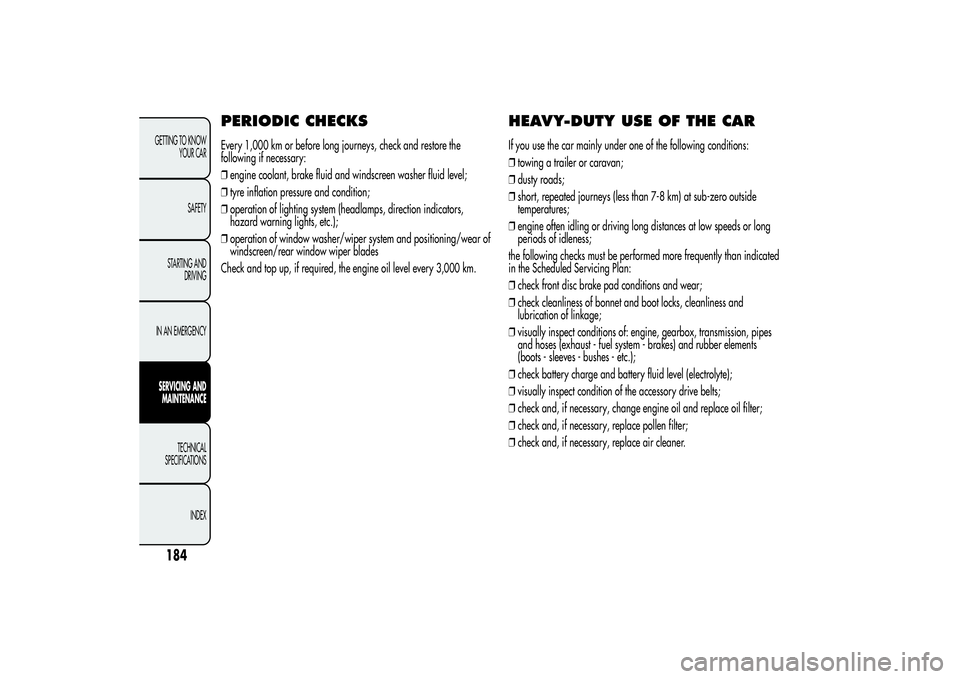
PERIODIC CHECKSEvery 1,000 km or before long journeys, check and restore the
following if necessary:
❒engine coolant, brake fluid and windscreen washer fluid level;
❒tyre inflation pressure and condition;
❒operation of lighting system (headlamps, direction indicators,
hazard warning lights, etc.);
❒operation of window washer/wiper system and positioning/wear of
windscreen/rear window wiper blades
Check and top up, if required, the engine oil level every 3,000 km.
HEAVY-DUTY USE OF THE CARIf you use the car mainly under one of the following conditions:
❒towing a trailer or caravan;
❒dusty roads;
❒short, repeated journeys (less than 7-8 km) at sub-zero outside
temperatures;
❒engine often idling or driving long distances at low speeds or long
periods of idleness;
the following checks must be performed more frequently than indicated
in the Scheduled Servicing Plan:
❒check front disc brake pad conditions and wear;
❒check cleanliness of bonnet and boot locks, cleanliness and
lubrication of linkage;
❒visually inspect conditions of: engine, gearbox, transmission, pipes
and hoses (exhaust - fuel system - brakes) and rubber elements
(boots - sleeves - bushes - etc.);
❒check battery charge and battery fluid level (electrolyte);
❒visually inspect condition of the accessory drive belts;
❒check and, if necessary, change engine oil and replace oil filter;
❒check and, if necessary, replace pollen filter;
❒check and, if necessary, replace air cleaner.
184GETTING TO KNOW
YOUR CAR
SAFETY
STARTING AND
DRIVING
IN AN EMERGENCYSERVICING AND
MAINTENANCE
TECHNICAL
SPECIFICATIONS
INDEX