ignition Alfa Romeo Giulietta 2016 Owner's Guide
[x] Cancel search | Manufacturer: ALFA ROMEO, Model Year: 2016, Model line: Giulietta, Model: Alfa Romeo Giulietta 2016Pages: 288, PDF Size: 7.34 MB
Page 53 of 288
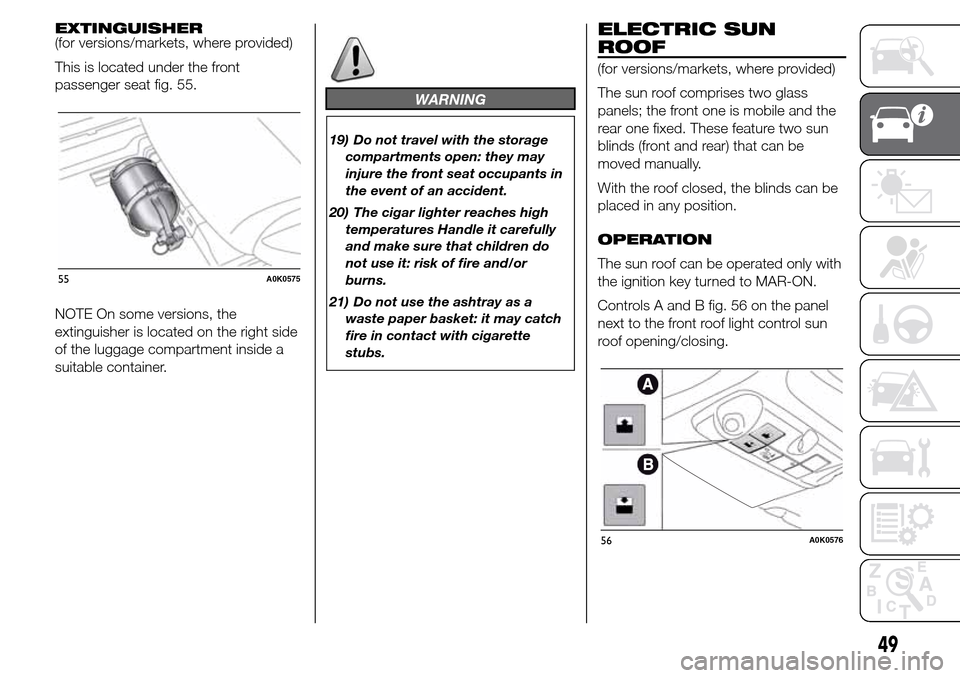
EXTINGUISHER
(for versions/markets, where provided)
This is located under the front
passenger seat fig. 55.
NOTE On some versions, the
extinguisher is located on the right side
of the luggage compartment inside a
suitable container.
WARNING
19) Do not travel with the storage
compartments open: they may
injure the front seat occupants in
the event of an accident.
20) The cigar lighter reaches high
temperatures Handle it carefully
and make sure that children do
not use it: risk of fire and/or
burns.
21) Do not use the ashtray as a
waste paper basket: it may catch
fire in contact with cigarette
stubs.
ELECTRIC SUN
ROOF
(for versions/markets, where provided)
The sun roof comprises two glass
panels; the front one is mobile and the
rear one fixed. These feature two sun
blinds (front and rear) that can be
moved manually.
With the roof closed, the blinds can be
placed in any position.
OPERATION
The sun roof can be operated only with
the ignition key turned to MAR-ON.
Controls A and B fig. 56 on the panel
next to the front roof light control sun
roof opening/closing.
55A0K0575
56A0K0576
49
Page 55 of 288
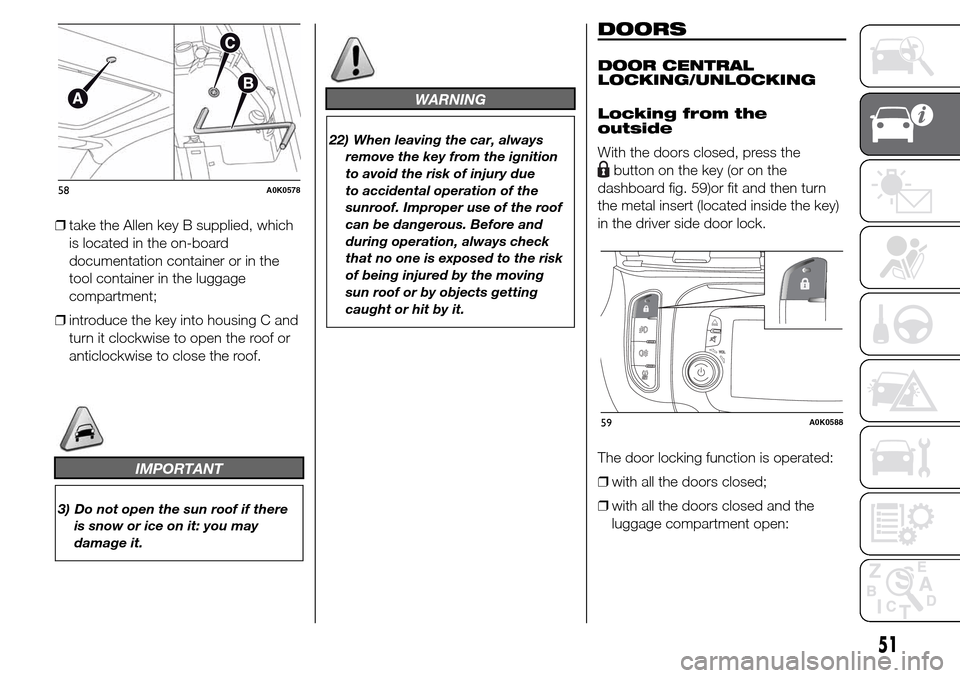
❒take the Allen key B supplied, which
is located in the on-board
documentation container or in the
tool container in the luggage
compartment;
❒introduce the key into housing C and
turn it clockwise to open the roof or
anticlockwise to close the roof.
IMPORTANT
3) Do not open the sun roof if there
is snow or ice on it: you may
damage it.
WARNING
22) When leaving the car, always
remove the key from the ignition
to avoid the risk of injury due
to accidental operation of the
sunroof. Improper use of the roof
can be dangerous. Before and
during operation, always check
that no one is exposed to the risk
of being injured by the moving
sun roof or by objects getting
caught or hit by it.
DOORS
DOOR CENTRAL
LOCKING/UNLOCKING
Locking from the
outside
With the doors closed, press the
button on the key (or on the
dashboard fig. 59)or fit and then turn
the metal insert (located inside the key)
in the driver side door lock.
The door locking function is operated:
❒with all the doors closed;
❒with all the doors closed and the
luggage compartment open:
58A0K0578
59A0K0588
51
Page 56 of 288
Door unlocking from the
outside
Press the
button on the key or turn
the metal insert (located inside the key)
in the driver side door lock.
Door locking/unlocking
from the inside
Press button
fig. 59 on the
dashboard.
IMPORTANT With central locking
active, pulling the internal opening lever
of the passenger side door unlocks
the door itself. Pulling the internal
opening lever of the driver side door
activates central unlocking.
IMPORTANT The rear doors cannot be
opened from the inside when the child
lock device is engaged.
In the absence of electrical power
supply (e.g. blown fuse, battery
disconnected, etc.) it is still possible to
lock the doors manually.
CHILD SAFETY DEVICE
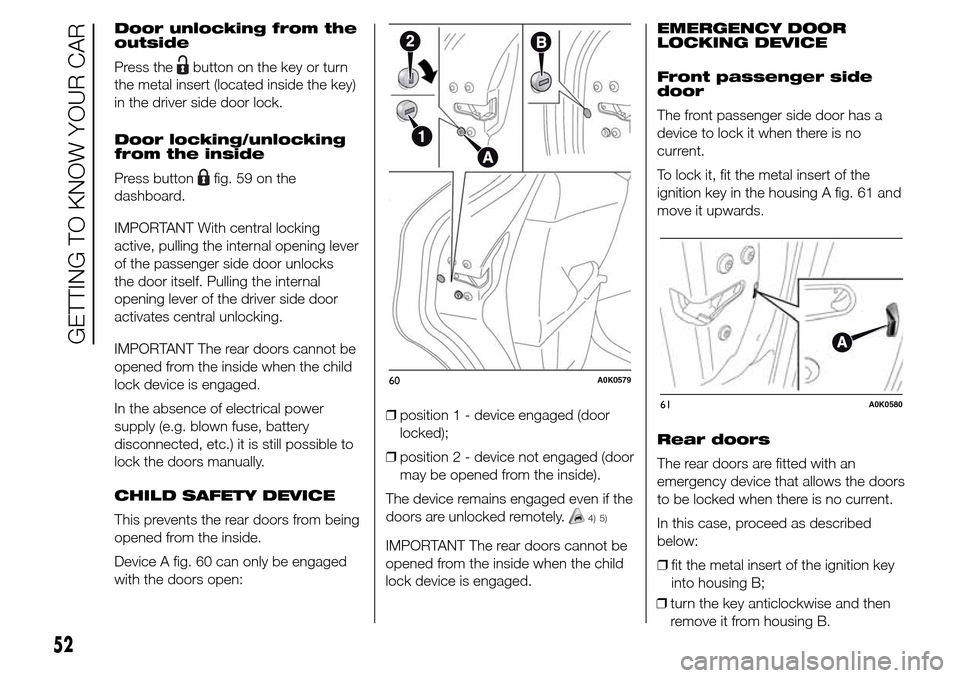
This prevents the rear doors from being
opened from the inside.
Device A fig. 60 can only be engaged
with the doors open:❒position 1 - device engaged (door
locked);
❒position 2 - device not engaged (door
may be opened from the inside).
The device remains engaged even if the
doors are unlocked remotely.
4) 5)
IMPORTANT The rear doors cannot be
opened from the inside when the child
lock device is engaged.EMERGENCY DOOR
LOCKING DEVICE
Front passenger side
door
The front passenger side door has a
device to lock it when there is no
current.
To lock it, fit the metal insert of the
ignition key in the housing A fig. 61 and
move it upwards.
Rear doors
The rear doors are fitted with an
emergency device that allows the doors
to be locked when there is no current.
In this case, proceed as described
below:
❒fit the metal insert of the ignition key
into housing B;
60A0K0579
61A0K0580
52
GETTING TO KNOW YOUR CAR
❒turn the key anticlockwise and then
remove it from housing B.
Page 57 of 288
The door lock knob can be realigned
(only when the battery charge has been
restored) as follows:
❒press button
on the key;
❒press the
locking/unlocking button
on the dashboard;
❒opening the door by inserting the key
in the front door pawl;
❒operate the internal door handle.
6)
Opening/closing
mechanism initialisation
If the battery is disconnected or the
protection fuse blows, the door
opening/closing mechanism must be
initialised as follows:
❒close all the doors;
❒press the
button on the key or the
button on the dashboard;
❒press the
button on the key or the
button on the dashboard.
IMPORTANT
4) Always use this device when
carrying children.
5) After engaging the device on both
rear doors, check for proper
engagement by trying to open a
rear door with the internal handle.
6) If the child lock was engaged and
the previously described locking
procedure carried out, operating
the internal opening handle will
not open the door, just the
realignment of the lock knob. To
open the door, pull the external
handle. The door central
locking/unlocking button
is not
disabled by the engagement of
the emergency lock.
ELECTRIC WINDOWS
These operate when the ignition key is
turned to MAR-ON and for about 3
minutes after turning the key to STOP
or removing it if one of the front doors is
open.
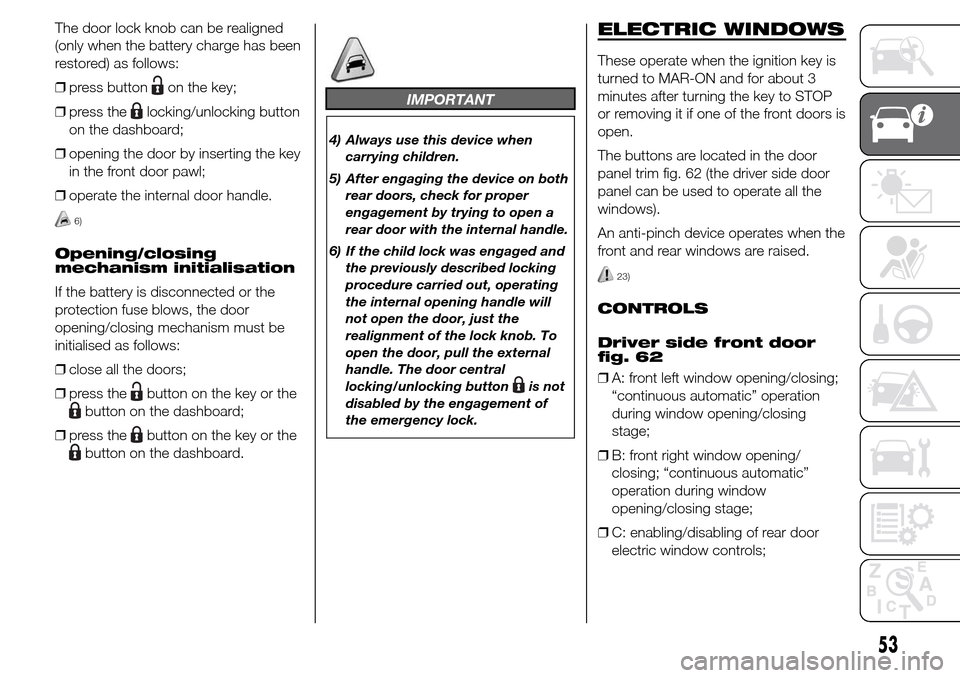
The buttons are located in the door
panel trim fig. 62 (the driver side door
panel can be used to operate all the
windows).
An anti-pinch device operates when the
front and rear windows are raised.
23)
CONTROLS
Driver side front door
fig. 62
❒A: front left window opening/closing;
“continuous automatic” operation
during window opening/closing
stage;
❒B: front right window opening/
closing; “continuous automatic”
operation during window
opening/closing stage;
❒C: enabling/disabling of rear door
electric window controls;
53
Page 58 of 288
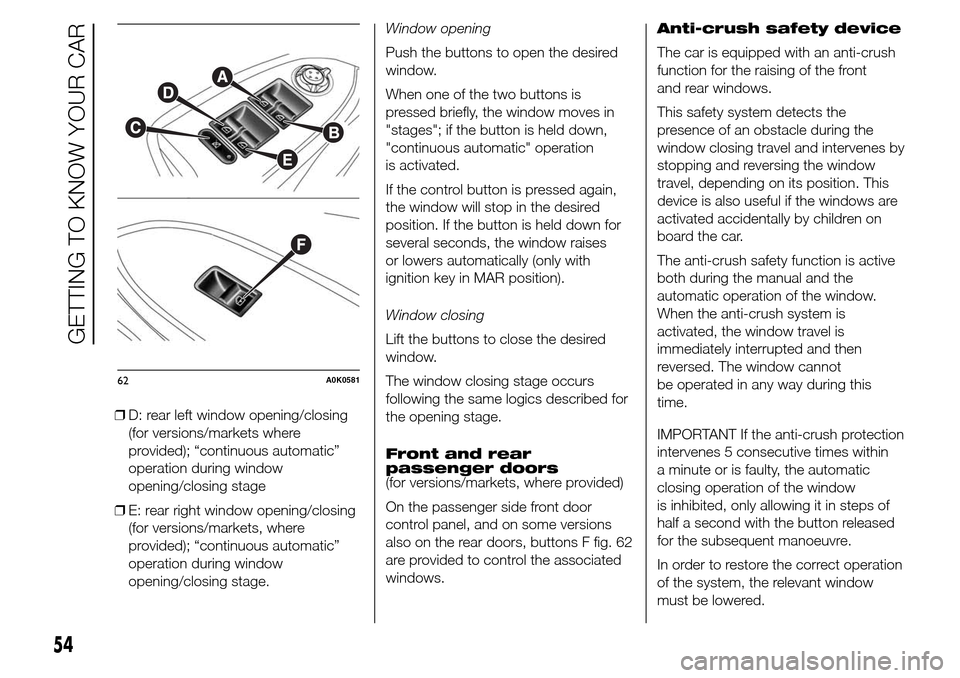
❒D: rear left window opening/closing
(for versions/markets where
provided); “continuous automatic”
operation during window
opening/closing stage
❒E: rear right window opening/closing
(for versions/markets, where
provided); “continuous automatic”
operation during window
opening/closing stage.Window opening
Push the buttons to open the desired
window.
When one of the two buttons is
pressed briefly, the window moves in
"stages"; if the button is held down,
"continuous automatic" operation
is activated.
If the control button is pressed again,
the window will stop in the desired
position. If the button is held down for
several seconds, the window raises
or lowers automatically (only with
ignition key in MAR position).
Window closing
Lift the buttons to close the desired
window.
The window closing stage occurs
following the same logics described for
the opening stage.
Front and rear
passenger doors
(for versions/markets, where provided)
On the passenger side front door
control panel, and on some versions
also on the rear doors, buttons F fig. 62
are provided to control the associated
windows.Anti-crush safety device
The car is equipped with an anti-crush
function for the raising of the front
and rear windows.
This safety system detects the
presence of an obstacle during the
window closing travel and intervenes by
stopping and reversing the window
travel, depending on its position. This
device is also useful if the windows are
activated accidentally by children on
board the car.
The anti-crush safety function is active
both during the manual and the
automatic operation of the window.
When the anti-crush system is
activated, the window travel is
immediately interrupted and then
reversed. The window cannot
be operated in any way during this
time.
IMPORTANT If the anti-crush protection
intervenes 5 consecutive times within
a minute or is faulty, the automatic
closing operation of the window
is inhibited, only allowing it in steps of
half a second with the button released
for the subsequent manoeuvre.
In order to restore the correct operation
of the system, the relevant window
must be lowered.
62A0K0581
54
GETTING TO KNOW YOUR CAR
Page 59 of 288
IMPORTANT With ignition key at STOP
or removed, the electric windows
remain active for about 3 minutes and
are deactivated when a door is opened.
IMPORTANT With the anti-crush
system, when the
button on the
remote control is pressed for longer
than 2 seconds the windows will open,
whilst if the
button is pressed for
longer than 2 seconds the windows will
close.
IMPORTANT
7) The system conforms to the
2000/4/EC standard concerning
the safety of passengers leaning
out of the passenger
compartment.
WARNING
23) Incorrect use of the electric
windows may be dangerous.
Before and during their operation,
ensure that any passengers are
not at risk from the moving glass
either by personal objects getting
caught in the mechanism or by
being hit by it directly. When
leaving the car, always remove
the key from the ignition to
prevent accidental operation of
the electric windows from being a
hazard for those still on board.
Electric window system
initialisation
The system must be re-initialised after
disconnecting the battery or if the
relevant protection fuse is blown.
Initialisation procedure:
❒fully close the window to initialise
manually;
❒after the window has reached the
upper end of travel, hold the up
button pressed for at least one
second.For versions/markets where provided,
after there has been no power supply
for the control units (battery replaced or
disconnected or protection fuses for
the electric window control units
replaced), the automatic operation of
the windows must be restored.
The restoration procedure must be
performed as described below with the
doors closed:
❒completely open the driver's door
window keeping the operating button
pressed for at least three seconds
after the (lower) end of travel position
is reached;
❒completely raise the driver side
window and hold the button down for
at least 3 seconds once the (upper)
end of travel position has been
reached;
❒proceed in the same way as
described in points 1 and 2 for the
passenger side door;
❒make sure that the initialisation is
correct by checking that the windows
work automatically.
55
Page 65 of 288
HEADLIGHTS
LIGHT BEAM DIRECTION
The correct orientation of the headlights
is important for the driver's comfort
and safety as well as for all other road
users. This is also covered by a specific
rule of the highway code.
The headlights must be correctly
directed to ensure the best visibility
conditions for all drivers. Contact a Alfa
Romeo Dealership to have the
headlights checked and adjusted, if
necessary.
HEADLIGHT ALIGNMENT
CORRECTOR
This device works with the ignition key
in the MAR position and the dipped
headlights on.
Headlight alignment
adjustment
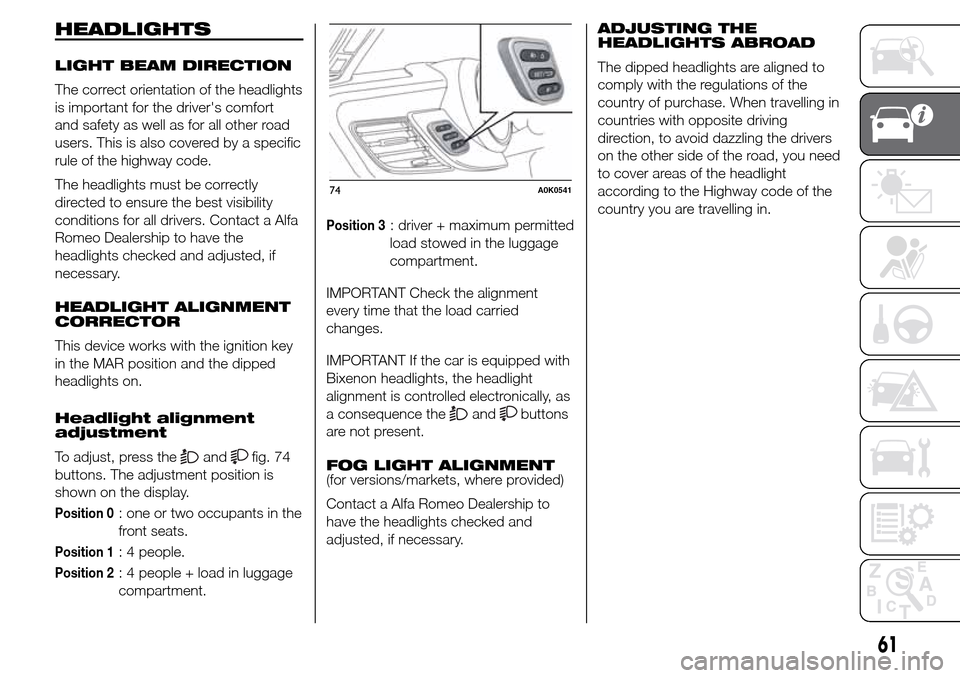
To adjust, press the
andfig. 74
buttons. The adjustment position is
shown on the display.
Position 0: one or two occupants in the
front seats.
Position 1: 4 people.
Position 2: 4 people + load in luggage
compartment.
Position 3: driver + maximum permitted
load stowed in the luggage
compartment.
IMPORTANT Check the alignment
every time that the load carried
changes.
IMPORTANT If the car is equipped with
Bixenon headlights, the headlight
alignment is controlled electronically, as
a consequence the
andbuttons
are not present.
FOG LIGHT ALIGNMENT
(for versions/markets, where provided)
Contact a Alfa Romeo Dealership to
have the headlights checked and
adjusted, if necessary.ADJUSTING THE
HEADLIGHTS ABROAD
The dipped headlights are aligned to
comply with the regulations of the
country of purchase. When travelling in
countries with opposite driving
direction, to avoid dazzling the drivers
on the other side of the road, you need
to cover areas of the headlight
according to the Highway code of the
country you are travelling in.
74A0K0541
61
Page 74 of 288
❒driver's door not shut;
❒driver's seat belt not fastened;
❒reverse gear engaged (for example,
for parking manoeuvres);
❒for versions equipped with dual zone
automatic climate control (for
versions/markets, where provided), if
an adequate level of thermal comfort
has not been reached or with
MAX-DEF function activation;
❒during the first period of use, to
initialise the system.
ENGINE RESTARTING
CONDITIONS
Due to comfort, emission control and
safety reasons, the engine can restart
automatically without any action by the
driver, under special conditions, such
as:
❒battery not sufficiently charged;
❒reduced braking system vacuum
(e.g. if the brake pedal is pressed
repeatedly);
❒car moving (e.g. when driving on
roads with a gradient);
❒engine stopping by Start&Stop
system for over 3 minutes;❒for versions equipped with dual zone
automatic climate control system (for
versions/markets, where provided),
if an adequate level of thermal
comfort has not been reached or
MAX-DEF function activation.
With gear engaged, automatic engine
restarting is possible only by fully
depressing the clutch pedal. The driver
is informed by the displaying of a
message on the display and -
for versions/markets, where provided -
by the flashing of the symbol
.
Notes
If the clutch is not pressed, about 3
minutes after the engine stops, the
engine can be restarted only using the
ignition key.
In cases when the engine stops and
this is not desired, due for example to
the clutch pedal being released sharply
with a gear engaged, if the Start&Stop
system is activated, the engine can
be restarted by fully depressing the
clutch pedal or by placing the gear lever
in neutral.SAFETY FUNCTIONS
When the engine is stopped by the
Start&Stop system, if the driver releases
his/her seat belt and opens the driver's
or passenger's door, the engine can
be restarted only using the ignition key.
The driver is informed by a buzzer
and by the flashing of the symbol
on
the display; on some versions, a
message is displayed as well.
"ENERGY SAVING"
FUNCTION
(for versions/markets, where provided)
If, following automatic engine restarting,
the driver does not carry out any
action on the car for over 3 minutes,
the Start&Stop system stops the engine
once and for all, to prevent fuel
consumption. In these cases, the
engine can be restarted only using the
ignition key.
NOTE In any case, it is possible to keep
the engine running by deactivating the
Start&Stop system.
IRREGULAR OPERATION
In the event of malfunction, the
Start&Stop system is deactivated.
70
GETTING TO KNOW YOUR CAR
Page 75 of 288
The driver is informed of the fault by the
flashing
symbol (versions with
multifunction display) or
symbol
(versions with reconfigurable
multifunction display). For versions/
markets where provided, a message is
also displayed.
In this case, contact an Alfa Romeo
Dealership.
CAR INACTIVITY
In the event of car inactivity (or if the
battery is replaced), special attention
must be paid to the disconnection
of the battery power supply.
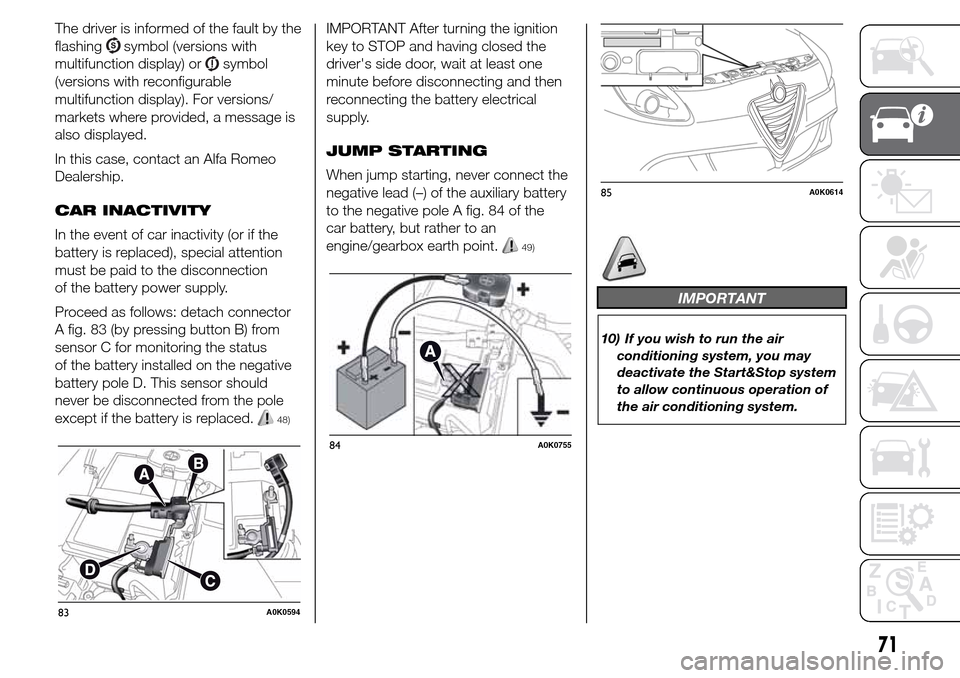
Proceed as follows: detach connector
A fig. 83 (by pressing button B) from
sensor C for monitoring the status
of the battery installed on the negative
battery pole D. This sensor should
never be disconnected from the pole
except if the battery is replaced.
48)
IMPORTANT After turning the ignition
key to STOP and having closed the
driver's side door, wait at least one
minute before disconnecting and then
reconnecting the battery electrical
supply.
JUMP STARTING
When jump starting, never connect the
negative lead (–) of the auxiliary battery
to the negative pole A fig. 84 of the
car battery, but rather to an
engine/gearbox earth point.
49)
IMPORTANT
10) If you wish to run the air
conditioning system, you may
deactivate the Start&Stop system
to allow continuous operation of
the air conditioning system.
83A0K0594
84A0K0755
85A0K0614
71
Page 76 of 288
WARNING
48) When replacing the battery,
always contact an Alfa Romeo
Dealership. The replacement
battery should be of the same
type (HEAVY DUTY) and should
have the same characteristics.
49) Before opening the bonnet,
make sure that the engine is off
and that the ignition key is in
the STOP position. Follow the
instructions on the dedicated
label on the front crossmember
(fig. 85). We recommend that you
remove the key from the ignition if
other people remain in the car.
The car should always be left after
the key has been removed or
turned to the STOP position.
During refuelling, make sure that
the engine is off (and that the
ignition key is in the STOP
position).
iTPMS (indirect Tyre
Pressure
Monitoring System)
(for versions/markets, where provided)
DESCRIPTION
The car can be equipped with the
iTPMS (indirect Tyre Pressure
Monitoring System) which monitors the
tyre inflation status thanks to wheel
speed sensors.
The system warns the driver if one or
more tyres are flat by the dedicated
warning light
continuously on and a
warning message on the display.
If one tyre only is flat, the system can
indicate its position: it is anyway
recommended to check the pressure
on all four tyres.
This indication is displayed also when
turning the engine off and on again until
the RESET procedure is carried out.
RESET PROCEDURE
The iTPMS system needs an initial
"self-learning" phase (with length
depending on the driving style and road
conditions: optimal conditions being
RESET procedure is carried out.❒whenever the tyre pressure is
modified;
❒when even only one tyre is changed;
❒when tyres are rotated/inverted;
❒when the space-saver wheel is fitted.
Before carrying out the RESET, inflate
the tyres to the rated pressure values
specified in the inflation pressure table
(see "Wheels" paragraph in the
"Technical specifications" section).
If the RESET is not carried out, in all
above cases, the warning lightmay
give false indications on one or more
tyres.
To carry out the RESET, with the car
stopped and the ignition key at
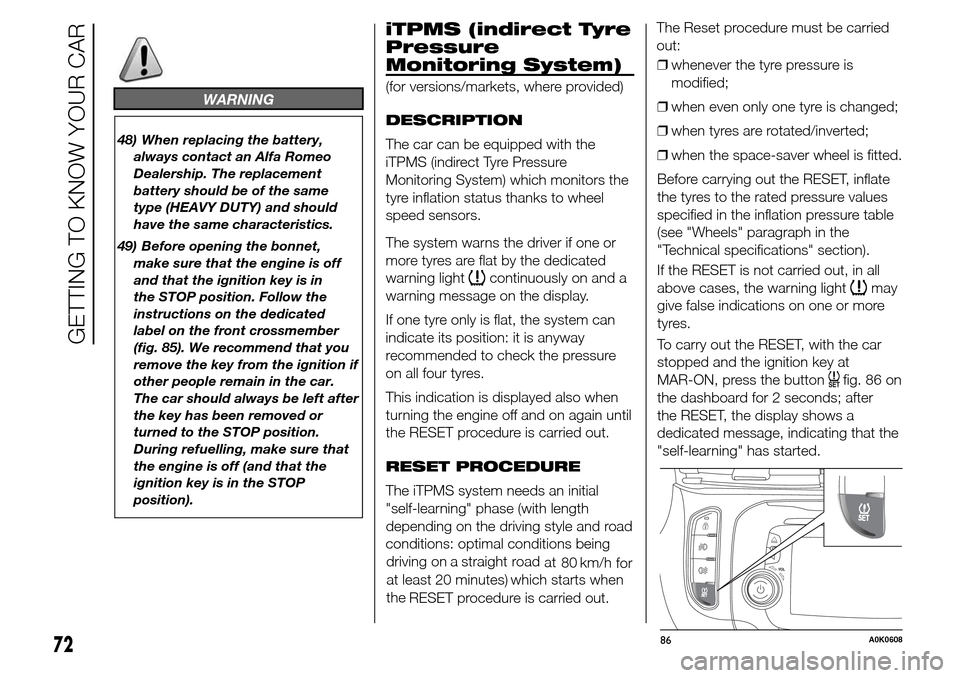
MAR-ON, press the button
fig. 86 on
the dashboard for 2 seconds; after
the RESET, the display shows a
dedicated message, indicating that the
"self-learning" has started.
86A0K060872
GETTING TO KNOW YOUR CAR
The Reset procedure must be carried
out:
which starts when driving
on
a
straight
road
at
80
km/h
for
at least 20 minutes)
the