ignition Alfa Romeo Giulietta 2016 Service Manual
[x] Cancel search | Manufacturer: ALFA ROMEO, Model Year: 2016, Model line: Giulietta, Model: Alfa Romeo Giulietta 2016Pages: 288, PDF Size: 7.34 MB
Page 124 of 288
Warning lights on
panelWhat it means What to do
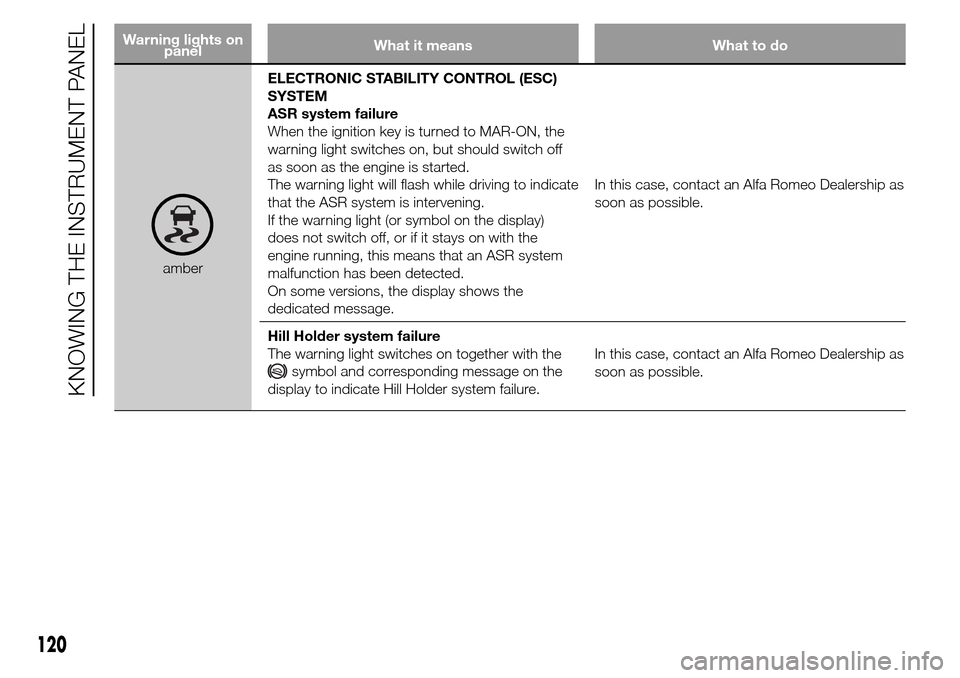
amberELECTRONIC STABILITY CONTROL (ESC)
SYSTEM
ASR system failure
When the ignition key is turned to MAR-ON, the
warning light switches on, but should switch off
as soon as the engine is started.
The warning light will flash while driving to indicate
that the ASR system is intervening.
If the warning light (or symbol on the display)
does not switch off, or if it stays on with the
engine running, this means that an ASR system
malfunction has been detected.
On some versions, the display shows the
dedicated message.In this case, contact an Alfa Romeo Dealership as
soon as possible.
Hill Holder system failure
The warning light switches on together with the
symbol and corresponding message on the
display to indicate Hill Holder system failure.In this case, contact an Alfa Romeo Dealership as
soon as possible.
120
KNOWING THE INSTRUMENT PANEL
Page 125 of 288
Warning lights on
panelWhat it means What to do
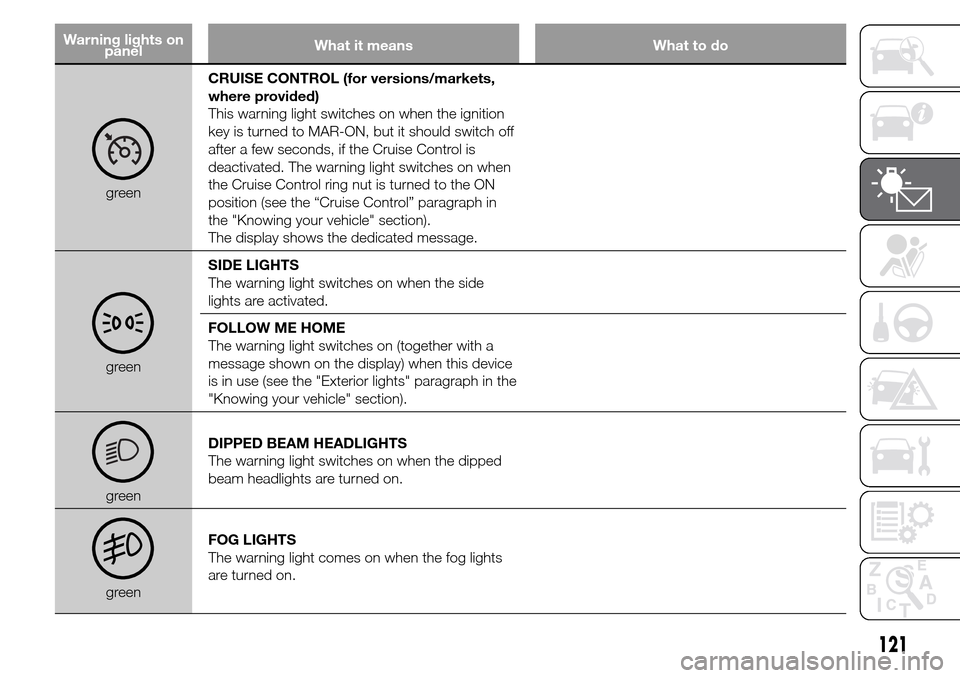
greenCRUISE CONTROL (for versions/markets,
where provided)
This warning light switches on when the ignition
key is turned to MAR-ON, but it should switch off
after a few seconds, if the Cruise Control is
deactivated. The warning light switches on when
the Cruise Control ring nut is turned to the ON
position (see the “Cruise Control” paragraph in
the "Knowing your vehicle" section).
The display shows the dedicated message.
greenSIDE LIGHTS
The warning light switches on when the side
lights are activated.
FOLLOW ME HOME
The warning light switches on (together with a
message shown on the display) when this device
is in use (see the "Exterior lights" paragraph in the
"Knowing your vehicle" section).
2
greenDIPPED BEAM HEADLIGHTS
The warning light switches on when the dipped
beam headlights are turned on.
greenFOG LIGHTS
The warning light comes on when the fog lights
are turned on.
121
Page 134 of 288
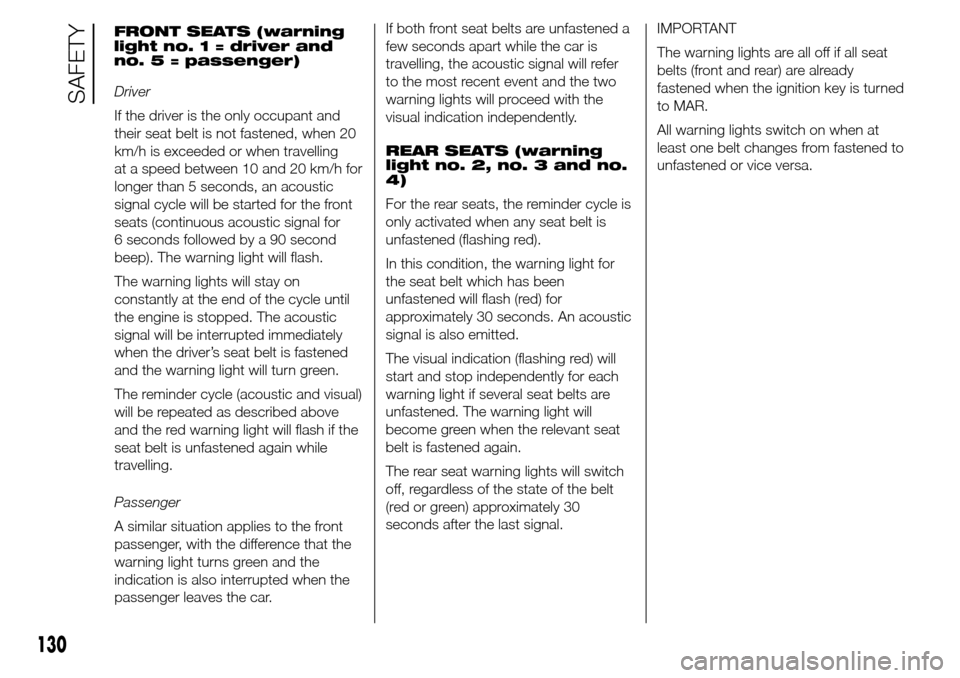
Driver
If the driver is the only occupant and
their seat belt is not fastened, when 20
km/h is exceeded or when travelling
at a speed between 10 and 20 km/h for
longer than 5 seconds, an acoustic
signal cycle will be started for the front
seats (continuous acoustic signal for
6 seconds followed by a 90 second
beep). The warning light will flash.
The warning lights will stay on
constantly at the end of the cycle until
the engine is stopped. The acoustic
signal will be interrupted immediately
when the driver’s seat belt is fastened
and the warning light will turn green.
The reminder cycle (acoustic and visual)
will be repeated as described above
and the red warning light will flash if the
seat belt is unfastened again while
travelling.
Passenger
A similar situation applies to the front
passenger, with the difference that the
warning light turns green and the
indication is also interrupted when the
passenger leaves the car.If both front seat belts are unfastened a
few seconds apart while the car is
travelling, the acoustic signal will refer
to the most recent event and the two
warning lights will proceed with the
visual indication independently.
REAR SEATS (warning
light no. 2, no. 3 and no.
4)
For the rear seats, the reminder cycle is
only activated when any seat belt is
unfastened (flashing red).
In this condition, the warning light for
the seat belt which has been
unfastened will flash (red) for
approximately 30 seconds. An acoustic
signal is also emitted.
The visual indication (flashing red) will
start and stop independently for each
warning light if several seat belts are
unfastened. The warning light will
become green when the relevant seat
belt is fastened again.
The rear seat warning lights will switch
off, regardless of the state of the belt
(red or green) approximately 30
seconds after the last signal.IMPORTANT
The warning lights are all off if all seat
belts (front and rear) are already
fastened when the ignition key is turned
to MAR.
All warning lights switch on when at
least one belt changes from fastened to
unfastened or vice versa.
130
SAFETY
FRONT SEATS (warning
light no. 1 = driver and
no. 5 = passenger)
Page 150 of 288
96) When the ignition key is in and
turned in the MAR-ON position
and the engine is off, the airbags
may deploy if the car is crashed
by another moving vehicle.
Therefore, even if the car is
stationary, when an active
passenger airbag is fitted, DO
NOT install rear facing child
restraint systems on the front
passenger seat. Deployment of
the airbag following an impact
could cause fatal injuries to the
child. Therefore, always
deactivate the passenger airbag
when a rear facing child restraint
system is installed on the front
passenger seat. The front
passenger seat must also be
positioned back as far as possible
in order to avoid the child
restraint system from coming into
contact with the dashboard.
Immediately reactivate the
passenger airbag as soon as the
child restraint system has been
removed. Also remember that,
if the key is turned to STOP, none
of the safety devices (airbags or
pretensioners) will be deployed in
the event of a collision. Non-
deployment in such cases does
not indicate a system malfunction.97) When the ignition key is turned
to MAR-ON, the
warning light
turns on (front airbag on
passenger's side enabled) and
blinks for a few seconds to remind
that the passenger airbag will
activate in the event of a collision.
Then it turns off.
98) The front airbags deploy in the
event of more severe collisions
than those required for deploying
the pretensioners. When the
impact is between the two
deployment thresholds, it is
normal that pretensioners only are
engaged.
99) The airbag does not replace seat
belts, but increases their
efficiency. Because front airbags
are not deployed for low-speed
crashes, side collisions, rear-end
shunts or rollovers, occupants are
protected, in addition to any side
bags, only by their seat belts,
which must therefore always be
fastened.
146
SAFETY
Page 152 of 288
STARTING THE
ENGINE
PROCEDURE FOR
PETROL VERSIONS
Proceed as follows:
❒engage the handbrake and place the
gear lever in neutral;
❒fully depress the clutch pedal,
without touching the accelerator;
❒turn the ignition key to AVV and
release it as soon as the engine
starts.
IMPORTANT INFORMATION
100) 101)
102)
16) 17) 18)
❒If the engine does not start at the first
attempt, return the ignition key to
STOP before repeating the starting
procedure.
❒If, when the ignition key is at
MAR-ON, the
instrument panel
warning light (or the symbol on the
display) stays on together with the
warning light, turn the key to
STOP and then back to MAR-ON. If
the warning light (or the symbol on
the display) remains on, try with
the other keys provided with the car.
Contact an Alfa Romeo Dealership
if the engine still does not start.❒Never leave the ignition key at MAR
when the engine is stopped.
PROCEDURE FOR DIESEL
VERSIONS
Proceed as follows:
19)
❒engage the handbrake and place the
gear lever in neutral;
❒turn the ignition key to MAR-ON: the
warning lights
andon the
instrument panel will turn on (for
versions/markets, where provided);
❒wait for the warning lights to switch
off;
❒fully depress the clutch pedal,
without touching the accelerator;
❒turn the ignition key to AVV as soon
as warning light
switches off.
Waiting too long will waste the
heating work carried out by the glow
plugs. Release the key as soon as
the engine starts.
WARMING UP THE
ENGINE JUST AFTER IT
HAS STARTED
Proceed as follows:
❒drive off slowly, letting the engine turn
at medium speed without
accelerating abruptly;❒do not demand full performance at
first. It is advisable to wait until the
engine coolant temperature indicator
starts moving.
STOPPING THE ENGINE
Turn the ignition key to STOP while the
engine is idling.
IMPORTANT After a demanding drive,
before turning the engine off you should
let it idle so that the temperature in the
engine compartment decreases.
WARNING
100) It is dangerous to run the
engine in enclosed areas. The
engine takes in oxygen and
releases carbon dioxide, carbon
monoxide and other toxic gases.
101) The brake servo is not active
until the engine is started, so
you would need to apply much
more force than usual to the
brake pedal.
102) Do not start the engine by
pushing, towing or driving
downhill. These manoeuvres may
damage the catalytic converter.
148
STARTING AND DRIVING
Page 153 of 288
IMPORTANT
16) In the first period of use, we
recommend not to demand
maximum performance from the
car (for instance excessive
accelerations, extended travel at
maximum speed, sudden braking,
etc.).
17) With the engine off, do not leave
the key in the ignition switch on
MAR-ON to prevent draining
the battery.
18) A quick burst on the accelerator
before turning off the engine
serves absolutely no practical
purpose; it wastes fuel and is
especially damaging to
turbocharged engines.
19) If the
warning light flashes
for about 1 minute after starting
or during prolonged cranking, this
indicates a fault in the glow plug
preheating system. If the engine
starts, you may use the car
normally, but should contact an
Alfa Romeo Dealership as soon as
possible.
PARKING
Always remove the ignition key when
leaving the car.
When parking and leaving the car,
proceed as follows:
❒engage a gear (1st gear if parked
uphill or reverse if facing downhill)
and leave the wheels turned;
❒stop the engine and engage the
handbrake.
Block the wheels with a wedge or a
stone if the car is parked on a steep
slope.
On versions equipped with Alfa TCT
transmission, before releasing the brake
pedal, wait for letter P to be displayed.
IMPORTANTNEVERleave the car
with the gearbox in neutral (or, on
versions equipped with Alfa TCT
transmission, before placing the gear
lever at P).
HANDBRAKE
To engage it, pull lever A fig. 126
upwards until the car is secured.
When the handbrake is engaged and
the ignition key is at MAR-ON, the
warning light will switch on in the
instrument panel.To release it, raise lever A slightly, hold
down button B and lower the lever:
the
warning light on the instrument
panel switches off.
103) 104)
IMPORTANT Carry out these
manoeuvres with the brake pedal
pressed.
IMPORTANT For cars equipped with a
front armrest, lift it up to ensure that
it does not interfere with the action of
the handbrake.
126A0K0615
149
Page 154 of 288
WARNING
103) Never leave children
unattended in the car. Always
remove the key from the ignition
device when leaving the car and
take it with you.
104) The car must be locked after a
few clicks of the parking brake: if
this is not so, contact an Alfa
Romeo Dealership to have it
adjusted. Always park the car
safely as indicated by the
Highway Code and as described
above.
USING THE
GEARBOX
To engage the gears, press the clutch
pedal fully and shift the gear lever
into one of the required positions (the
diagram for gear engagement is shown
on the knob of the lever
105)).
To engage the 6thgear, operate the
lever by pressing it towards the right in
order to avoid engaging the 4th gear
by mistake. The same applies to the
shift from 6
thto 5thgear.20)
To engage reverse gear (R) from the
neutral position, lift up ring A fig. 127
and simultaneously move the lever
to the left and then forwards.
IMPORTANT Reverse can only be
engaged when the car is completely
stationary.
WARNING
105) Press the clutch pedal fully to
change gears correctly. It is
therefore essential that there is
nothing under the pedals: make
sure the mats are lying flat and do
not get in the way of the pedals.
IMPORTANT
20) Do not drive with your hand
resting on the gear lever as the
force exerted, even if slight, could
lead over time to premature wear
of the gearbox internal
components.
127A0K0616
150
STARTING AND DRIVING
Page 156 of 288
POSITIONS OF THE
LEVER
Park (P)
Position P corresponds to the neutral
position of the transmission and locks
drive wheels mechanically.
It should only be engaged with the car
stationary and the handbrake should be
applied, if necessary.
With the ignition key at MAR-ON or with
engine running, or when the engine
switches off, if the gear lever is not
correctly positioned in P, letter P starts
flashing on the gear lever trim.
In this case, move the lever correctly to
position P.
21)
The ignition key can be removed only
when the lever is in position P. Moving
the lever from P to D must be
performed only when the car is
stationary and the engine at idling
speed.
Shifting from P to any other position of
the selector lever, with ignition key in
MAR-ON position, must be made
pressing the brake pedal and using the
button on the gear lever (see paragraph
"Selector lever").
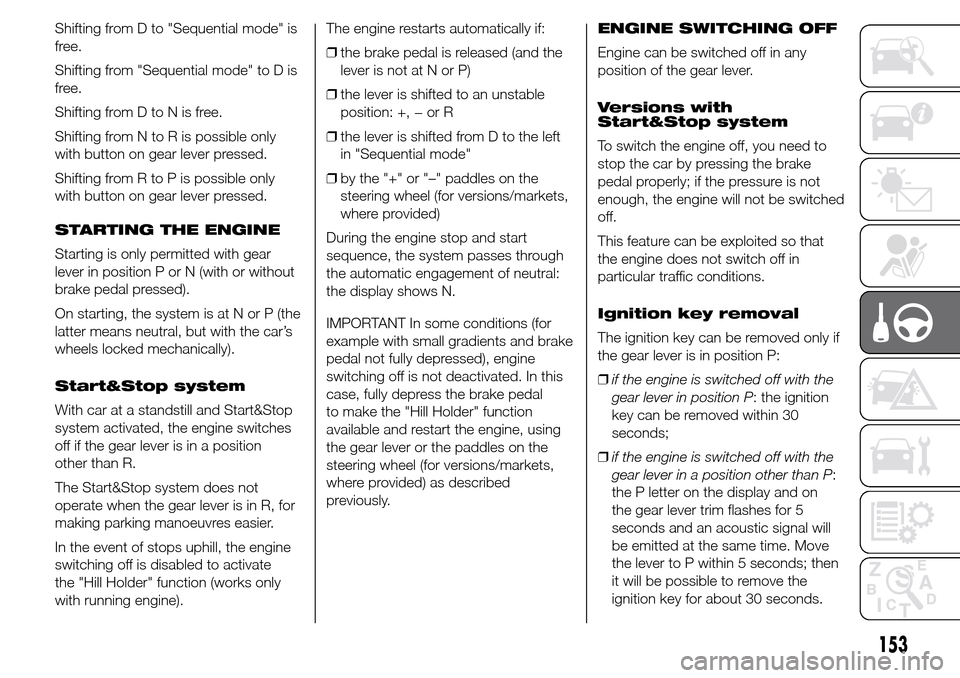
If the battery is flat, to release the lever
you need to remove the gaiter and
operate the lever A fig. 132.IMPORTANT NEVER leave the car
before having positioned the selector
lever in P.
Reverse (R)
The engine cannot be started with the
lever in position R.
Shifting from R to N or D is free, while
shifting from R to P can be made by the
button on the gear lever, with engine
at idling speed.
22)
Neutral (N)
It corresponds to neutral for a standard
manual gearbox. The engine can be
started with the lever in position N.
Engage N in case of prolonged stops.
To move the lever from position N,
release the accelerator and make sure
the engine is stable at idling speed.Shifting from N to D is free, while
shifting from N to R or P can only be
made by the button on the gear lever.
Drive (D) - Automatic
forward gear
It is the lever position in standard
running conditions.
Shifting from D to N is free, while
shifting from D to R or P can only be
made by the button on the gear lever.
Sequential mode (+ / –)
Shifting the lever from position D on
side in stable position, the transmission
is used in sequential mode.
Shifting the lever in unstable position (+
or −) gears are changed.
Important information
IMPORTANT All movements of the gear
lever must be performed with car
stationary and engine idling only.
The drive wheels are mechanically
locked in position P.
Shifting from P to R is possible with
brake pedal pressed and button on
gear lever pressed.
Shifting from R to N and from N to D is
free.
132A0K0619
152
STARTING AND DRIVING
Page 157 of 288
Shifting from D to "Sequential mode" is
free.
Shifting from "Sequential mode" to D is
free.
Shifting from D to N is free.
Shifting from N to R is possible only
with button on gear lever pressed.
Shifting from R to P is possible only
with button on gear lever pressed.
STARTING THE ENGINE
Starting is only permitted with gear
lever in position P or N (with or without
brake pedal pressed).
On starting, the system is at N or P (the
latter means neutral, but with the car’s
wheels locked mechanically).
Start&Stop system
With car at a standstill and Start&Stop
system activated, the engine switches
off if the gear lever is in a position
other than R.
The Start&Stop system does not
operate when the gear lever is in R, for
making parking manoeuvres easier.
In the event of stops uphill, the engine
switching off is disabled to activate
the "Hill Holder" function (works only
with running engine).The engine restarts automatically if:
❒the brake pedal is released (and the
lever is not at N or P)
❒the lever is shifted to an unstable
position: +, − or R
❒the lever is shifted from D to the left
in "Sequential mode"
❒by the "+" or "–" paddles on the
steering wheel (for versions/markets,
where provided)
During the engine stop and start
sequence, the system passes through
the automatic engagement of neutral:
the display shows N.
IMPORTANT In some conditions (for
example with small gradients and brake
pedal not fully depressed), engine
switching off is not deactivated. In this
case, fully depress the brake pedal
to make the "Hill Holder" function
available and restart the engine, using
the gear lever or the paddles on the
steering wheel (for versions/markets,
where provided) as described
previously.ENGINE SWITCHING OFF
Engine can be switched off in any
position of the gear lever.
Versions with
Start&Stop system
To switch the engine off, you need to
stop the car by pressing the brake
pedal properly; if the pressure is not
enough, the engine will not be switched
off.
This feature can be exploited so that
the engine does not switch off in
particular traffic conditions.
Ignition key removal
The ignition key can be removed only if
the gear lever is in position P:
❒if the engine is switched off with the
gear lever in position P: the ignition
key can be removed within 30
seconds;
❒if the engine is switched off with the
gear lever in a position other than P:
the P letter on the display and on
the gear lever trim flashes for 5
seconds and an acoustic signal will
be emitted at the same time. Move
the lever to P within 5 seconds; then
it will be possible to remove the
ignition key for about 30 seconds.
153
Page 158 of 288
In both cases, if the described
conditions and times are not respected,
the ignition key will be automatically
locked.
To remove the key, turn it to MAR-ON
and then to STOP.
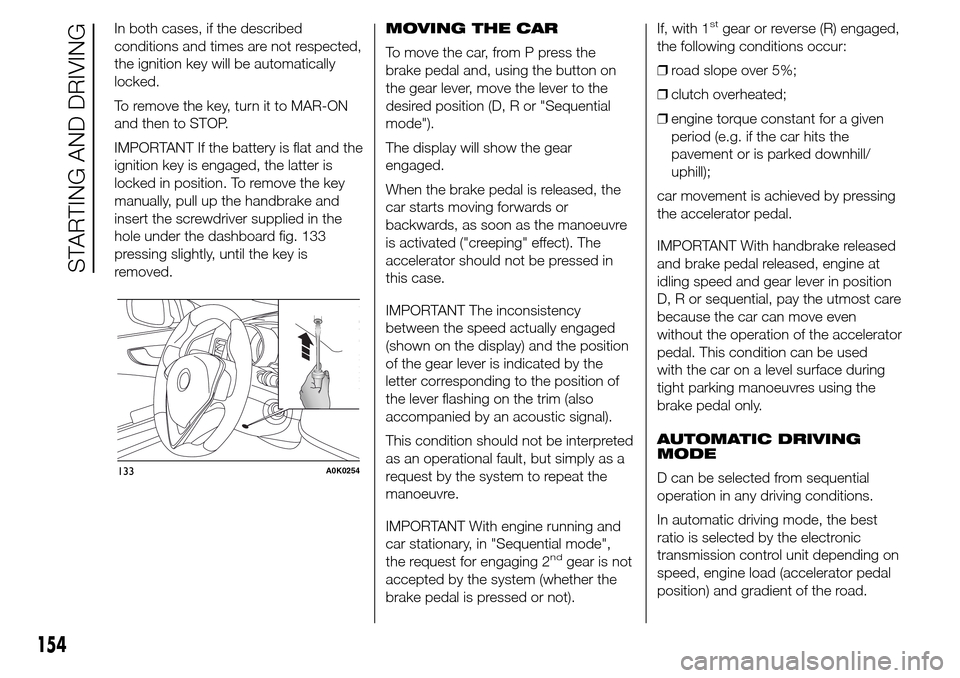
IMPORTANT If the battery is flat and the
ignition key is engaged, the latter is
locked in position. To remove the key
manually, pull up the handbrake and
insert the screwdriver supplied in the
hole under the dashboard fig. 133
pressing slightly, until the key is
removed.MOVING THE CAR
To move the car, from P press the
brake pedal and, using the button on
the gear lever, move the lever to the
desired position (D, R or "Sequential
mode").
The display will show the gear
engaged.
When the brake pedal is released, the
car starts moving forwards or
backwards, as soon as the manoeuvre
is activated ("creeping" effect). The
accelerator should not be pressed in
this case.
IMPORTANT The inconsistency
between the speed actually engaged
(shown on the display) and the position
of the gear lever is indicated by the
letter corresponding to the position of
the lever flashing on the trim (also
accompanied by an acoustic signal).
This condition should not be interpreted
as an operational fault, but simply as a
request by the system to repeat the
manoeuvre.
IMPORTANT With engine running and
car stationary, in "Sequential mode",
the request for engaging 2
ndgear is not
accepted by the system (whether the
brake pedal is pressed or not).If, with 1
stgear or reverse (R) engaged,
the following conditions occur:
❒road slope over 5%;
❒clutch overheated;
❒engine torque constant for a given
period (e.g. if the car hits the
pavement or is parked downhill/
uphill);
car movement is achieved by pressing
the accelerator pedal.
IMPORTANT With handbrake released
and brake pedal released, engine at
idling speed and gear lever in position
D, R or sequential, pay the utmost care
because the car can move even
without the operation of the accelerator
pedal. This condition can be used
with the car on a level surface during
tight parking manoeuvres using the
brake pedal only.
AUTOMATIC DRIVING
MODE
D can be selected from sequential
operation in any driving conditions.
In automatic driving mode, the best
ratio is selected by the electronic
transmission control unit depending on
speed, engine load (accelerator pedal
position) and gradient of the road.
133A0K0254
154
STARTING AND DRIVING