ESP Alfa Romeo Giulietta 2017 User Guide
[x] Cancel search | Manufacturer: ALFA ROMEO, Model Year: 2017, Model line: Giulietta, Model: Alfa Romeo Giulietta 2017Pages: 212, PDF Size: 4.56 MB
Page 63 of 212
The ESC system corrects the car’s
understeer and oversteer, distributing
the brake force on the appropriate
wheels. The torque supplied by the
engine can also be reduced in order to
maintain control of the vehicle.
28) 29) 30) 31) 32)
The ESC system comprises the active
safety systems such as: ABS, EBD, ASR,
HILL HOLDER, etc.
The ESC system switches on
automatically when the engine is started
and cannot be switched off.
System intervention
This is indicated by the flashing of the
warning light
on the instrument panel,
to inform the driver that the car is in
critical stability and grip conditions.
CBC (Cornering Brake Control)SYSTEM
This system acts when braking on
corners, optimising the distribution of
brake pressure on the four wheels: the
system prevents the wheels on the inside
of the corner (less affected by the weight
of the car) from locking, ensuring better
stability and direction for the car.
HILL HOLDERSYSTEM
This is an integral part of the ESC system
and facilitates starting on uphill or
downhill slopes by operating the brakes:
IMPORTANT The Hill Holder system is
not a parking brake; therefore, never
leave the car without having engaged the
handbrake, turned the engine off and
engaged first gear, so that it is parked in
safe conditions (for further information
read the "Parking" paragraph in the
"Starting and driving" chapter).
IMPORTANT There may be situations on
small gradients (less than 8%), with car
laden, in which the Hill Holder system
may not activate, causing a slight
reversing motion and increasing the risk
of collision with another vehicle or object.
The driver is, in any case, responsible for
safe driving.
“ELECTRONIC Q2”SYSTEM (“E-Q2”)
The "Electronic Q2" system intervenes
during acceleration on corners, braking
the inner drive wheel and thus increasing
the traction of the outer wheel (which
bears more of the car’s weight): the
torque is thus distributed optimally
between the drive wheels in accordance
with the driving conditions and road
surface, permitting particularly effective,
sporty driving.
"PRE-FILL"SYSTEM (RAB - Ready Alert
Brake)
(only with 'Dynamic" mode activated)
This function activates automatically if
the accelerator pedal is released rapidly,
reducing the brake pad travel (both at
front and back), with the aim of preparing
the braking system and enhancing its
responsiveness, thus reducing the
stopping distance in the event of
subsequent braking.
WARNING
28)The ESC system cannot alter the natural
laws of physics, and cannot increase grip,
which depends on the condition of the road.
29)The ESC system cannot prevent
accidents, including those due to excessive
speed on corners, driving on low-grip
surfaces or aquaplaning.
30)The capability of the ESC system must
never be tested irresponsibly and
dangerously, in such a way as to compromise
personal safety and the safety of others.
31)For the correct operation of the ASR
system, the tyres must of necessity be the
same make and type on all wheels, in perfect
condition and, above all, of the prescribed
type and dimensions.
32)Do not take unnecessary risks, even if
your vehicle is fitted with the ESC and ASR
systems. Your driving style must always be
suited to the road conditions, visibility and
traffic. The driver is always responsible for
road safety.
61
Page 64 of 212
33)When the ABS intervenes and you feel
the brake pedal pulsating, do not reduce the
pressure, but hold it down firmly and
confidently; in doing so you will brake in the
shortest distance possible, depending on the
current road conditions.
34)To obtain the maximum efficiency of the
braking system, a bedding-in period of about
500 km is needed: during this period it is
better to avoid sharp, repeated and
prolonged braking.
35)If the ABS intervenes, this indicates that
the grip of the tyres on the road is nearing its
limit: you must slow down to a speed
compatible with the available grip.
36)The ABS cannot overrule the natural
laws of physics, and cannot increase the grip
available according to the condition of the
road.
37)The ABS cannot prevent accidents,
including those due to excessive speed on
corners, driving on low-grip surfaces or
aquaplaning.
38)The capability of the ABS must never be
tested irresponsibly and dangerously, in
such a way as to compromise personal
safety and the safety of others.
39)For the correct operation of the ABS, the
tyres must of necessity be the same make
and type on all wheels, in perfect condition
and, above all, of the prescribed type and
dimensions.
40)The ASR cannot overrule the natural
laws of physics, and cannot increase the grip
available according to the condition of the
road.
41)The ASR system cannot prevent
accidents, including those due to excessive
speed on corners, driving on low-grip
surfaces or aquaplaning.42)The capability of the ASR must never be
tested irresponsibly and dangerously, in
such a way as to compromise personal
safety and the safety of others.
43)The HBA system can’t overrule the
natural laws of physics, and can’t increase
the grip available according to the condition
of the road.
44)The HBA system cannot prevent
accidents, including those due to excessive
speed on corners, driving on low-grip
surfaces or aquaplaning.
45)The features of the HBA system must
never be tested in imprudent or dangerous
ways, with the possibility of putting the
safety of the driver, occupants or other road
users at risk.
46)DST is an aid for driving and does not
relieve the driver of responsibility for driving
the vehicle.iTPMS System (indirect Tyre
Pressure Monitoring System)
(for versions/markets, where provided)
DESCRIPTION
The car can be equipped with the iTPMS
(indirect Tyre Pressure Monitoring
System) which monitors the tyre inflation
status thanks to wheel speed sensors.
The system warns the driver if one or
more tyres are flat by the dedicated
warning light
continuously on and a
warning message on the display.
If one tyre only is flat, the system can
indicate its position: it is in any case
recommended to check the pressure on
all four tyres.
This indication is displayed also when
turning the engine off and on again until
the RESET procedure is carried out.
RESET PROCEDURE
The iTPMS needs an initial "self-learning"
phase (with length depending on the
driving style and road conditions: optimal
conditions being driving on a straight
road at 80 km/h for at least 20 minutes)
which starts when the RESET procedure
is carried out.
The Reset procedure must be carried out:
each time tyre pressure is modified;
when even only one tyre is changed;
when tyres are rotated/inverted;
62
SAFETY
Page 68 of 212
After about 30 seconds from the last
indication, the warning lights for rear
seats will switch off, irrespective of the
belt conditions (red or green).
IMPORTANT NOTES
All warning lights will remain off if all the
seat belts (front and rear) are already
fastened when the key it turned to MAR.
All the warning lights will come on when
at least one belt changes from fastened
to unfastened status or vice versa.PRE-TENSIONERS
56) 57)
The vehicle is equipped with front seat
belt pretensioners, which draw back the
seat belts by several centimetres in the
event of a strong frontal impact. This
guarantees the perfect adherence of the
seat belts to the occupant's bodies
before the retention action begins.
It is evident that the pretensioners have
operated when the belt withdraws
toward the retractor.
This car is also equipped with a second
pretensioner (fitted in the kick plate
area). Its activation is signalled by the
shortening of the metal cable.
A slight discharge of smoke may be
produced during the activation of the
pretensioner which is not harmful and
does not involve any fire hazard.
IMPORTANT To obtain the highest
degree of protection from the action of
the pretensioner, wear the seat belt tight
to the chest and pelvis.
The pretensioner does not require any
maintenance or lubrication: any changes
to its original conditions will invalidate its
efficiency. If, due to unusual natural
events (floods, sea storms, etc.), the
device has been affected by water and/or
mud, contact an Alfa Romeo Dealership
to have it replaced.
LOAD LIMITERS
To increase passenger safety, the front
seat belt reels contain a load limiter
which allows the force acting on the chest
and shoulders to be modulated during the
belt restraining action in the event of a
frontal impact.
GENERAL INSTRUCTIONS FOR USING
THE SEAT BELTS
Respect and ensure that all the other
occupants of the vehicle comply with the
local laws in force regarding the use of
seat belts. Always fasten the seat belts
before starting off.
58) 59)
Seat belts must also be worn by pregnant
women: the risk of injury in the event of
an accident is reduced for them and the
unborn child if they are wearing a seat
belt.
Pregnant women must position the lower
part of the belt very low down so that it
passes over the pelvis and under the
abdomen fig. 45.
66
SAFETY
Page 72 of 212
GROUP 2
65) 66) 67) 68) 69)
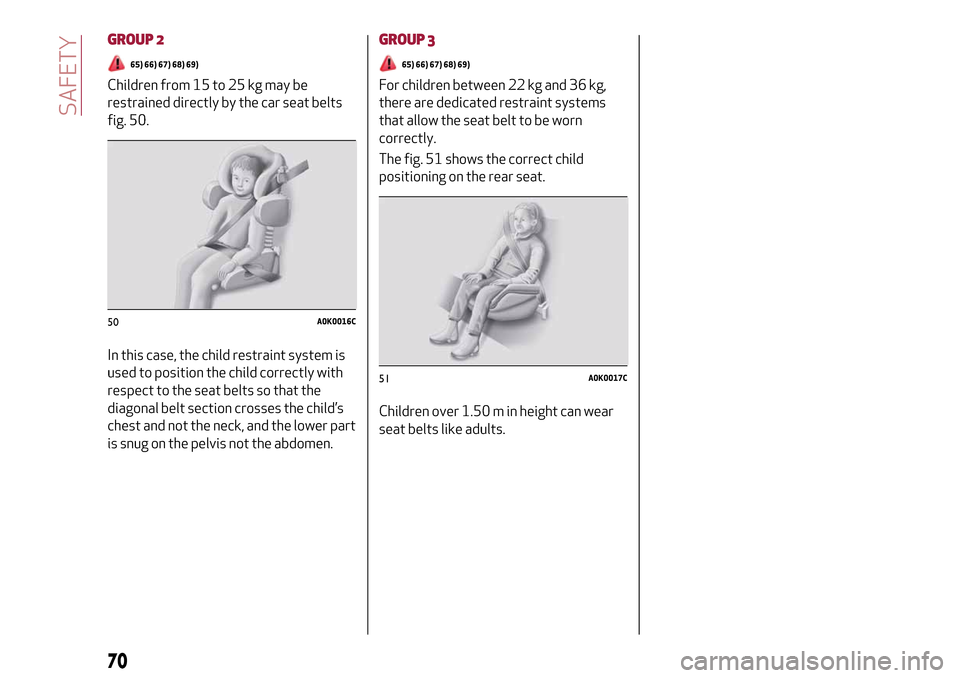
Children from 15 to 25 kg may be
restrained directly by the car seat belts
fig. 50.
In this case, the child restraint system is
used to position the child correctly with
respect to the seat belts so that the
diagonal belt section crosses the child’s
chest and not the neck, and the lower part
is snug on the pelvis not the abdomen.
GROUP 3
65) 66) 67) 68) 69)
For children between 22 kg and 36 kg,
there are dedicated restraint systems
that allow the seat belt to be worn
correctly.
The fig. 51 shows the correct child
positioning on the rear seat.
Children over 1.50 m in height can wear
seat belts like adults.
50A0K0016C
51A0K0017C
70
SAFETY
Page 77 of 212
FRONT AIRBAGS
“SMART BAG”SYSTEM (MULTISTAGE
FRONT AIRBAGS)
The car features multistage front airbags
(“Smart bag”) for driver and passenger.
The front driver/passenger airbags are
designed to protect occupants in the
event of frontal impacts of medium-high
severity, by placing the bag between the
occupant and the steering wheel or
dashboard.
Therefore non-activation in other types
of collisions (side collisions, rear shunts,
roll-overs, etc.) is not a system
malfunction.
Airbags are not a replacement of but
complementary to the seat belts, which
you are recommended to always wear. In
the event of impact, those not wearing a
seat belt are projected forwards and may
come into contact with the bag which is
still inflating. The protection offered by
the bag is compromised in these
circumstances.
76) 77) 79)
Front airbags may not activate in the
following situations:
frontal impacts against highly
deformable objects not involving the
front surface of the car (e.g. wing collision
against guard rail, etc.);
jamming of the car underneath other
vehicles or protective barriers (e.g.
underneath a truck or a guard rail) as, in
this case, the bags would offer no
additional protection with respect to the
seat belt and their deployment would be
inappropriate. Failure to activate in the
conditions described above is due to the
fact that they may not provide any
additional protection compared with seat
belts, so their activation would be
inappropriate. In these cases,
non-deployment does not indicate a
system malfunction.
FRONT AIRBAG DRIVER'S SIDE
This consists of an instantly inflating bag
contained in a special compartment in the
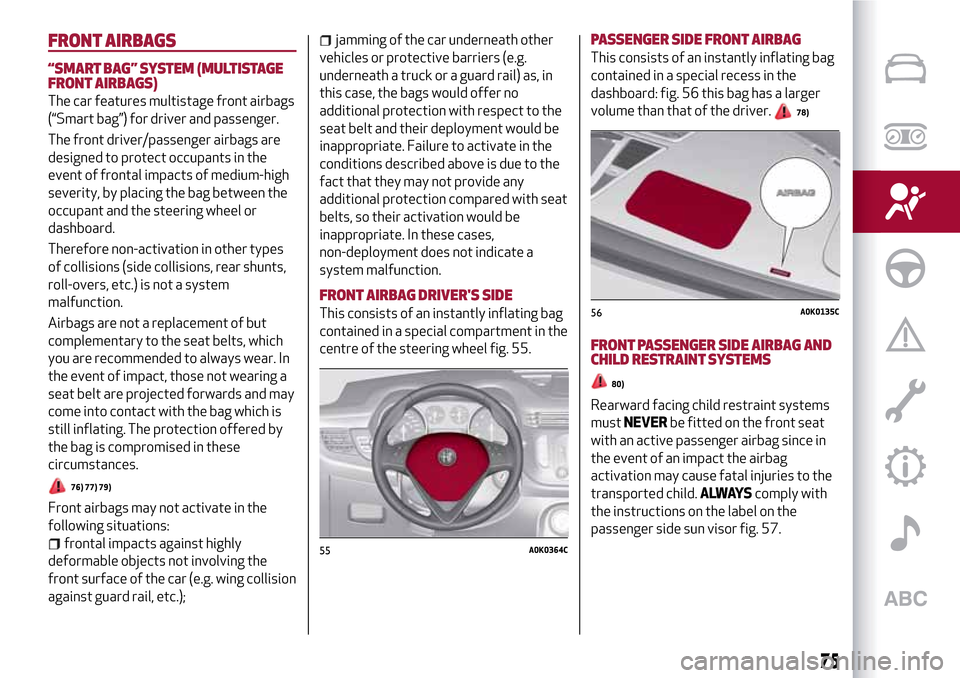
centre of the steering wheel fig. 55.
PASSENGER SIDE FRONT AIRBAG
This consists of an instantly inflating bag
contained in a special recess in the
dashboard: fig. 56 this bag has a larger
volume than that of the driver.
78)
FRONT PASSENGER SIDE AIRBAG AND
CHILD RESTRAINTSYSTEMS
80)
Rearward facing child restraint systems
mustNEVERbe fitted on the front seat
with an active passenger airbag since in
the event of an impact the airbag
activation may cause fatal injuries to the
transported child.ALWAYScomply with
the instructions on the label on the
passenger side sun visor fig. 57.
55A0K0364C
56A0K0135C
75
Page 86 of 212
Start&Stop system
With car at a standstill and Start&Stop
system activated, the engine switches
off if the gear lever is in a position other
than R (to allow parking).
In the event of stops uphill, the engine
switching off is disabled to activate the
"Hill Holder" function (except on gentle
slopes and if the brake pedal is not fully
pressed).
The engine restarts automatically if:
the brake pedal is released (and the
lever is not at N or P)
shifting the lever to an unstable
position +, - or R;
the lever is shifted from D to the left in
"Sequential mode"
the "+" or "–" paddles on the steering
wheel (for versions/markets, where
provided) are used
VEHICLE SHUTDOWN
Engine can be switched off in any
position of the gear lever.
Versions with Start&Stop system
To switch the engine off, you need to stop
the car by pressing the brake pedal
properly; if the pressure is not enough,
the engine will not be switched off.
This feature can be exploited so that the
engine does not switch off in particular
traffic conditions.
REMOVING THE IGNITION KEY
28)
The ignition key can be removed only if
the gear lever is in position P.
To remove the key, turn it to MAR and
then to STOP.
MOVING THE CAR
To move the car, from P press the brake
pedal and, using the button on the gear
lever, move the lever to the desired
position (D, R or "Sequential mode").
The display will show the gear engaged.
When the brake pedal is released, the car
starts moving forwards or backwards, as
soon as the manoeuvre is activated
("creeping" effect). The accelerator
should not be pressed in this case.
IMPORTANT The inconsistency between
the speed actually engaged (shown on
the display) and the position of the gear
lever is indicated by the letter
corresponding to the position of the lever
flashing on the trim (also accompanied by
an acoustic signal).
This condition should not be interpreted
as an operational fault, but simply as a
request by the system to repeat the
manoeuvre.
IMPORTANT With handbrake released
and brake pedal released, engine at idling
speed and gear lever in position D, R or
sequential, pay the utmost care because
the car can move even without the
operation of the accelerator pedal. This
condition can be used with the car on a
level surface during tight parking
manoeuvres using the brake pedal only.
AUTOMATIC DRIVING MODE
D can be selected from sequential
operation in any driving conditions.
In automatic driving mode, the best ratio
is selected by the electronic transmission
control unit depending on speed, engine
load (accelerator pedal position) and
gradient of the road.
“Kick-Down” function
To resume speed quickly, when the
accelerator pedal is pressed fully, the
transmission control system downshifts
("Kick-down" function).
IMPORTANT When driving on roads with
poor grip conditions (snow, ice, etc.) avoid
activating the kick-down function.
Integration with "Alfa DNA" system
With the “Alfa DNA” system 1 fig. 63,
three different driving modes can be
selected:
84
STARTING AND DRIVING
Page 88 of 212
depress the brake pedal with your left
foot and, simultaneously, fully depress
the accelerator pedal with your right
foot;
shift gear using the gear lever or the
steering wheel paddle "−" (pulling the
paddle towards the driver as previously
described): rpm are thus increased from
2750 to 4500; (1.4 Petrol versions) and
from 1700 to 2700 (2.0 JTD
Mversions)
and from 3000 to 3750 (1750 Turbo
petrol version);
release the brake pedal: in this way a
more "lively" start is achieved.
When the brake pedal is released, the car
will start with maximum acceleration.
Despite the "Sequential mode", the car
will autonomously shift the gear to
guarantee max. acceleration, once the
correct shifting speed has been reached.
To abandon the strategy, simply interrupt
the above sequence of operations or
release the accelerator pedal.
IMPORTANT
25)If the car is on a gradient, always engage
the electric parking brake BEFORE placing
the gear lever in P.
26)Engage reverse only with the car
stationary, engine at idling speed and
accelerator pedal fully released.27)Using the paddles incorrectly (paddles
pushed towards the dashboard ) could break
them.
28)It is advisable to contact an Alfa Romeo
Dealership to have the refitting procedure
carried out. If you would like to proceed
autonomously, special attention must be
paid to the correct coupling of the retaining
clips. Otherwise, noise might be heard due to
an incorrect fastening of the lower cover
with the upper cover.
WARNING
97)Never leave children unattended in the
car. Always remove the ignition key when
leaving the car and take the key with you.
98)While the Launch Control function is
being used, the ESC and ASR systems are
deactivated. This means that vehicle
dynamic control is the sole responsibility of
the driver. Therefore pay the utmost
attention when using the Launch Control.
Take into account traffic and road surface
conditions and during manoeuvres make
sure there is enough room in the area
concerned.
MANUAL TRANSMISSION
99)
29)
To engage the gears, press the clutch
pedal fully and put the gear lever
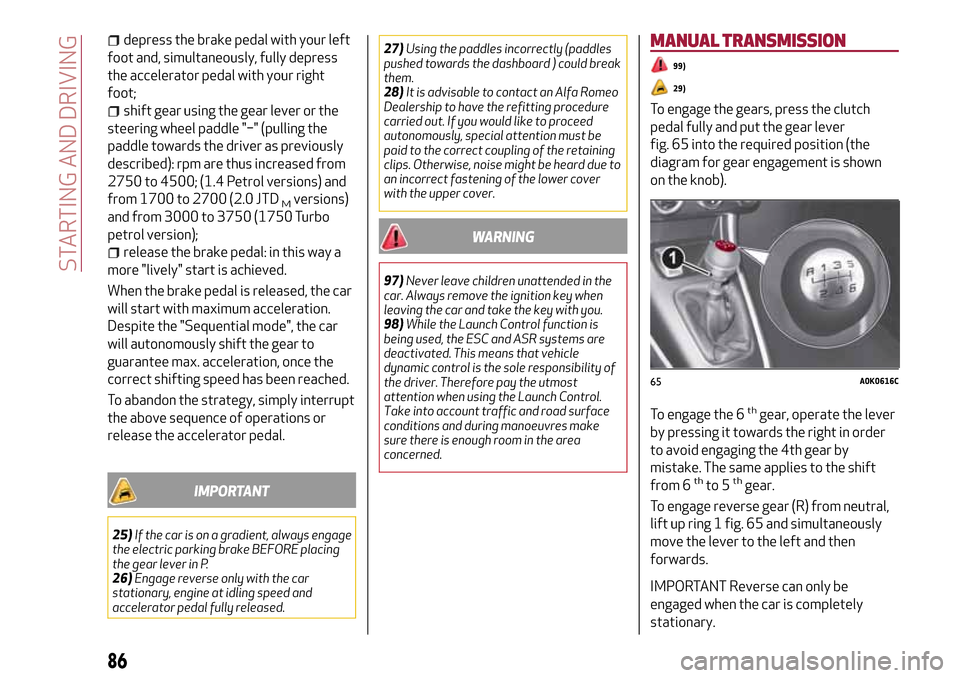
fig. 65 into the required position (the
diagram for gear engagement is shown
on the knob).
To engage the 6
thgear, operate the lever
by pressing it towards the right in order
to avoid engaging the 4th gear by
mistake. The same applies to the shift
from 6
thto 5thgear.
To engage reverse gear (R) from neutral,
lift up ring 1 fig. 65 and simultaneously
move the lever to the left and then
forwards.
IMPORTANT Reverse can only be
engaged when the car is completely
stationary.
65A0K0616C
86
STARTING AND DRIVING
Page 93 of 212
When reverse gear is engaged an
acoustic signal is automatically activated
if there is an obstacle within the range of
operation.
The acoustic signal:
increasesas distance between the car
and the obstacle decreases;
becomes continuouswhen the
distance between the car and the
obstacle is less that 30 cm and stops
immediately if the distance increases;
is constantif the distance is unvaried;
if this situation occurs for the side
sensors, the signal will stop after about
3 seconds to avoid, for example,
indications in the event of manoeuvres
alongside walls.
OPERATION WITH A TRAILER
Parking sensor operation is automatically
turned off when the trailer electric cable
plug is fitted into the car tow hook
socket.
31)
The sensors are automatically
reactivated when the trailer's cable plug
is removed.
103) 104)
IMPORTANT NOTES
During parking manoeuvres, pay the
utmost attention to any obstacles that
could be located above or below the
sensors.
Objects set close to the car rear, under
certain circumstances are not detected and
could therefore cause damage to the car or
be damaged.
The following conditions may influence the
performance of the parking assistance
system:
reduced sensor sensitivity and a
reduction in the parking assistance
system performance could be due to the
presence on the surface of the sensor of:
ice, snow, mud, thick paint
The sensors may detect a non-existent
obstacle (echo interference) due to
mechanical interference, for example when
washing the car, in rain (strong wind), hail.
The signals sent by the sensors can also
be altered by the presence of ultrasonic
systems (e.g. pneumatic brake systems or
pneumatic drills) near the vehicle.
sensor performance can also be
influenced by the position of the sensors.
For example by a change in the ride setting
(caused by the wear of the shock
absorbers, suspension), overloading the car
and carrying out specific tuning operations
that require the car to be lowered;
The detection of obstacles at the top
part of the car may not be guaranteed
because the system detects obstacles that
could cause an impact with the car in the
bottom part.
IMPORTANT
31)The sensor must be free of mud, dirt,
snow or ice in order for the system to work.
Be careful not to scratch or damage the
sensors while cleaning them. Avoid using dry,
rough or hard cloths. The sensors must be
washed using clean water, with the addition
of vehicle shampoo if necessary. When using
special washing equipment such as high
pressure jets or steam cleaning, clean the
sensors very quickly keeping the jet more
than 10 cm away.
WARNING
103)Only have the bumpers repainted or
any retouches to the paintwork in the area of
the sensors carried out by an Alfa Romeo
Dealership. Incorrect paint application could
affect the operation of the parking sensors.
104)Parking and other dangerous
manoeuvres are, however, always the
driver’s responsibility. While carrying out
these manoeuvres, always make sure that
no people (especially children) or animals are
in the area concerned. The parking sensors
are an aid for the driver, but the driver must
never allow their attention to lapse during
potentially dangerous manoeuvres, even
those executed at low speeds.
91
Page 98 of 212
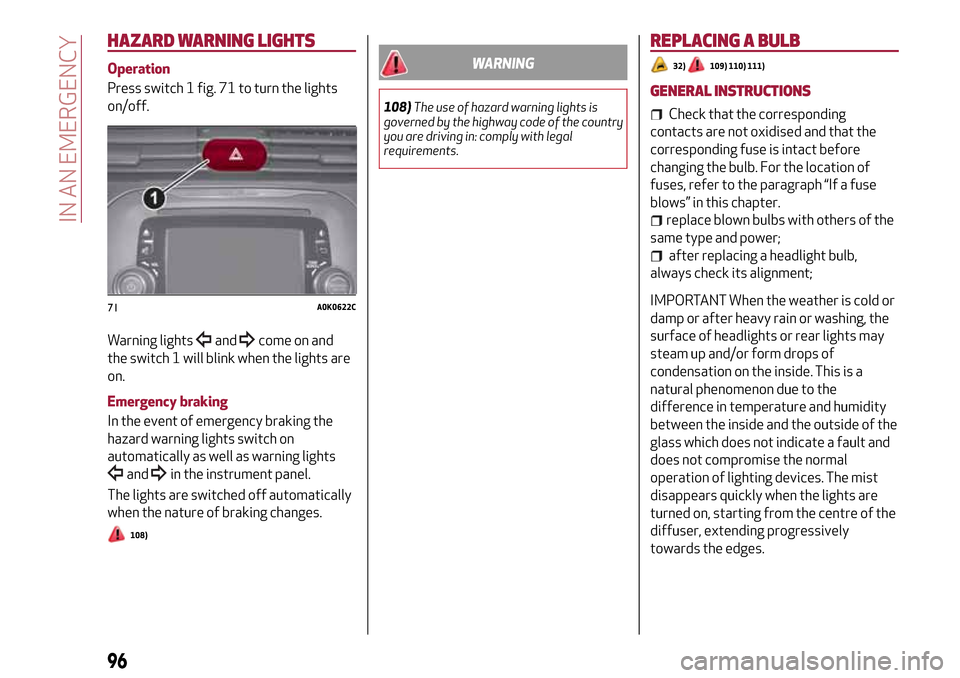
HAZARD WARNING LIGHTS
Operation
Press switch 1 fig. 71 to turn the lights
on/off.
Warning lights
andcome on and
the switch 1 will blink when the lights are
on.
Emergency braking
In the event of emergency braking the
hazard warning lights switch on
automatically as well as warning lights
andin the instrument panel.
The lights are switched off automatically
when the nature of braking changes.
108)
WARNING
108)The use of hazard warning lights is
governed by the highway code of the country
you are driving in: comply with legal
requirements.
REPLACING A BULB
32)109) 110) 111)
GENERAL INSTRUCTIONS
Check that the corresponding
contacts are not oxidised and that the
corresponding fuse is intact before
changing the bulb. For the location of
fuses, refer to the paragraph “If a fuse
blows” in this chapter.
replace blown bulbs with others of the
same type and power;
after replacing a headlight bulb,
always check its alignment;
IMPORTANT When the weather is cold or
damp or after heavy rain or washing, the
surface of headlights or rear lights may
steam up and/or form drops of
condensation on the inside. This is a
natural phenomenon due to the
difference in temperature and humidity
between the inside and the outside of the
glass which does not indicate a fault and
does not compromise the normal
operation of lighting devices. The mist
disappears quickly when the lights are
turned on, starting from the centre of the
diffuser, extending progressively
towards the edges.71A0K0622C
96
IN AN EMERGENCY
Page 99 of 212
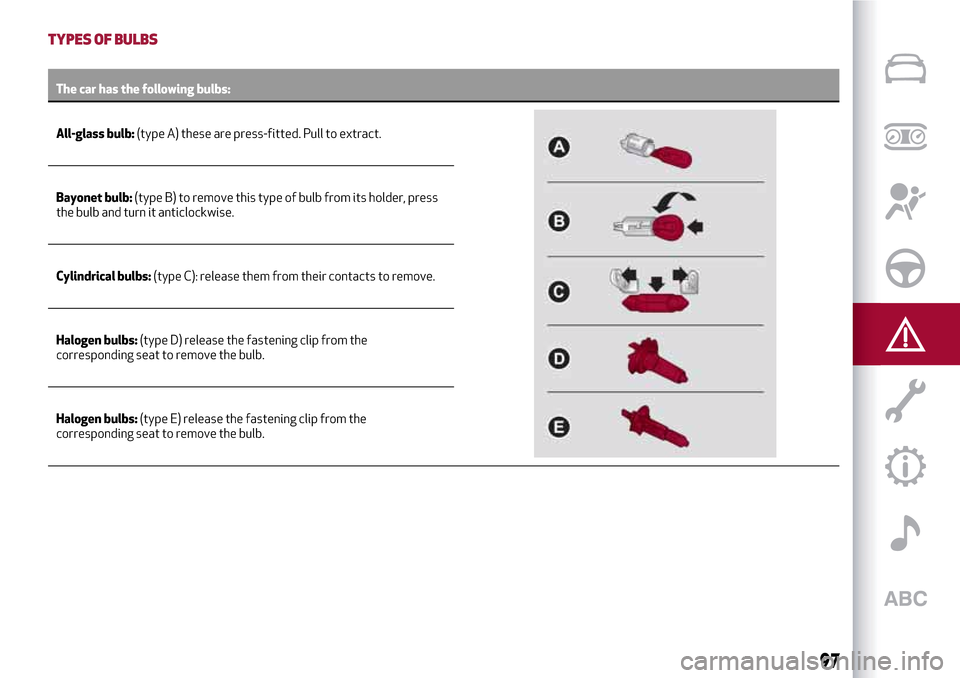
TYPES OF BULBS
The car has the following bulbs:
All-glass bulb:(type
A) these are press-fitted. Pull to extract.
Bayonet bulb:(type B) to remove this type of bulb from its holder, press
the bulb and turn it anticlockwise.
Cylindrical bulbs:(type C): release them from their contacts to remove.
Halogen bulbs:(type D) release the fastening clip from the
corresponding seat to remove the bulb.
Halogen bulbs:(type E) release the fastening clip from the
corresponding seat to remove the bulb.
97