belt Alfa Romeo Giulietta 2017 User Guide
[x] Cancel search | Manufacturer: ALFA ROMEO, Model Year: 2017, Model line: Giulietta, Model: Alfa Romeo Giulietta 2017Pages: 212, PDF Size: 4.56 MB
Page 71 of 212
62)Should it be necessary to carry a child on
the passenger side front seat in a rear facing
child restraint system, the passenger side
front airbag and side bag must be
deactivated through the display main menu
(see the "Display" paragraph, "Knowing the
instrument panel" chapter), verifying
deactivation by checking whether the
OFF LED has switched on in the trim
located on the dashboard. Move the
passenger's seat as far back as possible to
avoid contact between the child seat and the
dashboard.
63)Do not move the front or rear seat if a
child is seated on it or on the dedicated child
restraint system
FITTING "UNIVERSAL" CHILD
RESTRAINTSYSTEM (with seat
belts)
GROUP 0 and 0+
65) 66) 67) 68) 69)
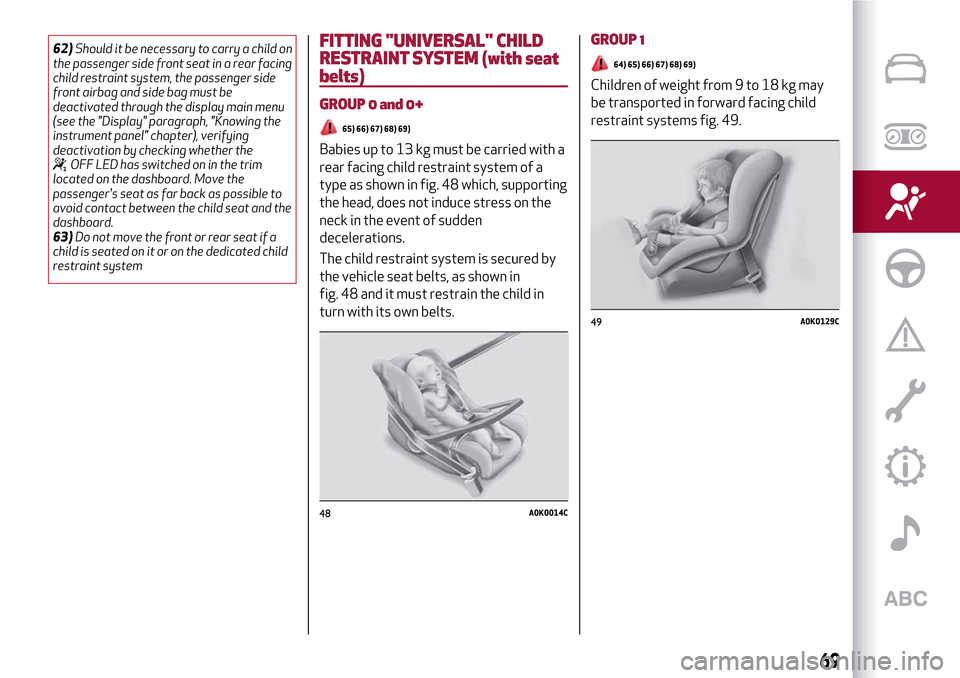
Babies up to 13 kg must be carried with a
rear facing child restraint system of a
type as shown in fig. 48 which, supporting
the head, does not induce stress on the
neck in the event of sudden
decelerations.
The child restraint system is secured by
the vehicle seat belts, as shown in
fig. 48 and it must restrain the child in
turn with its own belts.
GROUP 1
64) 65) 66) 67) 68) 69)
Children of weight from 9 to 18 kg may
be transported in forward facing child
restraint systems fig. 49.
48A0K0014C
49A0K0129C
69
Page 72 of 212
GROUP 2
65) 66) 67) 68) 69)
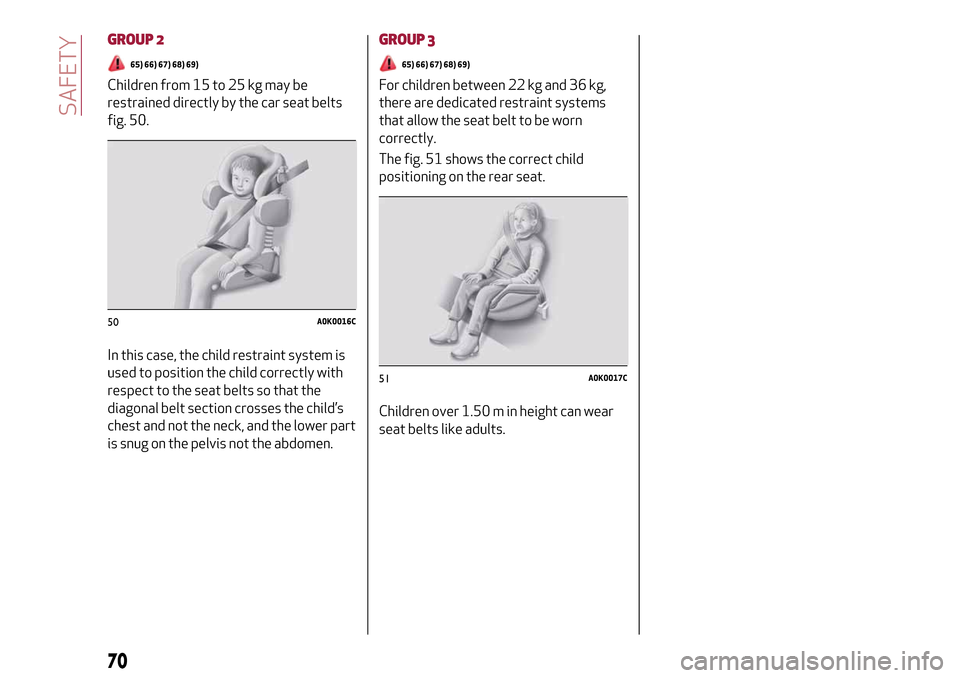
Children from 15 to 25 kg may be
restrained directly by the car seat belts
fig. 50.
In this case, the child restraint system is
used to position the child correctly with
respect to the seat belts so that the
diagonal belt section crosses the child’s
chest and not the neck, and the lower part
is snug on the pelvis not the abdomen.
GROUP 3
65) 66) 67) 68) 69)
For children between 22 kg and 36 kg,
there are dedicated restraint systems
that allow the seat belt to be worn
correctly.
The fig. 51 shows the correct child
positioning on the rear seat.
Children over 1.50 m in height can wear
seat belts like adults.
50A0K0016C
51A0K0017C
70
SAFETY
Page 73 of 212
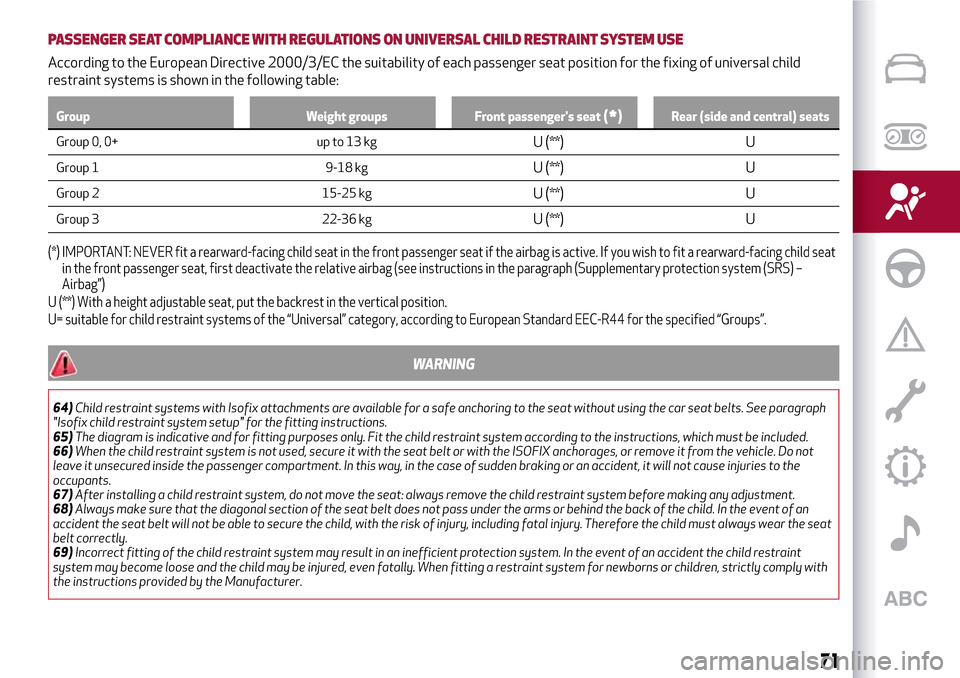
PASSENGER SEAT COMPLIANCE WITH REGULATIONS ON UNIVERSAL CHILD RESTRAINTSYSTEM USE
According to the European Directive 2000/3/EC the suitability of each passenger seat position for the fixing of universal child
restraint systems is shown in the following table:
Group Weight groups Front passenger's seat(*)Rear (side and central) seats
Group 0, 0+ up to 13 kgU (**) U
Group 1 9-18 kgU (**) U
Group 2 15-25 kgU (**) U
Group 3 22-36 kgU (**) U
(*) IMPORTANT: NEVER fit a rearward-facing child seat in the front passenger seat if the airbag is active. If you wish to fit a rearward-facing child seat
in the front passenger seat, first deactivate the relative airbag (see instructions in the paragraph (Supplementary protection system (SRS) –
Airbag”)
U (**) With a height adjustable seat, put the backrest in the vertical position.
U= suitable for child restraint systems of the “Universal” category, according to European Standard EEC-R44 for the specified “Groups”.
WARNING
64)Child restraint systems with Isofix attachments are available for a safe anchoring to the seat without using the car seat belts. See paragraph
"Isofix child restraint system setup" for the fitting instructions.
65)The diagram is indicative and for fitting purposes only. Fit the child restraint system according to the instructions, which must be included.
66)When the child restraint system is not used, secure it with the seat belt or with the ISOFIX anchorages, or remove it from the vehicle. Do not
leave it unsecured inside the passenger compartment. In this way, in the case of sudden braking or an accident, it will not cause injuries to the
occupants.
67)After installing a child restraint system, do not move the seat: always remove the child restraint system before making any adjustment.
68)Always make sure that the diagonal section of the seat belt does not pass under the arms or behind the back of the child. In the event of an
accident the seat belt will not be able to secure the child, with the risk of injury, including fatal injury. Therefore the child must always wear the seat
belt correctly.
69)Incorrect fitting of the child restraint system may result in an inefficient protection system. In the event of an accident the child restraint
system may become loose and the child may be injured, even fatally. When fitting a restraint system for newborns or children, strictly comply with
the instructions provided by the Manufacturer.
71
Page 74 of 212
ISOFIX CHILD RESTRAINT
SYSTEM SETUP
The vehicle is equipped with ISOFIX
anchorages, a new standard which makes
fitting a child restraint system quick,
simple and safe.
Traditional child restraint systems can be
fitted alongside Isofix child restraint
systems on different seats in the same
car.
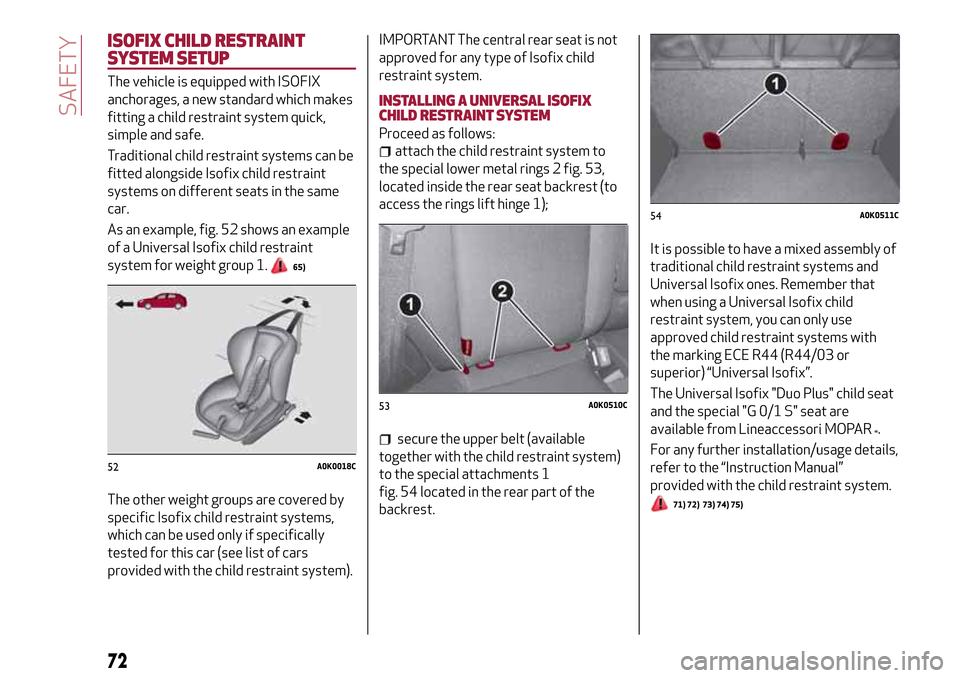
As an example, fig. 52 shows an example
of a Universal Isofix child restraint
system for weight group 1.
65)
The other weight groups are covered by
specific Isofix child restraint systems,
which can be used only if specifically
tested for this car (see list of cars
provided with the child restraint system).
IMPORTANT The central rear seat is not
approved for any type of Isofix child
restraint system.
INSTALLING A UNIVERSAL ISOFIX
CHILD RESTRAINTSYSTEM
Proceed as follows:
attach the child restraint system to
the special lower metal rings 2 fig. 53,
located inside the rear seat backrest (to
access the rings lift hinge 1);
secure the upper belt (available
together with the child restraint system)
to the special attachments 1
fig. 54 located in the rear part of the
backrest.It is possible to have a mixed assembly of
traditional child restraint systems and
Universal Isofix ones. Remember that
when using a Universal Isofix child
restraint system, you can only use
approved child restraint systems with
the marking ECE R44 (R44/03 or
superior) “Universal Isofix”.
The Universal Isofix "Duo Plus" child seat
and the special "G 0/1 S" seat are
available from Lineaccessori MOPAR®.
For any further installation/usage details,
refer to the “Instruction Manual”
provided with the child restraint system.
71) 72) 73) 74) 75)
52A0K0018C
53A0K0510C
54A0K0511C
72
SAFETY
Page 76 of 212
Main recommendations to carry
children safely
Install the child restraint systems on
the rear seat, which is the most protected
position in the event of an impact.
Keep children in rearward facing child
restraint systems for as long as possible,
at least until 3–4 years old.
Should a rearward facing child
restraint system be installed on the rear
seats, it is advisable to position it as far
forward as the position of the front seat
allows.
If the passenger side front airbag is
deactivated always check the permanent
switching on of the warning light
in
the trim above the interior rear view
mirror to make sure that it has actually
been deactivated.
Carefully follow the instructions
supplied with the child restraint system
itself. Keep the instructions in the vehicle
along with the other documents and this
handbook. Do not use second-hand child
restraint systems without instructions.
Only one child is to be strapped into
each restraint system; never carry two
children simultaneously.
Always check that the seat belts do
not rest on the child’s neck.
Always check that the seat belt is well
fastened by pulling on it.
While travelling, do not let the child sit
incorrectly or unfasten the belts.
Never allow a child to put the belt's
diagonal section under an arm or behind
their back.
Never carry children on your lap, even
newborns. No one can hold a child in the
case of an accident.
In the event of an accident, replace the
child restraint system with a new one. In
addition, and depending on the type of
child restraint system installed, replace
the seat belt with which the child
restraint system was connected.
WARNING
70)The diagram is indicative and for fitting
purposes only. Fit the child restraint system
according to the instructions, which must be
included.
71)If a Universal ISOFIX child seat system
is not fixed to all three anchorages, it will not
be able to protect the child correctly. In a
crash, the child could be seriously or fatally
injured.
72)Fit the child restraint system when the
car is stationary. The child restraint system
is correctly secured to the brackets when
you hear the click. Follow the instructions for
assembly, disassembly and positioning that
the Manufacturer must supply with the child
restraint system.
73)Do not use the same lower anchorage to
install more than one child restraint system.74)Fit the child restraint system when the
car is stationary. The child restraint system
is correctly secured to the brackets when
you hear the click. Follow the instructions for
assembly, disassembly and positioning that
the Manufacturer must supply with the child
restraint system.
75)If the vehicle was involved in an accident
of a certain severity, have the ISOFIX
anchorages and the child restraint system
replaced.
74
SAFETY
Page 77 of 212
FRONT AIRBAGS
“SMART BAG”SYSTEM (MULTISTAGE
FRONT AIRBAGS)
The car features multistage front airbags
(“Smart bag”) for driver and passenger.
The front driver/passenger airbags are
designed to protect occupants in the
event of frontal impacts of medium-high
severity, by placing the bag between the
occupant and the steering wheel or
dashboard.
Therefore non-activation in other types
of collisions (side collisions, rear shunts,
roll-overs, etc.) is not a system
malfunction.
Airbags are not a replacement of but
complementary to the seat belts, which
you are recommended to always wear. In
the event of impact, those not wearing a
seat belt are projected forwards and may
come into contact with the bag which is
still inflating. The protection offered by
the bag is compromised in these
circumstances.
76) 77) 79)
Front airbags may not activate in the
following situations:
frontal impacts against highly
deformable objects not involving the
front surface of the car (e.g. wing collision
against guard rail, etc.);
jamming of the car underneath other
vehicles or protective barriers (e.g.
underneath a truck or a guard rail) as, in
this case, the bags would offer no
additional protection with respect to the
seat belt and their deployment would be
inappropriate. Failure to activate in the
conditions described above is due to the
fact that they may not provide any
additional protection compared with seat
belts, so their activation would be
inappropriate. In these cases,
non-deployment does not indicate a
system malfunction.
FRONT AIRBAG DRIVER'S SIDE
This consists of an instantly inflating bag
contained in a special compartment in the
centre of the steering wheel fig. 55.
PASSENGER SIDE FRONT AIRBAG
This consists of an instantly inflating bag
contained in a special recess in the
dashboard: fig. 56 this bag has a larger
volume than that of the driver.
78)
FRONT PASSENGER SIDE AIRBAG AND
CHILD RESTRAINTSYSTEMS
80)
Rearward facing child restraint systems
mustNEVERbe fitted on the front seat
with an active passenger airbag since in
the event of an impact the airbag
activation may cause fatal injuries to the
transported child.ALWAYScomply with
the instructions on the label on the
passenger side sun visor fig. 57.
55A0K0364C
56A0K0135C
75
Page 81 of 212
SIDE AIRBAGS (SIDE BAGS -
WINDOW BAGS)
To increase protection of occupants in
case of side collision, the car is equipped
with front side bags for pelvis, chest and
shoulder protection (side bags) for the
driver and the passenger and airbags
protecting the head of front and rear
occupants (window bags).
Non-activation of side bags in other
types of collisions (front collisions, rear
shunts, roll-overs, etc.) is not a system
malfunction.
FRONT SIDE AIRBAGS (SIDE BAGS)
These comprise two types of bags
located in the front seat backrests
fig. 60 which protect the pelvic, chest and
shoulder area of the occupants in the
event of a side impact of medium-high
severity.
SIDE AIRBAGS FOR HEAD PROTECTION
(WINDOW BAGS)
These consist of two “drop-down”
cushions, housed behind the side trim of
the roof and covered with finishing
elements fig. 61.
They are designed to protect the head of
front and rear occupants in the event of a
side collision, thanks to the wide cushion
inflation surface.
The deployment of side bags in the event
of side impacts of low severity is not
required.
The airbags are not deployed in the event
of impact of low severity (for which the
restraining action of the seat belts is
sufficient). It is therefore always
necessary to wear seat belts.
In the event of a side impact, the system
provides best protection if the passenger
sits on the seat in a correct position, thus
allowing correct window bag deployment.IMPORTANT NOTES
Do not wash the seats with water or
pressurised steam (wash by hand or at
automatic seat washing stations).
The front and/or side bags may activate
in the event of sharp knocks to the
underbody of the car (e.g. impact with
steps, pavements, potholes or road
bumps etc.).
When the airbag deploys it emits a small
amount of dust: the dust is harmless and
does not indicate the beginning of a fire.
However, the dust may irritate the skin
and eyes: in this case, wash with neutral
soap and water.
Airbag checking, repair and replacement
must be carried out at an Alfa Romeo
Dealership.
If the car is scrapped, have the airbag
system deactivated at an Alfa Romeo
Dealership.
Pretensioners and airbags are deployed
according to different logic on the basis
of the type of collision. Failure to activate
one or more of the devices does not
indicate a system malfunction.
81) 82) 83) 84) 85) 86) 87) 88) 89) 90) 91)
60A0K0629C
61A0K0035C
79
Page 82 of 212
WARNING
81)Do not affix rigid objects to the garment
hooks or support handles.
82)Do not rest your head, arms or elbows on
the door, windows or the area in which the
Window bag is located to avoid possible
injury during airbag inflation.
83)Never lean your head, arms or elbows
out of the window.
84)If the
warning light does not switch
on when the key is turned to MAR, or stays
on while driving (on some versions together
with a message on the display) there may be
a fault in the restraint systems. In this case,
airbags or pretensioners may not be
activated in the case of an accident or (in a
lesser number of cases) they may be
activated incorrectly. Before proceeding,
contact an Alfa Romeo Dealership to have
the system checked immediately.
85)Do not travel carrying objects on your
lap, in front of your chest or between your
lips (pipe, pencils, etc.): they could cause
severe injury if the airbag is deployed.
86)If the car has been subject to theft,
attempted theft, vandalism, or flooding,
have the airbag system inspected at an Alfa
Romeo Dealership.87)The airbags may also be deployed when
the car is not moving, if the key is in the
ignition and turned to MAR-ON or when the
engine is off, if the car is hit by another
moving vehicle. Therefore, even if the vehicle
is stationary, when an active front
passenger airbag is fitted, DO NOT install
rearward facing child restraint systems on
the front passenger seat. Deployment of the
airbag following an impact could cause fatal
injuries to the child. Therefore, always
deactivate the passenger side airbag when a
rearward facing child restraint system is
installed on the front passenger seat. The
front passenger seat must also be
positioned back as far as possible in order to
prevent the child restraint system from
coming into contact with the dashboard.
Immediately reactivate the passenger
airbag as soon as the child restraint system
has been removed. Also remember that, if
the key is turned to STOP, none of the safety
devices (airbags or pretensioners) will be
deployed in the event of collision.
Non-deployment in such cases does not
indicate a system malfunction.
88)When the ignition key is turned to MAR,
the
warning light switches for few
seconds, then if the passenger airbag is
active it should switch off.
89)The front airbag is designed to be
deployed for impacts of a greater intensity
than for the pretensioners. For impacts
whose intensity falls between the two levels,
normally, only the pretensioners will be
activated.90)The airbag does not replace seat belts
but increases their efficiency. Because front
airbags are not deployed for low-speed
crashes, side collisions, rear-end shunts or
rollovers, occupants are protected, in
addition to any side bags, only by their seat
belts, which must therefore always be
fastened.
91)On cars with side bags, do not cover the
front seat backrests with extra covers.
80
SAFETY
Page 84 of 212
STARTING THE ENGINE
Before starting the engine, adjust the
seat, the interior rear view mirrors, the
door mirrors and fasten the seat belt
correctly.
Never press the accelerator pedal for
starting the engine.
If necessary, messages indicating the
starting procedure can be shown on the
display.
ENGINE STARTING PROCEDURE
92) 93) 94)
21) 22) 23)
Proceed as follows:
engage the handbrake and place the
gear lever in neutral;
turn the ignition key to the MAR-ON
position. ONLY FOR DIESEL VERSIONS:
The instrument panel
warning light
comes on and the
icon appears on
the display.
wait for the warning lights to switch
off;
fully depress the clutch pedal, without
touching the accelerator;
turn the ignition key to AVV and
release it as soon as the engine starts.
If, with the ignition key turned to MAR,
the icon
on the display stays on
together with the warning light
, turn
the key to STOP and then back to MAR. If
the icon continues to stay on, try with the
other keys provided with the car. Contact
an Alfa Romeo Dealership if the engine
still does not start.
Never leave the ignition key in
MAR-ON position when the engine is
stopped.
ENGINE MINIMUM OIL LEVEL
INDICATION
(where provided)
When the ignition key is turned to MAR
the display shows a warning message, for
a few seconds, if the engine oil is at the
minimum level.
IMPORTANT To perform the engine oil
reading correctly, after turning the
ignition key to MAR wait for about
2 seconds before starting the engine.
WARNING
92)It is dangerous to run the engine in
enclosed areas. The engine takes in oxygen
and releases carbon dioxide, carbon
monoxide and other toxic gases.
93)The brake servo is not active until the
engine is started, so you would need to apply
much more force than usual to the brake
pedal.94)Do not start the engine by pushing,
towing or driving downhill. These
manoeuvres may damage the catalytic
converter.
IMPORTANT
21)We recommend that during the initial
period, or during the first 1600 km
(1000 miles), you do not drive to full car
performance (e.g. excessive acceleration,
long journeys at top speed, sharp braking,
etc.).
22)When the engine is switched off never
leave the ignition device in the MAR position
to prevent useless current absorption from
draining the battery.
23)A quick burst on the accelerator before
turning off the engine serves absolutely no
practical purpose; it wastes fuel and is
damaging for the engine.
24)Warning light
will flash after starting
or during prolonged cranking to indicate a
fault with the glow plug heating system. If
the engine starts, the vehicle can be regularly
used, but an Alfa Romeo Dealership must be
contacted as soon as possible.
82
STARTING AND DRIVING
Page 90 of 212
MISSED ENGINE STOPPING
CONDITIONS
When the system is active, for a higher
comfort and safety, and to reduce
emissions, the engine does not stop in
certain ambient conditions, engine
conditions, with the doors not closed and
seat belts unfastened.
30)
ENGINE RESTARTING CONDITIONS
Due to comfort, emission control and
safety reasons, the engine can restart
automatically without any action by the
driver, when the vehicle and the climate
control system are in certain conditions,
such as:
With gear engaged, automatic engine
restarting is possible only by fully
pressing the clutch pedal. The driver is
informed by the displaying of a message
on the display and - for versions/markets,
where provided - by the flashing of the
symbol
.
SAFETY FUNCTIONS
When the engine is stopped by the
Start&Stop system, if the driver releases
his/her seat belt and opens the driver's or
passenger's door, the engine can be
restarted only by the ignition key.
The driver is informed by a buzzer and by
the flashing of the symbol
on the
display (on some versions, a message is
displayed as well).
"ENERGY SAVING" FUNCTION(for versions/markets, where provided)
If, following the automatic engine
restarting, the driver does not carry out
any action on the vehicle for over
3 minutes, the Start&Stop system stops
the engine definitely, to prevent fuel
consumption. In these cases, the engine
can be restarted only using the ignition
key.
NOTE In any case, it is possible to keep
the engine running by deactivating the
Start&Stop system.
IRREGULAR OPERATION
In the event of malfunction, the
Stop/Start system is deactivated.
The driver is informed of the fault by the
flashing of the symbol
.For
versions/markets, where provided, a
warning message will also appear on the
display.
In this case, contact an Alfa Romeo
Dealership.
VEHICLE INACTIVITY
In the event of vehicle inactivity (or if the
battery is replaced), special attention
must be paid to the disconnection of the
battery power supply.
100)
IMPORTANT
30)If climate comfort is to be favoured, the
Stop/Start system can be deactivated, for a
continuous operation of the climate control
system.
WARNING
100)When replacing the battery, always
contact an Alfa Romeo Dealership. Replace
the battery with one of the same type
(HEAVY DUTY) and with the same
specifications.
88
STARTING AND DRIVING