engine Alfa Romeo Giulietta 2017 User Guide
[x] Cancel search | Manufacturer: ALFA ROMEO, Model Year: 2017, Model line: Giulietta, Model: Alfa Romeo Giulietta 2017Pages: 212, PDF Size: 4.56 MB
Page 27 of 212
7 - passenger's side temperature adjustment knob;
8 - MONO function button (set temperature alignment) driver/passenger side;
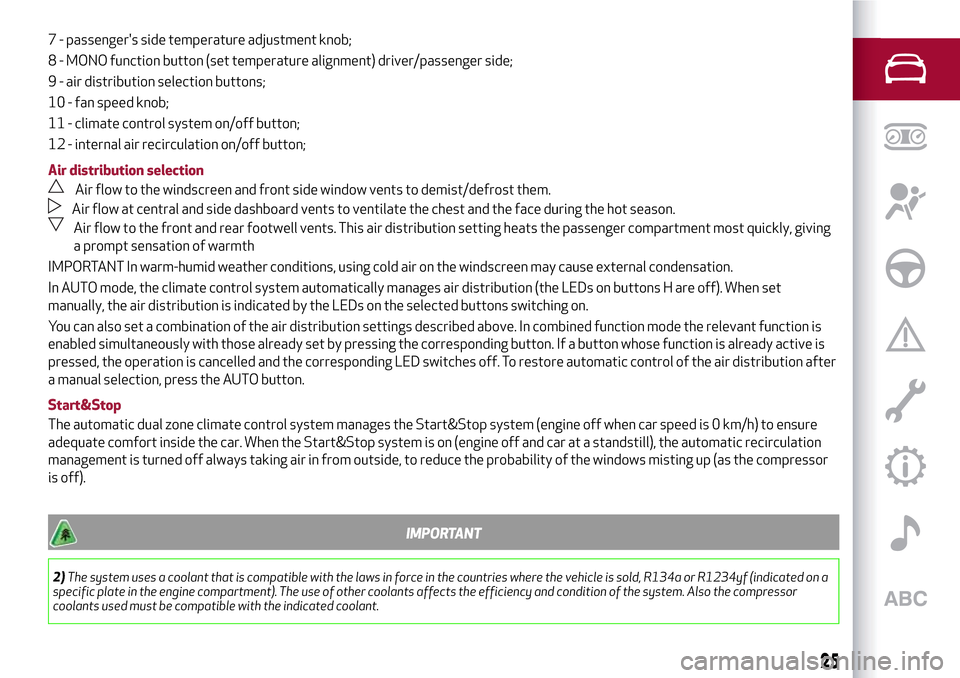
9 - air distribution selection buttons;
10 - fan speed knob;
11 - climate control system on/off button;
12 - internal air recirculation on/off button;
Air distribution selection
Air flow to the windscreen and front side window vents to demist/defrost them.
Air flow at central and side dashboard vents to ventilate the chest and the face during the hot season.
Air flow to the front and rear footwell vents. This air distribution setting heats the passenger compartment most quickly, giving
a prompt sensation of warmth
IMPORTANT In warm-humid weather conditions, using cold air on the windscreen may cause external condensation.
In AUTO mode, the climate control system automatically manages air distribution (the LEDs on buttons H are off). When set
manually, the air distribution is indicated by the LEDs on the selected buttons switching on.
You can also set a combination of the air distribution settings described above. In combined function mode the relevant function is
enabled simultaneously with those already set by pressing the corresponding button. If a button whose function is already active is
pressed, the operation is cancelled and the corresponding LED switches off. To restore automatic control of the air distribution after
a manual selection, press the AUTO button.
Start&Stop
The automatic dual zone climate control system manages the Start&Stop system (engine off when car speed is 0 km/h) to ensure
adequate comfort inside the car. When the Start&Stop system is on (engine off and car at a standstill), the automatic recirculation
management is turned off always taking air in from outside, to reduce the probability of the windows misting up (as the compressor
is off).
IMPORTANT
2)The system uses a coolant that is compatible with the laws in force in the countries where the vehicle is sold, R134a or R1234yf (indicated on a
specific plate in the engine compartment). The use of other coolants affects the efficiency and condition of the system. Also the compressor
coolants used must be compatible with the indicated coolant.
25
Page 31 of 212
ENGINE BONNET
OPENING
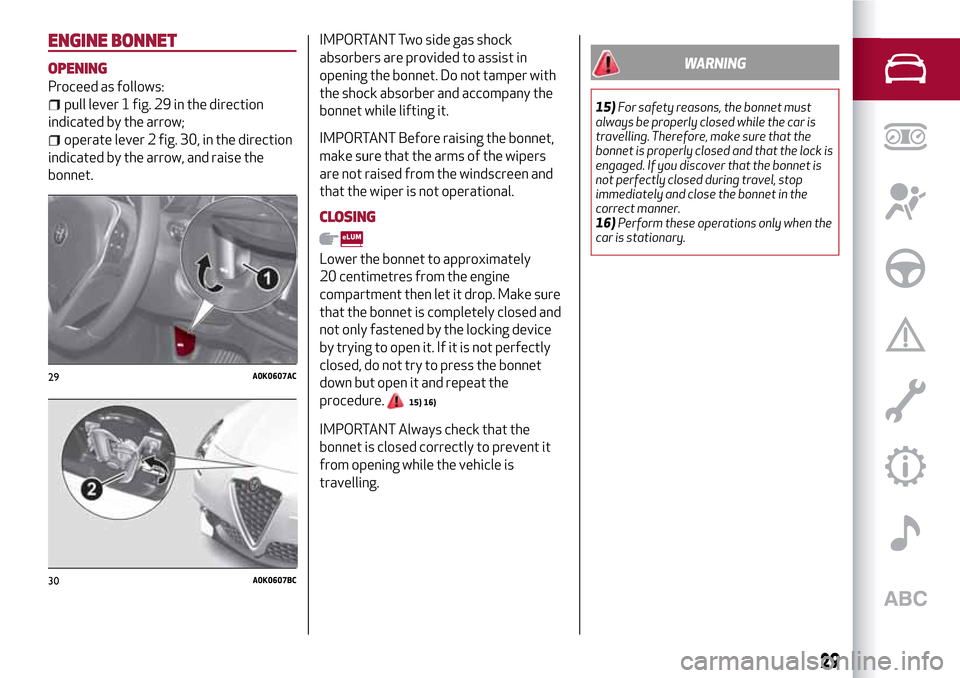
Proceed as follows:
pull lever 1 fig. 29 in the direction
indicated by the arrow;
operate lever 2 fig. 30, in the direction
indicated by the arrow, and raise the
bonnet.
IMPORTANT Two side gas shock
absorbers are provided to assist in
opening the bonnet. Do not tamper with
the shock absorber and accompany the
bonnet while lifting it.
IMPORTANT Before raising the bonnet,
make sure that the arms of the wipers
are not raised from the windscreen and
that the wiper is not operational.
CLOSING
Lower the bonnet to approximately
20 centimetres from the engine
compartment then let it drop. Make sure
that the bonnet is completely closed and
not only fastened by the locking device
by trying to open it. If it is not perfectly
closed, do not try to press the bonnet
down but open it and repeat the
procedure.
15) 16)
IMPORTANT Always check that the
bonnet is closed correctly to prevent it
from opening while the vehicle is
travelling.
WARNING
15)For safety reasons, the bonnet must
always be properly closed while the car is
travelling. Therefore, make sure that the
bonnet is properly closed and that the lock is
engaged. If you discover that the bonnet is
not perfectly closed during travel, stop
immediately and close the bonnet in the
correct manner.
16)Perform these operations only when the
car is stationary.
29A0K0607AC
30A0K0607BC
29
Page 34 of 212
When “Natural” mode is selected, no
messages or symbols are shown on the
display.
The device acts on the dynamic car
control systems (engine, steering, ESC,
ASR, ELECTRONIC Q2 systems, etc.).
TURNING “Dynamic” MODE ON/OFF
9)
IMPORTANT For versions/markets,
where provided, switching to "Dynamic"
mode is automatically disabled in the
first kilometres in order to guarantee
correct settling of the mechanical
components. If an attempt to activate
the system is made before this limit, the
display will show a dedicated message to
remind the driver that this request
cannot be fulfilled.
Activation
Move lever 1 fig. 33 downwards (to the
letter “d”) and hold in this position for
0.5 seconds until the corresponding LED
lights up or the word “Dynamic” appears
on the display.
When lever 1 fig. 33 is moved to the “d”
position, the activation of “Dynamic”
mode is confirmed by a temporary
variation in the brightness (flashing) of
the instrument panel.Turning off
Mover the lever 1 fig. 33 to the "Natural"
position;
TURNING“All Weather” MODE ON/OFF
Activation
Move lever 1 fig. 33 downwards (to the
letter “a”) and hold in this position for
0.5 seconds until the corresponding LED
lights up or the word “All Weather”
appears on the display.
Deactivation
Mover the lever 1 fig. 33 to the "Natural"
position;
IMPORTANT
9)"FAST" VERSION: Considering the high
levels of vehicle performance, it is
recommended to not use the "Dynamic"
mode when driving the first kilometres with
the vehicle in order to provide the
mechanical components with the necessary
running-in period.
VERSION WITH LPGSYSTEM
19) 21)10) 11) 12) 13) 14) 16)
INTRODUCTION
The LPG version features two fuel supply
systems: one for petrol and one for LPG.
PASSIVE SAFETY/ACTIVE SAFETY
Although the LPG system has numerous
safety features, it is advisable to proceed
as follows every time the vehicle is not in
use for a long period or moved in an
emergency as a result of a breakdown or
accident:
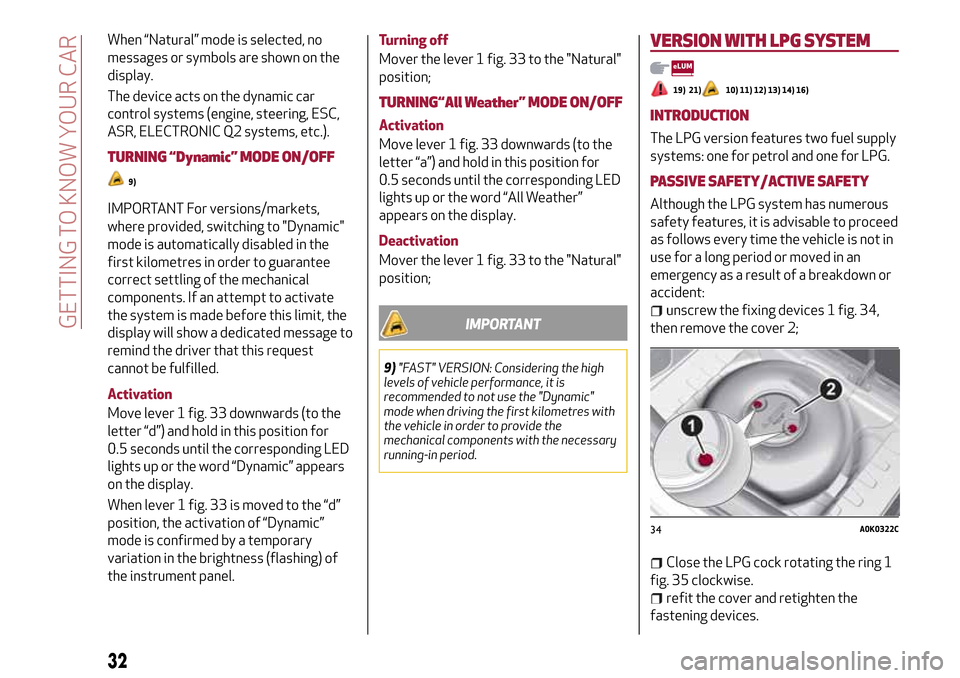
unscrew the fixing devices 1 fig. 34,
then remove the cover 2;
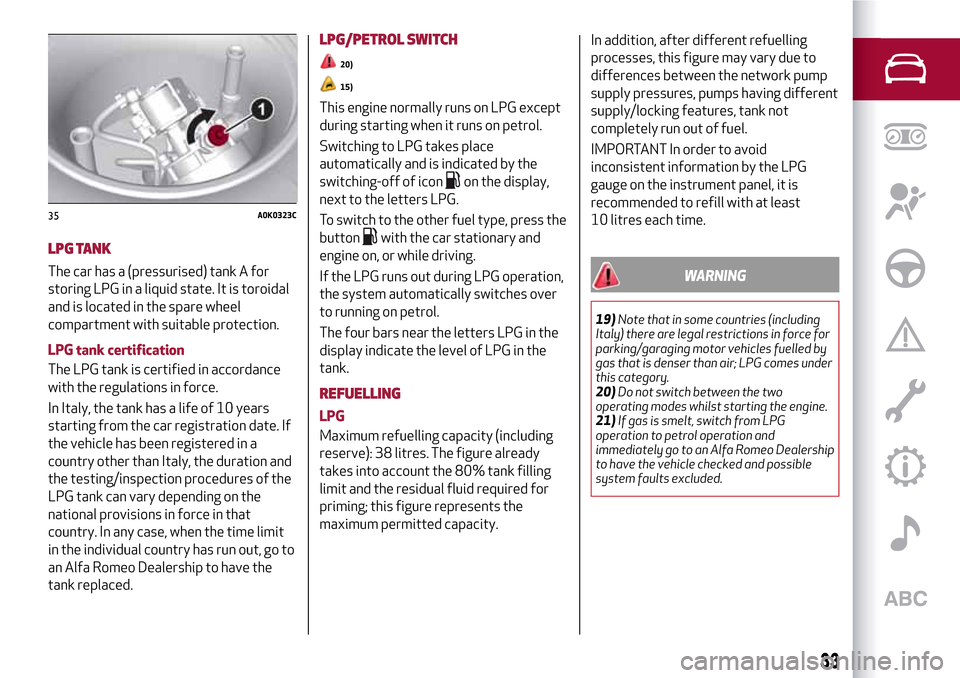
Close the LPG cock rotating the ring 1
fig. 35 clockwise.
refit the cover and retighten the
fastening devices.
34A0K0322C
32
GETTING TO KNOW YOUR CAR
Page 35 of 212
LPG TANK
The car has a (pressurised) tank A for
storing LPG in a liquid state. It is toroidal
and is located in the spare wheel
compartment with suitable protection.
LPG tank certification
The LPG tank is certified in accordance
with the regulations in force.
In Italy, the tank has a life of 10 years
starting from the car registration date. If
the vehicle has been registered in a
country other than Italy, the duration and
the testing/inspection procedures of the
LPG tank can vary depending on the
national provisions in force in that
country. In any case, when the time limit
in the individual country has run out, go to
an Alfa Romeo Dealership to have the
tank replaced.
LPG/PETROL SWITCH
20)
15)
This engine normally runs on LPG except
during starting when it runs on petrol.
Switching to LPG takes place
automatically and is indicated by the
switching-off of icon
on the display,
next to the letters LPG.
To switch to the other fuel type, press the
button
with the car stationary and
engine on, or while driving.
If the LPG runs out during LPG operation,
the system automatically switches over
to running on petrol.
The four bars near the letters LPG in the
display indicate the level of LPG in the
tank.
REFUELLING
LPG
Maximum refuelling capacity (including
reserve): 38 litres. The figure already
takes into account the 80% tank filling
limit and the residual fluid required for
priming; this figure represents the
maximum permitted capacity.In addition, after different refuelling
processes, this figure may vary due to
differences between the network pump
supply pressures, pumps having different
supply/locking features, tank not
completely run out of fuel.
IMPORTANT In order to avoid
inconsistent information by the LPG
gauge on the instrument panel, it is
recommended to refill with at least
10 litres each time.
WARNING
19)Note that in some countries (including
Italy) there are legal restrictions in force for
parking/garaging motor vehicles fuelled by
gas that is denser than air; LPG comes under
this category.
20)Do not switch between the two
operating modes whilst starting the engine.
21)If gas is smelt, switch from LPG
operation to petrol operation and
immediately go to an Alfa Romeo Dealership
to have the vehicle checked and possible
system faults excluded.
35A0K0323C
33
Page 36 of 212
IMPORTANT
10)The car is equipped with a specifically
designed gaseous LPG injection system: it is
therefore absolutely forbidden to alter the
configuration of the system or its
components. The use of other components or
materials could cause malfunctions and lead
to a reduction in safety; therefore, in the
case of problems, contact an Alfa Romeo
Dealership. When towing or lifting the
vehicle, follow the instructions in the main
handbook under the paragraph on "Towing
the vehicle" to prevent damage to the gas
system parts.
11)The system operates at temperatures
ranging between -20°C and 100°C.
12)When using a painting oven, the LPG
tank should be removed from the car and
later carefully refitted at an Alfa Romeo
Dealership. Although the LPG system has
numerous safety features, it is advisable to
proceed as follows every time the vehicle is
not in use for a long period or moved in an
emergency as a result of a breakdown or
accident: unscrew the devices fastening the
cover of the LPG tank, then remove it. Close
the LPG cock rotating the ring nut clockwise
(see "Passive safety / active safety"). Refit
the cover and retighten the fastening
devices.13)Only use LPG for motor vehicles.
14)It is strictly forbidden to use any additive
in the LPG. Periodically (at least once every
six months) it is advisable to let the LPG in
the tank run out and, at the first refuelling, to
check that it does not exceed the maximum
capacity of 38 litres (reserve included) (with
a tolerance of 2 litres excess). If the level is
above 38 litres (reserve included) contact an
Alfa Romeo Dealership immediately.
15)When switching is requested, metallic
noise from the valves which pressurise the
circuit can be heard. For the switching logic
described above, a delay between the valve
ticking and the switching off of the
instrument panel indication is completely
normal.
16)In particular usage conditions, such as
starting and operation at low ambient
temperature or LPG supply with low propane
content, the system may switch temporarily
to petrol operation, without a visual
indication of switching on the instrument
panel. In the event of low LPG levels in the
tank or request for high performance (e.g.
overtaking, car fully laden, steep hills) the
system may automatically switch to petrol
operation to guarantee the engine power
requested; the green warning light on the
instrument panel switches on to indicate this.
When the above conditions are no longer
present, the system automatically restores
LPG operation; the green warning light
switches off. To achieve the automatic
switching described above, make sure that
there is always enough fuel in the petrol tank.
34
GETTING TO KNOW YOUR CAR
Page 38 of 212
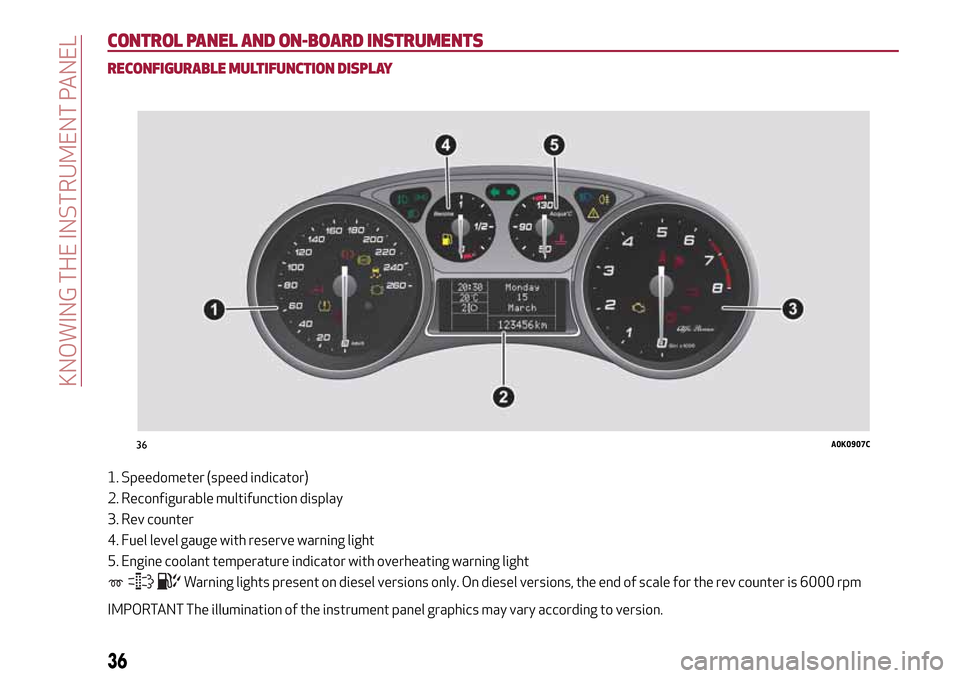
CONTROL PANEL AND ON-BOARD INSTRUMENTS
RECONFIGURABLE MULTIFUNCTION DISPLAY
1. Speedometer (speed indicator)
2. Reconfigurable multifunction display
3. Rev counter
4. Fuel level gauge with reserve warning light
5. Engine coolant temperature indicator with overheating warning light
Warning lights present on diesel versions only. On diesel versions, the end of scale for the rev counter is 6000 rpm
IMPORTANT The illumination of the instrument panel graphics may vary according to version.
36A0K0907C
36
KNOWING THE INSTRUMENT PANEL
Page 39 of 212
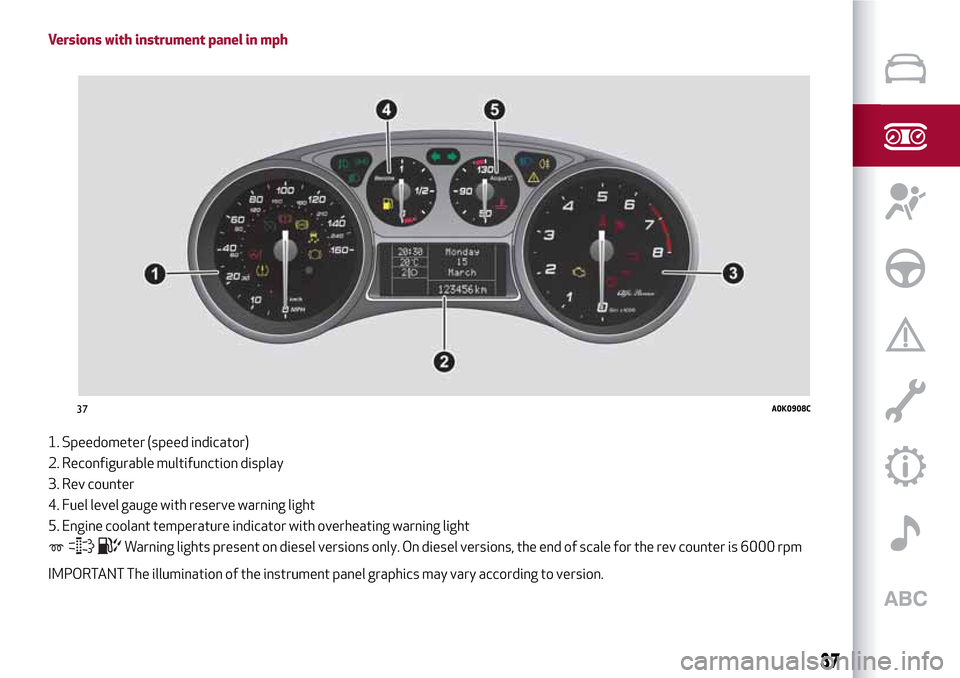
Versions with instrument panel in mph
1. Speedometer (speed indicator)
2. Reconfigurable multifunction display
3. Rev counter
4. Fuel level gauge with reserve warning light
5. Engine coolant temperature indicator with overheating warning light
Warning lights present on diesel versions only. On diesel versions, the end of scale for the rev counter is 6000 rpm
IMPORTANT The illumination of the instrument panel graphics may vary according to version.
37A0K0908C
37
Page 45 of 212
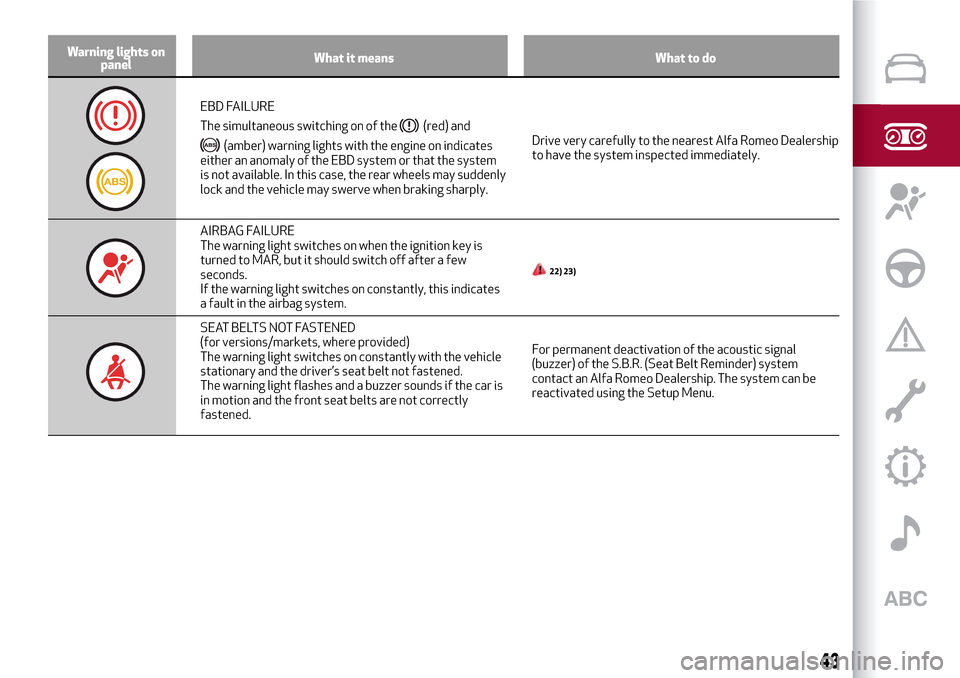
Warning lights on
panelWhat it means What to do
EBD FAILURE
The simultaneous switching on of the
(red) and
(amber) warning lights with the engine on indicates
either an anomaly of the EBD system or that the system
is not available. In this case, the rear wheels may suddenly
lock and the vehicle may swerve when braking sharply.Drive very carefully to the nearest Alfa Romeo Dealership
to have the system inspected immediately.
AIRBAG FAILURE
The warning light switches on when the ignition key is
turned to MAR, but it should switch off after a few
seconds.
If the warning light switches on constantly, this indicates
a fault in the airbag system.
22) 23)
SEAT BELTS NOT FASTENED
(for versions/markets, where provided)
The warning light switches on constantly with the vehicle
stationary and the driver’s seat belt not fastened.
The warning light flashes and a buzzer sounds if the car is
in motion and the front seat belts are not correctly
fastened.For permanent deactivation of the acoustic signal
(buzzer) of the S.B.R. (Seat Belt Reminder) system
contact an Alfa Romeo Dealership. The system can be
reactivated using the Setup Menu.
43
Page 46 of 212
Warning lights on
panelWhat it means What to do
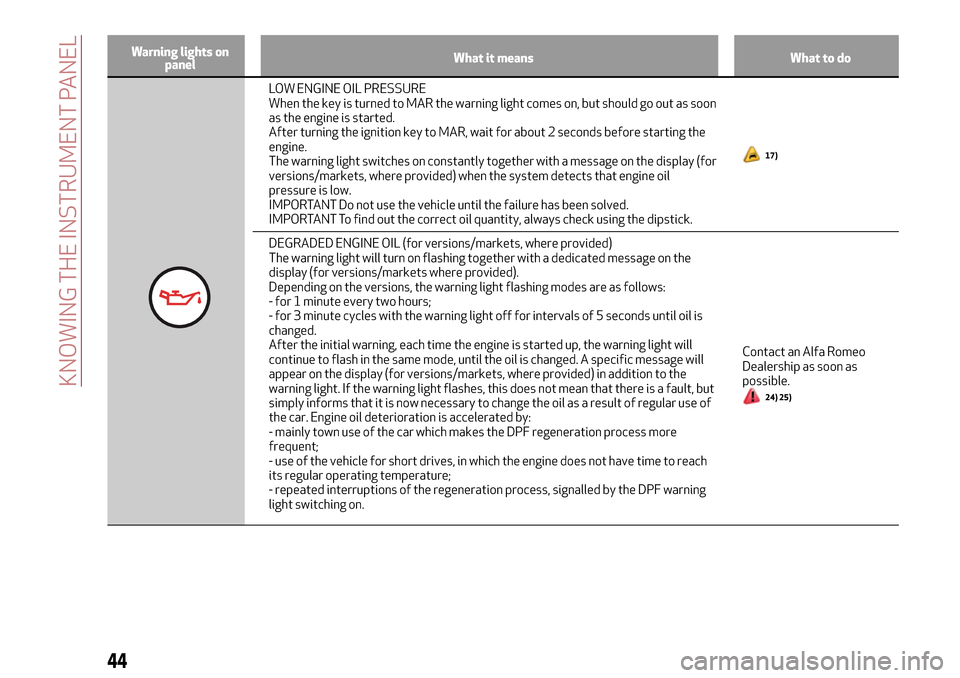
LOW ENGINE OIL PRESSURE
When the key is turned to MAR the warning light comes on, but should go out as soon
as the engine is started.
After turning the ignition key to MAR, wait for about 2 seconds before starting the
engine.
The warning light switches on constantly together with a message on the display (for
versions/markets, where provided) when the system detects that engine oil
pressure is low.
IMPORTANT Do not use the vehicle until the failure has been solved.
IMPORTANT To find out the correct oil quantity, always check using the dipstick.
17)
DEGRADED ENGINE OIL (for versions/markets, where provided)
The warning light will turn on flashing together with a dedicated message on the
display (for versions/markets where provided).
Depending on the versions, the warning light flashing modes are as follows:
- for 1 minute every two hours;
- for 3 minute cycles with the warning light off for intervals of 5 seconds until oil is
changed.
After the initial warning, each time the engine is started up, the warning light will
continue to flash in the same mode, until the oil is changed. A specific message will
appear on the display (for versions/markets, where provided) in addition to the
warning light. If the warning light flashes, this does not mean that there is a fault, but
simply informs that it is now necessary to change the oil as a result of regular use of
the car. Engine oil deterioration is accelerated by:
- mainly town use of the car which makes the DPF regeneration process more
frequent;
- use of the vehicle for short drives, in which the engine does not have time to reach
its regular operating temperature;
- repeated interruptions of the regeneration process, signalled by the DPF warning
light switching on.Contact an Alfa Romeo
Dealership as soon as
possible.
24) 25)
44
KNOWING THE INSTRUMENT PANEL
Page 47 of 212
Warning lights on
panelWhat it means What to do
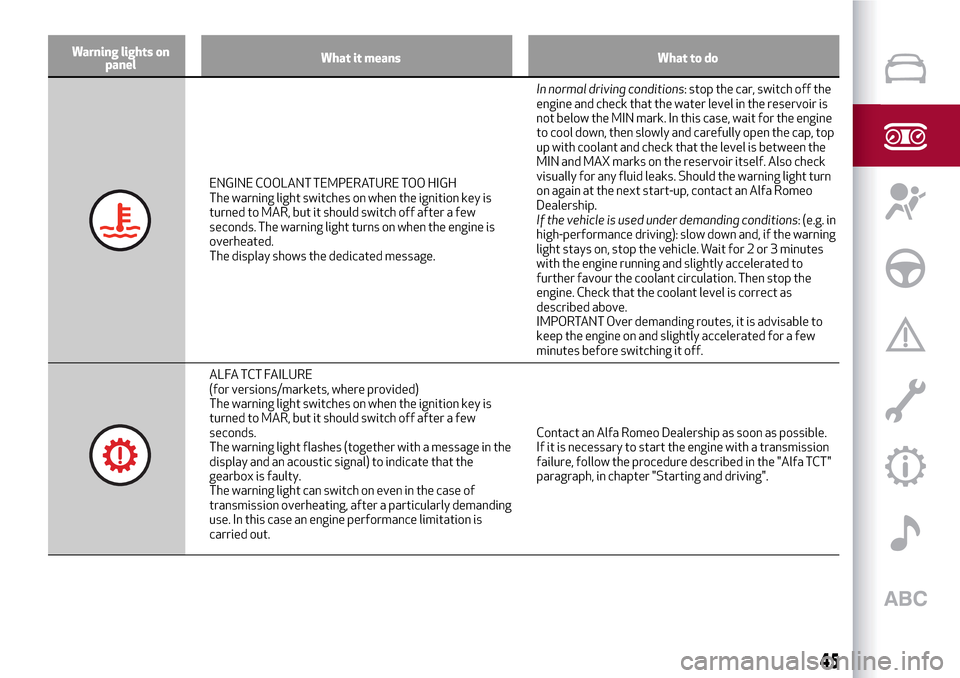
ENGINE COOLANT TEMPERATURE TOO HIGH
The warning light switches on when the ignition key is
turned to MAR, but it should switch off after a few
seconds. The warning light turns on when the engine is
overheated.
The display shows the dedicated message.In normal driving conditions: stop the car, switch off the
engine and check that the water level in the reservoir is
not below the MIN mark. In this case, wait for the engine
to cool down, then slowly and carefully open the cap, top
up with coolant and check that the level is between the
MIN and MAX marks on the reservoir itself. Also check
visually for any fluid leaks. Should the warning light turn
on again at the next start-up, contact an Alfa Romeo
Dealership.
If the vehicle is used under demanding conditions: (e.g. in
high-performance driving): slow down and, if the warning
light stays on, stop the vehicle. Wait for 2 or 3 minutes
with the engine running and slightly accelerated to
further favour the coolant circulation. Then stop the
engine. Check that the coolant level is correct as
described above.
IMPORTANT Over demanding routes, it is advisable to
keep the engine on and slightly accelerated for a few
minutes before switching it off.
ALFA TCT FAILURE
(for versions/markets, where provided)
The warning light switches on when the ignition key is
turned to MAR, but it should switch off after a few
seconds.
The warning light flashes (together with a message in the
display and an acoustic signal) to indicate that the
gearbox is faulty.
The warning light can switch on even in the case of
transmission overheating, after a particularly demanding
use. In this case an engine performance limitation is
carried out.Contact an Alfa Romeo Dealership as soon as possible.
If it is necessary to start the engine with a transmission
failure, follow the procedure described in the "Alfa TCT"
paragraph, in chapter "Starting and driving".
45