steering Alfa Romeo Giulietta 2017 User Guide
[x] Cancel search | Manufacturer: ALFA ROMEO, Model Year: 2017, Model line: Giulietta, Model: Alfa Romeo Giulietta 2017Pages: 212, PDF Size: 4.56 MB
Page 23 of 212
Move the stalk upwards (unstable
position) to limit operation to the time
for which the stalk is held in this position.
When released, the stalk will return to its
default position and the windscreen
wiper will be automatically stopped.
“Smart washing” function
Pull the stalk towards the steering wheel
(unstable position) to operate the
windscreen washer. Keep the stalk pulled
for more than half a second to operate
the windscreen washer jet and wiper
automatically with a single movement.
The windscreen wiper stops working
three strokes after the stalk is released.
A further stroke after approx. 6 seconds
completes the wiping cycle.
RAIN SENSOR
(for versions/markets, where provided)
It can detect the presence of rain and
consequently manage windscreen wiping
in accordance with the amount of water
on the windscreen.
The sensor is activated when the ring 2
fig. 22 is turned to "automatic" position
("AUTO" control): the windscreen wiper
stroke frequency is thus adjusted in
accordance with the amount of water on
the windscreen.
If no rain is detected, the wiper will not
carry out any strokes.If the engine is switched off with the
lever in the automatic position, when the
car is next started, no wiping cycle will
take place even if it is raining. This is to
prevent unwanted activation of the rain
sensor when the engine is started (i.e.
when the windscreen is being washed by
hand or the wiper blades are stuck to the
windscreen by ice).
To restore automatic operation of the
rain sensor, turn the ring on the right stalk
2 fig. 22 from automatic position (AUTO)
to positionOand then turn ring 2 back to
the AUTO position.
When the rain sensor is reactivated using
any of the manoeuvres described above,
reactivation is indicated by a single
stroke of the windscreen wipers,
regardless of the condition of the
windscreen.
REAR WINDOW WIPER/WASHER
(for versions/markets, where provided)
This operates only with the ignition key
turned to MAR.
Turn ring 1 fig. 22 from positionOto
position
to operate the rear window
wiper as follows:
in intermittent mode when the
windscreen wiper is not operating;
in synchronous mode (at half the
speed of the windscreen wiper) when the
windscreen wiper is operating;
in continuous mode with reverse gear
engaged and the control active.
Pushing the stalk towards the dashboard
(rocking position) will activate the rear
window washer jet. Keep the stalk pushed
for more than half a second to activate
the rear window wiper as well. Releasing
the stalk will activate the smart washing
function, as described for the windscreen
wiper.
IMPORTANT
5)Never use the windscreen wipers to
remove layers of snow or ice from the
windscreen. In such conditions, the
windscreen wiper may be subjected to
excessive stress and the motor cut-out
switch, which prevents operation for a few
seconds, may intervene. If operation is not
restored (even after restarting that car with
the key), contact an Alfa Romeo Dealership.
6)Do not operate the windscreen wiper with
the blades lifted from the windscreen.
21
Page 34 of 212
When “Natural” mode is selected, no
messages or symbols are shown on the
display.
The device acts on the dynamic car
control systems (engine, steering, ESC,
ASR, ELECTRONIC Q2 systems, etc.).
TURNING “Dynamic” MODE ON/OFF
9)
IMPORTANT For versions/markets,
where provided, switching to "Dynamic"
mode is automatically disabled in the
first kilometres in order to guarantee
correct settling of the mechanical
components. If an attempt to activate
the system is made before this limit, the
display will show a dedicated message to
remind the driver that this request
cannot be fulfilled.
Activation
Move lever 1 fig. 33 downwards (to the
letter “d”) and hold in this position for
0.5 seconds until the corresponding LED
lights up or the word “Dynamic” appears
on the display.
When lever 1 fig. 33 is moved to the “d”
position, the activation of “Dynamic”
mode is confirmed by a temporary
variation in the brightness (flashing) of
the instrument panel.Turning off
Mover the lever 1 fig. 33 to the "Natural"
position;
TURNING“All Weather” MODE ON/OFF
Activation
Move lever 1 fig. 33 downwards (to the
letter “a”) and hold in this position for
0.5 seconds until the corresponding LED
lights up or the word “All Weather”
appears on the display.
Deactivation
Mover the lever 1 fig. 33 to the "Natural"
position;
IMPORTANT
9)"FAST" VERSION: Considering the high
levels of vehicle performance, it is
recommended to not use the "Dynamic"
mode when driving the first kilometres with
the vehicle in order to provide the
mechanical components with the necessary
running-in period.
VERSION WITH LPGSYSTEM
19) 21)10) 11) 12) 13) 14) 16)
INTRODUCTION
The LPG version features two fuel supply
systems: one for petrol and one for LPG.
PASSIVE SAFETY/ACTIVE SAFETY
Although the LPG system has numerous
safety features, it is advisable to proceed
as follows every time the vehicle is not in
use for a long period or moved in an
emergency as a result of a breakdown or
accident:
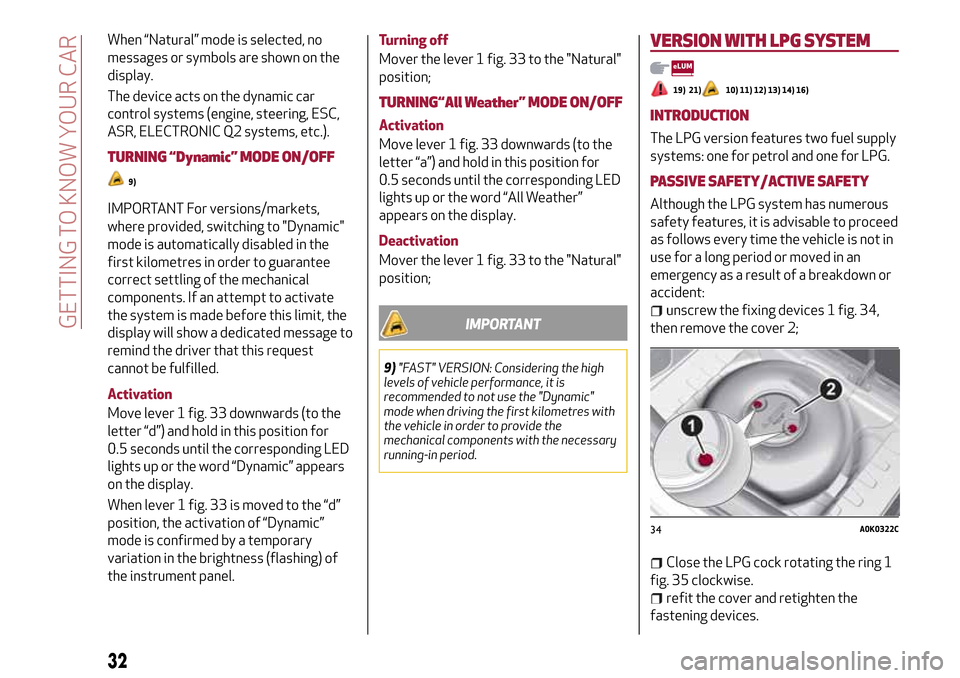
unscrew the fixing devices 1 fig. 34,
then remove the cover 2;
Close the LPG cock rotating the ring 1
fig. 35 clockwise.
refit the cover and retighten the
fastening devices.
34A0K0322C
32
GETTING TO KNOW YOUR CAR
Page 52 of 212
Warning lights on
panelWhat it means What to do
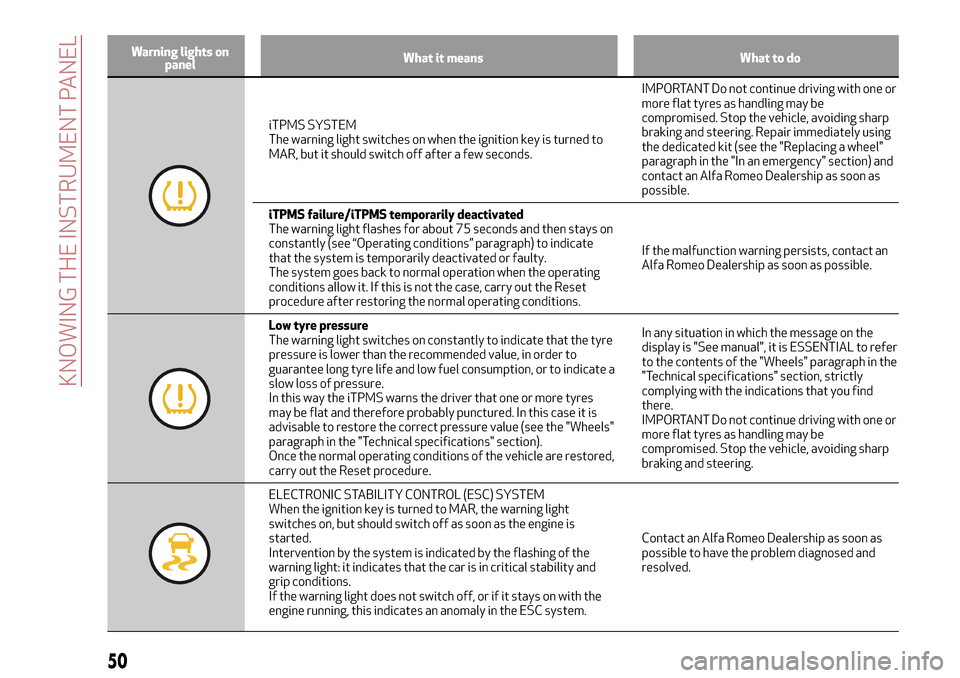
iTPMS SYSTEM
The warning light switches on when the ignition key is turned to
MAR, but it should switch off after a few seconds.IMPORTANT Do not continue driving with one or
more flat tyres as handling may be
compromised. Stop the vehicle, avoiding sharp
braking and steering. Repair immediately using
the dedicated kit (see the "Replacing a wheel"
paragraph in the "In an emergency" section) and
contact an Alfa Romeo Dealership as soon as
possible.
iTPMS failure/iTPMS temporarily deactivated
The warning light flashes for about 75 seconds and then stays on
constantly (see “Operating conditions” paragraph) to indicate
that the system is temporarily deactivated or faulty.
The system goes back to normal operation when the operating
conditions allow it. If this is not the case, carry out the Reset
procedure after restoring the normal operating conditions.If the malfunction warning persists, contact an
Alfa Romeo Dealership as soon as possible.
Low tyre pressure
The warning light switches on constantly to indicate that the tyre
pressure is lower than the recommended value, in order to
guarantee long tyre life and low fuel consumption, or to indicate a
slow loss of pressure.
In this way the iTPMS warns the driver that one or more tyres
may be flat and therefore probably punctured. In this case it is
advisable to restore the correct pressure value (see the "Wheels"
paragraph in the "Technical specifications" section).
Once the normal operating conditions of the vehicle are restored,
carry out the Reset procedure.In any situation in which the message on the
display is "See manual", it is ESSENTIAL to refer
to the contents of the "Wheels" paragraph in the
"Technical specifications" section, strictly
complying with the indications that you find
there.
IMPORTANT Do not continue driving with one or
more flat tyres as handling may be
compromised. Stop the vehicle, avoiding sharp
braking and steering.
ELECTRONIC STABILITY CONTROL (ESC) SYSTEM
When the ignition key is turned to MAR, the warning light
switches on, but should switch off as soon as the engine is
started.
Intervention by the system is indicated by the flashing of the
warning light: it indicates that the car is in critical stability and
grip conditions.
If the warning light does not switch off, or if it stays on with the
engine running, this indicates an anomaly in the ESC system.Contact an Alfa Romeo Dealership as soon as
possible to have the problem diagnosed and
resolved.
50
KNOWING THE INSTRUMENT PANEL
Page 56 of 212
SYMBOLS ON THE DISPLAY
Symbol on the display What it means What to do
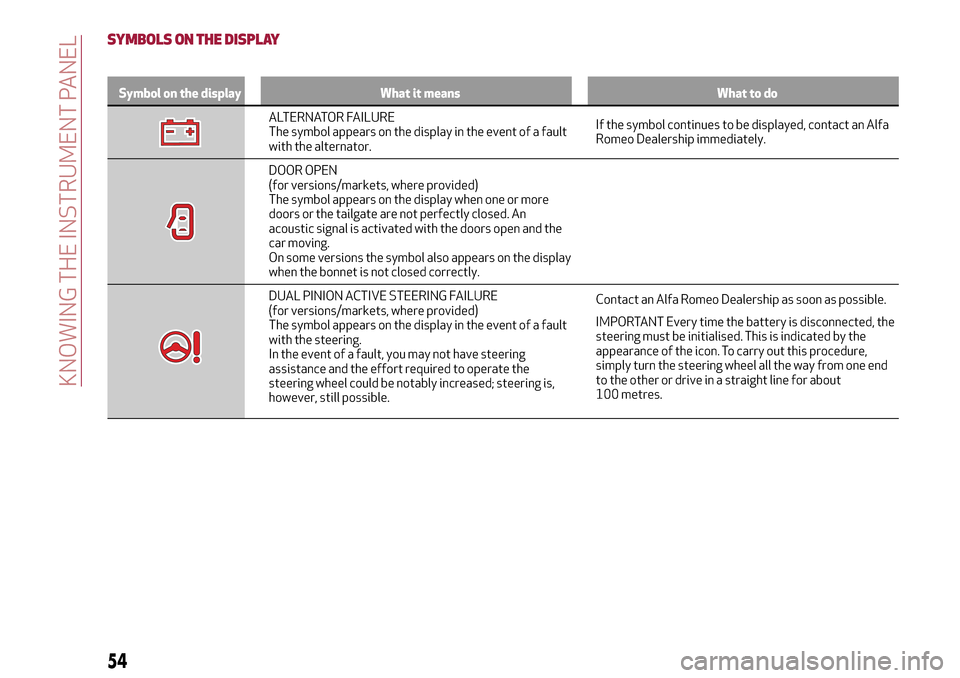
ALTERNATOR FAILURE
The symbol appears on the display in the event of a fault
with the alternator.If the symbol continues to be displayed, contact an Alfa
Romeo Dealership immediately.
DOOR OPEN
(for versions/markets, where provided)
The symbol appears on the display when one or more
doors or the tailgate are not perfectly closed. An
acoustic signal is activated with the doors open and the
car moving.
On some versions the symbol also appears on the display
when the bonnet is not closed correctly.
DUAL PINION ACTIVE STEERING FAILURE
(for versions/markets, where provided)
The symbol appears on the display in the event of a fault
with the steering.
In the event of a fault, you may not have steering
assistance and the effort required to operate the
steering wheel could be notably increased; steering is,
however, still possible.Contact an Alfa Romeo Dealership as soon as possible.
IMPORTANT Every time the battery is disconnected, the
steering must be initialised. This is indicated by the
appearance of the icon. To carry out this procedure,
simply turn the steering wheel all the way from one end
to the other or drive in a straight line for about
100 metres.
54
KNOWING THE INSTRUMENT PANEL
Page 62 of 212
ACTIVE SAFETYSYSTEMS
ABS SYSTEM
This system, which is an integral part of
the braking system, prevents one or more
wheels from locking and slipping in all
road surface conditions, irrespective of
the intensity of the braking action,
ensuring that the vehicle can be
controlled even during emergency
braking and optimising stopping
distances.
System intervention
The driver can feel that the ABS system
has come into action because the brake
pedal pulsates slightly and the system
gets noisier: this is entirely normal with
the system operating.
33) 34) 35) 36) 37) 38) 39)
ASR (AntiSlip Regulation)SYSTEM
40) 41) 42)
This is an integral part of the ESC system
and automatically operates in the event
of one or both drive wheels slipping, loss
of grip on wet roads (aquaplaning) and
acceleration on slippery, snowy or icy
roads, etc.System intervention
The system operates on the engine
power and brakes.
This is indicated by the flashing of the
warning light
on the instrument panel,
to inform the driver that the car is in
critical stability and grip conditions.
MSR (Motor Schleppmoment
Regelung)SYSTEM
The system prevents the drive wheels
from possibly locking, which could
happen, for example, if the accelerator
pedal is released suddenly or in the case
of a sudden downshifting in conditions of
poor grip.
In this conditions, the engine braking
effect could cause the drive wheels to
slip, resulting in a loss of vehicle stability.
In these situations, the system
intervenes, restoring torque to the
engine in order to conserve vehicle
stability and increase vehicle safety.
HBA (Hydraulic Brake Assist)SYSTEM
43) 44) 45)
The HBA system is designed to improve
the car’s braking capacity during
emergency braking: the HBA system
therefore completes the ABS system.
Maximum assistance from the HBA
system is obtained by continuously
pressing the brake pedal very quickly.
DST SYSTEM (Dynamic Steering
Torque)
46)
The DST function uses the integration of
the ESC system with the electric power
steering to increase the safety level of
the whole vehicle.
In critical situations (braking on surfaces
with different grip conditions), through
the DST function the ESC system
controls the steering to implement an
additional torque contribution on the
steering wheel, to suggest the most
correct manoeuvre to the driver.
The coordinated action of the brakes and
steering increases the sensation of
safety and control of the vehicle.
EBD SYSTEM
The EBD system is an integral part of the
ESC system and intervenes during
braking, distributing the brake force
optimally between front and rear wheels.
This guarantees greater braking stability
for the car, preventing sudden locking of
the rear wheels and the consequent
instability of the car.
ESC SYSTEM
The ESC system improves the directional
control and stability of the car in various
driving conditions.
60
SAFETY
Page 65 of 212
when the space-saver wheel is fitted.
Before carrying out the RESET, inflate
the tyres to the rated pressure values
specified in the inflation pressure table
(see "Wheels" paragraph in the "Technical
specifications" chapter).
If the RESET is not carried out, in all
above cases, the
warning light may
give false indications on one or more
tyres.
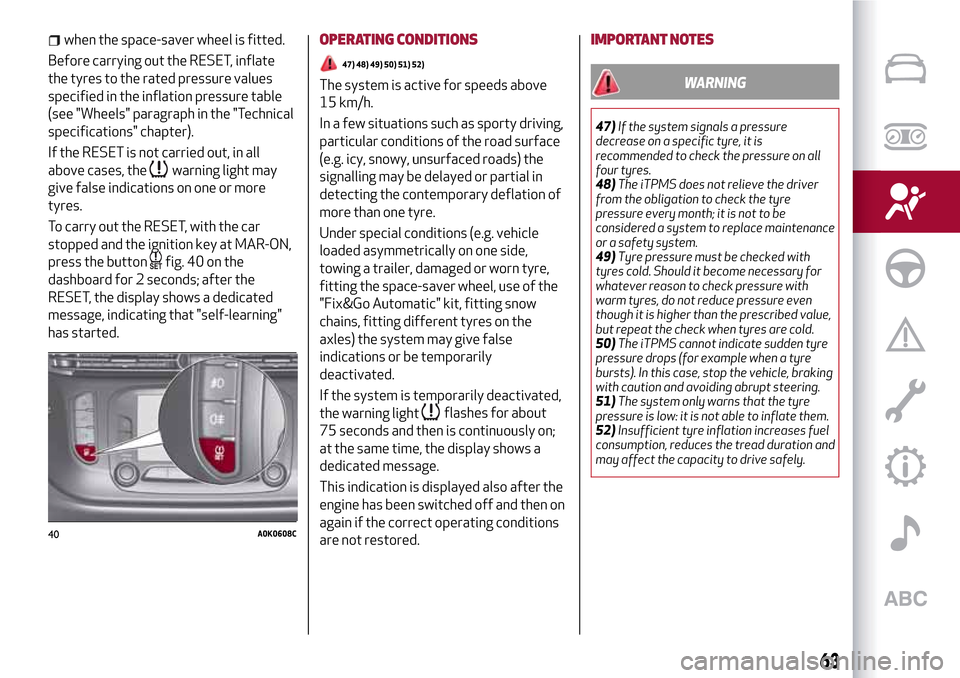
To carry out the RESET, with the car
stopped and the ignition key at MAR-ON,
press the button
fig. 40 on the
dashboard for 2 seconds; after the
RESET, the display shows a dedicated
message, indicating that "self-learning"
has started.
OPERATING CONDITIONS
47) 48) 49) 50) 51) 52)
The system is active for speeds above
15 km/h.
In a few situations such as sporty driving,
particular conditions of the road surface
(e.g. icy, snowy, unsurfaced roads) the
signalling may be delayed or partial in
detecting the contemporary deflation of
more than one tyre.
Under special conditions (e.g. vehicle
loaded asymmetrically on one side,
towing a trailer, damaged or worn tyre,
fitting the space-saver wheel, use of the
"Fix&Go Automatic" kit, fitting snow
chains, fitting different tyres on the
axles) the system may give false
indications or be temporarily
deactivated.
If the system is temporarily deactivated,
the warning light
flashes for about
75 seconds and then is continuously on;
at the same time, the display shows a
dedicated message.
This indication is displayed also after the
engine has been switched off and then on
again if the correct operating conditions
are not restored.
IMPORTANT NOTES
WARNING
47)If the system signals a pressure
decrease on a specific tyre, it is
recommended to check the pressure on all
four tyres.
48)The iTPMS does not relieve the driver
from the obligation to check the tyre
pressure every month; it is not to be
considered a system to replace maintenance
or a safety system.
49)Tyre pressure must be checked with
tyres cold. Should it become necessary for
whatever reason to check pressure with
warm tyres, do not reduce pressure even
though it is higher than the prescribed value,
but repeat the check when tyres are cold.
50)The iTPMS cannot indicate sudden tyre
pressure drops (for example when a tyre
bursts). In this case, stop the vehicle, braking
with caution and avoiding abrupt steering.
51)The system only warns that the tyre
pressure is low: it is not able to inflate them.
52)Insufficient tyre inflation increases fuel
consumption, reduces the tread duration and
may affect the capacity to drive safely.
40A0K0608C
63
Page 77 of 212
FRONT AIRBAGS
“SMART BAG”SYSTEM (MULTISTAGE
FRONT AIRBAGS)
The car features multistage front airbags
(“Smart bag”) for driver and passenger.
The front driver/passenger airbags are
designed to protect occupants in the
event of frontal impacts of medium-high
severity, by placing the bag between the
occupant and the steering wheel or
dashboard.
Therefore non-activation in other types
of collisions (side collisions, rear shunts,
roll-overs, etc.) is not a system
malfunction.
Airbags are not a replacement of but
complementary to the seat belts, which
you are recommended to always wear. In
the event of impact, those not wearing a
seat belt are projected forwards and may
come into contact with the bag which is
still inflating. The protection offered by
the bag is compromised in these
circumstances.
76) 77) 79)
Front airbags may not activate in the
following situations:
frontal impacts against highly
deformable objects not involving the
front surface of the car (e.g. wing collision
against guard rail, etc.);
jamming of the car underneath other
vehicles or protective barriers (e.g.
underneath a truck or a guard rail) as, in
this case, the bags would offer no
additional protection with respect to the
seat belt and their deployment would be
inappropriate. Failure to activate in the
conditions described above is due to the
fact that they may not provide any
additional protection compared with seat
belts, so their activation would be
inappropriate. In these cases,
non-deployment does not indicate a
system malfunction.
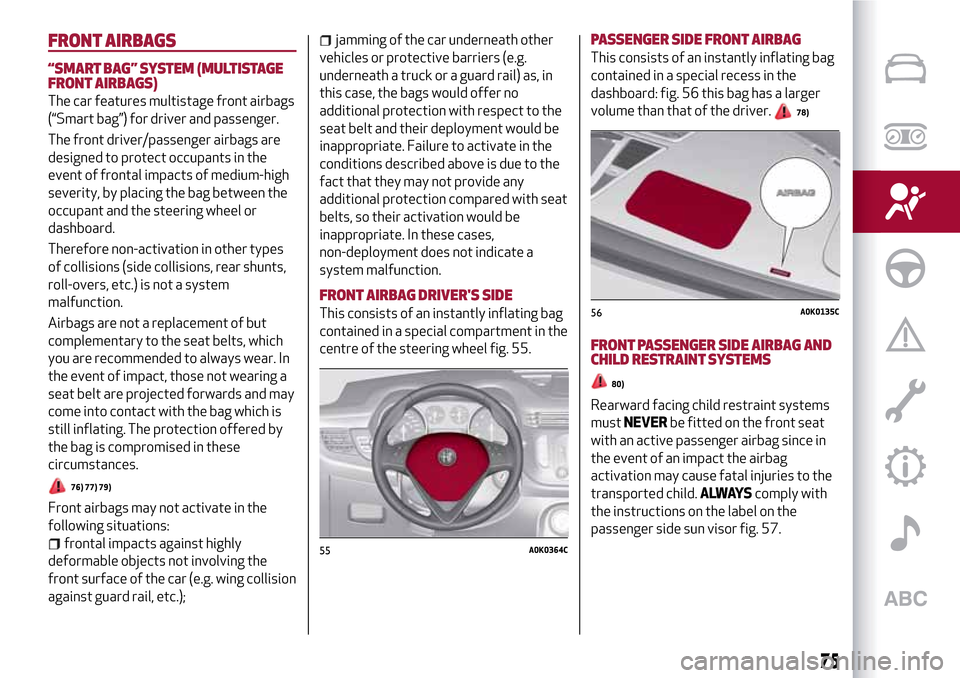
FRONT AIRBAG DRIVER'S SIDE
This consists of an instantly inflating bag
contained in a special compartment in the
centre of the steering wheel fig. 55.
PASSENGER SIDE FRONT AIRBAG
This consists of an instantly inflating bag
contained in a special recess in the
dashboard: fig. 56 this bag has a larger
volume than that of the driver.
78)
FRONT PASSENGER SIDE AIRBAG AND
CHILD RESTRAINTSYSTEMS
80)
Rearward facing child restraint systems
mustNEVERbe fitted on the front seat
with an active passenger airbag since in
the event of an impact the airbag
activation may cause fatal injuries to the
transported child.ALWAYScomply with
the instructions on the label on the
passenger side sun visor fig. 57.
55A0K0364C
56A0K0135C
75
Page 80 of 212
WARNING
76)Do not apply stickers or other objects on the steering wheel, on the dashboard in the passenger side airbag area, on side upholstery on the roof
or on the seats. Never put objects (e.g. mobile phones) on the passenger's side dashboard since they could interfere with correct inflation of the
airbag and also cause serious injury to the passengers.
77)Always drive keeping your hands on the steering wheel rim so the airbag can inflate freely if necessary. Do not drive with your body bent
forward. Keep the back of your seat upright and lean back into it.
78)When there is an active passenger airbag, DO NOT install rearward facing child restraint systems on the front seat. Deployment of the airbag
in an accident could cause fatal injuries to the child regardless of the severity of the impact. Therefore, always deactivate the passenger side
airbag when a rearward facing child restraint system is installed on the front passenger seat. The front passenger seat must also be positioned
back as far as possible in order to prevent the child restraint system from coming into contact with the dashboard. Immediately reactivate the
passenger airbag as soon as the child restraint system has been removed.
79)To deactivate the airbags, see the “Knowing your car” section, “Menu items” paragraph.
80)A failure of the
warning light is indicated by thewarning light switching on. In addition, the airbag system automatically disables the
airbag on the passenger's side (for versions/markets where provided). Before proceeding, contact an Alfa Romeo Dealership to have the system
checked immediately.
78
SAFETY
Page 86 of 212
Start&Stop system
With car at a standstill and Start&Stop
system activated, the engine switches
off if the gear lever is in a position other
than R (to allow parking).
In the event of stops uphill, the engine
switching off is disabled to activate the
"Hill Holder" function (except on gentle
slopes and if the brake pedal is not fully
pressed).
The engine restarts automatically if:
the brake pedal is released (and the
lever is not at N or P)
shifting the lever to an unstable
position +, - or R;
the lever is shifted from D to the left in
"Sequential mode"
the "+" or "–" paddles on the steering
wheel (for versions/markets, where
provided) are used
VEHICLE SHUTDOWN
Engine can be switched off in any
position of the gear lever.
Versions with Start&Stop system
To switch the engine off, you need to stop
the car by pressing the brake pedal
properly; if the pressure is not enough,
the engine will not be switched off.
This feature can be exploited so that the
engine does not switch off in particular
traffic conditions.
REMOVING THE IGNITION KEY
28)
The ignition key can be removed only if
the gear lever is in position P.
To remove the key, turn it to MAR and
then to STOP.
MOVING THE CAR
To move the car, from P press the brake
pedal and, using the button on the gear
lever, move the lever to the desired
position (D, R or "Sequential mode").
The display will show the gear engaged.
When the brake pedal is released, the car
starts moving forwards or backwards, as
soon as the manoeuvre is activated
("creeping" effect). The accelerator
should not be pressed in this case.
IMPORTANT The inconsistency between
the speed actually engaged (shown on
the display) and the position of the gear
lever is indicated by the letter
corresponding to the position of the lever
flashing on the trim (also accompanied by
an acoustic signal).
This condition should not be interpreted
as an operational fault, but simply as a
request by the system to repeat the
manoeuvre.
IMPORTANT With handbrake released
and brake pedal released, engine at idling
speed and gear lever in position D, R or
sequential, pay the utmost care because
the car can move even without the
operation of the accelerator pedal. This
condition can be used with the car on a
level surface during tight parking
manoeuvres using the brake pedal only.
AUTOMATIC DRIVING MODE
D can be selected from sequential
operation in any driving conditions.
In automatic driving mode, the best ratio
is selected by the electronic transmission
control unit depending on speed, engine
load (accelerator pedal position) and
gradient of the road.
“Kick-Down” function
To resume speed quickly, when the
accelerator pedal is pressed fully, the
transmission control system downshifts
("Kick-down" function).
IMPORTANT When driving on roads with
poor grip conditions (snow, ice, etc.) avoid
activating the kick-down function.
Integration with "Alfa DNA" system
With the “Alfa DNA” system 1 fig. 63,
three different driving modes can be
selected:
84
STARTING AND DRIVING
Page 87 of 212
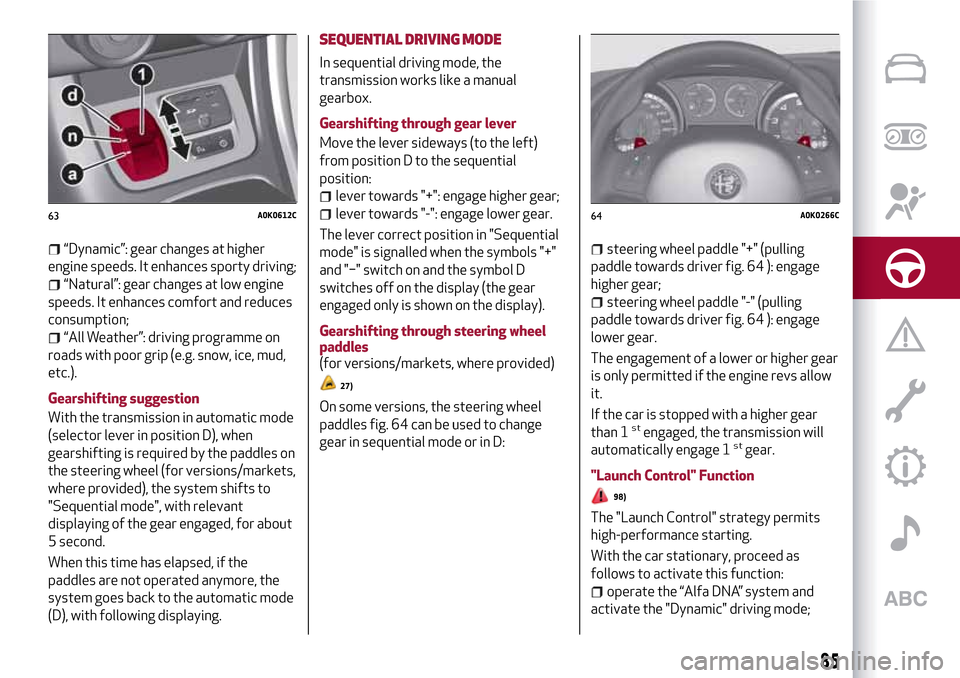
“Dynamic”: gear changes at higher
engine speeds. It enhances sporty driving;
“Natural”: gear changes at low engine
speeds. It enhances comfort and reduces
consumption;
“All Weather”: driving programme on
roads with poor grip (e.g. snow, ice, mud,
etc.).
Gearshifting suggestion
With the transmission in automatic mode
(selector lever in position D), when
gearshifting is required by the paddles on
the steering wheel (for versions/markets,
where provided), the system shifts to
"Sequential mode", with relevant
displaying of the gear engaged, for about
5 second.
When this time has elapsed, if the
paddles are not operated anymore, the
system goes back to the automatic mode
(D), with following displaying.
SEQUENTIAL DRIVING MODE
In sequential driving mode, the
transmission works like a manual
gearbox.
Gearshifting through gear lever
Move the lever sideways (to the left)
from position D to the sequential
position:
lever towards "+": engage higher gear;
lever towards "-": engage lower gear.
The lever correct position in "Sequential
mode" is signalled when the symbols "+"
and "−" switch on and the symbol D
switches off on the display (the gear
engaged only is shown on the display).
Gearshifting through steering wheel
paddles
(for versions/markets, where provided)
27)
On some versions, the steering wheel
paddles fig. 64 can be used to change
gear in sequential mode or in D:
steering wheel paddle "+" (pulling
paddle towards driver fig. 64 ): engage
higher gear;
steering wheel paddle "-" (pulling
paddle towards driver fig. 64 ): engage
lower gear.
The engagement of a lower or higher gear
is only permitted if the engine revs allow
it.
If the car is stopped with a higher gear
than 1
stengaged, the transmission will
automatically engage 1stgear.
"Launch Control" Function
98)
The "Launch Control" strategy permits
high-performance starting.
With the car stationary, proceed as
follows to activate this function:
operate the “Alfa DNA” system and
activate the "Dynamic" driving mode;
63A0K0612C64A0K0266C
85