lock Alfa Romeo MiTo 2012 Owner handbook (in English)
[x] Cancel search | Manufacturer: ALFA ROMEO, Model Year: 2012, Model line: MiTo, Model: Alfa Romeo MiTo 2012Pages: 262, PDF Size: 6.46 MB
Page 101 of 262

100GETTING TO KNOW YOUR CAR
LUGGAGE COMPARTMENT INITIALISATION
IMPORTANT If the battery is disconnected or the protection fuse
blows, the luggage compartment opening/closing mechanism must
be reinitialised as follows:
❍close all the doors and the luggage compartment;
❍press button Áon the remote control;
❍press button Ëon the remote control.
CLOSING
Pull tab A-fig. 61 and lower the tailgate by pressing near the lock
until a click is heard.
IMPORTANT Before closing the luggage compartment make sure
that you have the keys. The luggage compartment is locked au-
tomatically.
fig. 61A0J0079m
Page 104 of 262

GETTING TO KNOW YOUR CAR103
1BONNET
OPENING THE BONNET
Proceed as follows:
❍pull lever A-fig. 66 in the direction indicated by the arrow;
❍pull lever B in the direction indicated by the arrow;
❍lift the bonnet and, at the same time, release the bonnet stay
C - fig. 67 from its locking device. Then, insert the end in the
housing D, making sure that the stay is engaged in the small-
est opening of the retaining clip.
IMPORTANT Before lifting up the bonnet make sure that the wind-
screen wipers are in the rest position and not operational.
fig. 66A0J0085m
CLOSING THE BONNET
❍hold the bonnet up with one hand and with the other remove
rod C-fig. 67 from housing D and fit it back into its catch;
fig. 67A0J0086m
Page 105 of 262

104GETTING TO KNOW YOUR CAR
❍lower the bonnet to about 20 centimetres above the engine
compartment and then let it drop. Make sure that the bonnet
is closed correctly and not just in the safety position by trying
to lift it. If it is not perfectly closed, open the bonnet and re-
peat the procedure. Do not simply press it.
IMPORTANT Always check that the bonnet is closed properly to avoid
its opening while the car is travelling.ROOF RACK/SKI RACK
To fit the roof rack/ski rack, raise the special tabs A-fig. 68 using
the screwdriver provided to access attachment housings B.
The bonnet must always be perfectly closed while
travelling for safety reasons. Make sure that the
bonnet is perfectly closed and that the lock is en-
gaged. If when driving you realise that the bonnet is not
properly closed, stop immediately and close the bonnet
correctly.
Carry out these operations with the vehicle at a
standstill.
If the support rod is incorrectly positioned this may
cause the bonnet to fall down without warning.
fig. 68A0J0059m
Page 108 of 262

GETTING TO KNOW YOUR CAR107
1ABS SYSTEM
The car is fitted with an ABS braking system, which prevents the
wheels from locking when braking, makes the most of road grip
and gives the best control when performing emergency braking un-
der difficult road conditions.
The system is completed by EBD (Electronic Braking Force Distrib-
ution), which distributes the braking action between front and rear
wheels.
IMPORTANT To achieve maximum efficiency of the braking system,
a settlement period of about 500 km is required: During this time,
avoid sudden, repeated and prolonged braking.
SYSTEM INTERVENTION
Intervention of the ABS is detected by a slight pulsing of the brake
pedal accompanied by noise: such an event indicates that you need
to adjust your speed to the type of road on which you are travel-
ling.
MECHANICAL BRAKE ASSIST
(emergency braking assistance)
(for versions/markets, where provided)
This system, which cannot be excluded, recognises emergency brak-
ing (on the basis of the brake pedal operation speed) and allows
the braking system to react more quickly.
When the ABS intervenes it means that you are ap-
proaching the grip limit between tyres and road:
slow down to adjust the speed according to avail-
able grip.
The ABS optimally exploits grip between tyre and
road, but it cannot improve grip; you should there-
fore take every care not to take unnecessary risks
when driving on slippery surfaces.
When the ABS cuts in, and you feel the brake ped-
al pulsating, do not remove your foot, but keep it
pressed; by doing so you will stop in the shortest
amount of space possible in the current road conditions.
Page 121 of 262

120GETTING TO KNOW YOUR CAR
ELECTRIC POWER STEERING
This only works with the key turned to MAR and the engine start-
ed. Power steering allows the force required at the steering wheel
to adapt to driving conditions.
The different power assistance modes can be selected via the d,n,a
positions of the“Alfa DNA System” lever (see paragraph “Alfa DNA
System”).
EOBD SYSTEM
(for versions/markets, where provided)
The aim of the EOBD system (European On Board Diagnosis) is to:
❍keep the system efficiency under control;
❍indicate an increase in emissions;
❍indicate the need to replace deteriorated components.
The vehicle also has a diagnostic connector that can be interfaced
with appropriate tools, which makes it possible to read the error
codes stored in the electronic control units together with a series
of specific parameters for engine operation and diagnosis. This check
can also be carried out by the traffic police.
IMPORTANT After eliminating a fault, to check the system com-
pletely, Alfa Romeo Authorised Services are obliged to run tests
and, if necessary, road tests which may also call for a long journey.
It is absolutely forbidden to carry out any after-
market operation involving steering system or
steering column modifications (e.g.: installation of
anti-theft device). This could badly affect performance and
safety, invalidate the warranty and also result in the non-
compliance of the car with approval requirements.
Before carrying out any maintenance operation
switch off the engine and remove the ignition key
to activate the steering lock. This is particularly im-
portant if the vehicle’s wheels are raised from the ground.
Page 130 of 262

GETTING TO KNOW YOUR CAR129
1AT THE FILLING STATION
Switch off the engine before refuelling.
PETROL ENGINES
Only use unleaded petrol. The petrol octane rating (RON) must not
be lower than 95.
In order to prevent damage to the catalytic converter never intro-
duce even the smallest amount of leaded petrol, even in the event
of an emergency.
DIESEL ENGINES
Only use diesel fuel compliant with European specification EN590.
The use of other products or mixtures may damage the engine
beyond repair and consequently invalidate the warranty.
Operation at low temperatures
If the outside temperature is very low, the diesel thickens due to
the formation of paraffin clots with consequent defective operation
of the fuel supply system. In order to avoid these problems, dif-
ferent types of diesel are distributed according to the season: sum-
mer type, winter type and arctic type (cold, mountain areas).
If refuelling with diesel fuel whose features are not suitable for
the temperature of use, it is advisable to mix TUTELA DIESEL ART
additive with the fuel, in the proportions shown on the container.
Pour the additive into the tank before the fuel.When using or parking the vehicle for a long time in the mountains
or cold areas, it is advisable to refuel using locally available fuel.
In this case, it is also advisable to keep the tank over 50% full.
FUEL FILLER CAP
Opening
1) Open the flap A-fig. 82 pulling it outwards, keep the cap B
still, insert the ignition key in the lock and turn it anti-clockwise.
2) Turn the cap anti-clockwise and extract it. The cap has a de-
vice C retaining it to the flap so it cannot be lost. When refilling,
attach the cap to the flap D.
fig. 82A0J0327m
Page 131 of 262

The catalytic converter and particulate filter (DPF)
reach very high temperatures during operation.
Do not park on grass, dry leaves, pine needles or
other flammable material: fire risk.
130GETTING TO KNOW YOUR CAR
Closing
1) Fit the cap (complete with key) and turn it clockwise until it
clicks once or more.
2) Turn the key clockwise and extract it, then close the flap.
The hermetic seal may cause a slight increase in pressure in the
tank. A suction noise when you release the cap is therefore entirely
normal.
PROTECTING THE ENVIRONMENT
The devices for limiting petrol engine emissions are: catalytic con-
verter, Lambda sensors and anti-evaporation system.
The devices for curtailing diesel engine emissions are the follow-
ing: oxidising catalytic converter, exhaust gas recirculation system
(E.G.R.) and particulate filter (DPF).
DIESEL PARTICULATE FILTER (DPF)
(for versions/markets, where provided)
This is a mechanical filter, fitted in the exhaust system, which al-
most completely eliminates carbon particle emissions.
Keep naked flames or lighted cigarettes away from
the fuel filler hole as there is a danger of fire. Do
not bend too close to the hole either so as not to
breathe in harmful vapours.
Page 133 of 262

132SAFETY
SEAT BELTS
USING THE SEAT BELTS
Wear the belt keeping the chest straight and rested against the back-
rest. To fasten the seat belts, hold tongue A-fig. 1 and insert it into
buckle B, until the locking click is heard.
If the seatbelt jams when pulling it out, let it rewind for a short
stretch and then pull it out again without jerking.
To unfasten the seat belts, press button C. Guide the seat belt
with your hand while it is rewinding, to prevent it from twisting.
fig. 1A0J0101mfig. 2A0J0102m
Never press button C-fig. 1 when travelling.
The rear seat is fitted with inertia seat belts with three anchor points
and reel. Fasten the rear seat belts as shown in fig. 2.
Page 157 of 262

156STARTING UP AND DRIVING
PARKING
Switch off the engine and pull up the handbrake. Engage a gear
(1stif the car is facing uphill or reverse if it is facing downhill) and
leave the wheels steered to one side.
If the car is parked on a steep slope block the wheels with a wedge
or stone. Always remove the ignition key when leaving the vehi-
cle.
HANDBRAKE fig. 1
To engage the handbrake pull lever A upwards until the vehicle is
secured. To disengage slightly raise lever A, press and hold down
button B and lower the lever.IMPORTANT Carry out these manoeuvres with the brake pedal pressed.
IMPORTANT For vehicles equipped with a front armrest, lift this
up to ensure that it does not interfere with the action of the hand-
brake.
fig. 1A0J0110m
The vehicle should be secured after several clicks
of the lever: if this is not the case, contact an Alfa
Romeo Authorised Service Provider to have it ad-
justed.
Page 168 of 262
IN AN EMERGENCY167
4
JACK
Important notes:
❍the jack weight is 1.76 kg;
❍the jack requires no adjustment;
❍the jack cannot be repaired; if it breaks it must be replaced with
a new jack;
❍no tool other than the cranking device may be fitted on the
jack.Replace the wheel as follows:
❍stop the car in a position where it does not endanger on-com-
ing traffic and where you can replace the wheel safely. The
ground must be flat and compact;
❍switch off the engine, pull up the handbrake and engage 1st
gear or reverse; put on the high visibility jacket (required by
law) before leaving the vehicle;
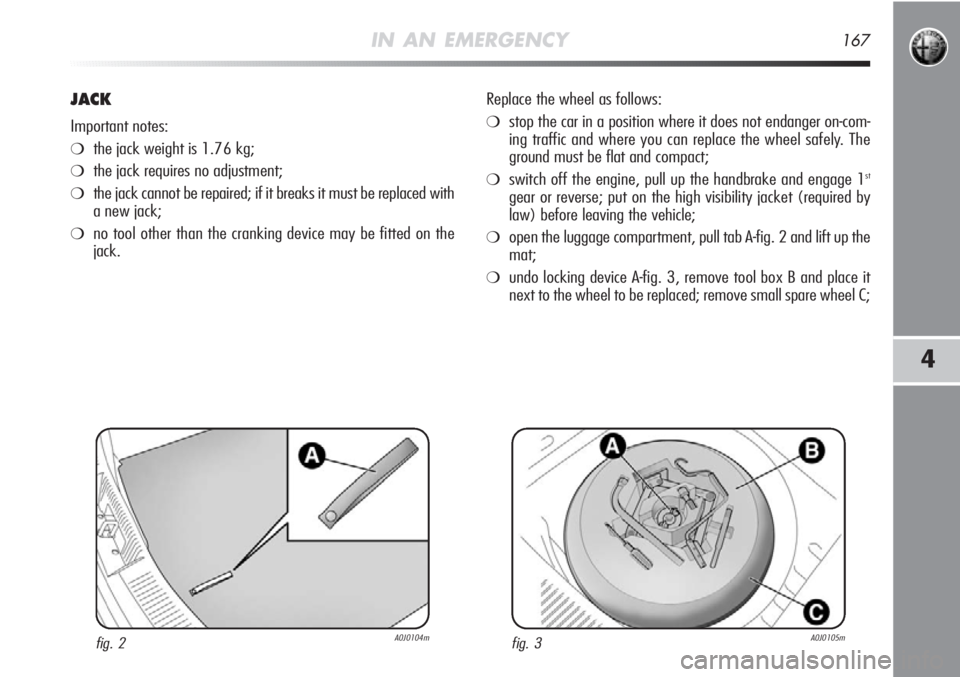
❍open the luggage compartment, pull tab A-fig. 2 and lift up the
mat;
❍undo locking device A-fig. 3, remove tool box B and place it
next to the wheel to be replaced; remove small spare wheel C;
fig. 2A0J0104mfig. 3A0J0105m