engine Alfa Romeo MiTo 2016 Owner's Guide
[x] Cancel search | Manufacturer: ALFA ROMEO, Model Year: 2016, Model line: MiTo, Model: Alfa Romeo MiTo 2016Pages: 280, PDF Size: 8.52 MB
Page 71 of 280
ROOF LIGHTS
FRONT ROOF LIGHT
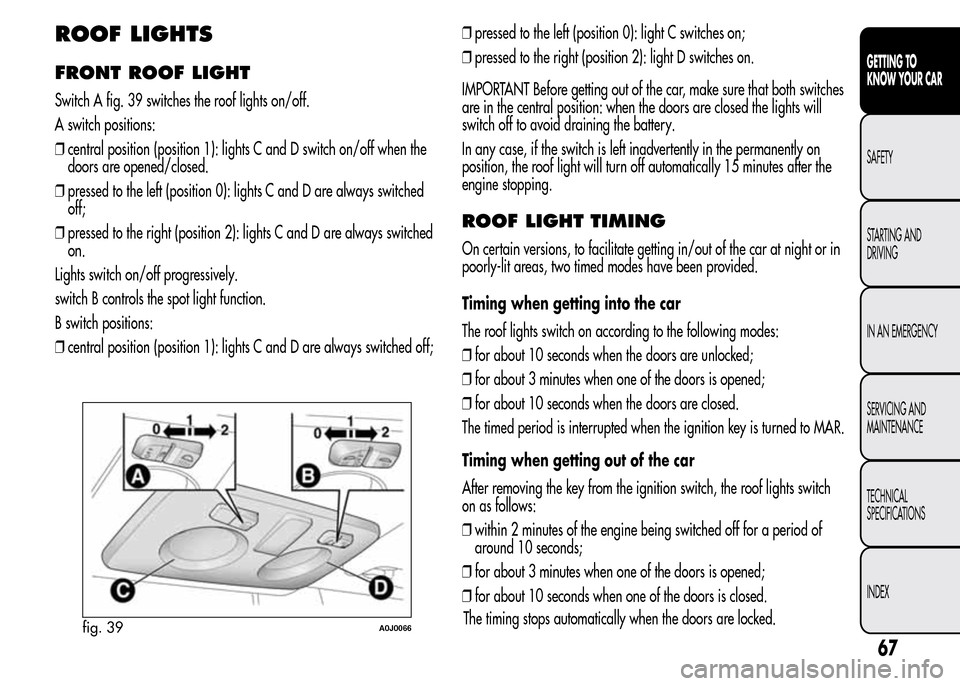
Switch A fig. 39 switches the roof lights on/off.
A switch positions:
❒central position (position 1): lights C and D switch on/off when the
doors are opened/closed.
❒pressed to the left (position 0): lights C and D are always switched
off;
❒pressed to the right (position 2): lights C and D are always switched
on.
Lights switch on/off progressively.
switch B controls the spot light function.
B switch positions:
❒central position (position 1): lights C and D are always switched off;❒pressed to the left (position 0): light C switches on;
❒pressed to the right (position 2): light D switches on.
IMPORTANT Before getting out of the car, make sure that both switches
are in the central position: when the doors are closed the lights will
switch off to avoid draining the battery.
In any case, if the switch is left inadvertently in the permanently on
position, the roof light will turn off automatically 15 minutes after the
engine stopping.
ROOF LIGHT TIMING
On certain versions, to facilitate getting in/out of the car at night or in
poorly-lit areas, two timed modes have been provided.
Timing when getting into the car
The roof lights switch on according to the following modes:
❒for about 10 seconds when the doors are unlocked;
❒for about 3 minutes when one of the doors is opened;
❒for about 10 seconds when the doors are closed.
The timed period is interrupted when the ignition key is turned to MAR.
Timing when getting out of the car
After removing the key from the ignition switch, the roof lights switch
on as follows:
❒within 2 minutes of the engine being switched off for a period of
around 10 seconds;
❒for about 3 minutes when one of the doors is opened;
❒for about 10 seconds when one of the doors is closed.
fig. 39A0J0066
67
GETTING TO
KNOW YOUR CAR
SAFETY
STARTING AND
DRIVING
IN AN EMERGENCY
SERVICING AND
MAINTENANCE
TECHNICAL
SPECIFICATIONS
INDEX
The timing stops automatically when the doors are locked.
Page 74 of 280
FOG LIGHTS
(for versions/markets, where provided)
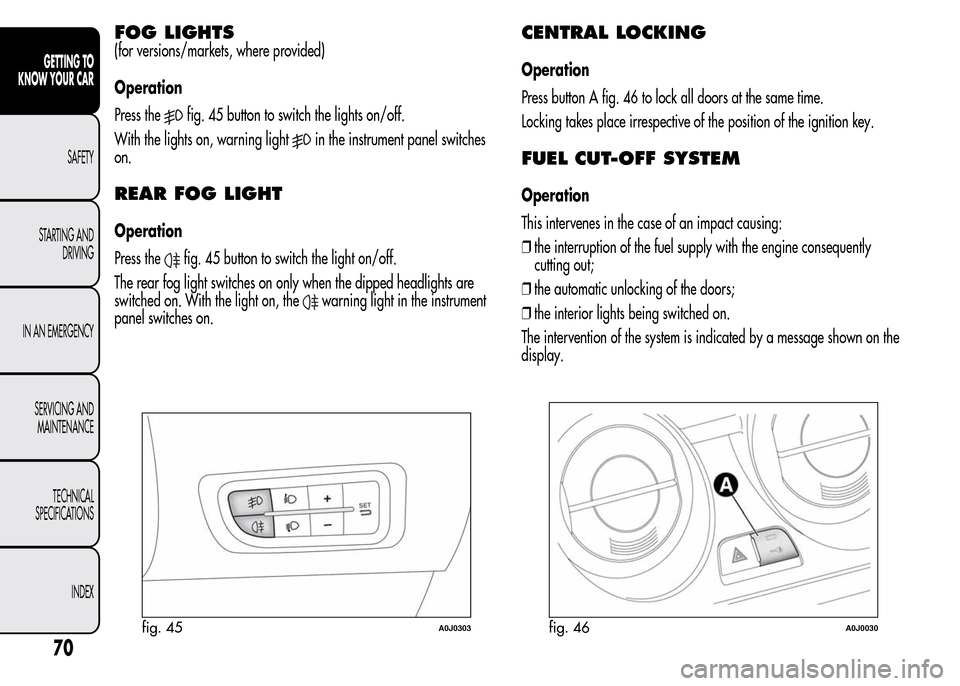
Operation
Press the
fig. 45 button to switch the lights on/off.
With the lights on, warning light
in the instrument panel switches
on.
REAR FOG LIGHT
Operation
Press the
fig. 45 button to switch the light on/off.
The rear fog light switches on only when the dipped headlights are
switched on. With the light on, the
warning light in the instrument
panel switches on.
CENTRAL LOCKING
Operation
Press button A fig. 46 to lock all doors at the same time.
Locking takes place irrespective of the position of the ignition key.
FUEL CUT-OFF SYSTEM
Operation
This intervenes in the case of an impact causing:
❒the interruption of the fuel supply with the engine consequently
cutting out;
❒the automatic unlocking of the doors;
❒the interior lights being switched on.
The intervention of the system is indicated by a message shown on the
display.
fig. 45A0J0303fig. 46A0J0030
70
GETTING TO
KNOW YOUR CAR
SAFETY
STARTING AND
DRIVING
IN AN EMERGENCY
SERVICING AND
MAINTENANCE
TECHNICAL
SPECIFICATIONS
INDEX
Page 75 of 280
Carefully check the car for fuel leaks, for instance in the engine
compartment, under the car or near the tank area.
After a collision, turn the ignition key to STOP to prevent the battery
from running down.
To restore the correct operation of the car, proceed as follows:
❒turn the ignition key to the MAR-ON position;
❒activate the right direction indicator;
❒deactivate the right direction indicator;
❒activate the left direction indicator;
❒deactivate the left direction indicator;
❒activate the right direction indicator;
❒deactivate the right direction indicator;
❒activate the left direction indicator;
❒deactivate the left direction indicator;
❒turn the ignition key to the STOP position;
❒turn the ignition key to the MAR-ON position.
If, after an impact, you smell fuel or notice leaks from
the fuel system, do not reactivate the system to avoid
the risk of fire.
INTERIOR FITTINGS
GLOVE COMPARTMENT
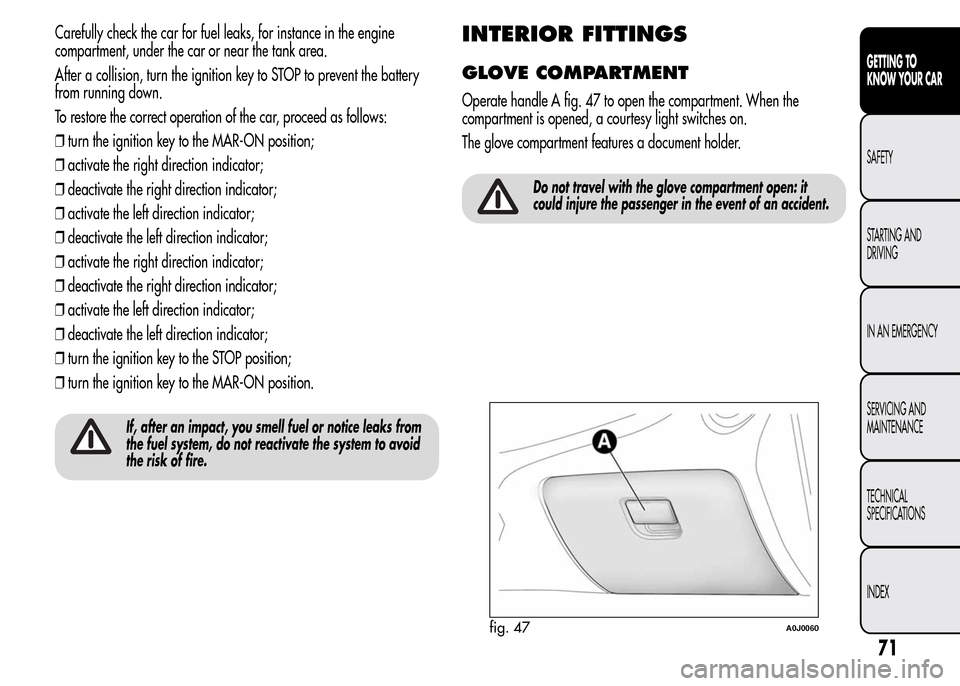
Operate handle A fig. 47 to open the compartment. When the
compartment is opened, a courtesy light switches on.
The glove compartment features a document holder.
Do not travel with the glove compartment open: it
could injure the passenger in the event of an accident.
fig. 47A0J0060
71
GETTING TO
KNOW YOUR CAR
SAFETY
STARTING AND
DRIVING
IN AN EMERGENCY
SERVICING AND
MAINTENANCE
TECHNICAL
SPECIFICATIONS
INDEX
Page 89 of 280
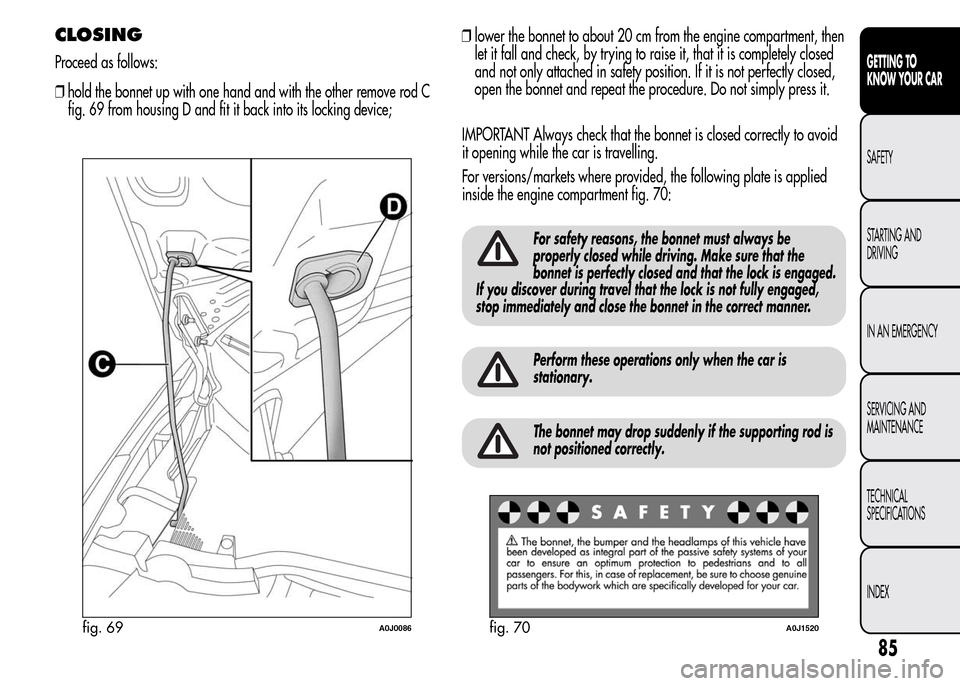
❒hold the bonnet up with one hand and with the other remove rod C
fig. 69 from housing D and fit it back into its locking device;❒lower the bonnet to about 20 cm from the engine compartment, then
let it fall and check, by trying to raise it, that it is completely closed
and not only attached in safety position. If it is not perfectly closed,
open the bonnet and repeat the procedure. Do not simply press it.
IMPORTANT Always check that the bonnet is closed correctly to avoid
it opening while the car is travelling.
For versions/markets where provided, the following plate is applied
inside the engine compartment fig. 70:
For safety reasons, the bonnet must always be
properly closed while driving. Make sure that the
bonnet is perfectly closed and that the lock is engaged.
If you discover during travel that the lock is not fully engaged,
stop immediately and close the bonnet in the correct manner.
Perform these operations only when the car is
stationary.
The bonnet may drop suddenly if the supporting rod is
not positioned correctly.
fig. 69A0J0086fig. 70A0J1520
85
GETTING TO
KNOW YOUR CAR
SAFETY
STARTING AND
DRIVING
IN AN EMERGENCY
SERVICING AND
MAINTENANCE
TECHNICAL
SPECIFICATIONS
INDEX
CLOSING
Proceed as follows:
Page 93 of 280
ESC (Electronic Stability
Control) SYSTEM
This is an electronic system that controls vehicle stability in the event of
tyre grip loss, helping maintain directional control.
The system is capable of recognising potentially dangerous situations
in terms of the stability and intervenes automatically on the brakes in a
differentiated manner for the four wheels in order to provide a
stabilising torque.
The ESC system also includes the following systems:
❒Hill Holder
❒ASR
❒Brake Assist
❒MSR
❒CBC
❒“ELECTRONIC Q2” (“E-Q2”)
❒DST
SYSTEM ACTIVATION
The ESC system switches on automatically when the engine is started
and cannot be switched off.
SYSTEM INTERVENTION
It is signalled by the blinking of the warning lighton the instrument
panel, to inform the driver that the car is in critical stability and grip
conditions.
HILL HOLDER SYSTEM
This system is an integral part of the ESC system and facilitates starting
on slopes.
It is automatically activated in the following conditions:
❒uphill: vehicle stationary on a road with a gradient higher than 5%,
engine running, brake pedal pressed and gearbox in neutral or
gear (other than reverse) engaged;
❒downhill: vehicle stationary on a road with a gradient higher than
5%, engine running, brake pedal pressed and reverse gear
engaged.
When setting off the ESC system control unit maintains the braking
pressure at the wheels until the engine torque required for departure is
reached or for approximately 2 seconds, allowing your right foot to
be moved easily from the brake pedal to the accelerator.
If the vehicle has not departed after this time, the system will deactivate
automatically by gradually releasing the brake force. A sound may
be heard during this stage: this indicates that the vehicle is about
to move off.
IMPORTANT The Hill Holder system is not a handbrake. Do not leave
the vehicle without having engaged the handbrake, switched off the
engine and engaged a gear.
89
GETTING TO
KNOW YOUR CAR
SAFETY
STARTING AND
DRIVING
IN AN EMERGENCY
SERVICING AND
MAINTENANCE
TECHNICAL
SPECIFICATIONS
INDEX
Page 94 of 280
ASR (AntiSlip Regulation) SYSTEM
It is an integral part of the ESC system. It automatically operates in the
event of one or both drive wheels slipping, loss of grip on wet roads
(aquaplaning) and acceleration on slippery, snowy or icy roads, etc.
Depending on the slipping conditions, two different control systems are
activated:
❒if the slipping involves both drive wheels, the ASR intervenes
reducing the power transmitted by the engine;
❒if the slipping only involves one of the drive wheels, the ASR
intervenes automatically braking the wheel that is slipping.
For the ESC and ASR systems to function correctly, all
four tyres must be the same brand and type, must
be in excellent condition and, above all, must be of the
prescribed type and size.
The ESC system operates even when the space-saver
wheel is being used. Always remember that the
space-saver wheel, being smaller than the original
wheel, provides less grip.
The performance of the ESC and ASR systems must not
encourage the driver to take unnecessary risks. Driving
style must always be adapted to road conditions,
visibility and traffic. The driver is, in any case, responsible for
safe driving.
BRAKE ASSIST (emergency braking
assistance)
The system, which cannot be turned off, recognises emergency braking
(on the basis of the brake pedal operating speed) and speeding up
the response of the braking system. The Brake Assist device is
deactivated if there is a ESC system failure.
MSR (Motor Schleppmoment
Regelung) SYSTEM
This system is an integral part of the ABS, that intervenes, if there is a
sudden downshifting, restoring torque to the engine, thereby
preventing excessive drive at the drive wheels which, especially in poor
grip conditions, could lead to a loss in stability of the car.
CBC (Cornering Brake Control)
SYSTEM
This function improves the distribution of the braking pressure at the
four wheels (to fully exploit the grip available on the ground) when
braking on bends if the ABS intervenes. This improves stopping
distances and above all vehicle stability when cornering.
“ELECTRONIC Q2” SYSTEM (“E-Q2”)
The “Electronic Q2” system uses the braking system to create an effect
similar to a limited slip differential.
The front braking system, when accelerating around a curve, acts on
the inside wheel to increase the drive to the outside wheel (increased
load), dynamically and continuously distributing the torque between
the front drive wheels according to driving and road conditions.
The system, combined with MacPherson front suspension, allows
particularly effective and sports driving to be achieved.
90
GETTING TO
KNOW YOUR CAR
SAFETY
STARTING AND
DRIVING
IN AN EMERGENCY
SERVICING AND
MAINTENANCE
TECHNICAL
SPECIFICATIONS
INDEX
Page 95 of 280
DST SYSTEM (Dynamic Steering
Torque)
This function integrates Dual Pinion active steering into the operation of
ESC. For particular manoeuvres, the ESC system controls the steering
to actuate a steering torque and assist the driver in the best possible
way.
The system operates the brakes and steering in a coordinated manner
to increase the suspension and safety level of the car as a whole.
The steering provides additional torque on the steering wheel.
“Alfa DNA” SYSTEM (Car
dynamic control system)
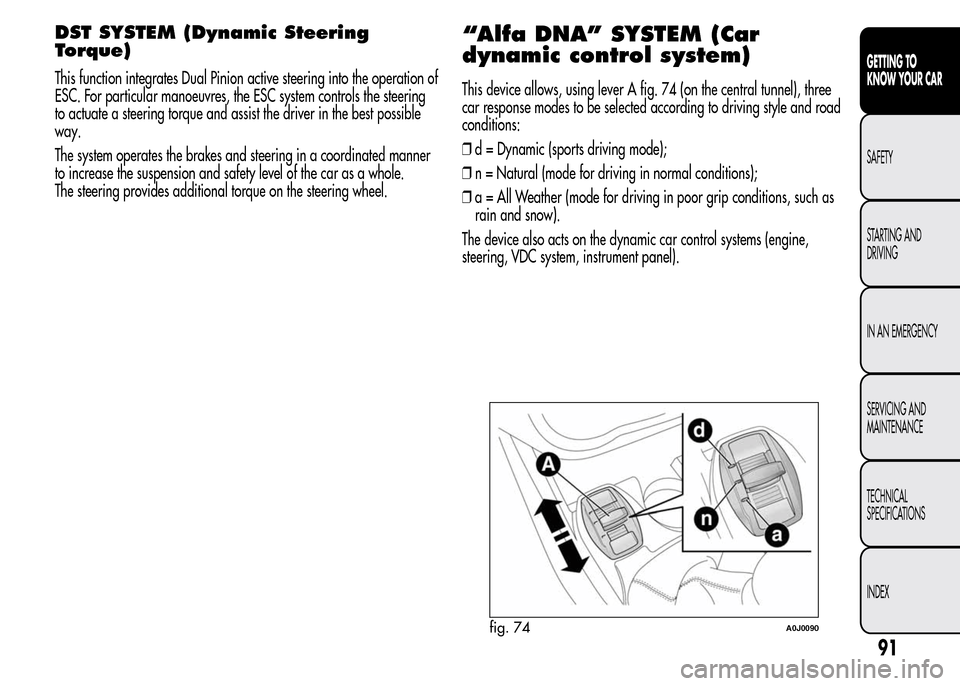
This device allows, using lever A fig. 74 (on the central tunnel), three
car response modes to be selected according to driving style and road
conditions:
❒d = Dynamic (sports driving mode);
❒n = Natural (mode for driving in normal conditions);
❒a = All Weather (mode for driving in poor grip conditions, such as
rain and snow).
The device also acts on the dynamic car control systems (engine,
steering, VDC system, instrument panel).
fig. 74A0J0090
91
GETTING TO
KNOW YOUR CAR
SAFETY
STARTING AND
DRIVING
IN AN EMERGENCY
SERVICING AND
MAINTENANCE
TECHNICAL
SPECIFICATIONS
INDEX
Page 96 of 280
DRIVING MODES
Lever A is monostable type. In other words, it always remains in a
central position.
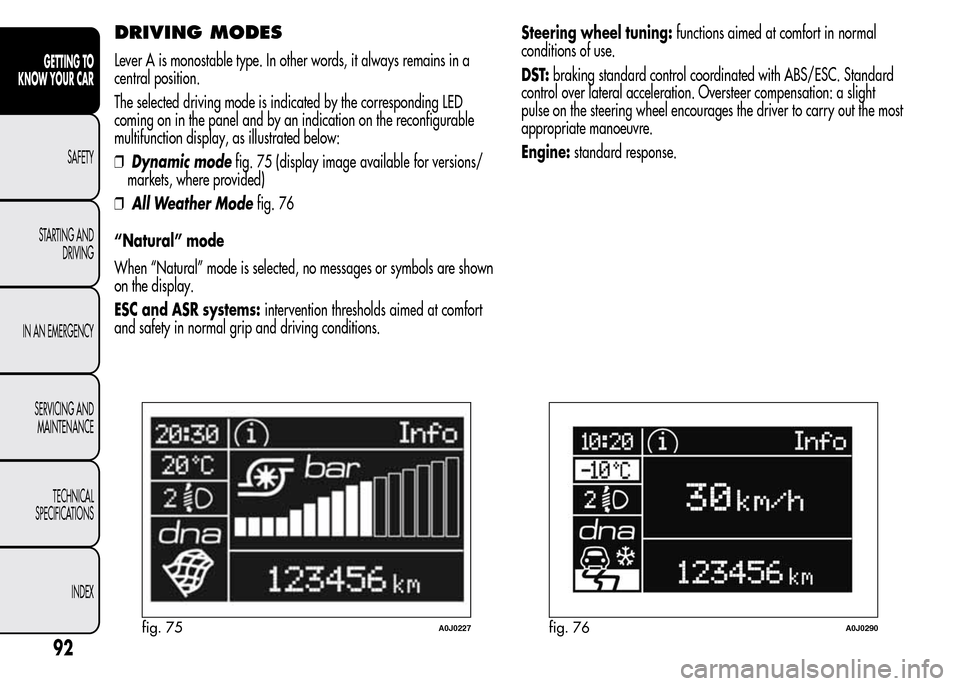
The selected driving mode is indicated by the corresponding LED
coming on in the panel and by an indication on the reconfigurable
multifunction display, as illustrated below:
❒Dynamic modefig. 75 (display image available for versions/
markets, where provided)
❒All Weather Modefig. 76
“Natural” mode
When “Natural” mode is selected, no messages or symbols are shown
on the display.
ESC and ASR systems:intervention thresholds aimed at comfort
and safety in normal grip and driving conditions.Steering wheel tuning:functions aimed at comfort in normal
conditions of use.
DST:braking standard control coordinated with ABS/ESC. Standard
control over lateral acceleration. Oversteer compensation: a slight
pulse on the steering wheel encourages the driver to carry out the most
appropriate manoeuvre.
Engine:standard response.
fig. 75A0J0227fig. 76A0J0290
92
GETTING TO
KNOW YOUR CAR
SAFETY
STARTING AND
DRIVING
IN AN EMERGENCY
SERVICING AND
MAINTENANCE
TECHNICAL
SPECIFICATIONS
INDEX
Page 97 of 280
ENGAGEMENT/DISENGAGEMENT OF
“Dynamic” MODE
Engagement
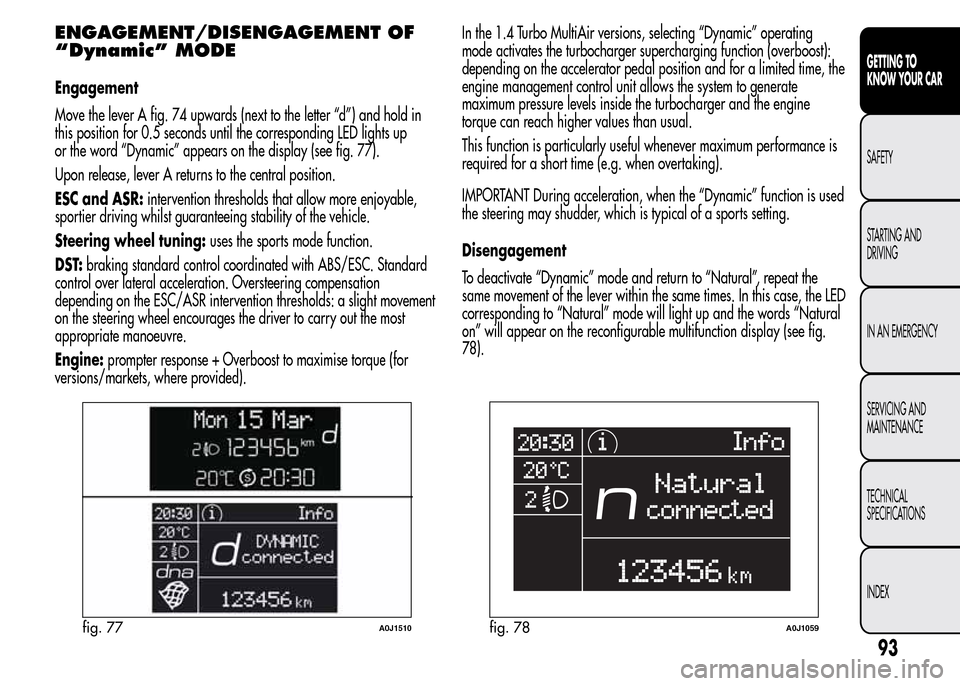
Move the lever A fig. 74 upwards (next to the letter “d”) and hold in
this position for 0.5 seconds until the corresponding LED lights up
or the word “Dynamic” appears on the display (see fig. 77).
Upon release, lever A returns to the central position.
ESC and ASR:intervention thresholds that allow more enjoyable,
sportier driving whilst guaranteeing stability of the vehicle.
Steering wheel tuning:uses the sports mode function.
DST:braking standard control coordinated with ABS/ESC. Standard
control over lateral acceleration. Oversteering compensation
depending on the ESC/ASR intervention thresholds: a slight movement
on the steering wheel encourages the driver to carry out the most
appropriate manoeuvre.
Engine:prompter response + Overboost to maximise torque (for
versions/markets, where provided).In the 1.4 Turbo MultiAir versions, selecting “Dynamic” operating
mode activates the turbocharger supercharging function (overboost):
depending on the accelerator pedal position and for a limited time, the
engine management control unit allows the system to generate
maximum pressure levels inside the turbocharger and the engine
torque can reach higher values than usual.
This function is particularly useful whenever maximum performance is
required for a short time (e.g. when overtaking).
IMPORTANT During acceleration, when the “Dynamic” function is used
the steering may shudder, which is typical of a sports setting.
Disengagement
To deactivate “Dynamic” mode and return to “Natural”, repeat the
same movement of the lever within the same times. In this case, the LED
corresponding to “Natural” mode will light up and the words “Natural
on” will appear on the reconfigurable multifunction display (see fig.
78).
fig. 77A0J1510fig. 78A0J1059
93
GETTING TO
KNOW YOUR CAR
SAFETY
STARTING AND
DRIVING
IN AN EMERGENCY
SERVICING AND
MAINTENANCE
TECHNICAL
SPECIFICATIONS
INDEX
Page 98 of 280
ENGAGEMENT/DISENGAGEMENT OF
“All Weather” MODE
Engagement
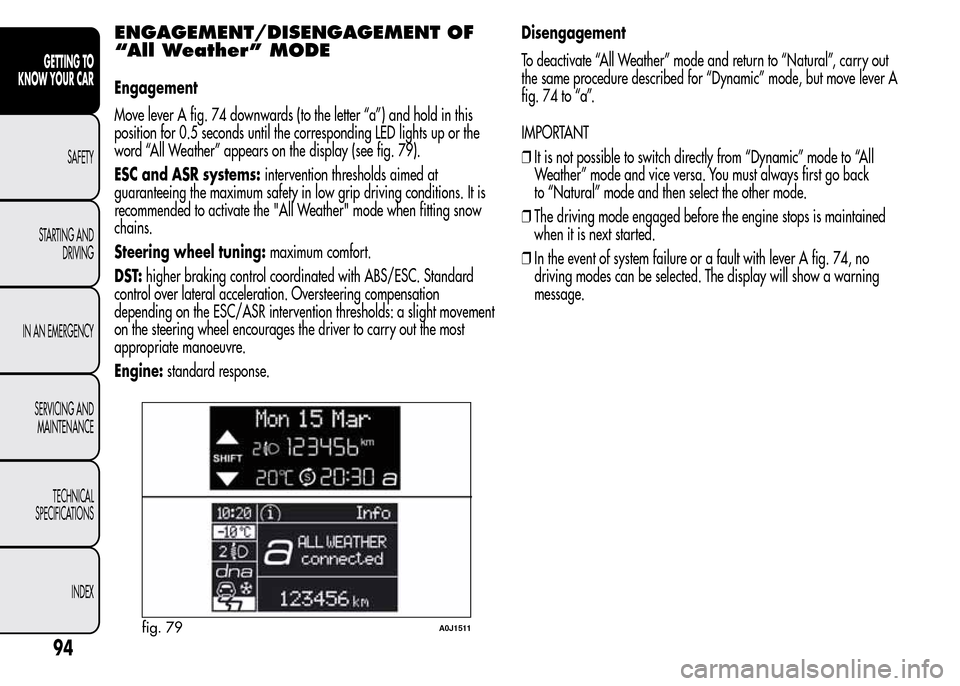
Move lever A fig. 74 downwards (to the letter “a”) and hold in this
position for 0.5 seconds until the corresponding LED lights up or the
word “All Weather” appears on the display (see fig. 79).
ESC and ASR systems:intervention thresholds aimed at
guaranteeing the maximum safety in low grip driving conditions. It is
recommended to activate the "All Weather" mode when fitting snow
chains.
Steering wheel tuning:maximum comfort.
DST:higher braking control coordinated with ABS/ESC. Standard
control over lateral acceleration. Oversteering compensation
depending on the ESC/ASR intervention thresholds: a slight movement
on the steering wheel encourages the driver to carry out the most
appropriate manoeuvre.
Engine:standard response.Disengagement
To deactivate “All Weather” mode and return to “Natural”, carry out
the same procedure described for “Dynamic” mode, but move lever A
fig. 74 to “a”.
IMPORTANT
❒It is not possible to switch directly from “Dynamic” mode to “All
Weather” mode and vice versa. You must always first go back
to “Natural” mode and then select the other mode.
❒The driving mode engaged before the engine stops is maintained
when it is next started.
❒In the event of system failure or a fault with lever A fig. 74, no
driving modes can be selected. The display will show a warning
message.
fig. 79A0J1511
94
GETTING TO
KNOW YOUR CAR
SAFETY
STARTING AND
DRIVING
IN AN EMERGENCY
SERVICING AND
MAINTENANCE
TECHNICAL
SPECIFICATIONS
INDEX