engine Alfa Romeo MiTo 2016 Repair Manual
[x] Cancel search | Manufacturer: ALFA ROMEO, Model Year: 2016, Model line: MiTo, Model: Alfa Romeo MiTo 2016Pages: 280, PDF Size: 8.52 MB
Page 152 of 280
INFLATION PROCEDURE
Wear the protective gloves provided with the kit.
Proceed as follows:
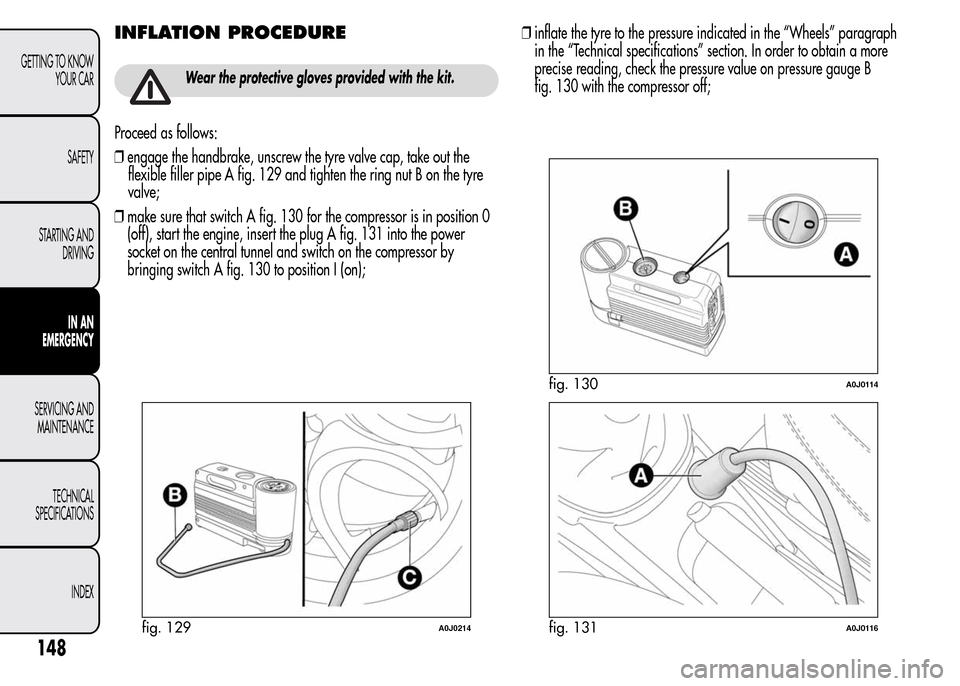
❒engage the handbrake, unscrew the tyre valve cap, take out the
flexible filler pipe A fig. 129 and tighten the ring nut B on the tyre
valve;
❒make sure that switch A fig. 130 for the compressor is in position 0
(off), start the engine, insert the plug A fig. 131 into the power
socket on the central tunnel and switch on the compressor by
bringing switch A fig. 130 to position I (on);❒inflate the tyre to the pressure indicated in the “Wheels” paragraph
in the “Technical specifications” section. In order to obtain a more
precise reading, check the pressure value on pressure gauge B
fig. 130 with the compressor off;
fig. 129A0J0214
fig. 130A0J0114
fig. 131A0J0116
148
GETTING TO KNOW
YOUR CAR
SAFETY
STARTING AND
DRIVING
IN AN
EMERGENCY
SERVICING AND
MAINTENANCE
TECHNICAL
SPECIFICATIONS
INDEX
Page 153 of 280
❒if after five minutes it is still impossible to reach at least 1.8 bar,
disengage the compressor from the valve and power socket, then
move the car forwards by approx. ten metres in order to distribute
the sealing fluid inside the tyre evenly, then repeat the inflation
operation;
❒if you still cannot obtain a pressure of at least 1.8 bar within 5
minutes from the compressor switching on, do not drive off and
contact Alfa Romeo Authorized Services;
❒after driving for about 10 minutes, stop and check the tyre pressure
again; remember to put the handbrake on;
❒if a pressure value of at least 1.8 bar is detected, restore the correct
pressure (with the engine running and the handbrake engaged),
resume driving and drive with great care to Alfa Romeo Authorized
Services.
Apply the adhesive label where it can be easily seen
by the driver as a reminder that the tyre has been
treated with the quick repair kit. Drive carefully,
particularly on bends. Do not exceed 80 km/h. Do not accelerate
or brake suddenly.
If the pressure has fallen below 1.8 bar, do not drive
any further: the Fix&Go Automatic quick tyre repair kit
cannot guarantee the correct hold because the tyre is
too damaged. Contact Alfa Romeo Authorized Services.
Inform the dealership that the tyre has been repaired
using the quick tyre repair kit. Give the leaflet to the
technicians who will be handling the tyre that was
repaired using the quick repair kit.
149
GETTING TO KNOW
YOUR CAR
SAFETY
STARTING AND
DRIVING
IN AN
EMERGENCY
SERVICING AND
MAINTENANCE
TECHNICAL
SPECIFICATIONS
INDEX
Page 165 of 280
REPLACING FUSES
GENERAL INFORMATION
Fuses protect the electrical system: they intervene (blow) in the event of
a failure or improper intervention on the system.
When a device does not work, check the condition of its protection
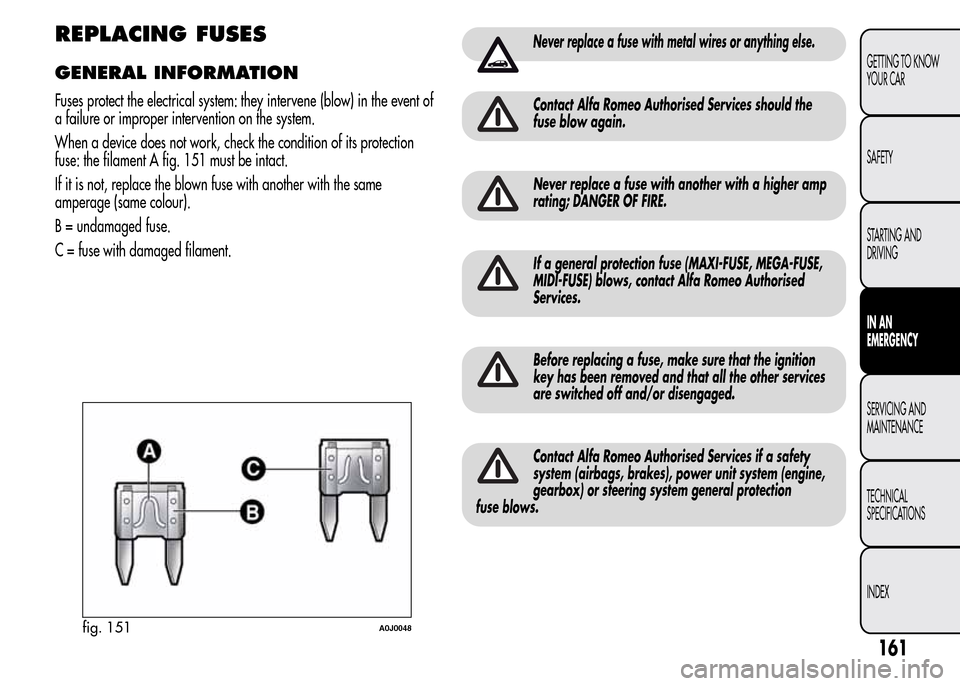
fuse: the filament A fig. 151 must be intact.
If it is not, replace the blown fuse with another with the same
amperage (same colour).
B = undamaged fuse.
C = fuse with damaged filament.
Never replace a fuse with metal wires or anything else.
Contact Alfa Romeo Authorised Services should the
fuse blow again.
Never replace a fuse with another with a higher amp
rating; DANGER OF FIRE.
If a general protection fuse (MAXI-FUSE, MEGA-FUSE,
MIDI-FUSE) blows, contact Alfa Romeo Authorised
Services.
Before replacing a fuse, make sure that the ignition
key has been removed and that all the other services
are switched off and/or disengaged.
Contact Alfa Romeo Authorised Services if a safety
system (airbags, brakes), power unit system (engine,
gearbox) or steering system general protection
fuse blows.
fig. 151A0J0048
161
GETTING TO KNOW
YOUR CAR
SAFETY
STARTING AND
DRIVING
IN AN
EMERGENCY
SERVICING AND
MAINTENANCE
TECHNICAL
SPECIFICATIONS
INDEX
Page 166 of 280
FUSE LOCATION
Fuses are grouped together in three fuse boxes located in the engine
compartment, dashboard and luggage compartment.
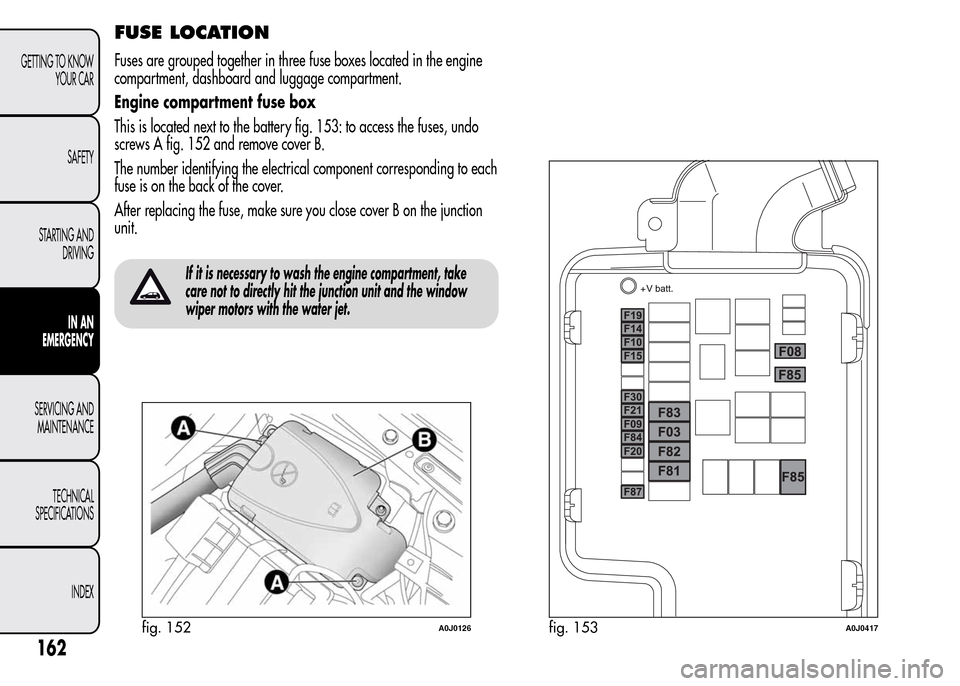
Engine compartment fuse box
This is located next to the battery fig. 153: to access the fuses, undo
screws A fig. 152 and remove cover B.
The number identifying the electrical component corresponding to each
fuse is on the back of the cover.
After replacing the fuse, make sure you close cover B on the junction
unit.
If it is necessary to wash the engine compartment, take
care not to directly hit the junction unit and the window
wiper motors with the water jet.
fig. 152A0J0126fig. 153A0J0417
162
GETTING TO KNOW
YOUR CAR
SAFETY
STARTING AND
DRIVING
IN AN
EMERGENCY
SERVICING AND
MAINTENANCE
TECHNICAL
SPECIFICATIONS
INDEX
Page 169 of 280
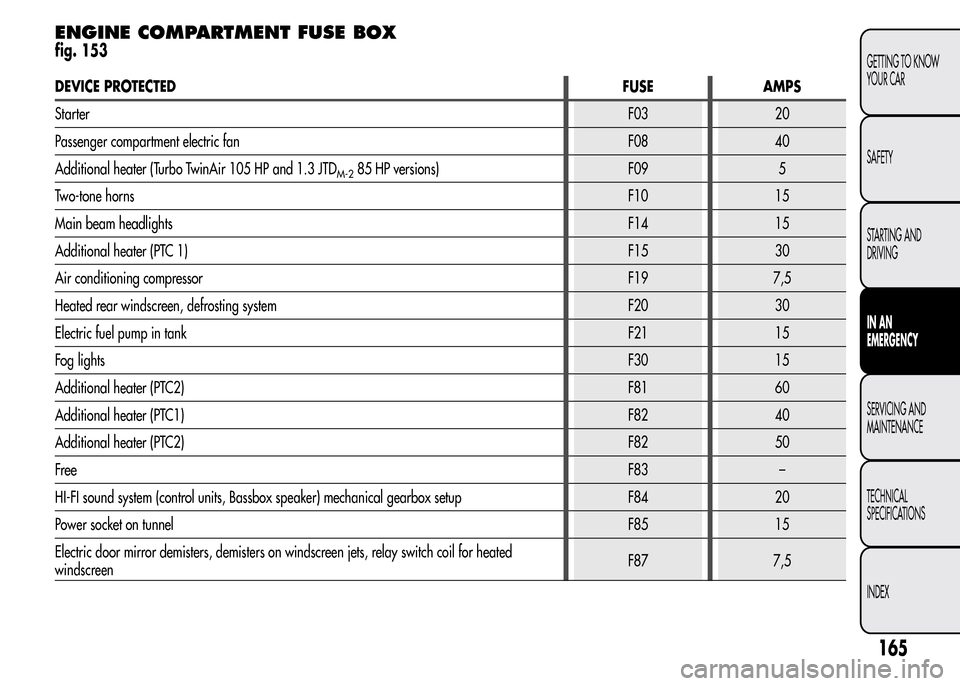
ENGINE COMPARTMENT FUSE BOX
fig. 153
DEVICE PROTECTEDFUSE AMPS
StarterF03 20
Passenger compartment electric fan F08 40
Additional heater (Turbo TwinAir 105 HP and 1.3 JTD
M-285 HP versions) F09 5
Two-tone hornsF10 15
Main beam headlightsF14 15
Additional heater (PTC 1)F15 30
Air conditioning compressorF19 7,5
Heated rear windscreen, defrosting system F20 30
Electric fuel pump in tankF21 15
Fog lightsF30 15
Additional heater (PTC2)F81 60
Additional heater (PTC1)F82 40
Additional heater (PTC2)F82 50
FreeF83 –
HI-FI sound system (control units, Bassbox speaker) mechanical gearbox setup F84 20
Power socket on tunnelF85 15
Electric door mirror demisters, demisters on windscreen jets, relay switch coil for heated
windscreenF87 7,5
165
GETTING TO KNOW
YOUR CAR
SAFETY
STARTING AND
DRIVING
IN AN
EMERGENCY
SERVICING AND
MAINTENANCE
TECHNICAL
SPECIFICATIONS
INDEX
Page 170 of 280
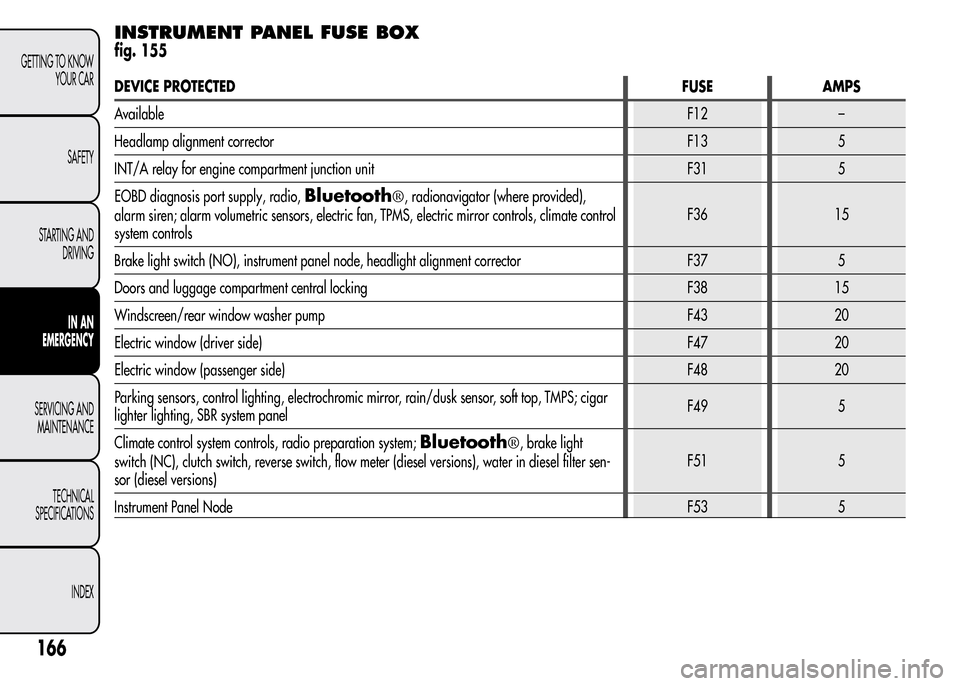
INSTRUMENT PANEL FUSE BOX
fig. 155
DEVICE PROTECTEDFUSE AMPS
AvailableF12 –
Headlamp alignment correctorF13 5
INT/A relay for engine compartment junction unit F31 5
EOBD diagnosis port supply, radio,
Bluetooth®, radionavigator (where provided),
alarm siren; alarm volumetric sensors, electric fan, TPMS, electric mirror controls, climate control
system controlsF36 15
Brake light switch (NO), instrument panel node, headlight alignment corrector F37 5
Doors and luggage compartment central locking F38 15
Windscreen/rear window washer pump F43 20
Electric window (driver side)F47 20
Electric window (passenger side)F48 20
Parking sensors, control lighting, electrochromic mirror, rain/dusk sensor, soft top, TMPS; cigar
lighter lighting, SBR system panelF49 5
Climate control system controls, radio preparation system;
Bluetooth®, brake light
switch (NC), clutch switch, reverse switch, flow meter (diesel versions), water in diesel filter sen-
sor (diesel versions)F51 5
Instrument Panel NodeF53 5
166
GETTING TO KNOW
YOUR CAR
SAFETY
STARTING AND
DRIVING
IN AN
EMERGENCY
SERVICING AND
MAINTENANCE
TECHNICAL
SPECIFICATIONS
INDEX
Page 174 of 280
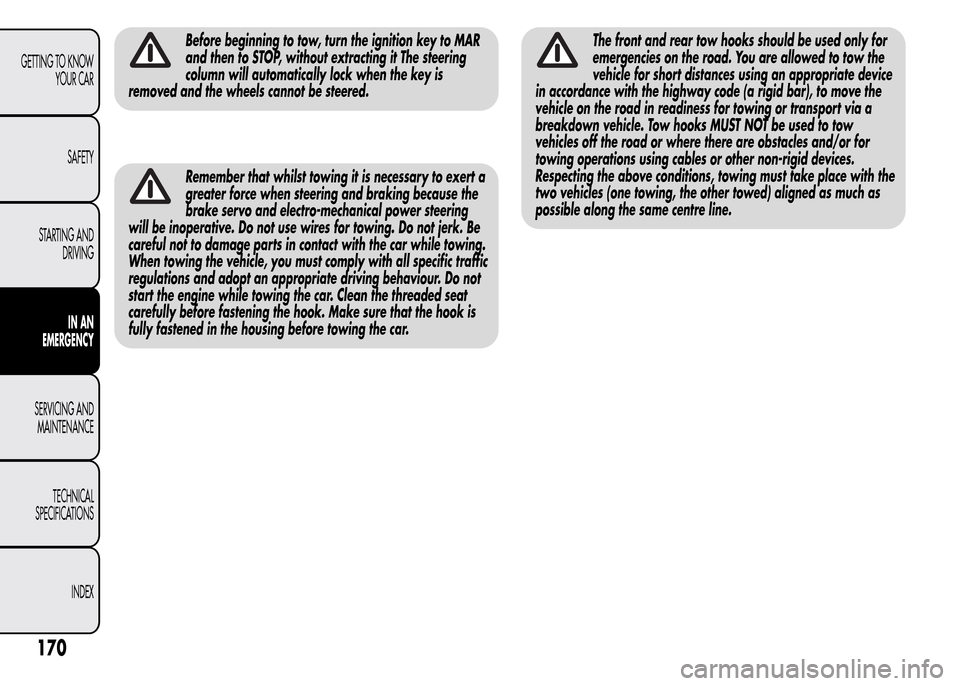
Before beginning to tow, turn the ignition key to MAR
and then to STOP, without extracting it The steering
column will automatically lock when the key is
removed and the wheels cannot be steered.
Remember that whilst towing it is necessary to exert a
greater force when steering and braking because the
brake servo and electro-mechanical power steering
will be inoperative. Do not use wires for towing. Do not jerk. Be
careful not to damage parts in contact with the car while towing.
When towing the vehicle, you must comply with all specific traffic
regulations and adopt an appropriate driving behaviour. Do not
start the engine while towing the car. Clean the threaded seat
carefully before fastening the hook. Make sure that the hook is
fully fastened in the housing before towing the car.
The front and rear tow hooks should be used only for
emergencies on the road. You are allowed to tow the
vehicle for short distances using an appropriate device
in accordance with the highway code (a rigid bar), to move the
vehicle on the road in readiness for towing or transport via a
breakdown vehicle. Tow hooks MUST NOT be used to tow
vehicles off the road or where there are obstacles and/or for
towing operations using cables or other non-rigid devices.
Respecting the above conditions, towing must take place with the
two vehicles (one towing, the other towed) aligned as much as
possible along the same centre line.
170
GETTING TO KNOW
YOUR CAR
SAFETY
STARTING AND
DRIVING
IN AN
EMERGENCY
SERVICING AND
MAINTENANCE
TECHNICAL
SPECIFICATIONS
INDEX
Page 176 of 280
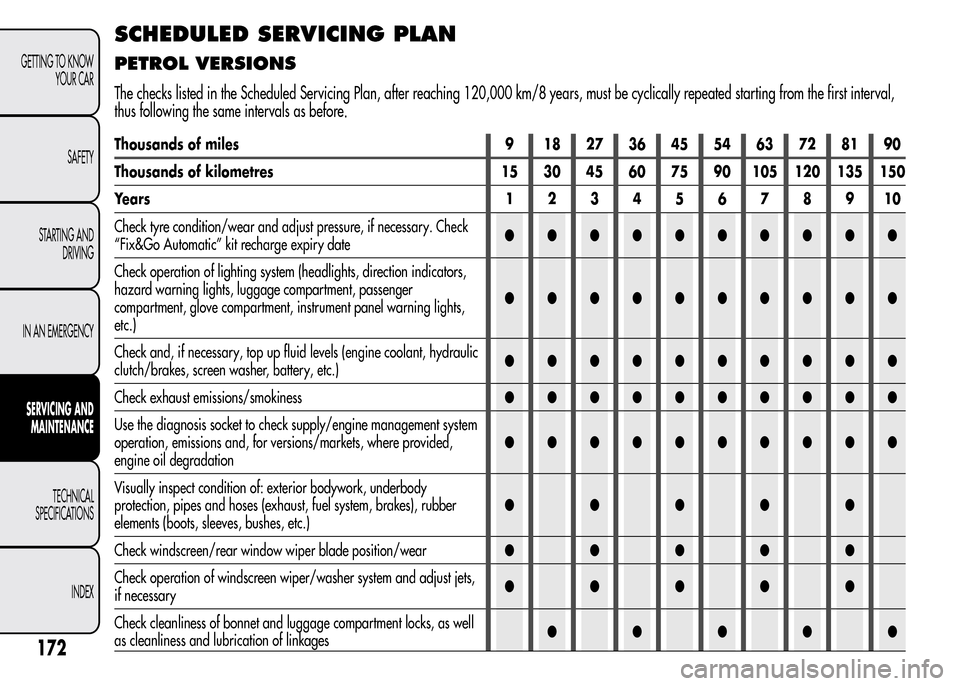
SCHEDULED SERVICING PLAN
PETROL VERSIONS
Thousands of miles 9 18 27 36 45 54 63 72 81 90
Thousands of kilometres 15 30 45 60 75 90 105 120 135 150
Years12345678910
Check tyre condition/wear and adjust pressure, if necessary. Check
“Fix&Go Automatic” kit recharge expiry date●●●●●●●●●●
Check operation of lighting system (headlights, direction indicators,
hazard warning lights, luggage compartment, passenger
compartment, glove compartment, instrument panel warning lights,
etc.)●●●●●●●●●●
Check and, if necessary, top up fluid levels (engine coolant, hydraulic
clutch/brakes, screen washer, battery, etc.)●●●●●●●●●●
Check exhaust emissions/smokiness●●●●●●●●●●
Use the diagnosis socket to check supply/engine management system
operation, emissions and, for versions/markets, where provided,
engine oil degradation●●●●●●●●●●
Visually inspect condition of: exterior bodywork, underbody
protection, pipes and hoses (exhaust, fuel system, brakes), rubber
elements (boots, sleeves, bushes, etc.)●●●●●
Check windscreen/rear window wiper blade position/wear●●●●●
Check operation of windscreen wiper/washer system and adjust jets,
if necessary●●●●●
Check cleanliness of bonnet and luggage compartment locks, as well
as cleanliness and lubrication of linkages●●●●●
172
GETTING TO KNOW
YOUR CAR
SAFETY
STARTING AND
DRIVING
IN AN EMERGENCY
SERVICING AND
MAINTENANCE
TECHNICAL
SPECIFICATIONS
INDEX
The checks listed in the Scheduled Servicing Plan, after reaching 120,000 km/8 years, must be cyclically repeated starting from the first interval,
thus following the same intervals as before.
Page 177 of 280
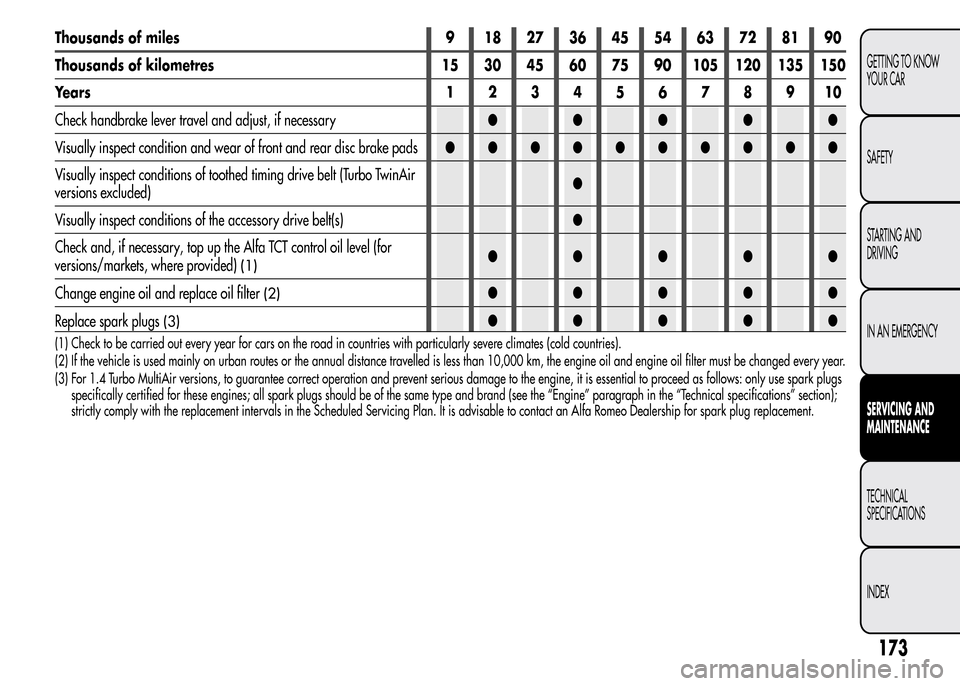
Thousands of miles 9 18 27 36 45 54 63 72 81 90
Thousands of kilometres 15 30 45 60 75 90 105 120 135 150
Years12345678910
Check handbrake lever travel and adjust, if necessary●●●●●
Visually inspect condition and wear of front and rear disc brake pads●●●●●●●●●●
Visually inspect conditions of toothed timing drive belt (Turbo TwinAir
versions excluded)●
Visually inspect conditions of the accessory drive belt(s)●
Check and, if necessary, top up the Alfa TCT control oil level (for
versions/markets, where provided)
(1)●●●●●
Change engine oil and replace oil filter
(2)●●●●●
Replace spark plugs
(3)●●●●●
(1) Check to be carried out every year for cars on the road in countries with particularly severe climates (cold countries).
(2) If the vehicle is used mainly on urban routes or the annual distance travelled is less than 10,000 km, the engine oil and engine oil filter must be changed every year.
(3) For 1.4 Turbo MultiAir versions, to guarantee correct operation and prevent serious damage to the engine, it is essential to proceed as follows: only use spark plugs
specifically certified for these engines; all spark plugs should be of the same type and brand (see the “Engine” paragraph in the “Technical specifications” section);
strictly comply with the replacement intervals in the Scheduled Servicing Plan. It is advisable to contact an Alfa Romeo Dealership for spark plug replacement.
173
GETTING TO KNOW
YOUR CAR
SAFETY
STARTING AND
DRIVING
IN AN EMERGENCY
SERVICING AND
MAINTENANCE
TECHNICAL
SPECIFICATIONS
INDEX
Page 179 of 280
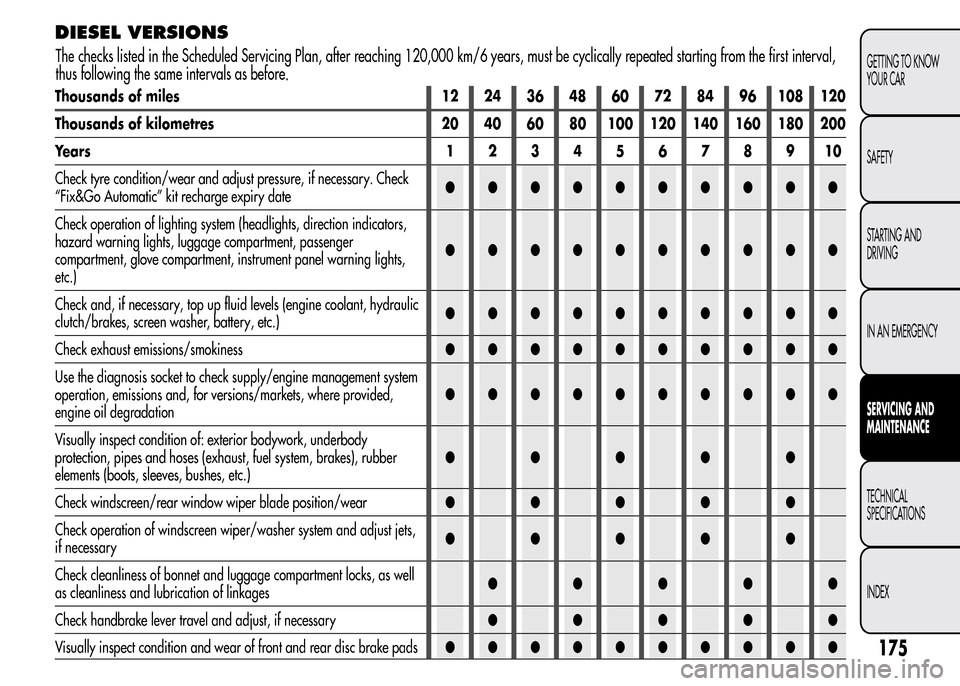
DIESEL VERSIONS
Thousands of miles 12 24 36 48 60 72 84 96 108 120
Thousands of kilometres 20 40 60 80 100 120 140 160 180 200
Years12345678910
Check tyre condition/wear and adjust pressure, if necessary. Check
“Fix&Go Automatic” kit recharge expiry date●●●●●●●●●●
Check operation of lighting system (headlights, direction indicators,
hazard warning lights, luggage compartment, passenger
compartment, glove compartment, instrument panel warning lights,
etc.)●●●●●●●●●●
Check and, if necessary, top up fluid levels (engine coolant, hydraulic
clutch/brakes, screen washer, battery, etc.)●●●●●●●●●●
Check exhaust emissions/smokiness●●●●●●●●●●
Use the diagnosis socket to check supply/engine management system
operation, emissions and, for versions/markets, where provided,
engine oil degradation●●●●●●●●●●
Visually inspect condition of: exterior bodywork, underbody
protection, pipes and hoses (exhaust, fuel system, brakes), rubber
elements (boots, sleeves, bushes, etc.)●●●●●
Check windscreen/rear window wiper blade position/wear●●●●●
Check operation of windscreen wiper/washer system and adjust jets,
if necessary●●●●●
Check cleanliness of bonnet and luggage compartment locks, as well
as cleanliness and lubrication of linkages●●●●●
Check handbrake lever travel and adjust, if necessary●●●●●
Visually inspect condition and wear of front and rear disc brake pads●●●●●●●●●●
175
GETTING TO KNOW
YOUR CAR
SAFETY
STARTING AND
DRIVING
IN AN EMERGENCY
SERVICING AND
MAINTENANCE
TECHNICAL
SPECIFICATIONS
INDEX
The checks listed in the Scheduled Servicing Plan, after reaching 120,000 km/6 years, must be cyclically repeated starting from the first interval,
thus following the same intervals as before.