Lin Alfa Romeo MiTo 2017 Owner's Guide
[x] Cancel search | Manufacturer: ALFA ROMEO, Model Year: 2017, Model line: MiTo, Model: Alfa Romeo MiTo 2017Pages: 212, PDF Size: 4.36 MB
Page 91 of 212
Let’s get to the core of the vehicle: seeing how you can exploit all
of its potential to the full.
We’ll look at how to drive it safely in any situation, so that it can be
a welcome companion, with our comfort and our wallets in mind.
STARTING AND DRIVING
STARTING THE ENGINE . .........................90
PARKING THE VEHICLE ...........................91
USING THE MANUAL GEARBOX .....................92
USING ALFA TCT TRANSMISSION . . . . ................93
START&STOP SYSTEM. ..........................95
CRUISE CONTROL ..............................97
PARKING SENSORS .............................98
TOWING TRAILERS . . . . . . . . .....................99
REFUELLING THE VEHICLE . . .....................100
Page 96 of 212
IMPORTANT The inconsistency between
the speed actually engaged (shown on
the display) and the position of the gear
lever is indicated by the letter
corresponding to the position of the lever
flashing on the trim (also accompanied by
an acoustic signal). This condition should
not be interpreted as an operational
fault, but simply as a request by the
system to repeat the manoeuvre.
IMPORTANT With handbrake released
and brake pedal released, engine at idling
speed and gear lever in position D, R or
sequential, pay the utmost care because
the car can move even without the
operation of the accelerator pedal. This
condition can be used with the car on a
level surface during tight parking
manoeuvres using the brake pedal only.
AUTOMATIC DRIVING MODE
D can be selected from sequential
operation in any driving conditions.
In automatic driving mode, the best ratio
is selected by the electronic transmission
control unit depending on speed, engine
load (accelerator pedal position) and
gradient of the road.
“Kick-Down” function
To resume speed quickly, when the
accelerator pedal is pressed fully, the
transmission control system downshifts
("Kick-down" function).
IMPORTANT When driving on roads with
poor grip conditions (snow, ice, etc.) avoid
activating the kick-down function.
Gearshifting suggestion
With the transmission in automatic mode
(selector lever in position D), when
gearshifting is required by the paddles on
the steering wheel (where provided), the
system shifts to "Sequential mode",
displaying the engaged gear for about
5 seconds.
When this time has elapsed, if the
paddles are not operated anymore, the
system goes back to the automatic mode
(D), with following displaying.
SEQUENTIAL DRIVING MODE
In sequential driving mode, the
transmission works like a manual
gearbox.
Gearshifting through selector lever
Move the lever sideways (to the left)
from position D to the sequential
position:
lever towards "+": engage higher gear;
lever towards "-": engage lower gear.
The lever correct position in “Sequential
Mode” is signalled when the symbols “+”
and “−” come on and, simultaneously, the
symbol D comes off on the display.
The gear engaged is shown on the display.Gearshifting through steering wheel
paddles
(where provided)
24)
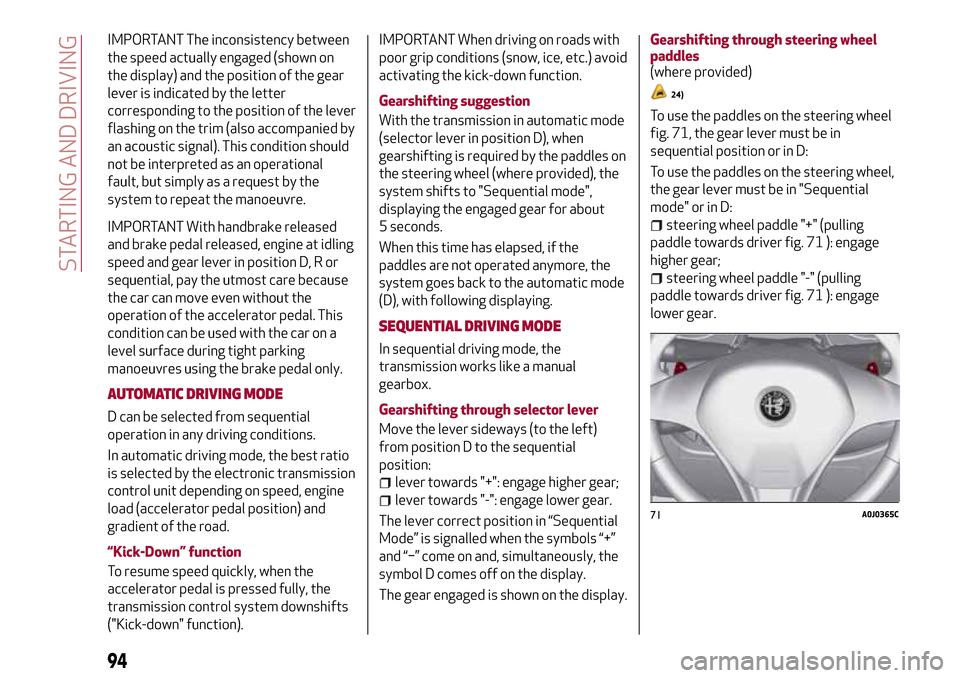
To use the paddles on the steering wheel
fig. 71, the gear lever must be in
sequential position or in D:
To use the paddles on the steering wheel,
the gear lever must be in "Sequential
mode" or in D:
steering wheel paddle "+" (pulling
paddle towards driver fig. 71 ): engage
higher gear;
steering wheel paddle "-" (pulling
paddle towards driver fig. 71 ): engage
lower gear.
71A0J0365C
94
STARTING AND DRIVING
Page 97 of 212
The upshifting/downshifting is only
permitted if the engine revs allow it
If the car is stopped with a higher gear
than 1st speed engaged, the
transmission will automatically engage
1st gear.
IMPORTANT
22)If the car is on a gradient, always engage
the handbrake BEFORE placing the gear
lever in P.
23)Engage reverse only with the car
stationary, engine at idling speed and
accelerator pedal fully released.
24)Using the paddles incorrectly (paddles
pushed towards the dashboard ) could break
them.
WARNING
99)Never leave children unattended in the
car. Always remove the ignition key when
leaving the car and take the key with you.
START&STOP SYSTEM
(where provided)
The Start&Stop system automatically
stops the engine each time the vehicle is
stationary and starts it again when the
driver wants to move off. In this way, the
vehicle efficiency is increased, by
reducing consumption, dangerous gas
emissions and sound pollution.
OPERATING MODE
Stopping the engine
With the vehicle stopped, the engine
stops with gearbox in neutral and clutch
pedal released.
NOTE The engine can only be stopped
automatically after exceeding about
10 km/h, to prevent the engine from
being repeatedly stopped when driving at
walking pace.
The symbol
appears on the display
when the engine stops.
Restarting the engine
To restart the engine, press the clutch
pedal.
72A0J0376C
95
Page 99 of 212
CRUISE CONTROL
(where provided)
DESCRIPTION
This is an electronic driving aid that
allows you to drive at a speed of above
30 km/h on long and straight dry roads
(e.g. motorways), at a preset speed
without having to press the accelerator
pedal. It is therefore not recommended
to use this device on extra-urban roads
with traffic. Do not use it in town.
ACTIVATING THE DEVICE
101) 102)
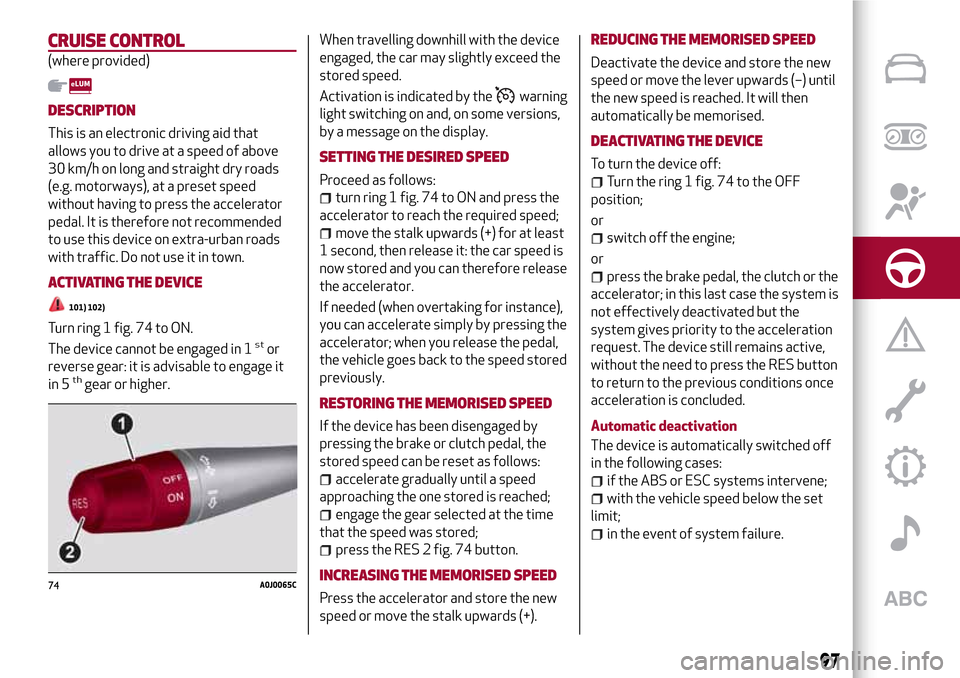
Turn ring 1 fig. 74 to ON.
The device cannot be engaged in 1stor
reverse gear: it is advisable to engage it
in 5
thgear or higher.When travelling downhill with the device
engaged, the car may slightly exceed the
stored speed.
Activation is indicated by the
warning
light switching on and, on some versions,
by a message on the display.
SETTING THE DESIRED SPEED
Proceed as follows:
turn ring 1 fig. 74 to ON and press the
accelerator to reach the required speed;
move the stalk upwards (+) for at least
1 second, then release it: the car speed is
now stored and you can therefore release
the accelerator.
If needed (when overtaking for instance),
you can accelerate simply by pressing the
accelerator; when you release the pedal,
the vehicle goes back to the speed stored
previously.
RESTORING THE MEMORISED SPEED
If the device has been disengaged by
pressing the brake or clutch pedal, the
stored speed can be reset as follows:
accelerate gradually until a speed
approaching the one stored is reached;
engage the gear selected at the time
that the speed was stored;
press the RES 2 fig. 74 button.
INCREASING THE MEMORISED SPEED
Press the accelerator and store the new
speed or move the stalk upwards (+).
REDUCING THE MEMORISED SPEED
Deactivate the device and store the new
speed or move the lever upwards (–) until
the new speed is reached. It will then
automatically be memorised.
DEACTIVATING THE DEVICE
To turn the device off:
Turn the ring 1 fig. 74 to the OFF
position;
or
switch off the engine;
or
press the brake pedal, the clutch or the
accelerator; in this last case the system is
not effectively deactivated but the
system gives priority to the acceleration
request. The device still remains active,
without the need to press the RES button
to return to the previous conditions once
acceleration is concluded.
Automatic deactivation
The device is automatically switched off
in the following cases:
if the ABS or ESC systems intervene;
with the vehicle speed below the set
limit;
in the event of system failure.
74A0J0065C
97
Page 100 of 212
WARNING
101)When travelling with the device active,
never move the gear lever to neutral.
102)In case of a malfunction or failure of
the device, contact an Alfa Romeo
Dealership.
PARKING SENSORS
(where provided)
103) 104)
26)
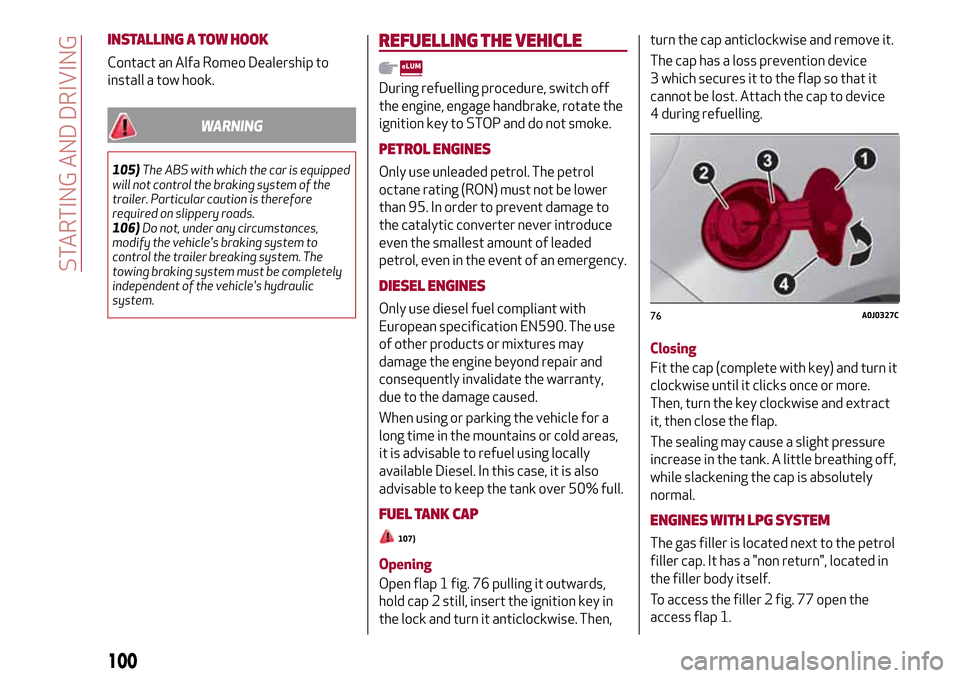
The sensors are located in the vehicle
rear bumper fig. 75 and their function is
to inform the driver, through an
intermittent acoustic and visual signal,
about the presence of obstacles behind
the vehicle.
ACTIVATION/DEACTIVATION
The sensors are turned on when reverse
gear is engaged. As the distance from the
obstacle behind the vehicle decreases,
the frequency of the acoustic signal
increases.
When the reverse gear is disengaged, the
sensors deactivate.
ACOUSTIC SIGNAL
When reverse gear is engaged an
acoustic signal is automatically activated
if there is an obstacle within the range of
operation.
The acoustic signal:
increases as the distance between the
vehicle and the obstacle decreases;
becomes continuous when the
distance between the car and the
obstacle is less than 30 cm and stops
immediately if the distance increases;
remains constant if the distance
remains unchanged; if this situation
concerns the side sensors, the buzzer will
stop after about 3 seconds to avoid, for
example, warning indications in the event
of manoeuvres along walls.
OPERATION WITH A TRAILER
Parking sensor operation is automatically
turned off when the trailer electric cable
plug is fitted into the car tow hook
socket.
IMPORTANT NOTES
During parking manoeuvres, pay the
utmost attention to any obstacles that
could be located above or below the
sensors.
Objects set close to the car rear, under
certain circumstances are not detected
and could therefore cause damage to the
car or be damaged.
75A0J0088C
98
STARTING AND DRIVING
Page 102 of 212
INSTALLING A TOW HOOK
Contact an Alfa Romeo Dealership to
install a tow hook.
WARNING
105)The ABS with which the car is equipped
will not control the braking system of the
trailer. Particular caution is therefore
required on slippery roads.
106)Do not, under any circumstances,
modify the vehicle's braking system to
control the trailer breaking system. The
towing braking system must be completely
independent of the vehicle's hydraulic
system.
REFUELLING THE VEHICLE
During refuelling procedure, switch off
the engine, engage handbrake, rotate the
ignition key to STOP and do not smoke.
PETROL ENGINES
Only use unleaded petrol. The petrol
octane rating (RON) must not be lower
than 95. In order to prevent damage to
the catalytic converter never introduce
even the smallest amount of leaded
petrol, even in the event of an emergency.
DIESEL ENGINES
Only use diesel fuel compliant with
European specification EN590. The use
of other products or mixtures may
damage the engine beyond repair and
consequently invalidate the warranty,
due to the damage caused.
When using or parking the vehicle for a
long time in the mountains or cold areas,
it is advisable to refuel using locally
available Diesel. In this case, it is also
advisable to keep the tank over 50% full.
FUEL TANK CAP
107)
Opening
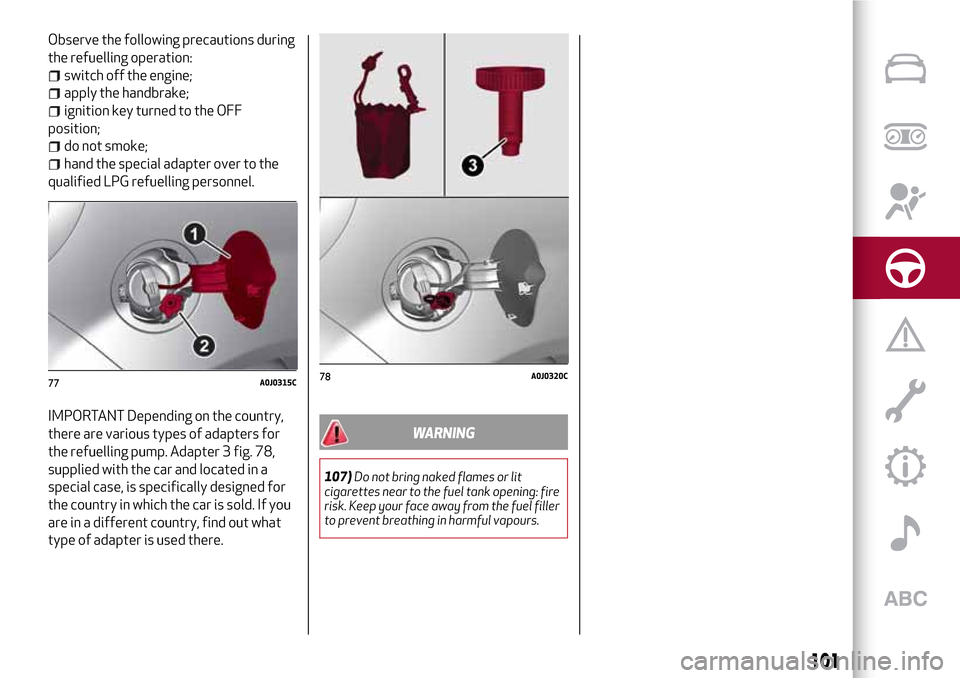
Open flap 1 fig. 76 pulling it outwards,
hold cap 2 still, insert the ignition key in
the lock and turn it anticlockwise. Then,turn the cap anticlockwise and remove it.
The cap has a loss prevention device
3 which secures it to the flap so that it
cannot be lost. Attach the cap to device
4 during refuelling.
Closing
Fit the cap (complete with key) and turn it
clockwise until it clicks once or more.
Then, turn the key clockwise and extract
it, then close the flap.
The sealing may cause a slight pressure
increase in the tank. A little breathing off,
while slackening the cap is absolutely
normal.
ENGINES WITH LPGSYSTEM
The gas filler is located next to the petrol
filler cap. It has a "non return", located in
the filler body itself.
To access the filler 2 fig. 77 open the
access flap 1.
76A0J0327C
100
STARTING AND DRIVING
Page 103 of 212
Observe the following precautions during
the refuelling operation:
switch off the engine;
apply the handbrake;
ignition key turned to the OFF
position;
do not smoke;
hand the special adapter over to the
qualified LPG refuelling personnel.
IMPORTANT Depending on the country,
there are various types of adapters for
the refuelling pump. Adapter 3 fig. 78,
supplied with the car and located in a
special case, is specifically designed for
the country in which the car is sold. If you
are in a different country, find out what
type of adapter is used there.
WARNING
107)Do not bring naked flames or lit
cigarettes near to the fuel tank opening: fire
risk. Keep your face away from the fuel filler
to prevent breathing in harmful vapours.
77A0J0315C78A0J0320C
101
Page 107 of 212
TYPES OF BULBS
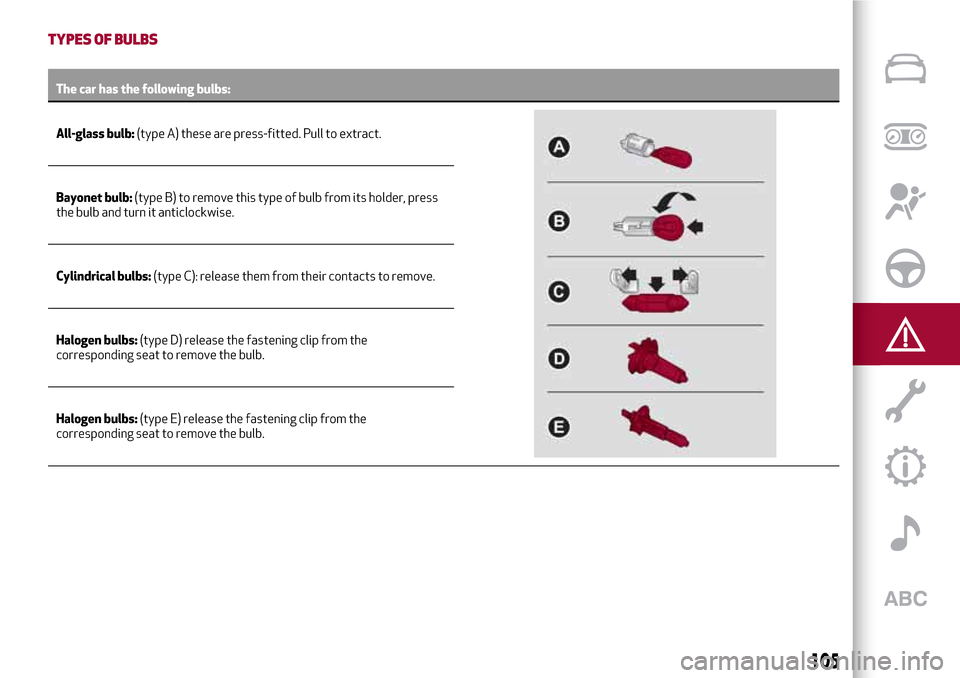
The car has the following bulbs:
All-glass bulb:(type A) these are press-fitted. Pull to extract.
Bayonet bulb:(type B) to remove this type of bulb from its holder, press
the bulb and turn it anticlockwise.
Cylindrical bulbs:(type C): release them from their contacts to remove.
Halogen bulbs:(type D) release the fastening clip from the
corresponding seat to remove the bulb.
Halogen bulbs:(type E) release the fastening clip from the
corresponding seat to remove the bulb.
105
Page 108 of 212
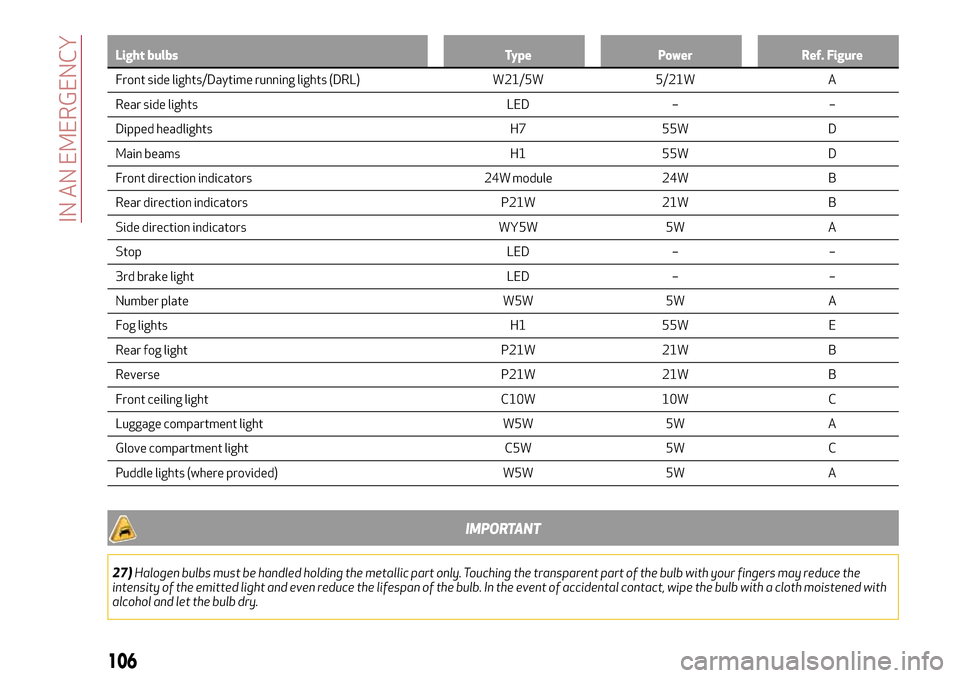
Light bulbs Type Power Ref. Figure
Front side lights/Daytime running lights (DRL) W21/5W 5/21W A
Rear side lights LED – –
Dipped headlights H7 55W D
Main beams H1 55W D
Front direction indicators 24W module 24W B
Rear direction indicators P21W 21W B
Side direction indicators WY5W 5W A
Stop LED – –
3rd brake light LED – –
Number plate W5W 5W A
Fog lights H1 55W E
Rear fog light P21W 21W B
Reverse P21W 21W B
Front ceiling light C10W 10W C
Luggage compartment light W5W 5W A
Glove compartment light C5W 5W C
Puddle lights (where provided) W5W 5W A
IMPORTANT
27)Halogen bulbs must be handled holding the metallic part only. Touching the transparent part of the bulb with your fingers may reduce the
intensity of the emitted light and even reduce the lifespan of the bulb. In the event of accidental contact, wipe the bulb with a cloth moistened with
alcohol and let the bulb dry.
106
IN AN EMERGENCY
Page 122 of 212
IMPORTANT
30)When turning the jack handle make sure
that it can turn freely without scraping your
hand against the ground. The moving
components of the jack ("worm screw" and
joints) can also cause injuries: avoid touching
them. If you come into contact with
lubricating grease, clean yourself
thoroughly.
31)Contact an Alfa Romeo Dealership as
soon as possible to have the correct
tightening of the wheel bolts checked.
"Fix&Go Automatic" KIT
123)
32) 33)
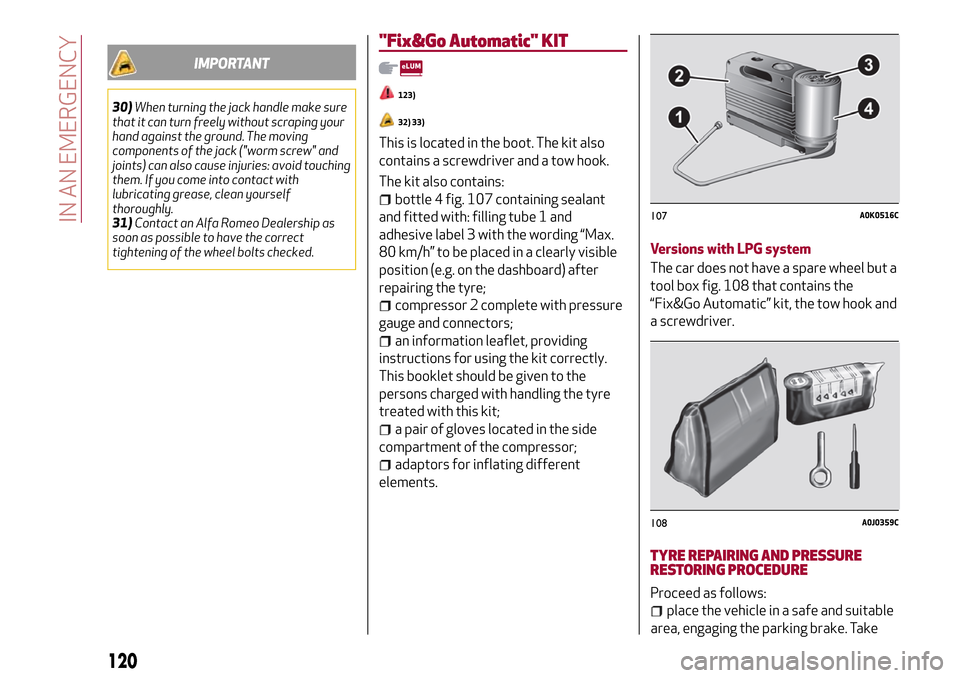
This is located in the boot. The kit also
contains a screwdriver and a tow hook.
The kit also contains:
bottle 4 fig. 107 containing sealant
and fitted with: filling tube 1 and
adhesive label 3 with the wording “Max.
80 km/h” to be placed in a clearly visible
position (e.g. on the dashboard) after
repairing the tyre;
compressor 2 complete with pressure
gauge and connectors;
an information leaflet, providing
instructions for using the kit correctly.
This booklet should be given to the
persons charged with handling the tyre
treated with this kit;
a pair of gloves located in the side
compartment of the compressor;
adaptors for inflating different
elements.Versions with LPG system
The car does not have a spare wheel but a
tool box fig. 108 that contains the
“Fix&Go Automatic” kit, the tow hook and
a screwdriver.
TYRE REPAIRING AND PRESSURE
RESTORING PROCEDURE
Proceed as follows:
107A0K0516C
108A0J0359C
120
IN AN EMERGENCY
place the vehicle in a safe and suitable
area, engaging the parking brake. Take