Lin Alfa Romeo MiTo 2017 Service Manual
[x] Cancel search | Manufacturer: ALFA ROMEO, Model Year: 2017, Model line: MiTo, Model: Alfa Romeo MiTo 2017Pages: 212, PDF Size: 4.36 MB
Page 123 of 212
the kit from the specific compartment;
remove the adhesive label of speed 3
(see previous paragraph) and apply it in a
visible position. Wear the protective
gloves provided;
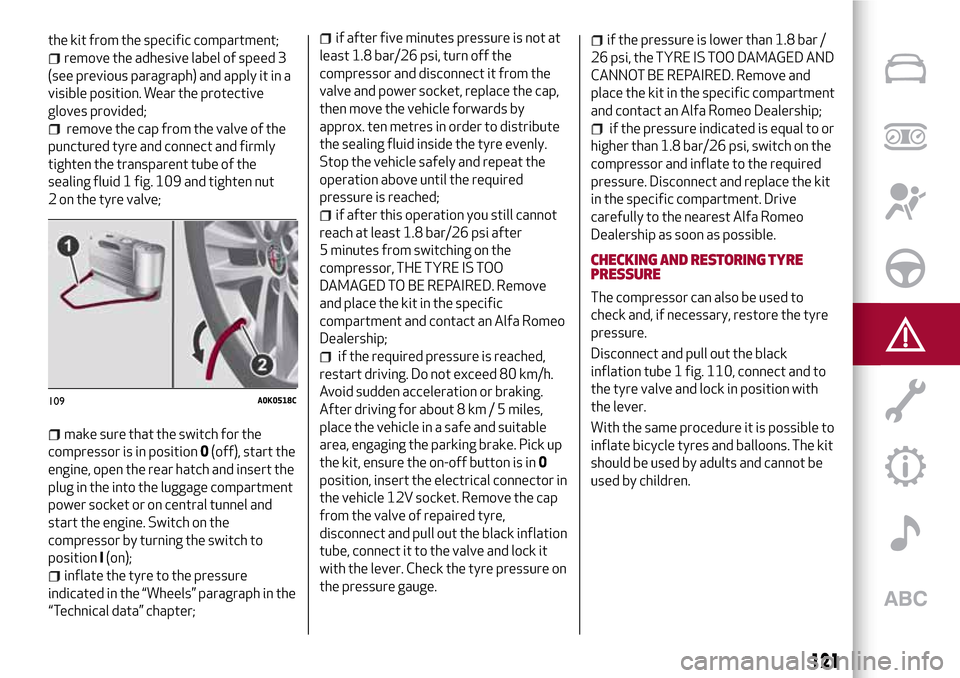
remove the cap from the valve of the
punctured tyre and connect and firmly
tighten the transparent tube of the
sealing fluid 1 fig. 109 and tighten nut
2 on the tyre valve;
make sure that the switch for the
compressor is in position0(off), start the
engine, open the rear hatch and insert the
plug in the into the luggage compartment
power socket or on central tunnel and
start the engine. Switch on the
compressor by turning the switch to
positionI(on);
inflate the tyre to the pressure
indicated in the “Wheels” paragraph in the
“Technical data” chapter;
if after five minutes pressure is not at
least 1.8 bar/26 psi, turn off the
compressor and disconnect it from the
valve and power socket, replace the cap,
then move the vehicle forwards by
approx. ten metres in order to distribute
the sealing fluid inside the tyre evenly.
Stop the vehicle safely and repeat the
operation above until the required
pressure is reached;
if after this operation you still cannot
reach at least 1.8 bar/26 psi after
5 minutes from switching on the
compressor, THE TYRE IS TOO
DAMAGED TO BE REPAIRED. Remove
and place the kit in the specific
compartment and contact an Alfa Romeo
Dealership;
if the required pressure is reached,
restart driving. Do not exceed 80 km/h.
Avoid sudden acceleration or braking.
After driving for about 8 km / 5 miles,
place the vehicle in a safe and suitable
area, engaging the parking brake. Pick up
the kit, ensure the on-off button is in0
position, insert the electrical connector in
the vehicle 12V socket. Remove the cap
from the valve of repaired tyre,
disconnect and pull out the black inflation
tube, connect it to the valve and lock it
with the lever. Check the tyre pressure on
the pressure gauge.
if the pressure is lower than 1.8 bar /
26 psi, the TYRE IS TOO DAMAGED AND
CANNOT BE REPAIRED. Remove and
place the kit in the specific compartment
and contact an Alfa Romeo Dealership;
if the pressure indicated is equal to or
higher than 1.8 bar/26 psi, switch on the
compressor and inflate to the required
pressure. Disconnect and replace the kit
in the specific compartment. Drive
carefully to the nearest Alfa Romeo
Dealership as soon as possible.
CHECKING AND RESTORING TYRE
PRESSURE
The compressor can also be used to
check and, if necessary, restore the tyre
pressure.
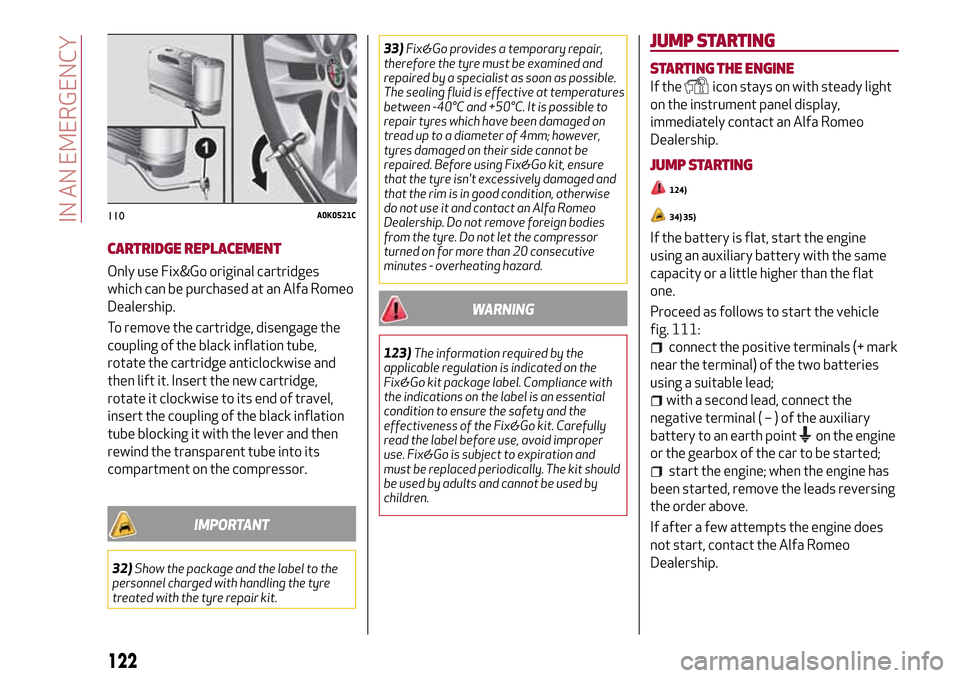
Disconnect and pull out the black
inflation tube 1 fig. 110, connect and to
the tyre valve and lock in position with
the lever.
With the same procedure it is possible to
inflate bicycle tyres and balloons. The kit
should be used by adults and cannot be
used by children.
109A0K0518C
121
Page 124 of 212
CARTRIDGE REPLACEMENT
Only use Fix&Go original cartridges
which can be purchased at an Alfa Romeo
Dealership.
To remove the cartridge, disengage the
coupling of the black inflation tube,
rotate the cartridge anticlockwise and
then lift it. Insert the new cartridge,
rotate it clockwise to its end of travel,
insert the coupling of the black inflation
tube blocking it with the lever and then
rewind the transparent tube into its
compartment on the compressor.
IMPORTANT
32)Show the package and the label to the
personnel charged with handling the tyre
treated with the tyre repair kit.33)Fix&Go provides a temporary repair,
therefore the tyre must be examined and
repaired by a specialist as soon as possible.
The sealing fluid is effective at temperatures
between -40°C and +50°C. It is possible to
repair tyres which have been damaged on
tread up to a diameter of 4mm; however,
tyres damaged on their side cannot be
repaired. Before using Fix&Go kit, ensure
that the tyre isn't excessively damaged and
that the rim is in good condition, otherwise
do not use it and contact an Alfa Romeo
Dealership. Do not remove foreign bodies
from the tyre. Do not let the compressor
turned on for more than 20 consecutive
minutes - overheating hazard.
WARNING
123)The information required by the
applicable regulation is indicated on the
Fix&Go kit package label. Compliance with
the indications on the label is an essential
condition to ensure the safety and the
effectiveness of the Fix&Go kit. Carefully
read the label before use, avoid improper
use. Fix&Go is subject to expiration and
must be replaced periodically. The kit should
be used by adults and cannot be used by
children.
JUMP STARTING
STARTING THE ENGINE
If theicon stays on with steady light
on the instrument panel display,
immediately contact an Alfa Romeo
Dealership.
JUMP STARTING
124)
34) 35)
If the battery is flat, start the engine
using an auxiliary battery with the same
capacity or a little higher than the flat
one.
Proceed as follows to start the vehicle
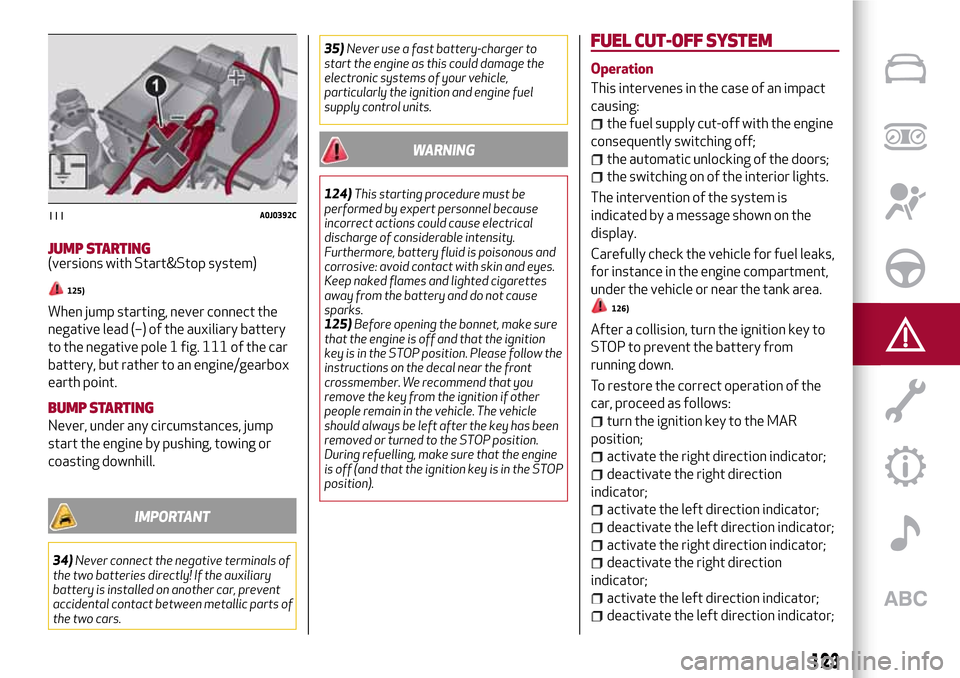
fig. 111:
connect the positive terminals (+ mark
near the terminal) of the two batteries
using a suitable lead;
with a second lead, connect the
negative terminal(–)oftheauxiliary
battery to an earth point
on the engine
or the gearbox of the car to be started;
start the engine; when the engine has
been started, remove the leads reversing
the order above.
If after a few attempts the engine does
not start, contact the Alfa Romeo
Dealership.
110A0K0521C
122
IN AN EMERGENCY
Page 125 of 212
JUMP STARTING(versions with Start&Stop system)
125)
When jump starting, never connect the
negative lead (–) of the auxiliary battery
to the negative pole 1 fig. 111 of the car
battery, but rather to an engine/gearbox
earth point.
BUMP STARTING
Never, under any circumstances, jump
start the engine by pushing, towing or
coasting downhill.
IMPORTANT
34)Never connect the negative terminals of
the two batteries directly! If the auxiliary
battery is installed on another car, prevent
accidental contact between metallic parts of
the two cars.35)Never use a fast battery-charger to
start the engine as this could damage the
electronic systems of your vehicle,
particularly the ignition and engine fuel
supply control units.
WARNING
124)This starting procedure must be
performed by expert personnel because
incorrect actions could cause electrical
discharge of considerable intensity.
Furthermore, battery fluid is poisonous and
corrosive: avoid contact with skin and eyes.
Keep naked flames and lighted cigarettes
away from the battery and do not cause
sparks.
125)Before opening the bonnet, make sure
that the engine is off and that the ignition
key is in the STOP position. Please follow the
instructions on the decal near the front
crossmember. We recommend that you
remove the key from the ignition if other
people remain in the vehicle. The vehicle
should always be left after the key has been
removed or turned to the STOP position.
During refuelling, make sure that the engine
is off (and that the ignition key is in the STOP
position).
FUEL CUT-OFFSYSTEM
Operation
This intervenes in the case of an impact
causing:
the fuel supply cut-off with the engine
consequently switching off;
the automatic unlocking of the doors;
the switching on of the interior lights.
The intervention of the system is
indicated by a message shown on the
display.
Carefully check the vehicle for fuel leaks,
for instance in the engine compartment,
under the vehicle or near the tank area.
126)
After a collision, turn the ignition key to
STOP to prevent the battery from
running down.
To restore the correct operation of the
car, proceed as follows:
turn the ignition key to the MAR
position;
activate the right direction indicator;
deactivate the right direction
indicator;
activate the left direction indicator;
deactivate the left direction indicator;
activate the right direction indicator;
deactivate the right direction
indicator;
activate the left direction indicator;
deactivate the left direction indicator;
111A0J0392C
123
Page 127 of 212
IMPORTANT
36)It is advisable to contact an Alfa Romeo
Dealership to have the refitting procedure
carried out. If you would like to proceed
autonomously, special attention must be
paid to the correct coupling of the retaining
clips. Otherwise, noise might be heard due to
an incorrect fastening of the lower cover
with the upper cover.
TOWING THE VEHICLE
The tow hook provided with the car is
located in the tool box in the luggage
compartment.
ATTACHING THE TOW RING
127) 128) 129)
Towing from the front
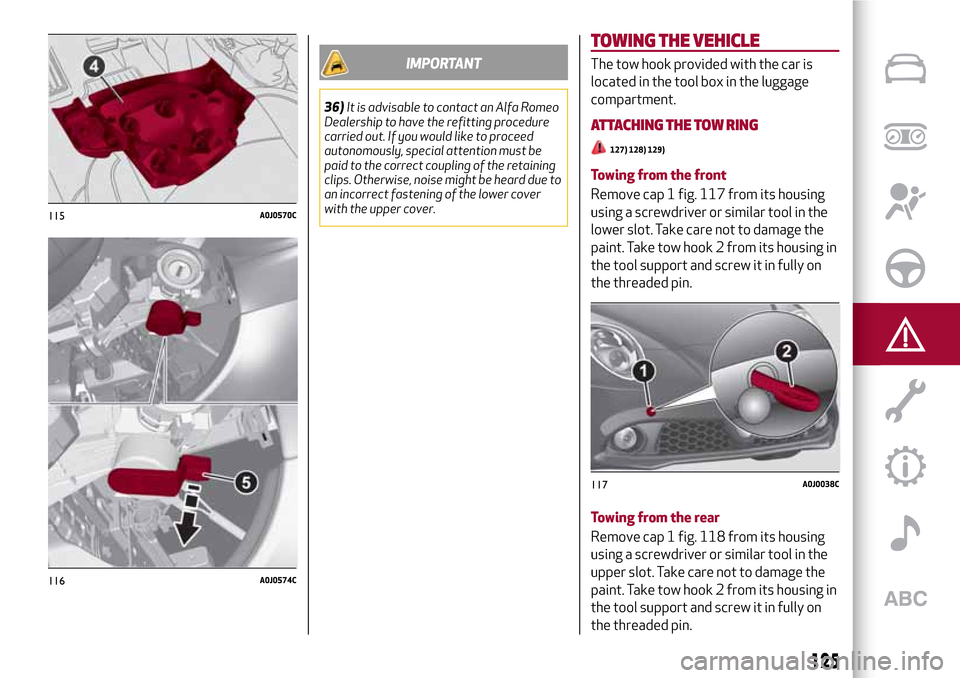
Remove cap 1 fig. 117 from its housing
using a screwdriver or similar tool in the
lower slot. Take care not to damage the
paint. Take tow hook 2 from its housing in
the tool support and screw it in fully on
the threaded pin.
Towing from the rear
Remove cap 1 fig. 118 from its housing
using a screwdriver or similar tool in the
upper slot. Take care not to damage the
paint. Take tow hook 2 from its housing in
the tool support and screw it in fully on
the threaded pin.
115A0J0570C
116A0J0574C
117A0J0038C
125
Page 128 of 212
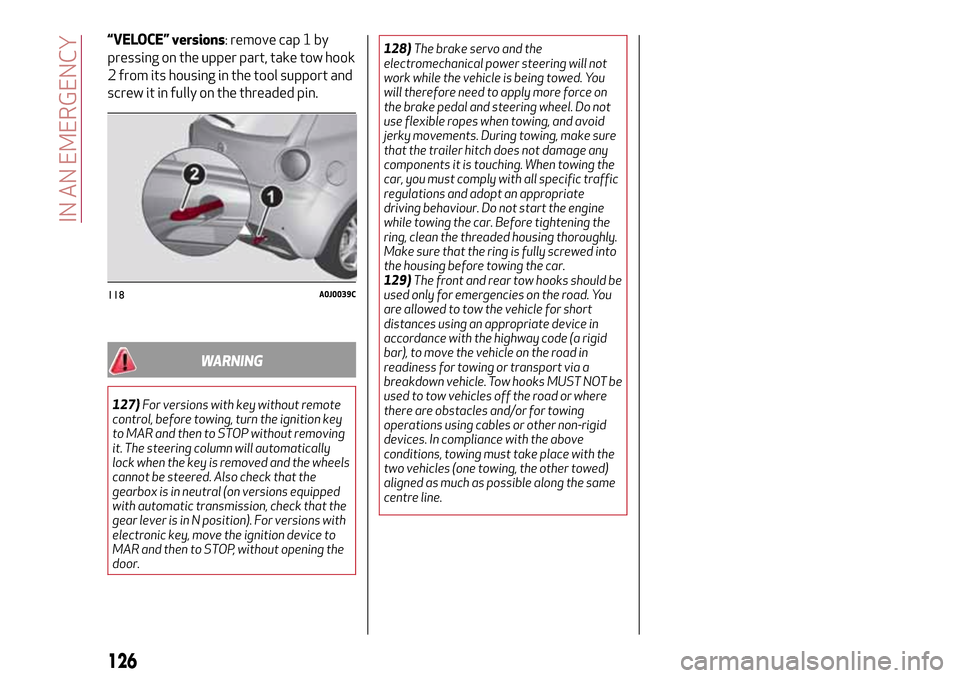
“VELOCE” versions: remove cap 1 by
pressing on the upper part, take tow hook
2 from its housing in the tool support and
screw it in fully on the threaded pin.
WARNING
127)For versions with key without remote
control, before towing, turn the ignition key
to MAR and then to STOP without removing
it. The steering column will automatically
lock when the key is removed and the wheels
cannot be steered. Also check that the
gearbox is in neutral (on versions equipped
with automatic transmission, check that the
gear lever is in N position). For versions with
electronic key, move the ignition device to
MAR and then to STOP, without opening the
door.128)The brake servo and the
electromechanical power steering will not
work while the vehicle is being towed. You
will therefore need to apply more force on
the brake pedal and steering wheel. Do not
use flexible ropes when towing, and avoid
jerky movements. During towing, make sure
that the trailer hitch does not damage any
components it is touching. When towing the
car, you must comply with all specific traffic
regulations and adopt an appropriate
driving behaviour. Do not start the engine
while towing the car. Before tightening the
ring, clean the threaded housing thoroughly.
Make sure that the ring is fully screwed into
the housing before towing the car.
129)The front and rear tow hooks should be
used only for emergencies on the road. You
are allowed to tow the vehicle for short
distances using an appropriate device in
accordance with the highway code (a rigid
bar), to move the vehicle on the road in
readiness for towing or transport via a
breakdown vehicle. Tow hooks MUST NOT be
used to tow vehicles off the road or where
there are obstacles and/or for towing
operations using cables or other non-rigid
devices. In compliance with the above
conditions, towing must take place with the
two vehicles (one towing, the other towed)
aligned as much as possible along the same
centre line.
118A0J0039C
126
IN AN EMERGENCY
Page 132 of 212
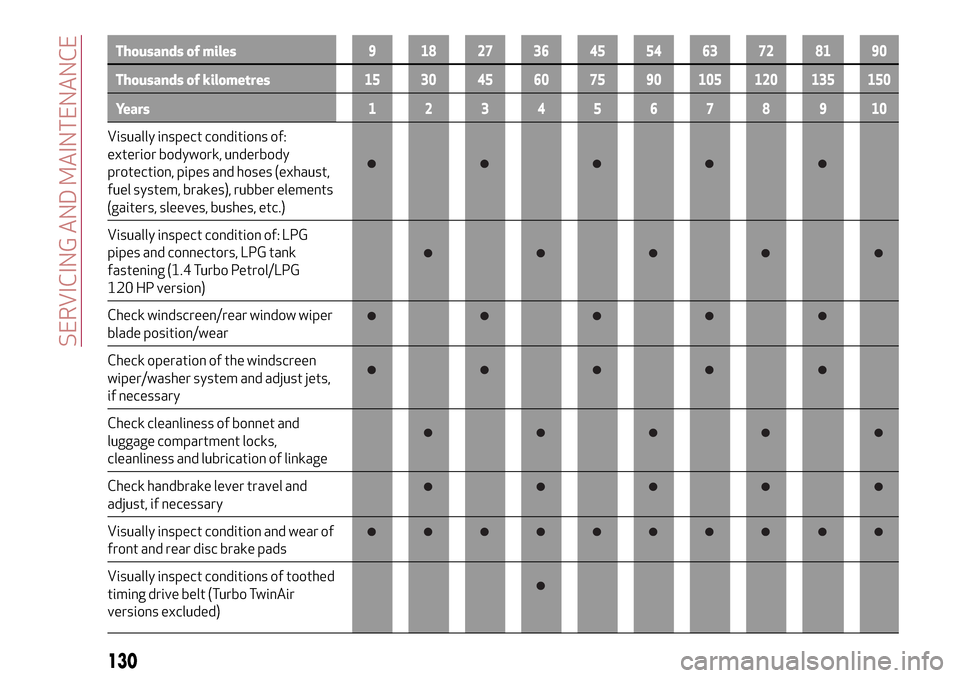
Thousands of miles9 182736455463728190
Thousands of kilometres15 30 45 60 75 90 105 120 135 150
Years12345678910
Visually inspect conditions of:
exterior bodywork, underbody
protection, pipes and hoses (exhaust,
fuel system, brakes), rubber elements
(gaiters, sleeves, bushes, etc.)
Visually inspect condition of: LPG
pipes and connectors, LPG tank
fastening (1.4 Turbo Petrol/LPG
120 HP version)
Check windscreen/rear window wiper
blade position/wear
Check operation of the windscreen
wiper/washer system and adjust jets,
if necessary
Check cleanliness of bonnet and
luggage compartment locks,
cleanliness and lubrication of linkage
Check handbrake lever travel and
adjust, if necessary
Visually inspect condition and wear of
front and rear disc brake pads
Visually inspect conditions of toothed
timing drive belt (Turbo TwinAir
versions excluded)
130
SERVICING AND MAINTENANCE
Page 133 of 212
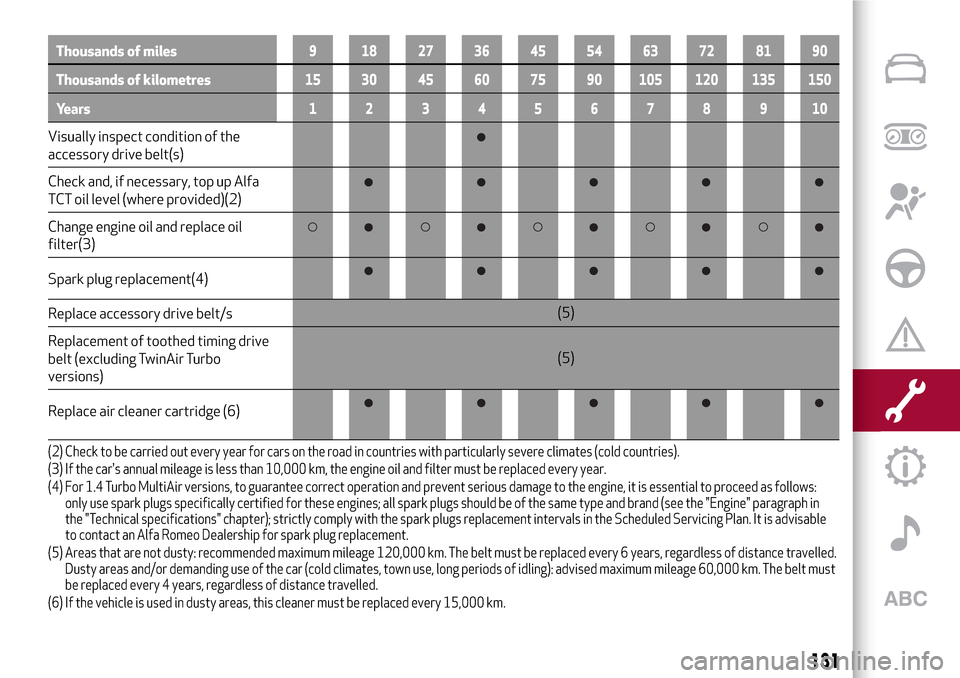
Thousands of miles9 182736455463728190
Thousands of kilometres15 30 45 60 75 90 105 120 135 150
Years12345678910
Visually inspect condition of the
accessory drive belt(s)
Check and, if necessary, top up Alfa
TCT oil level (where provided)(2)
Change engine oil and replace oil
filter(3)
Spark plug replacement(4)
Replace accessory drive belt/s(5)
Replacement of toothed timing drive
belt (excluding TwinAir Turbo
versions)(5)
Replace air cleaner cartridge (6)
(2) Check to be carried out every year for cars on the road in countries with particularly severe climates (cold countries).
(3) If the car's annual mileage is less than 10,000 km, the engine oil and filter must be replaced every year.
(4) For 1.4 Turbo MultiAir versions, to guarantee correct operation and prevent serious damage to the engine, it is essential to proceed as follows:
only use spark plugs specifically certified for these engines; all spark plugs should be of the same type and brand (see the "Engine" paragraph in
the "Technical specifications" chapter); strictly comply with the spark plugs replacement intervals in the Scheduled Servicing Plan. It is advisable
to contact an Alfa Romeo Dealership for spark plug replacement.
(5) Areas that are not dusty: recommended maximum mileage 120,000 km. The belt must be replaced every 6 years, regardless of distance travelled.
Dusty areas and/or demanding use of the car (cold climates, town use, long periods of idling): advised maximum mileage 60,000 km. The belt must
be replaced every 4 years, regardless of distance travelled.
(6) If the vehicle is used in dusty areas, this cleaner must be replaced every 15,000 km.
131
Page 136 of 212
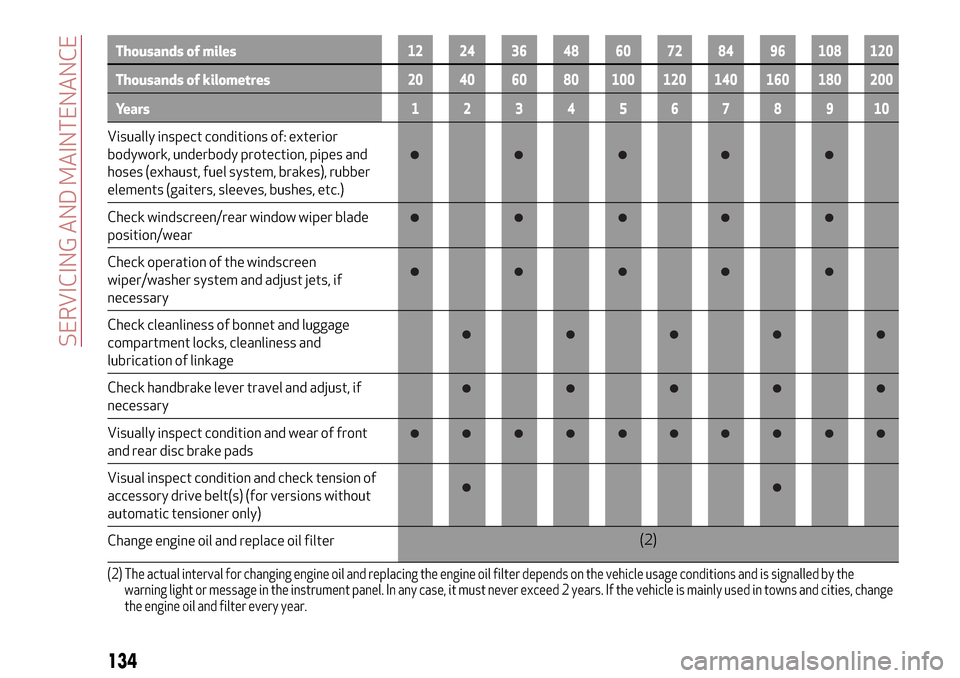
Thousands of miles12 24 36 48 60 72 84 96 108 120
Thousands of kilometres20 40 60 80 100 120 140 160 180 200
Years12345678910
Visually inspect conditions of: exterior
bodywork, underbody protection, pipes and
hoses (exhaust, fuel system, brakes), rubber
elements (gaiters, sleeves, bushes, etc.)
Check windscreen/rear window wiper blade
position/wear
Check operation of the windscreen
wiper/washer system and adjust jets, if
necessary
Check cleanliness of bonnet and luggage
compartment locks, cleanliness and
lubrication of linkage
Check handbrake lever travel and adjust, if
necessary
Visually inspect condition and wear of front
and rear disc brake pads
Visual inspect condition and check tension of
accessory drive belt(s) (for versions without
automatic tensioner only)
Change engine oil and replace oil filter(2)
(2) The actual interval for changing engine oil and replacing the engine oil filter depends on the vehicle usage conditions and is signalled by the
warning light or message in the instrument panel. In any case, it must never exceed 2 years. If the vehicle is mainly used in towns and cities, change
the engine oil and filter every year.
134
SERVICING AND MAINTENANCE
Page 137 of 212
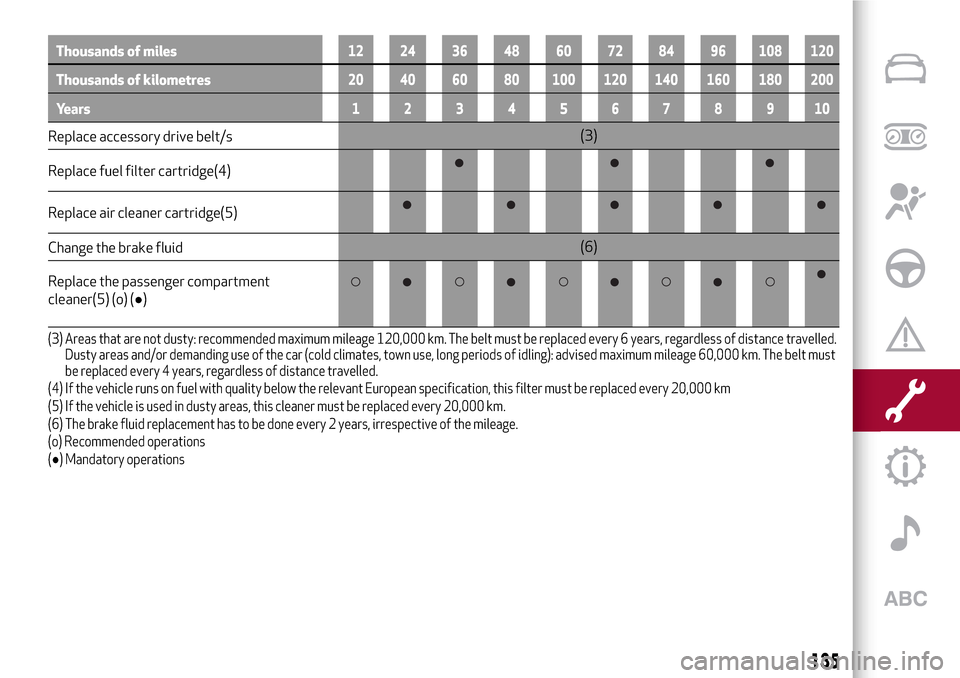
Thousands of miles12 24 36 48 60 72 84 96 108 120
Thousands of kilometres20 40 60 80 100 120 140 160 180 200
Years12345678910
Replace accessory drive belt/s(3)
Replace fuel filter cartridge(4)
Replace air cleaner cartridge(5)
Change the brake fluid(6)
Replace the passenger compartment
cleaner(5) (o) (●)
(3) Areas that are not dusty: recommended maximum mileage 120,000 km. The belt must be replaced every 6 years, regardless of distance travelled.
Dusty areas and/or demanding use of the car (cold climates, town use, long periods of idling): advised maximum mileage 60,000 km. The belt must
be replaced every 4 years, regardless of distance travelled.
(4) If the vehicle runs on fuel with quality below the relevant European specification, this filter must be replaced every 20,000 km
(5) If the vehicle is used in dusty areas, this cleaner must be replaced every 20,000 km.
(6) The brake fluid replacement has to be done every 2 years, irrespective of the mileage.
(o) Recommended operations
(●) Mandatory operations
135
Page 138 of 212
PERIODIC CHECKS
Every 1,000 km or before long trips
check and, if necessary, top up:
engine coolant, brake fluid and
windscreen washer fluid level;
tyre inflation pressure and condition;
operation of lighting system
(headlights, direction indicators, hazard
warning lights, etc.);
operation of screen wash/wipe system
and positioning/wear of windscreen/
rearscreen wiper blades
Every 3,000 km check and top up if
required: engine oil level.
IMPORTANT To find out the correct oil
quantity, always check using the dipstick.
Carry out the check with the vehicle
parked on level ground.
DEMANDING USE OF THE CAR
If the vehicle is used mainly under one of
the following conditions:
towing a trailer or caravan;
dusty roads;
short, repeated journeys (less than
7-8 km) at sub-zero outside
temperatures;
engine often idling or driving long
distances at low speeds or long periods
of inactivity;
the following checks must be carried out
more often than indicated in the
Scheduled Servicing Plan:
check front disc brake pad condition
and wear;
check cleanliness of bonnet and
luggage compartment locks, cleanliness
and lubrication of linkage;
visually inspect condition of: engine,
gearbox, transmission, pipes and hoses
(exhaust - fuel system - brakes) and
rubber elements (boots - sleeves - bushes
- etc.);
check battery charge and battery fluid
level (electrolyte);
visually inspect conditions of the
accessory drive belts;
check and, if necessary, change engine
oil and replace oil filter;
check and, if necessary, replace pollen
filter;
check and, if necessary, replace air
cleaner.
136
SERVICING AND MAINTENANCE