Lin Alfa Romeo MiTo 2017 Workshop Manual
[x] Cancel search | Manufacturer: ALFA ROMEO, Model Year: 2017, Model line: MiTo, Model: Alfa Romeo MiTo 2017Pages: 212, PDF Size: 4.36 MB
Page 144 of 212
ENGINE OIL
132)
38) 39)
2)
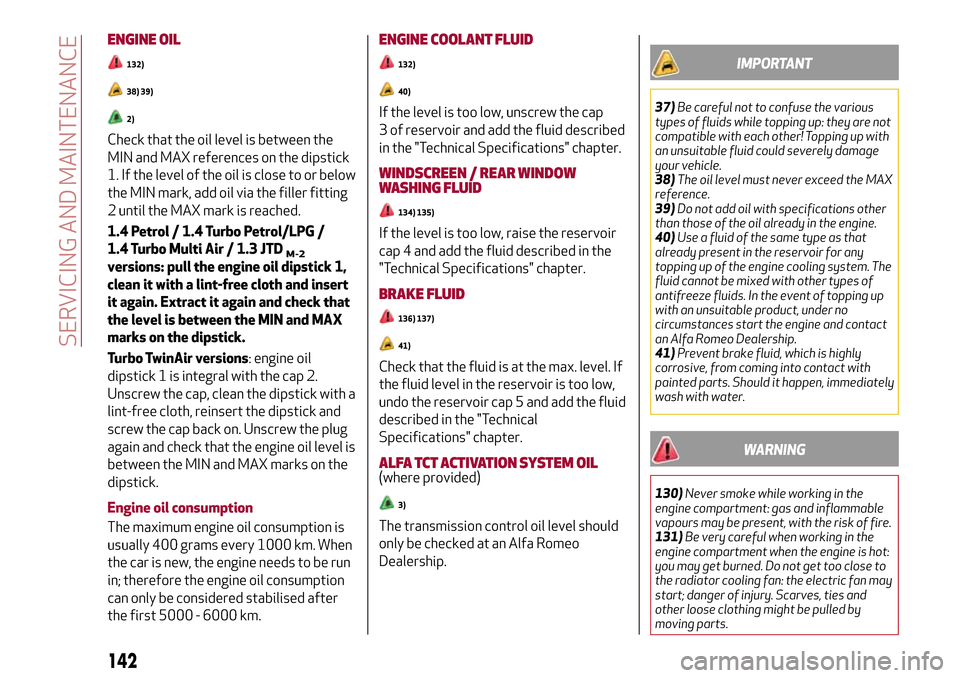
Check that the oil level is between the
MIN and MAX references on the dipstick
1. If the level of the oil is close to or below
the MIN mark, add oil via the filler fitting
2 until the MAX mark is reached.
1.4 Petrol / 1.4 Turbo Petrol/LPG /
1.4 Turbo Multi Air / 1.3 JTD
M-2versions: pull the engine oil dipstick 1,
clean it with a lint-free cloth and insert
it again. Extract it again and check that
the level is between the MIN and MAX
marks on the dipstick.
Turbo TwinAir versions: engine oil
dipstick 1 is integral with the cap 2.
Unscrew the cap, clean the dipstick with a
lint-free cloth, reinsert the dipstick and
screw the cap back on. Unscrew the plug
again and check that the engine oil level is
between the MIN and MAX marks on the
dipstick.
Engine oil consumption
The maximum engine oil consumption is
usually 400 grams every 1000 km. When
the car is new, the engine needs to be run
in; therefore the engine oil consumption
can only be considered stabilised after
the first 5000 - 6000 km.
ENGINE COOLANT FLUID
132)
40)
If the level is too low, unscrew the cap
3 of reservoir and add the fluid described
in the "Technical Specifications" chapter.
WINDSCREEN / REAR WINDOW
WASHING FLUID
134) 135)
If the level is too low, raise the reservoir
cap 4 and add the fluid described in the
"Technical Specifications" chapter.
BRAKE FLUID
136) 137)
41)
Check that the fluid is at the max. level. If
the fluid level in the reservoir is too low,
undo the reservoir cap 5 and add the fluid
described in the "Technical
Specifications" chapter.
ALFA TCT ACTIVATIONSYSTEM OIL(where provided)
3)
The transmission control oil level should
only be checked at an Alfa Romeo
Dealership.
IMPORTANT
37)Be careful not to confuse the various
types of fluids while topping up: they are not
compatible with each other! Topping up with
an unsuitable fluid could severely damage
your vehicle.
38)The oil level must never exceed the MAX
reference.
39)Do not add oil with specifications other
than those of the oil already in the engine.
40)Use a fluid of the same type as that
already present in the reservoir for any
topping up of the engine cooling system. The
fluid cannot be mixed with other types of
antifreeze fluids. In the event of topping up
with an unsuitable product, under no
circumstances start the engine and contact
an Alfa Romeo Dealership.
41)Prevent brake fluid, which is highly
corrosive, from coming into contact with
painted parts. Should it happen, immediately
wash with water.
WARNING
130)Never smoke while working in the
engine compartment: gas and inflammable
vapours may be present, with the risk of fire.
131)Be very careful when working in the
engine compartment when the engine is hot:
you may get burned. Do not get too close to
the radiator cooling fan: the electric fan may
start; danger of injury. Scarves, ties and
other loose clothing might be pulled by
moving parts.
142
SERVICING AND MAINTENANCE
Page 145 of 212
132)If the engine oil is being topped up, wait
for the engine to cool down before loosening
the filler cap, particularly for vehicles with
aluminium cap (where provided). WARNING:
risk of burns!
133)The cooling system is pressurised. If
necessary, only replace the plug with
another original or the operation of the
system may be adversely affected. Do not
remove the reservoir plug when the engine is
hot: you risk scalding yourself.
134)Do not travel with the windscreen
washer fluid reservoir empty: the
windscreen washer is essential for
improving visibility. Repeated operation of
the system without fluid could damage or
cause rapid deterioration of some system
components.
135)Some commercial additives for
windscreen washer fluid are flammable. The
engine compartment contains hot
components which may start a fire.
136)Brake fluid is poisonous and highly
corrosive. In the event of accidental contact,
immediately wash the affected parts with
water and mild soap. Then rinse thoroughly.
Call a doctor immediately if swallowed.
137)The symbol
, on the brake fluid
container indicates if a brake fluid is
synthetic or mineral-based. Use of mineral
type fluids will damage the special rubber
seals of the braking system beyond repair.
IMPORTANT
2)Used engine oil and oil filters contain
substances which are harmful to the
environment. To change the oil and filters, we
advise you to contact an Alfa Romeo
Dealership.
3)Used transmission fluid contains
substances that are harmful to the
environment. You are advised to contact an
Alfa Romeo Dealership for oil changes.
BATTERY RECHARGING
IMPORTANT The battery recharging
procedure is given as information only. To
carry out this operation contact an Alfa
Romeo Dealership.
IMPORTANT After turning the ignition
key to STOP and having closed the
driver's side door, wait at least one
minute before disconnecting and then
reconnecting the electrical supply to the
battery.
Charging should be slow at a low ampere
rating for approximately 24 hours.
Charging for a longer time may damage
the battery.
IMPORTANT The cables of the electrical
system must be correctly reconnected to
the battery, i.e. the positive cable (+) to
the positive terminal and the negative
cable (–) to the negative terminal. The
battery terminals are marked with the
positive (+) and negative (–) symbols, and
are shown on the battery cover. The
battery terminals must also be
corrosion-free and firmly secured to the
terminals. If a "quick-type" battery
charger is used with the battery fitted on
the vehicle, before connecting it
disconnect both cables of the battery
itself. Do not use a "quick-type" battery
charger to provide the starting voltage.
The cables of the electrical system must
143
Page 151 of 212
INTERIOR
143) 144) 145)
Periodically check the cleanliness of the
interior, beneath the mats, which could
cause oxidation of the sheet metal.
SEATS AND FABRIC PARTS
Remove dust with a soft brush or a
vacuum cleaner. It is advisable to use a
moist brush on velvet upholstery. Rub the
seats with a sponge moistened with a
solution of water and neutral detergent.
CLEANING ALCANTARA SEATS
Alcantara trim can be treated and
cleaned easily in the same way as the
other trims. The same indications given
for cleaning fabrics are also therefore
applicable for this trim.
LEATHER SEATS
(where provided)
Remove the dry dirt with a chamois or
slightly damp cloth, without exerting too
much pressure. Remove any liquid or
grease stains using an absorbent dry
cloth, without rubbing. Then clean with a
soft cloth or buckskin cloth dampened
with water and mild soap. If the stain
persists, use specific products and
observe the instructions carefully.
IMPORTANT Never use alcohol. Make
sure that the cleaning products usedcontain no alcohol or alcohol derivatives,
even in small quantities.
PLASTIC AND COATED PARTS
46)
Clean interior plastic parts with a damp
cloth (if possible made from microfibre),
and a solution of water and neutral,
non-abrasive detergent. To clean oily or
persistent stains, use specific products
free from solvents and designed to
maintain the original appearance and
colour of the components.
Remove any dust using a microfibre
cloth, if necessary moistened with water.
The use of paper tissues is not
recommended as these may leave
residues.
GENUINE LEATHER PARTS
(where provided)
Use only water and mild soap to clean
these parts. Never use alcohol or
alcohol-based products. Before using a
specific product for cleaning interiors,
make sure that it does not contain
alcohol and/or alcohol based substances.
WARNING
143)Never use flammable products, such as
petrol ether or rectified petrol to clean the
inside of the car. The electrostatic charges
which are generated by rubbing during the
cleaning operation may cause a fire.
144)Do not keep aerosol cans in the car:
they might explode. Aerosol cans must not
be exposed to a temperature exceeding
50°C. When the vehicle is exposed to
sunlight, the internal temperature can
greatly exceed this value.
145)There must be no obstacles on the
floor underneath the pedals; make sure that
mats are always flat and do not interfere
with the pedals.
IMPORTANT
46)Never use alcohol, petrols and
derivatives to clean the dashboard and
instrument panel lens.
149
Page 153 of 212
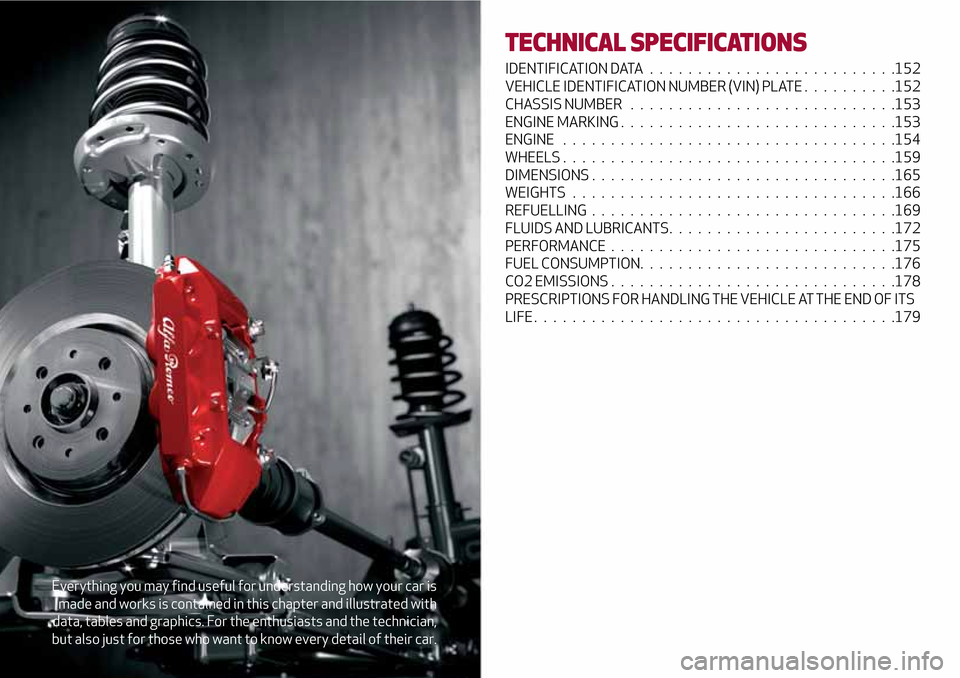
Everything you may find useful for understanding how your car is
made and works is contained in this chapter and illustrated with
data, tables and graphics. For the enthusiasts and the technician,
but also just for those who want to know every detail of their car.
TECHNICAL SPECIFICATIONS
IDENTIFICATION DATA..........................152
VEHICLE IDENTIFICATION NUMBER (VIN) PLATE . . . . ......152
CHASSIS NUMBER . . . . . .......................153
ENGINE MARKING . . . . . ........................153
ENGINE...................................154
WHEELS...................................159
DIMENSIONS . . ..............................165
WEIGHTS..................................166
REFUELLING................................169
FLUIDS AND LUBRICANTS. . . .....................172
PERFORMANCE . . . . . . . . . . . . . .................175
FUEL CONSUMPTION. . . . . ......................176
CO2 EMISSIONS . . . . ..........................178
PRESCRIPTIONS FOR HANDLING THE VEHICLE AT THE END OF ITS
LIFE......................................179
Page 155 of 212
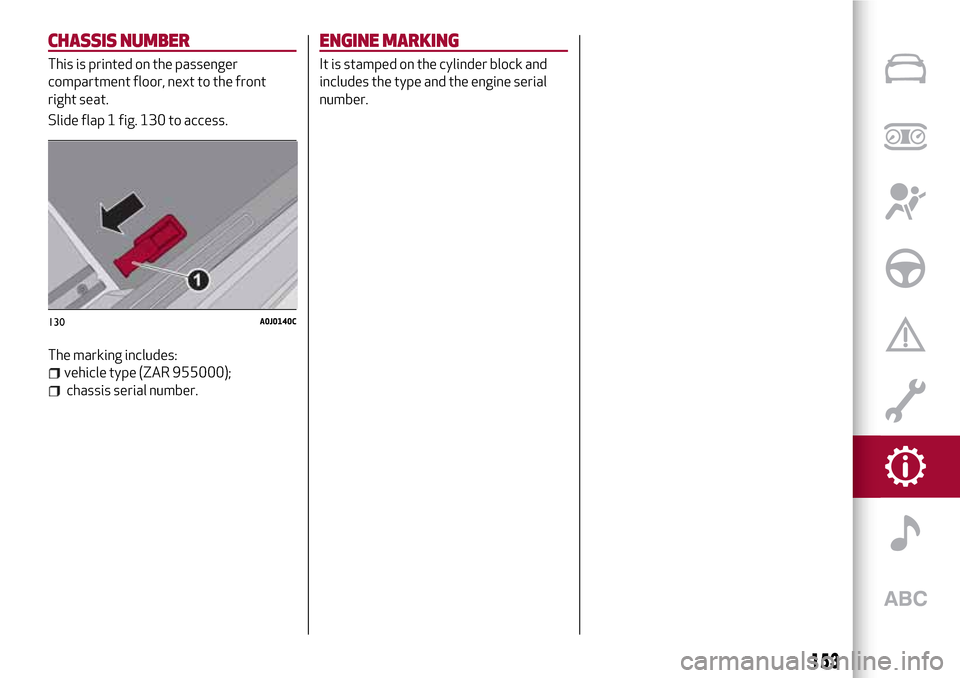
CHASSIS NUMBER
This is printed on the passenger
compartment floor, next to the front
right seat.
Slide flap 1 fig. 130 to access.
The marking includes:
vehicle type (ZAR 955000);
chassis serial number.
ENGINE MARKING
It is stamped on the cylinder block and
includes the type and the engine serial
number.
130A0J0140C
153
Page 156 of 212
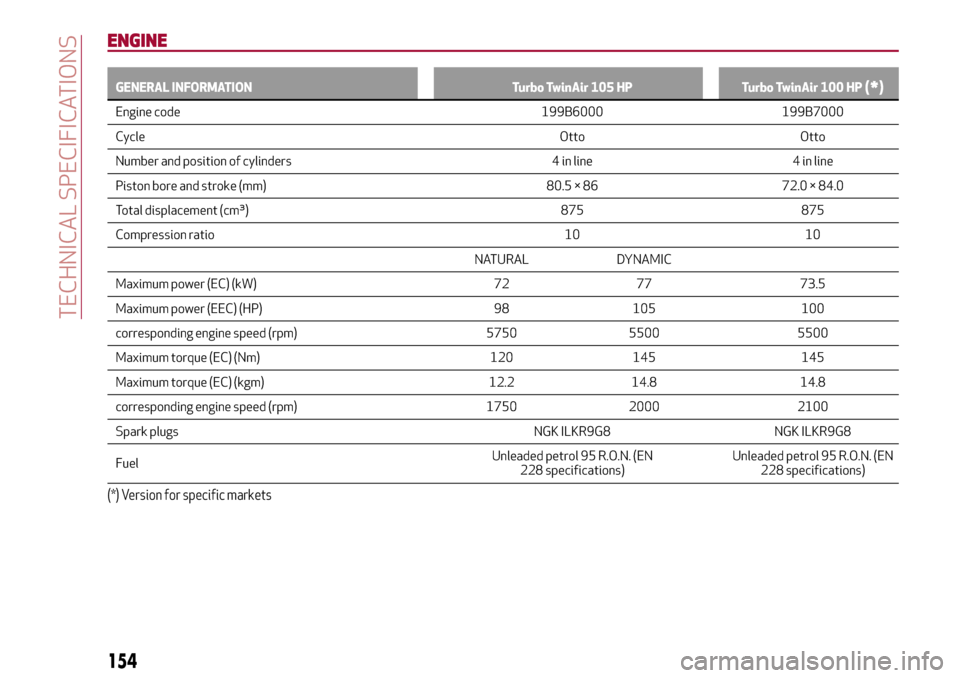
ENGINE
GENERAL INFORMATION Turbo TwinAir 105 HP Turbo TwinAir 100 HP(*)
Engine code 199B6000 199B7000
CycleOtto Otto
Number and position of cylinders 4 in line 4 in line
Piston bore and stroke (mm) 80.5 × 86 72.0 × 84.0
Total displacement (cm³) 875 875
Compression ratio 10 10
NATURAL DYNAMIC
Maximum power (EC) (kW) 72 77 73.5
Maximum power (EEC) (HP) 98 105 100
corresponding engine speed (rpm) 5750 5500 5500
Maximum torque (EC) (Nm) 120 145 145
Maximum torque (EC) (kgm) 12.2 14.8 14.8
corresponding engine speed (rpm) 1750 2000 2100
Spark plugs NGK ILKR9G8 NGK ILKR9G8
FuelUnleaded petrol 95 R.O.N. (EN
228 specifications)Unleaded petrol 95 R.O.N. (EN
228 specifications)
(*) Version for specific markets
154
TECHNICAL SPECIFICATIONS
Page 157 of 212
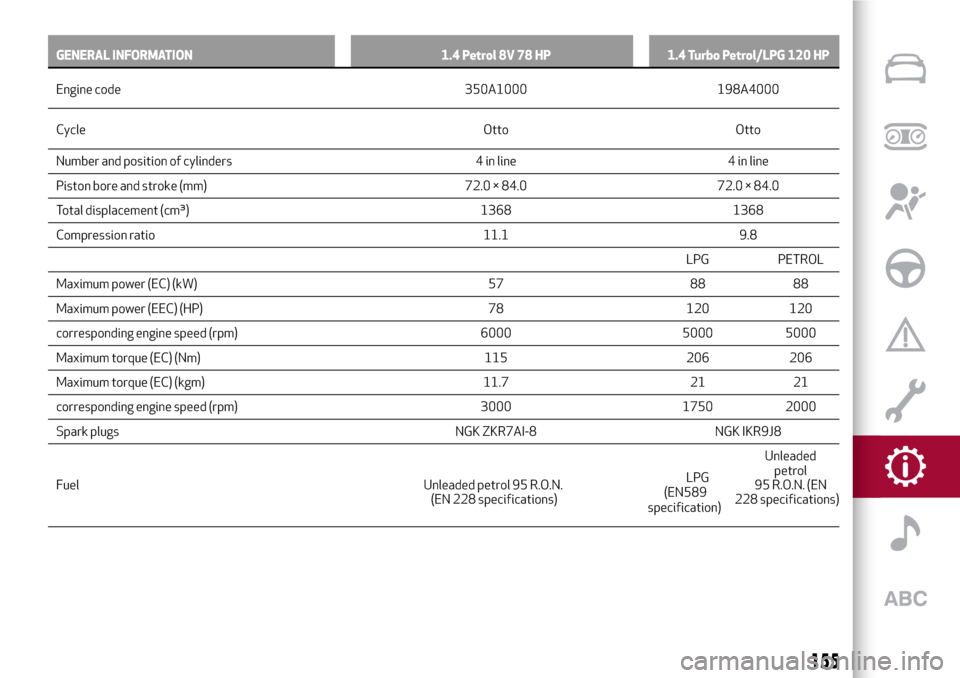
GENERAL INFORMATION 1.4 Petrol 8V 78 HP 1.4 Turbo Petrol/LPG 120 HP
Engine code 350A1000 198A4000
Cycle Otto Otto
Number and position of cylinders 4 in line 4 in line
Piston bore and stroke (mm) 72.0 × 84.0 72.0 × 84.0
Total displacement (cm³) 1368 1368
Compression ratio 11.1 9.8
LPG PETROL
Maximum power (EC) (kW) 57 88 88
Maximum power (EEC) (HP) 78 120 120
corresponding engine speed (rpm) 6000 5000 5000
Maximum torque (EC) (Nm) 115 206 206
Maximum torque (EC) (kgm) 11.7 21 21
corresponding engine speed (rpm) 3000 1750 2000
Spark plugs NGK ZKR7AI-8 NGK IKR9J8
Fuel Unleaded petrol 95 R.O.N.
(EN 228 specifications)LPG
(EN589Unleaded
petrol
95 R.O.N. (EN
228 specifications)
155
specification)
Page 158 of 212
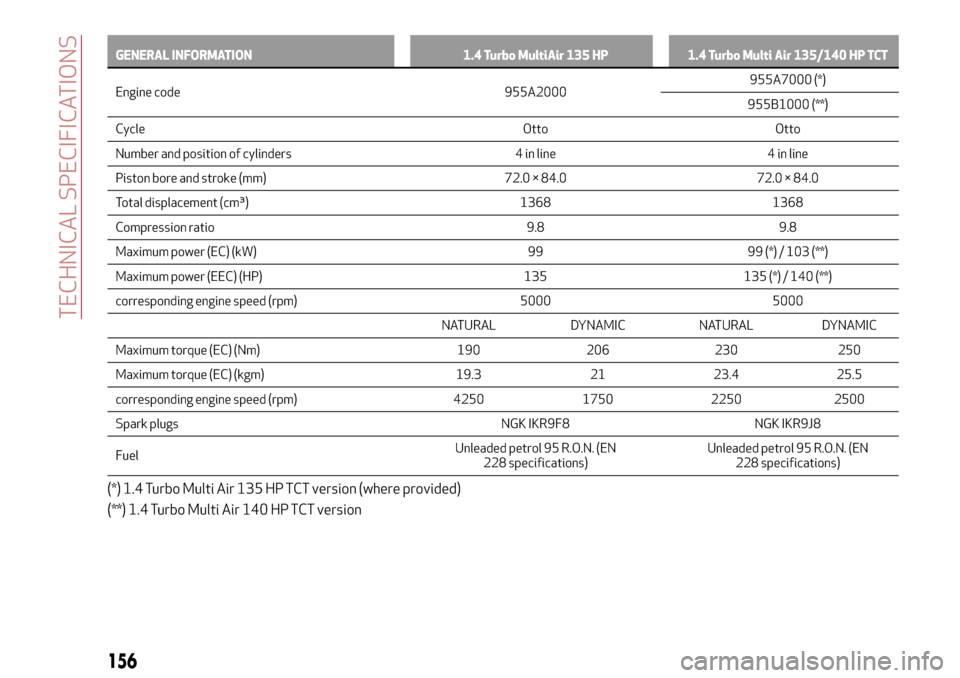
GENERAL INFORMATION 1.4 Turbo MultiAir 135 HP 1.4 Turbo Multi Air 135/140 HP TCT
Engine code 955A2000955A7000 (*)
955B1000 (**)
Cycle Otto Otto
Number and position of cylinders 4 in line 4 in line
Piston bore and stroke (mm) 72.0 × 84.0 72.0 × 84.0
Total displacement (cm³) 1368 1368
Compression ratio 9.8 9.8
Maximum power (EC) (kW) 99 99 (*) / 103 (**)
Maximum power (EEC) (HP) 135 135 (*) / 140 (**)
corresponding engine speed (rpm) 5000 5000
NATURAL DYNAMIC NATURAL DYNAMIC
Maximum torque (EC) (Nm) 190 206 230 250
Maximum torque (EC) (kgm) 19.3 21 23.4 25.5
corresponding engine speed (rpm) 4250 1750 2250 2500
Spark plugs NGK IKR9F8 NGK IKR9J8
FuelUnleaded petrol 95 R.O.N. (EN
228 specifications)Unleaded petrol 95 R.O.N. (EN
228 specifications)
(*) 1.4 Turbo Multi Air 135 HP TCT version (where provided)
(**) 1.4 Turbo Multi Air 140 HP TCT version
156
TECHNICAL SPECIFICATIONS
Page 159 of 212
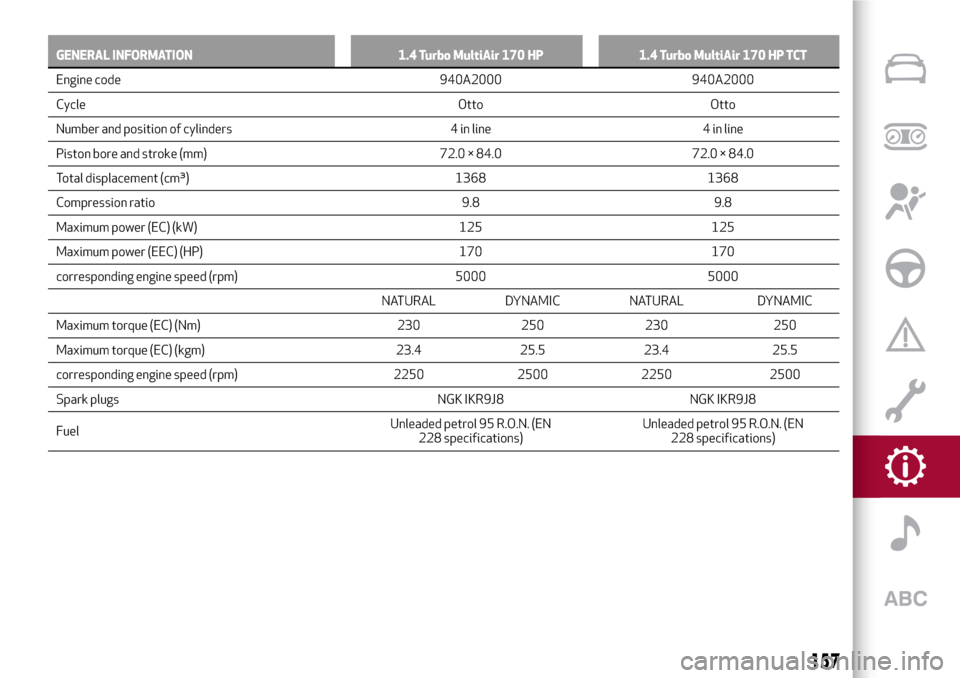
GENERAL INFORMATION 1.4 Turbo MultiAir 170 HP 1.4 Turbo MultiAir 170 HP TCT
Engine code 940A2000 940A2000
Cycle Otto Otto
Number and position of cylinders 4 in line 4 in line
Piston bore and stroke (mm) 72.0 × 84.0 72.0 × 84.0
Total displacement (cm³) 1368 1368
Compression ratio 9.8 9.8
Maximum power (EC) (kW) 125 125
Maximum power (EEC) (HP) 170 170
corresponding engine speed (rpm) 5000 5000
NATURAL DYNAMIC NATURAL DYNAMIC
Maximum torque (EC) (Nm) 230 250 230 250
Maximum torque (EC) (kgm) 23.4 25.5 23.4 25.5
corresponding engine speed (rpm) 2250 2500 2250 2500
Spark plugs NGK IKR9J8 NGK IKR9J8
FuelUnleaded petrol 95 R.O.N. (EN
228 specifications)Unleaded petrol 95 R.O.N. (EN
228 specifications)
157
Page 160 of 212
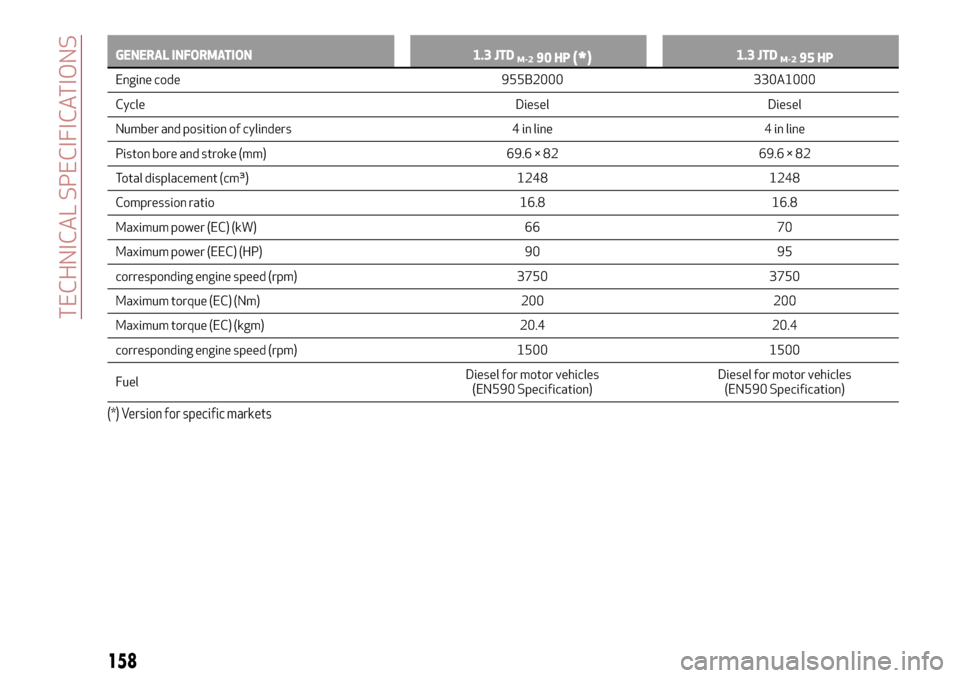
GENERAL INFORMATION 1.3 JTDM-290 HP(*)1.3 JTDM-295 HP
Engine code 955B2000 330A1000
Cycle Diesel Diesel
Number and position of cylinders 4 in line 4 in line
Piston bore and stroke (mm) 69.6 × 82 69.6 × 82
Total displacement (cm³) 1248 1248
Compression ratio 16.8 16.8
Maximum power (EC) (kW) 66 70
Maximum power (EEC) (HP) 90 95
corresponding engine speed (rpm) 3750 3750
Maximum torque (EC) (Nm) 200 200
Maximum torque (EC) (kgm) 20.4 20.4
corresponding engine speed (rpm) 1500 1500
FuelDiesel for motor vehicles
(EN590 Specification)Diesel for motor vehicles
(EN590 Specification)
(*) Version for specific markets
158
TECHNICAL SPECIFICATIONS