ECT Alfa Romeo Stelvio 2018 Owner's Manual
[x] Cancel search | Manufacturer: ALFA ROMEO, Model Year: 2018, Model line: Stelvio, Model: Alfa Romeo Stelvio 2018Pages: 276, PDF Size: 5.79 MB
Page 222 of 276
Ensure that the oil level is within the
interval on the dipstick between the
minimum and maximum limits
(Quadrifoglio only).
Changing The Engine Oil
See the "Maintenance Plan" for the
correct servicing intervals.
Choice Of Engine Oil Type
To ensure optimal performance and
maximum protection in all operating
conditions, it is advised to use certified
engine oils. Refer to "Fluid And
Lubricants" in "Technical Specifications"
for further information.
Additives For Engine Oil
It is strongly recommended not to use
additives (other than leak detection dyes)
with the engine oil.
The engine oil is a product designed
specially for the vehicle and its
performance may be deteriorated
through the use of further additives.
Disposal Of Used Engine Oil And Filters
For the disposal of the engine oil and
filters, contact the appropriate body to
determine local regulations.
Note:Used engine oil disposed of
incorrectly may seriously harm the
environment.Engine Oil Filter
Replacing the Engine Oil Filter
The engine oil filter must be replaced
each time the engine oil is changed. It is
advised to replace it with a genuine spare
part, specifically designed for this
vehicle.
Air Filter
Replacing the Air Cleaner
See the "Maintenance Plan" for the
correct servicing intervals. It is advised to
replace it with a genuine spare part,
specifically designed for this vehicle.
Air Conditioning System Maintenance
To ensure the best possible performance,
the air conditioning system must be
checked and undergo maintenance at an
authorized dealer at the beginning of the
summer.
Caution!
Do not use chemicals to clean the air
conditioning system, since the internal
components may be damaged. This kind of
damage is not covered by warranty.
Replace The Cabin Air Filter
See the "Maintenance Plan" for the
correct servicing intervals. For cleaner
replacement, contact an authorized
dealer.
Warning!
Use only refrigerants and compressor
lubricants approved by the manufacturer for
your air conditioning system. Some
unapproved refrigerants are flammable and
can explode, injuring you. Other unapproved
refrigerants or lubricants can cause the
system to fail, requiring costly repairs. Refer
to Warranty Information Book, located in
your owner’s information kit, for further
warranty information.
Lubricating Moving Parts Of The
Bodywork
Ensure that the locks and bodywork
junction points, including components
such as the seat guides, door hinges (and
rollers), liftgate and hood are periodically
lubricated with lithium-based grease to
ensure correct, silent operation and to
protect them from rust and wear.
Thoroughly clean the components,
eliminating every trace of dirt and dust.
After lubricating, eliminate excess oil and
grease. Also pay particular attention to
the hood closing devices, to ensure
correct operation. During operations on
the hood, to be carried out with the
engine cold, also remember to check,
clean and lubricate the locking, release
and safety devices.
220
SERVICING AND MAINTENANCE
Page 223 of 276
Lubricate the external lock barrels twice
a year. Apply a small amount of
high-quality lubricant directly into the
lock barrel.
If necessary, contact your authorized
dealer as soon as possible.
Windshield Wiper
Periodically clean the windshield and rear
window and rubber profile of the
windshield wiper blades, using a sponge
or a soft cloth and a non-abrasive
detergent. This eliminates the salt or
impurities accumulated when driving.
Prolonged operation of the windshield
window wipers with dry glass may cause
the deterioration of the blades, in
addition to abrasion of the surface of the
glass. To eliminate the impurities on the
dry glass, always operate the windshield
washers.
In the event of very low outdoor
temperatures, below zero degrees,
ensure that the movement of the rubber
part in contact with the glass is not
obstructed. Use a suitable deicing
product to release it if required.
Avoid using the windshield wipers to
remove frost or ice.
Also avoid contact of the rubber profile
of the blades with petroleum derivatives
such as engine oil, gas, etc.
Warning!
Driving with worn windshield wiper blades is
a serious hazard, because visibility is
reduced in bad weather conditions.
Note:The life of the windshield wiper
blades varies according to the usage
frequency. In any case, it is advised to
replace the blades approximately once a
year. When the blades are worn, noise,
marks on the glass or streaks of water
may be noticed. In the presence of these
conditions, clean the windshield wiper
blades or, if necessary, replace them.
Raising The Windshield Wiper Blades
("Service Position" Function)
The "service position" function allows the
driver to replace the windshield wiper
blades more easily. It is also
recommended to activate this function
when it is snowing and to make it easier
to remove any dirt deposits in the area
where the blades are normally
positioned, when washing.
Note: If the windshield wipers are raised
while not in the “service position,” it is
possible to damage the hood.
Activation Of The Function
To activate this function, disable the
windshield wiper before cycling the
ignition to STOP. This function can only be activated within
two minutes of cycling the ignition to
STOP.
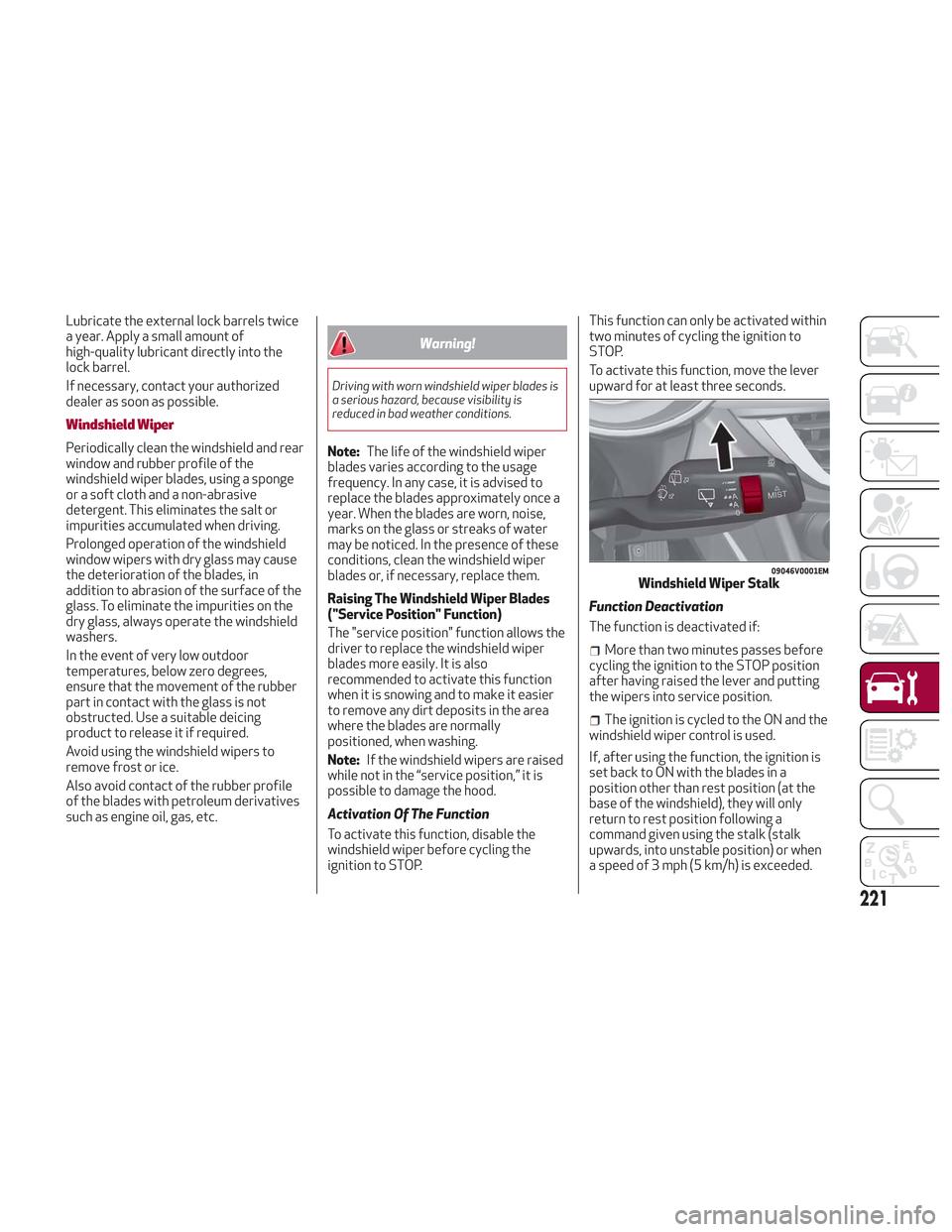
To activate this function, move the lever
upward for at least three seconds.
Function Deactivation
The function is deactivated if:
More than two minutes passes before
cycling the ignition to the STOP position
after having raised the lever and putting
the wipers into service position.
The ignition is cycled to the ON and the
windshield wiper control is used.
If, after using the function, the ignition is
set back to ON with the blades in a
position other than rest position (at the
base of the windshield), they will only
return to rest position following a
command given using the stalk (stalk
upwards, into unstable position) or when
a speed of 3 mph (5 km/h) is exceeded.
09046V0001EMWindshield Wiper Stalk
221
Page 224 of 276
Replacing The Windshield Wiper Blades
Proceed as follows:
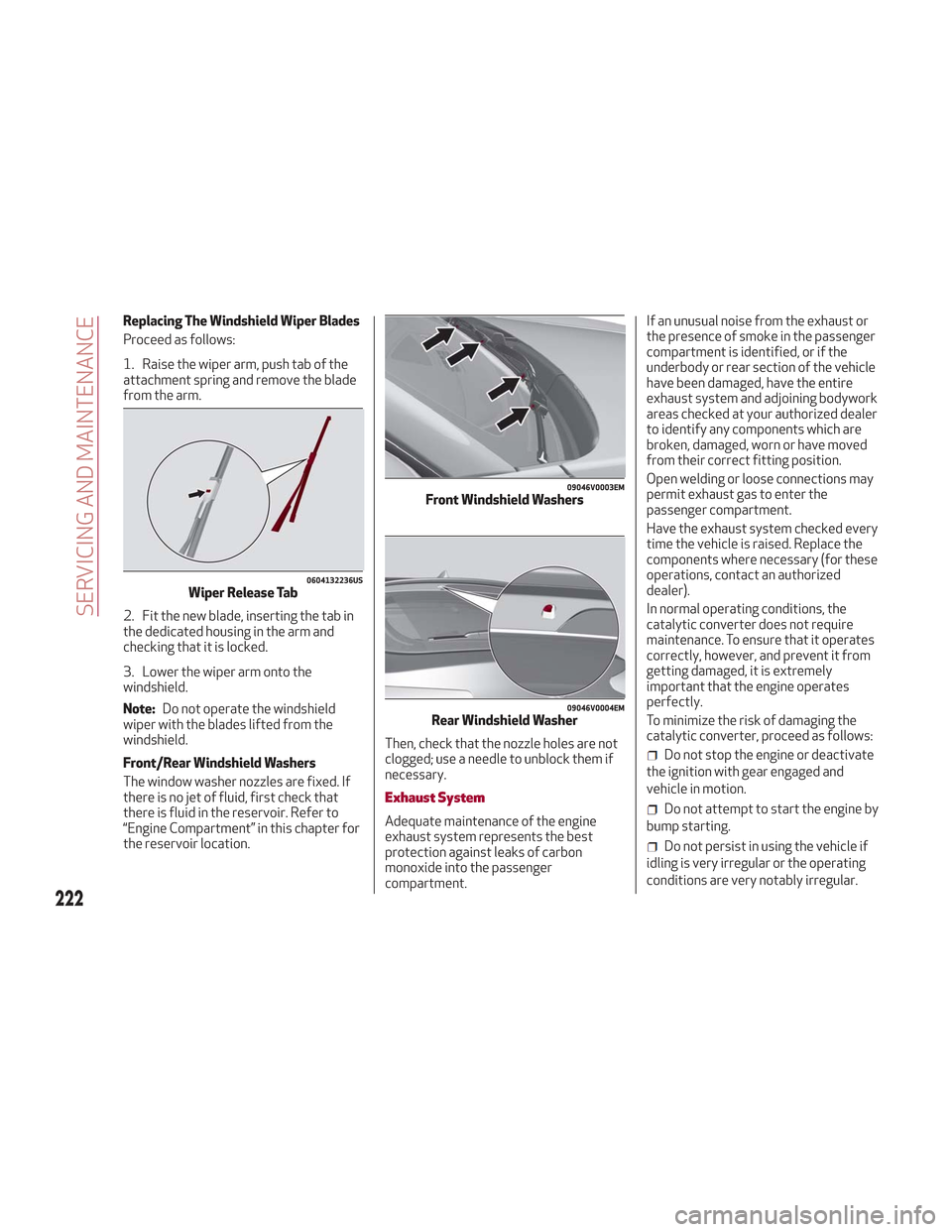
1. Raise the wiper arm, push tab of the
attachment spring and remove the blade
from the arm.
2. Fit the new blade, inserting the tab in
the dedicated housing in the arm and
checking that it is locked.
3. Lower the wiper arm onto the
windshield.
Note:Do not operate the windshield
wiper with the blades lifted from the
windshield.
Front/Rear Windshield Washers
The window washer nozzles are fixed. If
there is no jet of fluid, first check that
there is fluid in the reservoir. Refer to
“Engine Compartment” in this chapter for
the reservoir location. Then, check that the nozzle holes are not
clogged; use a needle to unblock them if
necessary.
Exhaust System
Adequate maintenance of the engine
exhaust system represents the best
protection against leaks of carbon
monoxide into the passenger
compartment.If an unusual noise from the exhaust or
the presence of smoke in the passenger
compartment is identified, or if the
underbody or rear section of the vehicle
have been damaged, have the entire
exhaust system and adjoining bodywork
areas checked at your authorized dealer
to identify any components which are
broken, damaged, worn or have moved
from their correct fitting position.
Open welding or loose connections may
permit exhaust gas to enter the
passenger compartment.
Have the exhaust system checked every
time the vehicle is raised. Replace the
components where necessary (for these
operations, contact an authorized
dealer).
In normal operating conditions, the
catalytic converter does not require
maintenance. To ensure that it operates
correctly, however, and prevent it from
getting damaged, it is extremely
important that the engine operates
perfectly.
To minimize the risk of damaging the
catalytic converter, proceed as follows:
Do not stop the engine or deactivate
the ignition with gear engaged and
vehicle in motion.
Do not attempt to start the engine by
bump starting.
Do not persist in using the vehicle if
idling is very irregular or the operating
conditions are very notably irregular.
0604132236USWiper Release Tab
09046V0003EMFront Windshield Washers
09046V0004EMRear Windshield Washer
222
SERVICING AND MAINTENANCE
Page 225 of 276
Warning!
Exhaust gases can injure or kill. They
contain carbon monoxide (CO), which is
colorless and odorless. Breathing it can
make you unconscious and can eventually
poison you.
A hot exhaust system can start a fire if
you park over materials that can burn. Such
materials might be grass or leaves coming
into contact with your exhaust system. Do
not park or operate your vehicle in areas
where your exhaust system can contact
anything that can burn.
Cooling System
Warning!
You or others can be badly burned by hot
engine coolant (antifreeze) or steam from
your radiator. If you see or hear steam
coming from under the hood, do not open the
hood until the radiator has had time to cool.
Never open a cooling system pressure cap
when the radiator or coolant bottle is hot.
Keep hands, tools, clothing, and jewelry
away from the radiator cooling fan when the
hood is raised. The fan starts automatically
and may start at any time, whether the
engine is running or not.
When working near the radiator cooling
fan, disconnect the fan motor lead or turn
the ignition to the OFF mode. The fan is
temperature controlled and can start at any
time the ignition is in the ON mode.
Coolant Check
Your vehicle has two cooling systems and
they both need to be checked to ensure
they are at proper fill levels. Refer to the
“Engine Compartment” section for the
locations.
Check the engine coolant and intercooler
coolant level every oil change or before
long trips.
If there are impurities in the engine
coolant, the system must be drained,
flushed and refilled: contact an
authorized dealer.
Check the front part of the condenser to
check for any build-up of insects, leaves
or other debris. Should it be dirty, clean it
by spraying delicately with water.
Check the hoses of the engine/
intercooler cooling system to ensure that
the rubber has not deteriorated and that
there are no cracks, tears, cuts or
obstructions in the expansion tank side
and radiator side connectors. Should
there be any doubt regarding leaks from
the system (e.g. if frequent top ups are
required), have the seal checked at an
authorized dealer. With the engine off and at normal
operating temperature, check that the
cooling system radiator cap is closed
properly.Warning!
Do not open hot engine cooling system.
Never add engine coolant (antifreeze) when
the engine is overheated. Do not loosen or
remove the cap to cool an overheated
engine. Heat causes pressure to build up in
the cooling system. To prevent scalding or
injury, do not remove the pressure cap while
the system is hot or under pressure.
Do not use a pressure cap other than the
one specified for your vehicle. Personal
injury or engine damage may result.
Note: Before removing the coolant
reservoir cap, wait for the system to cool
down.
Topping Up / Draining / Flushing The
Engine/Intercooler Coolant
If the engine coolant (antifreeze) is dirty,
have cleaning and flushing carried out at
an authorized dealer.
See the "Maintenance Plan" for the
correct servicing intervals.
223
Page 226 of 276
Note:
For topping up, refer to "Fluids And
Lubricants" in "Technical Specifications"
for proper coolant specifications.
Do not use pure water, alcohol-based
coolants, corrosions inhibitors or
additional anti-rust products because
they may be incompatible with the
engine coolant and cause the clogging
of the radiator. The use of propylene
glycol-based coolant is also not
recommended.
Engine Cooling/Intercooler System Cap
To prevent loss of engine coolant, make
sure that the expansion tank cap is
closed. If it is open, screw it completely
until you reach/hear the click.
Periodically check the cap and clean it
from any foreign bodies that may have
deposited on the external surface.
Warning!
Never add coolant with the engine hot or
overheated.
Do not attempt to cool an overheated
engine by loosening or removing the cap. The
heat causes a considerable increase in
pressure in the cooling system.
To prevent damage to the engine, only
use the engine cooling circuit caps provided.
Disposal of Used Coolant
Disposal of engine/intercooler coolant is
subject to legal requirements. Contact
the appropriate body to determine local
regulations.
Note:
To prevent the fluid from being
ingested by children or animals, do not
keep it in open containers or pour it on
the ground. If ingested, contact a doctor
immediately. Eliminate any traces of
fluid from the ground immediately.
When the vehicle stops after a short
trip, steam may be seen coming out
from front of the hood. This is a normal
phenomenon which is due to the
presence of rain, snow or a lot of
moisture on the surface of the radiator.
With engine and system cold, do not
top up with coolant beyond the
maximum level indicated on the
reservoir in the engine compartment.
Braking System
In order to guarantee the efficiency of
the braking system, periodically check its
components; for this operation, contact
an authorized dealer.
See the "Maintenance Plan" for the
correct servicing intervals.
Note: Driving with your foot resting on
the brake pedal may compromise its
efficiency, increasing the risk of accidents. When driving, never keep your
foot on the brake pedal and don’t put
unnecessary strain on it to prevent the
brakes from overheating. Excess pad
wear may cause damage to the braking
system.
When an insufficient oil level is
detected, contact an authorized dealer
to have the system checked.
Always keep the cap of the brake
fluid reservoir (in the engine
compartment) completely closed.
Warning!
Use only manufacturer's recommended
brake fluid. Refer to “Fluids And Lubricants”
in “Technical Specifications” for further
information. Using the wrong type of brake
fluid can severely damage your brake
system and/or impair its performance. The
proper type of brake fluid for your vehicle is
also identified on the original factory
installed hydraulic master cylinder
reservoir.
To avoid contamination from foreign matter
or moisture, use only new brake fluid or fluid
that has been in a tightly closed container.
Keep the master cylinder reservoir cap secured
at all times. Brake fluid in a open container
absorbs moisture from the air resulting in a
lower boiling point. This may cause it to boil
unexpectedly during hard or prolonged braking,
resulting in sudden brake failure. This could
result in a collision.
224
SERVICING AND MAINTENANCE
Page 228 of 276
TIRES
Tire Safety Information
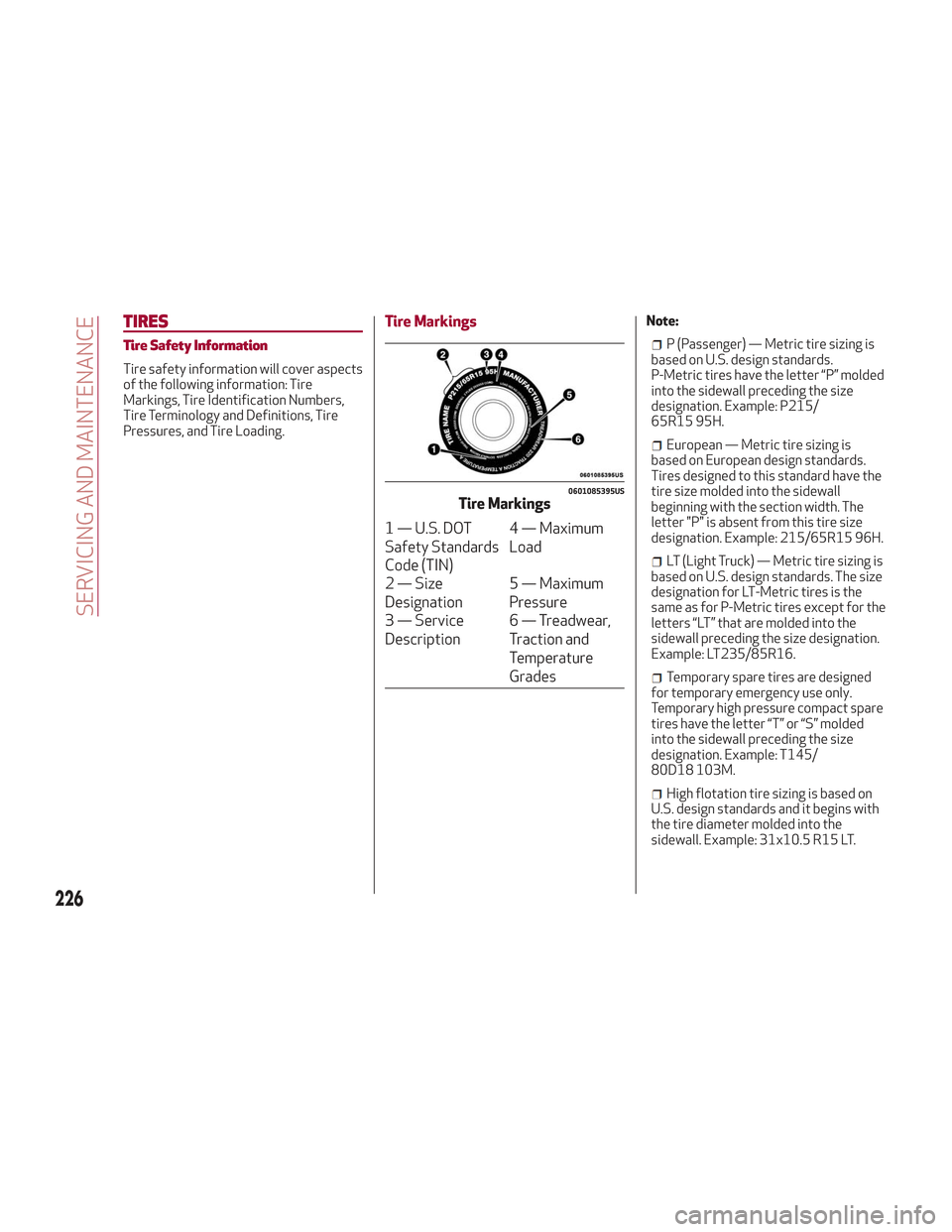
Tire safety information will cover aspects
of the following information: Tire
Markings, Tire Identification Numbers,
Tire Terminology and Definitions, Tire
Pressures, and Tire Loading.
Tire MarkingsNote:
P (Passenger) — Metric tire sizing is
based on U.S. design standards.
P-Metric tires have the letter “P” molded
into the sidewall preceding the size
designation. Example: P215/
65R15 95H.
European — Metric tire sizing is
based on European design standards.
Tires designed to this standard have the
tire size molded into the sidewall
beginning with the section width. The
letter "P" is absent from this tire size
designation. Example: 215/65R15 96H.
LT (Light Truck) — Metric tire sizing is
based on U.S. design standards. The size
designation for LT-Metric tires is the
same as for P-Metric tires except for the
letters “LT” that are molded into the
sidewall preceding the size designation.
Example: LT235/85R16.
Temporary spare tires are designed
for temporary emergency use only.
Temporary high pressure compact spare
tires have the letter “T” or “S” molded
into the sidewall preceding the size
designation. Example: T145/
80D18 103M.
High flotation tire sizing is based on
U.S. design standards and it begins with
the tire diameter molded into the
sidewall. Example: 31x10.5 R15 LT.
0601085395USTire Markings
1 — U.S. DOT
Safety Standards
Code (TIN) 4 — Maximum
Load
2 — Size
Designation 5 — Maximum
Pressure
3 — Service
Description 6 — Treadwear,
Traction and
Temperature
Grades
226
SERVICING AND MAINTENANCE
Page 229 of 276
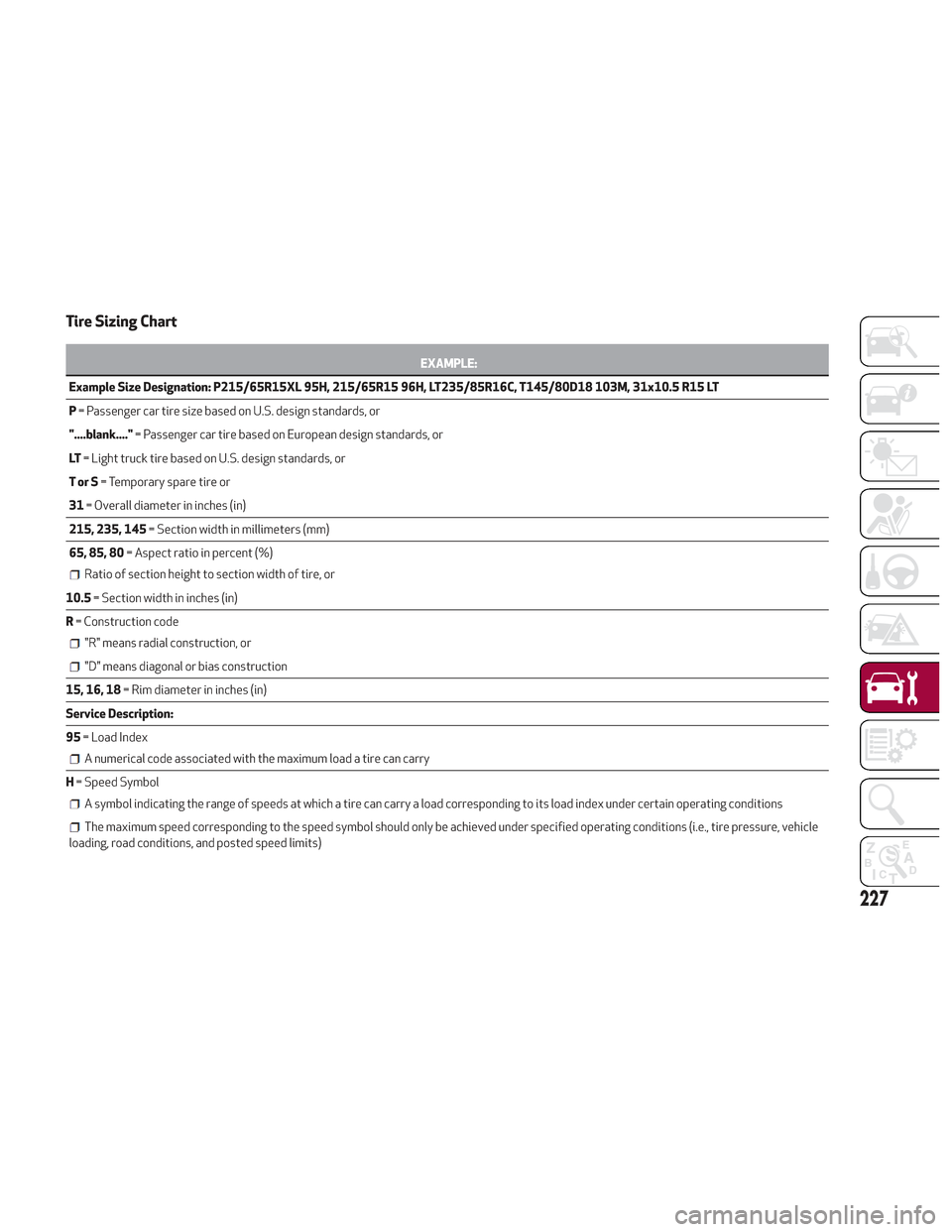
Tire Sizing Chart
EXAMPLE:
Example Size Designation: P215/65R15XL 95H, 215/65R15 96H, LT235/85R16C, T145/80D18 103M, 31x10.5 R15 LT
P =
Passenger car tire size based on U.S. design standards, or
"....blank...." = Passenger car tire based on European design standards, or
LT = Light truck tire based on U.S. design standards, or
TorS = Temporary spare tire or
31 = Overall diameter in inches (in)
215, 235, 145 = Section width in millimeters (mm)
65, 85, 80 = Aspect ratio in percent (%)
Ratio of section height to section width of tire, or
10.5= Section width in inches (in)
R = Construction code
"R" means radial construction, or
"D" means diagonal or bias construction
15, 16, 18 = Rim diameter in inches (in)
Service Description:
95 = Load Index
A numerical code associated with the maximum load a tire can carry
H= Speed Symbol
A symbol indicating the range of speeds at which a tire can carry a load corresponding to its load index under certain operating conditions
The maximum speed corresponding to the speed symbol should only be achieved under specified operating conditions (i.e., tire pressure, vehicle
loading, road conditions, and posted speed limits)
227
Page 232 of 276
Tire Loading And Tire Pressure
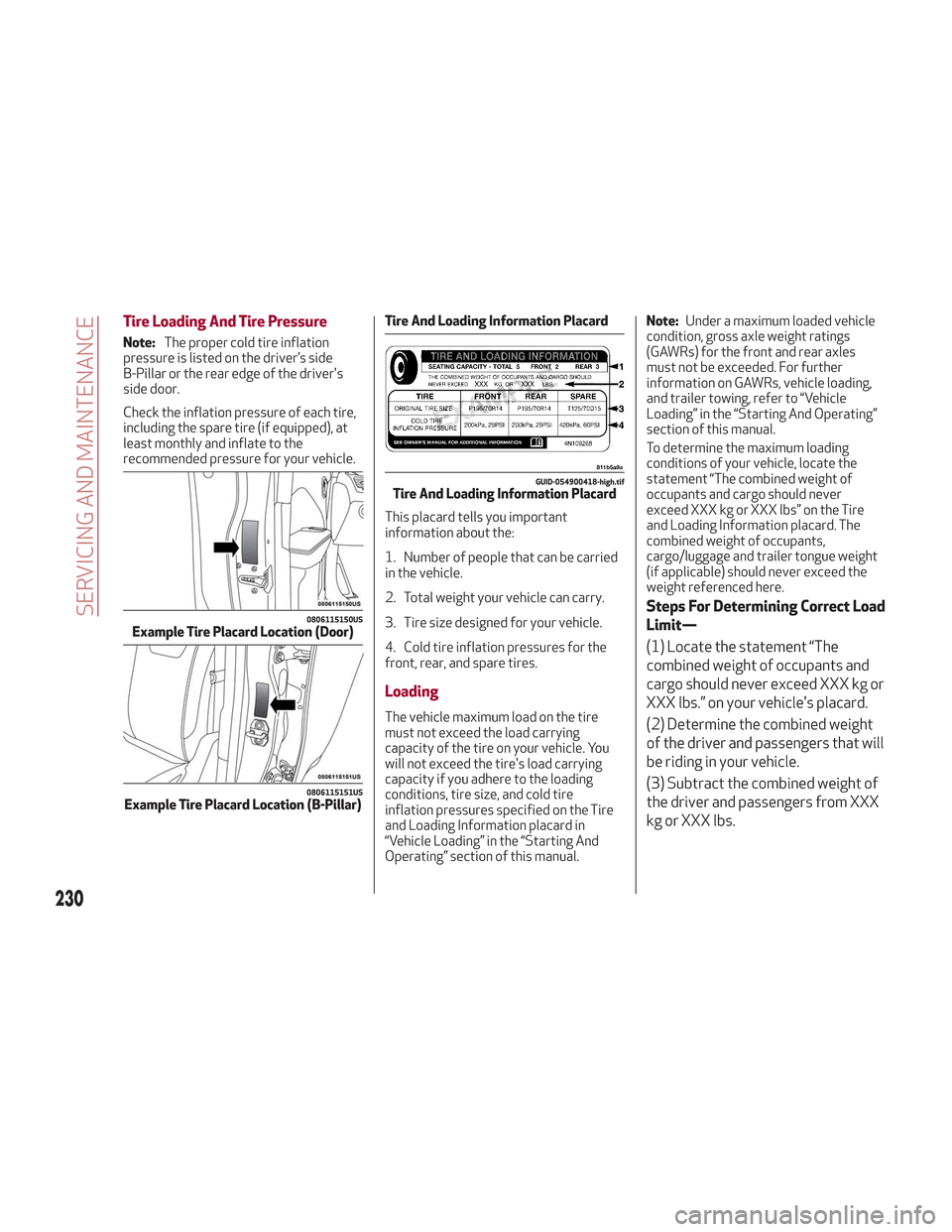
Note:The proper cold tire inflation
pressure is listed on the driver’s side
B-Pillar or the rear edge of the driver's
side door.
Check the inflation pressure of each tire,
including the spare tire (if equipped), at
least monthly and inflate to the
recommended pressure for your vehicle. Tire And Loading Information Placard
This placard tells you important
information about the:
1. Number of people that can be carried
in the vehicle.
2. Total weight your vehicle can carry.
3. Tire size designed for your vehicle.
4. Cold tire inflation pressures for the
front, rear, and spare tires.
Loading
The vehicle maximum load on the tire
must not exceed the load carrying
capacity of the tire on your vehicle. You
will not exceed the tire's load carrying
capacity if you adhere to the loading
conditions, tire size, and cold tire
inflation pressures specified on the Tire
and Loading Information placard in
“Vehicle Loading” in the “Starting And
Operating” section of this manual.Note:
Under a maximum loaded vehicle
condition, gross axle weight ratings
(GAWRs) for the front and rear axles
must not be exceeded. For further
information on GAWRs, vehicle loading,
and trailer towing, refer to “Vehicle
Loading” in the “Starting And Operating”
section of this manual.
To determine the maximum loading
conditions of your vehicle, locate the
statement “The combined weight of
occupants and cargo should never
exceed XXX kg or XXX lbs” on the Tire
and Loading Information placard. The
combined weight of occupants,
cargo/luggage and trailer tongue weight
(if applicable) should never exceed the
weight referenced here.
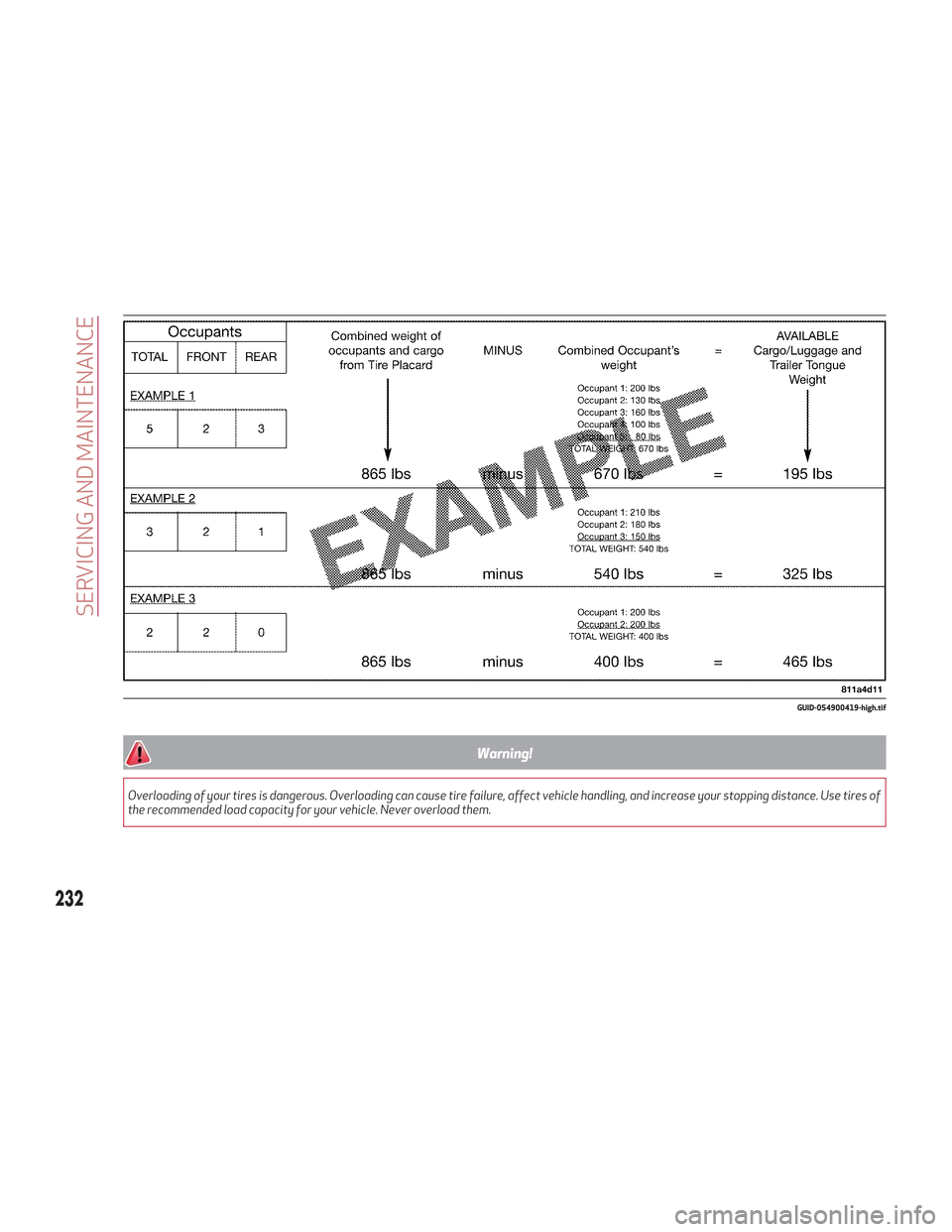
Steps For Determining Correct Load
Limit—
(1) Locate the statement “The
combined weight of occupants and
cargo should never exceed XXX kg or
XXX lbs.” on your vehicle's placard.
(2) Determine the combined weight
of the driver and passengers that will
be riding in your vehicle.
(3) Subtract the combined weight of
the driver and passengers from XXX
kg or XXX lbs.0806115150USExample Tire Placard Location (Door)
0806115151USExample Tire Placard Location (B-Pillar)
GUID-054900418-high.tifTire And Loading Information Placard
230
SERVICING AND MAINTENANCE
Page 234 of 276
Warning!
Overloading of your tires is dangerous. Overloading can cause tire failure, affect vehicle handling, and increase your stopping distance. Use tiresof
the recommended load capacity for your vehicle. Never overload them.
GUID-054900419-high.tif
232
SERVICING AND MAINTENANCE
Page 235 of 276
Tires — General Information
Tire Pressure
Proper tire inflation pressure is essential
to the safe and satisfactory operation of
your vehicle. Four primary areas are
affected by improper tire pressure:
Safety and Vehicle Stability
Economy
Tread Wear
Ride Comfort
Safety
Warning!
Improperly inflated tires are dangerous
and can cause collisions.
Underinflation increases tire flexing and
can result in overheating and tire failure.
Overinflation reduces a tire's ability to
cushion shock. Objects on the road and
chuckholes can cause damage that result in
tire failure.
Overinflated or underinflated tires can
affect vehicle handling and can fail
suddenly, resulting in loss of vehicle control.
Unequal tire pressures can cause steering
problems. You could lose control of your
vehicle.
Unequal tire pressures from one side of
the vehicle to the other can cause the
vehicle to drift to the right or left.
Always drive with each tire inflated to the
recommended cold tire inflation pressure.
Both under-inflation and over-inflation
affect the stability of the vehicle and can
produce a feeling of sluggish response or
over responsiveness in the steering.
Note:
Unequal tire pressures from side to
side may cause erratic and
unpredictable steering response.
Unequal tire pressure from side to
side may cause the vehicle to drift left or
right.
Fuel Economy
Underinflated tires will increase tire
rolling resistance resulting in higher fuel
consumption.
Tread Wear
Improper cold tire inflation pressures can
cause abnormal wear patterns and
reduced tread life, resulting in the need
for earlier tire replacement.
Ride Comfort And Vehicle Stability
Proper tire inflation contributes to a
comfortable ride. Over-inflation
produces a jarring and uncomfortable
ride.
Tire Inflation Pressures
The proper cold tire inflation pressure is
listed on the driver's side B-Pillar or rear
edge of the driver's side door.
At least once a month:
Check and adjust tire pressure with a
good quality pocket-type pressure gauge.
Do not make a visual judgement when
determining proper inflation. Tires may
look properly inflated even when they are
under-inflated.
Inspect tires for signs of tire wear or
visible damage.
Caution!
After inspecting or adjusting the tire
pressure, always reinstall the valve stem
cap. This will prevent moisture and dirt from
entering the valve stem, which could
damage the valve stem.
Inflation pressures specified on the
placard are always “cold tire inflation
pressure”. Cold tire inflation pressure is
defined as the tire pressure after the
vehicle has not been driven for at least
three hours, or driven less than 1 mile
(1.6 km) after sitting for a minimum of
three hours. The cold tire inflation
pressure must not exceed the maximum
inflation pressure molded into the tire
sidewall.
233