mirror ALFA ROMEO STELVIO 2022 User Guide
[x] Cancel search | Manufacturer: ALFA ROMEO, Model Year: 2022, Model line: STELVIO, Model: ALFA ROMEO STELVIO 2022Pages: 256, PDF Size: 10.17 MB
Page 124 of 256
STARTING AND OPERATING
122
(Continued)
After 15 seconds with the hands removed from
the steering wheel, the LKA system will be
deactivated and a dedicated message will be
shown on the instrument cluster display. A short
acoustic signal will sound in this case.
In any of the situations above where the hands
are removed from the steering wheel for more
than 6 seconds, it is necessary to reposition the
hands on the steering wheel.
Changing The System Sensitivity
The system's sensitivity can be set through the
radio system in the Driver Assistance menu.
Select “Lane Keep Assist - Settings” and then
“Keeping sensitivity”. Sensitivity “Early” or “Late”
can be selected.
Changing The System Strength
The system’s strength can be set through the
radio system in the Driver Assistance menu.
Select “Lane Keep Assist - Settings” and then
“Strength”. Strength “Low” or “High” can be
selected.
Limited Operation Warning
If a message appears on the display, a condition
limiting the LKA system operation may have
occurred. This could be an obstruction of the
camera view, or a fault in the system.
If an obstruction is detected, clean the area of the
windshield by the interior rearview mirror.
Although the vehicle can still be driven in normal
conditions, the system may not function properly.
When the conditions limiting the system are
corrected, it will go back to normal operation.
Should a fault persist, contact an authorized
dealer.
System Failure Signaling
If the system turns off and appears on the
display, it means that there is a system fault.
In this case, it is still possible to drive the vehicle,
but you are advised to contact an authorized
dealer as soon as possible.
REAR BACK UP CAMERA /
DYNAMIC GRIDLINES
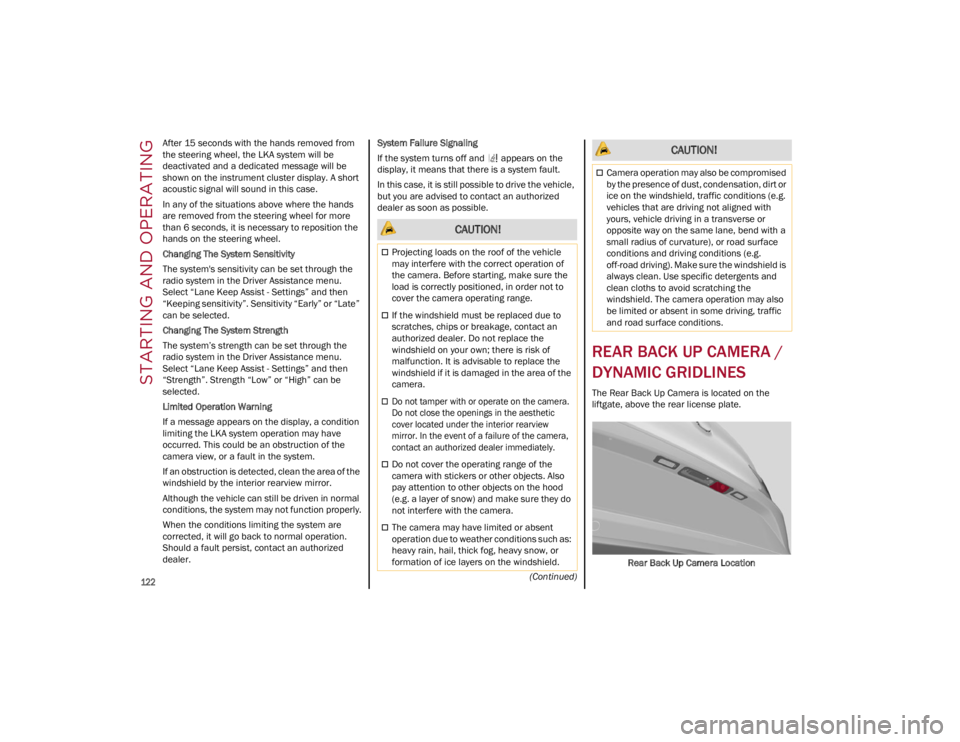
The Rear Back Up Camera is located on the
liftgate, above the rear license plate.
Rear Back Up Camera Location
CAUTION!
Projecting loads on the roof of the vehicle
may interfere with the correct operation of
the camera. Before starting, make sure the
load is correctly positioned, in order not to
cover the camera operating range.
If the windshield must be replaced due to
scratches, chips or breakage, contact an
authorized dealer. Do not replace the
windshield on your own; there is risk of
malfunction. It is advisable to replace the
windshield if it is damaged in the area of the
camera.
Do not tamper with or operate on the camera.
Do not close the openings in the aesthetic
cover located under the interior rearview
mirror. In the event of a failure of the camera,
contact an authorized dealer immediately.
Do not cover the operating range of the
camera with stickers or other objects. Also
pay attention to other objects on the hood
(e.g. a layer of snow) and make sure they do
not interfere with the camera.
The camera may have limited or absent
operation due to weather conditions such as:
heavy rain, hail, thick fog, heavy snow, or
formation of ice layers on the windshield.
Camera operation may also be compromised
by the presence of dust, condensation, dirt or
ice on the windshield, traffic conditions (e.g.
vehicles that are driving not aligned with
yours, vehicle driving in a transverse or
opposite way on the same lane, bend with a
small radius of curvature), or road surface
conditions and driving conditions (e.g.
off-road driving). Make sure the windshield is
always clean. Use specific detergents and
clean cloths to avoid scratching the
windshield. The camera operation may also
be limited or absent in some driving, traffic
and road surface conditions.
CAUTION!
22_GU_OM_EN_USC_t.book Page 122
Page 142 of 256
SAFETY
140
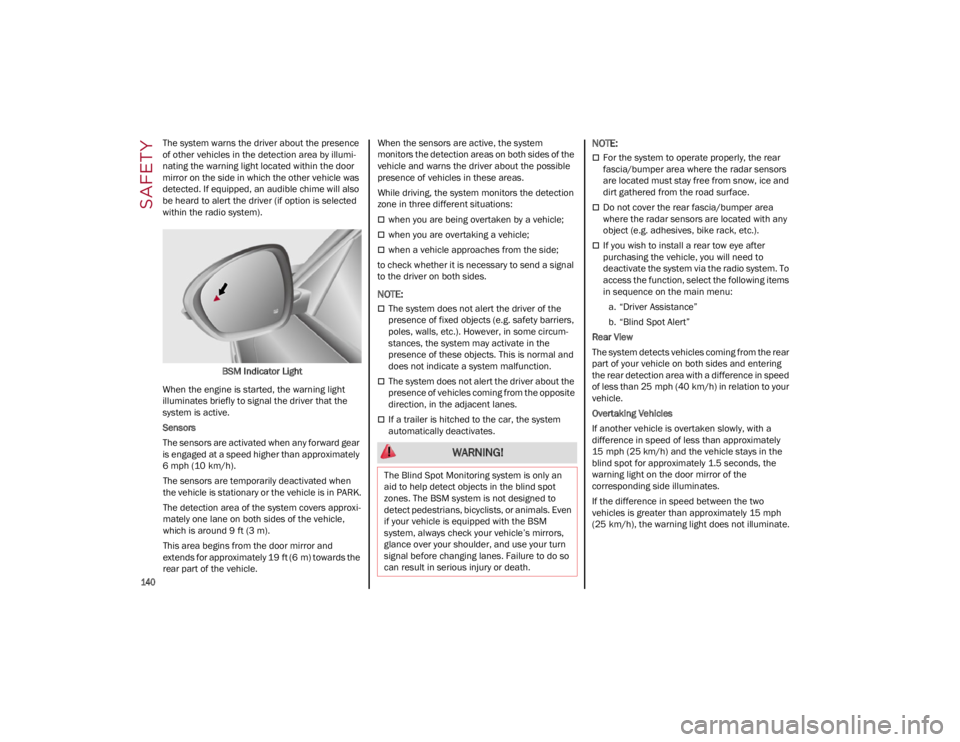
The system warns the driver about the presence
of other vehicles in the detection area by illumi-
nating the warning light located within the door
mirror on the side in which the other vehicle was
detected. If equipped, an audible chime will also
be heard to alert the driver (if option is selected
within the radio system).
BSM Indicator Light
When the engine is started, the warning light
illuminates briefly to signal the driver that the
system is active.
Sensors
The sensors are activated when any forward gear
is engaged at a speed higher than approximately
6 mph (10 km/h). The sensors are temporarily deactivated when
the vehicle is stationary or the vehicle is in PARK.
The detection area of the system covers approxi -
mately one lane on both sides of the vehicle,
which is around 9 ft (3 m).
This area begins from the door mirror and
extends for approximately 19 ft (6 m) towards the
rear part of the vehicle. When the sensors are active, the system
monitors the detection areas on both sides of the
vehicle and warns the driver about the possible
presence of vehicles in these areas.
While driving, the system monitors the detection
zone in three different situations:
when you are being overtaken by a vehicle;
when you are overtaking a vehicle;
when a vehicle approaches from the side;
to check whether it is necessary to send a signal
to the driver on both sides.
NOTE:
The system does not alert the driver of the
presence of fixed objects (e.g. safety barriers,
poles, walls, etc.). However, in some circum -
stances, the system may activate in the
presence of these objects. This is normal and
does not indicate a system malfunction.
The system does not alert the driver about the
presence of vehicles coming from the opposite
direction, in the adjacent lanes.
If a trailer is hitched to the car, the system
automatically deactivates.
NOTE:
For the system to operate properly, the rear
fascia/bumper area where the radar sensors
are located must stay free from snow, ice and
dirt gathered from the road surface.
Do not cover the rear fascia/bumper area
where the radar sensors are located with any
object (e.g. adhesives, bike rack, etc.).
If you wish to install a rear tow eye after
purchasing the vehicle, you will need to
deactivate the system via the radio system. To
access the function, select the following items
in sequence on the main menu:
a. “Driver Assistance”
b. “Blind Spot Alert”
Rear View
The system detects vehicles coming from the rear
part of your vehicle on both sides and entering
the rear detection area with a difference in speed
of less than 25 mph (40 km/h) in relation to your
vehicle.
Overtaking Vehicles
If another vehicle is overtaken slowly, with a
difference in speed of less than approximately
15 mph (25 km/h) and the vehicle stays in the
blind spot for approximately 1.5 seconds, the
warning light on the door mirror of the
corresponding side illuminates.
If the difference in speed between the two
vehicles is greater than approximately 15 mph
(25 km/h), the warning light does not illuminate.
WARNING!
The Blind Spot Monitoring system is only an
aid to help detect objects in the blind spot
zones. The BSM system is not designed to
detect pedestrians, bicyclists, or animals. Even
if your vehicle is equipped with the BSM
system, always check your vehicle’s mirrors,
glance over your shoulder, and use your turn
signal before changing lanes. Failure to do so
can result in serious injury or death.
22_GU_OM_EN_USC_t.book Page 140
Page 143 of 256
141
(Continued)
Rear Cross Path Detection (RCP) System
The Rear Cross Path Detection (RCP) system
assists the driver during reverse maneuvers in
the case of reduced visibility.
The RCP system monitors the rear detection areas
on both sides of the vehicle to detect objects
moving toward the sides of the vehicle, with a
minimum speed between approximately 1 mph
(1 km/h) and 2 mph (3 km/h) and objects moving
at a maximum speed of 21 mph (35 km/h), in
areas such as parking lots.
The system activation is signaled to the driver by
an audible warning.
NOTE:
If the sensors are covered by objects or
vehicles, the system may not work as intended.
For the system to operate correctly, the rear
fascia/bumper area where the radar sensors
are located must stay free from snow, ice and
dirt gathered from the road surface.
Do not cover the rear fascia/bumper area
where the radar sensors are located with any
object (e.g. adhesives, bike rack, etc.). Operating Mode
The system may be activated/deactivated via the
radio system. To access the function, select the
following items on the main menu in sequence:
1. “Driving Assistance”
2. “Blind Spot Alert”
“Blind Spot Alert”, “Visual” Mode
When the system is enabled, the warning light
within the door mirror on the side of the detected
object illuminates.
The visual warning on the mirror will blink if the
driver activates the turn signals, indicating a lane
change.
The warning light will be constant if the driver
stays in the same lane.
“Blind Spot Alert” Function Deactivation
When the system is deactivated (“Blind Spot
Alert” mode off), the BSM or RCP systems will not
emit an audible or a visual warning.
The BSM system will store the operating mode
that was active when the engine was stopped.
Each time the engine is started, the operating
mode stored previously will be recalled and used
Ú
page 247.
ACTIVE BLIND SPOT ASSIST (ABSA)
S
YSTEM — IF EQUIPPED
The ABSA system is to help avoid/limit lateral
collisions with cars coming from adjacent lanes
changing the vehicle’s trajectory in order to try to
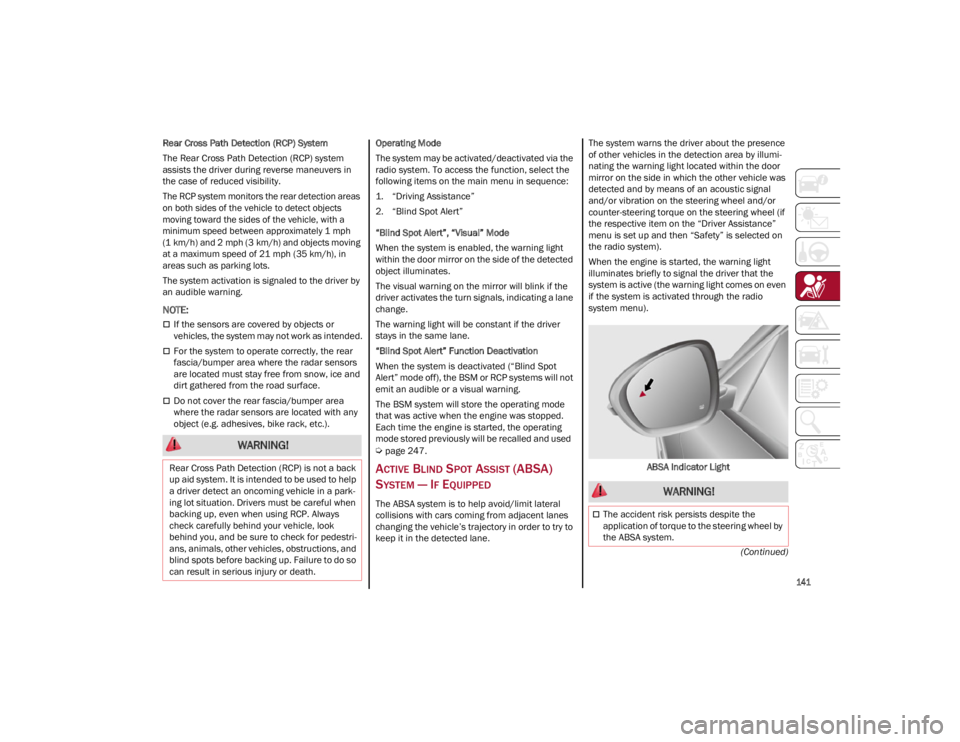
keep it in the detected lane. The system warns the driver about the presence
of other vehicles in the detection area by illumi
-
nating the warning light located within the door
mirror on the side in which the other vehicle was
detected and by means of an acoustic signal
and/or vibration on the steering wheel and/or
counter-steering torque on the steering wheel (if
the respective item on the “Driver Assistance”
menu is set up and then “Safety” is selected on
the radio system).
When the engine is started, the warning light
illuminates briefly to signal the driver that the
system is active (the warning light comes on even
if the system is activated through the radio
system menu).
ABSA Indicator Light
WARNING!
Rear Cross Path Detection (RCP) is not a back
up aid system. It is intended to be used to help
a driver detect an oncoming vehicle in a park -
ing lot situation. Drivers must be careful when
backing up, even when using RCP. Always
check carefully behind your vehicle, look
behind you, and be sure to check for pedestri -
ans, animals, other vehicles, obstructions, and
blind spots before backing up. Failure to do so
can result in serious injury or death.
WARNING!
The accident risk persists despite the
application of torque to the steering wheel by
the ABSA system.
22_GU_OM_EN_USC_t.book Page 141
Page 144 of 256
SAFETY
142
Sensors
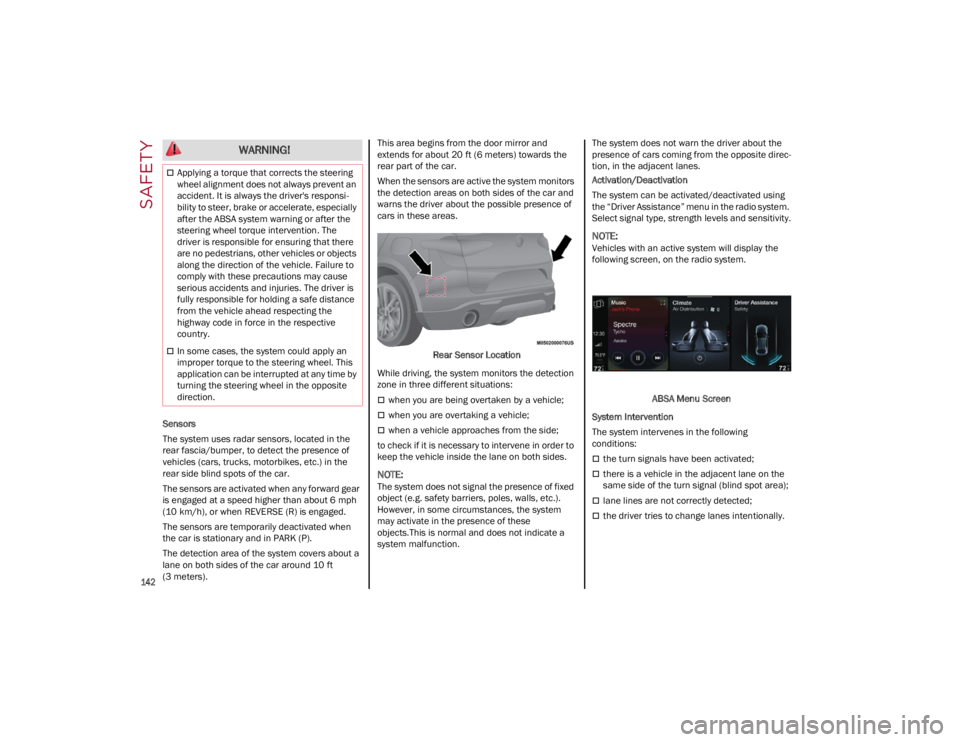
The system uses radar sensors, located in the
rear fascia/bumper, to detect the presence of
vehicles (cars, trucks, motorbikes, etc.) in the
rear side blind spots of the car.
The sensors are activated when any forward gear
is engaged at a speed higher than about 6 mph
(10 km/h), or when REVERSE (R) is engaged.
The sensors are temporarily deactivated when
the car is stationary and in PARK (P).
The detection area of the system covers about a
lane on both sides of the car around 10 ft
(3 meters).This area begins from the door mirror and
extends for about 20 ft (6 meters) towards the
rear part of the car.
When the sensors are active the system monitors
the detection areas on both sides of the car and
warns the driver about the possible presence of
cars in these areas.
Rear Sensor Location
While driving, the system monitors the detection
zone in three different situations:
when you are being overtaken by a vehicle;
when you are overtaking a vehicle;
when a vehicle approaches from the side;
to check if it is necessary to intervene in order to
keep the vehicle inside the lane on both sides.
NOTE:
The system does not signal the presence of fixed
object (e.g. safety barriers, poles, walls, etc.).
However, in some circumstances, the system
may activate in the presence of these
objects.This is normal and does not indicate a
system malfunction. The system does not warn the driver about the
presence of cars coming from the opposite direc
-
tion, in the adjacent lanes.
Activation/Deactivation
The system can be activated/deactivated using
the “Driver Assistance” menu in the radio system.
Select signal type, strength levels and sensitivity.
NOTE:
Vehicles with an active system will display the
following screen, on the radio system.
ABSA Menu Screen
System Intervention
The system intervenes in the following
conditions:
the turn signals have been activated;
there is a vehicle in the adjacent lane on the
same side of the turn signal (blind spot area);
lane lines are not correctly detected;
the driver tries to change lanes intentionally.
Applying a torque that corrects the steering
wheel alignment does not always prevent an
accident. It is always the driver's responsi -
bility to steer, brake or accelerate, especially
after the ABSA system warning or after the
steering wheel torque intervention. The
driver is responsible for ensuring that there
are no pedestrians, other vehicles or objects
along the direction of the vehicle. Failure to
comply with these precautions may cause
serious accidents and injuries. The driver is
fully responsible for holding a safe distance
from the vehicle ahead respecting the
highway code in force in the respective
country.
In some cases, the system could apply an
improper torque to the steering wheel. This
application can be interrupted at any time by
turning the steering wheel in the opposite
direction.
WARNING!
22_GU_OM_EN_USC_t.book Page 142
Page 178 of 256
176
IN CASE OF EMERGENCY
Have a flat tire or a burnt-out bulb?
At times, a problem such as these may interfere
with your driving experience.
The section on emergencies can help you to deal
with critical situations independently.
In an emergency, we recommend that you call the
phone number found in “Helpful Addresses And
Telephone Numbers” under “How To Deal With
Warranty Problems” in the Warranty Book.
You may also consider contacting an authorized
dealer.
HAZARD WARNING
FLASHERS
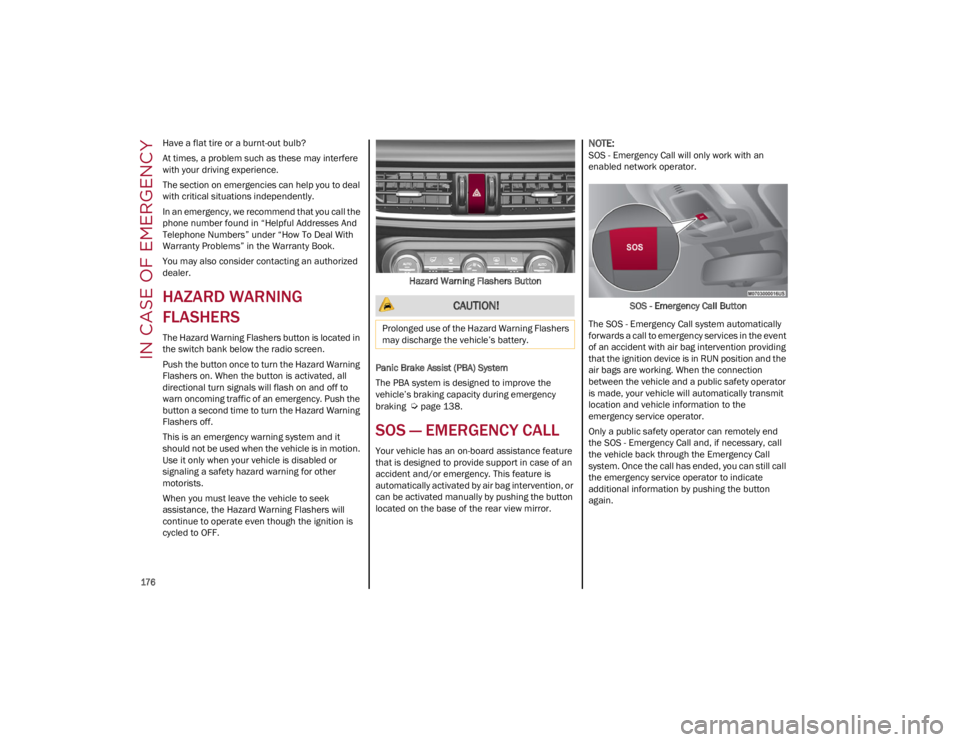
The Hazard Warning Flashers button is located in
the switch bank below the radio screen.
Push the button once to turn the Hazard Warning
Flashers on. When the button is activated, all
directional turn signals will flash on and off to
warn oncoming traffic of an emergency. Push the
button a second time to turn the Hazard Warning
Flashers off.
This is an emergency warning system and it
should not be used when the vehicle is in motion.
Use it only when your vehicle is disabled or
signaling a safety hazard warning for other
motorists.
When you must leave the vehicle to seek
assistance, the Hazard Warning Flashers will
continue to operate even though the ignition is
cycled to OFF.Hazard Warning Flashers Button
Panic Brake Assist (PBA) System
The PBA system is designed to improve the
vehicle’s braking capacity during emergency
braking
Ú
page 138.
SOS — EMERGENCY CALL
Your vehicle has an on-board assistance feature
that is designed to provide support in case of an
accident and/or emergency. This feature is
automatically activated by air bag intervention, or
can be activated manually by pushing the button
located on the base of the rear view mirror.
NOTE:
SOS - Emergency Call will only work with an
enabled network operator.
SOS - Emergency Call Button
The SOS - Emergency Call system automatically
forwards a call to emergency services in the event
of an accident with air bag intervention providing
that the ignition device is in RUN position and the
air bags are working. When the connection
between the vehicle and a public safety operator
is made, your vehicle will automatically transmit
location and vehicle information to the
emergency service operator.
Only a public safety operator can remotely end
the SOS - Emergency Call and, if necessary, call
the vehicle back through the Emergency Call
system. Once the call has ended, you can still call
the emergency service operator to indicate
additional information by pushing the button
again.
CAUTION!
Prolonged use of the Hazard Warning Flashers
may discharge the vehicle’s battery.
22_GU_OM_EN_USC_t.book Page 176
Page 211 of 256
209
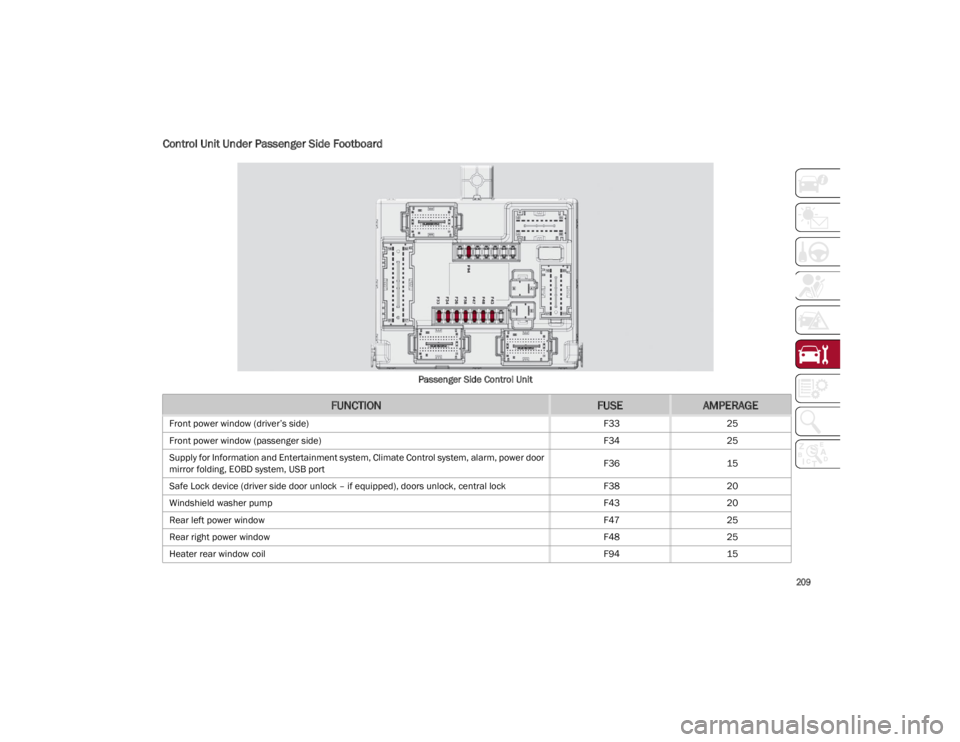
Control Unit Under Passenger Side Footboard
Passenger Side Control Unit
FUNCTIONFUSEAMPERAGE
Front power window (driver’s side)F3325
Front power window (passenger side) F3425
Supply for Information and Entertainment system, Climate Control system, alarm, power door
mirror folding, EOBD system, USB port F36
15
Safe Lock device (driver side door unlock – if equipped), doors unlock, central lock F3820
Windshield washer pump F4320
Rear left power window F4725
Rear right power window F4825
Heater rear window coil F9415
22_GU_OM_EN_USC_t.book Page 209
Page 216 of 256
SERVICING AND MAINTENANCE
214
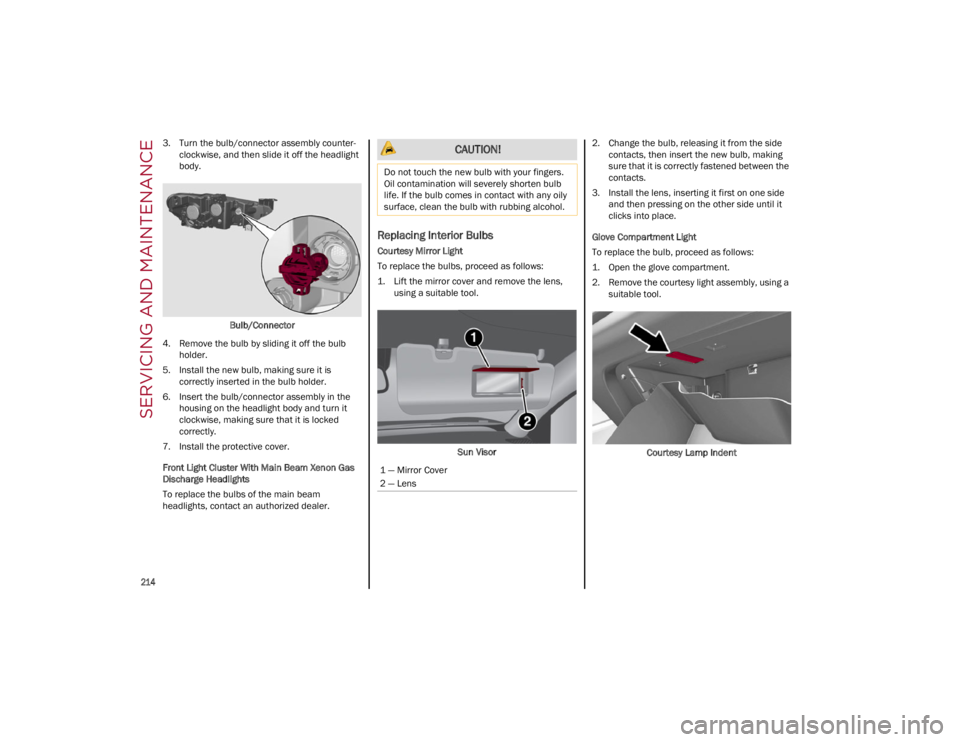
3. Turn the bulb/connector assembly counter-
clockwise, and then slide it off the headlight
body.
Bulb/Connector
4. Remove the bulb by sliding it off the bulb holder.
5. Install the new bulb, making sure it is correctly inserted in the bulb holder.
6. Insert the bulb/connector assembly in the housing on the headlight body and turn it
clockwise, making sure that it is locked
correctly.
7. Install the protective cover.
Front Light Cluster With Main Beam Xenon Gas
Discharge Headlights
To replace the bulbs of the main beam
headlights, contact an authorized dealer.
Replacing Interior Bulbs
Courtesy Mirror Light
To replace the bulbs, proceed as follows:
1. Lift the mirror cover and remove the lens, using a suitable tool.
Sun Visor 2. Change the bulb, releasing it from the side
contacts, then insert the new bulb, making
sure that it is correctly fastened between the
contacts.
3. Install the lens, inserting it first on one side and then pressing on the other side until it
clicks into place.
Glove Compartment Light
To replace the bulb, proceed as follows:
1. Open the glove compartment.
2. Remove the courtesy light assembly, using a suitable tool.
Courtesy Lamp Indent
CAUTION!
Do not touch the new bulb with your fingers.
Oil contamination will severely shorten bulb
life. If the bulb comes in contact with any oily
surface, clean the bulb with rubbing alcohol.
1 — Mirror Cover
2 — Lens
22_GU_OM_EN_USC_t.book Page 214
Page 238 of 256
TECHNICAL SPECIFICATIONS
236
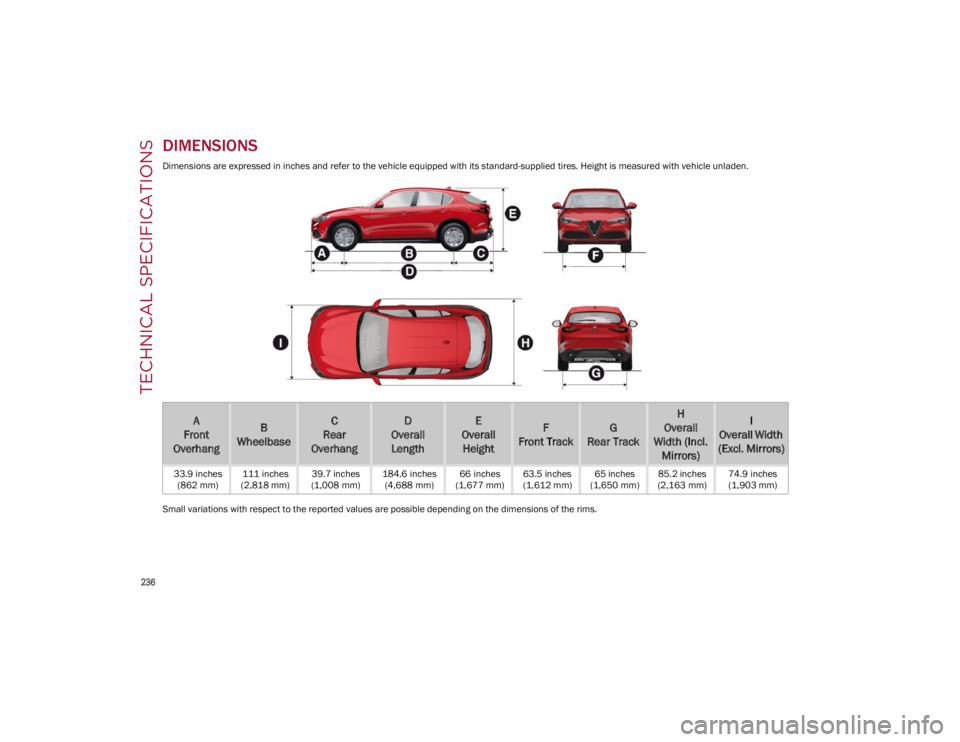
DIMENSIONS
Dimensions are expressed in inches and refer to the vehicle equipped with its standard-supplied tires. Height is measured with vehicle unladen.
Small variations with respect to the reported values are possible depending on the dimensions of the rims.
A
Front
OverhangB
WheelbaseC
Rear
OverhangD
Overall LengthE
Overall HeightF
Front TrackG
Rear Track
H
Overall
Width (Incl. Mirrors)I
Overall Width
(Excl. Mirrors)
33.9 inches (862 mm) 111 inches
(2,818 mm) 39.7 inches
(1,008 mm) 184.6 inches
(4,688 mm) 66 inches
(1,677 mm) 63.5 inches
(1,612 mm) 65 inches
(1,650 mm) 85.2 inches
(2,163 mm) 74.9 inches
(1,903 mm)
22_GU_OM_EN_USC_t.book Page 236
Page 250 of 256

248
INDEX
A
Accessories Purchased By The Owner.......... 4
Active Blind Spot Assist .............................141
Active Safety Systems ................................ 135
Active Speed Limiter .................................... 97
Active Torque Vectoring (ATV) System ......135
Adaptive Cruise Control (ACC) (Cruise
Control) ................................................ 98, 100Off ........................................................... 101
On............................................................101
Additives, Fuel ............................................ 240
Adjust Forward.............................................. 31, 33
Rearward ........................................... 31, 33
Air Bag......................................................... 157 Air Bag Operation ...................................158Air Bag Warning Light ............................156
Driver Knee Air Bag................................ 159Enhanced Accident Response .....161, 190
Event Data Recorder (EDR) ...................190
Front Air Bag...........................................157
If Deployment Occurs ............................161
Knee Impact Bolsters ............................159
Maintaining Your Air Bag System.......... 163
Maintenance ..........................................163
Redundant Air Bag Warning Light.........157
Side Air Bags ..........................................159
Transporting Pets...................................173
Air Bag Light ......................................156, 173
Air Pressure Tires ........................................................222
Alfa Active Suspension (AAS)....................... 94
Alfa DNA System .......................................... 92
Antifreeze (Engine Coolant) ....................... 241
Anti-Lock Braking (ABS) System ................ 135 Anti-Lock Warning Light ...............................72
Automatic Climate Controls .........................48
Automatic Dimming Mirror...........................37
Automatic Door Locks ..................................28
Automatic Headlights ...................................43
Automatic Temperature Control (ATC) ........48
Automatic Transmission ..............................86
Auxiliary Driving Systems .......................... 139
Auxiliary Power Outlet ..................................54
B
Battery ..................................................74, 199 Charging System Light .............................74
Keyless Key Fob Replacement ................20
Battery Recharging .................................... 200
Belts, Seat .................................................. 173
Blind Spot Monitoring ............................... 139
Bodywork (Cleaning And Maintenance) ... 231
B-Pillar Location......................................... 219
Brake System Warning Light .................................... 70, 71
Brakes ........................................................ 235 Brake Fluid Level................................... 199
Brightness, Interior Lights............................45
Bulbs, Light ................................................ 174
C
Camera, Rear ............................................. 122
Capacities, Fluid ........................................ 241
Carbon Monoxide Warning .............. 174, 175
Cargo Compartment .....................................62
Certification Label ..................................... 126
Chart, Tire Sizing........................................ 217
Check Engine Light (Malfunction
Indicator Light)..............................................80 Checking Levels ................................ 196, 197
Checking Your Vehicle For Safety ............. 173
Checks, Safety ........................................... 173
Child Restraint ........................................... 164
Child Restraints
Booster Seats ........................................ 166
Child Seat Installation ........................... 171
How To Stow An unused ALR SeatBelt ..................................................... 170
Infant And Child Restraints ................... 165
LATCH Positions ..................................... 167
Lower Anchors And Tethers For Children .............................................. 167
Older Children And Child Restraints ..... 166
Seating Positions ................................... 167
Clean Air Gasoline ..................................... 239
Cleaning Wheels.................................................... 227
Climate Control ......................................48, 53 Automatic ................................................. 48
Compact Spare Tire ................................... 226
Contract, Service........................................ 245
Cooling System Cooling Capacity .................................... 241
Selection Of Coolant (Antifreeze) ......... 241
Cruise Control (Speed Control) .......... 98, 100
Customer Assistance ................................. 245
D
Daytime Running Lights .............................. 42
Defroster, Windshield ................................ 173
Dimensions ................................................ 236
Disabled Vehicle Towing............................ 188
Door Ajar.................................................75, 76
Door Ajar Light .......................................75, 76
22_GU_OM_EN_USC_t.book Page 248
Page 251 of 256

249
Door Locks .................................................... 28Automatic ................................................. 28
Door Opener, Garage ................................... 39
Doors............................................................. 25
Drive Train Control (DTC) System ..............136
Driving Modes .............................................. 92
Dynamic Steering Torque (DST) System ... 136
E
Electric Park Brake....................................... 84
Electric Remote Mirrors ............................... 38
Electronic Speed Control (Cruise Control) .. 98
Electronic Stability Control (ESC)
System ........................................................136
Electronic Throttle Control Warning Light... 75
Emergency In Case Of ......................................176, 181
SOS Emergency Call .............................. 176
Emergency, In Case Of Jump Starting .........................................184
Overheating ............................................ 187
Towing.....................................................189
Emission Control System Maintenance...... 80
Engine ......................................................... 233 Block Heater............................................. 83
Engine Coolant Level .............................198
Exhaust Gas Caution ....................174, 175
Fuel Requirements ................................ 239Jump Starting .........................................186
Oil ............................................................241
Oil Selection ...........................................241
Overheating ............................................ 187
Starting ................................................... 187
Engine Compartment .................................196
Engine Compartment (Washing) ...............231 Engine Oil
Level Check ........................................... 197
Enhanced Accident Response
Feature .............................................. 161, 190
Ethanol ....................................................... 239
Exhaust Gas Cautions ...................... 174, 175 Exhaust System ......................................... 174
Exterior Lighting ............................................42
Exterior Lights ...................................... 42, 174
F
Flashers Hazard Warning ..................................... 176
Turn Signals .............................. 44, 74, 174
Fluid Capacities ......................................... 241
Fluid Leaks ................................................. 174
Fluids And Lubricants................................ 242
Fog Lights, Rear ............................................44
Forward Collision Warning ........................ 145
Fuel Additives ................................................ 240
Clean Air................................................. 239
Ethanol ................................................... 239
Light ..........................................................77
Materials Added .................................... 240
Methanol................................................ 239
Tank Capacity ........................................ 241
G
Garage Door Opener (HomeLink) ................39
Gasoline, Clean Air .................................... 239
Gasoline, Reformulated ............................ 239
Gross Axle Weight Rating .......................... 127
Gross Vehicle Weight Rating..................... 127
GVWR ......................................................... 126 H
Hands-Free Liftgate ..................................... 61
Hazard Warning Flashers .......................... 176
Head Restraints ........................................... 35
Head Rests ................................................... 35
Headlights
Switch ....................................................... 42
Headlights (Cleaning) ................................ 231
Heated Mirrors ............................................. 38
Heated Seats ............................................... 34
Heated Steering Wheel ............................... 30
Heater, Engine Block ................................... 83
Highway Assist System .............................. 106
Hill Decent Control (HDC) System............. 137
Hill Start Assist (HSA) System ................... 138
Hitches Trailer Towing......................................... 128
HomeLink (Garage Door Opener) ............... 39
Hood Closing ...................................................... 59Opening .................................................... 59
I
Ignition .......................................................... 22 Switch ....................................................... 22
Immobilizer (Sentry Key) ............................. 21
In Case Of Emergency ............................... 176
Installing Electrical/Electronic Devices ......... 4
Instrument Cluster ....................................... 64 Descriptions ................................ 65, 66, 74
Display ...................................................... 66Reconfigurable Display ........................... 66
Instrument Panel Features ................................................... 64
22_GU_OM_EN_USC_t.book Page 249