transmission AUDI A3 2012 Owner´s Manual
[x] Cancel search | Manufacturer: AUDI, Model Year: 2012, Model line: A3, Model: AUDI A3 2012Pages: 280, PDF Size: 70.11 MB
Page 104 of 280

102 Transmi ssion
the warning does not turn off, do not continue
driving . See your authorized Audi dealer or
qua lified repair fac ility for assistance. Other
wise serious transmission damage could re
sult. Once the indicator light has turned off,
drive to your authorized Audi dealer or quali
fied repair fac ility immediately to have t he
malfunction corrected.
Emergency release for selector lever
Appl ies to vehicles: with S tro nic®
If the vehicle's power supply fails, the selec
tor lever can be released in an emergency.
Fig. 115 Selector lever: Remove selector lever sleeve
Fig . 1 16 Selecto r lever : emerge ncy release from the
Park pos it io n
The emergency release mechanism is located
on the right front under the selector lever
shift gate. The release procedure requ ires pro
fess iona l dexterity . We recommend that you
seek assistance .
Removing the selector lever boot
.,. Engage the parking brake .
.,. Remove the screwdriver from the vehicle
tool kit . Use the flat side of the reversib le
screwdriver blade¢
page 234 .
.,. Carefully pry the cover out w ith the sc rew
dr ive r and pull it¢
fig. 115 towa rd the shift- er
knob in the direction of the arrow . The
screwdriver must grip at the lower edge of
the cover to loosen it .
Emergency rel ease for selector lev er
.,. Press t he ye llow release lever in the direc
tion of the arrow ¢
fig. 116 and hold it in
that position.
.,. Press t he re lease button in the selector lev-
er @ and move the lever into the N position.
.,. Clip the s hift boot back into the shift gate.
If the vehicle has to be pushed or towed if the
power supply fai ls (e.g. battery is discharged),
the selector lever must be moved to the N po
s ition using the emergency locking device.
A WARNING
-The selector must only be shifted from the
P position if the handbrake is firmly ap
p lied. Otherwise the vehi cle wou ld start
moving unexpe ctedly on a grade when the
se lec tor lever is s hifted from the P pos ition
- increasing the risk of an accide nt.
Page 171 of 280
Driving and
environment
The first 1
1000
miles
(11500 km) and
afterwards
New engine
The engine needs to be run-in during the first
1,000 miles (1 ,500 km) .
For the first 600 mile s (1,000
kilometers ):
.,. Do not use full throttle.
.,. Do not d rive at engine speeds that are more
than 2/3 of the max imimum permitted
RPM .
From 600 to 1,000 miles (1 ,000 to
1,500 kilometers):
.. Speeds can gradually be increased to the
maximum pe rm iss ible road or eng ine speed .
During and after break-in per iod
.,. Do not rev the engine up to h igh speeds
when it is cold. This applies whether the
transmission is i n N (Neutra l) or in gear.
After the break- in peri od
.. Do not exceed maximum engine speed un
der any circumstances .
.,. Upshift into the next higher gear
before
reaching the red area at the end of the tach
ometer scale
¢ page 10.
During the first few hours of driving, the en
g ine's interna l friction is higher than later
when all the moving parts have been broken
i n. How well this break-in p rocess is done de
pends to a conside rable extent on the way the
ve hicl e is driven d uring the first 1,0 00 miles
(1, 500 k ilome ters).
(D Note
Extremely high engine speeds are auto
mat ically reduced. However, t hese RPM
lim its we re p rogrammed fo r an engi ne
we ll ru n- in, not a new engine .
Driving and environment 169
@) For the sake of the environment
Do not drive with unnecessarily high en
g ine speeds -upshifting ear ly saves f uel,
reduces noise and protects the environ
ment.
New tires
If your vehicle is running on new tires, drive
particularly caref ul for the first 300 miles
(500 kilomete rs) afte r fitt ing.
.&, WARNING
N ew tires tend to be sl ippery and mus t al
so be "b roken -in" . Be sure to remember
this dur ing t he f irst 3 00 m iles (500 kilo
meters) . Brake gently . Avoid fo llow ing
closely behind other vehicles or other sit
uations that m ight require sudden, hard
b raking .
New brake pads
Remember that new brake pads do not have a
full brak ing effect dur ing the first 250 m iles
(400 kilomete rs) afte r they a re install ed.
New brake pads have to be "burnished in" be
fore they have optima l grab¢ .&. .
D uring the brea k-in period, yo u should avo id
putting severe loads on the brakes. Severe
l oads include , for example, sudden hard brak
i ng, in particular at very h igh speeds or, for
example, on mounta in passes .
.&, WARNING
Until they develop the maximum "bite" for
bes t stopping power, the s urfaces on new
brake p ads re quir e some "breaking -in" dur
ing the initia l 100 to 150 miles (15 0 to
200 kilometers) of no rma l city driving . You
can compensate for this by pressing the b rake peda l more f irm ly. This applies
whenever new pads are installed.
•
•
Page 178 of 280
176 Trailer towing
Always app ly bra kes early . When driving
downhill, shift into lower gear to use the en
g ine braking effect to slow down the vehicle.
Use of the brakes alone can cause them to
overheat and fail.
Coolant temperature
The coolant temperature gauge ¢ page 11
must be observed carefully. If the needle
moves close to the upper end of the scale, re
duce speed immed iate ly and/or switch
off the
a ir cond itioner.
If the coolant temperature warning light in
the instrument cluster starts flashing
J_, pull
off the road, stop and let the engine idle for
about two minutes to prevent heat build-up.
A WARNING
Anyone not properly restrained in a mov
ing veh icle is at a much greater risk in an
accident . Never let anyone r ide in your car
who is not prope rly wear ing the restra ints
provided by Aud i.
Trailer towing tips
Important to know
Your veh icle handles different ly when towing
-
a trailer because of the addit io nal weight and
weight distribution . Safety, performance and
economy w ill greatly depend on how carefu lly
you load your trai ler and ope rate your rig .
Before you actually tow your trailer, practice
turn ing, stopp ing and back ing up in an area
away from traffic. Keep practicing until you have comp letely become fam iliar w ith the way
your ve hicle-trai ler comb ination behaves and
responds .
Backing up is d iff icu lt and requires practice .
Backing up with a tra ile r genera lly requ ires
steer ing act ion opposite of tha t when backing
up your veh icle without a trailer .
Ma intain a g reater distance between your ve
h icle and the one in fro nt of you. You will need
mo re room to stop. To compensate for the trailer, yo
u will need a
larger than normal turning radius.
When passing, remember that you cannot ac
ce le rate as fas t as you no rma lly would be
cause of the added load. Make sure yo u have
enough room to pass . After passing, a llow
plenty of room for your trailer before chang
ing lanes again.
Avoid jerky starts , sharp turns or rapid lane
changes.
(D Tips
- Do not tow a trailer during the break -in
period of your vehicle.
- If you tow a trailer, yo ur Audi may re
quire more frequent maintenance due to
the extra load ¢
page 2 59.
Parking on a slope
Do not park with a trailer on a slope . If it can
not be avoided, do so only after doing the fol
lowing:
When parking:
.,. App ly the foot brake.
.. Have someone p lace cho cks under both the
veh icle and the trailer wheels.
.. With chocks in place, slowly release the
brakes unti l wheel b locks absorb th e load.
.. Turn the whee ls towards the cu rb.
.. App ly the parking brake.
.. Place an automat ic transm ission in
P, re
spectively a manual transmission in first or
reverse gear .
When restarting after p ark ing:
.. Start the engine.
.. Shift transm ission into gear .
.. Release the parking brake and slowly pull
out and away from the wheel blocks.
.,. Stop and have someone retr ieve the wheel
b locks .
Ill-
Page 189 of 280

(D Note
- Never use chemical solvents (e.g . lighter
flu id, turpentine), waxes, shoe polish or
s imilar products on Alcantara ® surfaces.
- To avoid damage, have stubborn stains
removed by a commercia l cleaning spe
cialist.
- Do not use brushes, stiff sponges or sim
ilarly abrasive cleaning aids.
Safety belts
Only well-maintained safety belts work relia
bly when needed.
.. Keep belts clean .
.. For cleaning, use a mi ld soap and water sol
ution . Let be lts dry thoroughly and away
from direct sunlight.
.,. Do not allow inertia reel safety belts to re
tract before they are completely dry.
.,. Check the condition of your safety belts
reg
ularly .
Heavily soiled safety belts may not retract
properly .
A WARNING
Damaged safety belts can break in a crash.
- Anything that might damage your safety
belts could mean that you and your pas
sengers wou ld not be adequately pro
tected in an acc ident.
- Safety belt performance depends on cor
rect installation. Never remove belts
from the vehicle to clean them.
- Do not use chemical cleaning agents,
bleach o r dyes. They have corros ive prop
erties whi ch weaken the webbing.
- When cleaning your safety belts, inspect
them for damage.
If you discover dam
age, see your a uthorized Audi dea ler.
- Always read and heed all WARN INGS and
other information
Q page 178.
l ) Use o nly the correct cleaning sol utions. Neve r use gas
oline or d iese l fuel.
Cleaning and protec tion
Engine compartment
Be especially careful when cleaning the en
gine compartment.
A lw ays switch o ff the ign it ion before cle an
i ng the eng ine
c> ,& .
Plenum pan el
Remove leaves from the plenum panel in front
of the windshield under the engine hood. This
prevents the water drain holes from becoming
blocked, and it prevents debris from enter ing
the vehicle interior through the heating and
vent ilat ion ducts.
Co rro sio n protect ion
The engine compartment and transmission
have been corrosion-protected at the factory.
Good anti -corrosion treatment is very impor
tant, partic ularly in the winter.
If the vehicle
is frequently driven on salt treated roads, the
entire engine compartment and p lenum panel
should be thoroughly cleaned at the end of
winter and retreated to prevent salt damage.
At the same time, the underside of the vehicle
shou ld be washed as well.
If the engine compartment is cleaned at any
time with grease remov ing solutions
1> , or if
you have the engine washed, the anti-corro
s ion treatment is almost always removed as
well.
It i s therefo re essentia l to have a long
lasti ng cor rosion pro tect ion reapplied to all
surfaces, seams, joints and components in the
engine compartment .
A WARNING
Be aware: The engine compartment of any
motor vehicle is a potentially hazardous
area.
- Before work ing in the engine compart
ment, be sure to read the information
c>page 194.
- Before reaching into the front plenum
panel, a lways remove the ignit ion key.
187
•
•
Page 197 of 280
-Set the parking brake fully.
- Move selector lever of automatic trans-
mission to "P" (Park); put manual trans
mission in Neutral.
- Always let the engine cool down . Hot
components will burn skin on contact.
- To reduce the risk of being burned, never
open the hood if you see or hear steam
or coolant escaping from the engine
compartment . Wait until no steam or
coolant can be seen or heard before care
fully opening the hood .
- Keep children away from the engine com
partment .
- Never spill fluids on hot engine compo
nents. They can cause a fire.
- Never touch the radiator fan. The auxili
ary electric fan is temperature controlled
and can switch on suddenly.
- Never open the coolant reservoir cap
when the engine is still warm. The cool
ant system is pressurized and hot cool ant could spray out!
- Protect your face, hands and arm from
steam or hot engine coolant by placing a
thick rag over the cap when you open the
coolant reservoir .
- If work on the fuel system or the electri
cal system is necessary:
-Always disconnect the battery.
- Never smoke or work near heaters or
open flames. Fluids in the engine com
partment could start a fire.
- Keep an approved fire extinguisher im
mediately available.
- To avoid electrical shock and personal in
jury while the engine is running or being
started, never touch:
- Ignition cables
- Other components of the high voltage
electronic ignition system.
- If you must perform a check or repair
with the engine running:
- First, fully apply the parking brake,
move selector lever of automatic trans-
Checking and filling 195
mission to "P" (Park); put manual
transmission in Neutral.
- Always use extreme caution to prevent
clothing, jewelry, or long hair from get
ting caught in the radiator fan, V-belts
or other moving parts, or from contact
ing hot parts . Tie back hair before
starting, and do not wear clothing that
will hang or droop into the engine .
- Minimize exposure to emission and
chemical hazards~&. .
A WARNING
California Proposition 65 Warning:
- Engine exhaust, some of its constituents,
and certain vehicle components contain
or emit chemicals known to the State of
California to cause cancer and birth de
fects and reproductive harm. In addition,
certain fluids contained in vehicles and
certain products of component wear con
tain or emit chemicals known to the State of California to cause cancer and
birth defects or other reproductive harm.
- Battery posts, terminals and related ac
cessories contain lead and lead com
pounds, chemicals known to the State of
California to cause cancer and reproduc
tive harms. Wash hands after handling.
Q) Note
When adding fluids, always make sure that
they are poured into the proper container
or filler opening, otherwise serious dam
age to vehicle systems will occur .
@ For the sake of the environment
To detect leaks in time, inspect the vehicle
floor pan from underneath regularly . If
you see spots from oil or other vehicle flu ids, have your vehicle inspected by an au
thorized Audi dealer. •
•
Page 238 of 280
236 What do I do now?
-After installing the compact spare wheel,
the tire inflation pressure should be
checked and, if necessary, increased to
60 psi (4.2 bar).
- The load carrying capacity is marked on
the tire sidewalls and must not be ex
ceeded.
- After installing the compact spare wheel,
make sure that you remount the flat tire
in its storage area properly.
- The compact spare tire should be proper
ly remounted in its storage area as soon
as the standard road tire can be re placed .
- Because the compact spare tire was spe
cifically designed for your vehicle, it must not be used on any other vehicle .
Likewise, compact spare wheels from
other vehicles must not be used on your
vehicle.
- The compact spare tire must not be
mounted on any other wheels, nor must
standard tires, snow tires, wheel covers
or trim rings be used with the compact
spare wheel. If such use is attempted,
damage to these items or other vehicle
components may occur .
(D Tips
Check the inflation pressure of the com
pact spare tire (60 psi/4.2 bar) periodically
to keep the tire ready for use.
Wheel change
Before changing a wheel
Observe the following precautions for your
own and your passenger's safety when chang
ing a wheel .
.. After you experience a tire failure, pull the
car well away from moving traffic and try to
reach
level ground before you stop c:> ,&. .
.. All passengers should leave the car and
move to a safe location (for instance, behind
the guardrail)
c:> _&. .
.. Apply the parking brake firmly c:> _&. .
.. Move selector lever to position Pon an au
tomatic transmission ; put manual transmis
sion in
first gear c:> _&..
.. If you are towing a trailer : unhitch the trail
e r from your vehicle.
.. Take the
tool and the spare tire c:> page 234
out of the luggage compartment .
.&, WARNING
You or your passengers could be injured
while changing a wheel if you do not fol
low these safety precautions:
- If you have a flat tire, move a safe dis
tance off the road. Turn off the engine,
turn the emergency flasher on and use
other warning devices to alert other mo
torists.
- Make sure that passengers wait in a safe place away from the vehicle and well
away from the roadway and traffic .
- To help prevent the vehicle from moving suddenly and possibly slipping off the
jack, always fully set the parking brake
and block the wheel diagonally opposite
the wheel being changed. When one
front wheel is lifted off the ground, plac
ing the automatic transmission in "P"
(Park) , or engaging a gear in a manual
transmission will
not prevent the vehicle
from moving.
- Before you change a wheel, be sure the
ground is level and firm. If necessary,
use a sturdy board under the jack.
- After installing the spare wheel, make
sure that you remount the flat tire/wheel
in its storage area properly and tighten
the knurled retaining screw securely.
Changing a wheel
-
When you change a wheel, follow these
quence described below step-by-step and ex
actly in that order .
1. Remove the decorative wheel cover*. For
more details see also
c:> page 23 7, Deco
rative wheel covers
or c:> page 238,
Wheels with cap-covered wheel bolts.
Page 246 of 280
244 Fuses and bulbs
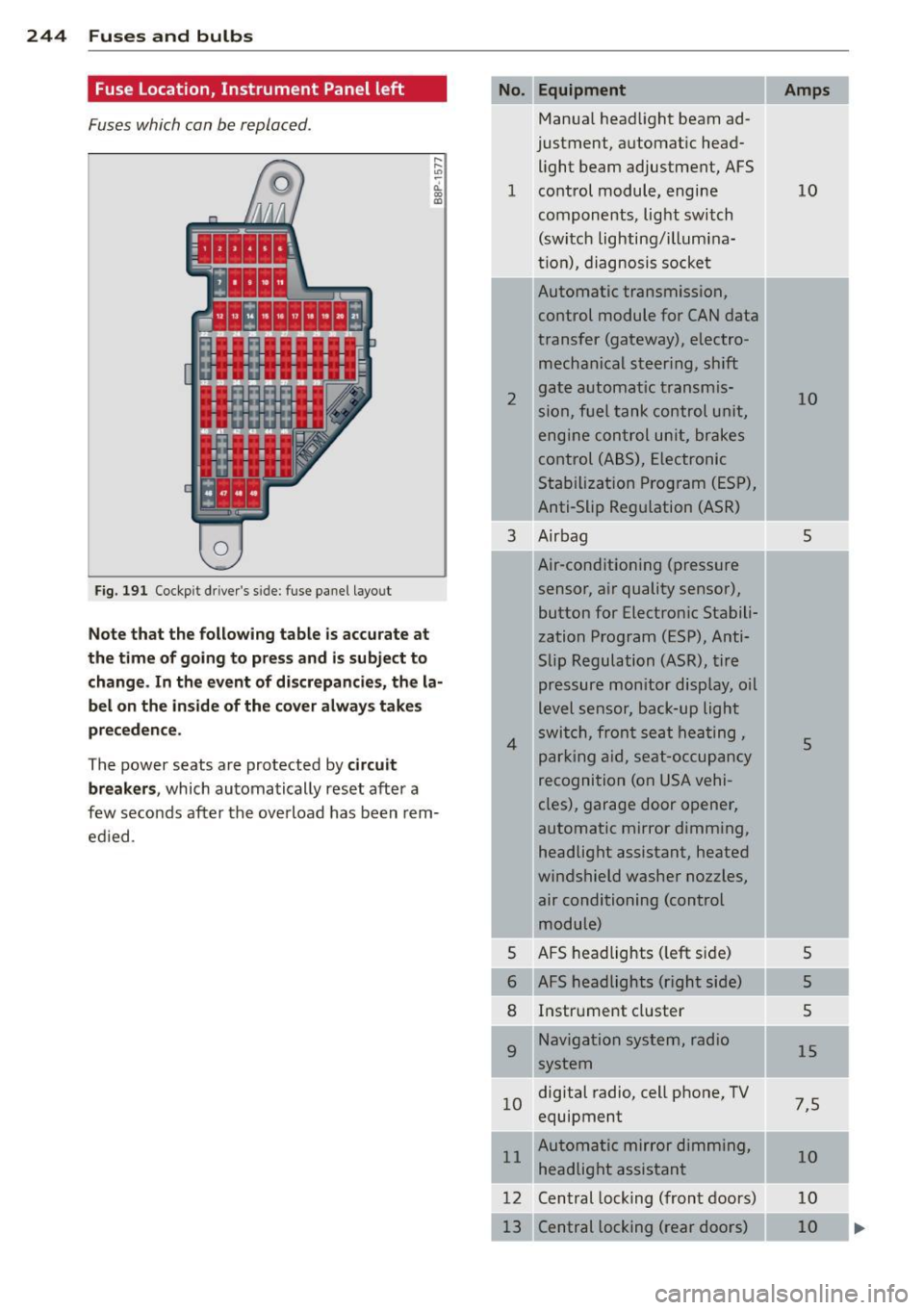
Fuse Location, Instrument Panel left
Fuses which can be replaced.
Fig. 191 Cockp it driver 's s ide: fuse pane l layout
Note that the following table is accurate at
the time of going to pr ess and i s subject to
change . In the event of d iscrepancies, the la
bel on the in side of the cover always take s
pr eceden ce .
The power seats are protected by circuit
break ers,
which automatically reset after a
few seconds after the ove rload has been rem
ed ied .
Equipment
Manua l head light beam ad
justment, a utomat ic head
light beam adjustment, AFS
1 co ntrol m odule, engine
components, light switch
(switch lighting/illumina
ti on), diagnosis socke t
2
3
4
5
6
8
9
Automatic transmission,
control module for CAN data
transfer (gateway), electro
mechanical steering, shift
gate automatic transmis
sion, fuel tank control unit,
engine control unit, brakes
control (A BS), Electronic
Stabili zation Program (ESP) ,
Anti-Slip Regulation (ASR)
Air bag
Air-conditioning (pressure
sensor, air quality sensor), button for Electronic Stabili
zation Program (ESP), Anti
Slip Regulat ion
(ASR), tire
pressure monitor display, oil
level senso r, back-up ligh t
s w itch, front se at he ati ng ,
p ark ing aid, sea t-occupancy
recognition (on USA vehi
cles), garage door opener,
automa tic mirror dimming,
headlight assistant, heated
windshield washer nozzles, air conditioning (control
module)
AFS headlights ( left si de)
AFS headlights (right side) Instr ument cluster
Navigation system, radio
system
1 0 digital
radio, cell phone, TV
equipment
11 Automatic mirror dimming,
headlight assistant
12 Central lock ing (front doors)
Central locking ( rear doors)
Amps
10
10
5
5
5
5
5
15
7 ,5
10
10
10
Page 247 of 280
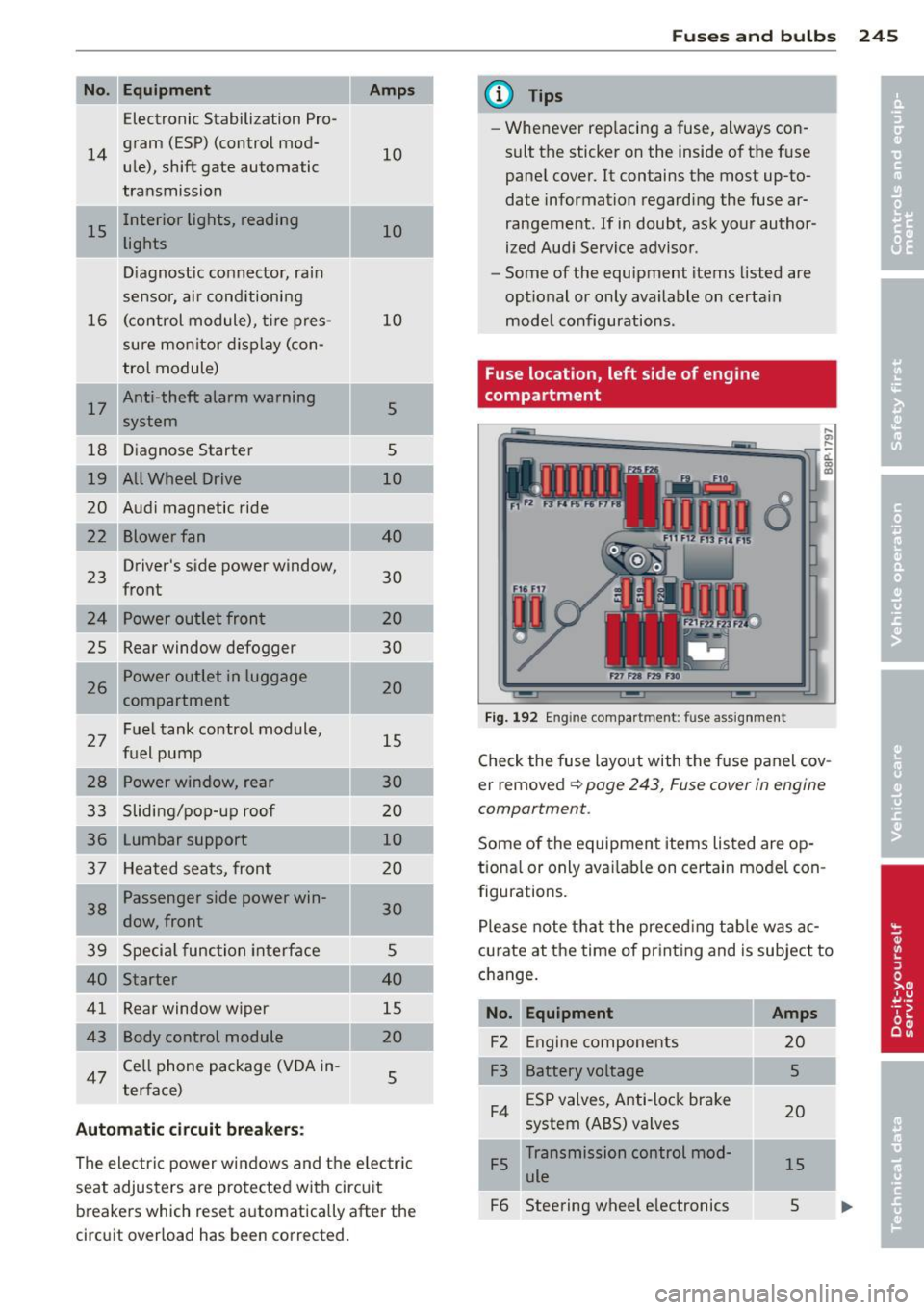
No. Equ ipment
Electronic Stabilization Pro-
14
gram (ESP) (control mod-
u le), shift gate automatic
transmission
15 Interior lights, reading
lights
Diagnostic connector, rain
sensor, air conditioning
16 (control module), t
ire pres-
sure monitor d isplay (con-
trol module)
I 17
Anti-theft alarm warning
system
18 D iagnose Starter
19 All Wheel D rive
20 Audi magnetic ride
Blower fan
23
Driver's
side power window,
front
24 Power outlet front
2S Rear window defogger
26 Power outlet in luggage
compartment
27 Fuel tank control module,
fuel pump
28 Power window, rear
33 Slidi ng/pop-up roof
36 Lumbar support
37 Heated sea ts, front
1 38
Passenger side power win-
dow, front
39 Specia l func tion interface
40 Starter
41 Rear window wiper
43 Body control module
47
Ce ll phone package (V OA in-
terface)
Automatic circuit breakers:
10
10
10
5
5
10
40
30
20
30
20
15
30
20 10
20
30
5
40
15
20 5
The electri c power w in dows and the e lectr ic
seat adjusters are pro tected with circu it
breake rs which reset automatically after the
circuit overload has been corrected.
Fu se s and bulb s 245
@ Tips
-Whenever rep lacing a fuse, always con
sult the sticker on the inside of the f use
pane l cover. It contains the most up-to
date information regarding the fuse ar
rangement. If in doubt, ask your author
ized Aud i Service adviso r.
- Some of the equipment items listed are
opt ional or only available on certa in
mode l configurations.
Fuse location, left side of engine
compartment
Fig . 192 En gine compar tment : fuse assig nment
,._
-d. a, a>
Check the fuse layout with the f use panel cov
er removed
¢ page 243, Fuse cover in engine
comportment.
Some of the equipmen t items listed are op
tiona l or only ava ilab le on certain model con
figurations.
Please note tha t the preced ing tab le was ac
c u rate at the time of pr int ing and is subject to
c h ange.
No. Equipment
F2 Engine compone nts
F3 Battery voltage ESP valves, Anti-lock brake
F4 system (ABS) valves
Transmission control mod
F5 ule
F6 Steering wheel e lectronics
Amps
20
5
20
15
s
Page 250 of 280
248 Emergency situations
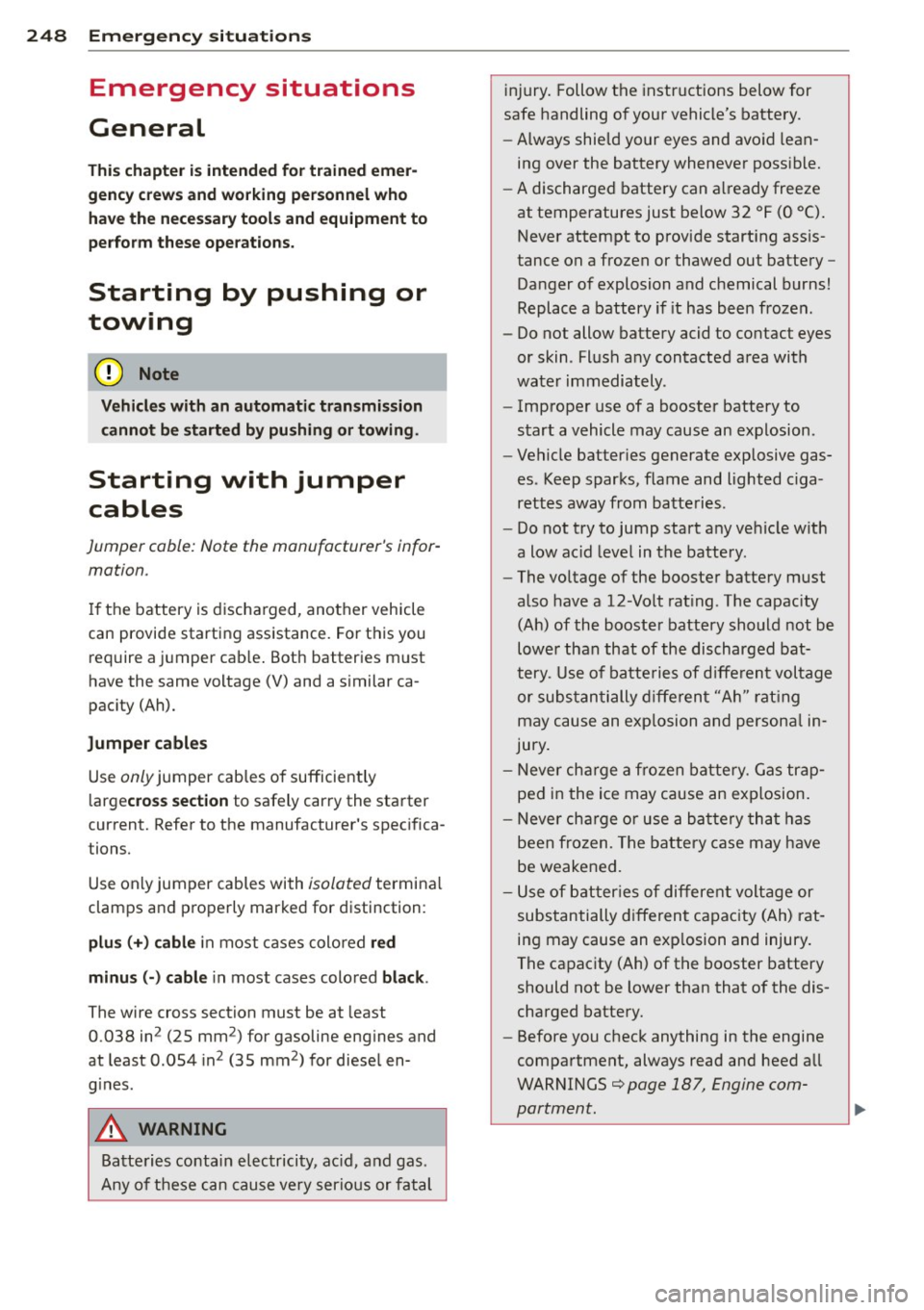
Emergency situations
General
This chapter is intended for trained emer
gency crews and working per sonnel who
have the necessary tools and equ ipment to
perform these ope rations.
Starting by pushing or
towing
Q;) Note
Vehicle s with an automati c transmission
cannot be started by pushing or towing .
Starting with jumper
cables
Jumper cable: Note the manufacturer's infor
mation.
If th e battery is d ischa rged, another vehicle
can provide starting assistance. For this you
req uire a j umper cab le . Both batteries m ust
have the same voltage (V) and a s imilar ca
pac ity (Ah).
Jumper cables
Use only jumper cab les of sufficiently
large cross section to safely carry the sta rter
cur rent. Refer to the manufacturer 's specifica
ti ons.
Use on ly jumper cables with
isola ted termina l
clamps an d properly marke d for distinction :
plus(+) cable in most cases colo red red
minu s(-) cable
in most cases colo red black .
The wire cross section must be at least
0.038 in
2 (25 mm2 ) for gasoline eng ines and
at least 0.054 in
2 (35 mm2
) for diese l en
gines .
A WARNING
Batte ries co ntain e lec tricity, ac id, a nd gas .
Any of these can cause ve ry ser io us or fatal i
njury . Follow the instructions below for
safe handling o f your vehicle's battery.
- Always shie ld your eyes and avo id lean-
ing over the battery wheneve r poss ib le.
- A discharged battery can a lready freeze
at temperatures just be low 32 °F (0 °() .
N ever attempt to provide start ing ass is
tance on a frozen or thawed out batte ry -
Da nger of explosion and chemical burns!
Replace a battery if it has bee n froze n.
- Do not allow battery acid to contact eyes
or skin . Fl ush a ny con tacted a rea with
wa te r immediat ely .
- Imp rope r use of a booster battery to
start a vehicle may cause an ex plosion .
- Vehicle batter ies ge nerate explosive gas
e s . K eep spar ks, flame and lighted c iga
r e ttes away from ba tteries.
- Do not try to ju mp start a ny ve hicle w it h
a low ac id leve l in the battery .
- The vo ltage of the bo oste r batte ry m ust
a lso have a 12-Vo lt rat ing. T he capacity
(A h) of the booste r battery sho uld not b e
lowe r than that of the discharged bat
tery . U se o f batte rie s of d iffe ren t voltage
or subs tan tia lly diffe ren t "Ah" rat ing
may c ause an exp losion and person al in
jury .
- N ever ch arge a fr oze n b atte ry. Gas t rap
ped in the i ce may c ause an ex plosion .
- N ever ch arge or use a batt ery th at h as
been frozen . T he battery case may have
be weake ned.
- Us e of batt erie s of diff ere nt vol tage or
subs tanti ally diff eren t ca pac ity (Ah) rat
in g may cause an exp losion and injury.
The ca pac ity ( Ah) of the booster battery
should not be lower than that of the dis
charged batte ry.
- Before you check anythin g in the engine
compa rtment, always read and heed a ll
WAR NIN GS¢
page 187, Engine com
partment.
Page 252 of 280

250 Emergency sit uat ions
2. Otherwise apply the hand brake and shift
into idle gear if your vehicle has manua l
transmission, and put the selector lever
into P position if your vehicle has auto
matic transmission.
3 . For both vehicles switch off all consumers
and the ig nition .
Connectin g/disco nn ecting th e jumper
cable
4 . Connect one end of the red jumper cable
to the positive term inal
(D ¢ fig . 193 of
the discharged battery @ ¢0
in General
information of starting assistance on
page 249 .
5. Connect the other end of the red jumper
cab le to the positive termina l@ of the
booster battery @.
6 . Connect one end of the black jumper ca
b le, preferably at the ground point. Other
wise, connect it to the negative terminal
@ of the booster battery @.
7 . Connect the other end of the black jumper
cab le to the
ground po int (bolt head )©
in your v ehi cle @ .
8. Route the jumper cables so that they can
not catch in any rotating parts in the en
gine compartment.
Starting the engine
9 . Start the engine of the vehicle provid ing
assistance and allow it to run at idle .
10. Now start the eng ine o f the vehicle w ith
the discharged battery, wa it for two to
three minutes unti l the engine "runs"
smoothly .
11. If the engine does not start: Stop trying
after
10 seconds and then try again after
about
30 seconds.
12 . In the veh icle that has received start as
sistance, turn on the heater blower and
the rea r window heat ing to eliminate any
voltage peaks when disconnecting. Driv
ing lights must be swi tched off!
13. Disconnect the cable whi le the engine is
running exact ly in
reverse order to that
described in¢
page 250, Connecting/dis
connecting the jumper cable.
When do ing so, make sure that the cable cannot con
tact rotating engine parts.
14. Turn the heater b lower and the rear w in-
dow heating off again .
The battery is vented to the outside to prevent gases from entering the vehicle interior .
Make sure that the jumper clamps are we ll
connected with thei r
metal ports in full con
tact
with the battery terminals .
A WARNING
To avoid serious personal injury and dam
age to the vehicle, heed all warnings and
instructions of the jumper cable manufac
turer. If in doubt, call for road service.
- Jumper cables must be long enough so
that the veh icles do not touch.
- When connecting jumper cables, make sure that they cannot get caught in any
mov ing parts in the engine compart
ment.
- Before you check anything in the engine
compartment, always read and heed all
WARNINGS ¢page 187, Engine com
partment.
{CT) Note
Improperly connected jumper cab les can
damage or destroy the generator .
- Do not use the battery negative terminal
for jump start ing or a malfunct ion could
occur in the vehicle electrical system.
- Always connect POSITIVE(+) to POSI-
TIVE(+), and NEGATIVE(-) to NEGATIVE
( - ) term inal.
- Check that all screw p lugs on the battery
cells are screwed in firm ly . If not, tighten
plugs prior to connecting clamp on nega
tive batte ry term inal.
- Please note that the procedure for con
necting a jumper cable as described
above applies specifically to t he case of
your vehicle being jump st arted. When
yo u are g iving a jump sta rt to another ve
hicle, do
not connect the minus( -) cable
to the minus (-) terminal on the dis
charged battery@¢fig.193 . Instead,