warning AUDI A3 2015 Owners Manual
[x] Cancel search | Manufacturer: AUDI, Model Year: 2015, Model line: A3, Model: AUDI A3 2015Pages: 288, PDF Size: 71.46 MB
Page 189 of 288
Smart Technology 187
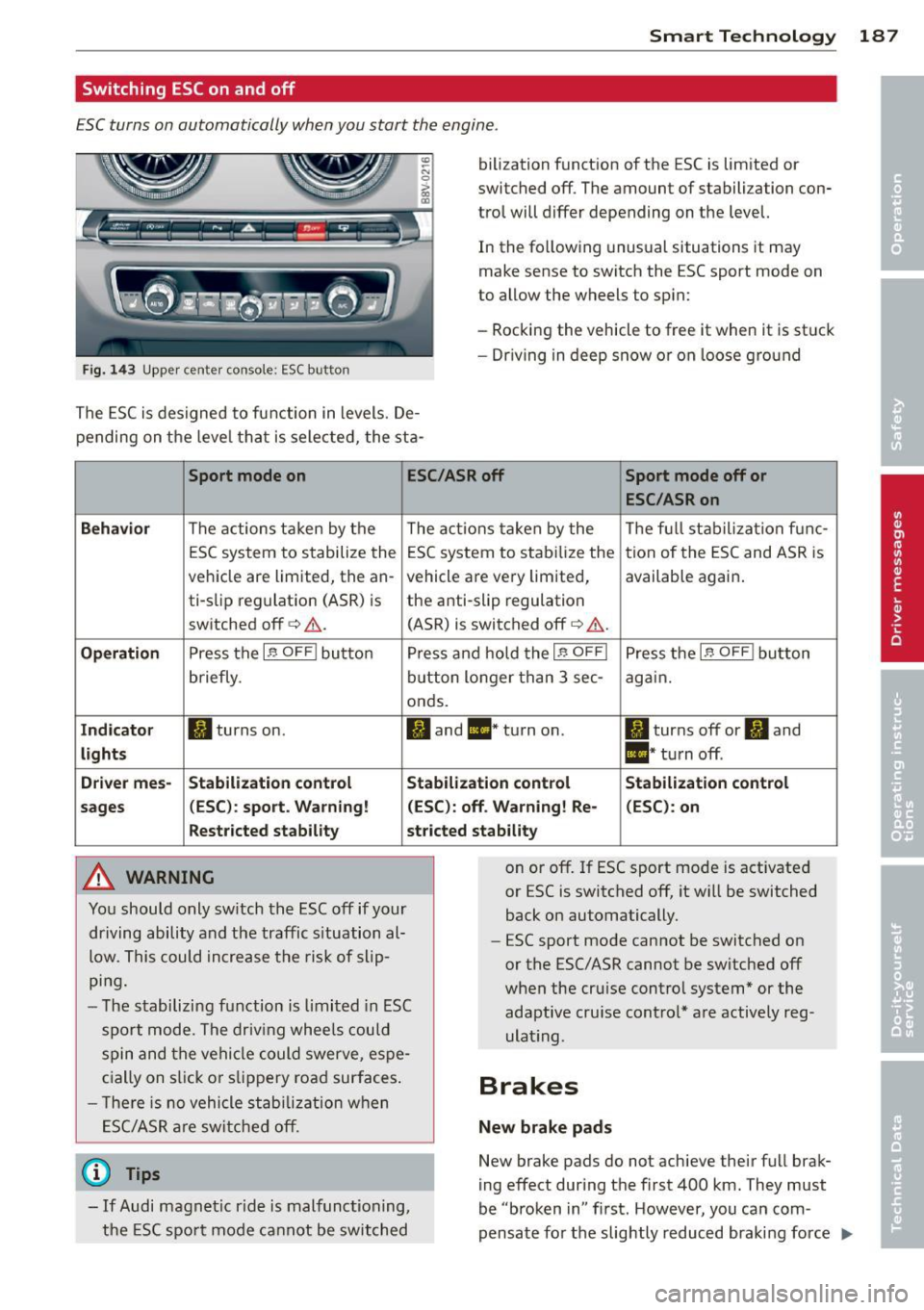
Switching ESC on and off
ESC turns on automatically when you start the engine .
Fig. 143 Upper center console: ESC button
bilization function of the ESC is limited or
switched off. The amount of stabilization con
tro l will differ depending on the level.
In the following unusual situations it may
make sense to switch the ESC sport mode on
to allow the wheels to spin:
- Rocking the vehicle to free it when it is stuck
- Dr iving in deep snow or on loose gro und
The ESC is designed to function in levels. De
pending on the leve l that is selected, the sta-
Sport mode on ESC
/ASR off
Sport mode off or
ESC /ASRon
Behavior
The actions taken by the
The actions taken by the Th
e fu ll stabilization fu nc-
ESC system to stabilize the ESC system to stab ilize the tion of the ESC and ASR is
vehicle are limited, the an- vehicle are very limited, available again.
ti-slip reg ulation (ASR) is the anti-slip regulation
sw itched off
q .&.. (ASR) is switched off q .&. .
Operation Press the If) OFF I button P ress and hold the If) OFFI Press the I.$ OFF I button
briefly. button longer than 3 sec- again.
onds.
Indicator II turns on. II and II * turn on . II turns off or II and
lights II* turn off.
Driver mes-
Stabilization control Stabilization control
Stabilization control
sages (ESC):
sport. Warning! (ESC): off. Warning! Re- (ESC): on
Restricted stability stricted stability
A WARNING
You should only sw itch the ESC off if your
driving ability and the traffic s ituation al
low. This could increase the risk of slip
ping.
- The stabilizing function is limited in ESC
sport mode. The driving wheels could
spin and the vehicle could swerve, espe
cially on slick o r slipp ery road surfaces .
- T here is no vehicle stabilizat ion when
ESC/ASR are switched off.
@ Tips
-If Audi magnet ic ride is malfunctioning,
the ESC sport mode cannot be switched on or off. If ESC sport mode is activated
or ESC is switched off, it w
ill be switched
back on automatically.
- ESC sport mode cannot be switched on
or the ESC/ASR cannot be switched off
when the cru ise contro l system* or the
adaptive cru ise contro l* are actively reg
ulat ing.
Brakes
New brake pads
New brake pads do not achieve their full brak
ing effect during the first 400 km. They must
be "broken in" first. However, you can com
pensate fo r the slightly reduced braking force ""
Page 190 of 288
188 Smart Technology
by pressing firmly on the brake pedal. Avoid
heavy braking during the break-in period.
Wear Brake pad
wear is largely dependent on the
way the vehicle is driven and on operating
conditions. This is especially true if you are
driving frequently in the city and on curves or
with a sporty driving style.
Operating noise
Noises may occur when braking depending on
the speed, braking force and outside condi
tions such as temperature and humidity.
Effect of water and road salt
In certain situations, for example after driving
through water, in heavy rain, after overnight
condensation or after washing your car, the
braking effect can be reduced by moisture or
ice on the brake rotors and brake pads. The
brakes must be "dried" first with a few careful
brake applications.
At higher speeds and with the windshield wip
ers turned on, the brake pads press against
the brake rotors for a short amount of time.
This action which is not felt by the driver hap
pens at regular intervals and facilitates a bet
ter reaction time for the brakes in wet weath
er.
The braking effect can also be reduced if you
are driving on salted roads and you do not ap ply the brakes for long periods of time. The
layer of salt on the brake rotors and pads
must be worn off first when the brakes are ap
plied.
Corrosion
Leaving the vehicle parked for long periods of
time, low mileage and avoiding heavy braking
can contribute to corrosion on the brake ro
tors and dirty brake pads.
If you usually avoid heavy braking or if there is
corrosion present, occasional heavy braking at
high speeds is recommended to clean the
brake rotors and pads
Q &. .
Brake system malfunction
if you notice that the brake pedal travel has
suddenly gotten larger, then a brake circuit
may have failed. Drive to your authorized Audi
dealer or qualified repair facility immediately
to have the problem corrected. On the way
there, drive with reduced speed and keep in
mind that a long braking distance and in
creased pressure on the brake pedal will be
necessary.
Low brake fluid level
When the brake fluid level is low, malfunc
tions in the brake system may occur. The brake fluid level is electronically monitored .
Brake booster
The brake booster amplifies the pressure you
apply to the brake pedal. It only works when
the engine is running.
A WARNING
-- You should perform braking maneuvers
for the purpose of cleaning the brake
system only if road conditions permit.
Other road users must not be put at risk -
you may cause an accident!
- Before descending a steep grade, reduce
speed and shift transmission into a lower
gear or lower driving range. Do not ride
the brakes or hold the pedal down too
long or too often. This could cause the
brakes to get hot and diminish braking
efficiency.
- Do not "ride the brakes" by resting your foot on the pedal when you do not intend
to brake. This may cause the brakes to
overheat, premature wear and increased
stopping distance.
- Under certain climatic and operating conditions such as passing through wa
ter, driving in heavy rain or after washing
the vehicle, the effectiveness of the brakes can be reduced. In winter, ice can
accumulate on the brake pads, linings,
discs and drums. Carefully apply brakes
Page 192 of 288
190 Smart T echnol ogy
Drive to an authorized Audi dea le r or qualified
repair facility immediately to have the ma l
function corrected .
_& WARNING
Have the system malfunction repaired as
soon as possible by an authorized Audi
dealer or qualified repair facility, as th is in
creases the risk of an acc ident.
(D Tips
If the . or ,1:-ij indicator light on ly stays
on for a short time , you may continue driv
ing .
ALL wheel drive
(quattro)
Appl ies to vehicles: wit h all whee l drive
In all wheel drive, all four wheels are pow
ered .
General information
In all wheel drive, the driving power is divided
between all four wheels. This happens auto
mat ica lly depending on you r driv ing behavior
as we ll as the current road conditions. Re fer
to
¢ page 185, Electronic stabilization con
trol (ESC) .
The all wheel drive concept is designed for
h igh engine power . Yo ur vehicle is exception
a lly powerful and has excellent driving charac
teristics bot h under normal driving conditions
and on snow and ice . A lways read and fo llow
safety precautions
c> & .
Wint er t ire s
By using all wheel drive, your vehicle has good
forward motion with standard tires in winter
conditions . However, in winter we recommend
using winter or all season t ires on
all four
wheels, because this will improve the braking
effec t.
Snow cha in s
If there are snow chain laws, snow chains
must also be used on vehicles with a ll whee l
drive
c> page 241, Snow chains.
Replacing tire s
For vehicles with a ll wheel d rive, only wheels
with the same ro lling circumference should be
u sed. Avoid wheels with different tread
depths ¢
page 236 .
Offroad vehicle?
You r A udi is not a n offroad vehicle -there is
not enoug h ground clearance. For this reason ,
avoid difficu lt terrain. Refer to
c::> page 266.
A WARNING ~
- Also, in vehicles with a ll w heel drive,
adapt your driving sty le to the c urrent
road and traffic cond itions. Do not let
the increased safety provided tempt you into taking risks .
- The braking ability of your veh icle is lim
ited to the traction of the wheels. In this
way, it is not different from a two wheel d rive vehicle . Do not be tempted to ac
celerate to a high speed when the road is
slippe ry this inc reases the r is k of an acci
dent.
- Note that o n wet s treets, the front
wheels ca n "hydrop lane " if driv ing at
speeds that are too high. Unlik e fron t
wheel drive vehicles, the engine does not rev higher sudden ly when the vehicle be
g ins hydroplaning. For this reason, pay
attention to the road conditions regard less of your speed.
Energy management
The starting ability is optimized
The energy management system manages
the electrical energy distribution and optimiz
es the availability of electrical energy for
starting the engine.
When a vehicle with a conventiona l energy
system is not d riven for a long time , the bat
te ry is drained by equ ipment ( for example the
immobilizer) . In certain c ircumstances, there
cou ld may not be enough energy to start the
engine .
1J1-
Page 195 of 288
Driving and the
environment
The first 1,000 miles (1,500 km) and
afterwards
New engine
The engine needs to be run-in during the first
1,000 miles (1 ,500 km) .
For the fir st 600 mil es
(1,000 kilometers):
.,. Do not use full throttle.
.,. Do not drive at engine speeds tha t are more
than 2/3 of the max imum permitted RPM .
.. Avoid high engine sp eeds .
From 600 to 1,000 mile s (1,000 to
1,500 kilometers):
.. Speeds can gradually be increased to the
max imum pe rm iss ib le road or eng ine speed .
During and after break-in per iod
.,. Do not rev the engine up to high speeds
when it is cold. Th is app lies whether the
transmission is i n N (Ne utra l) or in gear.
After the break- in period
.. Do not exceed maximum engine speed un
der any circumstances.
.,. Upshift into the next higher gear
before
reaching the red area at the end of the tach
ome ter scale
¢ page 10.
During the first few hours of driving, the en
g ine's interna l friction is higher than later
when all the moving parts have been broken
i n. How well this break-i n process is done de
pends to a conside rable extent on the way the
ve hicl e is driven d uring the first 1,0 00 miles
(1 ,5 00 k ilome ters).
(D Note
Extremely h igh engine speeds a re auto
ma tica lly reduced. However, t he se rpm
lim its are pr ogr amme d for an eng ine well
r u n- in, not a new engine .
Driving and the environment 193
@) For the sake of the environment
Do not drive with unnecessar ily hi gh en
g ine speeds -upsh ifting ear ly saves f uel,
r educes noise and protects the environ
ment.
New tires
If your vehicle is running on new tires, drive
particularly caref ul for the first 350 miles
(500 kilomete rs) afte r fitt ing.
.&, WARNING
N ew tires tend to be slippery and mus t al
so be "b roken -in" . Be s ure to remember
this dur ing t he f irst 350 m iles (500 kilo
meters) . Brake gently . Avoid fo llow ing
closely behind other vehicles or other sit
uations that m ight require sudden, hard
b raking .
New brake pads
Remember that new brake pads do not have a
full brak ing effect dur ing the first 250 m iles
(400 kilomete rs) afte r they a re install ed.
New brake pads have to be "burnished in" be
fo re they have optima l grab¢ .&. .
D uring the brea k-in pe riod, you should avo id
putting severe loads on the brakes. Severe
l oads include , for example, sudden hard brak
i ng, in particular at very h igh speeds or, for
example, on mounta in passes .
.&, WARNING
New b rake pa ds don 't have the best stop
p in g p ower a nd must be "b ro ken -in " dur
ing the ini tial 1 00 to 150 miles (15 0 to
2 00 kilometers) o f no rma l ci ty driving . You
can compensate for this by pressing t he
b rake peda l more fi rm ly . This also applies
l ater when new pads are installed.
•
•
•
Page 196 of 288
194 Driving and the environment
Driving through water
on roads
Note the following to avoid vehicle damage
when driving through water, for example on
flooded roads:
- The water must not be any higher than the
bottom of the vehicle body.
- Do not drive faster than wa lking speed.
A WARNING
After driving through water or mud, the
braking effect can be reduced due to mois
ture on the brake discs and brake pads. A
few careful brake applications should dry off the brakes.
@) Note
Vehicle components such as the engine, transmiss ion, suspension or electrical sys
tem can be severely damaged by driving
through water.
- Determ ine the depth before driving
through water.
- Do not stop the vehicle, drive in reverse
or switch the engine off when driving
through water .
- Keep in mind that oncoming vehicles may create waves that raise the water
level and make it too deep for your vehi
cle to drive through safely.
- Avoid dr iving through salt water (corro
s ion).
Catalytic converter
App lies to vehicles: with gasoline engine
It is very important that your emission con
trol system (catalytic converter) is function
ing properly to ensure that your vehicle is run
ning in an environmentally sound manner.
> Always use lead-free gaso line¢ page 206,
Fuel supply .
> Never run the tank down all the way to emp-
ty.
> Never put too much motor o il in your engine
¢ page 215, Adding engine oil
The catalytic converter is an efficient "clean
up" device built into the exhaust system of
the vehicle . The cata lytic converter burns
many of the pollutants in the exhaust gas be
fore they are released into the atmosphere.
The exclusive use of unleaded fuel is critica lly
important for the life of the catalytic convert
er and proper functioning of the engine.
A WARNING
-
The temperature of the exhaust system is high, both when driv ing and after stopping
the eng ine .
- Never touch the exhaust tail pipes once
they have become hot . This could result
in burns.
- Do not park or operate the vehicle in
areas where the hot exhaust system may
come in contact with dry grass, brush,
fue l spill or other material wh ich can
cause a fire.
- Do not app ly additional undercoating or
rustproofing on or near the exhaust manifold, exhaust pipes, catalytic con
verter or heat shields . Dur ing driving, the
substance used for undercoating could
overheat and cause a fire.
(D Note
- Be aware that just one tank filling with
leaded fuel will already seriously de
grade the performance of the catalytic
converter.
- Do not exceed the correct engine oil level
¢page 215.
-Do not drive until the fuel tank becomes
completely empty. The engine could mis
fire . Unburned fuel could also get into
the exhaust system and this cou ld cause
the catalytic converter to overheat.
- Do not switch off the ignition while the
vehicle is moving.
- Do not continue to operate your vehicle
under these conditions, as otherwise fuel
IIJ,,
Page 198 of 288
196 Driving and the environment
than the posted speed limit and weather con
ditions permit.
Reducing unnecessary idling
Even wh en your car is just idling it burns up
fuel.
,.. Shu t the engine off when you a re not dr iv ing
the vehi cle.
... Do not warm up the vehicle by letting the
engine run at idle.
It is efficien t to switch off the engine when
stopped at railroad crossings and long red
lights. Turning the engine
off for j ust 30-40
seconds saves mo re f uel than is burned by
start ing the engine again.
It takes a long time fo r the engine to wa rm up
fu lly when it is running at idle. However , wear
and noxious emissions are especially high
when the engine is warming up. So you should
drive away as soon as you start the engine and
avoid ru nning at h igh rpms while the engine is
still warming up.
{[) Note
Do not leave engine idling unattended af
ter starting. If warning lights s hould come
on to indicate improper operation, they
wou ld go unheeded . E xtended idling also
produces heat, which cou ld resu lt in over
heat ing or o ther da mage to the vehicle or
o ther prope rty.
Regular maintenance
A badly tuned engine unnecessarily wastes a
lot of fuel .
... Have your vehicle serv iced at regular inter-
vals.
H aving your vehicle regular ly serviced by an
author ized Audi dealer helps to ensure that it
runs properly and economically . T he condition
of yo ur vehicle not only affects its safety and
ab ility to hold its value, it also affec ts
fuel
con sumption. Check
your oil each t ime you fill your tank.
T he amou nt of oi l used is re lated to engine
lo ad a nd speed.
It is normal fo r the oil consumption of a new
engine to reach its lowest valu e after a c erta in
mileage has bee n driven.
You must drive your veh icle about 3,000 m iles
(5,000 kilometers) before you can properly
assess oil consumpt io n.
This also app lies to fue l consumption and en
gine output .
(0 Note
- Have your veh icle ma inta ined properly
and in accordance with the service rec
ommendations in your Wa rranty
& Ma in
tenance boo klet . Lack of proper ma inte
nance as well as improp er use of the ve
hicle will impair the fu nction of the
em iss io n con trol system and cou ld lead
t o dam age.
- Do not alte r or remove any component of
t he Emis sio n Control Sys tem unless ap
proved by the manufacturer .
- Do not alter or remove any device, such
as hea t sh ie lds, swi tches, ig nitio n w ires,
valves, which are designed to p rotec t
your vehicle's Emission Control System
and other impo rtant vehicle compo
nents.
' Fewer short trips
Fuel consumption will always be relatively
high on short trips.
... Try to avoid dr iv ing sho rt distances w it h a
cold engine .
T he eng ine and cat alytic conver ter h ave to
re ach their opt imal
operating t emperature to
reduce fuel consumpt io n and nox ious em is
sions effectively.
Jus t aft er s tarti ng, a c old eng ine in a mid-s ize
ca r on ly achieves a fuel economy of 6-8 m iles
per gallon (30 -40 l/100 km) . After about a
half a mile , fu el economy climbs to 12 mpg .,..
Page 200 of 288
198 Trailer towing
Trailer towing Driving with a trailer
General information
Your Audi was designed primarily for passen
ger transportation .
If you plan to tow a tra iler, p lease remember
that the addit ional load will affect durability,
economy and performance .
T railer towing not on ly places more stress on
the vehicle, it also calls for more concentra
tion from the driver.
F or this reason, always fo llow the operating
and drivi ng in str uctions provided and use
common sense.
@ Note
If you are going to tow a trai le r, you must
activate the trailer operation mode
c:::> page 198 , Operating instructions.
Technical requirements
Traile r hitch
Use a weight-carrying hitch conforming to the
gross trailer weight. The hitch must be suita
b le for your veh icle and trailer and must be
mo unted secure ly on the ve hicle's chassis at a
technically sound loca tion . Use only a trailer
hi tch with a removab le ball moun t. A lways
check with the tra ile r hitch manufac turer to
make sure that you are using t he cor rect
hitch.
Do not use a bumper hit ch .
The hitch must be installed in such a way that
i t does not interfe re with the impact-absorb
ing bumper system. No modifications should
be made to the vehicle exhaust and brake sys
tems . From time to time, check th at a ll hitch
mo unt ing bo lts remain securely fastened.
When you are not towing a trailer, remove the
tra iler hitch ball moun t. T his prevents the
h itch from causing damage sho uld your veh i
cle be str uck from be hind
c:::> A .
Trailer brake s
If your trailer is equipped wi th a b ra ki ng sys
tem, c heck to be sure t hat i t conforms to all
regulations .
T he trailer hyd rauli c brake system mus t not be
direc tly connec ted to the vehicle's hydraulic
brake system .
Safety chains
Always use safety chains between your veh icle
and the tra ile r.
Trailer lights
Trai ler lights must meet all regulations. Be
sure to check w ith your Audi dealer for correct
wiring, switches and relays .
Mirrors
If you are unable to see the traffic behind you
us ing the regular o utside mirrors, then you
must install extended mirrors. It is important
that you
always have clear v is ion to the rear.
A WARNING
--
Afte r removi ng the trailer hitch, do not
stor e it in your vehicle . In case of sudden
b raking, t he hitch co uld fly forwa rd and i n
j ur e you or your passengers.
Operating instructions
Maximum trailer weight
A tra ile r fo r your vehicle is limited to a typical
class 1 or class 2 tr ailer.
Trailer load distribution
Be sure the load in the tra ile r is held secure ly
i n place to p revent it from shift ing forward,
backward or sideways.
Ne ver allow a pa ssenger to ride in a trailer
c:::> A in Driving instructions on page 199 .
Engine cooling system
Towing a trailer makes the engine work hard
er . It is important that the cooling system's
performance is up to the additional load.
Page 201 of 288
Make sure that the cooling system has enough
f luid .
Tire pressure
When tow ing a trai ler, inflate the t ires of your
veh icle to the cold tire pressure listed under
"Full load" on the label located on the driver's
side B-pillar (visible when the door is open) .
Inflate trailer tires to trai ler and tire manufac
turers' specifications.
Lights
Check to make sure both veh icle and trailer
lights are working properly.
Safety chains Be sure tra iler safety cha ins are properly con
nected from the trailer to the hitch on the ve
hicle. Leave enough slack in the chains to per
mit turning corners . When you install safety
chains, make sure they wi ll not drag on the
road when you are driving.
The chains should cross under the trailer
tongue to prevent it from dropping in case of
sepa ration from the hitch.
Driving instructions
Driving with a trailer always requires extra
care and consideration.
To obta in the best poss ible handling of vehicle
and trai le r, p lease note the following:
.. Do not tow a loaded tra iler when your car it
self is not loaded .
.. Be especially carefu l when passing other
vehicles.
.. Observe speed limits.
.. Do not drive at the maximum permissible
speed .
.. Always apply brakes early.
.. Monitor the temperature gauge.
Weight distribution
Tow ing a loaded trailer with an empty ca r re
sults in a high ly unstable distribution of
weight . If this cannot be avoided, drive at very
Trailer towing 199
low speeds on ly to avoid the risk of losing
steering contro l.
A "balanced " rig is easier to operate and con
trol. This means that the tow vehicle should
be loaded to the extent possible and permissi
ble, while keeping the trailer as light as possi
ble under the c ircumstances. Whenever poss i
ble, transfer some cargo to the luggage com
partment of the tow vehicle while observing
tongue load requirements and vehicle loading
considerations.
Speed
The higher the speed, the more difficu lt it be
comes for the driver to control the rig. Do not
drive at the maximum permissible speed. Re
duce your speed even more if load, weather or
wind conditions are unfavorable -particularly
when going downhill .
Reduce vehicle speed
immediately if the trail
er shows the slightest sign of swaying .
Do not
try to stop the swaying by accelerating .
Observe speed limits. In some areas, speeds
for vehicles towing tra ilers are lower than for
regular veh icles .
Always apply brakes early. When driving
downhill, shift into a lower gear to use the en gine braking effect to slow the vehicle . Use of
the brakes alone ca n cause them to overheat
and fail.
Coolant tempe rature
The coo lant temperature gauge¢
page 12
must be observed carefully. The coolant tem
perature can increase if you drive on long in
cli nes in a low gear at high engine speeds . Re
duce your speed immediately if the LEDs in
the top part of the display turn on.
For more information about ind icator lights,
refer to. ¢
page 20 .
A WARNING
Anyone not properly restrained in a mov
ing vehicle is at a much greate r risk in an
accident. Never let anyone ride in yo ur car
-
•
•
•
Page 203 of 288
Caring and cleaning
General information
Regular, proper care helps to maintain your
vehicle's val ue . It can also be a requirement
when submitting warranty claims for corro
sion damage and paint defects on the body.
The necessary care products can be obtained
from your a uthorized Audi dea ler . Read and
follow the instructions for use on the packag
i ng.
A WARNING
- Us ing clean ing and care products incor
rectly can be dangerous to your hea lth .
- Always store cleaning and care products
out of reach of children to reduce the r isk
of po isoning.
-
@ For the sake of the environment
- Preferably use environmentally-friendly
products when buying cleaning agents.
- Do not d ispose of leftover cleaning and
care products with household trash.
Car washes
T he longer that deposits such as insects, bird
droppings, tree sap or road sa lt rema in on the
veh icle, the more the surface can be dam
aged . High tempe ratures such as those
caused by sunlight increase the cor rosive ef
fect .
Before washing, rinse off heavy depos its with
p lenty of water .
Also, was h the underside of your ve hicle once
road salt stops be ing used for the season.
P ressure wash ers
When washing your veh icles w ith a pressure
washer, always fo llow the operating instruc
tions provided with the pressure washe r. T his
is especially important in regard to the pres
sure and spraying d istance. Do not aim the
spray directly at seals on side w indows, doors,
the hood, the rear lid or the sunroof* or at
Caring and cle anin g 201
tires, rubber hoses, insulating material, sen
sors * or camera lenses* . Keep a distance of at
l east 16 inches (40 cm).
Do not remove snow and ice with a p ressure
washe r.
Neve r use rotary nozzles or high pressure noz
z les.
T he wate r temperature must not be above
140
°F (60 °() .
Automatic car washes
Spray off the ve hicle before washing.
Make sure that the windows and roof * are
c losed and the winds hield wipers are off . Fol
l ow instructions from the car wash operator,
especially if there are accessories attached to
your vehicle.
If possible, use car washes that do not have
brushes .
Washing by hand
Clean the ve hicle starting from the top and
working down using a soft sponge or cleaning
brush . Use solvent -free clean ing products.
Washing vehicles with matte finish paint
by hand
T o avoid damaging the paint when washing,
f irst remove dust and large particles from
your vehicle . Insects, grease spots and finger
prints are best removed with a spec ial cleaner
for matte finish paint .
Apply t he p rod uct using a microfiber cloth . To
avo id damaging the paint surface, do not use
too much pressure .
Rinse the vehicle thoroughly with water . Then
clean using a neutra l shampoo and a soft mi
crofiber cloth .
Rinse the ve hicle thoroughly again and le t it
air dry . Remove any water residue using a
shammy.
Stubborn deposits such as bi rd d roppings o r
t ree sap are best removed w it h ple nty o f w a-
ter and a microfiber cloth . .,..
•
•
•
Page 204 of 288
202 Caring and cle aning
_& WARNING
- Only wash the vehicle when the ignition
is off and follow the instructions from
the car wash operator to reduce t he risk
of accidents.
- To reduce the risk of cuts, protect your
self from sharp meta l components when
wash ing the underbody or the inside of
the wheel housings.
- After washing the vehicle, the braking ef
fect may be de layed due to mo isture on
the brake rotors or ice in the winter. The
brakes must be dried first with a few
careful brake applicat ions .
@ Note
- If you wash t he vehicle in an automatic
ca r wash, you must fold the exterior m ir
r o rs in to reduce the r isk of damage to
t h e m irrors. Power foldi ng exterior m ir
r o rs* must on ly be folded in and o ut us
i ng the p ower folding function.
- To prevent pa int damage, do not wash
t h e ve hicle in direc t sunli ght. -
To reduce the ris k of damage to the sur
face, do not use insect removing spong
es, kitchen sponges or similar items.
- Matte finish painted veh icle compo
nents:
- To reduce the risk of damage to the
surface, do not use polishi ng agents or
h a rd wax.
- Never use protect ive wax. It can de
stroy the matte fi nish effec t.
- Do not place any stickers o r mag net ic
s igns on vehicle parts painted w ith
matte fi nish pa int. The paint cou ld be
d amaged when the sticke rs o r mag nets
ar e removed. @ For the sake of the environment
Only wash the ve hicl e in facilities spec ia lly
de signed for that purpose. This will red uce
the r is k of dirty w ate r contam ina ted with
oi l from entering the sewer sys tem.
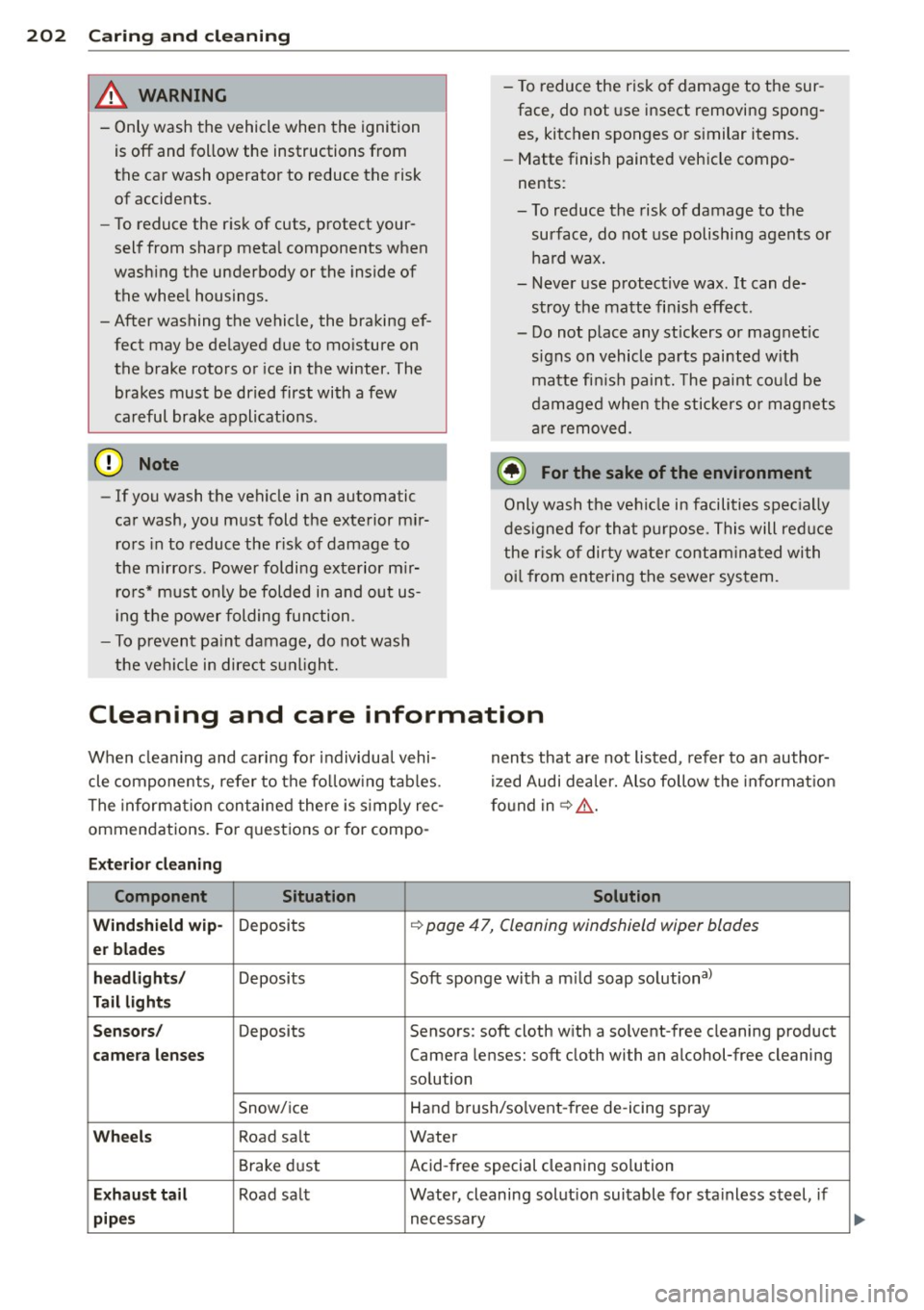
Cleaning and care information
When clea ning and ca rin g for individua l vehi
cle components, refer to the fo llow ing tab les.
The informa tion con taine d there is s imp ly rec
ommendations. Fo r quest ions or for compo -nents that ar
e not listed, refer to an author
i z ed Audi dea ler. Also follow the in format io n
f o und in¢ ,&..
Exterior cleaning
Component Situation Solution
Wind shield wip-
Deposi ts ¢ page 47, Cleaning windshield wiper blades
er blades
headlights /
Deposits Soft sponge with a m ild soap solutiona>
Tail lights
Sensors /
Deposits Sensors: soft cloth with a so lvent-free cleaning product
camera lenses Camera lenses: soft cloth with an alcohol-free cleaning
so lution
Snow/ ice Hand brush/solvent -free de -icing spray
Wheels Road sa lt Water
Brake d ust Acid-free special cleaning so lution
E x haust ta il Road sa lt Water, cleaning solut ion suitable fo r sta inless steel, if
pipes necessary