warning AUDI A3 2015 Owners Manual
[x] Cancel search | Manufacturer: AUDI, Model Year: 2015, Model line: A3, Model: AUDI A3 2015Pages: 288, PDF Size: 71.46 MB
Page 220 of 288
218 Check ing and F illin g
• Add coolant mixed in the correct ratio
¢page 216 up to the upper marking.
• Make sure that the fluid level rema ins sta-
ble. Add more coolant if necessary.
• Clove the cap securely.
A coo lant loss suggests a leak. Immediately
drive your vehicle to an authorized repair fa
cility and have the coolant system inspected.
If the coolant system is not leaking, a loss can
come from the coolant cooking through over
heat ing and being pushed out of the coolant
system.
.8, WARNING
The cool ing system is under pressure and
can get very hot. Reduce the risk of scald
ing from hot coolant by following these
steps .
- Do not open the coo lant expansion tank
cap with the engine hot . There is a risk of
burns.
- T urn off the engine and allow it to cool
down .
- Protect your face, hands and arms from
escaping fluid and steam by covering the
cap with a large, thick rag.
- T urn the cap slowly and ve ry carefu lly in
a counter-clockwise direction wh ile ap
plying light, downward pressure on the
top of the cap.
- To avoid being b urned, do not spill anti
freeze or coo lant on the exhaust system
or hot eng ine parts. Under certain condi
t ions, the ethylene g lycol in engine cool
ant can catch fire.
- The coo lant add itive and the coolant can
be dange rous to your hea lth. For th is
reason, keep the coolant in the or ig inal
conta iner away from children. There is a
risk of poisoning.
- Whe n work ing in the engine compart
ment, remembe r that the radiator fan
can swit ch on even if the ignition is
switched off, wh ic h increases the risk of
persona l inju ry .
(D Note
Do not add coo lant if the expansion tank is
empty. Air cou ld enter the cooling system
and damage the engine. If this is the case,
do not continue dr iving. See your author
i zed Audi dealer or qualified repair fac ility .
Radiator fan
The radiator fan switches on automatically by
itself
An a uxiliary electric radiator fan switches on
and off depending on coolant temperature
and other vehicle operat ing condit ions.
After you switch the engine off, the auxi liary
fan can continue running for up to 10 m inutes
- even w ith the ignition off.
It can even switch
on again later by itself¢.&. , if
- the temperature of the engine coo lant rises
due to the heat build- up from the engine in
the engine compartment, or
- the engine compartment heats up because
the vehicle is parked in intense sunlight.
.8, WARNING ,-
- To reduce the risk of personal injury nev-
er touch the radiator fan.
- The a uxiliary electric fan is temperat ure
controlled and can sw itch on suddenly
even when the engine is not ru nning.
- The auxiliary radiator fan sw itches on a u
tomatically when the engine coo lant
reaches a certain temperature and will
continue to run until the coolant temper
ature drops.
Page 221 of 288
Brake fluid
Checking brake fluid level
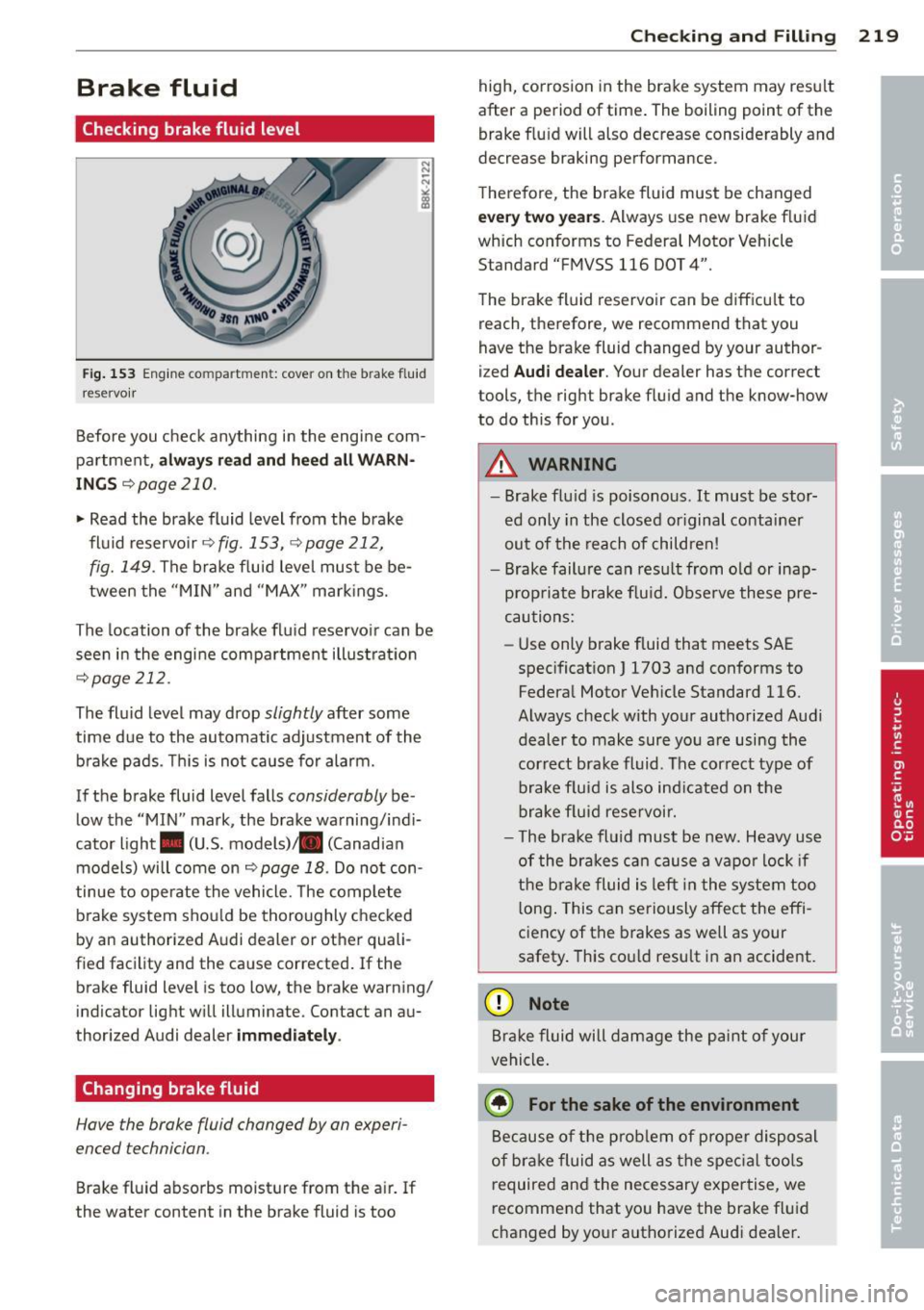
Fig . 153 Engine co mpa rtment: cove r on the b rake f lu id
reservo ir
B efore you check anything in the engi ne com
partment,
alwa ys read and heed all WARN ·
INGS r:=:,page 210 .
~ Read the brak e fluid level from the brake
fluid reservo ir
r:=;, fig . 153, r:=:, page 212,
fig. 149 .
The brake f luid leve l mus t be be
tween the "MIN" and "MAX " ma rkings.
The location of the brake flu id reservo ir can be
seen in the engi ne compa rtment illust ra ti on
¢ page 212 .
The fluid level may drop slightly after some
time due to the automatic adjustment of the b rake pads . Thi s is not cause for alarm.
If the brake fluid level falls
considerably be
low the "MIN" mark, the b rake wa rning/ind i
cato r light . (U .S . models)/ . (Canadian
models) will come on
r:=;, page 18 . Do not con
tinue to operate the vehicle. The comp lete
brake system should be thoroughly checked
by an authorized A udi dealer or other quali
f ied fac ility and the ca use corrected . If the
br ake fluid level is too low, the brake warning/
indica tor light w ill illuminate. Contact an au·
thor ized Audi dealer
immediately .
Changing brake fluid
Have the brake fluid changed by an experi
enced technician .
Brake fluid abso rbs moist ure from the air. If
the water content in the brake fluid is too
Che cking and Fillin g 219
high, co rrosion in the brake system may resu lt
after a period of time . The boiling point of the
brake f lu id will also decrease conside rably and
decrease braking performance.
T herefore, the brake fluid must be changed
eve ry two year s. Always use new brake f luid
which conforms to Federal Motor Veh icle
Standard "FMVSS 116 DOT 4".
The brake fluid reservoi r can be difficu lt to
reach, therefore, we recomm end that you
have the brake fluid changed by your author
i z ed
Audi dealer . Your dealer has the correct
tools, the right brake flu id and the know-how
to do this for you .
A WARNING
-
-Brake flu id is poisonous. It must be stor-
ed only in the closed or iginal containe r
out of the rea ch of children!
- Brake failure can resu lt from o ld or inap
p rop riate brake f lu id. Observe these pre
cautions:
- Use only brake f luid that meets SAE
spec ificat ion
J 1703 and conforms to
Federa l Motor Ve hicle Standard 116.
Always check with your authorized Audi
dealer to make sure yo u are using the
cor rect bra ke fluid. The cor rect type of
brake f luid is also i nd icated on t he
brake f lui d rese rvoir.
- The bra ke flu id must be new. Heavy us e
of the brake s can cause a vapo r lock if
the b ra ke fluid is left i n the system too
l ong . This can se riously affect the effi
ciency of the brakes as we ll as your
safety . This co uld resu lt i n an accident .
(D Note
Brak e fluid will dam age the pa int of your
vehicle .
@ For the sake of the environment
Because of the p rob lem of proper disposal
o f bra ke fluid as well as the spec ial too ls
r equired and the necessary exper tise, we
recommend that yo u have the brake flu id
changed by yo ur authorized Audi dea ler.
Page 222 of 288

220 Checking and Filling
Battery
General information
Under normal operating conditions, the bat
tery in your Audi does not need any mainte
nance. With
high outs ide temperatu res or
long daily drives we recommend that you have
the electro lyte level checked by a service fa
cility. The e lectrolyte level shou ld also be
checked each time the battery is charged
c:>page222.
Have the battery checked when you take your
vehicle in for service. You are well advised to replace a battery that is older than 5 years.
With certain types o f airbag deployment, the
battery is disconnected from the vehicle elec
trica l system for safety reasons
c;, .&. in Re
pair , care and disposal of the airbags on
page 156.
Disconnecting the battery terminals
Some vehicle functions such as power win
dows are unavai lable if the battery termina ls
are d isconnected. These functions have to be
relearned after the battery terminals are con
nected again. To prevent this, the battery
should only be disconnected from the vehicle
electrical system when absolutely necessary
for repairs .
To reprogram the functions, proceed as fol lows:
Function Reprogramming
Power window one-c;, page 40, Correcting
touch up/down power window mal-
function functions
Remote control key If the vehicle does not
or react to the key, it
convenience key must be synchroni zed
c:>page 33
Digital clock c:>page 10
ESC indicator light The indicator light
goes out after driving
a few meters
Vehicles not driven for long periods
If you do not drive your vehicle over a period
of severa l days or weeks, e lectrica l compo
nents are gradually sca led back or switched
off. This reduces energy consumption and
maintains starting capability over a longer pe
riod
c;, page 190. Some of the conven ience
functions may not operate, such as the interi
or lights or power seat adjustment. The con
venience functions will be availab le aga in
when you switch on the ignition and start the
engine.
Winter operation
During the winter months, battery capacity
tends to decrease as temperatures drop. This
is because more power is also consumed wh ile
sta rting, and the headlights, rear window de
fogger, etc. , are used more often.
Avoid unnecessary power consumpt ion, par
ticularly in city traffic or when traveling only
short distances. Let your authorized Aud i
dealer check the capacity of the vehicle bat
tery before winter sets in ~ page 222. A well
charged battery will not on ly prevent starting
problems when the weather is cold, but will
also last longer.
A WARNING -
-Work on the battery requ ires expert
know ledge. Contact your authorized Audi
dealer qualified repair facility for infor
mat ion regarding the vehicle battery.
There is a risk for chemical burns or ex
p losions.
- Never open the vehicle batte ry . Do not
try to change the battery electrolyte lev
el. Otherwise explosive gas will escape
from the battery and increase the risk of
an explosion .
(i) Tips
If your vehicle is left standing for several
weeks at extremely low temperatures, the
vehicle battery should be removed and
stored where it w ill not freeze. This will ..,.
Page 223 of 288
prevent it from being damaged and having
to be replaced .
Working on the battery
Be especially careful when working on or near
the battery.
The battery is loca ted in the luggage compart
men t under the floor. Before yo u check any
thing in the l uggage compartment,
read and
hee d all WARNINGS
¢ _A .
Always heed the sa fe ty warning s, when work
i ng on the vehicle battery or the vehi cle elec
trica l system to prevent injury.
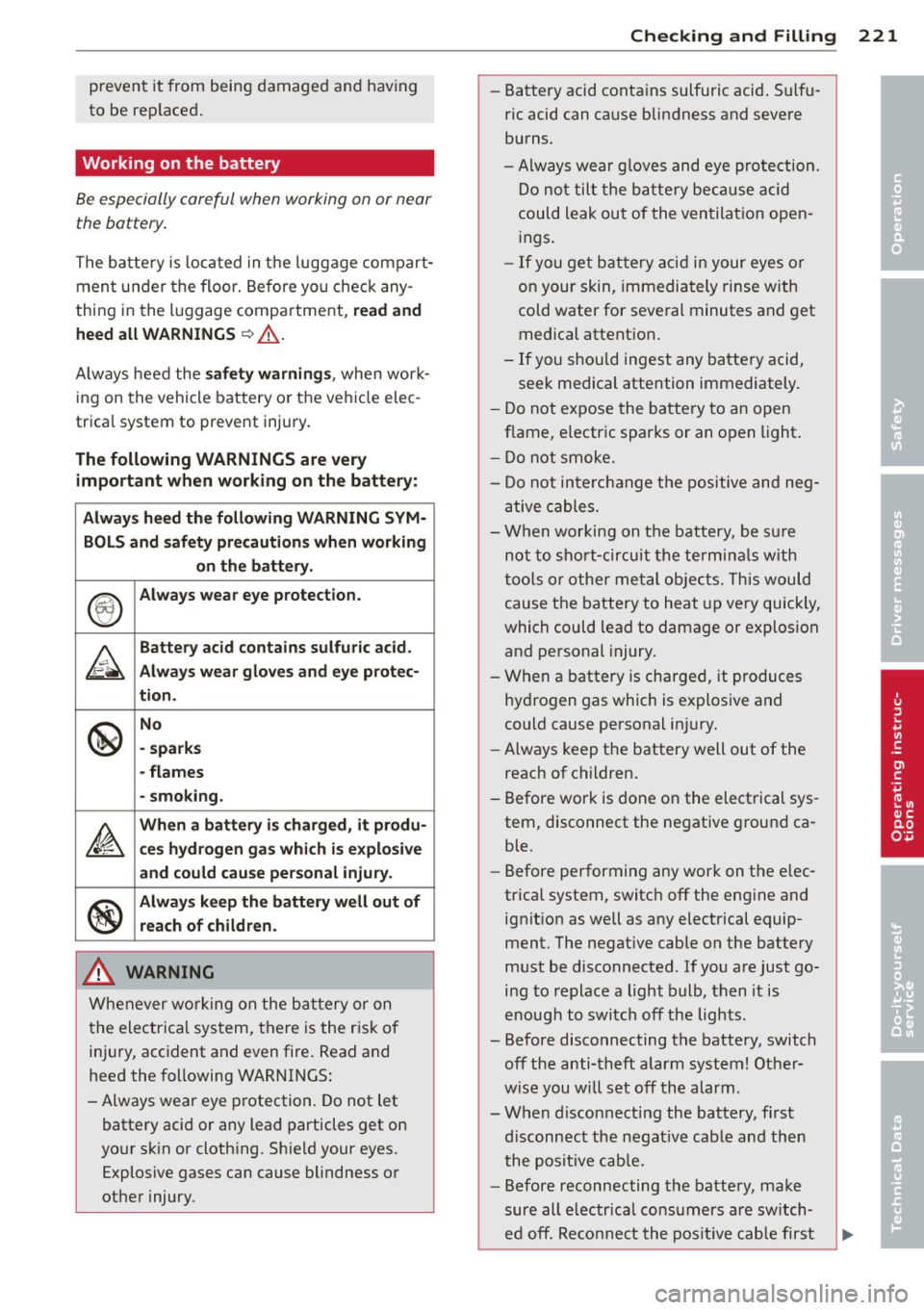
The following WARNINGS are very
impo rtant when working on the battery:
Alway s heed th e following WARNING SYM-
BOLS and saf ety precaution s when working
o n the b att ery.
®
Always wear e ye protection.
A
Batter y ac id contains sulfu ric acid .
Always w ear glo ves and e ye p rote c-
t ion .
@
No
- spark s
- flames
- smo king.
~
Wh en a battery i s charge d, it produ -
ce s hy d rogen ga s whi ch i s ex plo siv e
and could cau se perso na l injur y.
®
Alway s keep the b atter y w ell o ut of
r e ach of childr en.
A WARNING
Whenever working on the bat tery or on
the electrical system, there is the risk of
injury, accident and even fire. Read and
heed the following WARNINGS :
- Always wear eye p rotection. Do not let
battery acid or any lead particles get on
yo ur sk in or clothing. Sh ield your eyes.
Explosive gases can cause blindness or
other injury.
-
Checking and Fillin g 221
-Battery acid contains sulfuric acid . Sulfu
ric acid can cause blindness and severe
burns.
- Always wear g loves and eye protection.
Do no t tilt the ba ttery because acid
could leak out of the ventilat ion open
ings .
- If you ge t bat tery acid in your eyes or
on your skin, immediately rinse with
cold water for several minutes and get
med ical attention .
- If you should ingest any batte ry acid,
seek medical attention immediately.
- Do not expose the ba tte ry to an open
f lame, e lectric sparks or an open light .
- Do not smoke.
- Do not in terchange t he positive and neg-
ative cables.
- When working on t he battery, be su re
not to short-cir cuit the termina ls w ith
too ls or othe r metal objects. This would
cause the battery to heat up very quickly,
which could lead to damage or explosion
and pe rsonal injury.
- When a battery is charged, it produces
hydrogen gas which is explosive and
could cause personal inju ry.
- Always keep the battery well out of the
reach of children.
- Before work is done on the elect rical sys
tem, disconnect the negative ground ca
ble.
- Before performing any work on the e lec
trical system, switch off the engine and ignit ion as well as any electrical equip
ment. The negative cable on the battery
must be disconnected. If you are just go
ing to replace a light bulb, then it is
e nough to switc h off the lights.
- Before disconnecting the battery, switch off the anti-theft alarm system! Other
wise you will set off the alarm.
- When disconnecting the battery, first
disconnect the negat ive cab le and then
the posit ive cab le.
- Before reconnecting the battery, ma ke
sure all e lectr ica l consumers are sw itch
ed off. Reco nne ct the pos it ive cable first
•
•
•
Page 224 of 288
222 Checking and Fill in g
and then the negative cable . Never inter
change the cables -this could start a fire!
- Never charge a frozen or a thawed-out
battery. It could explode! If a battery has
frozen, then it must be replaced. A dead battery can freeze over at 32°F (0°C).
- Make sure the vent hose is always attach
ed to the opening on the side of the bat
tery.
- Never use batteries which are damaged.
There is the danger of an explosion! Al
ways replace a damaged battery.
&_ WARNING
California Propos ition 65 Warning:
- Battery posts, terminals and related ac
cessories contain lead and lead com
pounds, chemicals known to the State of
California to cause cancer and reproduc
t ive p roblems. Wash hands after han
dling.
(D Note
- Do not d isconnect t he veh icle battery
when the ignition is on or when the en
gine is running, otherwise, you will dam
age ele ctron ic componen ts in the elec tri
ca l system.
- If your vehicle is going to stand for a
l ong period of time wi thout being driven,
protect the battery from "freezing", oth
e rwise it w ill be damaged and wi ll then
have to be replaced.
Battery charging
Starting the engine requires a well charged battery.
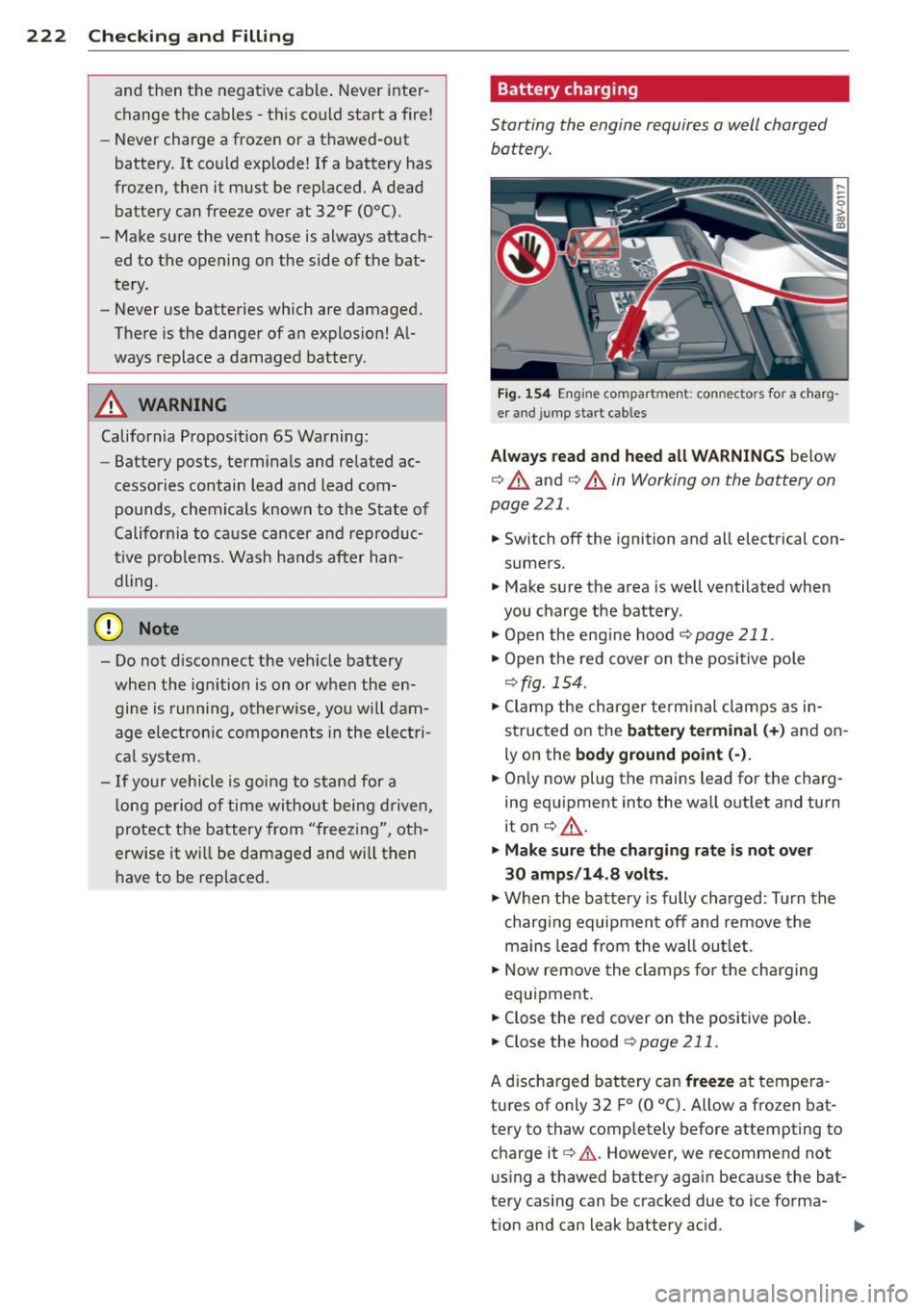
F ig . 1 54 Engine co mpartment : connectors for a charg
er and jump start cab les
Alwa ys read and heed all WARNINGS below
c> &. and c> &. in Working on the battery on
page 221.
.. Switch off the ignition and all electrical con
sumers.
.. Make sure the area is well ventilated when
you charge the battery .
.. Open the eng ine hood
r=;, page 211 .
.. Open the red cover on t he positive pole
r=;, fig. 154 .
.. Clamp the ch arger term inal clamps as in
structed on the
batter y terminal (+ ) and on
ly o n the
body ground po int (-) .
.. On ly now plug the mains lead for the charg
ing equ ipment into the wa ll outlet and turn
iton
c> &, .
.. Make sure th e charging rate is not over
30 amps /14 .8 volts .
.. When the battery is fully charged: Turn the
charg ing equipment off and remove the
mains lead from the wall ou tlet .
.. Now remove the clamps for the cha rging
equipment .
.. Close the red cover on the positive pole .
.. Close the hood
~ page 211.
A d ischarged bat tery can freeze at tempera
tu res of only 32 F
0 (0 °C). Allow a frozen bat
tery to thaw completely before attempting to charge it
r=;, .&, . However, we recommend not
using a thawed battery again because the bat
te ry casing can be cracked due to ice forma-
t ion and can leak battery acid . ..,.
Page 225 of 288
Battery charging (Ma ximum charging rate
o f 30 am ps/ 14.8 volt s)
When charging at
low voltages (e.g . with a
tri ckle ch arg er), the batte ry cables do not
have to be d isconnected first. The battery
caps should
not be opened when charging a
battery .
It is not necessary to remove the battery from
the luggage compartment, and it is also not
necessary to disconnect the cables.
F ast charging th e battery (charging rate
a bo ve 14 .8 volt s)
For technical reasons do not use a battery
charger that uses voltage greater than 14.8
volts to charge your ve hicle 's battery .
A WARNING
Charging a battery can be dangerous .
- Always follow the operating instructions
provided by the battery charge r manu
fact urer when charging your battery .
- Never charge a frozen battery . It may ex
plode because of gas t rapped in the ice .
Allow a frozen battery to thaw out first.
- Do not reuse batteries which we re fro
zen . The batte ry housing may have
cr acked and weakened whe n the battery
froze.
- Charge the battery in a we ll ventilated
area. Keep away from open flame o r ele c
trical spark. Do not smoke. Hydroge n gas
generated by the battery is exp losive.
- T o redu ce the danger o f explosion , never
conne ct or disconnect cha rger cables
wh ile the charger is operating .
- F ast charg ing a battery i s dangerous and
sho uld on ly be attempted by a compe
tent technician with the proper eq uip
me nt.
- Battery acid that may spill during charg
ing should be washed off with a so lution
of warm water and ba king soda to neu
tralize the acid.
Checking and Fillin g 223
@ Note
Neve r use a fast charger as a booster to
start the eng ine . This w ill seriously dam
age sens itive e lectronic components, such
as contro l units, relays, radio, etc., as well
as the batte ry charger .
Battery replacement
The new ba ttery mus t hove the some specifi
cations and dimensions as the original equip
ment battery .
Intelligent energy management in your vehi
cle is responsible for distributing the electri
ca l ene rgy throughout your vehicle
~ page 190 . The intelligent energy manage
ment system will keep the engine battery
c h arged better than vehicles without this sys
tem. To make sure the addition al ele ctri cal e n
ergy is ava ilab le once again after yo u have
changed the batte ry, we recommend that you
insta ll batteries of the same type an d manu
facture on ly (the same as those insta lled at
the time your veh icle was delivered) . Specif i
cations are listed on the battery housing. Your
authorized dea ler must code the battery in
the ene rgy management system to enab le you
to use the ene rgy management functions cor
re ct ly afte r repla cing the battery.
The new battery must have the same capacity,
vo ltage ( 12-volts) , amperage, construction
and plug sea ling .
When install ing the battery, make sure the ig
nition and a ll electrical consumers are switch
ed off .
~ Note
Make sure the ventilat ion hose on the side
of the battery is con nected, otherwise
fumes o r batte ry acid can lea k out.
@) For the sake of the environment
Because of the prob lem of proper disposal
of a battery, we recommend your author
i zed Audi dealer change the battery for
you. Batteries contain sulfur ic acid and ..,.
•
•
•
Page 226 of 288
224 Checking and Filling
lead and must always be disposed of prop
erly in compliance with a ll environmental
regulations. D isposing of vehicle batteries
improperly is very dangerous to the envi
ronment.
Windshield washer
fluid container
Fig. 155 Engine co mp artmen t: cove r on the wind shield
an d h ead ligh t* washer fluid rese rvo ir
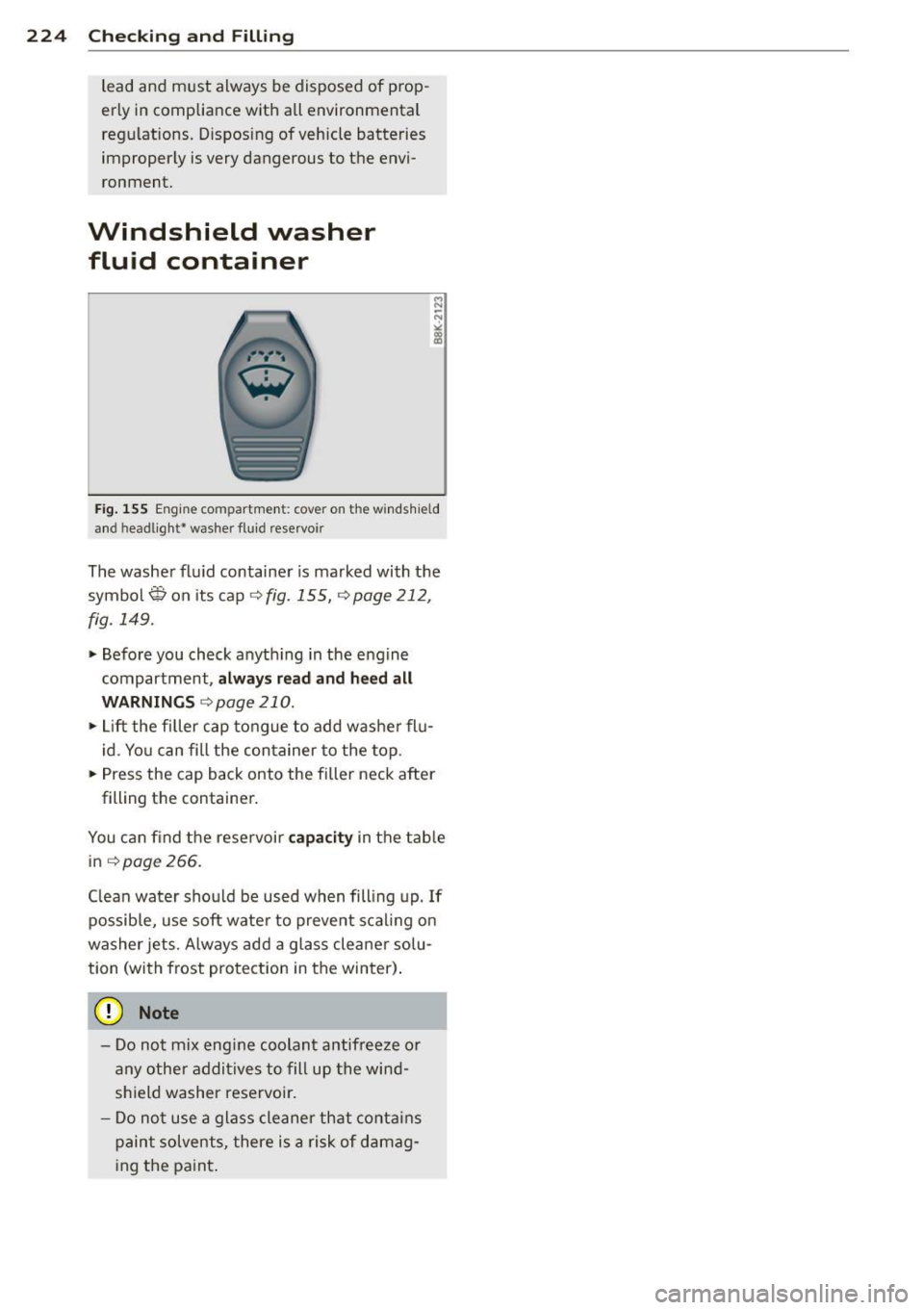
The washer flu id container is marked with the
symbol Won its cap
~fig. 155, ~page 212 ,
fig. 149 .
.. Before you check anyth ing in the engine
compartment,
always read and heed all
WARNINGS ~page 210 .
.. Lift the filler cap tongue to add washer flu
id. You can fill the container to the top .
.. Press the cap back onto the f iller neck after
filling the container.
You can find the reservoir
ca pa city in the table
in ~
page 266 .
C lean water should be used when filling up.
If
possible, use soft water to prevent scaling on
washer jets. A lways add a glass cleaner solu
tion (with frost protection in the winter) .
@ Note
- Do not mix engine coolant antifreeze or
any other additives to fill up the wind
shield washer reservoir.
- Do not use a glass cleaner that contains
paint solvents, there is a risk of damag
ing the paint.
Page 227 of 288
Tires and wheels
Tires
General notes
Tires may be the least appreciated and most
abused parts of a motor vehicle .
Tires may be the least appreciated and most
abused parts of a motor vehicle . Tires are,
however, one of the most important parts of a
veh icle, particularly considering the compara
tively small patch of rubber on each tire that
assures that a ll- important contact between
you, your vehicle and the road.
Maintaining the correct tire pressure, mak ing
sure that your vehicle and its tires do not have
to carry mo re weight than they can safely han
d le, avoiding damage from road hazards and
r eg ularly inspect ing t ires for damage includ
ing cuts, slashes irregu la r wear and overall
condition are the most important things that
you can do to he lp avoid sudden tire failure in
cluding tread separation and blowouts.
Avoiding damage If you have to d rive over a curb or similar ob
stacle, drive very slow ly and as close as possi
b le at a right angle to the curb.
A lways keep chemicals includ ing grease, o il ,
gasoline and brake fluid off the t ires .
I nspect the t ires regularly for damage (cuts,
cracks or b listers, etc.). Remove any fo reign
bod ies embedde d in the treads.
Storing tires Mark t ires when you remove them to indicate
the direction of rotation . T his ensures you to
be ab le to mount them correctly when you re
i nstall them .
When removed, the whee ls or t ires should be
sto red in a cool, d ry and preferably dark place .
Store tires in a vertical pos ition if they are not
mounted on rims, in a horizontal pos ition if
they are mounted on rims .
Tires an d wheel s 225
New tires
New ti res h ave to be broken in¢& .
The tread depth of new t ires may vary, accord
ing to the type a nd make of t ire and the tread
pa tte rn.
H idden damage
Damage to tires and rims is ofte n not readily
visible . If you notice unusual v ib rat ion or the
vehicle pulls to one s ide, th is may ind icate
that one of the t ires has been damaged . T he
ti res m ust be chec ked immed iate ly by an au
thorized Audi dea le r or q ua lified wor kshop .
Unidirectional tires
A un idirectional tire can be identified by ar
rows on the sidewa ll, that po int in the direc
tion the t ire is designed to rotate. You mus t
f ol low the specified di rection o f rotation . T his
is necessary so that these tires can develop
their optimum characteristics regarding grip, road noise, wear and hydrop laning resistance.
For more information
¢page 253.
A WARNING
New tires or t ires that are old, worn or
damaged cannot provide maximum con
trol and braking ability .
-
-New tires tend to be slippery and must
also be b roken-in. To reduce the risk of
losing control , a collision and serious
pe rsonal injuries, drive w it h special care
for the first 350 miles (560 km).
- Driving with worn or damaged tires can
lead to loss of control, sudden tire fail
ure, including a blowout and sudden de
fl ation, cras hes and se riou s personal in
juries . Have wo rn or damaged t ires re
placed immediate ly.
- Ti res age even if they are not being used
and can fai l sudden ly, especially at hig h
spee ds. Tires that are more than 6 years
old can only be used in an emergency
and then w ith special care and at low
speed.
•
•
•
Page 233 of 288
The correct tire pressure for the spare wheel is
l ocated on a label on the driver's side B-pillar.
Because tec hnical changes may be made to
vehicle equ ipment dur ing the model yea r, a l
ways compa re the tire size designation on the
tire pressure label on your vehicle wit h the
tires on your vehicle . Make s ure that the tire
size information on the veh icle label is the
same as the s ize of the tires on the vehicle.
This is especially important if the vehicle be
longs to someone else or you bought the veh i
cle with different rims/tires or you boug ht the
ve hicle as a previously owned vehicle.
Remember, your safety and that of your pas
sengers also depends on mak ing su re that
l oad limits are not exceeded. Vehicle load in
cludes everybody and everything in and on the
veh icle. These load limits are technically refer
red to as the vehicle's Gross Vehicle We ight
Rating ("GVWR") . The Gross Ax le Weight Rat
ing ("GAWR") is the maximum load that can
be app lied at each of the veh icle's two axles.
The Gross Vehicle Weight Rating and the
Gross Axle Weight Rating are listed on the
safety compliance st icker label located on the
driver's side B-p illa r. The t ire pressure label o n
your Aud i lists the maximum combined
weight of a ll of the occupants and luggage or
other cargo that the vehicle can carry. For the
l ocation of the tire pressure labe l~
fig. 156.
A WARNING
Overloading a vehicle can cause loss of ve
hicle control, a crash or other accident, se
rious personal injury, and even death.
- Carrying more weight than yo ur vehicle
was designed to carry will prevent the
vehicle from handling properly and in crease the risk of a loss of veh icle con
trol.
- The brakes on a veh icle that has been
overloaded may not be able to stop the
vehicle within a safe distance .
- Tires on a vehicle that has been overload
ed can fail suddenly causing loss of con
t rol and a crash.
Tire s an d wheel s 231
-Always make sure that the total load be
ing transported - includ ing the weight of
a trailer hitch and the tongue we ight of a
loaded trailer -does not make the vehi
cle heavier than the vehicles Gross Veh i
cle Weight Rating.
A WARNING
- Inco rrect tire pressures and/or underin
flation can lead to a ser ious or fatal acci
dent.
- Inco rrect tire pressures and/or underin
flation cause increased tire wear and can
affect the handling of the vehicle.
- Inco rrect tire pressures and/or underin
flation can a lso lead to sudden t ire fail
ure, including a blowou t and sudden de
flation, caus ing loss of veh icle contro l.
Checking tire pressure
The correct tire pressure for the tires original
ly installed on your vehicle is listed on the tire
pressvre label located on driver's side 8-pil
lar.
T he recommended tire pressures are on the
ti re pressure label and in the table
~ page 229, Cold tire inflation pressure . This
means that the pressure m ust be checked and
adjusted when the tire has not been dr iven for
more than a couple of miles (kilometers) at
low speeds during the previous three hours.
Air in the tires expands when the tire heats up
as a result of internal frict ion as it flexes in
use. The tire pressure is h igher when the tire
has warmed up t han when it is "cold."
It is the inflation pressure in a "cold" t ire that
counts. Therefore, you should never let a ir out
of a warm tire to match "Cold tire inflat ion
pressure" recommendat io ns ~
page 229 . Th e
ti res wo uld then be unde rinfl ated and co uld
fail suddenly.
T he tire pressure label on your Audi lists the
recommended co ld tire inflation pressures at
max imum capacity for the new, or ig inal
equipment tires that were on your vehi cle at
•
•
•
Page 234 of 288
232 Tire s and wheel s
the time it was manufactured . For the
location of the label
c::> page 229, fig . 156.
Most ti res lose a ir naturally over time. They
can also lose some a ir if you drive ove r a pot
ho le or hit a curb while parking . It is usua lly
not possible to see whether the radial tires
used today are under inflated just by looking
at them.
Therefore, be sure to check tire pressures at
l east once a month and always before going
on a long tr ip. Make sure to take the number
of people and the amount of luggage into ac
count when adjusting tire pressure for a trip -
even one that you would not consider to be
" long." See
c::> page 233 , Tires and vehicle
load limits
for more important information .
Always use an accurate tire pressure gauge
when checking and adjusting inflation pres
sures . Check all of the t ires and be sure not to
forget the spare t ire . If the pressure in any tire
is too high when the tire is "cold ," le t air out
of the tire slowly with the edge of the tire
gauge and keep checking the pressure until
you reach the pressure that is correct for the l oad (passengers and luggage) and kind of
driving you plan to do .
I f the pressure in any tire is too low, note the
diffe rence between the pressure in the cold
tire and the pressure you need and add the air
that you need to reach the cor rect pressure for
the vehicle load (passengers and luggage) for
the tires on your veh icle as lis ted on the on
your veh icle and in this manual and the k ind
of dr iv ing you pla n to do .
Never e xceed th e ma ximum inflatio n pres
sure li sted on th e tire s id ewall for an y rea
son .
Remember that the vehicle manufacturer, not
the tire manufacturer, determ ines the correct
tire pressure for the t ires on your vehicle .
It is important to check the tire pressure when
the tires are cold .
- Read the req uired ti re pressure from the tire
pressure label. The tire pressure labe l is lo
cated on the driver's side B-pi llar . - Tu
rn the va lve stem cap counter -clockwise
to remove it from the tire va lve .
- Place the air pressure gauge on the va lve.
- The tire pressu res should only be checked
and adj usted when the tires are co ld. The
slightly raised pressures of warm tires must
not be reduced.
- Adjust the tire pressure to the load you are
carrying.
- Reins tall the valve stem cap on the va lve.
When should I check the tire pr essure ?
The correct tire pressure is especially impor
tant at high speeds. The pressure should
the refore be che cked at least once a mo nth
and always before sta rting a jo urney. Do not
f orget to c heck the ti re p ress ure for the spare
whee l
c::> page 247.
When should I adjust the tire pressures?
Adjust the t ire pr essure to the load you are
ca rrying. After cha ng ing a whee l
or replacing
whee ls you have to adjust the ti re p ress ures
on all whee ls. In addition, you m ust then
store the new tire pressures in the tire pres
s u re monitoring system
c::> page 243 .
A WARNING
Incorrect tire pressures and/or underinfla
tion can lead sudden tire fa ilure, loss of
control, collision, serious personal injury
or even death.
- When the warning symbol
RIJ appears in
the instrument cluster, stop and inspect
the t ires.
- Incorrect tire pressure and/or underinfla
tion can cause increased tire wear and
can affect the handling of the vehicle and
stopping abi lity.
- Inco rrect tire pressures and/or underin
f lation can a lso lead to s udden t ire fail
ure, including a blowout a nd sudden de
f lation, ca using loss of veh icle cont ro l.
- The driver is responsible for the co rrect
tire pressures for all tires on the veh icle.
The appli cable pressure values are locat
ed on a sticker on the dr iver's side B-pil-
lar .
~