lock AUDI A3 2016 Owner´s Manual
[x] Cancel search | Manufacturer: AUDI, Model Year: 2016, Model line: A3, Model: AUDI A3 2016Pages: 328, PDF Size: 81.78 MB
Page 165 of 328
,....,
N
0 > co ,....,
• Do not drive vehicle: steering defective
If th is ind icator light turns on and stays on and
this message appears, the power steering may
h ave fa iled.
Do
not cont inue driving . See an authorized Aud i
dealer or authorized Aud i Serv ice Faci lity for as
sistance.
• Do not dr ive vehicle: steering defective
There is a malfunction in the electronic steering
lock. You cannot turn the ignition on.
Do
not tow your vehicle beca use it cannot be
steered. See an authorized A udi dealer or author
ized Audi Service Facility for assistance.
':r- ij Steering malfunction : you can continue driv
ing
I f the indicator light turns on, the steering whee l
may be more diff icult to move o r more sensitive
than usual. The steering wheel may also be at an
angle when driving st raight.
Drive slowly to an author ized Audi dealer or au
thor ized Audi Service Facility to have the mal
function corrected.
1;11 Steering lock: system fault! Please contact
Service
There is a malfunction in the electronic steering
lock.
Drive to an authorized Aud i dea ler or authorized
Aud i Service Faci lity immediately to have the
malfunct ion corrected.
A WARNING -
Have the system malfunction corrected as
soon as possible by an authorized Audi dealer
or authorized Audi Service Facility, as this in
creases the risk of an accident .
(D Tips
If the . or t~ff indicator light only stays on
for a short time, you may continue dr iv in g.
Intelligent Technology
All wheel drive (quattro)
Applies to vehicles: with all wheel drive
In all wheel drive, all four wheels ore powered.
General information
In all wheel dr ive, the driving power is div ided be
tween all fou r wheels . This happens automatical
ly depending on yo ur driving behavior as well as
the current road conditions . A lso see
c> page 159, Electronic stabilization control
(ESC).
The all whee l drive concept is designed for high
engine power. Yo ur vehicle is exceptionally pow
erfu l and has excellent driving characteristics
both under normal driving conditions and on
snow and ice. Always read and follow safety pre
cautions
c> ,&. .
Winter tires
By using all wheel drive, your vehicle has good
forward motion with standard tires in winter con
ditions. However, in winter we recommend using
winter or all season tires on
all four wheels, be
cause this will improve the
broking effect.
Snow chains
If there are snow chain laws, snow chains must
also be used on veh icles w ith all wheel dr ive
c> page 269, Snow chains.
Replacing tires
For vehicles with a ll wheel d rive, only wheels with
the same rolling circumference should be used .
Avoid wheels with different tread depths
c> poge 260.
Offroad vehicle?
Your Audi is not an offroad vehicle -there is not
enough ground clearance. For this reason, avoid
difficu lt terrain . Also see<=)
page 302.
A WARNING
--Also, in veh icles with all whee l drive, adapt
your driving style to the current road and
traffic cond itions. Do not let the increased
safety prov ided tempt you into taking r isks.
163
Page 170 of 328
Driving safety
is as close to this position as possible. Move the
head restraint so that it is as close to the back
of the head as possible.
"' Fasten and wear safety belts correctly
<=> page 179.
"'Always keep both feet in the footwell so that
you are in control of the vehicle at all times.
For detailed information on how to adjust the
driver's seat, see
<=> page 59.
A WARNING
Drivers who are unbelted, out of position or
too close to the airbag can be seriously in
jured by an airbag as it unfolds. To help re
duce the risk of serious personal injury:
- Always adjust the driver's seat and the
steering wheel so that there are at least
10 inches
(25 cm) between your breastbone
and the steering wheel.
- Always adjust the driver's seat and the
steering wheel so that there are at least
4 inches (10 cm) between the knees and the
lower part of the instrument panel.
- Always hold the steering wheel on the out
side of the steering wheel rim with your
hands at the 9 o'clock and 3 o'clock posi
tions to help reduce the risk of personal in
jury if the driver's airbag inflates.
- Never hold the steering wheel at the
12 o'clock position or with your hands at
other positions inside the steering wheel
rim or on the steering wheel hub. Holding
the steering wheel the wrong way can cause
serious injuries to the hands, arms and head if the driver's airbag inflates.
- Pointing the steering wheel toward your
face decreases the ability of the supplemen
tal driver's airbag to protect you in a colli
sion.
- Always sit in an upright position and never
lean against or place any part of your body
too close to the area where the airbags are
located.
- Before driving, always adjust the front seats
properly and make sure that all passengers
are properly restrained.
168
-
- For adjustable head restraints: before driv
ing, always also adjust the head restraints
properly.
- Never adjust the seats while the vehicle is
moving. Your seat may move unexpectedly
and you could lose control of the vehicle.
- Never drive with the backrest reclined or tilted far back! The farther the backrests are
tilted back, the greater the risk of injury due
to incorrect positioning of the safety belt
and improper seating position .
- Children must always ride in child seats
<=> page 209 . Special precautions apply
when installing a child seat on the front
passenger seat
c> page 184.
· Proper seating position for the front
passenger
The proper front passenger seating position is
important for safe , relaxed driving.
For your own safety and to reduce the risk of in
jury in the event of an accident, we recommend
that you adjust the seat for the front passenger
to the following position :
"'Adjust the angle of the seatback so that it is in
an upright position and your back comes in full
contact with it whenever the vehicle is moving.
"' For adjustable head restraints: adjust the head
restraint so the upper edge is as even as possi
ble with the top of your head. If that is not pos
sible, try to adjust the head restraint so that it
is as close to this position as possible
<=> page 170 . Move the head restraint so that it
is as close to the back of the head as possible.
"' Keep both feet flat on the floor in front of the
front passenger seat .
"' Fasten and wear safety belts correctly
<=> page 179 .
For detailed information on how to adjust the
front passenger's seat, see
9 page 58 .
A WARNING
Front seat passengers who are unbelted, out
of position or too close to the airbag can be
Page 175 of 328
.... N
0 > co ....
~page 166.
A WARNING
To help prevent poisonous exhaust gas from
being drawn into the vehicle, always keep the
rear lid closed while driving .
- Never transport objects larger than those
fitting completely into the luggage area be
cause the rear lid cannot be fully closed .
-If you absolutely must drive with the rear lid
open, observe the following notes to reduce
the risk of poisoning:
- Close all w indows,
- Close the power roof*,
- Open all air outlets in the instrument pan-
el,
- Switch off the air recirculation,
- Set the fresh air fan to the highest speed .
A WARNING
-
Always make sure that the doors, all win
dows, the power roof* and the rear lid are se
curely closed and locked to reduce the risk of
injury when the vehicle is not being used.
- After closing the rear lid, always make sure
that it is properly closed and locked.
- Never leave your vehicle unattended espe
cially with the rear lid left open. A child
could crawl into the vehicle through the lug
gage compartment and close the rear lid be
coming trapped and unable to get out. Be
ing trapped in a vehicle can lead to serious
personal injury.
- Never let children play in or around the vehi
cle.
- Never let passengers r ide in the luggage
compartment. Vehicle occupants must al
ways be properly restrained in one of the ve
hicle's seating positions.
(D Tips
- Air circulation helps to reduce window fog
ging. Stale air escapes to the outside
through vents in the trim panel. Be sure to
keep these slots free and open.
Driving safety
-The tire pressure must correspond to the
load. The tire pressure is shown on the tire
pressure label. The tire pressure label is lo
cated on the driver's side B-pillar . The tire
pressure label lists the recommended cold
tire inflation pressures for the vehicle at its
maximum capacity weight and the tires that
were on your vehicle at the time it was man ufactured. For recommended tire pressures
for normal load conditions, please see chap
ter
~ page 263.
' Tie-downs
The luggage compartment is equipped with four
tie-downs to secure luggage and other items.
Use the tie-downs to secure your cargo properly
~ page 172, Loading the luggage compartment.
In a collision, the laws of physics mean that even
smaller items that are loose in the vehicle will
become heavy missiles that can cause serious in
jury. Items in the vehicle possess energy which
vary w ith vehicle speed and the weight of the
item. Vehicle speed is the most significant factor.
For example, in a frontal collision at a speed of
30 mph (48 km/h), the forces acting on a 10-lb
(4.5 kg) object are about 20 times the normal
weight of the item. This means that the weight
of the item would sudden ly be about
200 lbs. (90 kg). You can imagine the injuries
that a 200 lbs. (90 kg) item flying freely through
the passenger compartment could cause in a col
lision like th is.
A WARNING
-Weak, damaged or improper straps used to
secure items to tie-downs can fail dur ing hard
braking or in a collision and cause serious per
sona l injury.
- Always use suitable mounting straps and
properly secure items to the tie-downs in
the luggage compartment to help prevent
items from shifting or flying forward as dan
gerous missiles .
- When the rear seat backrest is folded down,
always use suitable mounting straps and
properly secure items to the tie-downs in
173
Page 182 of 328
Safe ty belts
Autom ati c s afet y belt retr actors
Every safety belt is equ ipped with an automa tic
be lt retractor on the shoulder belt. This feature
locks the belt when the belt is pulled out fast,
during hard braking and in a n accident . The belt
may a lso lock when you drive up or down a steep
hill or through a sharp curve. Dur ing normal driv
ing the belt lets you
move freely .
Safety belt p ret en sion ers
The safety belts are equipped with a belt preten
sioner that helps to t ighten the safety belt and
remove slack when the pretensioner is activated
c;, page 182 . The function of the pretensioner is
mon itored by a warn ing light
c;,page 21.
Convertible loc king retracto r
Every safety belt except the one on the driver
seat is equipped with a convertible locking retrac
tor that
must be used when the safety belt is
used to attach a child seat. Be sure to read the
important information about this feature
¢ page 219 .
.&_ WARNING
Improperly pos it ioned safety be lts can cause
ser ious injury in an accident ¢
page 180,
Safety belt position.
- Safety belts offer optimum protection only
when the seatback is upright and belts are
properly positioned on the body.
- Always make sure that the rear seat bac k
rest to which the center rea r safety belt* is
attached is secure ly latched whenever the
rear center safety belt is being used. If the
backrest is not securely latched, the passen
ger will move forward with the backrest dur
ing sudden braking, in a sudden maneuver
and especially in a crash.
- Never attach the safety belt to the buckle for another seat. Attaching the belt to the
wrong b uckle will reduce safety belt effec
t iveness and can cause serious persona l in
jury.
- A passenger who is not properly restrained can be seriously in jured by the safety be lt it
self when it
moves from the stronger parts
180
of the body into critical areas like the abdo men.
- Always lock the convertible locking retractor
when you are securing a child seat in the ve
hicle
c;, page 221.
(D Tips
For information on safety belt pretensioners,
refer to
c;, page 182 .
Safety belt position
Correct belt position is the key to getting maxi
mum protection from safety belts.
Fig. 158 Safety belt posit ion
Use the height adjustment to change the posit ion
of the shoulder belt of the front safety belts .
.&_ WARNING
Imp roperly positioned safety belts can cause
serio us pe rsonal injury in an a cc ident.
- The shou lde r belt should lie as close to the
center of the collar bone as possib le and
should fi t well on the body. Ho ld the belt
above the latch to ngue and pull it evenly
across the chest so that it sits as low as pos
sible on the pe lvis and there is no pressure
on the abdomen. The belt should a lways f it
snug ly
c;, fig. 158. Pull on the belt to tighten
if necessary.
- The lap belt portion of the safety belt must
be positioned as low as possible across pel
vis and never over the abdomen . Make sure
the belt lies flat and snug
c::> fig. 158 . Pull on
the belt to tighten if necessary.
Ii-
Page 190 of 328
Airbag syste m
-Always make sure that there is nothing on
the front passenger seat that w ill cause the
capacitive passenger detection system in
the seat to signal to the Airbag System that
the seat is occupied by a person when it is
not, or to signa l that it is occupied by some
one who is heav ier than the person actually
sitting on the seat. The p resence of addi
tional objects could cause the passenger
front airbag to be turned on when it shou ld
be off, or could cause the airbag to work in a
way that is different from the way it would
have worked without the ob ject on the seat.
Front airbags
Description of front airbags
The airbag system can provide supplemental
protection to properly restrained front seat occu
pants.
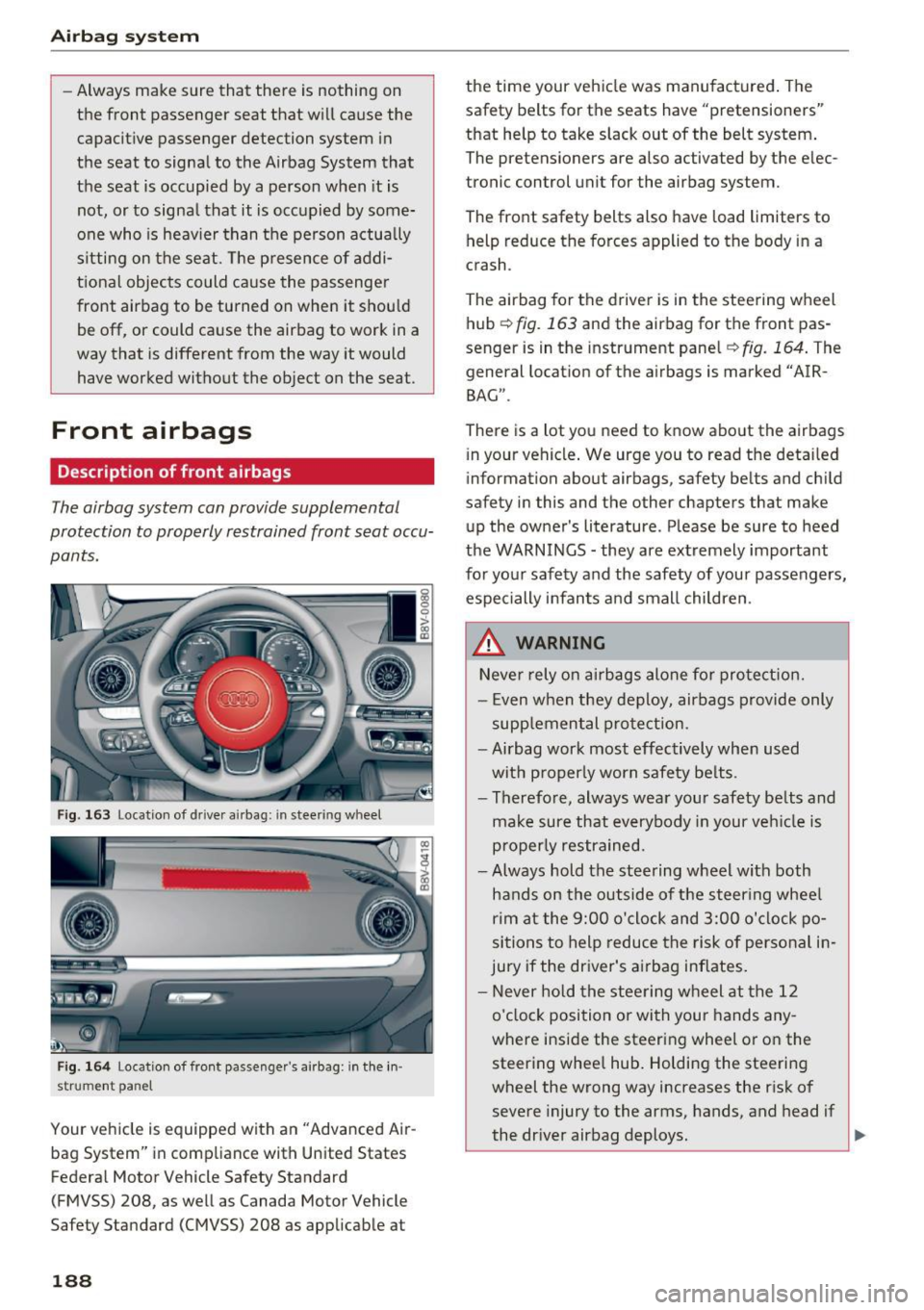
F ig. 163 Location of driver airbag: in steering wheel
Fi g. 16 4 Locatio n of front passenger 's airbag: in the in·
strument panel
Your vehicle is equipped with an "Advanced Air
bag System" in comp liance with United States
Federa l Motor Vehicle Safety Standard
(FMVSS) 208, as well as Canada Motor Vehicle
Safety Standard (CMVSS) 208 as applicable at
188
the time your vehicle was manufactured. T he
safety belts for the seats have "pretensioners"
that he lp to take s lack out of the belt system .
The pretensioners are also activated by the elec
tronic control unit for the airbag system.
The front safety belts also have load limiters to help reduce the forces applied to the body in a
crash.
The airbag for the driver is in the stee ring wheel
hub
~ fig. 163 and the airbag for the front pas
senger is in the instrument pane l
~fig. 164 . The
general locat ion of the airbags is marked "AIR
BAG" .
There is a lot you need to know abo ut the airbags
i n your vehicle . We urge you to read the detai led
information about airbags , safety belts and ch ild
safety in this and the other chapters that make
up the ow ner's literature . Please be sure to heed
the WARNINGS -they are extremely important
fo r your safety and the safety of your passengers,
especially i nfants and small children .
.&, WARNING
-
Never rely on a irbags alone for prote ct io n.
- Even when they deploy, airbags p rovide only
supp lemental protection.
- Airbag work most effec tively when used
wit h properly worn safety be lts .
- Therefo re, always wear your safety be lts and
make sure that everybody in your veh icle is
properly restrained.
- Always hold the steering wheel w ith both
hands on the outside o f the steer ing whee l
rim at the 9:00 o'clock and 3:00 o'clock po
si tions to help reduce the risk of personal i n
jury if the driver's a irbag inflates.
- Never hold the stee ring wheel at the 12
o 'clock posi tion or with your hands any
where inside the steering wheel o r on the
steer ing whee l hub. Holding the steeri ng
wheel the wrong way increases the r isk of
severe injury to the arms, hands, and head if
the driver airbag deploys. .,,.
Page 199 of 328
,....,
N
0 > co ,....,
the front passenger seat . Always make sure that
the safety belt for the front passenger seat is
properly fastened.
Th e PASSENGER AIR BAG OFF light will show
the status of the front seat p assenger' s fr ontal
Ad vanced Airbag a few se cond s after the igni·
tion i s swit ched on and the ai rbag in d icator
light goes off . The PA SSEN GER AIR BA G OFF
light :
-will stay on if the front passenger seat is not
occupied;
- wi ll stay on if the electrical ca pacita nee meas
ured by the capacit ive passenger detection sys
tem for the front passenger seat equals the combined capacitance of an infant up to about
one year of age and one of the rearward-facing
o r fo rwa rd-facing ch ild restraints listed in Fed
era l Moto r Vehicle Safety Standard 208 w it h
wh ich the Advanced Airbag System in your veh i
cl e was certified; Fo r a listing of the child re
straints that were used to certify you r vehicle 's
compliance with the U.S. Safety Standard
¢ page 211 .
-will go out if the front passenger seat is occu
pied by an adult as registered by the capacitive
passenger detection system .
- The
PASSENGER AIR BAG OFF light must come
on and stay on if the ignition is on and ...
- a car bed has been insta lled on the front pas
senger seat, or
- a rearward-facing child restrai nt has been in
sta lled on the front passenger seat, or
- a forwa rd-facing child restra int has bee n instal
l ed on the front passenge r seat,
- and if the e lectr ic al capaci tance registered on
the front passenger seat is equal to or less than
the combined capacitance of a typical 1 year o ld infant and one of the rearward-facing or
forward -facing chi ld restraints listed in Federal
Motor Vehicle Safety Standard 208 w ith which
the Advanced Airbag System in your vehicle was
certified.
If the front passenger seat is not occupied, the
front airbag w ill not deploy, and the
PA SSENGER
AIR BAG OFF
light will stay on. Never install a
rearward -fac ing ch ild restraint on the front pas-
Airb ag sys tem
senger seat, the safest place for a chi ld in any
kind of child restraint is at one of the seating po
s itions on the rear seat¢
page 185, Child re
straints on the front seat -some important
things to know
and ¢ page 209, Child safety .
If the PASSENGER AIR BAG light comes
on ...
If the PA SSEN GER AIR BAG OFF light comes on
when one of the conditions listed above is met,
be sure to check the light regu larly to make cer
ta in that the
PASSENGER AIR BAG OFF l ight
stays on continuously whenever the ignition is
on. If the
PASSENGER AIR BAG OFF li ght does
not appear on and does no t stay on a ll the time,
stop as soon as it is safe to do so and
- react ivate the system by turning the ignit ion
off for more than 4 seconds a nd then turn ing it
on again;
- remove and re insta ll the chi ld restraint. Make
sure that the chi ld restraint is properly insta l
led and that the safety belt for the front pas
senger seat has been correct ly routed through
the child restraint as described in the c hild re
straint manufacturer's instructions;
- make sure that the convertible locking retrac
tor on the safety belt for the front passenge r
seat has been activated and that the safety belt has been pulled tight.
- make sure that no e lectr ica l device (such as a
laptop, CD player, e lectron ic games device,
power inverter or seat heater for ch ild seats) is
placed or used on the fro nt passenger seat if
the device is connected to the 12-volt socket or
the c igarette lighter socket;
- make sure that no seat heater has been retro
fitted or othe rw ise added to the front passen
ger seat;
- make sure that not hing can inte rfere with the
safety belt buckles and that they are not ob
structed;
- make sure that there are no wet objects (such
as a wet towe l) and no water or other liquids on
the front passenge r seat cushion. .,..
197
Page 214 of 328
Child safet y
sold in the past or will be sold ove r the course of
the useful life of your vehicle.
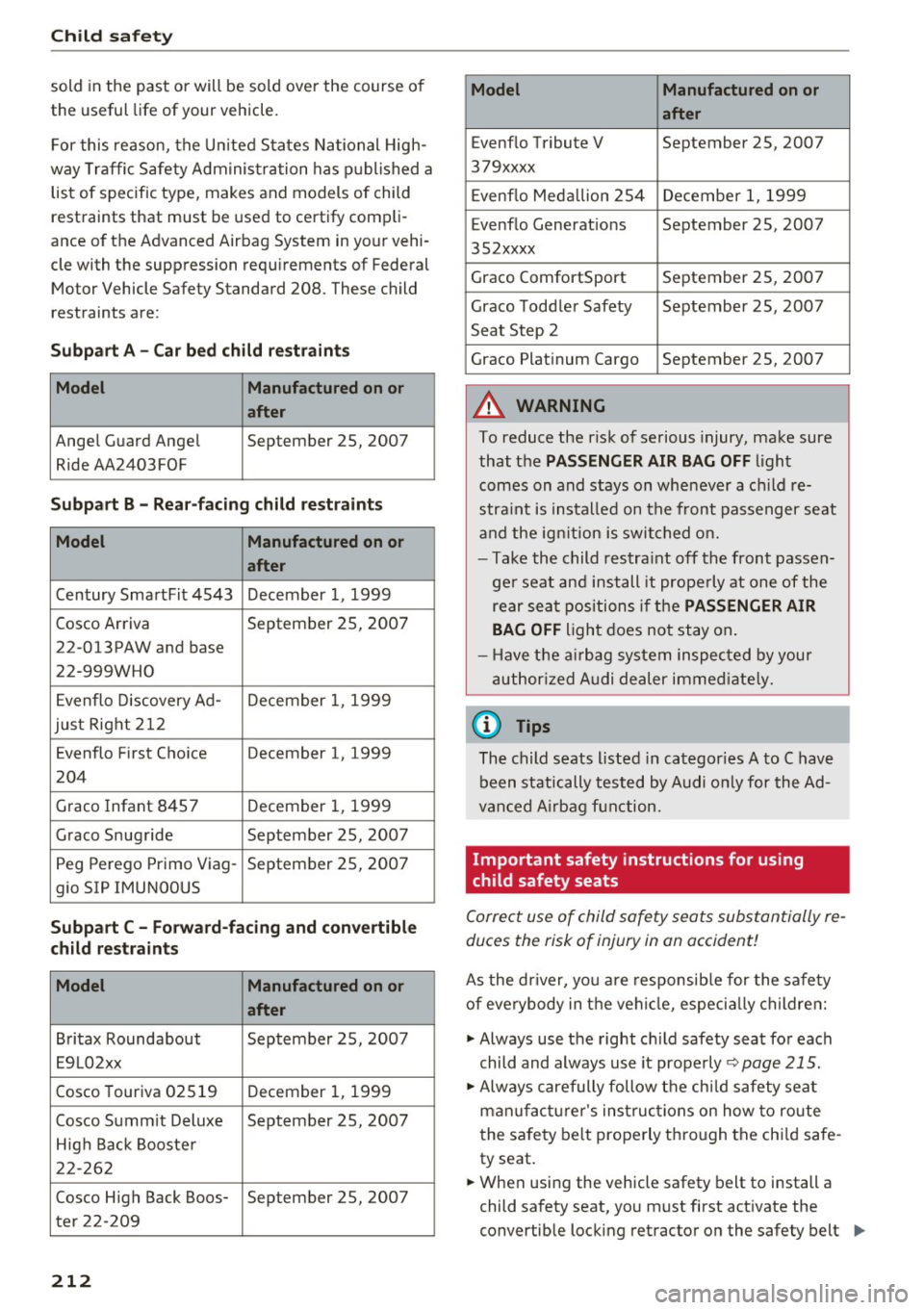
F or this reason, the U nited States National High
way Traffic Safety Adm inis tration has p ublished a
list of specific type, makes and models of child
restraints that must be used to certify compli
ance of the Advanced Airbag System in your vehi
cle with the suppression requ irements of Federal
Motor Vehicle Safety Standard 208. These child
restraints are:
Subpart A - Car bed child re straint s
Model Manufactured on or
after
Angel Guard Angel September 25, 2007
Ride AA2403FOF
Subp art B -Rear-facing child restr aint s
Model Manufactured on or
after
Century SmartFit 4543 December 1, 1999
Cosco Arriva September 25, 2007
22-013PAW and base
22-999WHO
E venflo Discovery Ad- December 1, 1999
jus t Right 21 2
Evenflo First Cho ice December 1, 1999
204
Graco Infant 8457
December 1, 1999
Graco Snug ride September 25, 2007
Peg Perego Primo V iag- September 25, 2007
gio SIP IMUNOOUS
Subpart C - Forward -facing and convertib le
child restraint s
Model Manufactured on or
after
Britax Roundabout September 25, 2007
E9L02xx
Cosco Touriva 02519 December 1, 1999
Cosco S umm it Deluxe September 25, 2007
High Back Booste r
2 2-262
Cosco High Back Boos- September 25, 2007
ter 22-209
212
Model Manufactured on or
after
Evenflo Tribute V September 25, 2007
379xxxx
E venflo Meda llion 254 December 1, 1999
Evenflo Generat ions September 25, 2007
352xxxx
Graco ComfortSport September 25, 2007
Graco Toddler Safety September 25, 2007
Seat Step 2
Graco Plat inum Cargo September 25, 2007
A WARNING
To reduce the risk of serious injury, make sure
that the
PASSENGER AIR BAG OFF light
comes on and stays on whenever a ch ild re
stra int is installed on the front passenger seat
and the ign ition is swi tched on.
- Take the child restra int off the front passen
ge r seat and install it prope rly at one of the
rear sea t positions i f the
PASSENGER AIR
BAG
OFF light does no t stay on .
-Have the ai rbag system in spec ted by y our
author ized Audi dealer immed iate ly.
(D Tips
The child seats listed in categor ies A to C have
been statically tested by Audi only for the Ad
van ced A irbag fun ction.
Important safety instructions for using
child safety seats
Correct use of child safety sea ts substantially re
duces the risk of injury in an accident!
As the dr iver, yo u are responsib le for the safety
of eve rybody in the veh icle, e speci ally childre n:
.,. Always use the right c hild safety seat for each
child and always use it properly
~ page 215.
.,. Always carefully follow t he chi ld safety seat
man ufac turer's ins truc tions on how to route
t he sa fety belt properly th ro ugh the ch ild safe
ty seat.
.,. When using the vehicle safety belt to install a
child sa fety seat, yo u must first activate the
convertib le locking retracto r on the safety belt
Ill-
Page 216 of 328
Child safety
-Make sure the forward-facing seat has
been designed and certified by its manu
facturer for use on a front seat with a
passenger front and side airbag .
- Always carefully follow the manufacturer's
instructions provided with the child safety
seat o r carrier .
- Always move the front passenger seat into
the rearmost position of the passenger
seat's fore a nd aft adjustment range, and
as far away from the airbag as possible be
fore insta lling the child restraint.
- Always make sure that nothing prevents
the front passenge r's seat from be ing
moved to the rearmost posit ion in its fore
and aft adjustment range.
- Always make sure that the back rest is in
the upr ight position.
- Never place or use any e lectr ica l device
(such as a laptop, CD player, e lectron ic
g ames device, power inve rter or sea t heat
er for ch ild seats) on the front passenger
seat if the device is connected to the 12 -
volt socket or the cigarette lighter socket.
- If a seat heater has been retrofitted or
otherwise added to the front passenger
seat, never install any chi ld restraint sys
tem on th is seat.
- Make sure that there are no wet objects
(such as a wet towel) and no water or oth
er liqu ids on the front passenger seat
cushion.
- Never place objects on the seat (such as a
laptop, CD p layer, electron ic games de
vice, power inverter or seat heater for
child seats). These may influence the elec
trical capacitance measured by the capaci tive passenge r detection system and can
a lso fly around in an accident and cause
serio us personal in jury.
- Always bu ckle the child safety seat firmly in
place even if a child is not s itting in it. A
loose child safety seat can fly around during
a sudden stop or in a collisio n.
- Always re ad a nd heed all WARN INGS when
ever using a child restrained in a vehicle is
being used
¢ page 176, Safety belts,
214
c::> page 184, Airbag system and
c::> page 209 , Child safety.
A WARNING
To reduce the risk of serious injury, make sure
that the
PASSENGER AIR BAG OFF light
comes on and stays on whenever a ch ild re
stra int is installed on the front passenger seat
and the ign ition is switched on.
- Take the child restra int off the front passen
ge r seat and install it prope rly at one of the
rear seat positions if the
PASSENGER AIR
BAG OFF
light does no t stay on.
- Have the airbag system inspected by your
author ized Audi dealer immed iate ly.
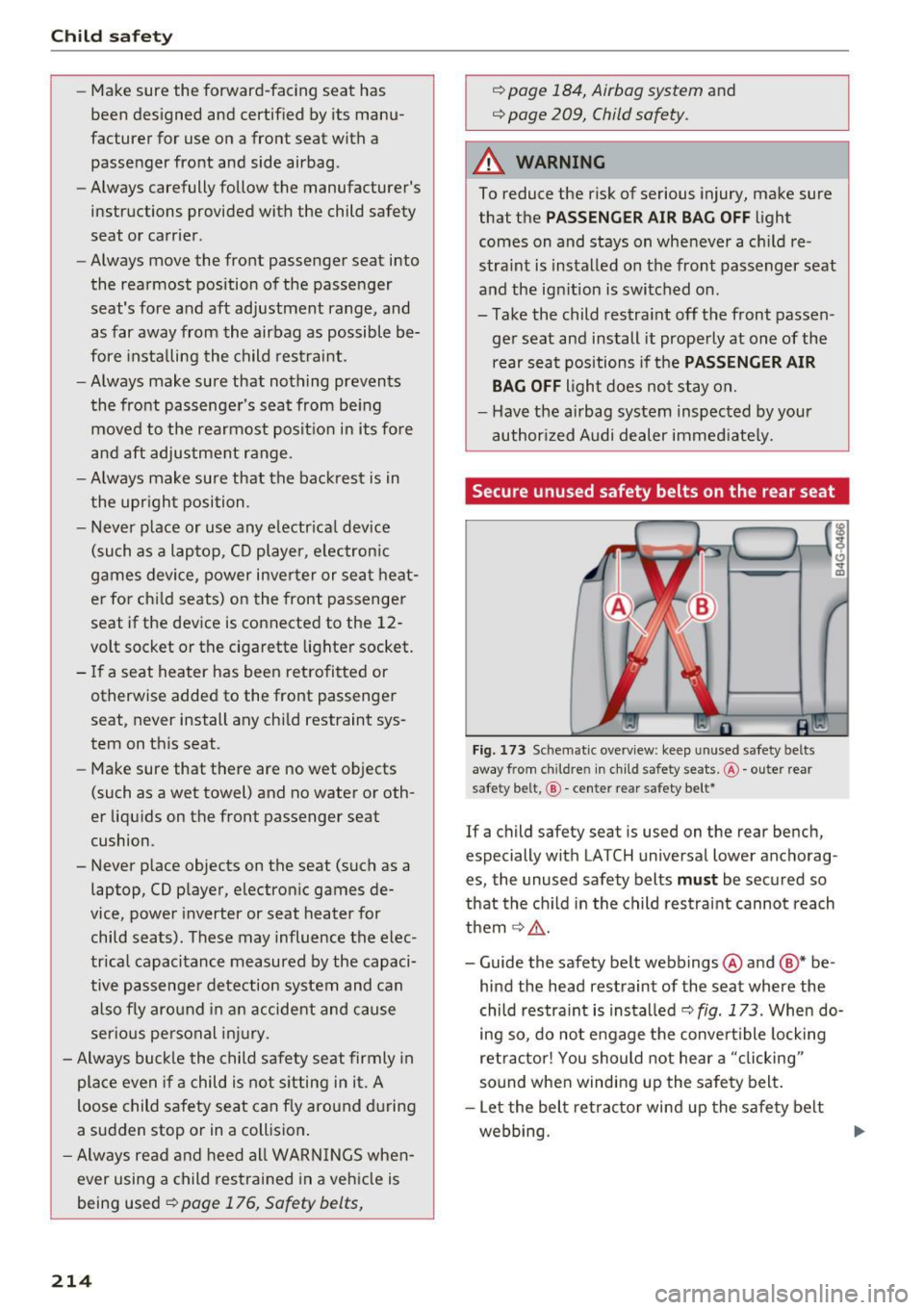
Secure unused safety belts on the rear seat
Fi g. 173 Schema tic overv iew: keep unused safety belts
away from children in c hild safety seats.@· outer rear
safety belt,@· ce nter rear safety belt*
If a child safety seat is used on the rear bench,
especially with LATCH universal lower anchorag
es, the unused safety belts
must be sec ured so
that the c hild in the child rest raint cannot reach
them
c::> _&. .
- Guide the safety belt webbings @and @* be
hind the head restraint of the seat where the
child restra int is installed
c::> fig. 173. When do
ing so, do not engage the convert ible locking
ret ra ctor! You should not hear a "cl icking"
sound when winding up the sa fe ty belt.
- Let the belt ret racto r wind up the safety belt
webbing.
Page 217 of 328
.... N
0 > CX)
.... I.Cl U"I ,....,
I.Cl ....
_& WARNING
A child in a child safety seat installed with the
LATCH lower anchorages or w ith the standard
safety belt or a child in a booster seat on the
rear seat could play with unused rear seat
safety belts and become entangled. This
co uld cause the ch ild ser ious personal inj ury
and even death .
- Always se cure unused rear seat safety belts
out of reach of ch ildren in child seats such
as by properly routing them around the
head restraint of the seat where the child
restraint is installed .
- Never activate the convertible locking re
tractor when routing the safety belts around
the head restraints.
- Never let anyone sit at the center rear seat
ing position if the center rear safety belt has
been routed around a rear head restraint.
Child seats
Infant seats
Babies and infants up to about one year old and
20 lbs. or
9 kg need special rearward-facing
child restraints that support the back, neck and
head in a crash .
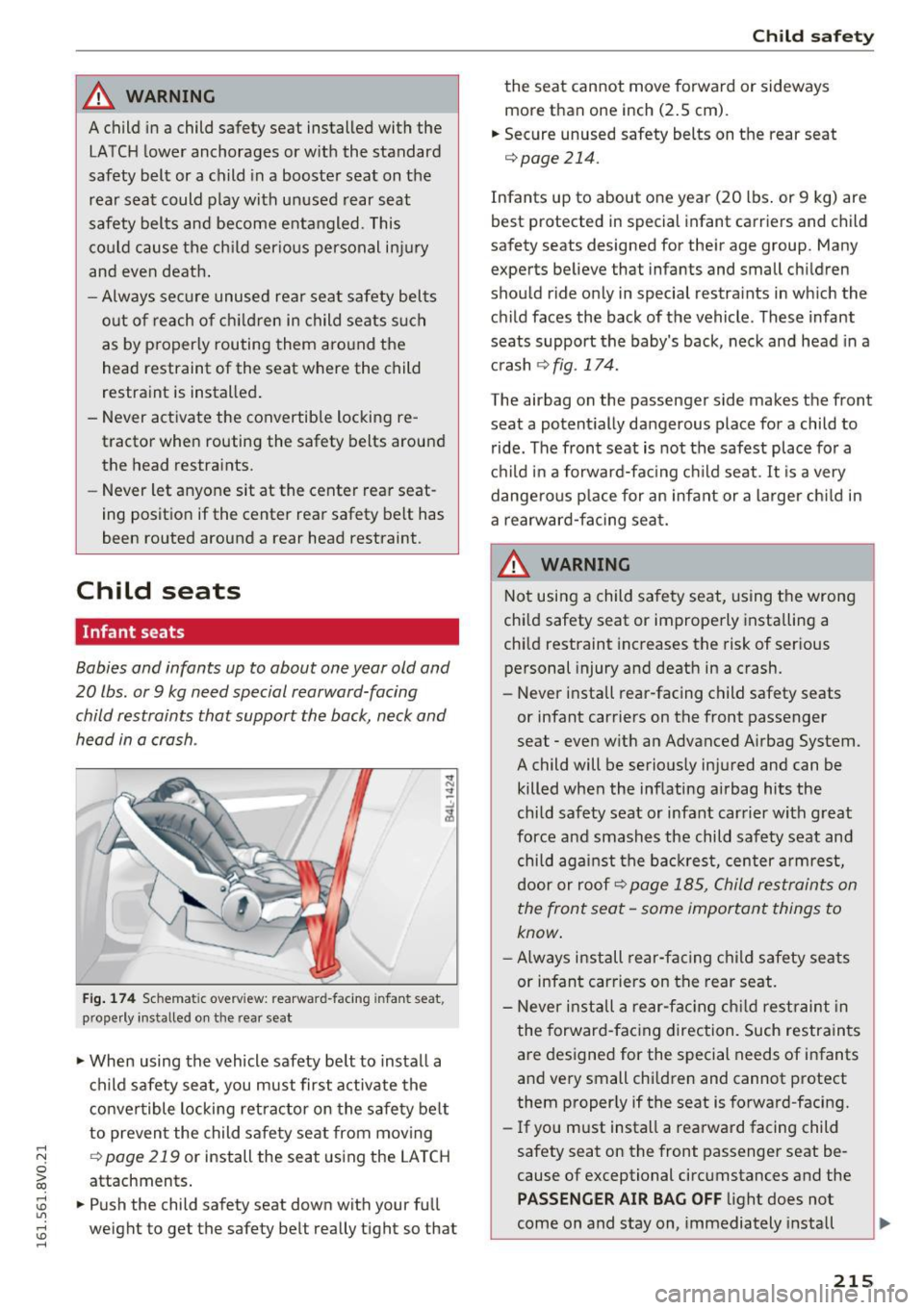
Fig. 174 Schematic overv iew: rearwa rd-facing infant seat,
properly installed on the rear seat
• When using the vehicle safety be lt to install a
ch ild safety sea t, you must first activate the
co nve rtible locking retractor on the safety be lt
to prevent the child safe ty seat from moving
r=.> page 219 or install the seat using the LA TCH
attachments .
• Push the child safety seat down with your fu ll
weight to get the safety be lt rea lly t ight so that
Child sa fety
the seat cannot move forward or sideways
more than one inch (2.5 cm).
• Secure unused safety belts on the rear seat
r::;, page 214.
Infants up to about one year (20 lbs . or 9 kg) are
best protected in special infant carr iers and child
safety seats designed for their age group. Many
experts believe that infants and small children
should ride only in special restra ints in wh ich the
child faces the back of the vehicle . These infant
seats support the baby's back, neck and head in a
crash
¢ fig . 174.
The airbag on the passenger side makes the front
seat a potent ially dangerous place for a child to
ride. The front seat is not the safest place for a
c h ild in a forward-fac ing c hild seat.
It is a very
dange ro u s p lace for an infant or a la rger ch ild in
a rearward-facing sea t.
_& WARNING
-
No t usi ng a child sa fety seat, using t he wrong
chi ld safety seat or imprope rly installing a
chi ld restraint increases the risk of serious
personal injury and death in a crash.
- Never install rear-facing child safety seats
or infant carriers on the front passenger
seat -even w ith an Advanced A irbag System .
A child will be serious ly injured and can be
killed when the inflating airbag hits the
child safety seat or infant carrier with great
force and smashes the child safety seat and child agai nst the ba ckrest, center armrest,
door or roof
r::!.> page 185, Child restraints on
t he front seat -some important things to
know .
-Always install rear-fac ing child safety seats
or infant carriers on the rear seat .
- Never install a rear-fac ing ch ild restraint in
the forward-fac ing direction. Such restrain ts
are des igned for the special needs of infants
and ve ry small children and cannot protect
them proper ly if the seat is forward-facing.
- If you m ust install a rearward facing child
safety seat on the front passenger seat be
cause of exceptional circumstances and the
PASSENGER AIR BA G OFF light does not
come on and stay on, immediately install
215
Page 218 of 328
Child safety
the rear-fac ing ch ild safety seat in a rear
seat ing pos ition and have the airbag system
inspected by your Audi dealer.
- Never place or use any electrical device
(such as a laptop, CO player, electronic
games dev ice, power inverte r or s eat heater
for child seats) on the front passenger seat if the device is connected to the 12-volt
socket or the cigarette lighter socket.
- If a seat heater has been retrofitted or oth erwise added to the front passenger seat,
never install any ch ild rest raint system on
this seat .
- Make s ure that there are no wet objects
(s uch as a wet towel) and no water or other
liquids on the front passenger seat cushion.
- Never place objects on the seat (such as a
laptop, CD player, electronic games dev ice,
power inverter or seat hea ter for child
seats) . These may influence the e lectr ica l
capacitance measured by the capacitive pas
senger detection system and can also fly
around in an accident and ca use serio us per
sonal injury .
- Always read and heed all WARNINGS when
ever using a child restrained in a veh icle is
being used
¢ page 176, Safety belts,
i::> page 184 , Airbag system and
c:::;, page 209, Important information .
Convertible child safety seats
Properly used convertible child safe ty sea ts con
help protect toddlers and children over age one
who weigh between 20 and 40 lbs . (9 and 18 kg)
in a crash.
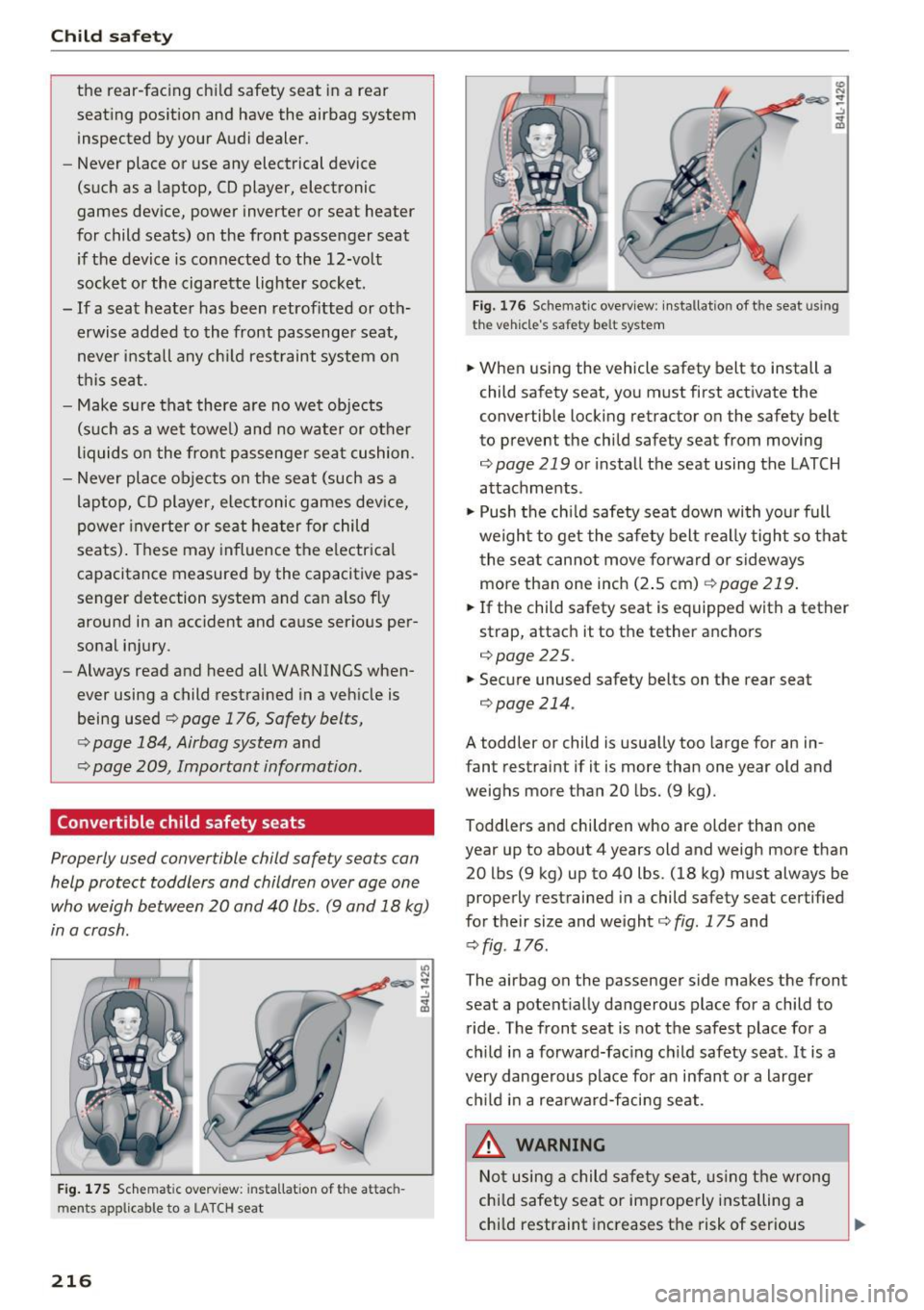
F ig. 1 75 Schema tic overv iew : in stallat io n of the a ttac h
m ents app lica ble to a LATCH seat
216
F ig. 17 6 Schem at ic ove rv iew: in stallat ion of t he seat usin g
t he vehicle's sa fety bel t system
.,. When using the vehicle safety belt to install a
child safety seat, you must first activate the
convertib le locking retractor on the safety belt
to prevent the child safety seat from moving
c:::;, poge 219 or install the seat using the LATCH
attachments .
.,. Push the chi ld safety sea t down with you r full
weigh t to get the safety belt really tight so that
the seat cannot move fo rward or sideways
more than one inch (2 .5 cm)
¢ page 219.
.,. If the child safety seat is equipped with a tether
strap, attach it to the tether ancho rs
c:::;, poge225 .
.,. Secure unused safety belts on the rear seat
c:::;, poge 214.
A toddler o r child is usually too large for an in
fant restraint if it is more than one year old and
weighs more than 20 lbs. (9 kg).
Toddlers and children who are older than one
year up to about 4 years old and weigh more than
20 lbs (9 kg) up to 40 lbs. (18 kg) must always be
properly restrained in a child safety seat certified
for their size and we ight
c:::;, fig . 175 and
¢ fig. 176.
The airbag on the passenger side makes the front
seat a potent ially dangerous place for a child to
ride . The front seat is not the safest place for a
ch ild in a forward-fac ing ch ild safety seat .
It is a
very dangerous place for an infant or a large r
ch ild in a rea rward-faci ng seat .
& WARNING
Not using a child safe ty se at, us ing t he wrong
chi ld safety seat or improperly insta lling a
chi ld restraint increases the risk of serious