ignition AUDI A3 2020 Owner´s Manual
[x] Cancel search | Manufacturer: AUDI, Model Year: 2020, Model line: A3, Model: AUDI A3 2020Pages: 400, PDF Size: 107.47 MB
Page 285 of 400

8V2012721BK
Child safety
— The child and the passenger can also injure
each other in an accident.
Never install rear-facing child safety seats or
infant carriers on the front passenger seat.
A child will be seriously injured and can be
killed when the passenger airbag inflates -
even with an Advanced Airbag System.
The inflating airbag will hit the child safety
seat or infant carrier with great force and
will smash the child safety seat and child
against the backrest, center armrest, door
or roof.
Always install rear-facing child safety seats
or infant carriers on the rear seat.
Make sure there is enough space in front of
the child in the child seat. If necessary, ad-
just the angle and position of the seat in
front of the child seat.
Forward-facing child safety seats installed
on the front passenger's seat can interfere
with the airbag when it inflates and cause
serious injury to the child. Always install for-
ward-facing child safety seats on the rear
seat.
If exceptional circumstances require the use
of a forward-facing child restraint on the
front passenger's seat, the child's safety and
well-being require that the following special
precautions be taken:
— Make sure the forward-facing seat has
been designed and certified by its manu-
facturer for use on a front seat with a pas-
senger front and side airbag.
— Always carefully follow the manufacturer's
instructions provided with the child safety
seat or carrier.
— Always move the front passenger seat to
the highest position in the up and down
adjustment range and move it back to the
rearmost position in the seat's fore and aft
adjustment range, as far away from the
airbag as possible, before installing the
forward-facing child restraint.
— Always make sure that the safety belt up-
per
anchorage is behind the child restraint
and not next to or in front of the child re-
straint so that the safety belt will be prop-
erly positioned.
— Always make sure that nothing prevents
the front passenger's seat from being
moved to the rearmost position in its fore
and aft adjustment range.
— Always make sure that the backrest is in
the upright position.
— Never place or use any electrical device
(such as a laptop, CD player, electronic
games device, power inverter or seat heat-
er for child seats) on the front passenger
seat if the device is connected to the 12-
volt socket or the cigarette lighter socket.
— If a seat heater has been retrofitted or
otherwise added to the front passenger
seat, never install any child restraint sys-
tem on this seat.
— Make sure that there are no wet objects
(such as a wet towel) and no water or oth-
er liquids on the front passenger seat
cushion.
— Never place objects on the seat (such as a
laptop, CD player, electronic games device,
power inverter or seat heater for child
seats). These may influence the electrical
capacitance measured by the capacitive
passenger detection system and can also
fly around in an accident and cause serious
personal injury.
— Always buckle the child safety seat firmly in
place even if a child is not sitting in it. A
loose child safety seat can fly around during
a sudden stop or ina collision.
— Always read and heed all WARNINGS when-
ever using a child restrained in a vehicle is
being used > page 245, Safety belts,
=> page 253, Airbag system and > page 278,
Child safety.
ZA WARNING
To reduce the risk of serious injury, make sure
that the PASSENGER AIR BAG OFF light
comes on and stays on whenever a child re-
straint is installed on the front passenger seat
and the ignition is switched on.
— Take the child restraint off the front passen-
ger seat and install it properly at one of the
rear seat positions if the PASSENGER AIR
BAG OFF light does not stay on.
283
Page 289 of 400

8V2012721BK
Child safety
as possible, before installing the forward-
facing child restraint.
— Always make sure that the safety belt upper
anchorage is behind the child restraint and
not next to or in front of the child restraint
so that the safety belt will be properly posi-
tioned.
— Always make sure that nothing prevents the
front passenger's seat from being moved to
the rearmost position in its fore and aft ad-
justment range.
— Always make sure the backrest is in an up-
right position.
— Never place or use any electrical device
(such as a laptop, CD player, electronic
games device, power inverter or seat heater
for child seats) on the front passenger seat
if the device is connected to the 12-volt
socket or the cigarette lighter socket.
— If a seat heater has been retrofitted or oth-
erwise added to the front passenger seat,
never install any child restraint system on
this seat.
— Make sure that there are no wet objects
(such as a wet towel) and no water or other
liquids on the front passenger seat cushion.
— Never place objects on the seat (such as a
laptop, CD player, electronic games device,
power inverter or seat heater for child
seats). These may influence the electrical
capacitance measured by the capacitive pas-
senger detection system and can also fly
around in an accident and cause serious per-
sonal injury.
— Make sure that the PASSENGER AIR BAG
OFF light comes on and stays on all the time
whenever the ignition is switched on.
— If the PASSENGER AIR BAG OFF light does
not come on and stay on, immediately in-
stall the forward-facing child seat at a seat-
ing position on the rear seat and have the
airbag system inspected by your authorized
Audi dealer.
— Take the child restraint off the front passen-
ger seat and install it properly at one of the
rear seat positions if the PASSENGER AIR
BAG OFF light does not stay on whenever
the ignition is switched on.
Booster seats and safety belts
Properly used booster seats can help protect
children weighing between about 40 lbs. and 80
lbs. (18 kg and 36 kg) who are less than 4 ft. 9
in. (57 inches/1.45 meters) tall.
B4H-0275
Fig. 230 Rear seat: child properly restrained in a booster
seat
The vehicle's safety belts alone will not fit most
children until they are at least 4 ft. 9 in. (57 in-
ches/1.45 meters) tall and weigh about 80 lbs.
(36 kg). Booster seats raise these children up so
that the safety belt will pass properly over the
stronger parts of their bodies and the safety belt
can help protect them in a crash.
> Do not use the convertible locking retractor
when using the vehicle's safety belt to restrain
a child on a booster seat.
> The shoulder belt must lie as close to the cen-
ter of the child's collar bone as possible and
must lie flat and snug on the upper body. It
must never lie across the throat or neck. The
lap belt must lie across the pelvis and never
across the stomach or abdomen. Make sure the
belt lies flat and snug. Pull on the belt to tight-
en if necessary.
> Applies to: vehicles with safety belt height ad-
justment: If you must transport an older child
in a booster seat on the front passenger seat,
you can use the safety belt height adjustment
to help adjust the shoulder portion properly.
> Secure unused safety belts on the rear seat
=> page 284.
Children up to at least 8 years old (over 40 Lbs or
18 kg) are best protected in child safety seats de-
signed for their age and weight. Experts say that
the skeletal structure, particularly the pelvis, of >
287
Page 291 of 400
8V2012721BK
Child safety
OFF light must come on and stay on, when-
ever the ignition is switched on.
— If the PASSENGER AIR BAG OFF light does
not come on and stay on, perform the
checks described > page 265, Monitoring
the Advanced Airbag System.
— Take the child restraint off the front passen-
ger seat and install it properly at one of the
rear seat positions if the PASSENGER AIR
BAG OFF light does not stay on whenever
the ignition is switched on.
— Always read and heed all WARNINGS when-
ever using a child restrained in a vehicle is
being used > page 245, Safety belts,
=> page 253, Airbag system and > page 278,
Important information.
Securing child safety
seats
Securing a child safety seat using a safety
ert
Safety belts for the rear seats and the front pas-
senger can be locked with the convertible locking
retractor to properly secure child safety seats.
The safety belts emergency locking retractors for
the rear seats safety belts and for the front pas-
senger’s seat safety belt have a convertible lock-
ing retractor for child restraints. The safety belt
must be locked so that belt webbing cannot un-
reel. The retractor can be activated to lock the
safety belt and prevent the safety belt webbing
from loosening up during normal driving. A child
safety seat can only be properly installed when
the safety belt is locked so that the child and
child safety seat will stay in place.
Always remember: Even though your vehicle is
equipped with an Advanced Airbag system, all
children, especially those 12 years and younger,
should always ride in the back seat properly re-
strained for their age and size.
ZA\ WARNING
Improperly installed child safety seats in-
crease the risk of serious personal injury and
death in a collision.
— Always make sure that the safety belt retrac-
tor is locked when installing a child safety
seat. An unlocked safety belt retractor can-
not hold the child safety seat in place during
normal driving or in a crash.
— Always buckle the child safety seat firmly in
place even if a child is not sitting init. A
loose child safety seat can fly around during
a sudden stop or in a collision.
— Always make sure that the rear seat backrest
to which the center rear safety belt* is at-
tached is securely latched whenever the rear
center safety belt is being used to secure a
child restraint.
—If the backrest is not securely latched, the
child and the child restraint will be thrown
forward together with the backrest and will
strike parts of the vehicle interior. The child
can be seriously injured or killed.
— Never install rear-facing child safety seats or
infant carriers on the front passenger seat.
A child will be seriously injured and can be
killed when the passenger airbag inflates.
— The inflating airbag will hit the child safety
seat or infant carrier with great force and
will smash the child safety seat and child
against the backrest, center armrest, door
or roof.
— Always install rear-facing child safety seats
or infant carriers on the rear seat.
— Forward-facing child safety seats or infant
carriers installed on the front passenger's
seat may interfere with the deployment of
the airbag and cause serious injury to the
child.
—It is safer to install a forward-facing child
safety seat on the rear seat.
— Always read and heed all WARNINGS when-
ever using a child restrained in a vehicle is
being used > page 278. Special precautions
apply when installing a child safety seat on
the front passenger seat > page 254, Child
restraints on the front seat - some impor-
tant things to know.
289
Page 292 of 400
Child safety
ZA WARNING
Always take special precautions if you must
install a forward or rearward-facing child re-
straint on the front passenger's seat in excep-
tional situations:
— Whenever a forward or rearward-facing
child restraint is installed on the front pas-
senger seat, the PASSENGER AIR BAG OFF
light must come on and stay on whenever
the ignition is switched on.
— If the PASSENGER AIR BAG OFF light does
not come on and stay on, perform the
checks described > page 265, Monitoring
the Advanced Airbag System.
— Take the child restraint off the front passen-
ger seat and install it properly at one of the
rear seat positions if the PASSENGER AIR
BAG OFF light does not stay on whenever
the ignition is switched on.
— Improper installation of child restraints can
reduce their effectiveness or even prevent
them from providing any protection.
— An improperly installed child restraint can
interfere with the airbag as it deploys and
seriously
injure or even kill the child.
— Always carefully follow the manufacturer's
instructions provided with the child safety
seat or carrier.
— After checking to make sure that the child
restraint is properly installed, make certain
that the child restraint is correctly recog-
nized by the capacitive passenger detection
system in the front passenger seat and that
the PASSENGER AIR BAG OFF light signals
the correct front passenger frontal airbag
status.
ZA\ WARNING
Forward-facing child restraints:
— Always make sure the forward-facing seat
has been designed and certified by its manu-
facturer for use on a front seat with a pas-
senger front and side airbag.
— Never put the forward-facing child restraint
up, against or very near the instrument pan-
el
290
— Always move the front passenger seat to the
highest position in the up and down adjust-
ment range and move it back to the rear-
most position in the seat's fore and aft ad-
justment range, as far away from the airbag
as possible, before installing the forward-
facing child restraint.
— Always make sure that the safety belt upper
anchorage is behind the child restraint and
not next to or in front of the child restraint
so that the safety belt will be properly posi-
tioned.
— Make sure that the PASSENGER AIR BAG
OFF light comes on and stays on all the time
whenever the ignition is switched on.
ZA WARNING
Rearward-facing child restraints:
-Achild in a rearward-facing child safety seat
installed on the front passenger seat will be
seriously injured and can be killed if the
front airbag inflates - even with an Ad-
vanced Airbag System.
— The inflating airbag will hit the child safety
seat or infant carrier with great force and
will smash the child safety seat and child
against the backrest, center armrest, door
or roof.
— Always be especially careful if you must in-
stall a rearward facing child safety seat on
the front passenger seat in exceptional cir-
cumstances.
— Make sure that the PASSENGER AIR BAG
OFF light comes on and stays on all the time
whenever the ignition is switched on.
— If the PASSENGER AIR BAG OFF light does
not come on and stay on, immediately in-
stall the rear-facing child safety seat ina
rear seating position and have the airbag
system inspected by your Audi dealer.
Activating the convertible locking retractor
Use the convertible locking retractor to secure a
child restraint.
Always heed the child safety seat manufacturer's
instructions when installing a child restraint in
Page 302 of 400

Checking and Filling
> After the fuel pump has switched off, wait five
seconds before removing the nozzle to allow
the rest of the fuel to finish dripping into the
fuel tank.
> Turn the fuel cap clockwise until it clicks into
place.
> Close the fuel filler door and then press on the
left side until it latches.
The correct fuel type for your vehicle can be
found ona label located on the inside of the fuel
filler door. For additional information on fuel, see
=> page 298.
For the tank capacity in your vehicle, refer to the
Technical Data > page 380.
To reduce the risk of fuel leaking out or vapors
escaping, make sure that the fuel tank is closed
correctly. Otherwise the Ey indicator light will
turn on.
If the central locking system malfunctions, there
is a fuel filler door emergency release
= page 301.
Messages
Plug-in hybrid drive: for additional information
on refueling, see > page 302.
| Tank system: malfunction! Please contact
Service
There is a malfunction in the fuel tank system.
Drive to an authorized Audi dealer or authorized
Audi Service Facility immediately to have the
malfunction corrected.
— If you do not insert the fuel pump nozzle all
the way into the filler tube, then fuel can
leak out. Spilled fuel can ignite and start a
fire.
— Never get into the vehicle when refueling. If
there is an exceptional situation where you
must enter the vehicle, close the door and
touch a metal surface before touching the
fuel pump nozzle again. This will reduce the
risk of electrostatic discharge that can cause
flying sparks. Sparks can start a fire when
refueling.
ZA\ WARNING
Improper fueling procedures and improper
handling of fuel can lead to explosions, fires,
severe burns, and other injuries.
— Do not smoke. Keep away from open flames.
— The ignition must be switched off when re-
fueling.
— Mobile devices, radio devices, and other ra-
dio equipment should always be switched
off when refueling. Electromagnetic rays
ZA WARNING
Transporting fuel containers inside the vehicle
is not recommended. Fuel could leak out of
the container and ignite, especially during an
accident. This can cause explosions, fires, and
injuries.
— If you must transport fuel in a fuel contain-
er, note the following:
— Always place the fuel container on the
ground before filling. Never fill the fuel
container with fuel while it is inside or on
the vehicle. Electrostatic discharge can oc-
cur while refueling and the fuel vapors
could ignite.
— When using fuel containers made of met-
al, the fuel pump nozzle must always re-
main in contact with the container to re-
duce the risk of static charge.
— Insert the fuel pump nozzle as far as pos-
sible into the filler opening while refuel-
ing.
— Follow the applicable legal regulations in
the country where you are driving when
using, storing and transporting fuel con-
tainers.
— Make sure that the fuel container meets
the industry standards, for example ANSI
or ASTM F852-86.
could cause sparks and start a fire.
1) Depending on the engine and country
300
Page 304 of 400
Checking and Filling
Emergency release behind the rear seat
backrest
Applies to: version 2
The emergency release is located behind the
right
rear seat.
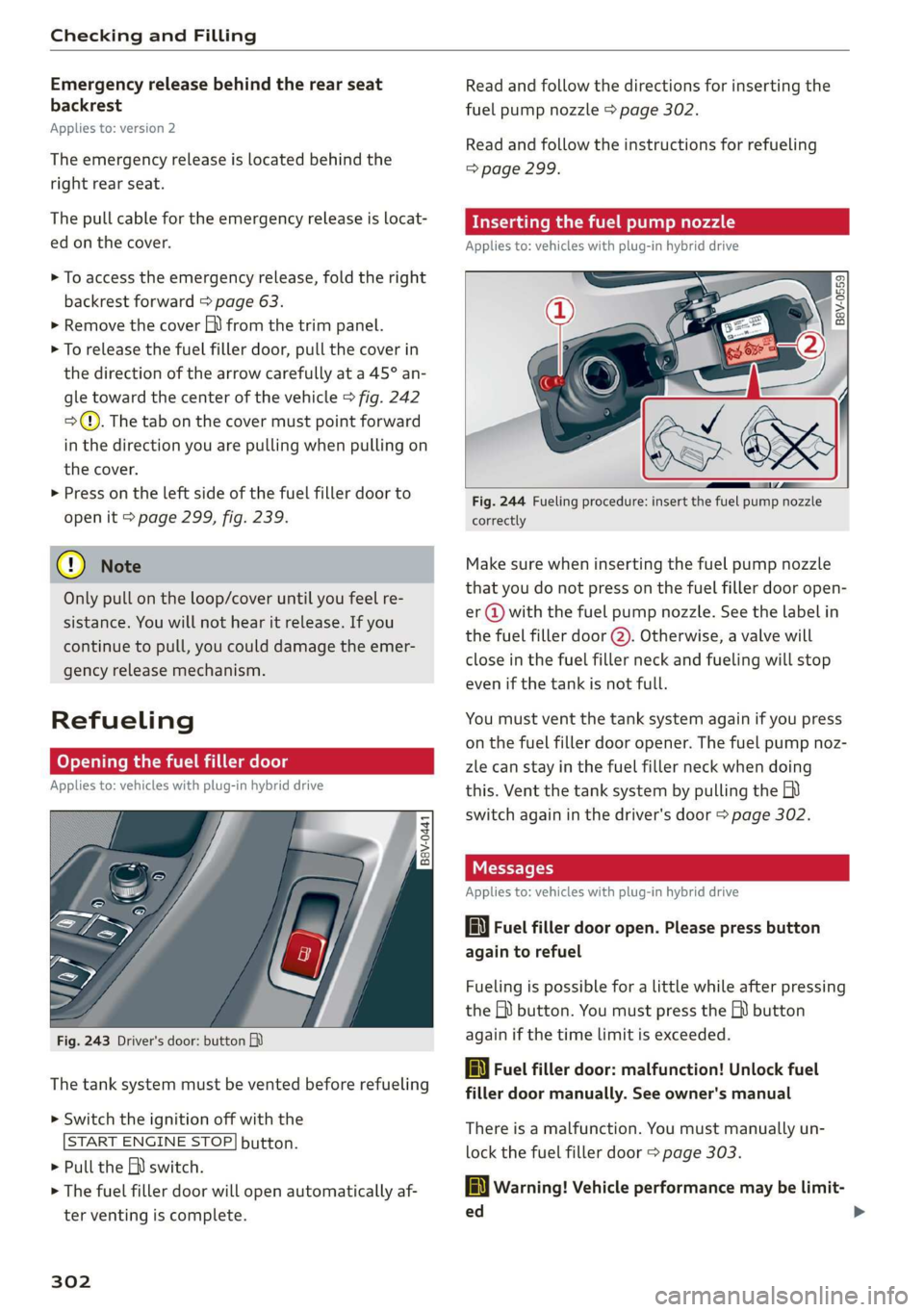
The pull cable for the emergency release is locat-
ed on the cover.
> To access the emergency release, fold the right
backrest forward > page 63.
> Remove the cover fh) from the trim panel.
> To release the fuel filler door, pull the cover in
the direction of the arrow carefully at a 45° an-
gle toward the center of the vehicle > fig. 242
>). The tab on the cover must point forward
in the direction you are pulling when pulling on
the cover.
> Press on the left side of the fuel filler door to
open it > page 299, fig. 239.
© Note
Only pull on the loop/cover until you feel re-
sistance. You will not hear it release. If you
continue to pull, you could damage the emer-
gency
release mechanism.
Refueling
Opening the fuel filler door
Applies to: vehicles with plug-in hybrid drive
B8V-0441
Fig. 243 Driver's door: button
The tank system must be vented before refueling
> Switch the ignition off with the
START ENGINE STOP] button.
> Pull the EN) switch.
> The fuel filler door will open automatically af-
ter venting is complete.
302
Read and follow the directions for inserting the
fuel pump nozzle > page 302.
Read and follow the instructions for refueling
=> page 299.
Inserting the fuel pump nozzle
Applies to: vehicles with plug-in hybrid drive
a o o 2
> fay oO
Fig. 244 Fueling procedure: insert the fuel pump nozzle
correctly
Make sure when inserting the fuel pump nozzle
that you do not press on the fuel filler door open-
er @ with the fuel pump nozzle. See the label in
the fuel filler door @). Otherwise, a valve will
close in the fuel filler neck and fueling will stop
even if the tank is not full.
You must vent the tank system again if you press
on the fuel filler door opener. The fuel pump noz-
zle can stay in the fuel filler neck when doing
this. Vent the tank system by pulling the
switch again in the driver's door > page 302.
Messages
Applies to: vehicles with plug-in hybrid drive
li Fuel filler door open. Please press button
again to refuel
Fueling is possible for a little while after pressing
the Gi) button. You must press the M button
again if the time limit is exceeded.
ly Fuel filler door: malfunction! Unlock fuel
filler door manually. See owner's manual
There is a malfunction. You must manually un-
lock the fuel filler door > page 303.
la Warning! Vehicle performance may be limit-
ed
Page 306 of 400
Checking and Filling
or authorized Audi Service Facility to have the
malfunction corrected.
The indicator light can also turn on if the fuel fill-
er cap is not closed correctly > page 2991).
ZA\ WARNING
Incorrect use of the connection port for the
On Board Diagnostic System can cause mal-
functions, which can then result in accidents
and serious injuries.
— Only allow an authorized Audi dealer or au-
thorized Audi Service Facility to read out the
engine data.
Engine compartment
(ee eel)
Special care is required if you are working in the
engine compartment
For work in the engine compartment, such as
checking and filling fluids, there is a risk of in-
jury, scalding, accidents, and burns. For this
reason, follow all the warnings and general
safety precautions provided in the following in-
formation. The engine compartment is a dan-
gerous area. > /\.
Z\ WARNING
— Turn the engine off.
— Switch the ignition off.
— Set the parking brake.
— Select the “P” (Park) selector lever position.
— Allow the engine to cool.
— Keep children away from the engine com-
partment.
— Never spill fluids on a hot engine. These flu-
ids (such as the anti-freezing agent con-
tained in the coolant) can ignite.
— Avoid short circuits in the electrical system.
— Never reach into the radiator fan. The fan is
temperature-controlled and can turn on
suddenly, even when the ignition is switched
off.
1) Depending on the engine and country
304
— Never open the hood when there is steam or
coolant escaping from the engine compart-
ment, because there is a risk that you could
be burned. Wait until no steam or coolant is
escaping.
Plug-in hybrid drive: the coolant expansion
tank cap is equipped with a seal that must
never be removed under any circumstances
=> page 312, fig. 251. If the coolant expan-
sion tank for the high-voltage system is not
sealed, please contact an authorized Audi
dealer or authorized Audi Service Facility.
Plug-in hybrid drive: the sealed cap must on-
ly be opened by an authorized Audi dealer or
authorized Audi Service Facility.
The cap on the coolant expansion tank must
never be opened as long as the coolant is
hot. The cooling system is under pressure.
There is a risk of burns
To protect your face, hands, and arms from
hot steam or coolant, cover the cap with a
thick cloth when opening.
Do not remove the engine cover under any
circumstances. This increases the risk of
burns.
Due to the risk of electric shock, never touch
the ignition cable or other components in
the electronic high-voltage ignition system
when the engine is running or is starting.
If a gear is engaged while the vehicle is sta-
tionary and the engine is running, do not
press the accelerator pedal inadvertently.
Pressing the accelerator pedal will cause the
vehicle to move, and this could result in an
accident.
If inspections or repairs must be performed
while the engine is running, moving compo-
nents (such as the ribbed belt, generator,
and radiator fan) pose an additional risk.
— Set the parking brake first and select the
“p” (Park) selector lever position.
— Always make sure that no parts of the
body, jewelry, ties, loose clothing, and
long hair can be caught in moving engine
Page 307 of 400
8V2012721BK
Checking and Filling
components. Before any work, always re-
move any jewelry and/or ties, tie back long
hair, and make sure all clothing fits close
to the body to reduce the risk of anything
becoming caught in engine components.
— Pay attention to the following warnings list-
ed when work on the fuel system or on the
electrical equipment is required.
— Do not smoke.
— Never work near open flames.
— Always have a working fire extinguisher
nearby.
— All work on the battery or electrical system
in your vehicle can result in injuries, chemi-
cal burns, accidents, or burns. Because of
this, all work must be performed only by an
authorized Audi dealer or authorized Audi
Service Facility.
— Limit your exposure to exhaust and chemi-
cals to as short a time as possible.
ZA WARNING
California Proposition 65 Warning:
— Engine exhaust, some of its constituents,
and certain vehicle components contain or
emit chemicals known to the State of Cali-
fornia to cause cancer and birth defects and
reproductive harm. In addition, certain flu-
ids contained in vehicles and certain prod-
ucts of component wear contain or emit
chemicals known to the State of California
to cause cancer and birth defects or other
reproductive harm.
— Battery posts, terminals and related acces-
sories contain lead and lead compounds,
chemicals known to the State of California
to cause cancer and reproductive harms.
Wash hands after handling.
@) Note
When filling fluids, be sure not to add any flu-
ids to the wrong reservoirs. Otherwise severe
malfunctions and engine damage will occur.
@ For the sake of the environment
You should regularly check the ground under
your vehicle in order to detect leaks quickly. If
there are visible spots from oil or other fluids,
bring your vehicle to an authorized Audi deal-
er or authorized Audi Service Facility to be
checked.
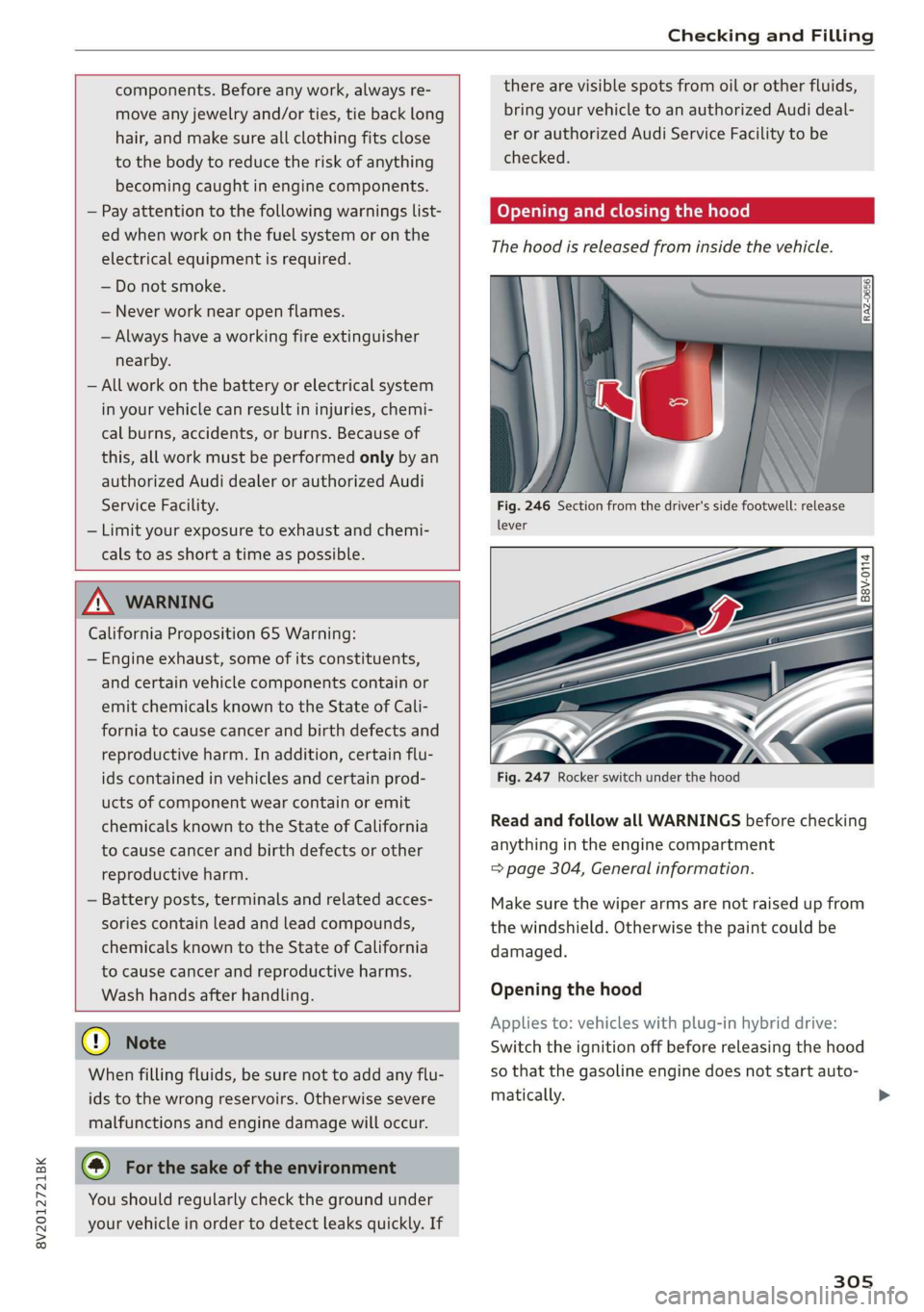
Opening and closing the hood
The hood is released from inside the vehicle.
j | ON }
li KW
Fig. 246 Section from the driver's side footwell: release
lever
2
SI = & a
Read and follow all WARNINGS before checking
anything
in the engine compartment
=> page 304, General information.
Make sure the wiper arms are not raised up from
the windshield. Otherwise the paint could be
damaged.
Opening the hood
Applies to: vehicles with plug-in hybrid drive:
Switch the ignition off before releasing the hood
so that the gasoline engine does not start auto-
matically.
305
>
Page 314 of 400

Checking and Filling
Facility check if the coolant additive in your
vehicle matches the percentage appropriate
for the climate. This is especially important
when driving in colder climates.
— If the appropriate coolant additive is not
available in an emergency, do not add any
other additive. You could damage the en-
gine. If this happens, only use water and re-
store the correct mixture ratio with the
specified coolant additive as soon as possi-
ble.
— Only refill with new coolant.
— Radiator sealant must not be mixed with
the coolant.
— Due to the risk of engine damage, the cool-
ing system should only be refilled by an au-
thorized Audi dealer or authorized Audi
Service Facility. An authorized Audi dealer or
authorized Audi Service Facility can also pro-
vide you with important information about
the recommended coolant additive.
@® Tips
Applies to: RS models: In certain weather
conditions, moisture such as rain or snow may
evaporate on the radiator after stopping the
vehicle. This may cause steam to escape from
the front of the vehicle.
Applies to: vehicles with plug-in hybrid drive
Fig. 251 Engine compartment: coolant expansion tank
Your vehicle has two coolant expansion tanks
that are separate from each other:
@) expansion tank for gasoline engine and elec-
tric motor.
@®): expansion tank for the high-voltage area.
312
The expansion tank (@) must not be opened
oA.
> Switch the ignition off.
> Open the hood > page 305.
> Always check the coolant level in both coolant
expansion tanks (@) and @) using the outer
markings.
> When you fill coolant in the expansion tank (A),
please refer to > page 311, Cooling system.
> Do not drive any farther if the coolant level in
the expansion tank (@) is low. Contact an au-
thorized Audi dealer or authorized Audi Service
Facility immediately > A\.
ZA WARNING
— Read and follow the warnings in
=> page 304, General information before
opening the hood and checking the coolant
level.
— The expansion tank (8) may only be opened
and filled by an authorized Audi dealer or
authorized Audi Service Facility.
— Coolant can enter the inside of the high-
voltage battery when filling the expansion
tank @) and cause a short circuit, which in-
creases the risk of fire.
Checking coolant
RAZ-0539
MIN
Fig. 252 Engine compartment - coolant expansion tank
(diagram): @ cover; @) markings
Observe the safety precautions > page 304, Gen-
eral information.
Checking the engine coolant level
> Park the vehicle on a level surface.
> Switch the ignition off.
> Open the hood > page 305.
Page 315 of 400
8V2012721BK
Checking and Filling
> Check the coolant level in the coolant expan-
sion tank > page 307, fig. 248 using the outer
markings (2) > fig. 252. The coolant level must
be between the markings (2) when the engine is
cold. When the engine is warm it can be slight-
ly above the upper marking.
Adding coolant
Applies to: vehicles with plug-in hybrid drive:
Your vehicle has two coolant expansion tanks
that are separate from each other. The smaller of
the two expansion tanks must not be opened
= page 312. Read and follow the important safe-
ty precautions > A\ in Coolant on page 312.
Requirement: there must be a residual amount of
coolant in the expansion tank >@).
If you must add coolant, use a mixture of water
and coolant additive. Mixing the coolant additive
with distilled water is recommended.
> Allow the engine to cool.
> Place a large, thick towel on the coolant expan-
sion tank cover.
> Remove the cover (@) © fig. 252 carefully to the
left > AX.
» Add the correct mixture ratio of coolant
> page 311 up to the upper marking @
> fig. 252.
> Make sure that the fluid level remains stable.
Add more coolant if necessary.
> Close the cap securely.
Coolant loss usually indicates that there is a leak.
Immediately drive your vehicle to an authorized
Audi dealer or authorized Audi Service Facility
and have the cooling system inspected. If the
cooling system is not leaking, coolant loss can re-
sult from the coolant boiling due overheating
and then being forced out of the cooling system.
— Never open the hood if you can see or hear
steam or coolant escaping from the engine
compartment. This increases the risk of
burns. The cooling system is under pressure.
When you no longer see or hear steam or
coolant escaping, you may open the engine
compartment with caution.
—When working in the engine compartment,
remember that the radiator fan can switch
on even if the ignition is switched off, which
increases the risk of injury.
— Coolant additive and coolant can be danger-
ous to your health. For this reason, store the
coolant in the original container and away
from children. There is a risk of poisoning.
@) Note
Do not add coolant if the expansion tank is
empty. Air could enter the cooling system and
damage the engine. If this is the case, do not
continue driving. See an authorized Audi deal-
er or authorized Audi Service Facility for assis-
tance.
Brake fluid
BFV-0229)
Z\ WARNING
— The engine compartment in any vehicle can
be a dangerous area. Stop the engine and al-
low it to cool before working in the engine
compartment. Always follow the informa-
tion found in > page 304, General informa-
tion.
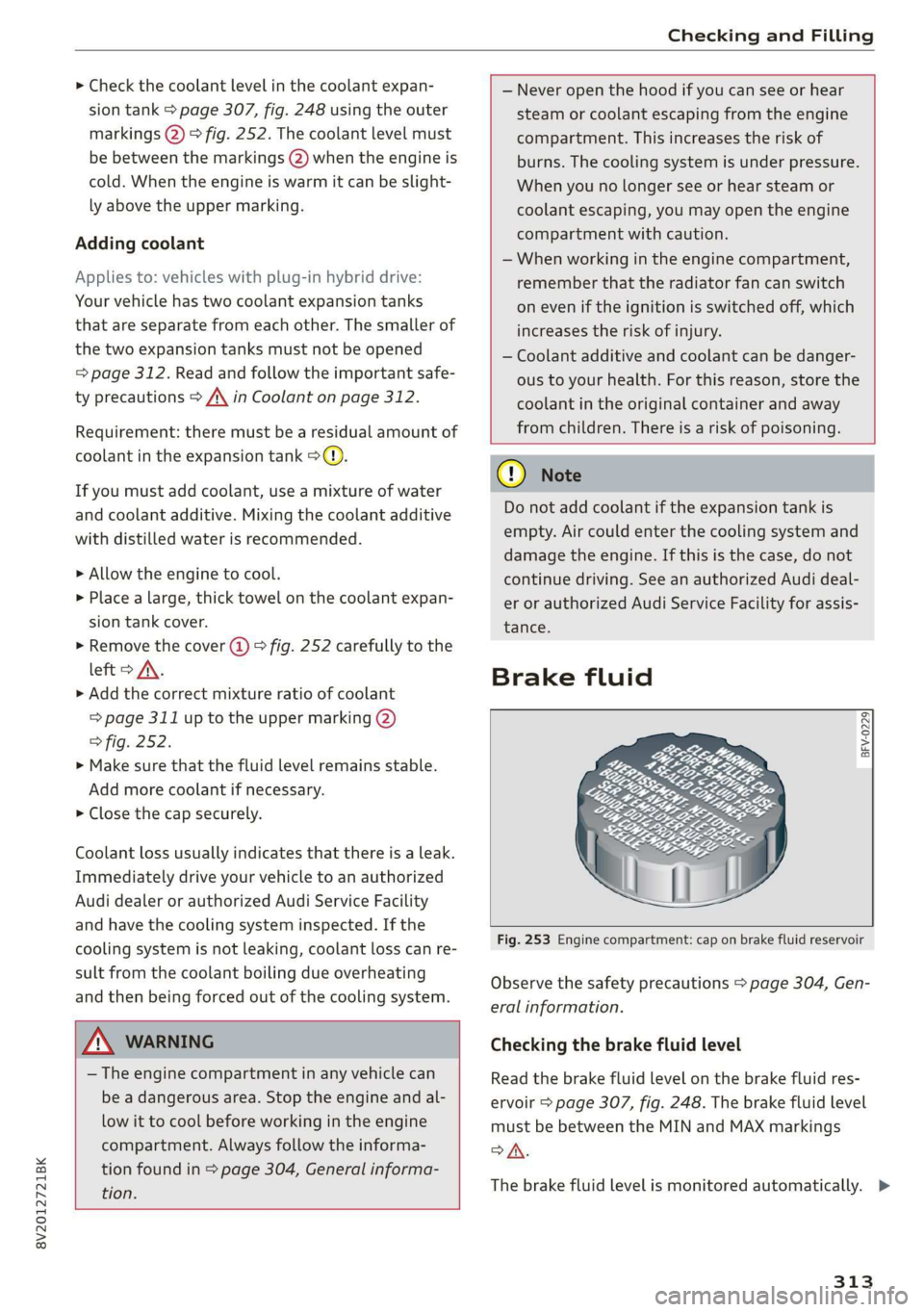
Fig. 253 Engine compartment: cap on brake fluid reservoir
Observe the safety precautions > page 304, Gen-
eral information.
Checking the brake fluid level
Read the brake fluid level on the brake fluid res-
ervoir > page 307, fig. 248. The brake fluid level
must be between the MIN and MAX markings
>A.
The brake fluid level is monitored automatically. >
313