warning AUDI A3 CABRIOLET 2015 Owners Manual
[x] Cancel search | Manufacturer: AUDI, Model Year: 2015, Model line: A3 CABRIOLET, Model: AUDI A3 CABRIOLET 2015Pages: 302, PDF Size: 73.83 MB
Page 183 of 302
Child Safet y 181
precautions apply when installing a chi ld -Always make sure the forward-facing
safety seat on t he front passenger seat seat has been designed and certified by
Q page 148, Child restraints on the front its manufacturer for use on a front seat
seat- some important things to know . with a passenger front and side a irbag .
- Never put the forward-facing child re-
_&. WARNING straint up, against or very near the in-
-strument panel.
Always take special precautions if you •
•
must install a forward or rearwa rd-facing -
Always move the passenger seat into its
child rest raint on the front passenger's rearmost position in t
he seat's fore and
sea t in except iona l situat ions: aft adjustment range, as fa
r away from
- Whenever a fo rward or rearward-facing the airbag as possible before installing
child restraint is installed on the front the forward-fa
cing ch ild restra int. The
passenge r seat, the
PASSENGER AIR b ackrest mu st be ad ju sted to an upright
BAG OFF light must come on and s tay on position
.
whenever the ignition is switched on . -
Ma ke sure that the
PASSENGER AIR BAG
- If the PASSENGER AIR BAG OFF light OFF light comes on and stays on all the
does no t come on and s tay on, per form time wheneve
r the ignit ion is switched
the checks described
Q page 158, Moni -on.
toring the Advanced Airbag System.
_&. WARNING - T ake the child restrain t off the front pas-~
senger seat and install it properly at one Rearward-facing child rest raints:
of the rea r seat positions if the
PASS EN-- A child in a re arward-facing chi ld safety
GER AIR BAG OFF light does not stay on
seat installed on the front passenger
whenever the ignition is switched on. seat will be seriously in jured and can be
- Improper installation of child restraints killed i
f the front airbag inflates -even
can reduce the ir effectiveness or even with an Advanced Airbag System.
prevent them from prov iding any protec-
-The inflating air bag will hit the ch ild
t ion .
safety seat or infant carrier with great
- An improperly installed child restraint force and will smash the child safety seat
can interfe re with the airbag as it de- and child against the backrest , center
ploys and serio usly injure or even kill the armrest, door or roof.
child .
-Always be especially careful if you must
- Always carefully follow the manufactur- install a rearward facing child safety seat
er's instructions provided with the child on the front passenger seat i n exception-
safety seat or carrier . al circumstances .
- After checking to make sure that the - Make sure that the
PASSENGER AIR BAG
child restrain t is properly installed, make OFF light comes on and stays on all the
certain that the child restraint is correct- time whenever the ig nit ion is switch ed
Ly recog nized by the capacitive pa ssenge r on.
de te ct ion sys tem in t he front p assenger
-If the
PASSENGER AIR BAG OFF light
sea t and that the
PASSENGER AIR BAG does not come on and stay on, immed i-
OFF light signals the correct front pas-
ately insta ll the rear-fa cing child s afety
senger fronta l airbag status.
seat in a rear seat ing pos ition and h ave
the airbag system inspected by your Audi
M
_&. WARNING • N dea le r. ,....
> co Forward-facing child restra ints: ,...., \!) 1.1'1 ,...., 1.1'1 ,....,
Page 184 of 302
182 Child Safety
Activating the convertible locking retractor
Use the convertible locking retractor to se
cure a child restraint.
Always heed the child safety seat manufactur
er's instructions when installing a child re
straint in your vehicle. To activate the conver
tible locking retractor:
• Place the child restraint on a seat, prefera
bly on the rear seat.
• Slowly pull the belt
all the way out.
• Route it around or through the child re
straint belt path¢.&_ .
• Push the child safety seat down w ith your
full weight to get the safety belt really tight.
• Insert the belt tongue into the buckle for
that seating position.
• Guide the safety belt back into the retractor
until the belt lies flat and snug on the child
safety seat .
• You should hear a "clicking " noise as the
belt winds back into the inertia reel. Test the
convertible locking retractor by pulling on
the belt. You should no longer be able to
pull the belt out of the retractor. The con
vertible locking retractor is now activated.
• Make sure that the red release button is fac
ing away from the child restraint so that it
can be unbuckled quickly .
•Pullon the belt to make sure the safety belt
is properly tight and fastened so that the
seat cannot move forward or sideways more
than one inch (2.5 cm).
.&_ WARNING
Using the wrong child restraint or an im
properly installed child restraint can cause
serious personal injury or death in a crash.
- Always make sure that the safety belt re-
tractor is locked when installing a child
safety seat. An unlocked safety belt re
tractor cannot hold the child safety seat in place during normal driving or in a
crash .
- Always buckle the child safety seat firmly
in place even if a child is not sitting in it.
-
A loose child safety seat can fly around
during a sudden stop or in a crash.
- Always make sure the seat backrest to
which the child restraint is installed is in
an upright position and securely latched
into place and cannot fold forward. Oth
erwise, the seatback with the child safety
seat attached to it could fly forward in
the event of an accident or other emer
gency situation.
- Always read and heed all WARNINGS
whenever using a child restrained in ave
hicle is being used
¢page 169. Special
precautions apply when installing a child
safety seat on the front passenger seat
¢ page 148, Child restraints on the front
seat -some important things to know.
'
Deactivating the convertible locking
retractor
T he convertible locking retractor for child re
strain ts will be deactiva ted automatically
when the bel t is wound all the way back in to
the retractor .
• Press the red button on the safety belt buck
le . The belt tongue will pop out of the buck
le .
• Guide the safety belt all the way back into
its stowed position .
Always let the safety bel t retract completely
into its stowed position . The safety belt can
now be used as an ordinary safety belt with
out the convertible locking retractor for child
restraints.
If the convertible locking retractor should be
activated inadvertently, the safety belt must be unfastened and guided completely back in
to its stowed position to deactivate this fea
ture. If the convertible locking retractor is not
deactivated , the safety belt will gradually be-
come tighter and uncomfortable to wear.
11>-
Page 185 of 302
M N
" > co ,...., \!) 1.1'1 ,...., 1.1'1 ,....,
A WARNING 1= •
Improperly installed child safety seats in-
crease the risk of serious personal injury
and death in a collision .
- Never unfasten the safety belt to deacti
vate the convert ible lock ing retractor for
child restraints while the veh icle is mov
ing. You would not be rest rained and
c ou ld be ser iously injured in an ac cident.
- Always read and heed all WARNINGS
whenever using a child rest rained in ave
hicle is being used
~page 169. Special
precautions apply when installing a ch ild
safety sea t on the front passenger seat
~ page 148, Child restraints on the front
seat -some important things to know.
LATCH Lower
anchorages and tethers
for children
Child Restraint System anchors and how
are they related to child safety
To provide a s imp ler and mor e pract icable way
to attach the ch ild restraint on the vehicle
seat, Fede ral regu lations requi re speci al lower
a ncho rages in veh icles and dev ices on new
chi ld res traints to attach to the vehicle ancho
rages .
The combination of the tether anchorages and
the lower anchorages is now generally called
the
LATCH system for " Lower Anchorages and
T ethers for Children ."
F orward -facing child rest rain ts manuf actured
a ft er Sep tembe r 1, 1999, are require d by U .S .
federal regulations to comply with new child
h ead movement performance requirements .
T hese new performance requirements make a
tether necessary on most new chi ld seats.
Instal ling a child restraint that req uir es a top
tether witho ut one can serio usly impair the
performance of the chi ld restraint and its ab il
ity to protect the ch ild in a co llision . Installing
a child restraint that requires a top tether
Child Sa fet y 183
without the top tether may be a violat ion o f
state law.
Child rest rain t manufacture rs offer LA TCH
lower anchorages on their child seats w ith
hook -on or push -on connectors attached to
adjustable straps.
In add it ion to the LATCH lower anchorages,
these ch ild restraint systems usually requi re
the use o f tether straps to he lp keep the chi ld
restraint firm ly in place.
A WARNING
Improper installation of child restra ints
will increase the r isk of injury and death in
a crash.
-Always follow the instr uctions provided
by the manufacturer of the child re
straint you intend to install in your vehi
cle .
- Never install a child restraint without a
properly attached top tether strap if the
child restraint manufacture r's instruc
tions require the top tether st rap to be
used.
- Improper use of child rest raint LATC H
lowe r ancho rage points can lead to injury
in a collision. The LATC H lowe r anchorage
points are designe d to withstand o nly
those loads impose d by correctly fitted
child restraints .
- Never mo unt two child restra int systems
on one LATCH lower anchorage point.
- Never secure or attach any lugg age or
o ther item to the LAT CH lower anchorag
es.
(D Tips
- I n Canada, the terms "top tether" w ith
" lower universal anchorages" (or "lower
universal anchorage bars") are used to
describe the system.
- In o ther coun tries, the term " ISO FIX" is
used to describe the lower anchorages .
-
•
•
•
Page 186 of 302
184 Child Safet y
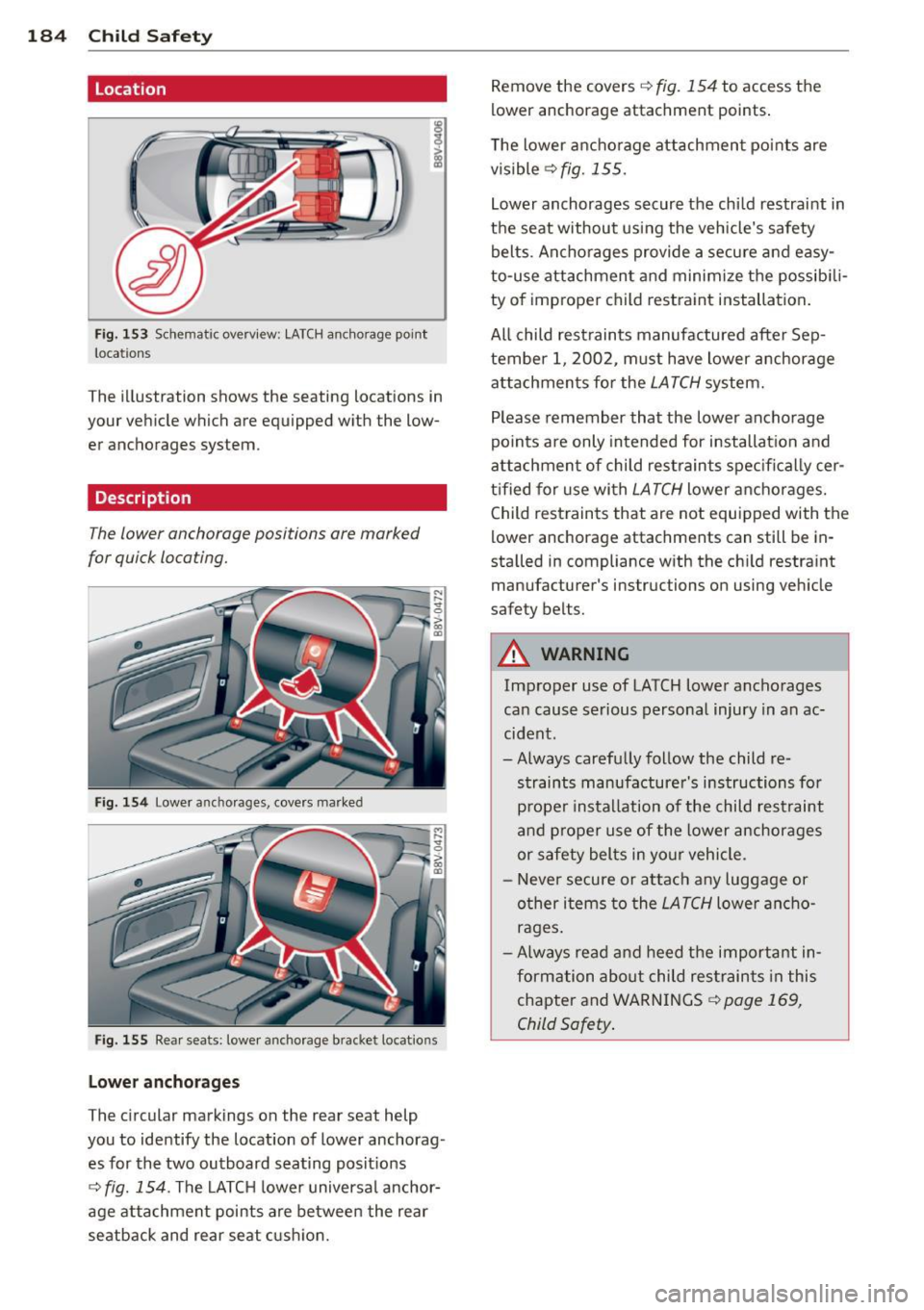
location
Fig. 153 Schematic overview: LATCH ancho rage point
locations
The illustration shows the seating locations in
your vehicle which are equipped with the low
er anchorages system.
Description
The lower anchorage positions are marked
for quick locating.
F ig. 15 4 Lower anchorages, covers marked
F ig. 155 Rear seats: lowe r anchorage bra cket locat io n s
Lowe r ancho rages
The c ircular markings on the rear seat help
you to identify the location of lower anchorag
es for the two outboard seating posit ions
~ fig. 154. The LATC H lower universal anchor
age attachment points are between the rear
seatback and rear seat cus hion. Remove the
covers~
fig. 154 to access the
lower anchorage attachment points .
T he lower ancho rage attachmen t po ints are
visible
~ fig. 155.
Lower anchorages secure the chi ld restraint in
the seat without using the vehicle's safety belts. Ancho rages provide a secure and easy
to-use attachmen t and minimize the possib ili
ty of imp roper child restraint installation .
All child rest raints manufactured after Sep
tember 1, 2002, m ust have lower anchorage
attachmen ts for the
LATCH system.
Please remember that the lower anchorage
points are only intended for installation and
attachment of child rest raints spec ifically cer
t ified for use with
LATCH lower anchorages.
Child rest raints that are not equipped with the
lower anchorage attachments can still be in
sta lled in compliance with the ch ild restra int
manufacturer's instructions on using vehicle
safety belts.
A WARNING
-Improper use of LATCH lower ancho rages
can cause serious personal injury in an ac
cident .
-Always carefully follow the child re straints manufacturer's instructions for p roper installation of the child restraint
an d proper use of the lower anchorages
or safety belts in your vehicle.
- Never secure or attach any luggage or
o ther items to the
LATCH lower an cho
rages .
- Always read and heed the important in
formation about child res train ts in this
chapter and WARN INGS
~ page 169,
Child Safety .
Page 187 of 302
....,
N
r--. > co
rl I.O
"' rl
"' rl
Installing a child restraint with LATCH
lower anchorages
Applies to vehicles: with Top Tether
Whenev er you install a child res traint always
follow the child restraint manufacturer's in
structions.
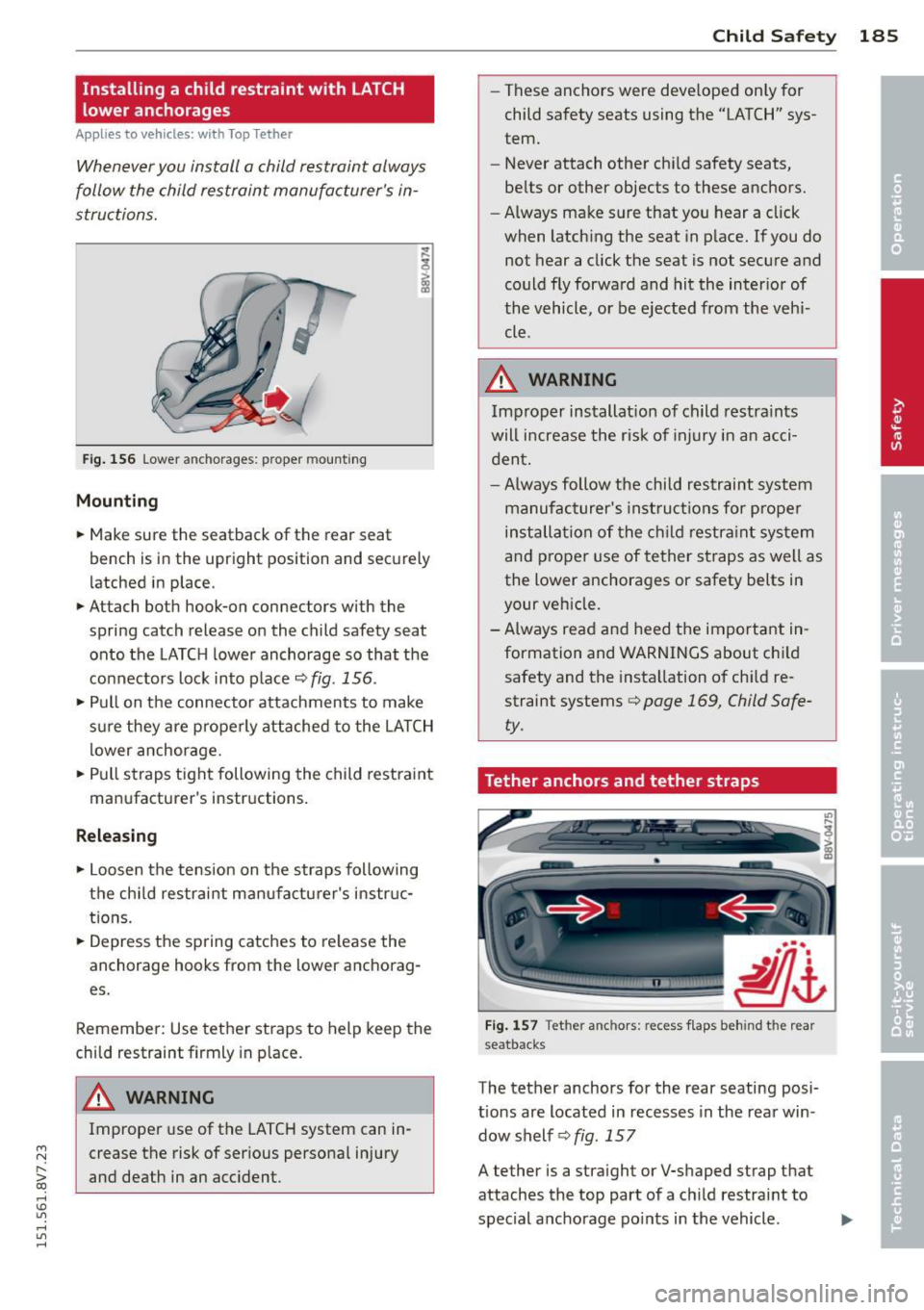
F ig . 156 Lowe r anch ora ges: proper mount ing
Mount ing
.. Make sure th e seatback of the rear seat
bench is in th e upright posit ion and s ecur ely
latched in place .
.. Attach bo th hook-on connectors wi th the
spring c atch release on the child safety seat
onto the LATC H lower anchorage so that the
connectors lock into place~
fig. 156.
.. Pull on the connector attachments to make
su re they are properly attached to the LATCH
lower anchorage .
.. Pull straps tight following the child restra int
manufacturer's instruct ions.
Releasing
.. Loosen the tens ion on the straps following
the chi ld restraint manufacturer's instr uc
t ions .
.. Depress the spring catches to re lease the
anchorage hooks from the lowe r anchorag
es.
Remember: Use tether straps to help keep the
ch ild restraint firmly in p lace.
A WARNING
Improper use of the LATC H system can in
crease the risk of ser ious personal injury
and death in an acc ident.
Child S afety 185
-These anchors were deve loped only for
child safety seats using the "LATCH" sys
tem.
- Never attach other chi ld safety seats,
be lts or other objects to these anchors.
- Always make sure that you hear a click
when latch ing the seat in p lace. If you do
not hear a click the seat is not secure and
could fly forward and hit the interior of
the vehicle, or be e jected from the veh i
cle .
A WARNING
Imp roper installat ion of ch ild rest ra ints
will increase the risk of injury in an acci
dent.
- Always follow the child restraint system
manufac turer's inst ruct io ns for prope r
installation of the c hild restra int system
and p roper use of te ther s traps as well as
the lower anchorages or safety belts in
your vehicle .
- Always read and heed the im portant in
formation and WARNINGS about chi ld
safety and the insta llation of ch ild re
straint systems ~
page 169, Child Safe
ty .
Tether anchors and tether straps
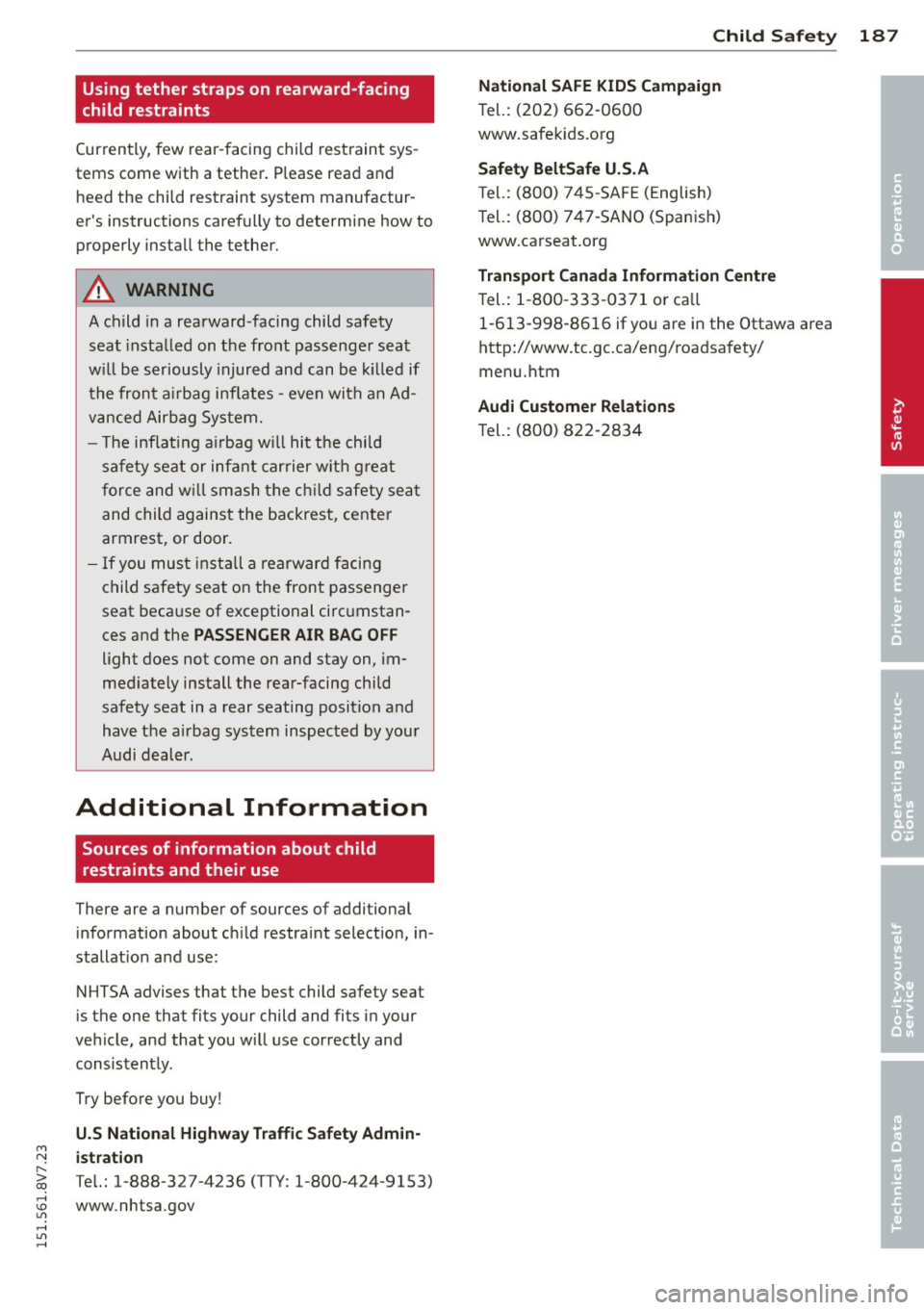
Fig . 1 57 Tether an ch or s: re cess f lap s behi nd the re ar
seatbac ks
T he tether anchors for the rear seating posi
t ions are located in recesses in the rear win
dow shelf ~
fig. 157
A tether is a s tra ight or V- shaped strap that
attaches the top part of a ch ild restraint to
special anchorage po ints in the vehicle .
-
Page 188 of 302
186 Child Safet y
The purpose of the tether is to reduce the for
ward movement of the child restraint in a
crash, in order to help reduce the r isk of head
injury that could be caused by striking the ve
h icle interior.
F orward facing child restraints manufactured
after September 1, 1999, are required by U.S.
federal regulations to comply with new child
head movement performance requirements.
These new performance requ irements make a
tether necessary on most new ch ild safety
seats .
A WARNING
Imprope r insta llation of chi ld restrai nts
w ill increase the risk of inju ry and death in
a crash.
- Always follow the instructions p rov ided
by the manufacturer of the ch ild re
st raint you in tend to install in your Audi.
- Improper use of c hild restr aint anchors
(including tether anchors) can lead to in
jury in a co llision. The anchors are de
signed to withstand on ly those loads im
posed by correctly fitted ch ild restraints.
- Never mount two ch ild restraint systems
on one LATCH lower anchor po int.
- Never a ttach two child rest ra int sys tems
to one tether strap or tether anchorage.
- Never attac h a tether st rap to a tie -down
hook in the luggage compartment.
- Never use c hild restra int te ther ancho
rages to secure sa fety belts o r othe r
k inds of occupant restraints.
- Never secure or attach any luggage or
other items to the LATCH lowe r ancho
rages or to the tether anchors .
- If you must install a rearward facing
child safety seat on the front passenger
seat because of exceptional circ umstan
ces and the
PAS SENGER AIR BAG OFF
light does not come on and stay on, im
med iately install the rear-facing child
safety seat in a rear seating position and
have the a irbag system inspected by you r
Audi dea ler.
Installing the upper tether strap on the
anchorage
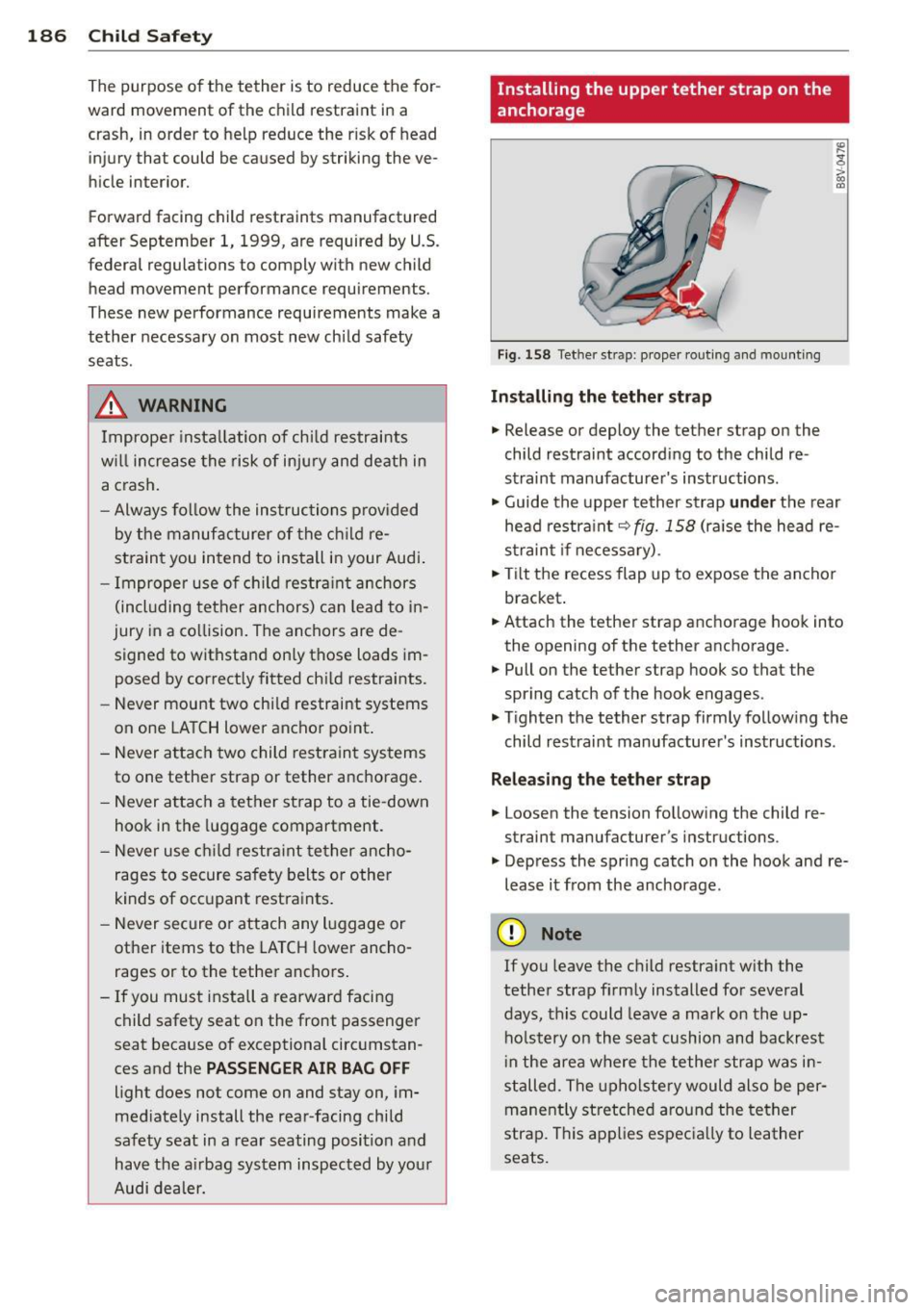
Fig. 158 Tet her strap: proper ro u ting and mountin g
Installing the tether st rap
" Release or deploy the tether strap on the
child restraint according to the child re
s tr aint manufacturer's instructions.
" Guide the upper t ether strap
und er the rear
head restra int~
fig. 158 (ra ise the head re
s traint if ne cess ary) .
" Ti lt the recess flap up to expose the anchor
bracket .
" Attach the tether strap anchorage hoo k into
the opening of the tether anchorage.
" Pull on the tether strap hook so that the
spring catch of the hook engages.
" Tighten the tether strap firmly follow ing the
child r estraint manufacturer 's ins tructions.
Relea sing the tether strap
" Loosen the tension fo llow ing the child re
straint manufacturer's instructions.
" Depress the spri ng catch on the hook and re
lease it from the anchorage .
(D Note
If you leave the c hild restra int wit h the
tethe r strap firm ly installed for seve ral
days, this could leave a ma rk on the up
ho lstery on the seat cushion and backrest
i n the area w here the tethe r strap was in
s talled. The upholstery would also be per
manent ly st retche d around the tether
strap. T his applies espec ia lly to leather
seats.
Page 189 of 302
Using tether straps on rearward-facing
child restraints
Currently, few rear- facing child rest raint sys
tems come with a tether . P lease read and
heed the child res traint system manufactur
er 's instructions carefully to determine how to
prope rly install the tether.
A WARNING
A child in a rearward-facing child safety
seat installed on the front passenger seat
w ill be seriously injured and can b e kill ed if
the front a irbag inflates -even with an Ad
v a nced Airbag System.
- T he inflating a irbag w ill hit the child
safety sea t or infan t carrier w ith g reat
f orce and w ill smash the ch ild safety se at
and child against the backrest, center
armrest, or door.
- If you mus t inst all a rearward facing
child safety seat on the front passenger
seat beca use of exceptional circ umstan
ces and the
PASSENGER AIR BAG OFF
light does not come on and stay on, im
med iately install the rear-facing child
safety seat in a rear seating position a nd
have t he a irbag system inspected by you r
Audi dealer.
Additional Information
Sources of information about child
restraints and their use
There are a number of sources of additional in formation about ch ild restrai nt select ion, in
stallat ion a nd use:
NHTSA advises that the best child safety seat
i s the one that fits your child and fits in your
ve hicle, and that you wi ll use correctly and
consistently .
Try before you buy!
U.S National Highway Traffic Safety Admin· M N i s tration ,....
> co ,...., \!) 1.1'1 ,...., 1.1'1 ,....,
Te l.: 1-888-327-4236 (TTY: 1-800-424-9153)
www.nhtsa.gov
Child Sa fet y 187
National SAFE KIDS Campaign
Tel.: (202) 662-0600
www.safe kids.o rg
Safet y BeltSafe U.S .A
T el.: (800) 7 45-SAFE (English)
Tel.: (800) 747 -SANO (Spanish)
www.carseat.org
Transport Canada Information Centre
T el.: 1 -800 -333-0371 o r ca ll
1-613-998-86 16 if yo u are in the Ottawa area
http://www.tc.gc.ca/eng/roadsafety/
menu.htm
Audi Cu stomer Relation s
Tel.: (800) 822-2834
•
•
•
Page 191 of 302
....,
N
r--. > co
rl I.O
"' rl
"' rl
Stee ring re comm endat ion
The ESC helps to stabilize the vehicle by
changing the steering torque.
Selective wheel torqu e control
Select ive wheel torque control is used when
driving on curves . The front wheel on the in
side of the curve or both wheels on the inside
of the curve are braked selective ly as needed.
This a llows more precise driving in curves.
Automatic post -collisi on brakin g system
The "Automatic post-collision braking system "
can help to reduce the risk of slidi ng and of
other coll is ions afte r an accident. I f the airbag
con tro l modu le detects a collision above ace r
tain vehicle speed, the vehicle is braked by the
ESC.
The vehicle does not brake automatically if:
- the driver presses the accelerator pedal, or
- the braking force generated by the pressed
brake pedal is greater than the braking force
that would be initiated by the system, or
- the ESC, the brake system or the vehicle
electrical system are not functioning.
A WARNING
-The ESC and its integrated systems can
not overcome the limits posed by natura l
physical laws. This is especially impor
tant on s lippery or wet roads. If the sys-
Switching on/off
Sm art Te chnol og y 189
terns beg in acting to stabilize your vehi
cle, you should immediately alter your
speed to match the road and traffic con
ditions . Do not let the increased safety
provided tempt you into taking r isks .
This could increase your risk of a co lli
SIOn.
- Please note the r isk of a coll is ion increas
es when driving fast, especially through
curves and on slippery or wet roads, and
when dr iv ing too close to objects ahead.
The ESC and its integrated systems can
not a lways prevent collisions -there is
still a risk of accidents!
- Press the accelerator pedal caref ully
when acce lerating on even, slippery sur
faces such as ice and snow. The drive
wheels can spin even when these control systems are installed and this can affect
driving stability and increase the r isk of a
coll is ion.
@ Tips
-ABS and ASR only function correctly
when all four wheels are equipped w ith
identical tires. Different t ire sizes can
lead to a reduct ion in engine power.
- You may hear noises when the systems
descr ibed are working.
- If the
Bl or [I] indicator light appears,
there may be a malfunction
¢ page 21.
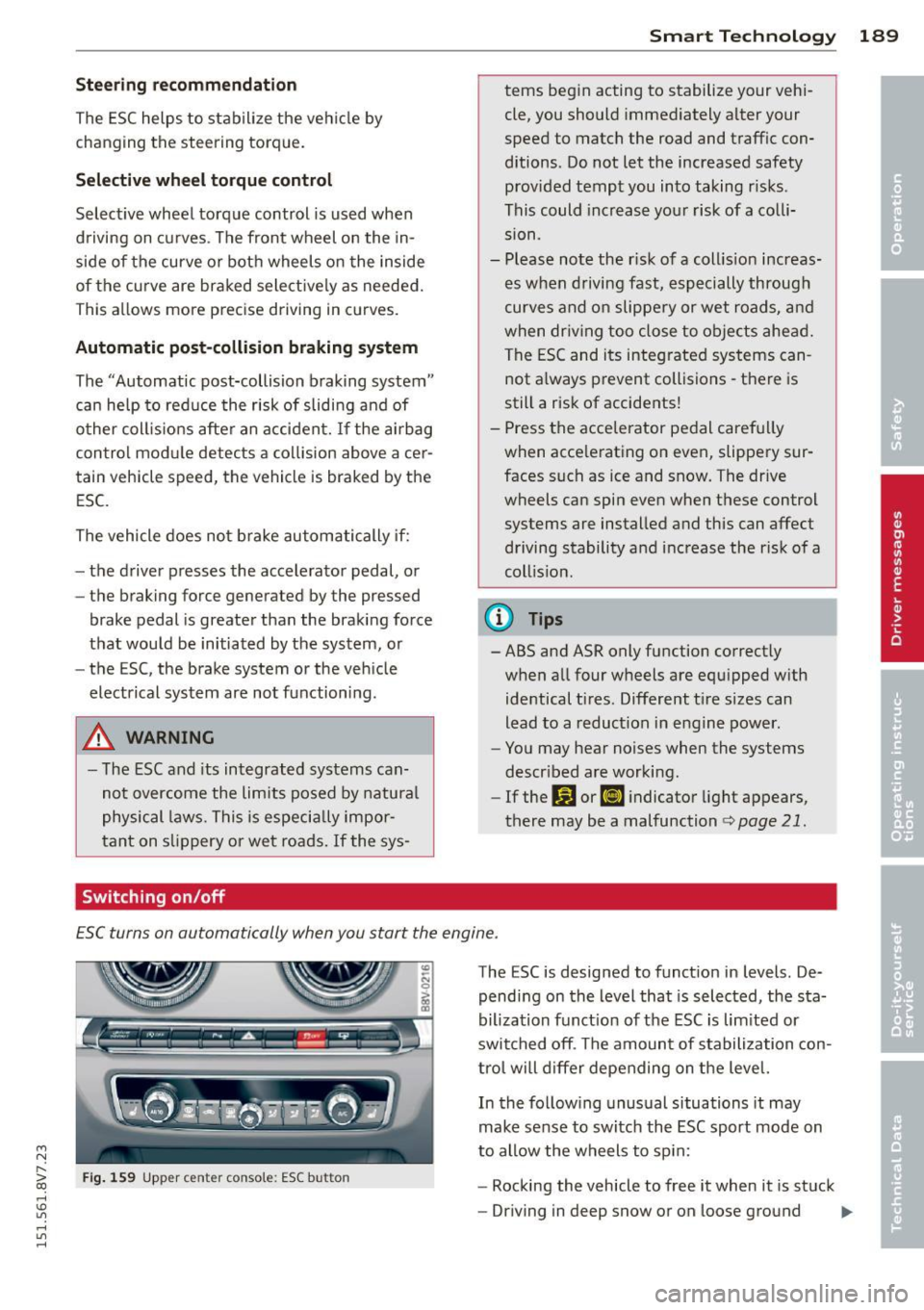
ESC turns on automatically when you start the engine .
Fig. 159 Upper c ente r conso le: ESC button
The ESC is designed to funct ion in levels . De
pend ing on the level that is selected, the sta
bilization funct ion of the ESC is lim ited or
swi tched off . The amoun t of stabilization con
trol wi ll differ depending on the level.
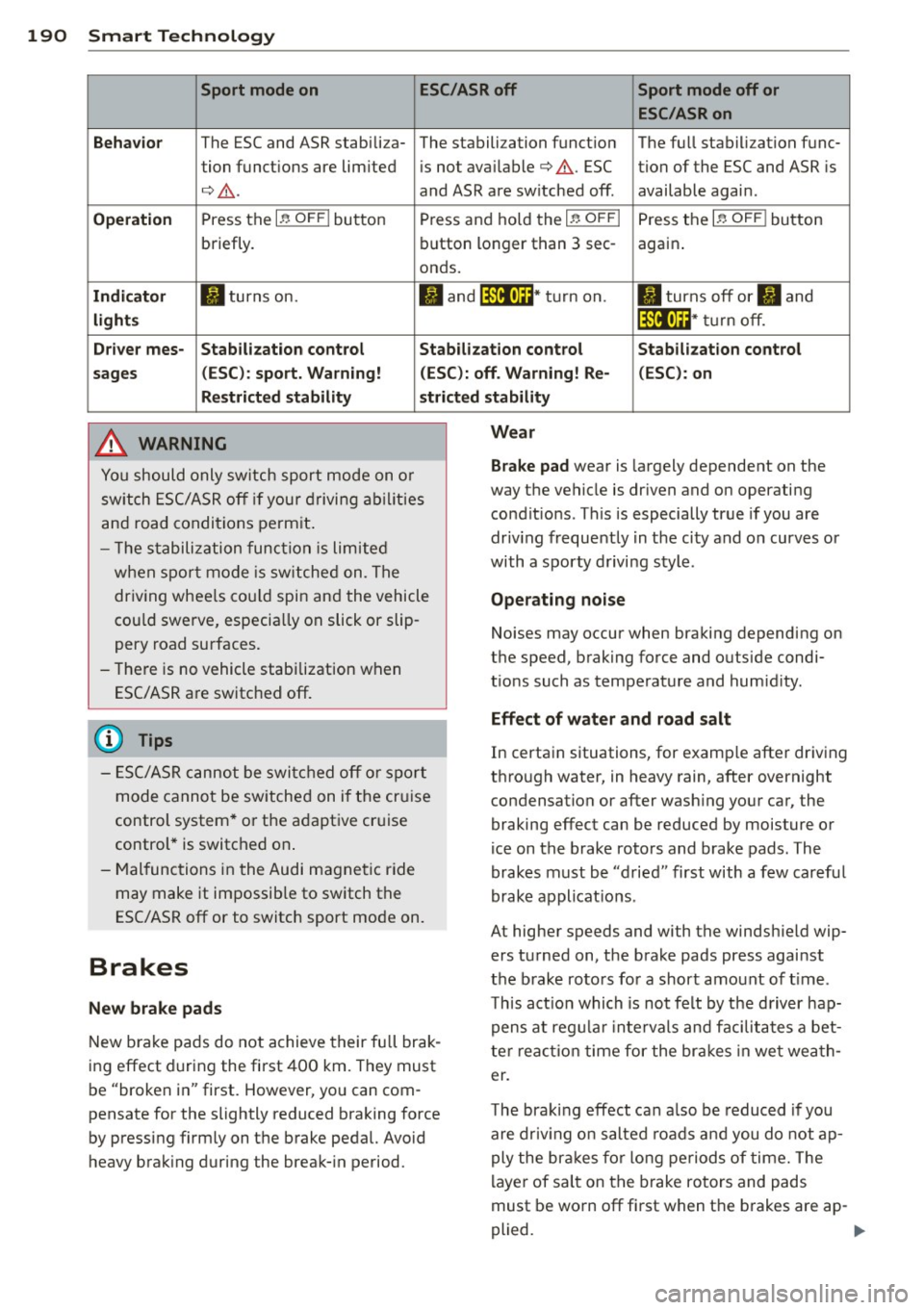
In the follow ing unusual situations it may
make sense to switch the ESC sport mode on
to allow the wheels to sp in:
- Rocking the vehicle to free it when it is stuck
- Driving in deep snow or on loose ground
IJJ-
Page 192 of 302
190 Smart Technology
Sport mode on ESC/ASR off Sport mode off or
ESC/ASR on
Beha vior
The ESC and ASR stabiliza- The stabilization funct ion The full stab ilization f unc-
tion funct ions are lim ited is not ava ilable
c> .&. . ESC tion of the ESC and ASR is
¢ _&. . and ASR are sw itched off. available agai n.
Operation Press the l.i; OFF ! button P ress and hold the 1.i; OFFI Press the l.i; OFF ! button
briefly. button lo
nger than 3 sec-
again.
onds.
Indicator II turns on. II and jf'ill•lH * tu rn on. II turns off or fl and
light s jf 'ill•li~* t ur n off.
Dr iver mes- Stabilization control Stab ilizat ion control Stabilization control
sages (ESC ): sport. Warning! (ESC ): off . Warning! Re- (ESC ): on
R estricted stability stricted stability
_& WARNING
You should only switch spor t mode on o r
switch ESC/ASR o ff if your driving abiliti es
an d road condi tions perm it.
- T he s tabilization func tio n i s limite d
whe n spor t mode is sw itche d on. T he
dr iv ing whee ls co ul d spin an d the vehicle
cou ld swe rve , especia lly on slick or slip
pery road surfaces.
- The re is no vehicle stabilization w hen
ESC/ASR a re switched off .
@ Tips
- ESC/ASR c ann ot b e swi tc h ed off o r spor t
mode canno t be sw itche d on i f the cr uise
control system * or the a dapt ive cr uise
control * is switc hed on .
- Mal func tions in the Audi magne tic ride
may make it impossib le to sw itch t he
ESC/ASR off or to switch sport mo de on.
Brakes
New brake pads
-
N ew brake pads do not achieve their fu ll brak
ing effect d urin g the first
400 km. They must
be "broken i n" first. However, yo u can com
pensate for the slightly reduced braking force
by pressing fi rmly on t he brake pedal. Avo id
heavy brak ing dur ing the break- in period.
Wear
Brake pad
wear is largely dependent on the
way the vehicle is dr iven and on operati ng
condit io ns. This is especially true if you are
driv ing frequent ly in t he ci ty and o n curves or
with a spor ty d rivi ng s tyle.
Operating noise
Noises may occur when bra king depending on
the speed , braking force and outside condi
t ions such as tempe rature and hum id ity.
Effect of water and road salt
In certa in situations, for examp le after dr iv ing
t hr ough water, in heavy rain, after overnight
condensation or after was hing your car, the
braking effect can be reduced by moisture or
ice on the brake rotors and brake pads. The
brakes must be "d rie d" first with a few carefu l
brake applicat ions .
At highe r speeds and with the winds hield wip
ers tu rned on, the brake pads press against
the b rake ro to rs fo r a short a mount of t ime .
T h is act ion which is not felt by the d river hap
pen s at reg ular i nte rvals an d facilit ates a bet
te r rea ction t ime for the br akes in we t we ath
er.
T he bra king effect can a lso be redu ced if you
are dr iv ing o n sal ted roads a nd you do not a p
ply the br akes fo r long periods of time. The
l aye r of sa lt on the b rake roto rs and pads
must be wo rn off first when t he b rakes are ap -
plied. ..,..
Page 193 of 302
M N ,....
> co ,...., \!) 1.1'1 ,...., 1.1'1 ,....,
Corrosion
Leaving the vehicle parked for long periods of
time, low mi leage and avoiding heavy braking
can contribute to corrosion on the brake ro
tors and dirty brake pads.
If you usually avoid heavy braking or if there is
corrosion present, occasiona l heavy braking at
high speeds is recommended to clean the
brake rotors and pads~,& .
Brake system malfunction
if you notice that the brake pedal t ravel has
suddenly gotten larger, then a brake circuit
may have failed . Drive to you r authorized Audi
dealer or qualified repair facility immediately
to have the problem corrected. On the way
there, drive with reduced speed and keep in
mind that a long braking distance and in
creased pressure on the brake pedal will be
necessary .
Low brake fluid level
When the brake fluid level is low, ma lfunc
tions in the brake system may occur . The
brake fluid level is electronically monitored.
Brake booster
The brake booster amplifies the pressure you
apply to the brake pedal. It only works when
the eng ine is running.
A WARNING
-You should on ly perform braking maneu
vers to clean the brakes when the road condit ions perm it . Never put others on
the road at risk -never forget the risk of
acc idents!
- On steep slopes, reduce the speed and
select a lower gear or lower selector lev
er posi tion. Drive as little as possible
wh ile pressing the bra ke peda l and avoid
putt ing your left foot on the brake pedal
whi le driving. This could ca use the brakes
to overheat and impair the efficiency of
the brakes.
- Do not let the brakes "grind" by always
keeping yo ur foot on the brake peda l.
Smart Technolog y 191
This can cause the brakes to overheat in-,
crease wear and increase braking dis
tance unnecessar ily.
- Certain weather and operating condi
tions such as driving through water, driv
ing in heavy rain or driving after washing
your veh icle can impa ir the effectiveness
of the brakes. In the winter, ice may
bui ld up on the brake pads, rotors and
drums . Check these components by brak
ing caref ully. App lying the brakes care
fu lly several times dries the brakes and
removes ice build-up .
- The effic iency of the brakes can also be
impaired by driving for long stretches on
roads covered with salt without using the
brakes. You can remove salt deposits
from the brake rotors and pads by care
fully applying the brakes several times.
- If the front spoiler is damaged or you in
stall another spoiler, make sure the front
wheel brakes are ventilated properly.
Otherwise, the brake system could over heat, wh ich reduces their effectiveness .
- Failure of a brake circuit impa irs braking
performance, wh ich increases braking
d istance . Avoid driving the vehicle and
have it towed it to the nearest author
i z ed Audi dealer or authorized Audi Serv
ice Facility.
- Do not let your veh icle roll w ith the en
gine switched off under any circumstan
ces .
- If the brak e booster is not working, you
wi ll have to press much harder on the
brake peda l to compensate for the lack
of the booster.
(D Note
-Never let the brakes "rub" by pressing
the pedal lightly when braking is not
really necessary. This causes the brakes
to overheat and increases braking dis
tance and causes wear.
- Before driving on a long stretch with
steep s lopes, reduce your speed and shift
to the next lower gear This makes use of
the engine brak ing effect and relieves ..,.
•
•
•