change time AUDI A3 CABRIOLET 2015 User Guide
[x] Cancel search | Manufacturer: AUDI, Model Year: 2015, Model line: A3 CABRIOLET, Model: AUDI A3 CABRIOLET 2015Pages: 302, PDF Size: 73.83 MB
Page 163 of 302
M N
" > co ,...., \!) ..,.,
,...., ..,., ,....,
on the front passenger seat that might cause the capa citive passenger detecti on
system to miscalcu late electrical capac i
tance.
Important safety instructions on
monitoring the Advanced Airbag System
A WARNING
- If the status of the Adv a need Airb ag Sys
tem has changed while the vehicle is
moving, the
PASSENGER AIR BAG OFF
light b links for about S seconds to catch
the driver's attent ion. If this happens, al
ways stop as soon as it is safe to do so
and check the steps described above .
- If the
PASSENGER AIR BAG OFF light
does not go off when an adult who is not
very small is sitting on the front passen ger seat after taking the steps descr ibed
above, make sure the adult is properly
seated and restrained at one of the rear seating pos it ions. Have the a irbag sys
tem inspected by your authorized Audi
dealer before transporting anyone on the
front passenger seat .
A WARNING
An airbag system that is not funct ioning
properly cannot provide supplemental pro
tection in a frontal crash.
- If the airbag indicator light
c> page 20
turns on when the vehicle is being used,
have the system inspected immediately
by you r autho rized Aud i dea le r. It is pos
sible that the a irbag will inf late when it
is not s upposed to, or w ill not inflate
when it sho uld.
A WARNING
If the front airbag infla tes, a ch ild witho ut
a c hild restraint , or in a rearwar d-fac ing
child safety seat , or in a forward-facing
child rest raint that has not been properly
installed will be serio usly injured and can
be killed.
-
A irbag system 16 1
-Even tho ugh you r vehicle is equipped
with an Advanced A irbag System, make
certa in that all children, espec ia lly 12
yea rs and younger, always ride on the
back seat prope rly rest rained for their
age and size .
- Always install forward o r rear-facing
child seats on the rear seat -even with
an Advan ced A irbag System.
- I f you must install a rearwa rd-facing
child seat on the front passenger seat because of ex ceptio nal circumstances
an d the
PASSENGER AIR BAG OFF light
does not appear and s tay on, immedi ate
ly install the rear -facing child seat in a
rea r seating pos ition and have the airbag
system inspected by you r Audi dealer.
- If, in exceptiona l circumstances, you
m ust install a forwar d-fac ing ch ild re
straint on the front passenger seat, al
ways move the seat into its rearmost po
sition in the seat's fore and aft adjust
ment range, as fa r away from the a irbag
as poss ible. The backrest must be ad just
ed to an upright pos ition. Make su re that
the
PASSENGER AIR BAG OFF light
comes on a nd stays on all the time when
eve r the ignit ion is switched on .
A WARNING
=
- If the PASSENGER AIR BAG OFF light
does not go o ut when an a dult is sitting
on the front passenger seat after taking
the steps described above, make sure the
adu lt is properly seated and restra ined at
one of the rea r seat ing pos itions .
- Have the airbag system inspected by
your Aud i dea ler before transporting
anyone on the front passenger seat .
(D Tips
If the capacitive passenger detection sys
tem dete rm ines that the front passenger
seat is empty, t he fronta l airbag on the
passenger side will be turned off, and the
PASSENGER AIR BAG OFF light will stay
on.
•
•
•
Page 173 of 302
M N ,....
> co ,...., \!) ..,.,
,...., ..,., ,....,
-Always read and heed all WARNINGS
whenever using a child restraint in ave
hicle
¢ page 138, Safety belts,
¢ page 146, Airbag system and
¢ page 169, Important things to
know.
(D Tips
Always replace child restraints that were
installed in a vehicle during a crash. Dam
age to a child restraint that is not visible
could cause it to fail in another collision
situation.
Advanced front airbag system and children
Your vehicle is equipped with a front "Ad
vanced Airbag System" in compliance with United States Federal Motor Vehicle Safety
Standard (FMVSS) 208 as applicable at the
time your vehicle was manufactured .
The Advanced Airbag system in your vehicle
has been certified to meet the "low-risk" re
quirements for 3-and 6-year old children on
the passenger side and small adults on the
driver side. The low risk deployment criteria
are intended to reduce the risk of injury
through interaction with the airbag that can
occur, for example, by being too close to the
steering wheel and instrument panel when
the airbag inflates . In addition, the system
has been certified to comply with the "sup
pression" requirements of the Safety Stand
ard, to turn off the front airbag for infants up
to 12 months who are restrained on the front passenger seat in child restraints that are list
ed in the Standard .
Even though your vehicle is equipped with an
Advanced Airbag system, all children, espe
cially those 12 years and younger, should al
ways ride in the back seat properly restrained
for their age and size. The airbag on the pas
senger side makes the front seat a potentially
dangerous place for a child to ride. The front
seat is not the safest place fo r a child in a for
ward-facing child safety seat. It can be a very
Child Safety 1 71
dangerous place for an infant or a larger child
in a rearward-facing seat.
The vehicle's Advanced Airbag System has a
capacitive passenger detection system in the
front passenger seat cushion that can detect
the presence of a baby or a child in a child re
straint system on this seat.
The capacitive passenger detection system
registers the changes that result in an electri
cal field when a child, a child restraint, and a
baby blanket are on the front passenger seat .
The change in the measured capacitance due
to the presence of a child, a child restraint,
and a baby blanket on the front passenger
seat is related to the child restraint system resting on the seat . The measured capacitance
of a child restraint system varies depending
on the type of system and specific make and model.
The electrical capacitance of the various
types, makes, and models of child restraints
specified by the U.S.National Highway Traffic
Safety Administration (NH TSA) in the relevant
safety standard are stored in the Advanced
Airbag System control unit together with the capacitances typical of infants and a 1-year
old child. When a child restraint is used on the
front passenger seat with a typical 1 year-old infant, the Advanced Airbag System compares
the capacitance measured by the capacitive passenger detection system with the data
stored in the electronic control unit.
Child restraints and Advanced front
airbag system
Regardless of the child restraint that you use,
make sure that it has been certified to meet
United States Federal Motor Vehicle Safety
Standards and has been certified by its manu
facturer for use with an airbag. Always be sure
that the child restraint is properly installed at
one of the rear seating positions. If in excep
tional circumstances you must use it on the
front passenger seat, ca refully read all of the
information on child safety and Advanced Air-
bags and heed all of the applicable ..,.
•
•
•
Page 190 of 302
188 Smart Technology
Smart Technology
Information about
data recorded by
vehicle control
modules
Your vehicle is not equipped with a crash data
recorder. This device is insta lled by some vehi
cle manufacturers to record data about crash
es so tha t it can be analy zed later. Crash data
recorders are also called "Event Data Record
ers (EDR)" .
In some legal jurisdictions, it is not permitted
to access or download data recorded by pre
installed crash data recorders in order to eval
uate a crash without clear consent of the vehi
cle owner .
Your veh icle is not equipped with a crash data
recorder. However it does contain a var iety of
e lectronic control modules for various vehicle
systems such as eng ine funct ion, exhaust
treatment or airbags and safety belts .
These electron ic control modules record vehi
cle data during normal driv ing for diagnosis
and repair purposes. The recording capab ility
of the electron ic control modules is lim ited to
data only- no sound is reco rded.
If t he control
mo dule detects a sys tem m alfu nction or other
change in sta tus, a very lim ited amount of da
ta is recorded for an extreme ly sma ll period of
time . Data t hat is recorded in s uch a case may
include veh icle speed, driving direction, the
load on the brakes and head restraints and
performance in the event of an acc iden t or
other change in status . The stored data can
only be read o r down loaded w ith specia l dev i
ces.
Electronic stabilization
control (ESC)
Description
The E lectronic Stabilization Cont rol (ESC) con
tr ibutes to d river safety. It reduces the risk of
slipp ing and improves driving stability. ESC detects critical situations such as the veh
icle
oversteering and understeering or the whee ls
are spinning . The vehicle is stabilized by ap
plying the brakes or reducing engine torq ue.
Once the ESC is activated, the ind icator light
Bl blinks in the instrument cluster .
The following systems are integrated in the ESC:
Anti -lock braking s ystem (ABS)
ABS prevents the whee ls from locking when
braking . The vehicle can still be steered even
during hard braking . App ly steady pressure to
the brake peda l. Do not pump the peda l. A
puls ing in the brake peda l ind icates that the
system is act ing to stabilize the ve hicle.
Brake assi st sy st e m
The brake assist system can decrease braking
distance .
It increases braking power when the
driver presses the brake peda l quickly in emer
gency s ituations. You m ust press and hold the
brake pedal until the dangerous situation is
over . In vehicles with adaptive cruise control*,
the brake assist system is more sens it ive if the
distance detected to the vehicle ahead is too
small.
Anti-slip regu lation (ASR )
ASR reduces engine power when the drive
wheels begin sp inning and adapts the force to
the road conditions. This makes it easier to
sta rt , accelerate and dr ive up inclines .
Electronic differenti al lock (EDL )
The EDL brakes whee ls that are spinning and
transfers the drive power to the other drive
wheel or wheels if the vehicle is equ ipped with
all wheel drive *). This function is not ava ilable
at h igher speeds .
In extreme cases, EDL automatically sw itches
off to keep t he b rake on the braked wheel
from overheat ing. The ve hicle is still working
co rrect ly. EDL w ill switch o n aga in automat i
ca lly when cond itions have ret urned to no r-
mal. .,._
Page 213 of 302
M N
" > co ,...., \!) ..,.,
,...., ..,., ,....,
Many gasoline grades are blended to perform
especially well for winter or summer driving. During seasonal change-over , we suggest that
you fill up at busy gas stations where the sea sonal adjustment is more likely to be made in
time.
Q;) Note
- Methanol fuels which do not meet these requirements may cause corrosion and
damage to plastic and rubber compo
nents in the fuel system .
- Do not use fuels that fail to meet the
specified criteria in this chapter .
- If you are unable to determine whether
or not a particular fuel blend meets the
specificat ions, ask your service station or
i ts fuel supp lier .
- Do not use fuel for which the contents cannot be identified .
- Fuel system damage and performance
problems resulting from the use of fuels
different from those specified are not
the responsibility of Audi and are not
covered under the New Vehicle or the
Emission Control System Warranties.
- If you experience a loss of fuel economy
or driveability and performance prob
lems due to the use of one of these fuel
blends, we recommend that you switch
to unblended fuel.
Gasoline additives
A major concern among many auto manufac
turers is carbon deposit build-up caused by
the type of gasoline you use .
Although gasoline grades differ from one manufacturer to another, they have cer tain
things in common. All gasoline grades contain substances that can cause deposits to collect
on vital engine parts, such as fuel injectors
and intake valves. Although most gasoline
brands include additives to keep engine and
fuel systems clean, they are not equally effec
tive.
Checking and Filling 211
Audi recommends using TOP TIER Detergent
Gasoline . For more information on TOP TIER
Detergent Gasoline, please go to the official
website (www .toptiergas .com) .
After an extended period of using inadequate
fuels, carbon deposit build-ups can rob your engine of peak performance.
CJ) Note
Damage or malfunction due to poor fuel
quality is not covered by the Audi New Ve
hicle Limited Warranty.
Fuel tank
Fuel filler neck
The fuel filler neck is located on the right rear
side panel behind the fuel filler flap.
If the power locking system should fail, you
can still open the flap manually -for detailed
instructions see~
page 213.
You can find the fuel tank capacity of your ve
hicle in
~ page 280.
The label on the inside of the fuel filler flap
tells you the correct fuel for your vehicle. For
more information about fuel specifications,
see
~ page 210 .
Your vehicle fuel tank has an on board refuel
ling vapor recovery system. This feature helps
to prevent fuel vapors from escaping from the
tank and polluting the environment while you refuel your vehicle. In order to fill the tank
properly while protecting the environment,
please follow this refueling procedure careful
ly .
A WARNING ~
Under normal operating conditions, never
carry additional fuel containers in your car.
Gas canisters and other containers used to
transport fuel can be dangerous. Such con
tainers, full or empty, may leak and could
cause a fire in a collision . If you must
transport fuel to use for your lawn mower, ..,.
•
•
•
Page 219 of 302
M N ,....
> co ,...., \!) 1.1'1 ,...., 1.1'1 ,....,
Engine oil
Engine oil specifications
The engine oil used must conform to exact
specifications .
The service interval display in the instrument
cluster of your vehicle w ill inform you when it
is t ime for an oil change. We recommend that
you have your o il changed by an author ized
Aud i Service Advisor .
If you have to top off the oil between oil
changes, use the Aud i oil quality standard
specified in the table .
Audi oil quality standard
G asoline
VW 502 00 or
e ngin e vw 504 00
Using the proper engine o il is important for
the functionality and service life of the en
g ine . Your engine was factory-filled with a
hi gh-quality oil which can usua lly be used
throughout the enti re yea r.
(D Note
Your Limited New Vehicle Warranty does
not cover damage or ma lfun ctions due to
fa ilure to fo llow recommended ma in te
nance and use requ irements as set forth in
the Audi Owner's Manua l and Warranty
&
Maintenance book let.
- U se only a high q uality eng ine oi l that ex
pressly comp lies with the Audi oil quality
standard specified for your vehicle's en
gine. Using any other oil can cause seri
ous engine damage.
- Do not mix any l ubricants or other addi
tives into the eng ine oi l. Doing so can
cause eng ine damage.
(D Tips
I f you need to add oi l and there is none
availab le that meets the Audi oil quality
standard your engine requires, you may
add a total of no more than 0.5 quart/liter
of a high-quality "synthetic"oil that meets
t he follow ing specifica tions.
Checking and Fillin g 217
-Veh icles with gasoline engine : ACEA A3
or AP! SM with a viscosity grade of
SAE O W-30, SAE 5W -30 or SAE SW-40 .
- For more information about engine o il
that has been approved for yo ur vehicle,
please contact either your authorized
Audi dealer or Aud i Customer Relations
at 1 (800) 822-2834 or visit our web site
at www .audiusa.com or
www.a udicanada.ca.
Engine oil consumption
The engine in your vehicle depends on an ade
quate amount of oil to lubricate and cool all
of its moving parts .
In order to provide effective lubrication and
cooling of interna l eng ine components, all in
te rnal combust io n engines consume a certa in
amount of oil. Oil consumpt ion va rie s from
engine to engine and may change sign ifi can tly
ove r th e life of the engine. Typically, engines
wi th a spec ified break -in pe riod (see
¢ page 196) consume more oil during the
break-in pe riod than they cons ume after oi l
consumption has stabilized.
U nder normal cond itions, the rate o f oi l con
s u mption depen ds on the q ual ity and viscos ity
of the oil, the RPM (revolutions per minute) at
which the engine is operated, the ambient
temperature and road conditions. Further fac
tors are the amount of oil dilut ion from water
condensa tion or fuel residue a nd the oxida
tion level of the oil. As any engine is subject to
wea r as m ileage builds up, the oil consump
t ion may incre ase over time until replacement
of wo rn components may be come necessary.
With a ll these va riab les coming into p lay, no
standard rate of oil consumpt io n can be es
tabl is h ed or spec ified. There is no alte rn ative
to regul ar and frequent che cking of the o il lev
el , see
Note.
If the yellow engine o il leve l warning sy mbo l
Ill in the ins trument cl uste r lights up, you
sho uld check the oil leve l as soon as possib le
¢ page 2 18 . Top off the oil at your earliest
convenience
¢ page 218 . ll-
•
•
•
Page 221 of 302
M N ,....
> co ,...., \!) 1.1"1 ,...., 1.1"1 ,....,
A WARNING ,~
- When adding oil, do not let oil drip onto
hot engine components. There could be
risk of a fire.
- You must secure the cap on the oil filler
opening correctly so that oil does not
leak out onto the hot engine and exhaust
system when the engine is running, be
cause this is a fire hazard.
-Always clean skin thoroughly if it comes
into contact with engine oil.
(D Note
- The oil level must not be above the G)
range ~page 218, fig. 166, because this
can cause damage to the catalytic con
verter or the engine. Contact your au
thorized Audi dealer or qualified repair
facility to have excess oil extracted if
necessary.
- Do not mix any additional lubricants into
the engine oil. Damage cause by such ad
ditives is not covered by the warranty.
@ For the sake of the environment
- Oil should never enter the sewer system
or come into contact with the ground.
- Pay attention to legal requirements
when disposing of empty oil containers.
Changing the engine oil
We recommend that have your oil changed by
an authorized Audi dealer or a qualified serv
ice station.
Before you check anything in the engine com
partment, always read and heed all WARN
INGS
~ page 214.
The engine oil must be changed according to
the intervals specified in your Warranty
&
Maintenance booklet. This is very important
because the lubricating properties of oil di
minish gradually during normal vehicle use.
Under some circumstances the engine oil
should be changed more frequently . Change
oil more often if you drive mostly short dis-
Checking and Filling 219
tances, operate the vehicle in dusty areas or
under predominantly stop-and-go traffic con
ditions, or have your vehicle where tempera
tures remain below freezing for extended pe riods.
Detergent additives in the oil will make fresh
oil look dark after the engine has been run
ning for a short time. This is normal and is not
a reason to change the oil more often than
recommended .
Because of the problem of proper disposal,
along with the special tools and necessary ex pertise required, we strongly recommend that
you have your oil changed by an authorized
Audi dealer or a qualified service station.
If you choose to change your oil yourself, please note the following important informa
tion:
A WARNING
To reduce the risk of personal injury if you
must change the engine oil in your vehicle
yourself:
- Wear eye protection.
- To reduce the risk of burns from hot en-
gine oil, let the engine cool down to the
touch .
- When removing the oil drain plug with
your fingers, stay as far away as possible. Always keep your forearm parallel to the
ground to help prevent hot oil from run
ning down your arm.
- Drain the oil into a container designed
for this purpose, one large enough to
hold at least the total amount of oil in
your engine.
- Engine oil is poisonous. Keep it well out
of the reach of children.
- Continuous contact with used engine oil
is harmful to your skin. Always protect
your skin by washing oil off thoroughly
with soap and water.
•
•
•
Page 224 of 302
222 Checking and Filling
After you switch the engine off, the auxiliary
fan can continue running for up to 10 minutes
- even with the ignition off. It can even switch
on again later by itself
c:> .&. , if
- the temperature of the engine coolant rises
due to the heat build-up from the engine in
the engine compartment, or
- the engine compartment heats up beca use
the vehicle is parked in intense sunlight.
A WARNING
- To reduce the risk of personal injury
nev
er touch the radiator fan.
- The auxiliary electr ic fan is temperature
contro lled and can switch on sudden ly
even when the engine is not running.
- The auxiliary radiator fan switches on au tomatically when the engine coolant
reaches a certain temperature and will
continue to run until the coolant temper
ature drops.
Brake fluid
Checking brake fluid level
N
N
;;;
" 00 co
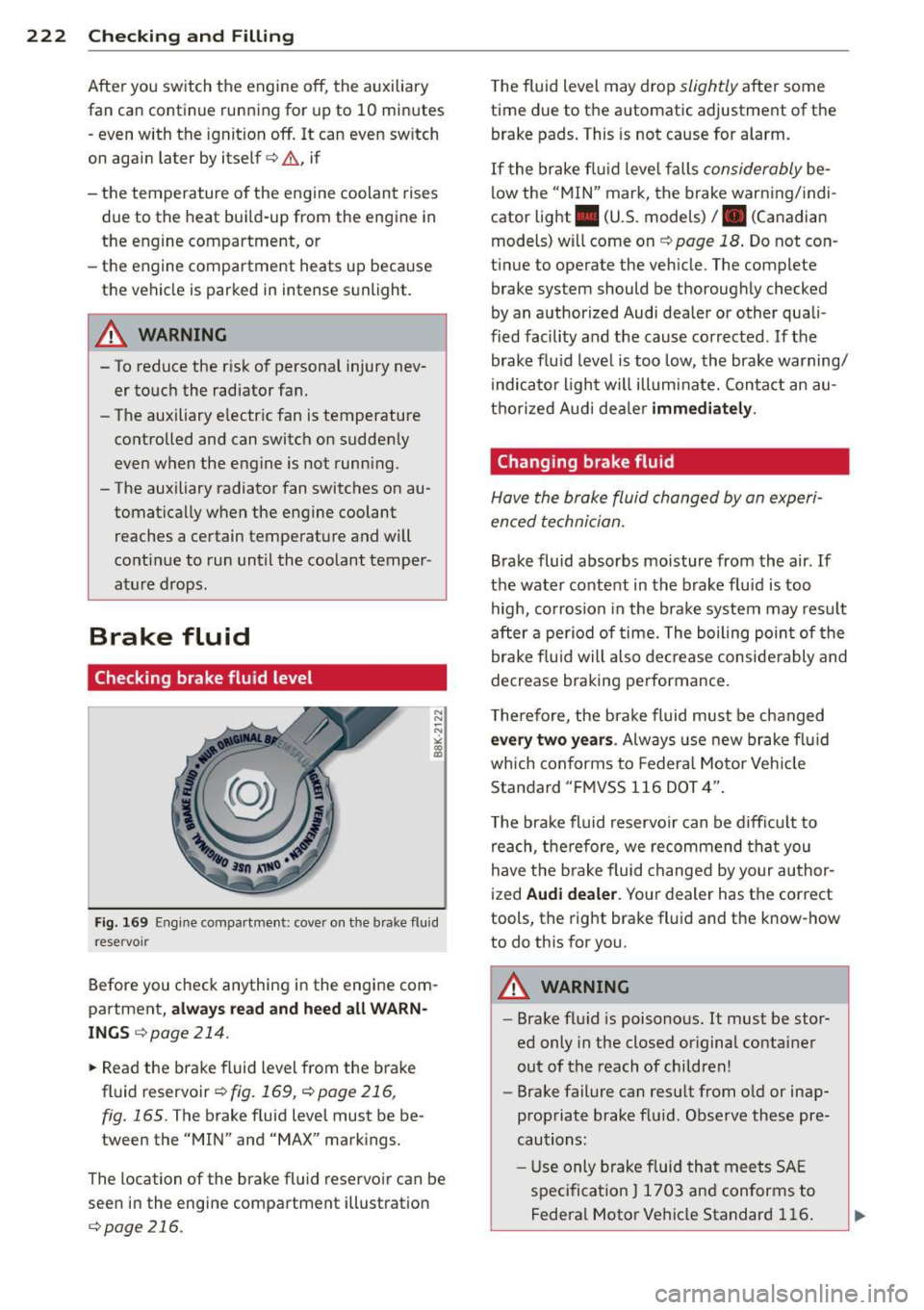
Fig . 169 Engine compartment : cove r on the brake flu id
r eservoir
Before you check anything in the engine com
partment,
always read and heed all WARN ·
INGS c:> page 214.
.. Read the brake fluid level from the brake
fluid reservoir
c:> fig.169, c:>poge216 ,
fig. 165.
The brake f luid level must be be
tween the "MIN" and "MAX" markings.
The location of the brake fluid reservoir can be
seen in the engine compartment illustration
c:> page 216 .
The fluid level may drop slightly after some
time due to the automatic adjustment of the
brake pads . This is not cause for a larm.
If the brake f luid level falls
considerably be
low the "MIN" mark, the brake warning/indi
cator light . (U.S. models)
I. (Canad ian
models) will come on
c:> page 18 . Do not con
tinue to operate the vehicle. The complete brake system should be thoroughly checked
by an authorized Audi dealer or other quali
fied facility and the cause corrected. If the
brake fluid level is too low, the brake warning/
indicator ligh t will illuminate. Contact an au
thorized Audi dea ler
immediately.
Changing brake fluid
Have the broke fluid changed by an experi
enced technician.
Brake fluid absorbs moisture from the air. If
the water content in the brake f luid is too
high, corrosion in the brake system may result
after a period of time. The boiling point of the
brake fluid will also decrease considerably and
decrease braking performance.
T he refo re, the brake fluid must be changed
every two years. Always use new brake fluid
wh ich conforms to Federal Motor Vehicle
Standard "FMVSS 116 DOT 4".
T he brake fluid reservoir can be difficult to
reach, therefore, we recommend that you
have the b rake fluid changed by your author
ized
Audi dealer. Your dealer has the correct
tools, the right brake fluid and the know-how
to do this for you .
A WARNING
---Brake flu id is poisonous. It must be stor
ed only in the closed or iginal container
out of the reach of children!
- Brake failure can resu lt from o ld or inap·
propriate brake flu id. Observe these pre·
cautions:
- Us e only brake fluid that meets SAE
specification
J 1703 and conforms to
Federa l Motor Vehicle Standard 116.
Page 225 of 302
M N
" > co ,...., \!) ..,.,
,...., ..,., ,....,
Always check with your authorized Audi
deale r to make s ure you are using the
correct brake f luid. The correct type of
b rake fluid is a lso indicated on the
b rake fluid reservoir .
- The brake f luid must be new. Heavy use
of the brakes can cause a vapor lock if
the brake fl uid is left in t he system too
long. This ca n ser ious ly aff ect th e effi
ciency of the bra kes a s well as yo ur
safety. This could resul t in an accid ent.
(D Note
Brake fl uid will damage the paint of your
ve hicle .
@ For the sake of the environment
Because of the problem of proper d isposa l
of brake flu id as we ll as the special tools
req uired and the necessa ry expert ise, we
recom mend tha t you have t he b rake fluid
changed by your aut hor ized Audi de aler.
Battery
General information
The batte ry in you r Audi does not need any
maintenance unde r
normal operating condi
tions . Aud i recommends having the elect ro
l y te level check by a n author ized Audi dealer
or author ized A udi Se rv ice F acili ty when there
a re
high outside tempe ra tur es or when dr iv ing
all day. The e lec trolyte level sho uld also be
checked each time the battery is charged
¢ page 225.
Have the bat tery c hecked w hen you br ing yo ur
ve hicl e in for an inspec tion. I t is a good idea
to re place the battery if it is mo re than 5 years
old .
D uring certa in types of a irbag deploymen ts,
t he bat tery is disconnected from the vehi cle
e lectrical system fo r safety reasons ~ &.
in
Repair, care and disposal of the airbags on
page 162.
Checking and Fillin g 223
Disconnecting the battery terminals
Some vehi cle fu nctions (such as power w in
dows) a re not ava ilable when the batte ry is
disco nnected . These fu nctions must be p ro
grammed afte r the battery is reconnected . To
avo id hav ing to do this, only disconnect the
battery from the vehicle electrical system
whe n that is necessary to perform repairs .
To reprogram the functions, proceed as fo l
lows:
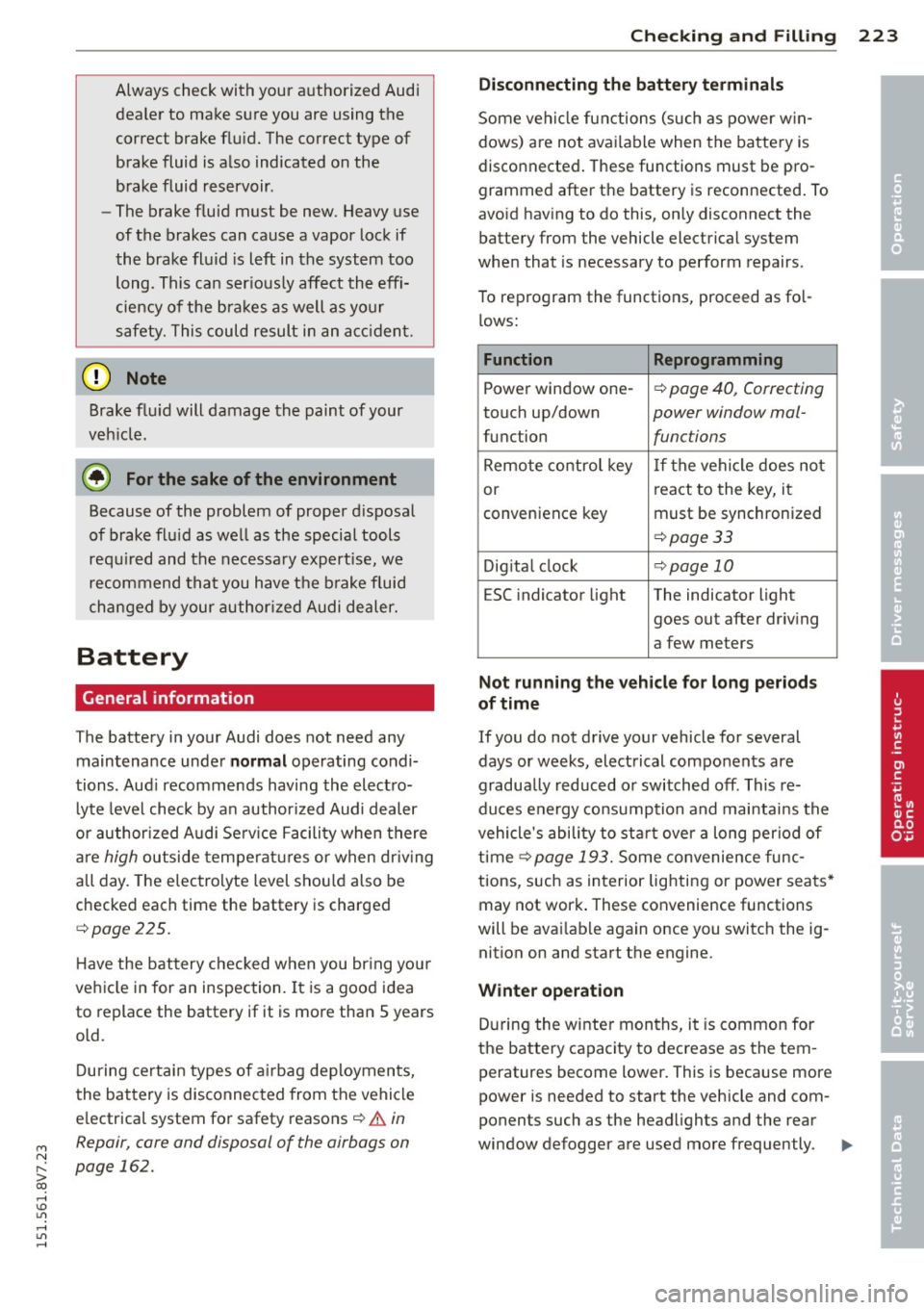
Function Reprogramming
Power window one -¢ page 40, Correcting
touch up/down power window ma/-
function functions
Remo te control key If the vehicle does no t
or r
eact to the key, i t
convenience key must be synchronized
¢ page33
Dig ita l cl ock ¢pag e 10
ESC indicator light The indicator light
goes out after driv ing
a few meters
Not running the vehicle for long period s
of time
If you do not drive your vehicle fo r several
days or weeks, elect rical componen ts are
gradua lly reduc ed o r switched off. This re
duces e nergy consumption and maintai ns the
vehicle 's ability to star t ove r a long per iod of
t ime ~
page 193. Some co nvenience func
tions, s uch as in terior lighting or power sea ts*
may not work . These convenience functions
will be ava ilab le again once you switc h the ig
nit ion on and sta rt the engine.
Winter operation
D uring the winte r mon ths, i t is common for
the battery capacity to dec rease as the tem
peratures become lower . This is because more
power is needed to start the vehicle and com
ponents such as the head lights and the rear
window defogger are used more frequently . .,..
•
•
•
Page 227 of 302
....,
N
r--. > co
rl I.O
"' rl
"' rl
-Do not interchange the positive and neg
ative cables .
- When working on the battery , be sure
not to short-circuit the terminals with
tools or other metal objects. This would cause the battery to heat up very quickly,
which could lead to damage or explosion
and personal injury.
- When a battery is charged, it produces
hydrogen gas which is explosive and
could cause personal injury .
- Always keep the battery well out of the reach of children .
- Before work is done on the electrical sys
tem, disconnect the negative ground ca
ble .
- Before performing any work on the elec
trical system , switch off the engine and
ignition as well as any electrical equip
ment. The negative cable on the battery
must be disconnected. If you are just go
ing to replace a light bulb, then it is
enough to switch off the lights.
- Before disconnecting the battery, switch
off the anti-theft alarm system! Other
wise you will set off the alarm.
- When disconnecting the battery, first
disconnect the negative cable and then
the positive cable.
- Before reconnecting the battery, make
sure all electrical consumers are switch
ed off. Reconnect the positive cable first
and then the negative cable. Never inter
change the cables - this could start a fire!
- Never charge a fro zen or a thawed-out
battery. It could explode! If a battery has
fro zen, then it must be replaced. A dead
battery can freeze over at 32°F (O°C) .
- Make sure the vent hose is always attach
ed to the opening on the side of the bat
tery .
- Never use batteries which are damaged.
There is the danger of an explosion ! Al
ways replace a damaged battery .
A WARNING
California Proposition 65 Warning:
Checking and Filling 225
-Battery posts, terminals and related ac
cessories contain lead and lead com
pounds, chemicals known to the State of
California to cause cancer and reproduc
tive problems . Wash hands after han
dling.
(D Note
- Do not disconnect the vehicle battery
when the ignition is on or when the en gine is running, otherwise, you will dam
age electronic components in the electri
cal system.
- If your vehicle is going to stand for a
long period of time without being driven ,
protect the battery from "freezing", oth
erwise it will be damaged and will then
have to be replaced.
Battery charging
Starting the engine requires a well charged
battery.
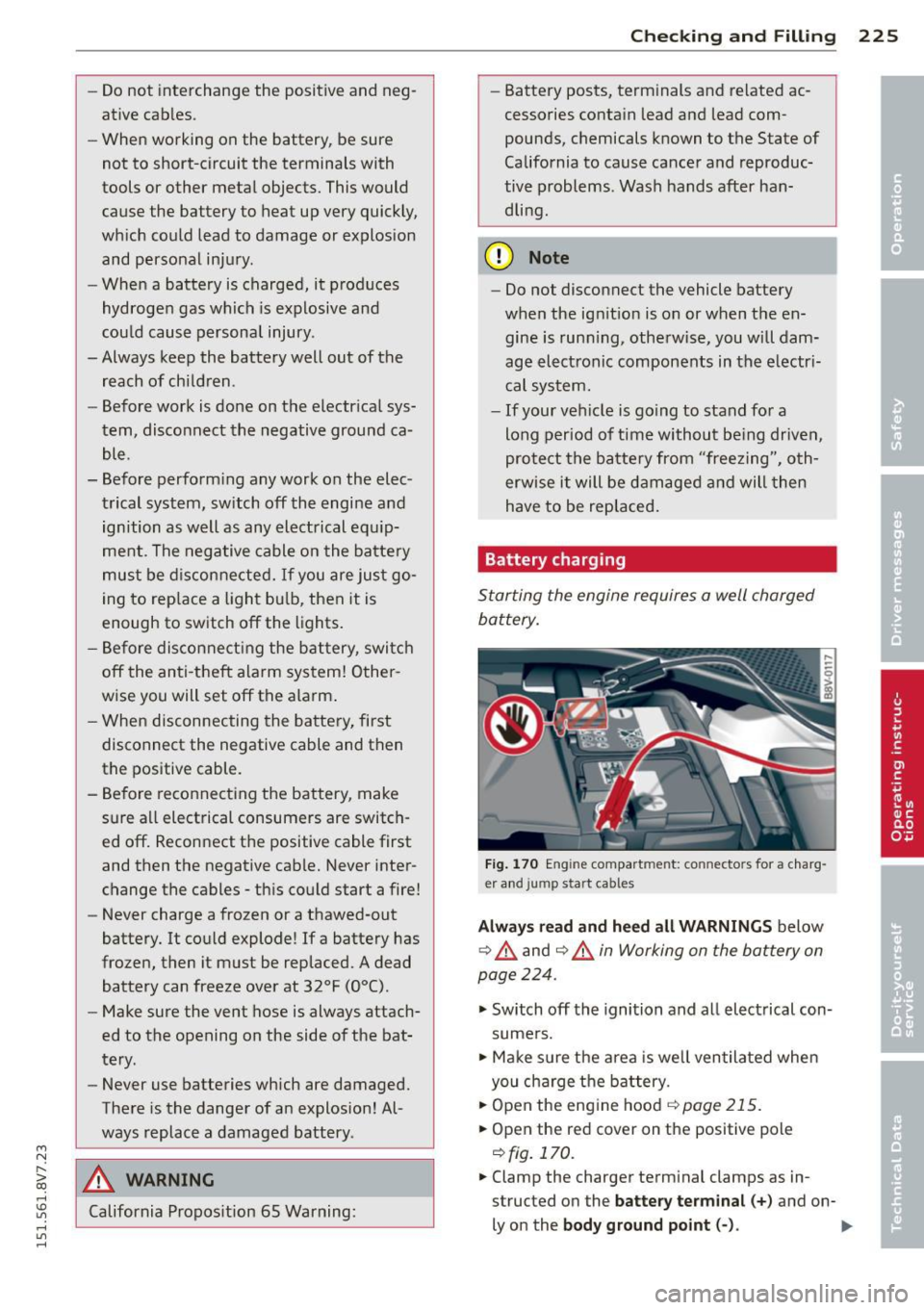
Fig. 170 E ngin e compar tmen t: co nn ecto rs fo r a charg
e r and jump st art ca bles
Always read and heed all WARNINGS below
c:::> ,& and c:::> ,& in Working on the battery on
page
224 .
.,. Switch off the ignition and all electrical con
sumers .
.,. Make sure the area is well ventilated when
you charge the battery.
.,. Open the engine hood
c:::> page 215 .
.,. Open the red cov er on the pos itive pole
c:::> fig. 170.
.,. Clamp the cha rger termin al clamps as in
structed on the
battery terminal(+) and on-
l y on the
body ground point(-) . .,._
Page 228 of 302
226 Check ing and F illin g
• Only now plug the mains lead for the charg
ing equipment into the wall outlet and turn
iton ¢_& .
• M ake sure the ch arging rate is not o ver
30 amp s / 14. 8 Volt.
• When the battery is fully charged: Turn the
charging equ ipment off and remove the
mains lead from the wa ll outlet .
• Now remove the clamps for the charg ing
equipment.
• Close the red cover on the posit ive po le.
• Close the hood
¢ page 216.
A discharged batte ry can fr eez e at tempera
tures of on ly 32 F
0 (0 °C). A llow a frozen bat
tery to thaw completely before attempting to
charge it¢ .&. . However, we recommend not
using a thawed battery again because the bat
tery casing can be cracked due to ice forma
tion and can leak battery acid.
Batt ery cha rg ing (Ma ximum cha rging rate
of
30 a mp s/ 14.8 Vo lt )
When charging at low voltages (e .g. w ith a
t ric kle char ger ), the battery cables do not
have to be d isconnected first . The battery
caps should
not be opened when charging a
battery.
It is not necessary to remove the battery from
the luggage compartment, and it is also not
necessary to disconnect the cables .
Fas t ch arg ing th e batter y (charging r ate
above 14.8 Volt s)
For technical reasons do not use a battery
charger that uses voltage g reate r than
14 .8 Volts to charge your veh icle's battery .
A WARNING
-
Charging a batte ry can be dangerous.
- Always follow the operating instructions
provided by the batte ry charger manu
facturer when charging your battery.
- Never charge a frozen battery .
It may ex
plode because of gas t rapped in the ice.
Allow a frozen batte ry to thaw o ut first.
- Do not reuse batteries which were fro
zen. The batte ry housing may have cracked and weakened when the battery
froze.
- Charge the battery in a well ventilated
area. Keep away from open flame or elec
tr ical spark. Do not smoke. Hydrogen gas
generated by the battery is explos ive.
- To reduce the danger of explosion, never connect or d isconnect charger cables
while the charger is operat ing .
- Fast charging a battery is dangerous and
should only be attempted by a compe
tent techn ic ian with the proper equip
ment.
- Battery acid that may sp ill dur ing charg
i n g should be washed off with a solut ion
of warm water and baking soda to neu
tralize the ac id.
(D Note
Never use a fast charger as a booster to
start the eng ine . Th is w ill seriously dam
age sens it ive e lectronic components, such
as contro l units, re lays, radio, etc., as well
as the battery charger.
Battery replacement
The new battery must have the same specifi
cations and dimensions as the original equip
ment battery.
Intelligent energy management in your vehi
cle is responsible for distributing the elect ri
ca l ene rgy th rougho ut yo ur vehicle
¢page 193. The intelligent energy manage
ment system will keep the engine battery
charged better than vehicles without this sys
tem. To make sure the additional electrical en
ergy is ava ilable once again after you have
changed the battery, we recommend that you
install batteries of the same type and manu
facture only (the same as those installed at
the time your veh icle was de livered) . Specifi
cations are listed on the batte ry housing. Your
a utho rized deale r must code the batte ry in
the energy management system to enab le you
to use the energy management functions cor -
rect ly after replacing the battery.
ll-