battery AUDI A3 CABRIOLET 2015 Owner's Manual
[x] Cancel search | Manufacturer: AUDI, Model Year: 2015, Model line: A3 CABRIOLET, Model: AUDI A3 CABRIOLET 2015Pages: 302, PDF Size: 73.83 MB
Page 195 of 302
M N ,....
> co ,...., \!) 1.1'1 ,...., 1.1'1 ,....,
Winter tires
By using all wheel drive, yo ur vehicle has good
forward motion with standard tires in winter
conditions. However, in winter we recommend
using winter or all season tir es on
all four
wheels, because this will imp rove the broking
effec t.
Snow chains
If there are snow chain laws, snow chains
must also be used on vehicles with a ll whee l
drive ¢
page 256, Snow chains .
Replacing tires
For vehicles w ith all wheel dr ive, only wheels
with the same rolling circumference should be
used . Avoid wheels with different tread
depths ¢
page 248.
Offroad vehicle?
Your Audi is not an offroad veh icle -there is
not enough ground clearance. For t his reason,
avoid difficult terrain. Refer to ¢
page 280.
.&_ WARNING -
-Also , in vehicles with all whee l drive,
adapt your driving style to the current
road and traff ic conditions. Do not let
the increased safety provided tempt you
into taking risks.
- The brak ing ability of your vehicle is lim
ited to the traction of the wheels . In this
way, it is not different from a two wheel dr ive vehicle. Do not be tempted to ac
celerate to a h igh speed when the road is
slippery th is increases the risk of an acci
dent.
- Note that on wet streets, the front
wheels can "hydroplane" if driving at
speeds that are too high. Unlike front
wheel drive vehicles, the engine does not
rev higher suddenly when the vehicle be
gins hydroplaning. For this reason, pay
attention to the road conditions regard
less of your speed .
Smart Technolog y 193
Energy management
The starting ability is optimized
The energy management system manages
the electrical energy distribution and optimiz
es the availability of electrical energy for
starting the engine.
When a vehicle with a conventional energy
system is not driven for a long time , the bat
tery is drained by equipment (for example the
immobilizer). In certain circumstances, there
could may no t be enough energy to start the
engine .
Your vehicle is equipped with an intelligent
energy management system for distr ibut ing
electric ity. This significantly improves the
starting ability and increases the battery life.
The energy management system Is made up
of
battery diagnosis , idling current manage
ment
and dynamic energy management.
Battery diagnosis
The battery diagnosis determines the battery
charge level. The sensors determine the bat
tery voltage, the battery current, and the bat
tery temperature. The current charge leve l
and t he performance of the battery are deter
mined based on this.
Idling current management
The idling current management decreases the
energy used while parked. With the engine
switched off, it manages the energy distribu
tion to the different elect rical components.
Date from battery diagnosis is taken into ac
count for this.
Depend ing on the battery charge leve l, elec
trical equip ment is switched off one item after
the other, to prevent the battery from drain
ing and to retain the starting ability.
Dynamic energy management
While driv ing , dynamic energy management
distributes the appropriate amount of energy
to the e lectr ica l equipment . It controls the
battery charge level so that more energy is .,. •
•
•
Page 196 of 302
194 Smart T echnol ogy
not used then is being generated in o rder to
maintain an optimal battery charge level.
(D Tips
- Energy management cannot overcome
the laws o f physics. Note that the charge
l evel and length of the battery life are
li mited .
- When the starting ability is endangered,
the (•) indicator light turns on
c> page20.
What you should know
Maintaining the starting ability is the highest
priority .
A lot of stress is p laced on the battery when
driving short distances, in traffic, and at co ld
times of the year. A lot of energy is used but
little is generated.
It is also critical when the
engine is not running but electrical equip ment is switched on . In this case, energy is
used but none is generated .
In situations like this, energy management
will actively regulated the distribut ion of en
ergy.
L ong periods wi thout u se
If you do not drive your vehicle for several
days or weeks, e lectrica l equipment is gradu
ally sca led back or switched off. This reduces
energy use and ensures the vehicle will be
able to start after long periods of time. Some
conven ience functions such as opening with
the remote control key may not be ava ilable.
These convenience functions w ill be availab le
again o nce you swi tch the ign ition on and
start the engine.
With the engine switched off
For example, if you listen to the radio when
the eng ine is sw itched off, the battery w ill
d rain .
A warning text w ill appear if energy consump
tion could impair starting ab ility .
The message shows that you need to start the
engine in order to charge the battery.
With the en gine running
Although e lectrical energy is gene rated while
driving, the battery can dra in. This can happen
when litt le energy is generated, and much is
u sed and the charge leve l of the battery is not
optimal.
T o restore the balance of ene rgy, components
that require large amounts of energy are tem
porari ly scaled back or switched off. Heating
systems in particular require a great deal of
energy. If you notice, for example, that the
seat heating* or rear window defroster is not
worki ng, then it has been temporar ily reduced
or switched off . These systems are available
again as soon as the energy balance has been
resto red.
In add ition, you may notice that the idle
speed has slightly increased. That is normal
and no cause for concern. Due to the in
c reased idling speed, the additional required
energy w ill be gene rated and the battery will
be charged.
Notice about data
recorded by the Event
Data Recorder and
vehicle control
modules
E v ent D ata Reco rder
This vehicle is equ ipped with an Event Data
Recorder (EDR). The main purpose of an EDR
is to record, in certain crash or near crash-like
situations, such as an a irbag deployment or
hitting a road obstacle, data that will assist in
understanding how a vehicle's systems per
formed . T he EDR is des igned to record data
related to vehicle dynam ics and safety sys
tems fo r a short period of time, typically
30 seconds or less . The EDR in this vehicle is
designed to record such data as:
- How various systems in your vehicle were
operating;
- Whether or not the driver and passenge r
safety belts were b uckled/fastened;
Page 200 of 302
198 Driving and the environment
can reach the cata lytic converter. This
could result in overheating of the con
verter, requ iring its replacement.
- To assure efficient operation of the Emis
sion Control System:
- Have your veh icle ma intained properly
and in accordance with the service rec
ommendations in your Warranty
&
Ma intenance booklet.
- Lack of proper maintenance as well as
improper use of the vehicle will impa ir
the function of the emission control
system and could lead to damage.
@ For the sake of the environment
Even when the Emission Contro l System is
operating properly, the exhaus t gas can
have a sulfur-like exhaust gas smell under
some operating states. This depends on
the sulfur content of the fue l being used .
Using a different brand of fuel may help,
or filling the tank w ith lead-free super
grade gasoline.
Placing your vehicle
out of service
If you wou ld like to take your vehicle out of
service for a longer t ime, contact your author
ized Audi dealer or qualified repair facility.
They will advise you of important measures,
such as corrosion protection, maintenance
and storage procedures. Also follow the infor
mat ion about the battery
¢ page 223.
Operate your vehicle
economically and
minimize pollution
General
Your personal style of driving will determine
the economy of your vehicle, as well as ex
haust and noise levels .
Fuel economy, environmental impact, and
wear on your engine, brakes and t ires largely
depend on three factors: -your
personal driving style
- operating conditions
- technical limitations
If you ant ic ipate what you need to do next and
drive econom ically, you can easily cut your
fuel consumpt ion by 1O-lS percent . This sec
t ion w ill give you some tips on how you can
help the env ironment and your pocketbook.
(D Tips
The consumption estimates as published
by ENVIRONMENTAL PROTECTION AGENCY
(EPA) and Transport Canada may not corre
spond to your actual consumption on the
road, which will vary depending upon vehi
cle load and speed, road and weather con
ditions, trip length, etc.
Drive smoothly and keep a lookout
ahead
Vehicles use the most fuel when they are ac
celerating.
.,. Avoid unnecessary accelerating and braking.
Vehicles use the most fuel when they are ac
ce lerating. If you anticipate what is going to
happen next, you will need to brake less and,
thus, acce lerate less. Let the vehicle coast
whenever possible -for example when you see
that the next traffic light is red.
Avoid full throttle '
Driving at moderate speeds saves fuel and
improves your mileage.
.,. Try and keep well below your car's maximum
speed.
Acce lerating gently reduces fue l consump
tion, engine wear, and does not disturb the
environment.
Fuel consumpt ion, exhaust emissions and en
gine noise increase disproportionate ly at high
speeds. If you drive at approximately three
quarters of top speed, fuel consumption wi ll
be reduced by one half. Never drive faster
1111>
Page 216 of 302
214 Check ing and F illin g
•Pullon the cover carefu lly ¢ fig. 162. The
tab on the cover must point forward in the direction you are pulling when pu lling on
the cover.
• To open the fuel filler door, press on the left
side
¢ page 212, fig . 160 .
{Q) Note
Only pull on the cover unt il you feel resist
ance. You will not hear it release . Other
w ise you could damage the emergency re
lease mechanism.
Hood
Working in the engine compartment
Special care is required if you are working in the engine compartment
F o r w ork in th e eng in e c omp artm ent su ch as
c h ecking and fi llin g fluid s, t he re i s a risk of
inj ury, sca lding, accid ents, a nd b urn s. Fo r
thi s re aso n, follow all the follow in g listed
war ning s and ge neral safety p recaution s.
T he engine compartment is a d ang ero us
area. ¢,& .
A WARNING
To reduce the risk of injur ies, complete the
following steps before opening the hood:
- Turn the engine off.
- Switch the ignition off.
- Set the parking brake.
- Place the selector lever in the P position .
- Let the engine coo l down.
- Never open the hood when you see that
steam o r coolant drips from the engine
c ompartment- there is a danger of
burns! Wait until no steam or coolant
flows out.
- Keep chi ldren away from the engine com
partment.
- Never spill flu ids on a hot eng ine. These
fluids (such as the freeze protection con
tained in the coolant) can catch fire .
- Avo id short circuits in the electrical sys
tem, especially the battery . -
When working in the engine compart
ment, remember that the radiator fan
can switch on even if the ignition is
sw itched off, which increases the risk of
personal injury.
- Never open the cap on the coolant ex
pans ion tank when the eng ine is warm.
The cooling system is unde r pressure.
- To protect your face, hands, and arms
from hot steam or coolant, cover the cap
with a large cloth when opening .
- Do not remove the engine cover under any circumstances. This increases the
risk of burns .
- If tests need to be performed with the engine runn ing, there is add itiona l dan
ge r due to moving components (such as
the ribbed belt, generator and radiator
fan) and from the high voltage ignit ion
system.
- Never reach into the radiator fan. The
electric auxilia ry fan is controlled by
temperature and can switch on sudden ly .
- Pay attention to the fo llow ing warnings
listed when work on the fuel system or
on the e lectrica l equipment is required.
- Always disconnect the vehicle battery
from the vehicle e lectr ical system
- Do not smoke
- Never work near open flames
- Always have a working fire exting uisher
nearby
- To reduce the risk of electric s hock and
inj ury, never touch the fo llowing compo
nents when the engine is running or is
be ing started :
- Ig nition cable
- Other compone nts in the electronic
high voltage ign it ion system
- If you must check or perform work on the eng ine while it is runn ing:
- Set the parking brake and place these
lector lever in the P (park) position
first.
- Always proceed with extreme caution
so that clot hing, jewe lry or long hai r do
not become caught in the radiator fan, ..,.
Page 217 of 302
....,
N
r--. > co
rl I.O
"' rl
"' rl
fan belt or other moving components or do not come into contact w ith hot
components. T ie back long hair before
beginning work and do not wear cloth ing that can hang down into the en
g ine .
- Limit your exposure to exhaust and
chemicals to as short a time as poss ible
c::;, &. .
& WARNING
California P ropos ition 65 Warning:
- Engine exhaust, some of its constituents,
and certain veh icle components conta in
o r emit chemicals known to the State of
Californ ia to cause cancer and b irth de
fec ts and reproduct ive harm . In addition,
certain fluids conta ined in vehicles and
certain products of component wear con
tain or emit chemicals known to the State of California to cause cancer and
birth defects or other reproductive harm.
- Battery posts, terminals and related ac
cessories contain lead and lead com pounds , chemicals known to the State of
Californ ia to cause cancer a nd reproduc
t ive harms . Wash hands after handling .
(D Note
When filling fluids, be sure not to m ix the
fluids up. Othe rwise severe malfunctions
and e ng ine damage will occur .
@ For the sake of the environment
You should regularly check the ground un
der your vehicle in orde r to detect leaks
quickly . If there are visible spots from oil
or other fluids, b ring your veh icle to an au
thori zed Audi dealer or qualified repair fa
cility to be checked .
Checking and Fillin g 215
Opening the hood
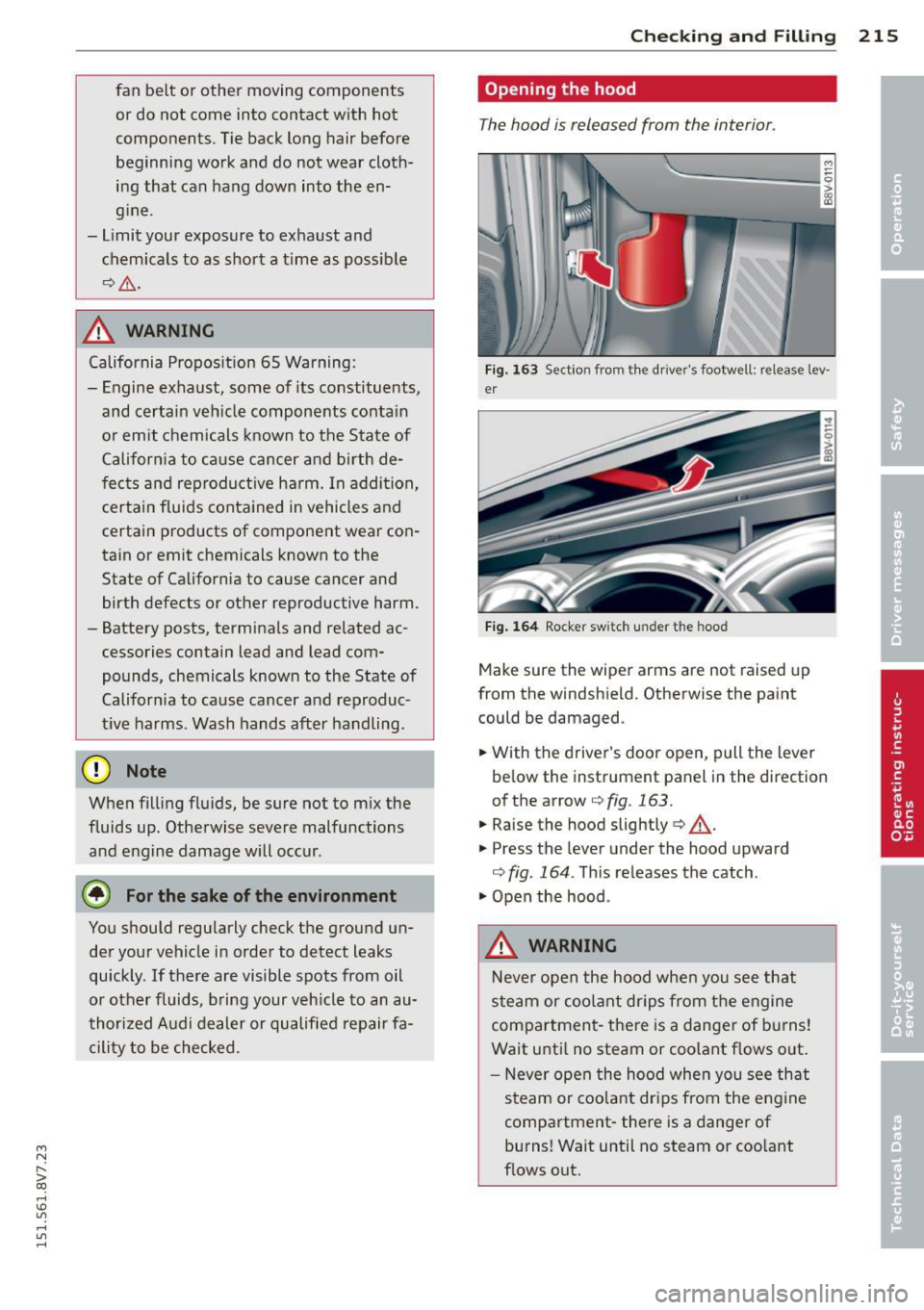
The hood is released from the interior .
Fig. 163 Se ct io n fro m t he dr iver 's footwell : release Lev ·
er
Fi g. 1 64 Rocke r sw it ch under t he hood
Make sure the wiper arms are not raised up
from the windshield. Otherwise the paint could be damaged .
... With the drive r's door open, pull the lever
be low the instrument panel in the direction
of the arrow
¢ fig. 163.
.,. Raise the hood slightly c::;, ,A .
.,. Press the lever under the hood upward
¢ fig . 164 . This releases the catch .
.,. Open the hood .
& WARNING
Never open the hood whe n you see that
steam or coo lant drips from the engine
compartment -there is a danger of b urns!
Wait unti l no steam or coolant flows o ut.
- Never open the hood when you see that
steam or coolant dr ips from the engine
compartment- there is a danger of burns! Wait until no steam or coo lant
flows out.
-
Page 218 of 302
216 Checking and Filling
Closing the hood
,. Push the hood down until the force of the
strut is overcome.
,. Then lower the hood and let it fall into the
engine hood latch -you do
not have to press
on the hood after it is locked.~
A-
_& WARNING
If the hood is not latched completely, it
could fly up while you are driving and ob
struct your vision .
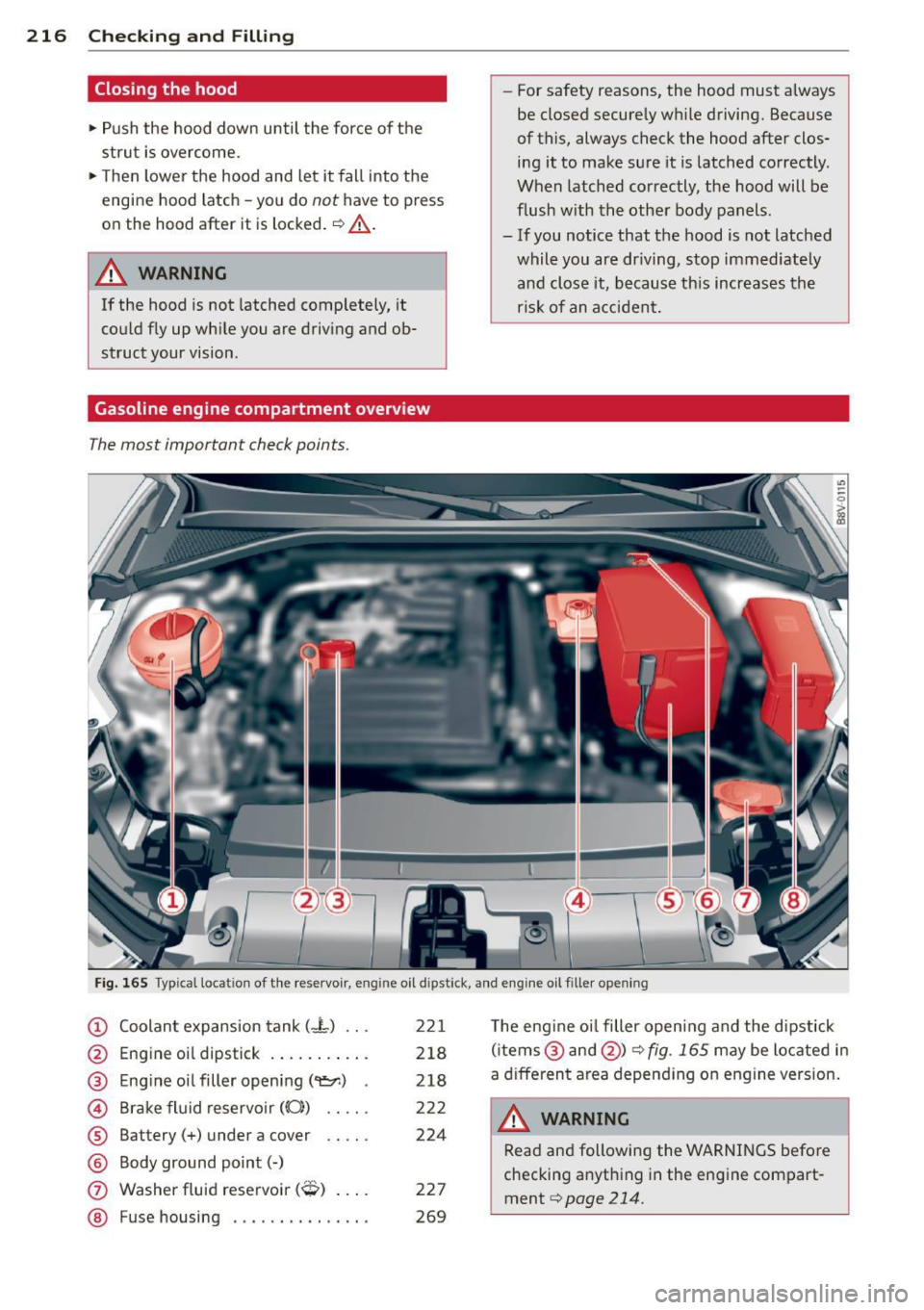
Gasoline engine compartment overview
The most important check points.
-
-For safety reasons , the hood must a lways
be closed secure ly while driving. Because
of this, always check the hood after clos
ing it to make sure it is latched correctly.
When latched correctly , the hood will be
f lush w ith the other body panels.
- If you notice that the hood is not latched
while you are dr iving, stop immediately
and close it, because this increases the
risk of an acciden t.
Fig. 165 Typica l locat ion of the reservoir, engine o il dipst ick, and engine o il filler open ing
@ Coolant expansion tank (- L) .. . 221 The engine oi l filler opening and the dipstick
@ Engine oil dipstick .......
... .
218 (items @ and @) c> fig. 165 may be located in
® Eng ine oil filler opening ('e::r.) 218 a different area depending on engine version.
© Brake fluid reservoir ((0) .. .. . 222 A WARNING
® Battery(+) under a cover .. .. . 224
® Body ground point(-) Read
and following the WARNINGS before
checking anything in the engine compart-
(J) Washer f luid reservoir (0) ... . 227 ment c> page 214.
® Fuse housing .......... .... . 269
Page 225 of 302
M N
" > co ,...., \!) ..,.,
,...., ..,., ,....,
Always check with your authorized Audi
deale r to make s ure you are using the
correct brake f luid. The correct type of
b rake fluid is a lso indicated on the
b rake fluid reservoir .
- The brake f luid must be new. Heavy use
of the brakes can cause a vapor lock if
the brake fl uid is left in t he system too
long. This ca n ser ious ly aff ect th e effi
ciency of the bra kes a s well as yo ur
safety. This could resul t in an accid ent.
(D Note
Brake fl uid will damage the paint of your
ve hicle .
@ For the sake of the environment
Because of the problem of proper d isposa l
of brake flu id as we ll as the special tools
req uired and the necessa ry expert ise, we
recom mend tha t you have t he b rake fluid
changed by your aut hor ized Audi de aler.
Battery
General information
The batte ry in you r Audi does not need any
maintenance unde r
normal operating condi
tions . Aud i recommends having the elect ro
l y te level check by a n author ized Audi dealer
or author ized A udi Se rv ice F acili ty when there
a re
high outside tempe ra tur es or when dr iv ing
all day. The e lec trolyte level sho uld also be
checked each time the battery is charged
¢ page 225.
Have the bat tery c hecked w hen you br ing yo ur
ve hicl e in for an inspec tion. I t is a good idea
to re place the battery if it is mo re than 5 years
old .
D uring certa in types of a irbag deploymen ts,
t he bat tery is disconnected from the vehi cle
e lectrical system fo r safety reasons ~ &.
in
Repair, care and disposal of the airbags on
page 162.
Checking and Fillin g 223
Disconnecting the battery terminals
Some vehi cle fu nctions (such as power w in
dows) a re not ava ilable when the batte ry is
disco nnected . These fu nctions must be p ro
grammed afte r the battery is reconnected . To
avo id hav ing to do this, only disconnect the
battery from the vehicle electrical system
whe n that is necessary to perform repairs .
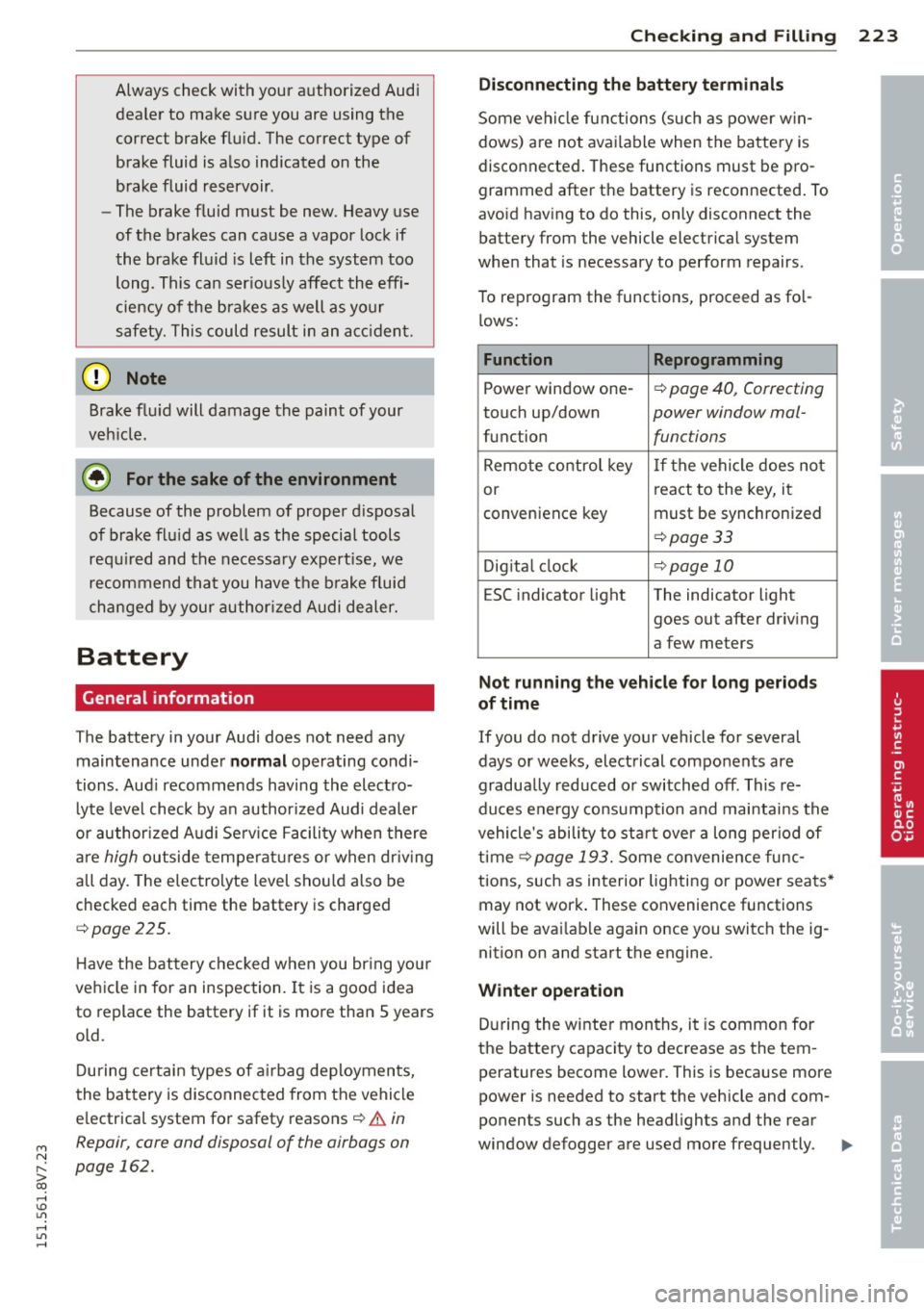
To reprogram the functions, proceed as fo l
lows:
Function Reprogramming
Power window one -¢ page 40, Correcting
touch up/down power window ma/-
function functions
Remo te control key If the vehicle does no t
or r
eact to the key, i t
convenience key must be synchronized
¢ page33
Dig ita l cl ock ¢pag e 10
ESC indicator light The indicator light
goes out after driv ing
a few meters
Not running the vehicle for long period s
of time
If you do not drive your vehicle fo r several
days or weeks, elect rical componen ts are
gradua lly reduc ed o r switched off. This re
duces e nergy consumption and maintai ns the
vehicle 's ability to star t ove r a long per iod of
t ime ~
page 193. Some co nvenience func
tions, s uch as in terior lighting or power sea ts*
may not work . These convenience functions
will be ava ilab le again once you switc h the ig
nit ion on and sta rt the engine.
Winter operation
D uring the winte r mon ths, i t is common for
the battery capacity to dec rease as the tem
peratures become lower . This is because more
power is needed to start the vehicle and com
ponents such as the head lights and the rear
window defogger are used more frequently . .,..
•
•
•
Page 226 of 302
224 Check ing and F illin g
Avoid using power unnecessarily, especially in
city driving or on short trips. Have your au
thor ized Audi dealer or authorized Audi Serv
ice Facility check the battery capacity before
the start of winter
c;,page 225. A well-charg
ed battery will not only reduce starting prob
lems in cold weather, but it w ill also last lon
ger .
A WARNING
-
-Wor k on the battery requires expert
knowledge. Contact your authorized Audi
dealer qualified repair facility for infor
mation regarding the vehicle battery .
There is a risk for chemical burns or ex
plosions.
- Never open the vehicle battery. Do not
t ry to change the battery e lectrolyte lev
el. Otherwise exp losive gas will escape
from the battery and increase the risk of
an exp losion .
(D Tips
If your vehicle is not driven for severa l
weeks in very cold temperat ures, remove
the battery and store it in a place where it
w ill not freeze. This prevents the battery
from being damaged and need ing to be re
placed .
Working on the battery
Be especially careful when working on or near
the battery .
The battery is located in the luggage comp art
ment under the floor . Before you check any
thing in the luggage compartment,
re ad and
heed all WARNINGS
¢ ,& .
Always heed the s afet y warnings , when work
ing on the vehicle battery or the vehicle elec
tr ica l system to preve nt injury .
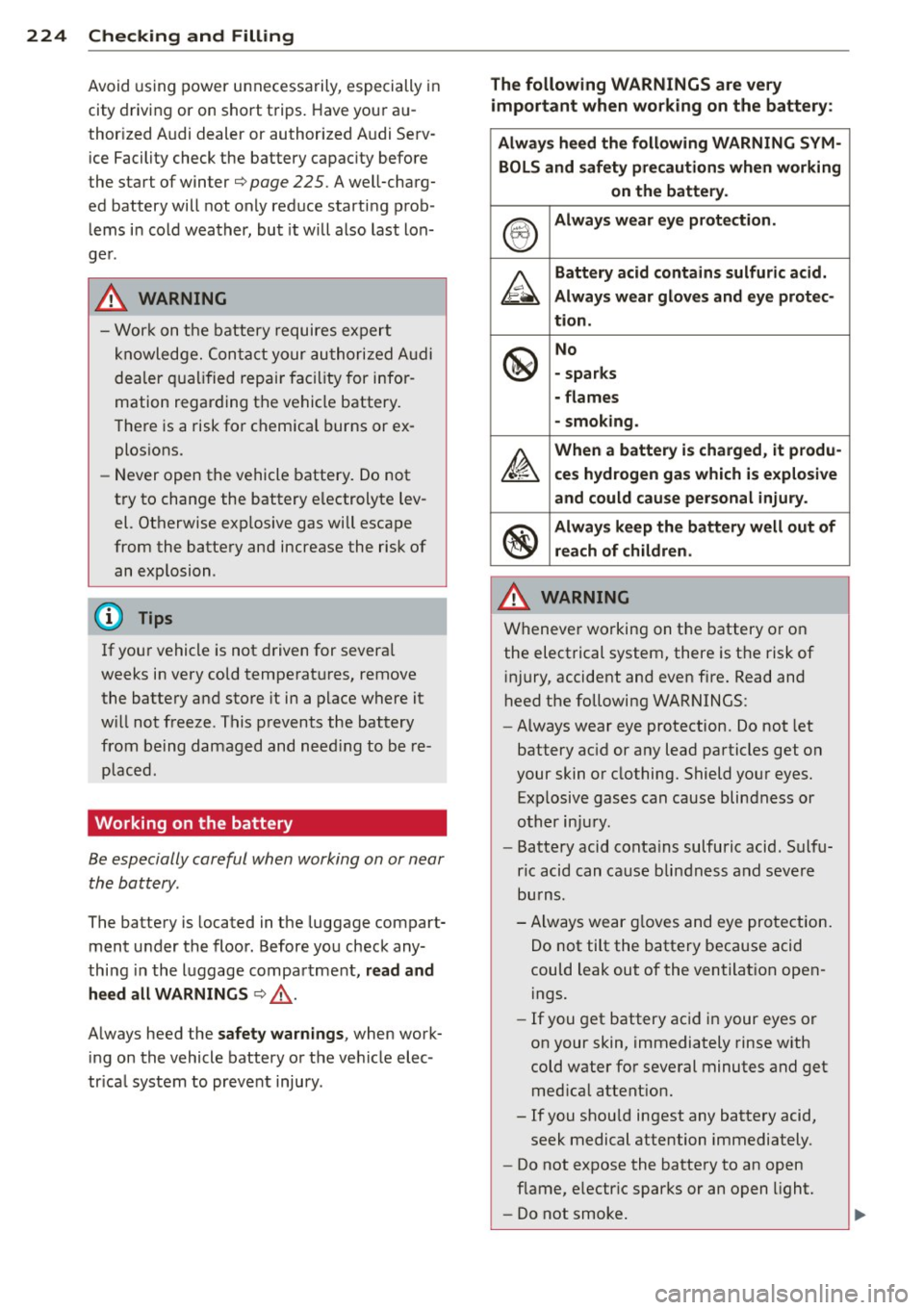
The following WARNINGS are very
i mp ortan t wh en wo rking on th e battery :
Alw ay s hee d the followin g WARNING SYM ·
BOL S and safety pr ecaution s when w orking
on the battery.
®
Alwa ys wear eye prote ction .
&
Battery acid contain s sulfuri c acid.
Always wear glov es and e ye protec-
tion.
@
No
· spark s
· flames
· smoking .
~
When a battery is charged, it produ-
ces hyd rogen gas which is ex plosi ve
and could caus e personal injury.
®
Alwa ys keep th e batt ery well out of
rea ch of children .
A WARNING
Whenever working on the battery or on
the electrical system, there is the risk of
i njury, accident and even fire. Read and
heed the following WARNINGS:
- Always wear eye protection. Do not let
battery ac id or any lead particles get on
your skin or clothing. Shield your eyes.
Exp losive gases can cause blindness or
other inju ry.
- Battery acid conta ins sulfuric acid. Sulfu
ric acid can cause blindness and severe
burns .
- Always wear g loves and eye protection.
Do not tilt the battery because acid
could leak out of the ventilat ion open
ings.
- If you get battery ac id in your eyes or
on your skin, immediately rinse with
cold water for several minutes and get
med ica l attent ion.
- If you shou ld ingest any battery acid,
seek medical attention immediately .
- Do not expose the battery to an open
f lame, e lectr ic sparks or an open light.
- Do not smoke .
-
Page 227 of 302
....,
N
r--. > co
rl I.O
"' rl
"' rl
-Do not interchange the positive and neg
ative cables .
- When working on the battery , be sure
not to short-circuit the terminals with
tools or other metal objects. This would cause the battery to heat up very quickly,
which could lead to damage or explosion
and personal injury.
- When a battery is charged, it produces
hydrogen gas which is explosive and
could cause personal injury .
- Always keep the battery well out of the reach of children .
- Before work is done on the electrical sys
tem, disconnect the negative ground ca
ble .
- Before performing any work on the elec
trical system , switch off the engine and
ignition as well as any electrical equip
ment. The negative cable on the battery
must be disconnected. If you are just go
ing to replace a light bulb, then it is
enough to switch off the lights.
- Before disconnecting the battery, switch
off the anti-theft alarm system! Other
wise you will set off the alarm.
- When disconnecting the battery, first
disconnect the negative cable and then
the positive cable.
- Before reconnecting the battery, make
sure all electrical consumers are switch
ed off. Reconnect the positive cable first
and then the negative cable. Never inter
change the cables - this could start a fire!
- Never charge a fro zen or a thawed-out
battery. It could explode! If a battery has
fro zen, then it must be replaced. A dead
battery can freeze over at 32°F (O°C) .
- Make sure the vent hose is always attach
ed to the opening on the side of the bat
tery .
- Never use batteries which are damaged.
There is the danger of an explosion ! Al
ways replace a damaged battery .
A WARNING
California Proposition 65 Warning:
Checking and Filling 225
-Battery posts, terminals and related ac
cessories contain lead and lead com
pounds, chemicals known to the State of
California to cause cancer and reproduc
tive problems . Wash hands after han
dling.
(D Note
- Do not disconnect the vehicle battery
when the ignition is on or when the en gine is running, otherwise, you will dam
age electronic components in the electri
cal system.
- If your vehicle is going to stand for a
long period of time without being driven ,
protect the battery from "freezing", oth
erwise it will be damaged and will then
have to be replaced.
Battery charging
Starting the engine requires a well charged
battery.
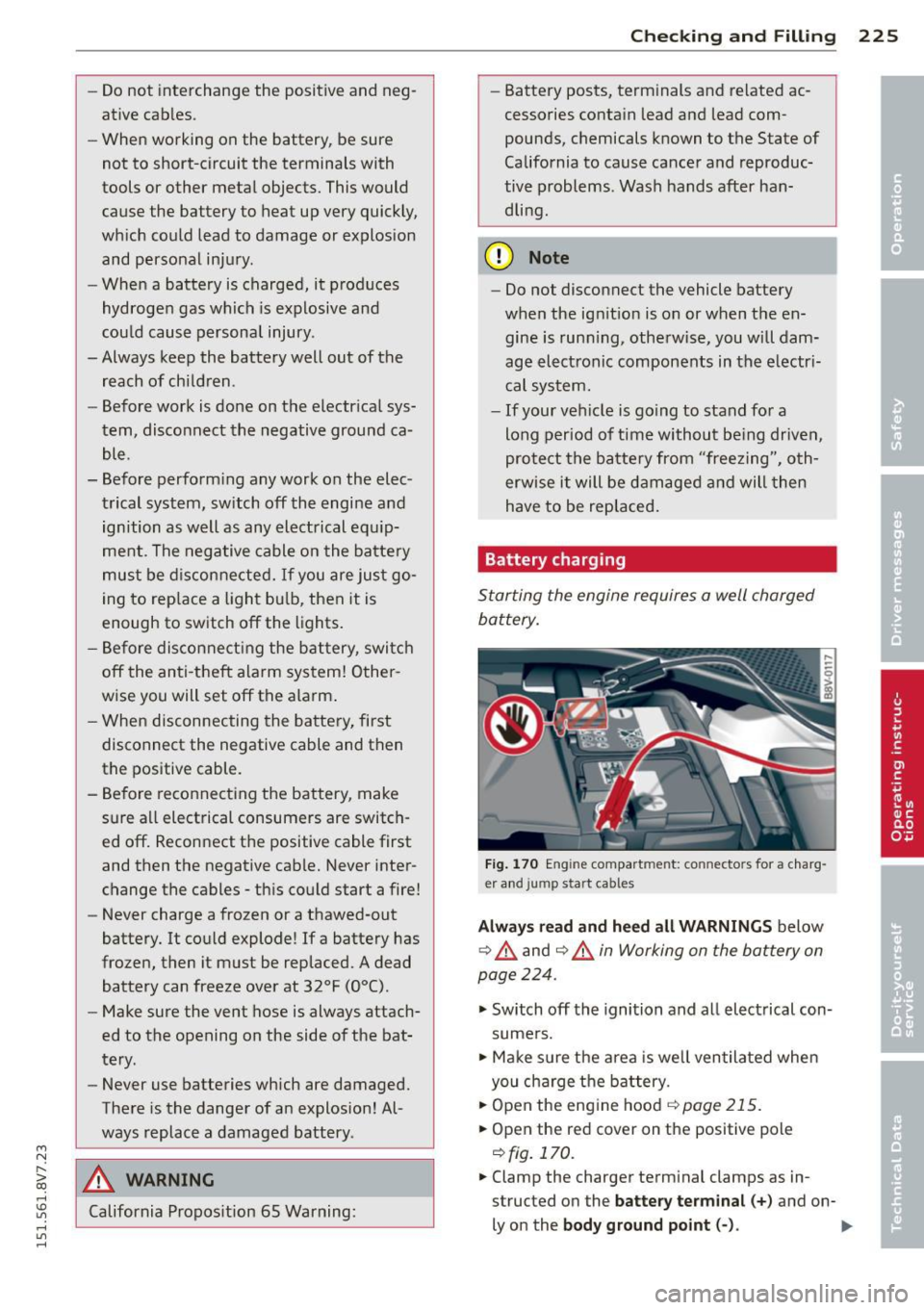
Fig. 170 E ngin e compar tmen t: co nn ecto rs fo r a charg
e r and jump st art ca bles
Always read and heed all WARNINGS below
c:::> ,& and c:::> ,& in Working on the battery on
page
224 .
.,. Switch off the ignition and all electrical con
sumers .
.,. Make sure the area is well ventilated when
you charge the battery.
.,. Open the engine hood
c:::> page 215 .
.,. Open the red cov er on the pos itive pole
c:::> fig. 170.
.,. Clamp the cha rger termin al clamps as in
structed on the
battery terminal(+) and on-
l y on the
body ground point(-) . .,._
Page 228 of 302
226 Check ing and F illin g
• Only now plug the mains lead for the charg
ing equipment into the wall outlet and turn
iton ¢_& .
• M ake sure the ch arging rate is not o ver
30 amp s / 14. 8 Volt.
• When the battery is fully charged: Turn the
charging equ ipment off and remove the
mains lead from the wa ll outlet .
• Now remove the clamps for the charg ing
equipment.
• Close the red cover on the posit ive po le.
• Close the hood
¢ page 216.
A discharged batte ry can fr eez e at tempera
tures of on ly 32 F
0 (0 °C). A llow a frozen bat
tery to thaw completely before attempting to
charge it¢ .&. . However, we recommend not
using a thawed battery again because the bat
tery casing can be cracked due to ice forma
tion and can leak battery acid.
Batt ery cha rg ing (Ma ximum cha rging rate
of
30 a mp s/ 14.8 Vo lt )
When charging at low voltages (e .g. w ith a
t ric kle char ger ), the battery cables do not
have to be d isconnected first . The battery
caps should
not be opened when charging a
battery.
It is not necessary to remove the battery from
the luggage compartment, and it is also not
necessary to disconnect the cables .
Fas t ch arg ing th e batter y (charging r ate
above 14.8 Volt s)
For technical reasons do not use a battery
charger that uses voltage g reate r than
14 .8 Volts to charge your veh icle's battery .
A WARNING
-
Charging a batte ry can be dangerous.
- Always follow the operating instructions
provided by the batte ry charger manu
facturer when charging your battery.
- Never charge a frozen battery .
It may ex
plode because of gas t rapped in the ice.
Allow a frozen batte ry to thaw o ut first.
- Do not reuse batteries which were fro
zen. The batte ry housing may have cracked and weakened when the battery
froze.
- Charge the battery in a well ventilated
area. Keep away from open flame or elec
tr ical spark. Do not smoke. Hydrogen gas
generated by the battery is explos ive.
- To reduce the danger of explosion, never connect or d isconnect charger cables
while the charger is operat ing .
- Fast charging a battery is dangerous and
should only be attempted by a compe
tent techn ic ian with the proper equip
ment.
- Battery acid that may sp ill dur ing charg
i n g should be washed off with a solut ion
of warm water and baking soda to neu
tralize the ac id.
(D Note
Never use a fast charger as a booster to
start the eng ine . Th is w ill seriously dam
age sens it ive e lectronic components, such
as contro l units, re lays, radio, etc., as well
as the battery charger.
Battery replacement
The new battery must have the same specifi
cations and dimensions as the original equip
ment battery.
Intelligent energy management in your vehi
cle is responsible for distributing the elect ri
ca l ene rgy th rougho ut yo ur vehicle
¢page 193. The intelligent energy manage
ment system will keep the engine battery
charged better than vehicles without this sys
tem. To make sure the additional electrical en
ergy is ava ilable once again after you have
changed the battery, we recommend that you
install batteries of the same type and manu
facture only (the same as those installed at
the time your veh icle was de livered) . Specifi
cations are listed on the batte ry housing. Your
a utho rized deale r must code the batte ry in
the energy management system to enab le you
to use the energy management functions cor -
rect ly after replacing the battery.
ll-