battery AUDI A3 CABRIOLET 2015 Owner's Guide
[x] Cancel search | Manufacturer: AUDI, Model Year: 2015, Model line: A3 CABRIOLET, Model: AUDI A3 CABRIOLET 2015Pages: 302, PDF Size: 73.83 MB
Page 229 of 302
....,
N
r--. > co
rl I.O
"' rl
"' rl
The new battery must have the same capacity,
voltage (12-vo lts), amperage, construction
and p lug sealing .
When insta lli ng the bat tery, make sure the ig
nition and all e lectr ica l consumers are switch
ed off .
CD Note
Ma ke sure the vent ilat ion hose on the s ide
of the battery is connected, otherwise
fumes or battery acid can leak out.
@) For the sake of the environment
Because of the problem of proper disposal
of a battery, we recommend your author
ized Audi dealer change the battery for
you. Batter ies contain su lfuric ac id and
lead and must always be disposed of prop
erly in compliance with all environmental
regulations. D isposing of vehicle batteries
improperly is very dangerous to t he envi
ronment.
Windshield washer container
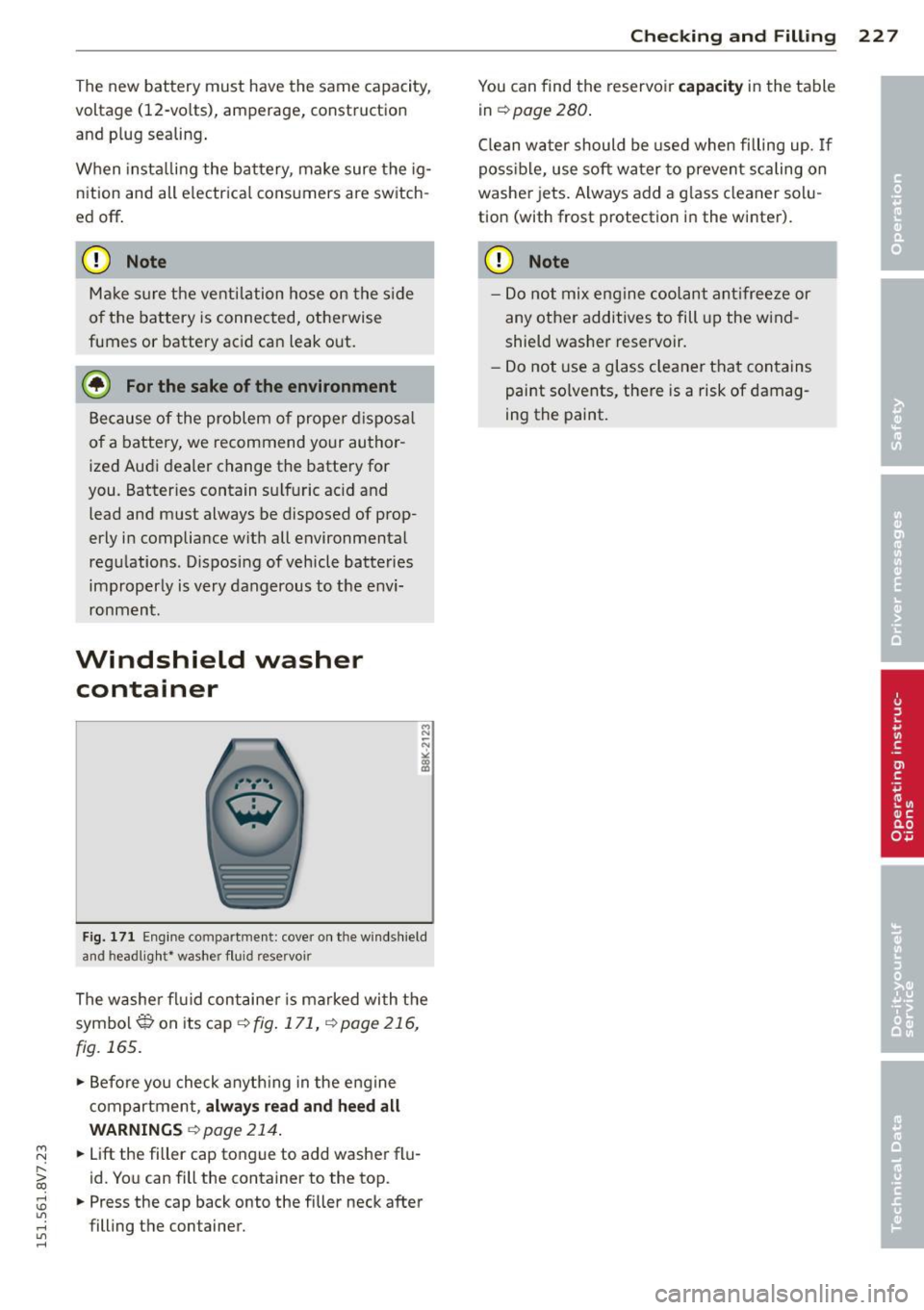
F ig. 171 Engine co mpa rtment: cover on the windsh ield
an d headligh t* washer fluid reservo ir
The washer flu id containe r is marked with the
symbol~ on its cap ¢
fig. 171, q page 216,
fig. 165 .
.,. Before you check anything in the engine
compartment,
always read and heed all
WARNINGS q page 214 .
.,. Lift the filler cap tongue to add washer flu
id. You can fill the container to the top.
.,. Press the cap back onto the filler neck after
filling the container.
Che cking and Fillin g 22 7
You can find the reservoir capacity in the table
in ¢
page 280 .
Clean water should be used when filling up. If
poss ible, use soft wa ter to prevent scaling on
washe r jets. Always add a g lass cleaner solu
tion (with frost protection in the winter).
CD Note
- Do not mix eng ine coolant antifreeze or
any other additives to fill up the wind
shield washer reservoir.
- Do not use a glass cleaner that contains
pai nt so lvents, there is a risk of damag
ing the paint.
Page 275 of 302
M N
" > co ,...., \!) ..,.,
,...., ..,., ,....,
Emergency situations
General
This chapter is intended for trained emer
gency crews and working personnel who have the necessary tools and equipment to
perform these operations.
Starting by pushing or
towing
(D Note
Vehicles with an automatic transmission
cannot be started by pushing or towing.
Starting with jumper
cables
If necessary, the engine can be started by
connecting it to the battery of another vehi
cle.
If the engine should fail to start because of a
discharged or weak battery, the battery can be
connected to the battery of
another vehicle,
using a
pair of jumper cables to start the en
gine.
Jumper cables
Use only jumper cables of sufficiently large
cross section to carry the starter current safe
ly. Refer to the manufacturer's specifications.
Use only jumper cables with
insulated termi
nal clamps which are distinctly marked :
plus(+) cable in most cases colored red
minus(-) cable
in most cases colored black.
A WARNING
Batteries contain electricity, acid, and gas.
Any of these can cause very serious or fatal
injury. Follow the instructions below for
safe handling of your vehicle's battery.
- Always shield your eyes and avoid lean
ing over the battery whenever possible.
- A discharged battery can freeze at tem
peratures just below 32 °F (0 °C). Before
Emergency situations 273
connecting a jumper cable, you must
thaw the frozen battery completely, oth
erwise it could explode.
- Do not allow battery acid to contact eyes
or skin. Flush any contacted area with
water immediately .
- Improper use of a booster battery to start a vehicle may cause an explosion.
- Vehicle batteries generate explosive gas
es. Keep sparks, flame and lighted ciga
rettes away from batteries.
- Do not try to jump start any vehicle with a low acid level in the battery.
- The voltage of the booster battery must
also have a 12-volt rating. The capacity
(Ah) of the booster battery should not be
lower than that of the discharged bat
tery . Use of batteries of different voltage
or substantially different "Ah" rating
may cause an explosion and personal in
JU ry.
- Never charge a frozen battery. Gas trap
ped in the ice may cause an explosion.
-Never charge or use a battery that has
been frozen. The battery case may have
be weakened.
- Use of batteries of different voltage or
substantially different capacity (Ah) rat
ing may cause an explosion and injury.
The capacity (Ah) of the booster battery
should not be lower than that of the dis
charged battery.
- Before you check anything in the engine
compartment, always read and heed all
WARNINGS ¢
page 214.
(D Note
-Applying a higher voltage booster bat
tery will cause expensive damage to sen
sitive electronic components, such as
control units, relays, radio, etc.
- There must be no electrical contact be
tween the vehicles as otherwise current
could already start to flow as soon as the
positive(+) terminals are connected. ..,. •
•
•
Page 276 of 302
2 7 4 Emergency situations
@ Tips
The discharged battery must be properly
connected to the vehicle's electrical sys
tem. When jump starting or charging the
battery, never connect the negative
ground cable to the battery negative post
because the batte ry manager system must
be able to detect the battery 's state of
charge. Always connect the negative
ground cab le to the negative ground post
of the battery manager control unit.
Using jump start cables
Connect the jump start cables in the exact or
der described below.
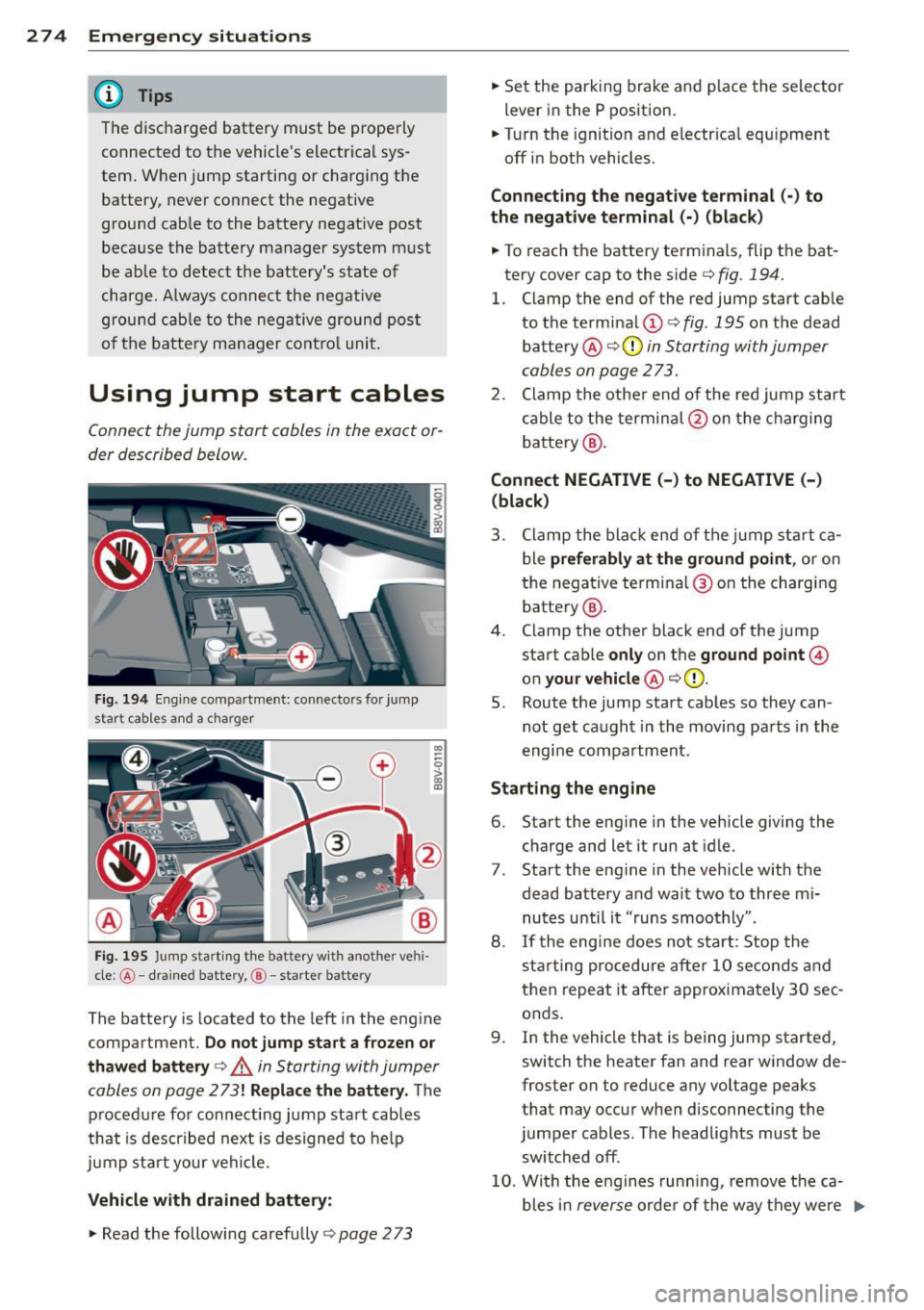
Fig. 194 Engine compartment: connecto rs fo r jump
start cab les and a charger
Fig. 195 Jump sta rting the battery with another ve hi
cle :@ -drained battery, @-starte r battery
CD
--0 > ~
The battery is located to the left in the engine
compartment.
Do not jump start a frozen or
thawed battery¢
,A in Starting with Jumper
cables on page
273! Replace the battery. The
procedure for connecting jump start cables
that is described next is designed to help
jump start your vehicle.
Vehicle with drained battery:
.. Read the following carefully ¢ page 2 73
.. Set the parking brake and place the selector
lever in the P position.
.. Turn the ignition and electr ical equipment
off in both vehicles.
Connecting the negative terminal(·) to
the negative terminal (-) (black)
.. To reach the battery terminals, flip the bat
tery cover cap to the side¢
fig. 194.
l. Clamp the end of the red jump start cable
to the terminal (!)¢
fig. 195 on the dead
battery @¢0
in Starting with Jumper
cables on page 273.
2. Clamp the other end of the red jump start
cable to the terminal @on the charging
battery @.
Connect NEGATIVE (-) to NEGATIVE (-)
(black)
3. Clamp the black end of the jump start ca
ble
preferably at the ground point, or on
the negative terminal@on the charging
battery @.
4. Clamp the other black end of the jump
start cab le
only on the ground point@
on your vehicle @¢(D.
5. Route the jump start cables so they can
not get caught in the moving parts in the
engine compartment .
Starting the engine
6. Start the engine in the vehicle giving the
charge and let it run at idle.
7 . Start the engine in the vehicle with the
dead battery and wait two to three mi nutes until it "runs smoothly" .
8.
If the engine does not start: Stop the
starting procedure after
10 seconds and
then repeat it after approximately
30 sec
onds .
9 . In the vehicle that is being jump started,
switch the heater fan and rear window de
froster on to reduce any voltage peaks
that may occur when disconnecting the
jumper cables. The headlights must be
switched off .
10. With the engines running, remove the ca
bles in
reverse order of the way they were ..,.
Page 277 of 302
M N ,....
> co ,...., \!) 1.1'1 ,...., 1.1'1 ,....,
installed. Make sure the cables do not get
caught in moving engine components .
11. Sw itch the heater fan and rear window de-
froster off.
12. Close the battery cover.
The battery is vented to the outside so that not gases enter the passenger compartment.
Make sure that the connected positive termi
nal clamps on the jump start cable have suff i
cient contact with metal.
A WARNING
Follow the warn ings and instructions from
the jump start cable manufacturer to re duce the risk of serious injuries and vehicle
damage .
If you are uns ure abo ut anything,
call roadside assistance.
- T he jump start cables must be long
enough so that the vehicles do not
touch.
- Route the jump sta rt cab les so they can
not get ca ught in the moving parts in the
engine compartment .
- Always read and follow the warnings be
fore checking anything in the engine
compartment <=>
page 214.
(D Note
Correctly jump start cables incorre ctly can
destroy the a lternator .
- Always connect the positive term inal(+)
to the positive terminal( +) and the neg
ative termina l (-) to the negative termi
nal(-) on the body ground point, but not
the negative termina l on the battery.
- Make sure the screw plugs on the batte ry
ce lls are insta lled securely. If not, tight
en the plugs before connecting the
clamps to the negat ive termina l on the
battery.
- P lease note that the connecting process
described be low for the jump start ca
bles is intended for when your vehicle is
being jump started. If you are jump
starting another vehicle, do not connect
the negat ive cab le to the negative termi
nal(·) on the drained battery, but rathe r
Emerg en cy si tuation s 275
connect it to a large metal component
that is bolted securely to the engine
bloc k, or to the engine block itsel f. If the
battery in the vehicle being jump started
is not vented to the outside, there is a
r isk of explosion due to hydrogen gas.
- Make sure that the connected positive
terminal clamps have sufficient contact
with metal.
- Do not use the battery negat ive terminal
for jump start ing or a malfunct ion could
occur in the vehicle electrical system.
Emergency towing
with commercial tow
truck
General hints
Your Audi requires special handling for tow
ing .
The following information is to be used by
commerc ial tow truck operators who know
how to operat e th eir equipment safely.
- Never to w you r Aud i. Towing will cause
damage to the engine and tran smission.
- Nev er wra p the s afety ch ains or wi nch ca
bles a round the brake li nes.
- To p revent unnece ssary dam age , your Aud i
must be t ranspo rted with a flat bed truck.
- To load the vehicle on to the fl at bed , us e
the towing loop fo und in the vehicle tool s
and attach to the front o r rear anchorage
<=> page 2 76 and <=> page 2 76.
A WARNING
A vehicle being towed is not safe for pas
sengers. Neve r allow anyone to ride in a
vehicle be ing towed, fo r any reason.
-
•
•
•
Page 289 of 302
M N
" > co ,...., \!) ..,.,
,...., ..,., ,....,
_______________________________ I~ n~ d:::: e~x 287
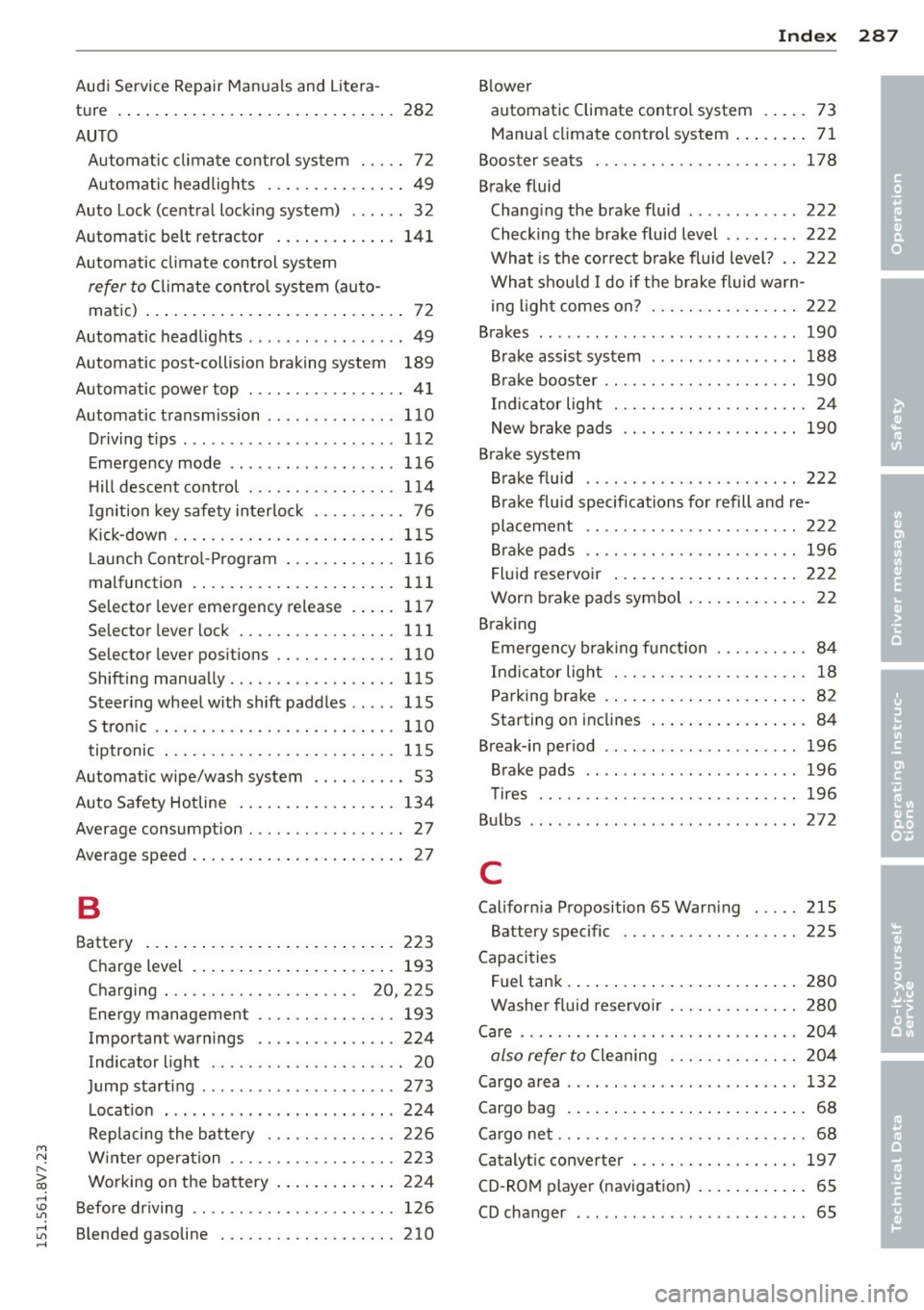
Audi Service Repair Manuals and Litera
ture
AUTO 282
Automatic cl imate control system . .. .. 72
Automatic headlights ............... 49
Auto Lock (central locking system) ...... 32
Automatic belt retractor . . . . . . . . . . . . . 14 1
Automatic climate control sys tem
refer to C limate cont rol system (au to-
mat ic) ... .. .. .... .. .... ... .. .. .... 72
Automatic headlights ......... .. .. .. .. 49
Automatic post-collision braking system 189
Automatic power top ................. 41
Automatic transmission ............. .
D.. .
nvmg tips ..................... . .
E me rgency mode ................ . . 110
112
116
H ill desce nt co ntrol ................ 114
I gnition key safety in ter lo ck . . . . . . . . . . 76
Kick-dow n .. ................. .. ... 115
L aunch Contro l-Program ... .. .. .. .. . 11 6
malfunction . .. .. ..... ... .. .. .. .. . 111
Selecto r lever emergency release . . . . . 1 17
Selector lever lock . . . . . . . . . . . . . . . . . 111
Selector lever po sit ions . . . . . . . . . . . . . 11 O
Shifting manua lly ... ..... .... ... .. . 115
Steer ing whee l w ith shift paddles ..... 115
Stro nic .. ...................... .. 110
tiptronic . .. .... ............. .. .. . 115
Automatic wipe/wash system . . . . . . . . . . 53
Auto Safety Hotline ..... ... .. .. .. .. . 134
Average consumption ......... .. .. .. .. 27
Average speed ............. .. .. .. .. .. 27
B
Battery ..... .. .. ... . .... ... .. .. ... 223
Charge level . .... ..... ... .. .. .. .. . 193
Charging . . . . . . . . . . . . . . . . . . . . . 20, 225
Energy management ............... 193
Important warnings ............... 224
Indicator light . . . . . . . . . . . . . . . . . . . . . 20
J ump starti ng .. ........... ...... .. 273
L ocat ion . .. .... .......... ..... ... 224
Replacing the ba tte ry .............. 226
W inte r op era tion .................. 223
Wo rking on the battery . ... .. .. .. .. . 224
B efore dr iving .................... .. 126
Blended gasoline .......... .... .. .. . 210 B
lower
automatic Climate contro l system . . . . . 73
Manua l cl imate control system ... .. .. . 71
Boos ter seats . .. .. .... ........... .. 178
Brake fluid Changi ng the brake fluid ............ 222
Checking the brake fluid level ........ 222
What is the correct bra ke fluid level? .. 2 22
What shou ld I do if t he b rake fluid wa rn-
ing ligh t comes on? . ........... .... 2 22
B rakes ............................ 190
B rake assist system ................ 188
B ra ke booste r .. .. .... ........... .. 190
Ind icator light . .. .. .. ........... .. . 24
New brake pads . . . . . . . . . . . . . . . . . . . 19 0
Brake system Brake fluid 222
Br ake fluid specifications fo r refill and re-
pla cement .. .. .. ................. 222
Br ake pads .. .. .. .... ........... .. 196
Fl uid reservo ir ... ... .. .. ..... ... .. 2 22
Worn b rake pads symbo l . . . . . . . . . . . . . 22
B rak ing
E mergen cy b ra ki ng f unct io n ........ .. 84
Ind icator lig ht . .. .... ........... .. . 18
Pa rking brake ...... . .. .. ..... ... .. . 82
Starting on inclines .. .. ..... ... .. .. . 84
B reak-in per iod . . . . . . . . . . . . . . . . . . . . . 196
Br ake pads . . . . . . . . . . . . . . . . . . . . . . . 196
T ires ..... .. .. .. ................. 196
Bu lbs ..... .... .... ................ 272
C
California Proposition 65 Warn ing . .. .. 215
Battery specific .. ................. 225
Capacities Fuel tank
.. .. .... .. . .. .. ..... ... .. 280
Washer fl uid reservo ir .............. 280
Care .............................. 20 4
also refer to Cleaning
Cargo area ........ .. .............. .
Cargo bag . ... .... .. . .. .. ..... ... .. . 204
132
68
Cargo ne t . . . . . . . . . . . . . . . . . . . . . . . . . . . 68
Catalytic converter ... ............... 197
CD -RO M player (navigation) . . . . . . . . . . . . 65
CD changer ... .. .. .. . .. .... ...... .. . 65
•
•
•
Page 292 of 302
290 Index
E
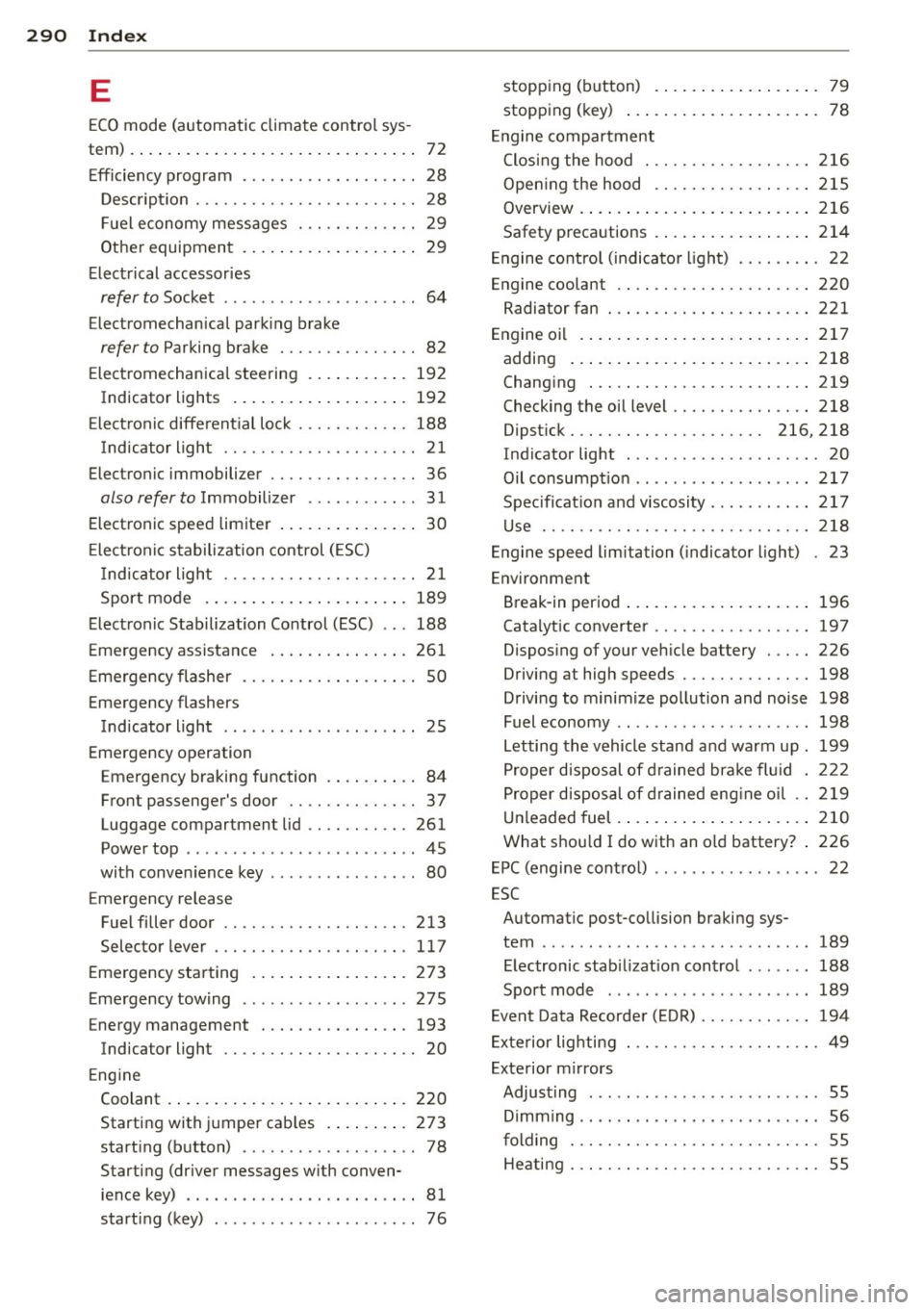
ECO mode (automatic climate control sys -
tem) . ..... .. ................ ..... ..
72
Efficiency program . . . . . . . . . . . . . . . . . . . 28
Description .............. .... .. .. .. 28
Fu el economy messages . . . . . . . . . . . . . 29
Other equipment . . . . . . . . . . . . . . . . . . . 29
Electrical accessor ies
refer to Socket . . . . . . . . . . . . . . . . . . . . . 64
Electromechanical parking brake
refer to Parking brake ......... .... .. 82
Electromechanical steering ....... ... . 192
Indicator lights ................... 192
Electronic diffe rent ial loc k ... .. .. .. .. . 188
Indicator light . . . . . . . . . . . . . . . . . . . . . 21
Electronic immobilizer ...... .... .... .. 36
also refer to Immobilizer . . . . . . . . . . . . 31
Electronic speed limiter . . . . . . . . . . . . . . . 30
Electronic stabilization control (ESC)
I ndicator light . . . . . . . . . . . . . . . . . . . . .
21
Sport mode ................ ..... . 189
Electronic Stabilization Control (ESC) . . . 188
Emergency assistance ....... ... .... . 261
Emergency flasher . . . . . . . . . . . . . . . . . . . 50
Emergency flashers
Indicator light . . . . . . . . . . . . . . . . . . . . .
25
Emergency operation
Emergency braking function .... .... ..
84
Front passenger's door ...... .. .. .. . . 37
Luggage compartment lid .. .... .... . 261
Power top . . . . . . . . . . . . . . . . . . . . . . . . . 45
·th ' k
w1 convenience ey . . . . . . . . . . . . . . . . 80
Emergency release
Fuel filler door ........... .........
213
Selector lever . . . . . . . . . . . . . . . . . . . . . 117
Emergency starting ......... ... .... . 273
Emergency towing ... .. .... .. .. .. .. . 275
Energy management ....... .. .. .. .. . 193
Indicator light . . . . . . . . . . . . . . . . . . . . . 20
Engine
Coolant
.. .. ................ ..... . 220
Starting with jumper cables . ..... .. . 273
starting (button) ............. .... .. 78
Starting (driver messages with conven-
ience key) .. ........ ..... .. ........
81
start ing (key) . .. ...... .... ... .. .. .. 76
stopping (button) ............. ..... 79
stopping (key) ... ................ .. 78
Engine compartment
Closing the hood .............. .. ..
216
Open ing the hood ................. 215
Overview . ..... .. ................ . 216
Safety precautions ............. .... 214
Engine control (indicator light) ...... .. . 22
Engine coolant .. .. ............. .... 220
Radiator fan ... .. ... .......... .... 221
Engine oil . ..... .. ................ . 217
adding ....... .. ................ . 218
Changing ........................ 219
Checking the oil level ............... 218
Dipstick. .. .. .. .. ............ 216, 218
Indicator light . .. ... ......... ... .. . 20
Oil consumption .. ..... ..... ... .. .. 217
Specification and viscosity ... .. .. .. .. 217
Use ...... .... ................... 218
Engine speed limitation (indicator light) . 23
Environment
Break-in period . . . . . . . . . . . . . . . . . . . .
196
Catalytic converter ............. .. .. 197
Disposing of your vehicle battery . .. .. 226
Driving at high speeds ............ .. 198
Driving to minimize pollution and noise 198
Fuel economy . ... ....... ...... .. .. 198
Letting the vehicle stand and warm up. 199
Proper disposal of drained brake fluid . 222
Proper disposal of drained eng ine oil .. 219
Unleaded fuel .... ................ . 210
What should I do with an o ld battery? . 226
EPC (engine contro l) . . . . . . . . . . . . . . . . . . 22
ESC
Automatic post-collision braking sys-
tem .. ... ... .. .. .. ...... ....... ..
189
Electronic stabilizat ion control . .. .. .. 188
Sport mode . .. .. ... ....... ... .. .. 189
Event Data Recorder (EDR) . . . . . . . . . . . . 194
Exterior lighting . .. ... .......... ..... 49
Exterior m irrors
Adjusting . . . . . . . . . . . . . . . . . . . . . . . . .
55
D. . 1mming .. .. ...... .. ... ... ... ..... 56
folding ... ................... ..... 55
Heating . .. ................... .... . 55
Page 294 of 302
292 Index
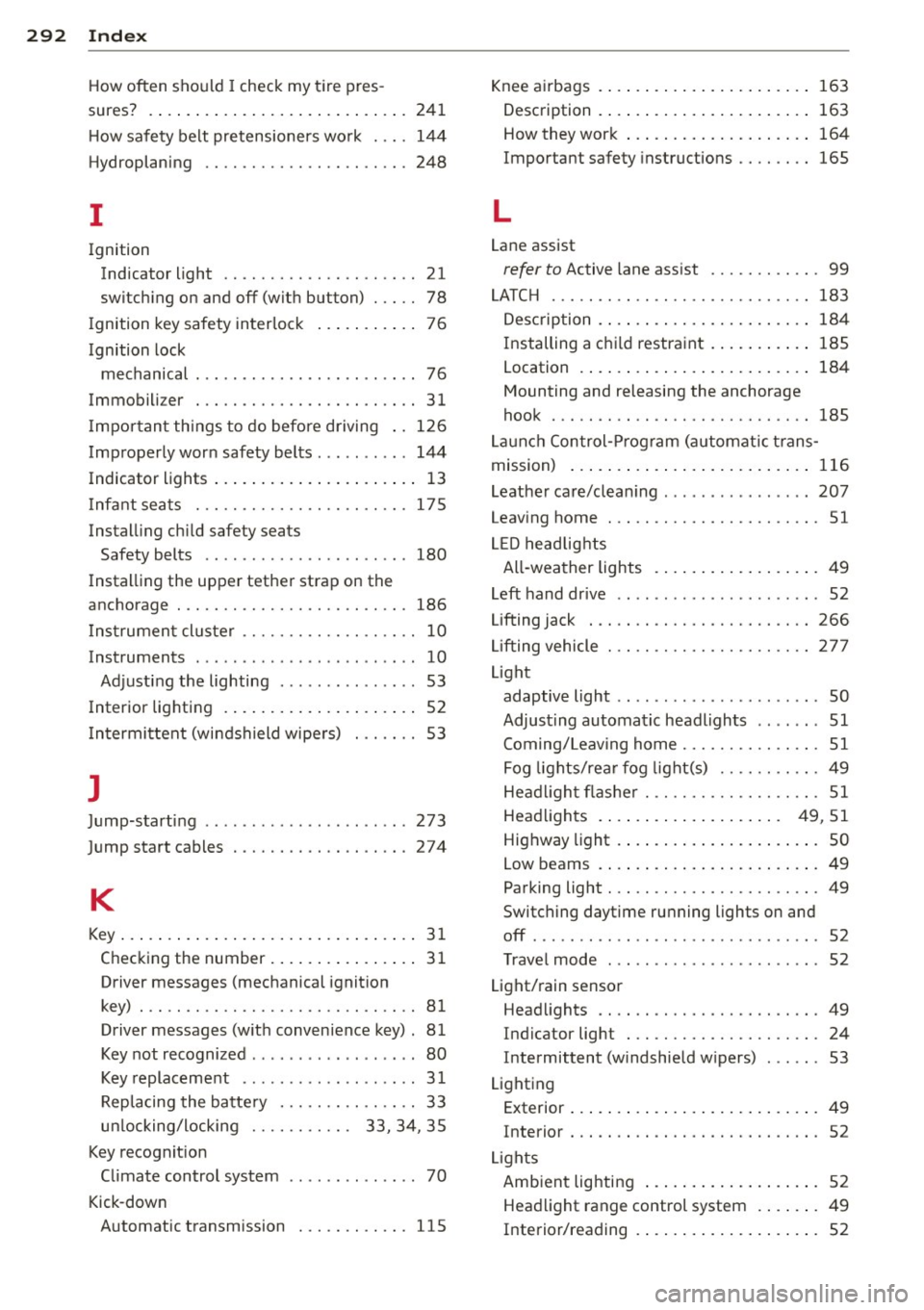
How often should I check my tire pres -
sures? . ..... ... ............. ..... .
241
How safety belt pretensioners work ... . 144
Hydroplaning ................. .... . 248
I
Ignition
Indicator light . . . . . . . . . . . . . . . . . . . . .
21
switching on and off (with button) ..... 78
Ignition key safety interlock . . . . . . . . . . . 76
Ignition lock mechanical . . . . . . . . . . . . . . . . . . . . . . . . 76
Immobili zer . . . . . . . . . . . . . . . . . . . . . . . .
31
Important things to do before driving .. 126
Improperly worn safety belts ....... .. . 144
Indicator lights ...................... 13
Infant seats . . . . . . . . . . . . . . . . . . . . . . . 17 5
Installing child safety seats Safety belts . . . . . . . . . . . . . . . . . . . . . .
180
Installing the upper tether strap on the
anchorage . .. ............. .. .. .. ...
186
Instrument cluster ......... .... .... .. 10
Instruments .... .... ...... .. .. .. .. .. 10
Adjusting the lighting ......... .. .... 53
Interior lighting .............. ..... .. 52
Intermittent (windshield wipers) . . . . . . . 53
]
Jump-starting
Jump start cables 273
274
K
Key
..... .... ................ ..... .. 31
Checking the number ....... ... .... .. 31
Driver messages (mechanical ignition
key) . .. .. .. .. . .......... .. .. .... ..
81
Driver messages (with convenience key) . 81
Key not recognized . . . . . . . . . . . . . . . . . . 80
Key replacement . . . . . . . . . . . . . . . . . . . 31
Replacing the battery ..... .. .. .. .. .. 33
unlocking/locking . . . . . . . . . . .
33, 34, 35
Key recognition
Climate control system . . . . . . . . . . . . . . 70
Kick-down Automatic transmission ... .. .. .....
115
Knee airbags .... .. ............. .... 163
Description . ..... ................ . 163
How they work ... ................ . 164
Important safety instructions ........ 165
L
Lane assist
refer to Active lane assist ........... . 99
LATCH ... .. .. .. .. ............. .. ..
183
Description .. .. .. .. .............. . 184
Installing a child restraint ........ ... 185
Location . . . . . . . . . . . . . . . . . . . . . . . . . 184
Mounting and releasing the anchorage
hook ..... .... .. .. ........... ....
185
Launch Control-Program (automatic t rans-
m1ss1on) ....... .. .. .............. .
116
Leather care/cleaning ............... . 207
Leaving home .................... .. .
51
LED headlights
All-weather lights ................ .. 49
Left hand drive . . . . . . . . . . . . . . . . . . . . . .
52
Lifting jack . .... ............... .... 266
Lifting vehicle . .. .. .. ........... .. .. 277
Light adaptive light . . . . . . . . . . . . . . . . . . . . . . SO
Adjusting automatic headlights ...... .
51
Coming/Leaving home .......... .... . 51
Fog lights/rear fog light(s) .... ...... . 49
Headl ight flasher .... .......... .. .. .
51
Headlights . . . . . . . . . . . . . . . . . . . . 49, 51
Highway light .... ................ .. SO
Low beams . ..... ................ .. 49
Parking light .................... .. . 49
Switching daytime running lights on and
off . .. ... ... .. .. .. ..... ...... .. .. .
52
Travel mode . . . . . . . . . . . . . . . . . . . . . . . 52
Light/rain sensor
Headlights .... .. ................. . 49
Indicator light ... ............. .....
24
Intermittent (windshield wipers) ..... . 53
Lighting
Exterior . . . . . . . . . . . . . . . . . . . . . . . . . . . 49
Interior . . . . . . . . . . . . . . . . . . . . . . . . . . .
52
Lights
Ambient lighting . . . . . . . . . . . . . . . . . . .
52
Headlight range control system ... ... . 49
Interior/reading . . . . . . . . . . . . . . . . . . . .
52
Page 297 of 302
M N ,....
> co ,...., \!) 1.1'1 ,...., 1.1'1 ,....,
_______________________________ I~ n~ d:::: e~x 295
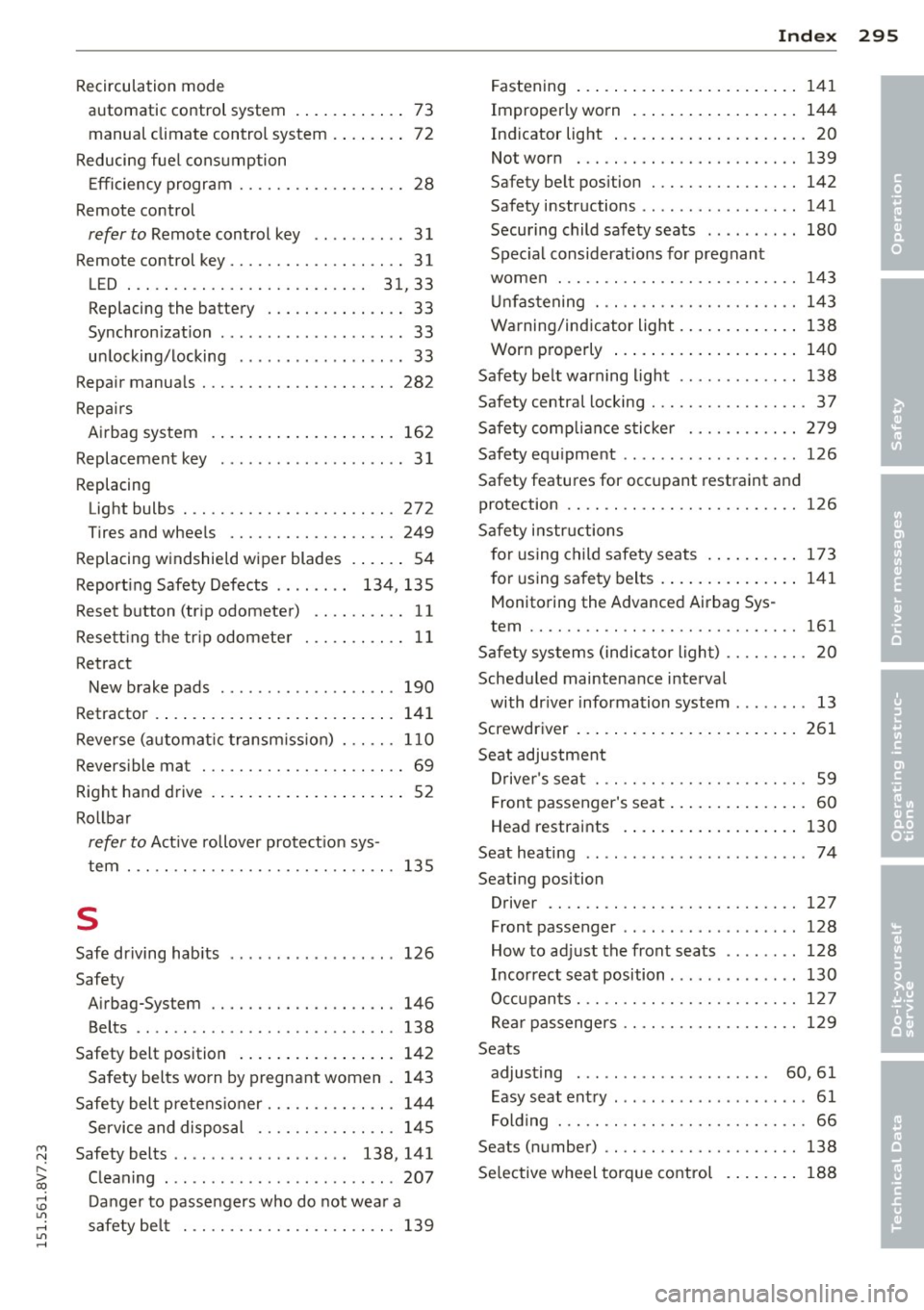
Recirculation mode
automatic control system . . . . . . . . . . . . 73
manual climate control system . . . . . . . . 72
Reducing fuel consumption
Efficiency program . . . . . . . . . . . . . . . . . . 28
Remote control
refer to Remote control key . . . . . . . . . . 31
Remote control key . . . . . . . . . . . . . . . . . . . 31
LED . . . . . . . . . . . . . . . . . . . . . . . . . . 31 33
,
Replacing the battery ..... .. .. .. .. .. 33
Synchron izat ion ....... ...... .... ... 33
un locking/locking ........... .... ... 33
Repair manuals ............ .... .. .. . 282
Repairs Airb ag system ........ ......... .. . 162
Replacement key . . . . . . . . . . . . . . . . . . . . 31
Replacing Light bulbs . ............. .... .. .. . 272
Tires and wheels ......... .. .. .. .. . 249
Replacing windshield wiper blades .. .. .. 54
Report ing Safety Defects . . . . . . . . 134, 135
Reset button (tr ip odometer) . . . . . . . . . . 11
Resetting the trip odometer ... .. .. .. .. 11
Retract New brake pads 190
Retractor
' . .. .. .............. ... .. . 141
Reverse (automat ic transmission) . .. .. . 110
Reversible mat ............ .... .. .. .. 69
Right hand drive .............. ... .. .. 52
Rollba r
refer to Active rollover protection sys -
tem ... .. .. .. .. ........... .. .. ... 135
s
Safe driving hab its
Safety 126
Airbag-System ........... .... .. .. . 146
Belts .. .. .. .. ........ ... .. ... ... . 138
Safety belt position ................. 142
Safety belts worn by pregnant women . 143
Safety belt pretens ioner ..... .. .. .. .. . 144
Service and disposal ...... .. .. .. .. . 145
Safety belts . . . . . . . . . . . . . . . . . . . 138, 141
Cleaning ... .. ........ ... .. ... ... . 207
Danger to passengers who do not wear a
safety belt .............. .. .. .. .. . 139 Fastening .
. . . . . . . . . . . . . . . . . . . . . . . 141
Improperly worn ... ............... 144
Ind icator light ... .. ................ 20
Not worn . .. .. .. ................. 139
Safety belt position . . . . . . . . . . . . . . . . 142
Safety instructions ................. 141
Securing child safety seats ...... .. .. 180
Spec ial considerations for pregnant
women . .. .. .. .. .. . .............. 143
Unfastening . .. .. .... ........... .. 143
Warning/indicator light ............. 138
Worn properly . . . . . . . . . . . . . . . . . . . . 140
Safety belt warning light ............. 138
Safety central locking ............ .. .. . 37
Safety compliance sticker ............ 279
Safety equ ipment ................... 126
Safety features for occupant restraint and
protection .. .. .. .. ................. 126
Safety instructions for using child safety seats .......... 173
for using safety belts .............. . 141
Monitoring the Advanced Airbag Sys -
tem .... .. .. .. .. .. ............... 161
Safety systems (indicator light) . . . . . . . . . 20
Scheduled maintenance interval
with dr iver information system . . . . . . . . 13
Screwdriver ....... .. ............... 261
Seat adjustment
Driver's seat . . . . . . . . . . . . . . . . . . . . . . . 59
Front passenger's seat . . . . . . . . . . . . . . . 60
Head restraints .................. . 130
Seat heating ....... ................. 74
Seating position Driver .... .. .. .. ................. 127
Front passenger .. .. ... ....... ..... 128
How to adjust the front seats ....... . 128
Incorrect seat position ............. . 130
Occupants . .. .. .. ............... .. 127
Rear passengers ...... ........... .. 129
Seats adjusting . . . . . . . . . . . . . . . . . . . . . 60, 61
Easy seat entry . . . . . . . . . . . . . . . . . . . . . 61
Folding ..... .. .. .. .. ........... .. . 66
Seats (number) .. ...... ............. 138
Selective wheel torque control ........ 188
•
•
•
Page 300 of 302
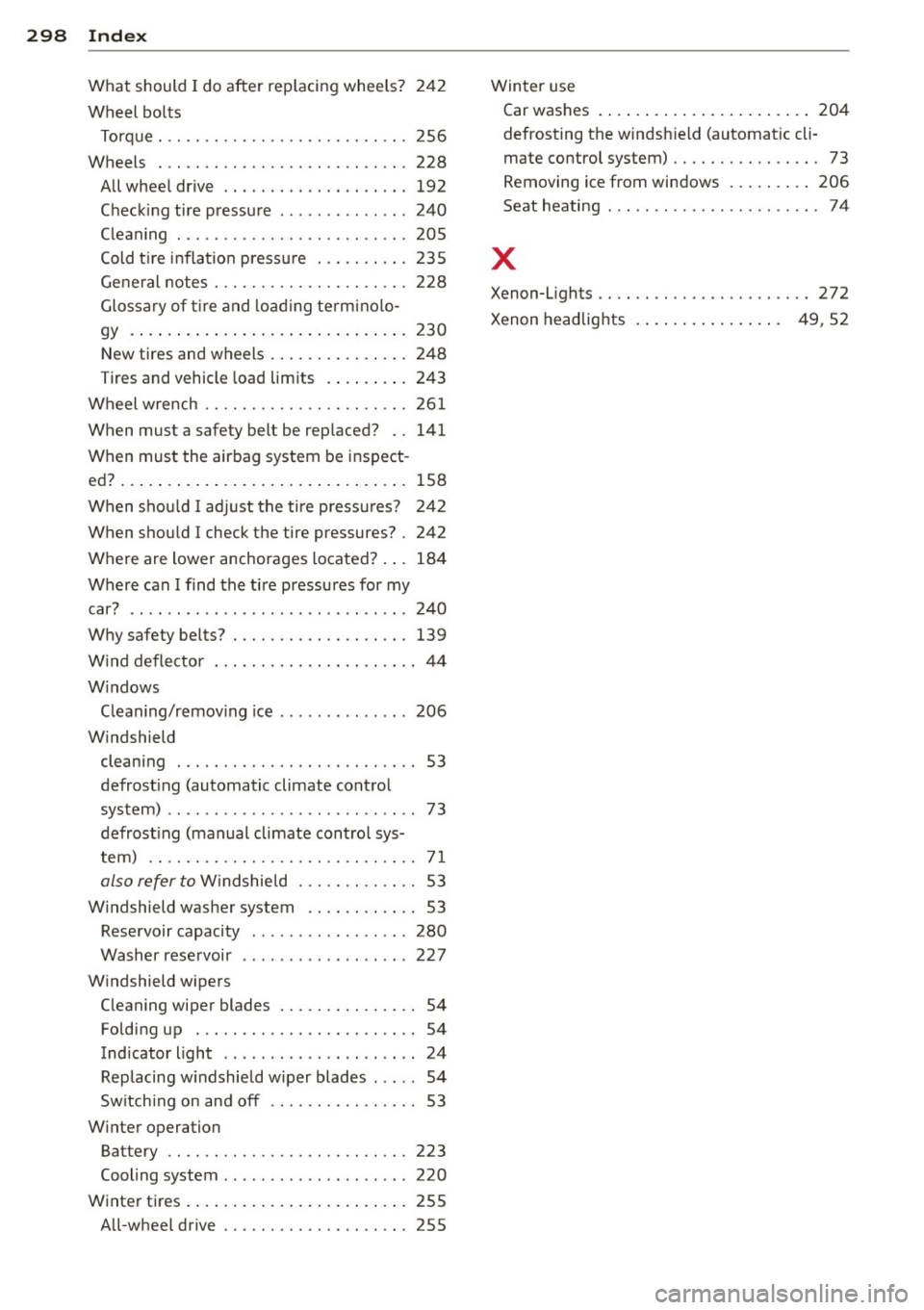
298 Index
What should I do after replacing wheels? 242
Wheel bo lts
Torque . .. .... ........... ........ . 256
Wheels . .. ................. .. .... . 228
All wheel drive .............. ... .. .
192
Check ing tire pressure .......... .... 240
C leaning . .. ................ ... ... 205
Cold t ire in flat ion pressu re ... .. .. .. . 235
General notes . ............... .... . 228
Glossary of t ire and load ing te rm ino lo-
gy .. .... .. ............ ... .. .... . 230
New tires and wheels .... .. .. .... .. . 248
Tires and vehicle load limits . ....... . 243
Wheel wrench ........... .. .. .. .. .. .
261
When must a safety belt be replaced? .. 141
When must the airbag system be inspect-
ed? ... .. .... .. .. ...... ... ... ..... . 158
When should I ad just the tire p ressu res? 242
When should I check the tire pressures? . 242
Where are lower anchorages located? . ..
184
Where can I find the tire pressures for my
car? ...... ....... ........... ... .. . 240
Why safety belts? ...................
139
Wind deflector .. ... .... ... .. .. .... .. 44
W indows
C leaning/remov ing ice ...... ... .. ... 206
W indshield
cleaning ... ............. .. .. .. ... . 53
defrost ing (automatic climate control
system) .. ................. ...... .. 73
defrost ing (manual climate cont ro l sys-
tem) .. .. .. .. ... ........ .. .. .. .. .. 7 1
also refer to Windshie ld ... .. .. .. .. . . 53
W indshield washer system ............ 53
Reservoir capacity ............ .. ...
280
Washer rese rvoir .......... .... .... 227
Windshield wipers Cleaning wiper blades ..... .... ...... 54
Folding up ............... ..... .. .. 54
Ind icator light . . . . . . . . . . . . . . . . . . . . .
24
Replacing w indshield w iper blades ... . . 54
Sw itching on and off ................ 53
W inter operation
Battery .... ...................... 223
Cooling system ................ .... 220
Winter tires .. ... .. ..... ... .. .. .... . 255
A ll-wheel drive .................... 255 Winter use
Car washes . ..... .. ... ..... ... .. .. 204
defrosting the windsh ie ld (automatic cli
mate control system) . . . . . . . . . . . . . . . . 73
Removing ice from windows ..... .... 206
Seat heating ..... ................ .. 74
X
Xenon-Lights .... ............... .... 272
Xenon headlig hts . . . . . . . . . . . . . . . .
49 , 52