service AUDI A3 CABRIOLET 2015 Service Manual
[x] Cancel search | Manufacturer: AUDI, Model Year: 2015, Model line: A3 CABRIOLET, Model: AUDI A3 CABRIOLET 2015Pages: 302, PDF Size: 73.83 MB
Page 146 of 302
144 Safety belts
Improperly worn safety belts
Incorrectly positioned safety belts can cause
severe injuries .
Wearing safety belts improperly can cause se
rious injury or death. Safety belts can only
work when they are correctly positioned on
the body . Improper seating positions reduce
the effect iveness of safety belts and will even
i ncrease the r isk of injury and death by mov
ing the safety belt to cr itical areas of the
body . Improper seating positions also in
crease the risk of serio us inj ury and death
when an airbag deploys and strikes an occu pant who is not in the correct seating posi
tion . A driver is responsible for the safety of
all vehicle occupants and especially for ch il
dren . Therefore:
.. Never permit anyone to assume an incorrect
sitting position in the vehicle wh ile traveling
¢ _& .
A WARNING
Improperly worn safety belts increase the
risk of se rious personal injury and death
whenever a veh icle is being used .
- Always make sure that al l vehicle occu-
pants are cor re ct ly restrained a nd stay in
a corre ct seating posit ion wheneve r the
vehicle is be ing used.
- Always read and heed all WARNI NGS and
other important informat ion
¢page 141.
Safety belt preten
sioners
How safety belt pretensioners work
In front, side and rear -end collisions above a
particular severity and in a rollover , safety
belts are tensioned automatically.
R ev er sible s afety belt ten sioners
The safety belts on the front seats are equip
ped with power reve rsible tensioners . The fol
low ing funct ions are available when the driv -er's/front passenger's safety belts are fas
tened:
- Automatic tens ioners : at the start of a dr ive,
t he sa fe ty belts automat ica lly adjust to the
passenger after a certain time period or ve
hicle speed.
- In certain driving situations, the safety belts
may tighten w ith a reversible tensioning
function
¢ page 95.
-The safety be lts may a lso tighten with this
reversible tensioning function in minor co lli
sions .
Pyrotechnic s afety belt pretens ioners
T he safety belts are equipped with sa fety belt
pretensioners. The system is ac tivated by sen
sors in front, side and rear-end co llisions of
great severity and in a rollover. This tightens
the belt and takes up belt slack ¢.&.
in Service
and disposal of safety belt pretensioner on
page 145.
Taking up the slack helps to reduce
forward occupant movement dur ing a colli
s ion .
A WARNING
-- It is poss ible for the pretens ioners to de-
p loy inco rrectly.
- The pyrotechnic system can only provide
p rotection fo r one coll is ion. If the pyro
technic pretensioners deploy, the preten sioning sys tem must be replaced .
{!) Tips
The pyrotechnic safety be lt pretensioners
can only deploy once.
- The safety belt pretensioners do not de
ploy in minor frontal and s ide collisions,
in rear-end co llisions, in rollovers and in
co llisions involving very little impact
force.
- A fine dust is released when the py ro
t echnic safety be lt pretensioners dep loy.
T his is normal and is not caused by a fire
in the vehicle .
- T he re levant safety requ irements must
be observed when the vehicle or compo
nents of the system are scrapped. A
Page 147 of 302
M N
" > co ,...., \!) ..,.,
,...., ..,., ,....,
qualified dealership is familiar with
these regulations and will be pleased to pass on the information to you.
- Be sure to observe all safety, environ
mental and other regulations if the vehi
cle or individual parts of the system, par
ticularly the safety belt or airbag, are to be disposed. We recommend you have
your authorized Audi dealer perform this
service for you.
Service and disposal of safety belt
pretension er
The safety belt pretensioners are parts of the
safety belts on your Audi. Installing, remov ing, servicing or repairing of belt pretension
ers can damage the safety belt system and
prevent it from working correctly in a colli
sion.
There are some important things you have to
know to make sure that the effectiveness of
the system will not be impaired and that dis
carded components do not cause injury or pol
lute the environment .
A WARNING
Improper care, servicing and repair proce
dures can increase the risk of personal in
jury and death by preventing a safety belt
pretensioner from activating when needed
or activating it unexpectedly:
- The belt pretensioner system can be acti
vated only once. If belt pretensioners
have been activated, the system must be
replaced.
- Never repair, adjust, or change any parts
of the safety belt system.
- Safety belt systems including safety belt
pretensioners cannot be repaired. Spe
cial procedures are required for removal,
installation and disposal of this system.
- For any work on the safety belt system,
we strongly recommend that you see
your authorized Audi dealer or qualified technician who has an Audi approved repair manual, training and special equip
ment necessary.
Safety belts 145
@:) For the sake of the environment
Undeployed airbag modules and preten
sioners might be classified as Perchlorate
Material -special handling may apply, see
www. dtsc. ca.gov/hazard o u swa ste/ per-
ch lo rate. When the vehicle or parts of the
restraint system including airbag modules
safety belts with pretensioners are scrap
ped, all applicable laws and regulations
must be observed. Your authorized Audi
dealer is familiar with these requirements
and we recommend that you have your
dealer perform this service for you. •
•
•
Page 164 of 302
162 Airbag system
Repair, care and disposal of the airbags
Parts of the airbag system are installed at
many different places on your Audi. Installing,
removing, servicing or repairing a part in an
area of the vehicle can damage a part of an
airbag system and prevent that system from
working properly in a collision.
There are some important things you have to know to make sure that the effectiveness of
the system will not be impaired and that dis
carded components do not cause injury or pol lute the environment.
A WARNING
Improper care, servicing and repair proce
dures can increase the risk of personal in
jury and death by preventing an airbag from deploying when needed or deploying
an airbag unexpectedly:
- Never cover, obstruct, or change the
steering wheel horn pad or airbag cover
or the instrument panel or modify them
in any way.
- Never attach any objects such as cup
holders or telephone mountings to the
surfaces covering the airbag units.
- For cleaning the horn pad or instrument
panel, use only a soft, dry cloth or one
moistened with plain water. Solvents or
cleaners could damage the airbag cover
or change the stiffness or strength of the material so that the airbag cannot de
ploy and protect properly.
- Never repair, adjust, or change any parts
of the airbag system.
- All work on the steering wheel, instru
ment panel, front seats or electrical sys
tem (including the installation of audio
equipment, cellular telephones and CB
radios, etc .) must be performed by a
qualified technician who has the training
and special equipment necessary.
- For any work on the airbag system, we
strongly recommend that you see your
authorized Audi dealer or qualified work
shop. -
Never modify the front bumper or parts
of the vehicle body.
- Always make sure that the side airbag
can inflate without interference:
- Never install seat covers or replace
ment upholstery over the front seat
backs that have not been specifically
approved by Audi.
- Never use additional seat cushions that
cover the areas where the side airbags
inflate.
- Damage to the original seat covers or
to the seam in the area of the side air
bag module must always be repaired
immediately by an authorized Audi
dealer.
- The airbag system can deploy only once.
After an airbag has been deployed, it must be replaced with new replacement
parts designed and approved especially
for your Audi model version. Replace
ment of complete airbag systems or air
bag components must be performed by
qualified workshops only . Make sure that
any airbag service action is entered in
your Audi Warranty
& Maintenance book
let under
AIRBAG REPLACEMENT RE
CORD.
- For safety reasons in severe accidents,
the alternator and starter are separated
from the vehicle battery with a pyrotech nic circuit interrupter.
- Work on the pyrotechnic circuit inter
rupter must only be performed by a
qualified technicians who have the ex perience, information and special tools
necessary to perform the work safely.
- If the vehicle or the circuit interrupter
is scrapped, all applicable safety pre
cautions must be followed.
@) For the sake of the environment
Undeployed airbag modules and preten
sioners might be classified as Perchlorate
Material -special handling may apply, see
Page 194 of 302
192 Smart Technology
the brakes. If you need to brake addition
ally, brake in intervals and not continu
ously.
(D Tips
- If the brake booster is not working, you
must press the brake pedal with much
more force then norma l.
- If you retrofit your vehicle with a front
spoiler, wheel covers or similar items,
make sure that the air flow to the front
wheels is not interrupted. Otherwise the
brake system can become too hot.
Electromechanical
steering
The electromechanical steering supports the
driver's steering movements .
Power steering adapts electronically based on
the vehicle speed.
The vehicle still has full steering functionality if the power steering fai ls or when the engine
is stopped (towing). To steer, you must apply
much more force than usual.
Indicator lights and messages
• Do not drive vehicle: steering defective
If this indicator light turns on and stays on
and this message appears, the power steering may have failed.
Do
not continue driving. See an authorized
Audi dea ler or authorized Audi Service Facility
for assistance.
• Do not drive vehicle: steering defective
There is a malfunct ion in the electron ic steer
ing lock. You cannot turn the ign ition on.
Do
not tow your vehicle because it cannot be
steered. See an authorized Aud i dealer or au
thor ized Audi Serv ice Facility for ass istance.
'I j Steering malfunction: you can continue
driving
If the indicator light turns on, the steering
wheel may be more difficult to move or more sensitive than usual.
The stee ring wheel may
also be at an angle when driving straight.
Drive slowly to your authorized Audi dealer or
qualified wo rkshop to have the malf u nct ion
corrected.
II Steering lock : system fault! Please con
tact Service
There is a malfunction in the electronic steer
ing lock .
Drive to an authorized Audi dealer or author
ized Audi Service Facility immediately to have
the malfunction corrected.
A WARNING ,___
Have the system malfunction corrected as
soon as possible by an authorized Aud i
dealer or authorized Audi Service Facility,
as this increases the risk o f an accident.
@ Tips
If the . or ,~ n ind icator light only stays
on for a short tim e, you may continue dr iv
in g.
All wheel drive
(quattro)
Applies to vehicles: with all wheel drive
In all wheel drive, all four wheels are pow
ered.
General information
In all whee l drive, the driving power is divided
between a ll four wheels . This happens auto
matically depending on your driving behavior
as well as the current road conditions. Refer
to
¢ page 188, Electronic stabilization con
trol (£SC) .
The all wheel drive concept is designed for
high engine power. Your vehicle is exception
ally powerful and has excellent driving charac
teristics both under normal driving cond itions
and on snow and ice . Always read and follow
safety p recaut ions
Q ,& . .,.
Page 197 of 302
M N
-How far (if at all) the driver was depressing
the accelerator and/or brake pedal; and,
- How fast the vehicle was traveling.
These data can he lp provide a better under
standing of the circumstances in which crash
es and injuries occur. NOTE: EDR data are re
corded by your vehicle only if a non-trivial
crash situation occurs; no data are recorded by
the EDR under normal driving conditions and
no personal data (e.g., name, gender, age,
and crash location) are recorded. However,
other parties, such as law enforcement, could
comb ine the EDR data with the type of per
sonally identify ing data routinely acquired
during a crash invest igation.
To read data recorded by an EDR, special
equ ipment is required, and access to the veh i
cle or the EDR is needed . In add ition to the ve
hicle manufacturer, other parties, such as law
enforcement, that have the special equip
ment, can read the information if they have
access to the vehicle or the EDR.
Some state laws restrict the retrieval or down
loading of data stored by EDRs installed in a
vehicle for the express pu rpose of retr ieving
data after an accident or crash event without
the owner's consent.
Aud i will not access the EDR and/or sim ilar
data or give it to others -
- unless the vehicle owner (or lessee if the ve
hicle has been leased) agrees; or
- upon the official request by the police; or
- upon the order of a court of law or a govern-
ment agency; or
- for the defense of a lawsuit through the ju
dicial discovery process .
- Audi may also use the data for research
about vehicle operation and safety perform
ance or provide the data to a third party for
research purposes without identifying the
specific vehicle or information about the
identity of its owner or lessee and only after
the recorded vehicle data has been ac-
S: cessed. co ,...., \!) 1.1'1 ,...., 1.1'1 ,....,
Smart Technology 195
Vehicle control modules
Your vehicle is also equipped with a number of
electronic control modules for various vehicle
systems, such as engine management, emis
sion control, airbags, and safety belts.
T hese electronic control modu les record data
during norma l vehicle operation that may be
needed by trained technicians for diagnostic
and repair purposes. The recording capability
of these modules is limited to data (no sound
is recorded). Only a small amount of data is
actually recorded over a very lim ited period of
time, or stored when a system fault is detect
ed by a control module. Some of the data
stored may relate to vehicle speed, direction,
or braking, as well as restraint system use and
performance in the event of a crash. Stored
data can also only be read and downloaded
with special equipment that is directly con
nected to the vehicle.
(D Tips
Your vehicle may be equipped with Audi
connect. Your use of certain Audi connect
features requires wireless services that are
provided by a third party wire less telecom
munications provider. For details regard
ing how information obtained through
Audi connect is collected, processed,
transmitted, used, and shared, please see
your contract with the wireless telecom
munications provider and the "About Audi
connect" tab in your vehicle's
MMI: I MENU I
button > Audi connect > About Audi con
nect.
•
•
•
Page 200 of 302
198 Driving and the environment
can reach the cata lytic converter. This
could result in overheating of the con
verter, requ iring its replacement.
- To assure efficient operation of the Emis
sion Control System:
- Have your veh icle ma intained properly
and in accordance with the service rec
ommendations in your Warranty
&
Ma intenance booklet.
- Lack of proper maintenance as well as
improper use of the vehicle will impa ir
the function of the emission control
system and could lead to damage.
@ For the sake of the environment
Even when the Emission Contro l System is
operating properly, the exhaus t gas can
have a sulfur-like exhaust gas smell under
some operating states. This depends on
the sulfur content of the fue l being used .
Using a different brand of fuel may help,
or filling the tank w ith lead-free super
grade gasoline.
Placing your vehicle
out of service
If you wou ld like to take your vehicle out of
service for a longer t ime, contact your author
ized Audi dealer or qualified repair facility.
They will advise you of important measures,
such as corrosion protection, maintenance
and storage procedures. Also follow the infor
mat ion about the battery
¢ page 223.
Operate your vehicle
economically and
minimize pollution
General
Your personal style of driving will determine
the economy of your vehicle, as well as ex
haust and noise levels .
Fuel economy, environmental impact, and
wear on your engine, brakes and t ires largely
depend on three factors: -your
personal driving style
- operating conditions
- technical limitations
If you ant ic ipate what you need to do next and
drive econom ically, you can easily cut your
fuel consumpt ion by 1O-lS percent . This sec
t ion w ill give you some tips on how you can
help the env ironment and your pocketbook.
(D Tips
The consumption estimates as published
by ENVIRONMENTAL PROTECTION AGENCY
(EPA) and Transport Canada may not corre
spond to your actual consumption on the
road, which will vary depending upon vehi
cle load and speed, road and weather con
ditions, trip length, etc.
Drive smoothly and keep a lookout
ahead
Vehicles use the most fuel when they are ac
celerating.
.,. Avoid unnecessary accelerating and braking.
Vehicles use the most fuel when they are ac
ce lerating. If you anticipate what is going to
happen next, you will need to brake less and,
thus, acce lerate less. Let the vehicle coast
whenever possible -for example when you see
that the next traffic light is red.
Avoid full throttle '
Driving at moderate speeds saves fuel and
improves your mileage.
.,. Try and keep well below your car's maximum
speed.
Acce lerating gently reduces fue l consump
tion, engine wear, and does not disturb the
environment.
Fuel consumpt ion, exhaust emissions and en
gine noise increase disproportionate ly at high
speeds. If you drive at approximately three
quarters of top speed, fuel consumption wi ll
be reduced by one half. Never drive faster
1111>
Page 201 of 302
M N
" > co ...... \!) 1.1'1
...... 1.1'1 ......
than the posted speed limit and weather con
ditions permit. Reducing unnecessary idling
Even wh en your car is just idling it burns up
fuel.
.,. Shu t the engine off when you a re not dr iv ing
the vehi cle.
... Do not warm up the vehicle by letting the
engine run at idle.
It is effic ient to switch off the eng ine when
stopped at railroad crossings and long red
lights. Turning the engine
off for just 30-40
seconds saves more fu el than is burned by
starting the engine again.
It takes a long time fo r the engine to wa rm up
fu lly when it is running at idle. However , wear
and noxious emissions are especially high
when the engine is wa rming up. So you should
drive away as soon as you start the eng ine and
avoid running at h igh RPM while the engine is
still warm ing up.
Do not leave engine idling unattended af
ter starting. If warning lights should come on to indicate improper operation, they
wou ld go unheeded. Extended idling also
p roduces heat, which cou ld result in over
heating or other damage to the vehicle or
other prope rty .
Regular maintenance
A badly tuned engine unnecessarily wastes a lot of fuel.
.,. Have your vehicle serv iced at regular inter-
vals.
H aving your vehicle regularly serviced by an
author ized Audi dealer helps to ensure that it
runs properly and economically . T he condition
of your vehicle not only affects its safety and
ab ility to hold its value, it also affects fuel
c onsum ption.
Dri ving and the en vironm ent 199
Chec k your oil e ach t ime you fill your tank.
T he amou nt of oi l used is re lated to engine
load a nd speed.
It is normal for the oil consumption of a new
engine to reach its lowest value after a certa in
mileage has bee n driven.
You must drive your veh icle about 3,000 m iles
(5,000 kilometers) before you can properly
assess oil consumpt ion.
This also app lies to fue l consumption and en
gine output .
(D Note
- Have your veh icle ma inta ined properly
and in accordance with the service rec
ommendations in your Warranty
& Ma in
tenance booklet . Lack of proper mainte
nance as well as improper use of the ve
hicle will impair the function of the
em iss ion cont ro l system and cou ld lead
t o damage.
- Do not alter or remove any component of
the Emission Control System unless ap
proved by the manufacture r.
- Do not alter or remove any device, such
as hea t shie lds, switches, ign ition w ires,
valves, which are designed to protect
your vehicle's Emission Control System
and other important vehicle compo
nents.
Fewer short trips
Fuel consumption will always be relatively
high on short trips.
... Try to avoid dr iving sho rt distances with a
cold engine .
T he eng ine and catalytic conve rter have to
reach their optimal operati ng t emperature to
reduce fuel consumption and noxious emis
sions effectively.
Just after starting, a co ld eng ine in a mid-s ize
ca r only achieves a fuel economy of 6 -8 mi les
per gallon (30-40 l/100 km). After about a
half a mile, fuel economy climbs to 12 mpg ..,.
•
•
•
Page 213 of 302
M N
" > co ,...., \!) ..,.,
,...., ..,., ,....,
Many gasoline grades are blended to perform
especially well for winter or summer driving. During seasonal change-over , we suggest that
you fill up at busy gas stations where the sea sonal adjustment is more likely to be made in
time.
Q;) Note
- Methanol fuels which do not meet these requirements may cause corrosion and
damage to plastic and rubber compo
nents in the fuel system .
- Do not use fuels that fail to meet the
specified criteria in this chapter .
- If you are unable to determine whether
or not a particular fuel blend meets the
specificat ions, ask your service station or
i ts fuel supp lier .
- Do not use fuel for which the contents cannot be identified .
- Fuel system damage and performance
problems resulting from the use of fuels
different from those specified are not
the responsibility of Audi and are not
covered under the New Vehicle or the
Emission Control System Warranties.
- If you experience a loss of fuel economy
or driveability and performance prob
lems due to the use of one of these fuel
blends, we recommend that you switch
to unblended fuel.
Gasoline additives
A major concern among many auto manufac
turers is carbon deposit build-up caused by
the type of gasoline you use .
Although gasoline grades differ from one manufacturer to another, they have cer tain
things in common. All gasoline grades contain substances that can cause deposits to collect
on vital engine parts, such as fuel injectors
and intake valves. Although most gasoline
brands include additives to keep engine and
fuel systems clean, they are not equally effec
tive.
Checking and Filling 211
Audi recommends using TOP TIER Detergent
Gasoline . For more information on TOP TIER
Detergent Gasoline, please go to the official
website (www .toptiergas .com) .
After an extended period of using inadequate
fuels, carbon deposit build-ups can rob your engine of peak performance.
CJ) Note
Damage or malfunction due to poor fuel
quality is not covered by the Audi New Ve
hicle Limited Warranty.
Fuel tank
Fuel filler neck
The fuel filler neck is located on the right rear
side panel behind the fuel filler flap.
If the power locking system should fail, you
can still open the flap manually -for detailed
instructions see~
page 213.
You can find the fuel tank capacity of your ve
hicle in
~ page 280.
The label on the inside of the fuel filler flap
tells you the correct fuel for your vehicle. For
more information about fuel specifications,
see
~ page 210 .
Your vehicle fuel tank has an on board refuel
ling vapor recovery system. This feature helps
to prevent fuel vapors from escaping from the
tank and polluting the environment while you refuel your vehicle. In order to fill the tank
properly while protecting the environment,
please follow this refueling procedure careful
ly .
A WARNING ~
Under normal operating conditions, never
carry additional fuel containers in your car.
Gas canisters and other containers used to
transport fuel can be dangerous. Such con
tainers, full or empty, may leak and could
cause a fire in a collision . If you must
transport fuel to use for your lawn mower, ..,.
•
•
•
Page 219 of 302
M N ,....
> co ,...., \!) 1.1'1 ,...., 1.1'1 ,....,
Engine oil
Engine oil specifications
The engine oil used must conform to exact
specifications .
The service interval display in the instrument
cluster of your vehicle w ill inform you when it
is t ime for an oil change. We recommend that
you have your o il changed by an author ized
Aud i Service Advisor .
If you have to top off the oil between oil
changes, use the Aud i oil quality standard
specified in the table .
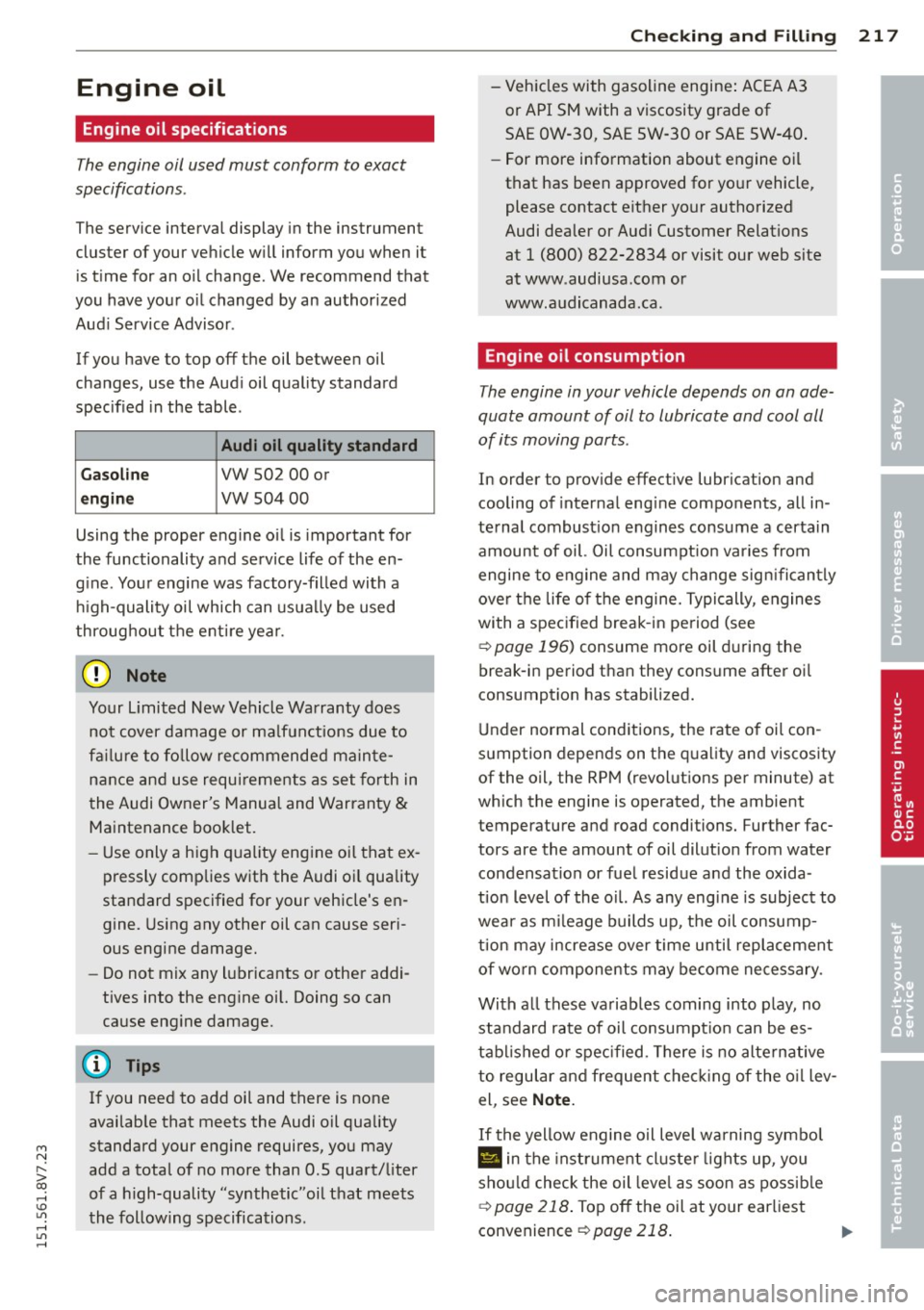
Audi oil quality standard
G asoline
VW 502 00 or
e ngin e vw 504 00
Using the proper engine o il is important for
the functionality and service life of the en
g ine . Your engine was factory-filled with a
hi gh-quality oil which can usua lly be used
throughout the enti re yea r.
(D Note
Your Limited New Vehicle Warranty does
not cover damage or ma lfun ctions due to
fa ilure to fo llow recommended ma in te
nance and use requ irements as set forth in
the Audi Owner's Manua l and Warranty
&
Maintenance book let.
- U se only a high q uality eng ine oi l that ex
pressly comp lies with the Audi oil quality
standard specified for your vehicle's en
gine. Using any other oil can cause seri
ous engine damage.
- Do not mix any l ubricants or other addi
tives into the eng ine oi l. Doing so can
cause eng ine damage.
(D Tips
I f you need to add oi l and there is none
availab le that meets the Audi oil quality
standard your engine requires, you may
add a total of no more than 0.5 quart/liter
of a high-quality "synthetic"oil that meets
t he follow ing specifica tions.
Checking and Fillin g 217
-Veh icles with gasoline engine : ACEA A3
or AP! SM with a viscosity grade of
SAE O W-30, SAE 5W -30 or SAE SW-40 .
- For more information about engine o il
that has been approved for yo ur vehicle,
please contact either your authorized
Audi dealer or Aud i Customer Relations
at 1 (800) 822-2834 or visit our web site
at www .audiusa.com or
www.a udicanada.ca.
Engine oil consumption
The engine in your vehicle depends on an ade
quate amount of oil to lubricate and cool all
of its moving parts .
In order to provide effective lubrication and
cooling of interna l eng ine components, all in
te rnal combust io n engines consume a certa in
amount of oil. Oil consumpt ion va rie s from
engine to engine and may change sign ifi can tly
ove r th e life of the engine. Typically, engines
wi th a spec ified break -in pe riod (see
¢ page 196) consume more oil during the
break-in pe riod than they cons ume after oi l
consumption has stabilized.
U nder normal cond itions, the rate o f oi l con
s u mption depen ds on the q ual ity and viscos ity
of the oil, the RPM (revolutions per minute) at
which the engine is operated, the ambient
temperature and road conditions. Further fac
tors are the amount of oil dilut ion from water
condensa tion or fuel residue a nd the oxida
tion level of the oil. As any engine is subject to
wea r as m ileage builds up, the oil consump
t ion may incre ase over time until replacement
of wo rn components may be come necessary.
With a ll these va riab les coming into p lay, no
standard rate of oil consumpt io n can be es
tabl is h ed or spec ified. There is no alte rn ative
to regul ar and frequent che cking of the o il lev
el , see
Note.
If the yellow engine o il leve l warning sy mbo l
Ill in the ins trument cl uste r lights up, you
sho uld check the oil leve l as soon as possib le
¢ page 2 18 . Top off the oil at your earliest
convenience
¢ page 218 . ll-
•
•
•
Page 221 of 302
M N ,....
> co ,...., \!) 1.1"1 ,...., 1.1"1 ,....,
A WARNING ,~
- When adding oil, do not let oil drip onto
hot engine components. There could be
risk of a fire.
- You must secure the cap on the oil filler
opening correctly so that oil does not
leak out onto the hot engine and exhaust
system when the engine is running, be
cause this is a fire hazard.
-Always clean skin thoroughly if it comes
into contact with engine oil.
(D Note
- The oil level must not be above the G)
range ~page 218, fig. 166, because this
can cause damage to the catalytic con
verter or the engine. Contact your au
thorized Audi dealer or qualified repair
facility to have excess oil extracted if
necessary.
- Do not mix any additional lubricants into
the engine oil. Damage cause by such ad
ditives is not covered by the warranty.
@ For the sake of the environment
- Oil should never enter the sewer system
or come into contact with the ground.
- Pay attention to legal requirements
when disposing of empty oil containers.
Changing the engine oil
We recommend that have your oil changed by
an authorized Audi dealer or a qualified serv
ice station.
Before you check anything in the engine com
partment, always read and heed all WARN
INGS
~ page 214.
The engine oil must be changed according to
the intervals specified in your Warranty
&
Maintenance booklet. This is very important
because the lubricating properties of oil di
minish gradually during normal vehicle use.
Under some circumstances the engine oil
should be changed more frequently . Change
oil more often if you drive mostly short dis-
Checking and Filling 219
tances, operate the vehicle in dusty areas or
under predominantly stop-and-go traffic con
ditions, or have your vehicle where tempera
tures remain below freezing for extended pe riods.
Detergent additives in the oil will make fresh
oil look dark after the engine has been run
ning for a short time. This is normal and is not
a reason to change the oil more often than
recommended .
Because of the problem of proper disposal,
along with the special tools and necessary ex pertise required, we strongly recommend that
you have your oil changed by an authorized
Audi dealer or a qualified service station.
If you choose to change your oil yourself, please note the following important informa
tion:
A WARNING
To reduce the risk of personal injury if you
must change the engine oil in your vehicle
yourself:
- Wear eye protection.
- To reduce the risk of burns from hot en-
gine oil, let the engine cool down to the
touch .
- When removing the oil drain plug with
your fingers, stay as far away as possible. Always keep your forearm parallel to the
ground to help prevent hot oil from run
ning down your arm.
- Drain the oil into a container designed
for this purpose, one large enough to
hold at least the total amount of oil in
your engine.
- Engine oil is poisonous. Keep it well out
of the reach of children.
- Continuous contact with used engine oil
is harmful to your skin. Always protect
your skin by washing oil off thoroughly
with soap and water.
•
•
•