steering AUDI A3 CABRIOLET 2015 Owners Manual
[x] Cancel search | Manufacturer: AUDI, Model Year: 2015, Model line: A3 CABRIOLET, Model: AUDI A3 CABRIOLET 2015Pages: 302, PDF Size: 73.83 MB
Page 5 of 302
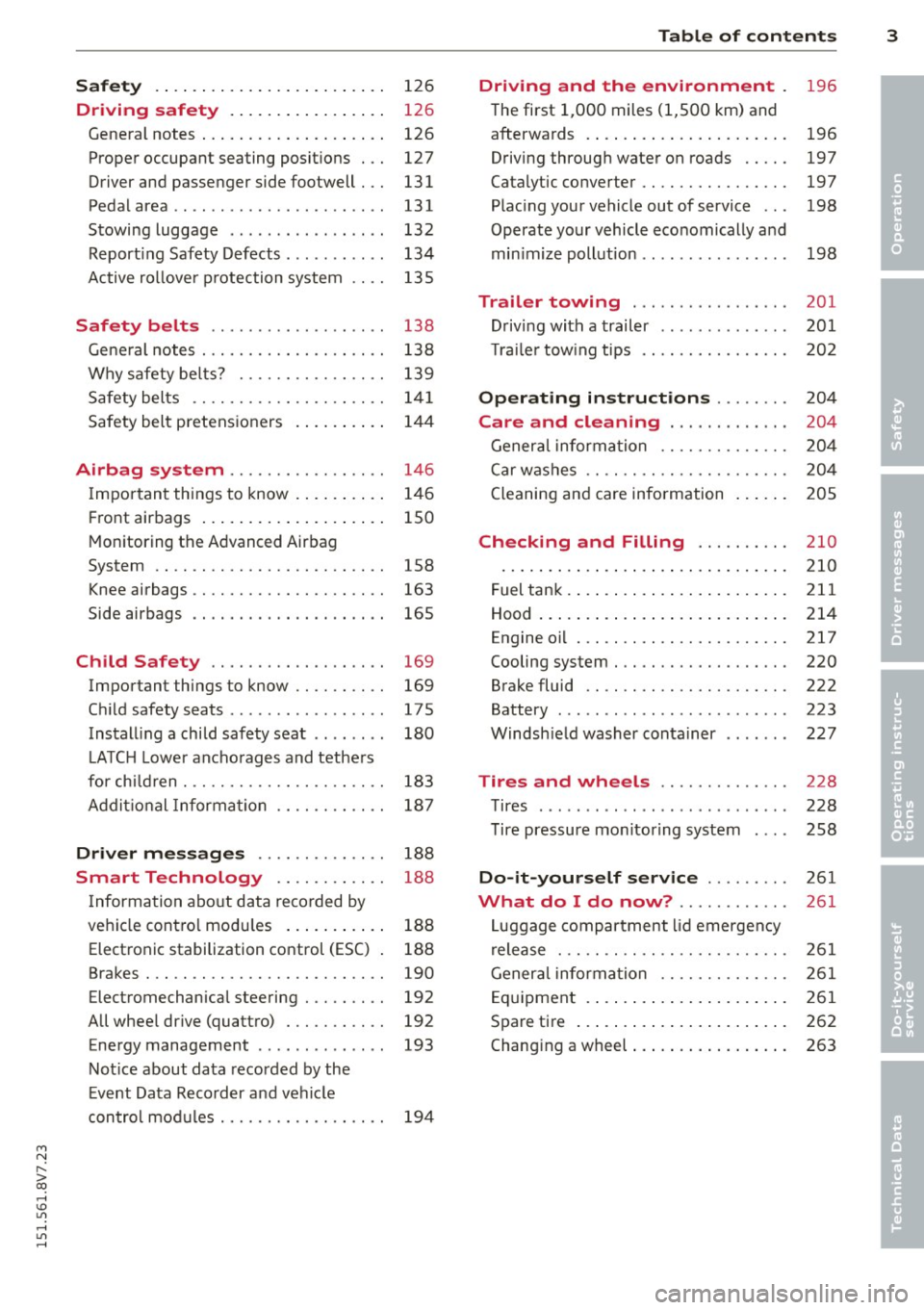
Safety . . . . . . . . . . . . . . . . . . . . . . . . . 126
Driving safety . . . . . . . . . . . . . . . . . 126
General notes . . . . . . . . . . . . . . . . . . . . 126
Proper occupant seating posit ions . . . 127
Driver and passenger side footwell . . . 131
Pedalarea .. .. .............. ... .. 131
Stowing luggage . . . . . . . . . . . . . . . . . 132
R eport ing Safety Defects . . . . . . . . . . . 134
Active ro llover p rotection system 135
Safety belt s . . . . . . . . . . . . . . . . . . . 138
Gene ral notes . . . . . . . . . . . . . . . . . . . . 138
Why safety be lts? . . . . . . . . . . . . . . . . 139
Safety belts . . . . . . . . . . . . . . . . . . . . . 1 41
Safety bel t pretens ioners . . . . . . . . . . 14 4
Airbag system ......... .. .. .. . .
Impor tant things to know . ... .. .. . .
Fr ont airbags .... ..... ... .. .. .. . .
Monitoring the Advanced Airbag
System .. .. ................. .. . .
Knee airbags .. ........... .. .. .. . .
Side airbags .. .. .. .... .... . .... . .
Ch ild Safety ............... .. . .
Important things to know .. .. .. .. . .
C hi ld safety seats ............ .... .
Install ing a chi ld safety seat .. .. ... .
L A TC H L ower ancho rag es and tethe rs
fo r ch ild ren . ............. .... .. . .
A ddit io nal Informa tion 146
1
46
150
158
163
165
169 169
175
180
183
187
Driver messages . . . . . . . . . . . . . . 188
Smart Technology . . . . . . . . . . . . 188
I nforma tion abo ut data reco rded by
ve hicl e cont ro l mod ules . . . . . . . . . . . 188
Elect ron ic stabilization control (ESC) 188
Brakes . . . . . . . . . . . . . . . . . . . . . . . . . . 190
Electromechanical steering . . . . . . . . . 192
All whee l drive (quatt ro) . . . . . . . . . . . 192
Energy management . . . . . . . . . . . . . . 193
Not ice about data recorded by the
E vent Data R eco rder and ve hicle
con tro l mod ules . . . . . . . . . . . . . . . . . . 194
Table of contents 3
Driving and the environment
196
T he first 1,000 miles (1 ,500 km) and
afterwa rds . . . . . . . . . . . . . . . . . . . . . . 196
Driving through wate r on roads . . . . . 197
Catalytic converter . . . . . . . . . . . . . . . . 197
Plac ing your vehicle out of service . . . 198
Operate your vehicle eco nomically and
min imize poll ution . . . . . . . . . . . . . . . . 198
Trailer towing . . . . . . . . . . . . . . . . . 201
D rivi ng with a trailer . . . . . . . . . . . . . . 201
T ra ile r tow ing t ips . . . . . . . . . . . . . . . . 202
Operating instructions . . . . . . . . 204
Care and cleaning . . . . . . . . . . . . . 204
Genera l infor mation . . . . . . . . . . . . . . 20 4
C ar w ashes .. .. .. .. . ............ .
Cleaning and care information
Checking and Filling ......... .
Fuel tank . ... .... .. . .. .. ..... ... .
Hood ... .. .. .. .... . ... ...... ... .
Engine oi l ... .. .. .... ........... .
Cooling system . .. .. ............. .
Brake fluid .. .. .. .... ........... .
Battery ......... .. ..... ........ .
Windsh ie ld washer container
Tires and wheels ............. .
Tires ... .. .. .. .... .. ........ ... . 2
0 4
20 5
210
210
2 11
214
217
220
222
223
22 7
228
228
T ire pressure mo nitoring system 258
Do-it-yourself service . . . . . . . . . 261
What do I do now? . . . . . . . . . . . . 261
L uggage compartment lid emergency
r elease . . . . . . . . . . . . . . . . . . . . . . . . . 261
Gener al infor mation . . . . . . . . . . . . . . 261
E q uipment . . . . . . . . . . . . . . . . . . . . . . 261
Spare tire . . . . . . . . . . . . . . . . . . . . . . . 262
Changi ng a wheel . . . . . . . . . . . . . . . . . 263
•
•
M a N ,....
> co ,...., \!) 1.1'1 ,...., 1.1'1 ,....,
Page 17 of 302
or
or
or
or
or Engine o
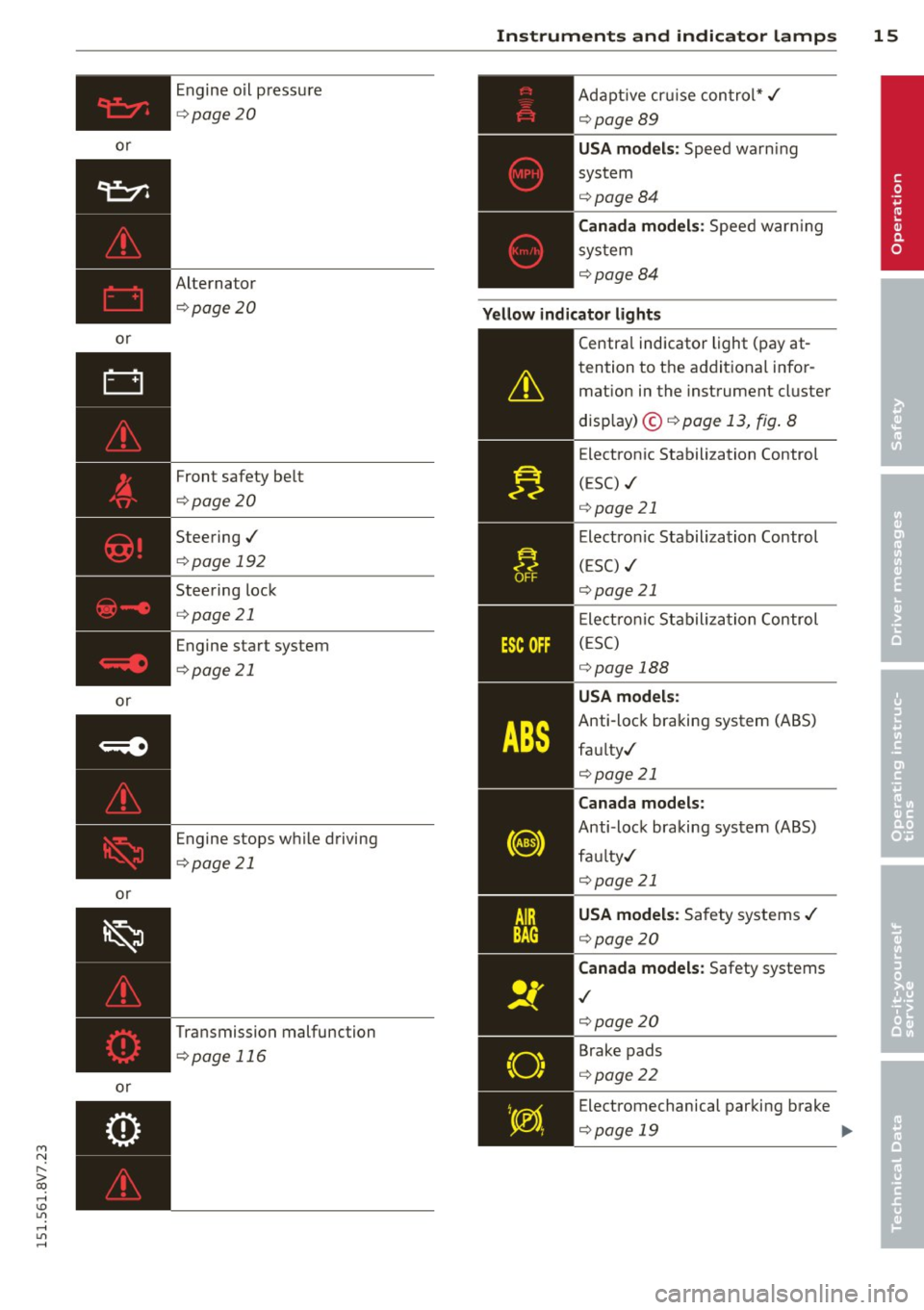
il p ress ure
¢ page 20
Alternator ¢page 20
Front safety be lt
¢page20
Steering./
¢page 192
Stee ring lock
¢ page 21
Engine start system
¢page 21
Engine stops w hile driving
¢page 21
Transmission malfunction ¢page 116
Instruments and indicator lamps 15
Ad aptive cr uise c on tro l*./
¢page89
USA models : Speed wa rn ing
sys tem
¢ page84
Canada models: Spee d war ning
sys tem
¢page84
Yellow indicator lights
"O~ I I ~ 'I
-------------
Centra l indicator light ( pay at-
tention to t he addit ional info r
mat ion in the instrument cluster
d isp lay) @ ¢ page 13, fig . 8
E lectron ic Stabilization Control
( E SC) ./
¢ page 21
Electro nic Stabilization Control
(ESC) ./
¢page 21
El ect ro nic Sta bili zat ion Control
(E SC )
¢page 188
USA models:
Anti-loc k bra king system (ABS)
fau lty ./
¢ page 21
Canada models:
Anti-lock braking sys tem (ABS)
fau lty./
¢page 21
USA model s: Sa fety systems ./
¢ page 20
Canada models: Safety systems
./
¢page2 0
Brake pads
¢ page22
E lectromechanical par king brake
¢page 19
lill-
M a N
" > co ,...., \!) ..,.,
,...., ..,., ,....,
Page 18 of 302
16 Instruments and indicator lamps
or
·~
Lt
CD
TPMS
;
or
or
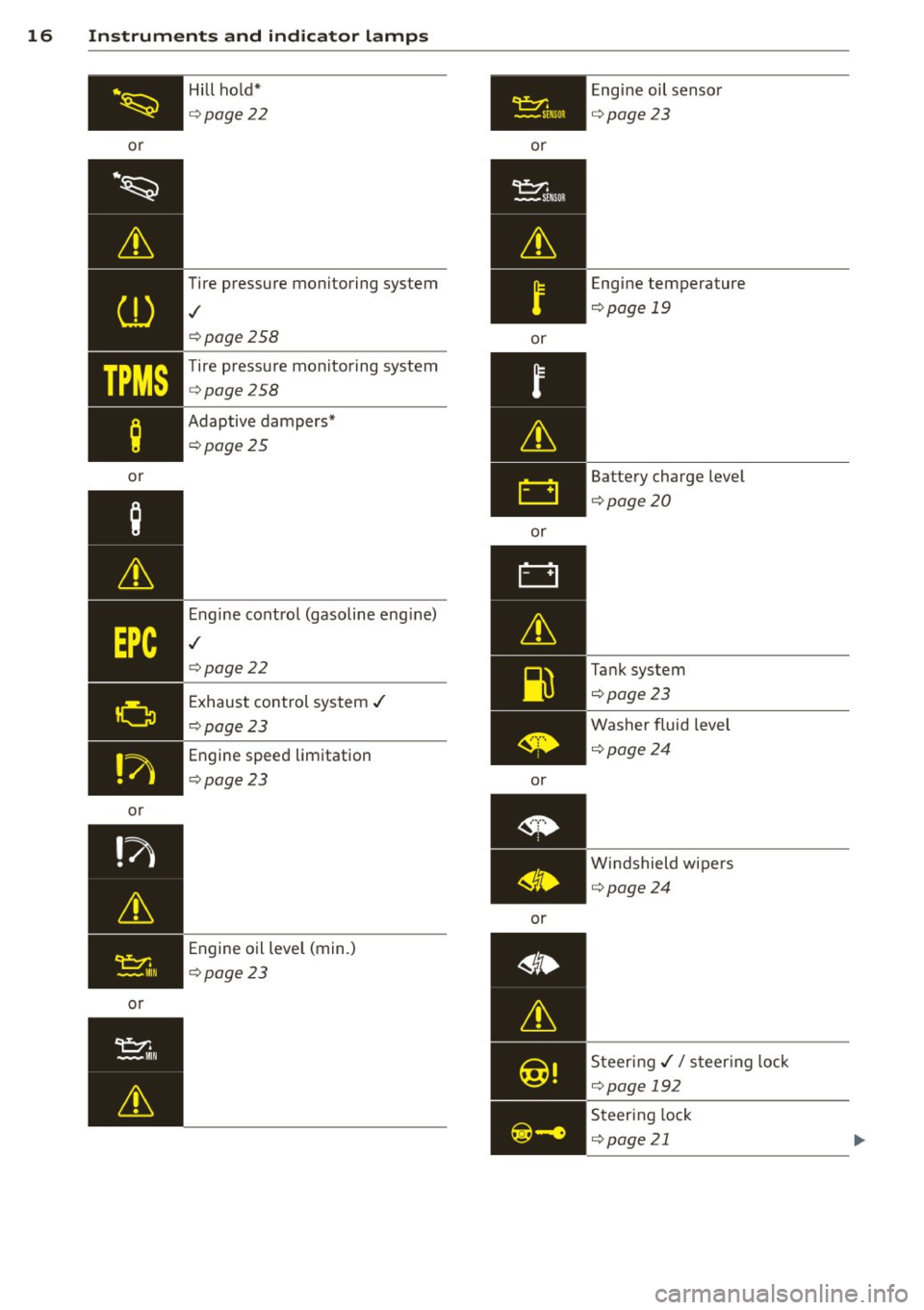
or Hill ho
ld*
Q page 22
Tire pressure monitoring system
,/
Qpage 258
Tire pressure monitoring system
Q page 258
Adaptive dampers*
Qpage25
Engine control (gasoline eng ine)
,/
Q page 22
Exhaust control system ,/
Qpage 23
Engine speed limitation
Qpage 23
Engine oil level (min.)
Qpage 23
~ -SE NSOR
or
or
or
or
or Engine
oil sensor
Qpage23
Engine temperature
Qpage 19
Battery charge level
Qpage20
Tank system
Qpage23
Washer fluid level
Qpage24
Windshield wipers
Qpage24
Steer ing,// s teer ing lock
Qpage 192
Steering lock
Q page21
Page 23 of 302
M N
" > co ,...., \!) 1.1"1 ,...., 1.1"1 ,....,
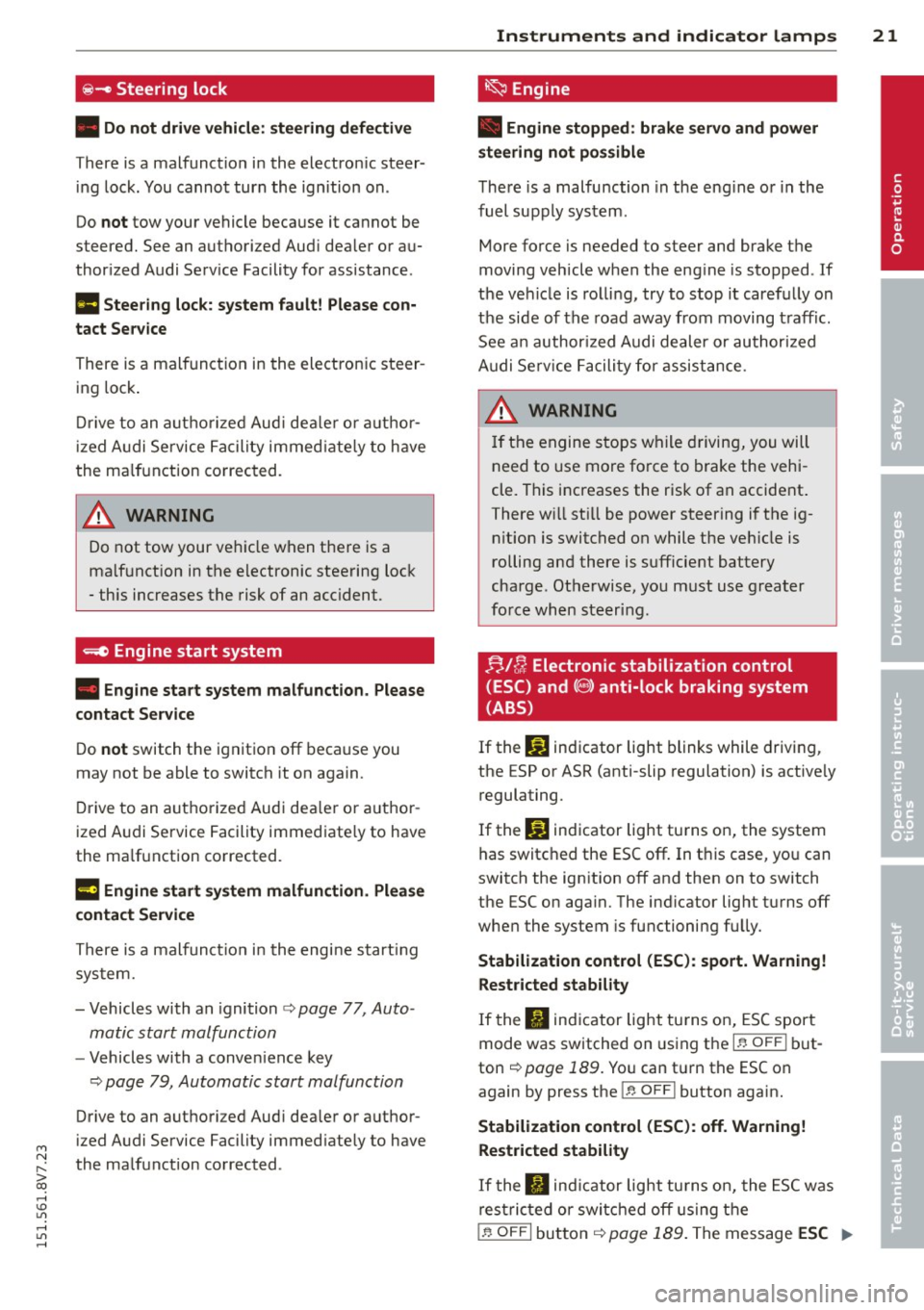
~- Steering lock
• Do not drive vehicle : ste ering defective
There is a malfunct io n in the electron ic steer
in g lock . You canno t turn the ign ition on .
Do
not tow your vehicle beca use it ca nnot be
steered. See an authorized Aud i dea ler or a u
thor ized Audi Se rv ice Facility for assistance .
Ill Steering lock: system fault! Please con
tact Service
There is a malfunct ion in the electron ic s teer
ing lock .
Dr ive to an a uth o rize d Aud i de aler or auth or
iz ed A udi Service Faci lity immed iate ly to h ave
the ma lf u nction co rrec ted.
~ WARNING
Do not tow your ve hicle when t he re is a
ma lf u nction in t he e lectronic steering lock
- this increases t he risk of an acc ident.
-.e Engine start system
-
• Engine start system malfunction. Please
contact Service
Do not switch the ignit io n off because you
may not be able t o switch it on aga in.
D rive to an a uth o rized Aud i dea le r o r a uth or
ized A udi Service Facility immed iate ly to have
the ma lfunction co rrected.
l3 Engine start system malfunction . Please
contact Service
Th ere is a malfunct io n in th e engi ne s tart ing
s y st em.
- Vehicles with an ignition <=>
page 77, Auto
matic start malfunction
- Vehicles with a conve nience key
¢ pag e 79, Automatic start malfunction
Drive to an authori zed Aud i dea ler or a uth or
i zed A udi Service Facility immed iate ly to have
the ma lfunction corrected .
Instruments and indicator lamps 21
~ Engine
• Engine stopped: brake servo and power
steering not pos sible
T he re is a malfunction in the eng in e or i n the
fuel sup ply sys tem .
More force is needed to steer and brake t he
moving veh icle when the eng ine is stopped . If
t h e ve hicle is rolli ng, try to stop i t caref ully on
the side of the ro ad away fro m moving t raffi c.
S ee a n author ized Audi dealer or au thor ized
A udi Serv ice F acili ty for a ssistance .
A WARNING
If th e engine stops w hile driving, you will
need to use mo re fo rce to brake the vehi
cle. T his increases the r isk of an accident .
There w ill still be power steer ing i f th e ig
n it ion is switched on while t he ve hicle is
rolling and there is sufficie nt battery
cha rge . Ot herwise, you must use greater
fo rce when steer ing.
r;,/ fr, Electronic stabilization control
(ESC) and(@)) anti-lock braking system
(ABS)
If the DJ ind icator light blinks while driving,
the ESP or ASR (anti-slip regulation) is active ly
regulating.
If the
DJ ind icator light tu rns on, the system
has switc hed the ESC off . In t his case, yo u can
switch the ign ition off and then on to switch
the ESC on aga in. The ind icator lig ht tu rns off
whe n the system is fu nctioni ng fu lly.
Stabilization control (ESC): sport . Warning!
Restricted stability
If the B ind icator light tu rns on, ES C sport
mode was switched on using the
I" OF F! bu t
ton <=>
page 189. You can t urn the ESC on
again by press the
I ~ O FF ! button again.
Stabilization control (ESC): off . Warning!
Restricted stability
If t he II in dica tor light tu rn s on, the ESC was
rest ricted or swi tc h ed o ff usin g th e
i .i, OFF I but to n <=> page 189. T he message ESC .,..
•
Page 28 of 302
26 Driver information system
Driver information
system
Overview
Ap plies to vehicles: with d river in format ion syste m
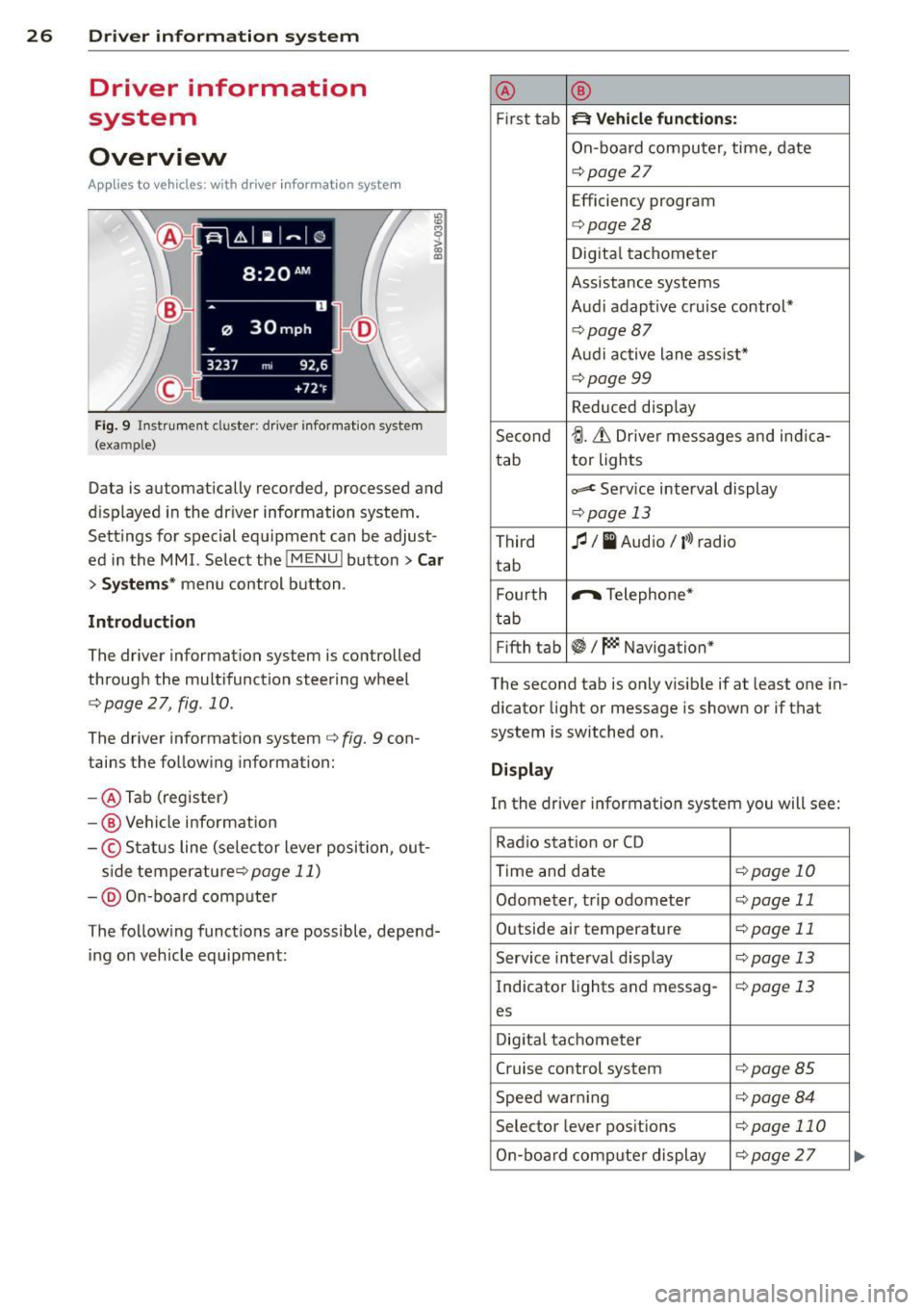
Fig. 9 Instrument cluster: driver informat ion system
(example)
Data is automatically recorded, processed and
d isplayed in the driver information system.
Sett ings for special equipment can be adjust
ed in the MMI. Select the
I MENU ! button> Car
> Systems* menu control button .
Introduction
The driver information system is controlled
through the multifunction steering wheel
c::;, page 2 7, fig. 10.
The driver information system c;, fig. 9 con
tains the following information:
- @ Tab (register)
-@ Vehicle information
-© Status line (se lector lever posi tion, out-
s ide temperaturec:=;,
page 11)
-@ On-board compute r
The following functions are possible, depend ing on vehicle equipment: @
®
First tab ~ Vehicle
functions:
On-board computer, time, date
c:=;,page 27
Efficiency program
c:=;,page28
Digital tachometer
Assistance systems
Audi adaptive cruise control*
¢page87
Audi active lane ass ist*
¢page99
Reduced display
Second
tJ. 6 Driver messages and ind ica-
tab tor lights
c,,..c Service interval display
c:=;,pag
e 13
Third fl I I Audio/ i»> radio
tab
F ourth .,..,.
Telephone*
tab
Fifth tab
~I~ Navigation*
The second tab is only visible if at least one in
dicator light or message is shown or if that
system is switched on .
Display
In the driver information system you will see:
Radio station or CD
Time and date
¢page 10
Odometer, trip odometer ¢page 11
Outside air temperature ¢page 11
Service interval display c::;, page 13
Indicator lights and messag-¢page 13
es
Digital tachometer
Cruise control system
c:=;,page 85
Speed warn ing c:=;,page 84
Selector lever positions c::;, page 110
On-board computer display c::;, page 27 ...
Page 29 of 302
....,
N
r--. > co
rl I.O
"' rl
"' rl
On-board computer display
The on-boa rd comp uter display monitors the
d iffe rent memory levels:
- Sho rt-term memory (on-board computer
1)
- Long-term memory (on-board computer 2)
-Eff iciency p rogram
The fo llowing information can be displayed in
on-boa rd compute r
1 and 2 one after the oth
er.
- Date
- Estimated range based on current fuel leve l
- T rave l time
- Average consumption
- Average speed
- Distance
- Current fuel consumption
On-board computer D (short -te rm
mem ory )
The sho rt-term memory co llects d riving infor
mation from the time the ignition is switched
on until it is switched off . If you continue driv
ing
w ith in two hours after switc hing the igni
tion off, the new values a re included when cal
culating the cu rrent trip information .
If stop
ped for more the two hours, the short term
memory is automatically erased once you be
g in d riving.
On-board computer fJ (long-term
memory )
Unlike the short-term memory , the long -term
memory is not erased automa tica lly. You can
selec t the time pe riod for evaluat ing t rip in
formation yo urself.
Efficiency program ii
The eff ic iency program can help you to use
l ess fuel ¢
page 28.
(D Tips
-The on-board computer is controlled by
the left but ton fields on the multifunc
tion steering wheel.
- For information on using the other but
ton fields, such as the aud io, telephone*
Dr iver in formation system 2 7
and navigation* f unct ions, see the M MI
owner's manual.
Operation
Applies to veh icles: w ith driver information system
T he dr iver information system is controlled
with the multifunction steering wheel.
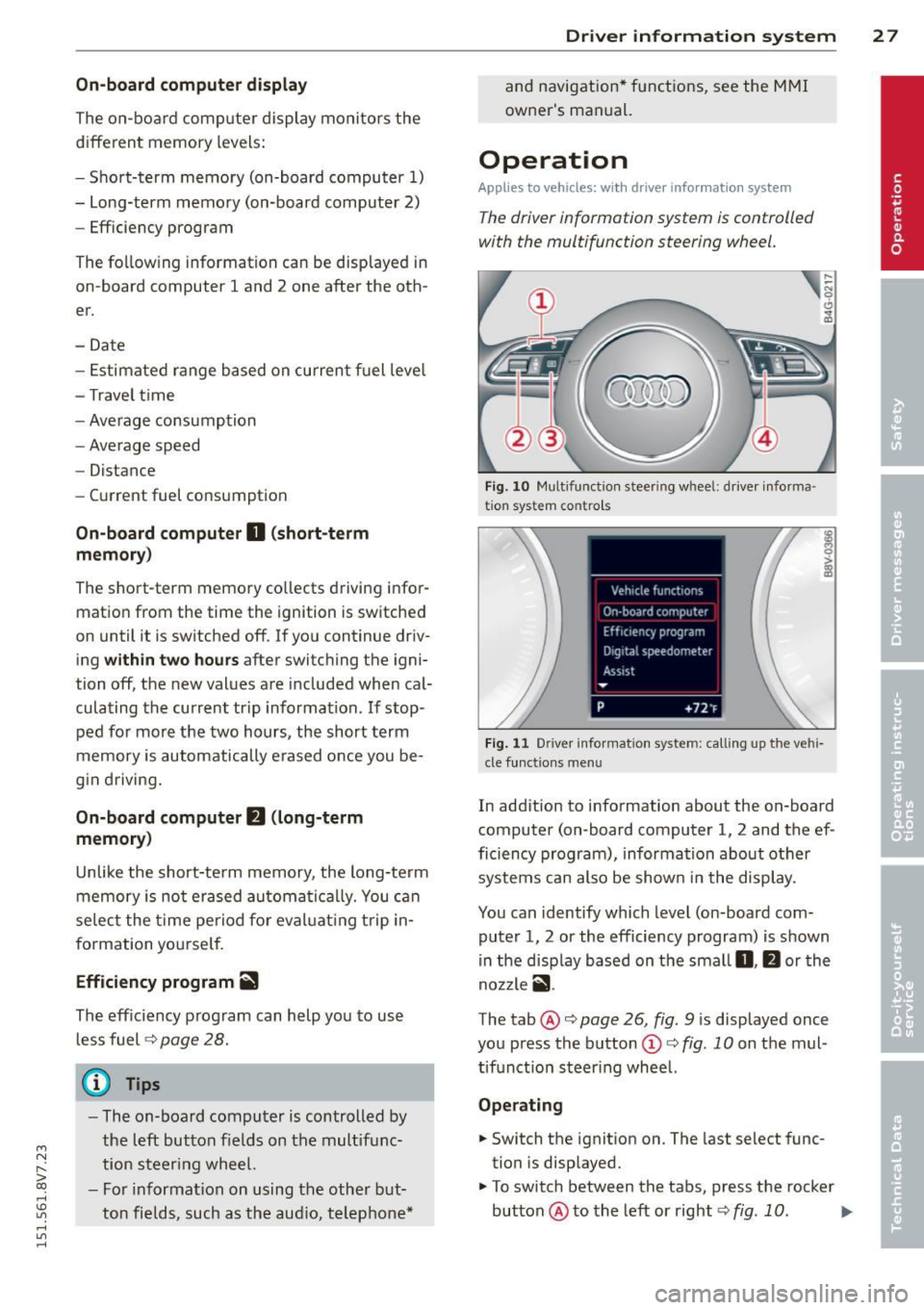
F ig . 1 0 Mu lt ifun ction s tee rin g w heel : d river i nforma
t ion s ystem c ontro ls
F ig . 1 1 Driv e r in forma tion syst em: calling up the vehi
cle funct io ns me nu
In add ition to information about the on-board
computer (on -board computer 1, 2 and the ef
ficiency program), informa tion about othe r
systems can also be show n in the display .
You can identify which level (on-board com
puter 1, 2 or the efficiency program) is shown
i n the d isp lay based on the sma ll
0, fJ or th e
no zzle
ii .
The tab@¢ page 26 , fig. 9 is displayed once
you press the b utton
(D ¢ fig. 10 on the mul
tif unctio n steer ing wheel.
Operating
.. Switch the ignit ion on. The last select func
tion is disp layed.
.,. To switch between the tabs, press the rocker
button @to the left or right¢
fig. 10. IJJJ,
Page 30 of 302
28 Driver information system
• To access additional in formation be low or
above, rotate the thumbwheel @dow n or
up .
• To confirm a se lection, press the thumb
whee l@ .
• To select a fu nction programmed to a steer
i ng w heel button, p ress the bu tto n@ . Fo r
additional information, see
9 page 28, As
signing a fun ction to the programmable
s teering wheel button
Calling up the Vehicle functions
> Se lect the first tab w ith the button @.
• Press the button @. The
Vehicle functions
me nu is displayed 9 fig . 11 .
• To se lec t a menu item, turn and p ress the
t hu mbwheel @.
Resetting values to zero
• In the Vehicle functions menu, se lect On
board computer or Efficiency program .
• Se lect a va lue in th e desired t rip computer
o r i n the efficiency program.
• To reset the va lues i n a memo ry, press and
ho ld the thumbwhee l@ for one second.
Recalling indicator lights and messages
.. Pr ess the button CD repeate dly until the a
tab appears .
The
U tab is only vis ible whe n there is a mal
f u nction.
Assigning a functi on to the
programmable steering wheel button
> Se lect: the I MENU ! button >Car > Systems*
co ntrol button > Vehicle settings > Ste ering
wheel button programming .
The U tab is only visible whe n there is at
least one i ndicator light or message d is
p layed .
@ Tips
-If the vehicle battery is d iscon nected, all
memo ry values are e rased .
- Informati on on the efficiency program
¢ page 28.
- There is more in formation on the m ulti
function stee ring w heel in the
M MI*
owne r's manual.
Efficiency program
Description
Applies to vehicles: with driver informat ion system
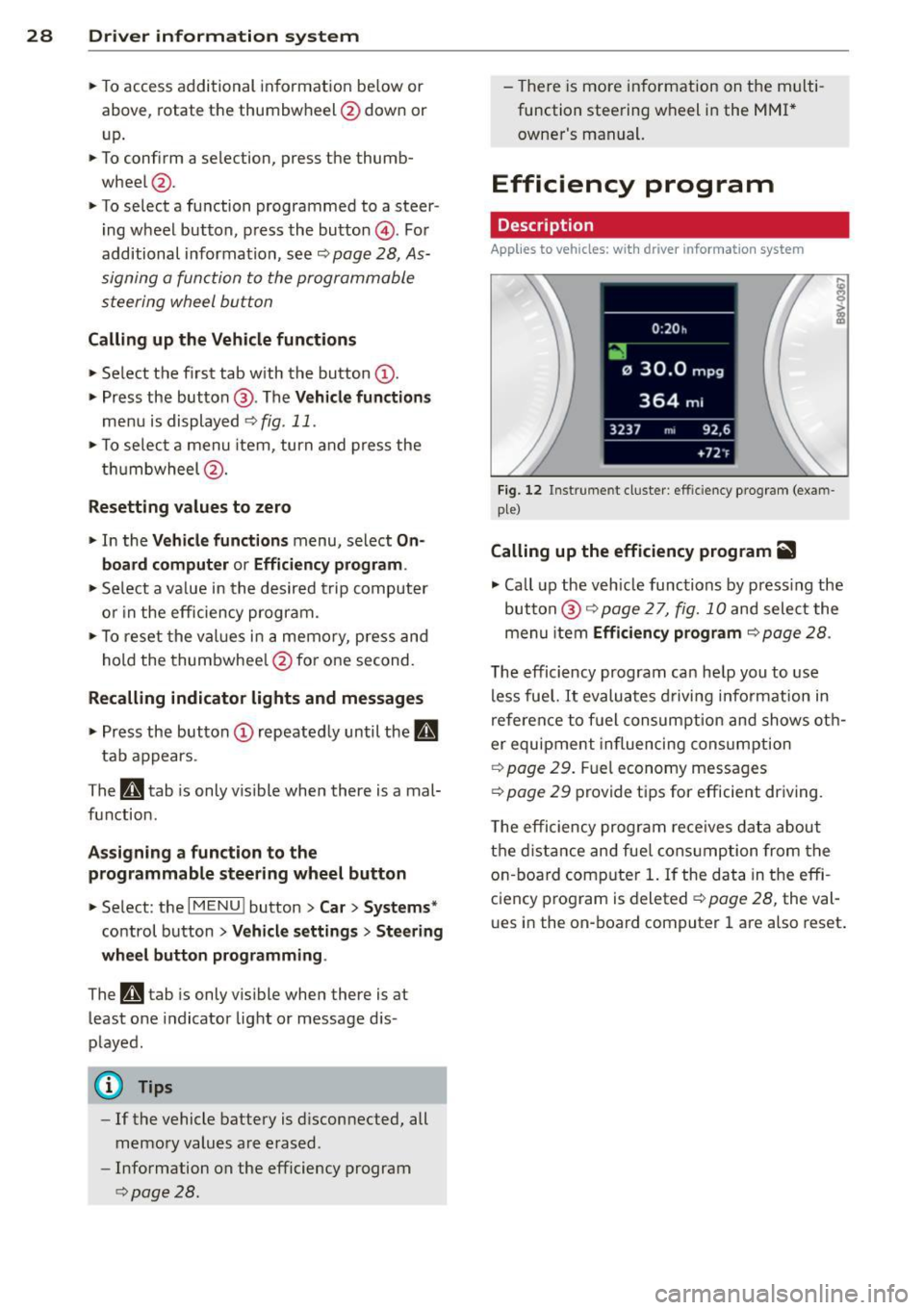
Fig . 12 Instrume nt cluste r: effi cie ncy progra m (exa m
p le)
Calling up the efficiency program ii
• Call up the veh icle func tions by press ing the
bu tton @
9 page 2 7, fig. 1 0 and select the
menu item
Efficiency program 9 page 28.
The effici ency program ca n he lp you to use
less fue l.
It evaluates d riving info rmation in
refe ren ce to f uel consum ption and shows ot h
er equipment in fluencing cons umption
9 page 2 9. Fuel economy messages
9 page 29 prov ide t ips for efficie nt dr iv ing .
T he efficiency progr am re ce ives da ta abou t
t h e di sta nce and fue l cons ump tion from the
on -board com puter
1. If the data in the effi
c iency p rog ram is deleted
¢ page 28, the va l
u es i n the on -board computer 1 are a lso reset .
Page 33 of 302
M N
" > co ,...., \!) ..,.,
,...., ..,., ,....,
Opening and closing
Central locking
Key set
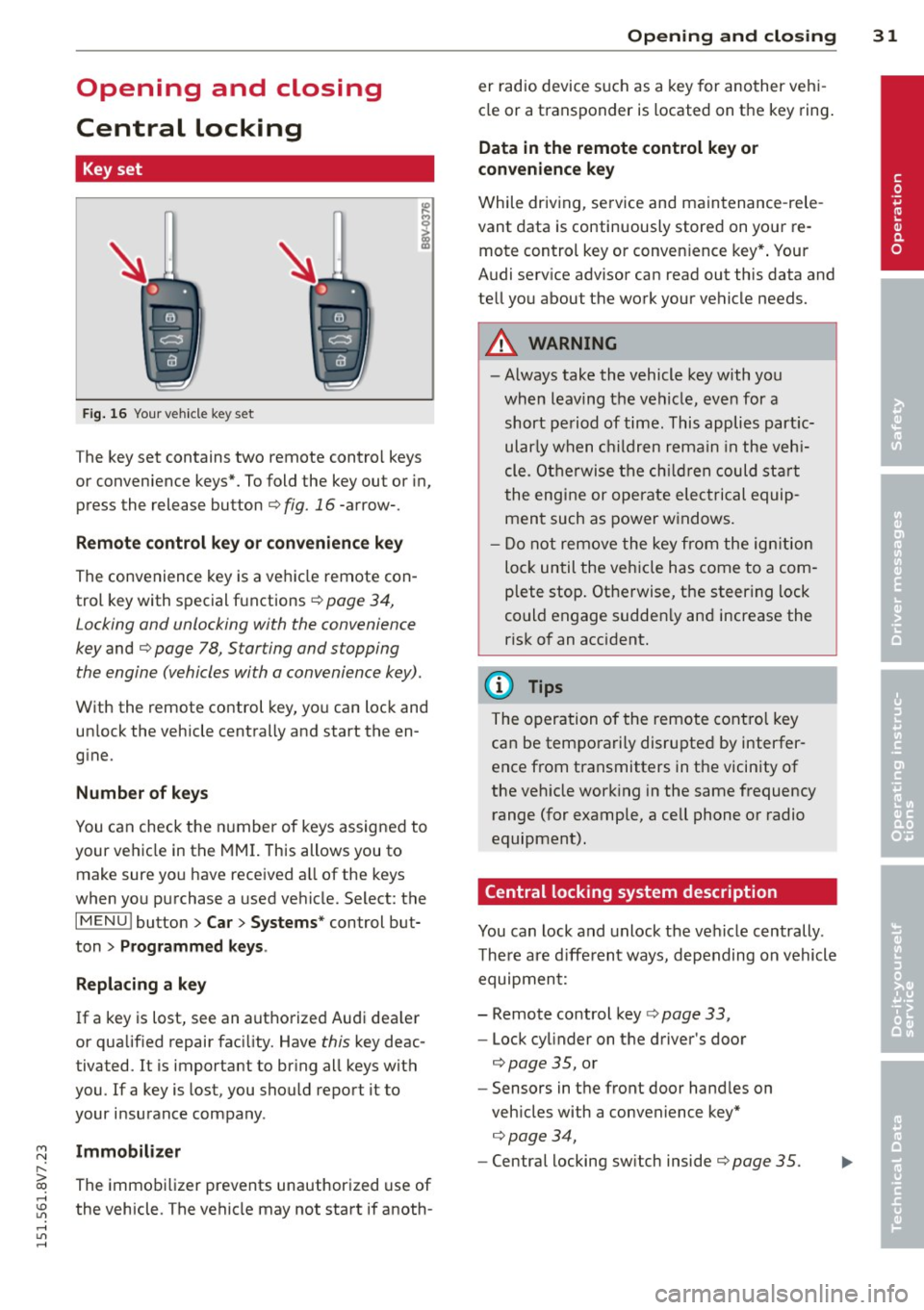
Fig . 16 Your vehicle key set
The key set contains two remote contro l keys
or convenience keys*. To fold the key out or in,
press the release button
q fig. 16 -arrow-.
Remote control key or convenience key
The convenience key is a vehicle remote con
trol key with special functions
q page 34,
Locking and unlocking with the convenience
key and q page 78, Star ting and stopping
the engine (vehicles with a convenience key).
With the remote control key, you can lock and
un lock the vehicle centrally and start the en
gine.
Number of keys
You can check the number of keys assigned to
your vehicle in the MMI. This allows you to
make sure you have received a ll of the keys
when you purchase a used vehicle. Select: the
I MENU I button > Car> Systems* control but
ton
> Programmed keys.
Replacing a key
If a key is lost, see an authorized Audi dea ler
or qualified repair facility. Have this key deac
tivated. It is important to bring all keys with
you.
If a key is lost, you should report it to
your insurance company .
Immobilizer
The immobilizer prevents unauthorized use of
the vehicle . The vehicle may not start if anoth -
Opening and closing 31
er radio device such as a key for another veh i
cle or a transponder is located on the key ring.
Data in the remote control key or
convenience key
While driving , service and maintenance -rele
vant data is continuously stored on your re
mote control key or convenience key*. Your
Audi serv ice advisor can read out this data and
tell you about the work your vehicle needs.
_& WARNING
- Always take the vehicle key with you
when leaving the vehicle, even for a
short period of time. This applies partic
ularly when children remain in the vehi
cle . Otherwise the children could start
the engine or operate electrical equip
ment such as power windows.
- Do not remove the key from the ignition
lock until the vehicle has come to a com
plete stop. Otherwise, the steering lock
could engage sudden ly and increase the
risk of an accident.
{i) Tips
The operation of the remote control key
can be temporarily disrupted by interfer
ence from transmitters in the vicinity of
the veh icle working in the same frequency
range (for example, a cell phone or radio
equipment).
Central locking system description
You can lock and unlock the vehicle centrally .
There are different ways, depending on vehicle
equipment:
- Remote control key
q page 33,
- Lock cylinder on the driver's door
q page 35, or
- Sensors in the front door handles on
veh icles with a convenience key*
q page 34,
- Central locking sw itch inside q page 35.
•
Page 52 of 302
50 Lights an d Vi sion
Audi adapt ive light *
The adaptive light on ly functions when the
light switch is in the AU TO position. You can
deactivate adaptive light in the MMI
r::!.> poge
51 .
When switched on, adapt ive light adjusts to
curves depending on the vehicle speed and
steering wheel ang le . This provides better
lighting throug h the curve . The system oper
ates in a speed r ange from approximately
6 mph (10 km/h) to 68 mph (110 km/h).
Static co rnering light* (vehicles with adaptive
light) -the corn ering light switches on auto
matica lly when the steering wheel is turned at
a certa in angle at speeds up to approximately
44 mph (70 km/h) and when the turn signal is
activated at speeds up to approximately
25 mph (40 km/h). The area to the s ide of the
vehicle is il luminated better when turning .
Speed dependent light distr ibution* -The
speed dependent light distribution adapts the
light in towns and on highways or express
ways. Intersect ions can also be ill uminated on
ve hicl es w ith a navigation system *.
Highwa y light funct ion *
(Vehicles with adaptive light or L ED head
lights) -This function adapts the light ing for
h ighway driving based on vehicle speed .
_&. WARNING
-Automati c headlights* are only intended
to assist the dr iver . T hey do not re lieve
the drive r of responsibility to check the
head lights and to turn them on man ually
according to the current light and visibili
ty conditions. For examp le, fog cannot
be detected by the light sensors. So al
ways switch on the low beam under
these weather conditions and when driv ing in the dark
fD.
- Acc idents could occur if you cannot see
the road ahead of you well and if others
on the road cannot see you . A lways
swit ch you r headlights o n so that yo u can see the road ahead of you and others can
see your vehicle from beh
ind.
- Please observe legal regulations when
using the lighting systems described.
(D Note
The rear fog lights shou ld only be turned
on in accordance with t raffic regu lations,
to prevent glare for traffic behind your ve hicle.
(D Tips
- The light sensor for the automatic head
lights * is in the rea rview mir ror mount.
Therefore, do not place any stickers in
this area o n the windshield .
- Some functions of the exterior lighting
can be adjusted
c> page 51.
-If you tu rn off the ignition whi le the ex
terior lights are on and open the door,
you will hear a warning tone.
- The tail lights do not sw itch on when the
daytime r unning lights switch on.
- In cool or damp weather, the inside of
the headlights, turn signals and tail
lights can fog over due to the tempera
ture difference between the inside and
outside. They w ill clear shortly after
switching them on . This does not affect
the serv ice life of the lighting.
- A message w ill appea r in the i nstrument
cluster if there is a malfunction in the
light senso r
r::!.> page 24.
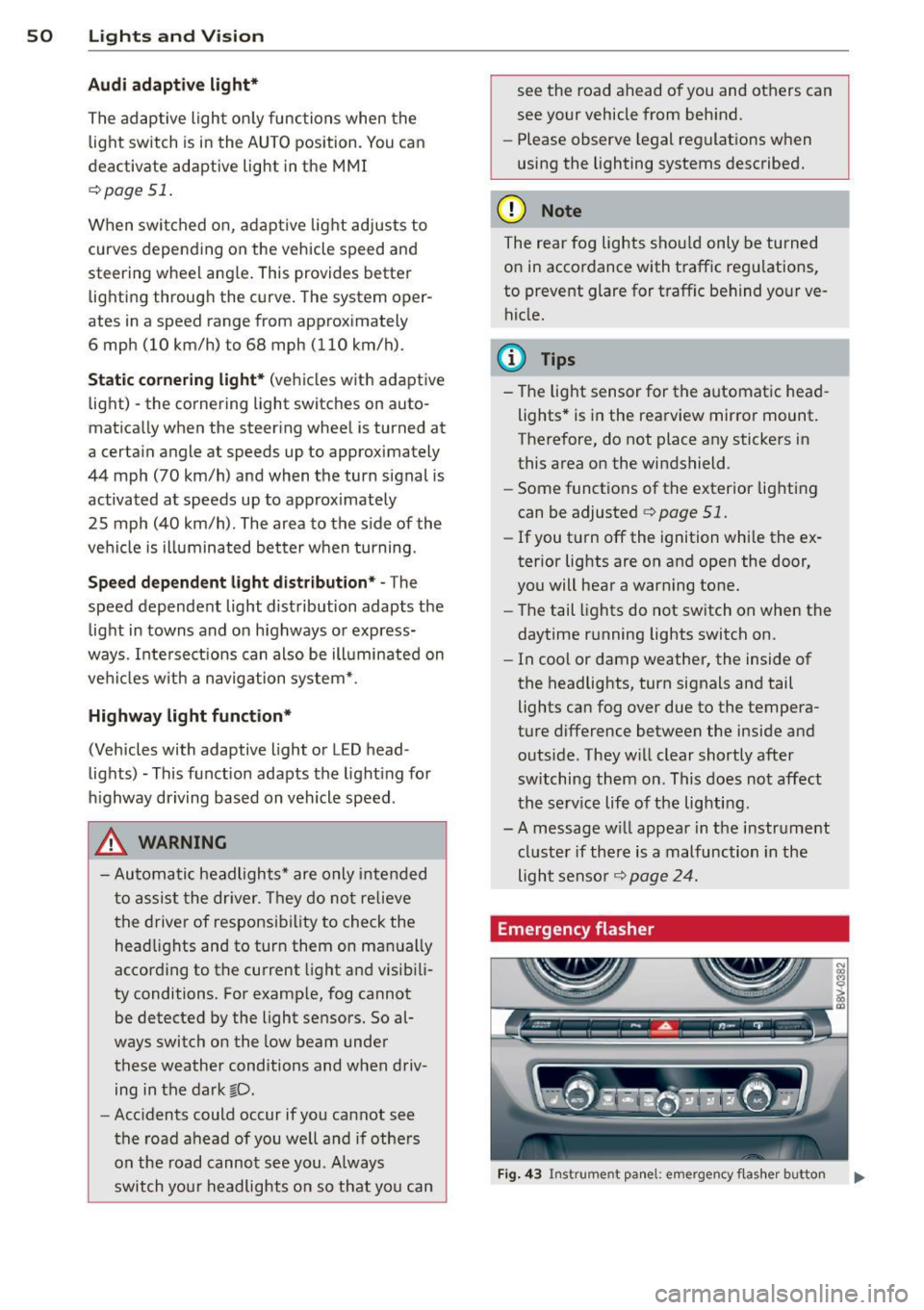
Emergency flasher
Fig . 4 3 Ins trume nt panel: e mergency f las her button
N
I
Page 61 of 302
M N ,....
> co ,...., \!) ..,.,
,...., ..,., ,....,
Seats and storage
General information
Important information
A WARNING
Refer to the chapter Driving Safely
¢ page 126, Driving safety for important
information, tips, suggestions and warn
ings that you should read and follow for
your own safety and the safety of your pas sengers.
The safety belts and the airbag system con
only provide maximum protection if the front
seats ore correctly adjusted.
There are various ways of adjusting the front
seats to provide safe and comfortable support
for the driver and the front passenger. Adjust
your seat properly so that :
- you can easily and quick ly reach all the
switches and controls in the instrument
panel
- your body is properly supported thus reduc
ing physical stress and fatigue
- the safety be lts and airbag system can offer
maximum protection
¢ page 146.
In the following sections, you will see exactly
how you can best adjust your seats .
There are special regulations and instructions
for installing a child seat on the front pas
senger's seat. Always follow the information
regarding chi ld safety provided in
¢ page 169, Child Safety.
A WARNING
Incorrect seating position of the driver and
all other passengers can result in serious
personal injury.
- Always keep your feet on the floor when
the vehicle is in motion -never put your
feet on top of the instrument panel, out
of the window or on top of the seat cush ion. This applies especially to the passen-
Seats and storage 59
gers. If your seating position is incorrect,
you increase the risk of injury in the case
of sudden braking or an accident. If the
airbag inflates and the seating position is incorrect, this could result in pe rsonal
injury or even death.
- It is important for both the driver and
front passenger to keep a distance of at
least 10 inches (25 cm) between them
selves and the steering wheel and/or in
strument panel. If you're sitting any
closer than this, the airbag system can
not protect you properly. In addition, the
front seats and head restraints must be
adjusted to your body height so that they
can give you maximum protect ion.
- Always try to keep as much distance as
possible between yourself and the steer
ing wheel or instrument panel.
- Do not adjust the driver's or front pas
senger's seat whi le the vehicle is moving.
Your seat may move unexpectedly, caus
ing sudden loss of veh icle control and
personal injury. If you adjust your seat
while the veh icle is moving, you are out
of posit ion.
Driver's seat
The correct seat position is important for safe
and relaxed driving .
We recommend that you adjust the dr iver's
seat in the follow ing manner:
"" Adjust the seat in fore and aft direction so
that you can easily push the pedals to the
floor wh ile keeping your knees slightly bent
¢ &, on page 59.
"" Adjust the backrest so that when you sit
w ith your back against the backrest, you can
still hold the top of the steering wheel.
""For adjustab le head restra ints: adjust the
head restraint so the uppe r edge is as even
as possible with the top of your head. If that
is not possible , try to adjust the head re
straint so that it is as close to this position ..,_
•