belt AUDI A3 CABRIOLET 2016 User Guide
[x] Cancel search | Manufacturer: AUDI, Model Year: 2016, Model line: A3 CABRIOLET, Model: AUDI A3 CABRIOLET 2016Pages: 272, PDF Size: 67.88 MB
Page 80 of 272
<( co .... N ,.__
N .... 0 ,.__
> co
Stopping /p ark ing
If the selecto r lever is not in the P position when
you open the driver's door, the vehicle could rol l.
I n vehicles with a convenience key*, the message :
Shift to P, v eh icle can roll awa y. Doo rs can be
lo cked onl y i n P
appears. You will also hear a
warning tone.
~ Press and hold the brake pedal¢.&_ .
~ Set the parking brake.
~ Select the P selector lever pos ition.
Stopp ing on an incline
~ Always press the brake peda l to hold the vehi
cle in place and prevent it from "rolling back"
¢
A -Do not try to prevent the vehicle from
"ro lling back" when a gear is engaged by in
creasing the engine speed¢@) .
Starting on a n incline in vehicl es w ithout Hill
H old *
~ Set the parking brake.
~ With the driving gear se lected, press the acce l
erator pedal carefully. The parking brake re
leases automatically . Requirement: the driver's
door must be closed and the driver's safety belt
must be fastened .
Starting on an incline in vehicle s with Hill
Hold*
~ With the driving gear selected, remove your
foot from the brake pedal and press the accel
erator pedal¢
page 75, Hill hold.
Under certain c ircumstances, (such as driving in
the mountains or towing a trailer), it may be use
fu l to sw itch temporari ly to the manua l shift pro
g ram in orde r to adjust the gears to t he d riving
conditions by hand
¢ page 81 .
When parking on a level surface , simply place the
se lector lever in the P position. On inclines, acti
vate the parking b rake first and then move the
selecto r lever to the P position
¢ page 73. This
prevents the locking mechanism from being
l oaded too heavi ly and wi ll make it easier to
move the selector lever out of the P position.
Autom atic tran sm iss ion
A WARNING
- The vehicle can roll even when the eng ine is
sw itched off .
- Unintended vehicle movement can lead to
serious injuries .
- Never leave your veh icle w ith the engine
running while in gear. If you must leave
your veh icle when the engine is running, set
the park ing brake and move the selector lev
er to the P posit ion.
- Power is still transferred to the wheels when the engine is runn ing at idle. To pre
vent the vehicle from "creeping", yo u must
keep your foot on the b rake when the en
g ine is r unning and the selector lever is in
the D, Sor R position or " tip tronic" mode is
selected.
- Do not in adver ten tly press the accelerator
pedal when the vehicle is stationary. Other
wise the vehicle wi ll start to move immedi
ately, even if the parking brake is set. This
could result in a crash.
- Do not press the acce lerator pedal when
changing the se lector lever position while
the vehicle is stationary and the engine is running.
- Never engage the R or P selector level pos i
tions while dr iv ing.
It could cause a crash.
- Before driving down a steep slope, reduce your speed and sh ift into a lower gear w ith
"t i ptronic".
- Do not r ide the brakes or press the brake
pedal too often or too long when dr iving
downhill. Constant braking causes the brakes to overheat and substant ially re
duces bra king performance, increases b rak
ing d istance or causes comp lete failure of
the brake sys tem.
- I f you must stop on an incline, a lways hold
the vehicle in place w it h the foot brake or
p ar king brake to p reve nt i t from rolling
back.
- Never hold the vehicle on an incline with a
slipp ing clu tc h . The clutch opens automati
cally when it becomes too hot from the
overload . The
mJ indicator light turns on
79
Page 81 of 272

Automatic transmissio n
and a message appears~ page 82 when
the clutch is overloaded.
- If the engine must run while you are work
ing in the engine compartment with the
hood open, make sure a gear is not engag
ed. The selector lever must be firmly in the
P position and locked in place and the park
ing brake m ust be set~
page 188. Other
wise, the vehicle could begin moving when
the engine speed increases, even with the
par king brake set.
{UJ Note
- When stopp ing on a n incline, do not t ry to
ho ld the vehicle in p lace by press ing the ac
ce le ra to r pedal wh ile a driv ing gear is se
l ected. Th is can ca use the au toma tic trans
mission to overheat and can damage it. Set
the parking brake or press the brake pedal
to prevent the vehicle from rolling .
- A llow ing the vehicle to ro ll when the eng ine
is stopped and the se lector lever is in the N
position will damage the automatic trans
mission because it is not l ubricated under
those circumstances.
- The transmiss ion can overheat and be dam
aged under certa in driving and traffic cond i
tions such as frequent starts, creep ing for a
long time, or stop-and-go traffic . W hen the
@l or. indicator light turns on, stop the
vehicle at the next oppo rt u nity and let the
transmission coo l~
page 82.
- Allow ing the veh icle to roll when the eng ine
i s stopped will damage the S tron ic trans
mission beca use it is not l ubricated
¢ page 246, Towing with a tow truck .
(D Tips
For safety reasons, the parking brake releases
automatically only when the driver's door is
closed and driver 's safety belt is fastened.
80
· Hill descent control
App lies to: vehicles with automatic transmissions
The hill descent control system assists the driver
when driving downhill .
Hill descent control is act ivated when the selec
tor lever is in the D or S position and you press
the brake pedal. The transmission automatically
selects a gear that is s uitable for the incline. H ill
descent control tries to maintain the speed ach
i eved at the t ime of braking, w it hi n phys ical and
technica l lim itations . If may still be necessary to
adjust the speed w ith the brakes. Because h ill de
scent control cannot shift down farther tha n 3rd
gear, it may be necessary to shift into tiptronic
mode in very steep areas. In this case, shift into 1st or 2nd gear in tiptronic mode to use the en
gine's braking force to relieve the brakes.
Hill descent control switches
off once the decline
l evels out or you press the accelerator pedal.
On vehicles with a cru ise control system*
¢ page 88, hi ll descent control is a lso activated
when the speed is set.
A WARNING
Hill descent contro l cannot overcome physical
limitations, so it may not be able to ma intain
a constant speed under all conditions. A lways
be ready to app ly the brakes.
Page 95 of 272
Ass is t
Changing the speed
Applies to: vehicles with Aud i adapt ive cruise contro l
0
f
•
0
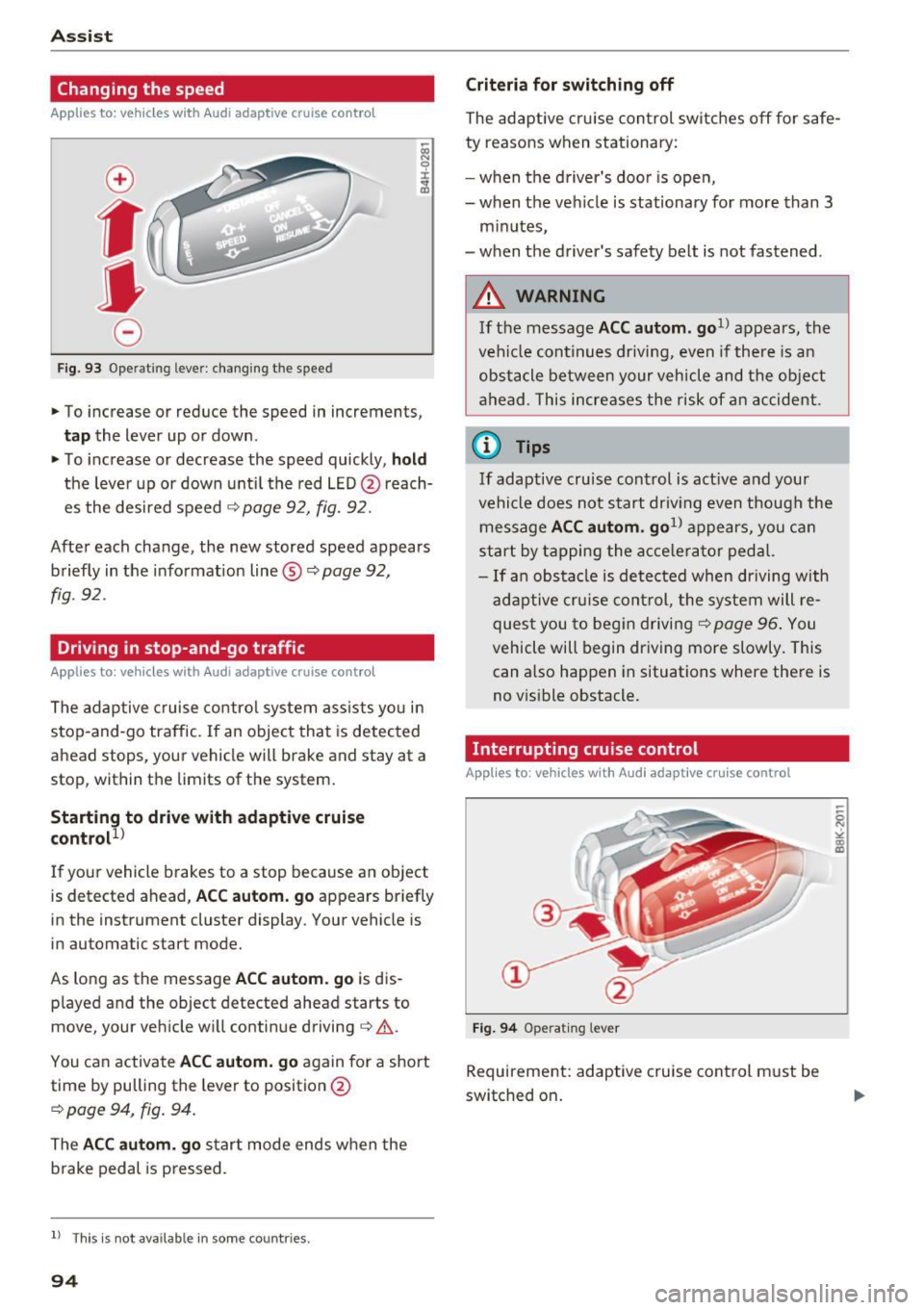
Fig. 93 Operat ing lever: changing the speed
.,. To increase or reduce the speed in increments,
tap the lever up or down.
.,. To increase or decrease the speed quickly,
hold
the leve r up or down until the red LED @ reach
es the desired speed
¢ page 92, fig. 92.
After each change, the new stored speed appears briefly in the informat ion line ®¢
page 92,
fig. 92.
Driving in stop-and-go traffic
Applies to : vehicles with Aud i adapt ive cru ise control
The adaptive c ruise control system assists yo u in
stop-and-go traffic. If an object that is detected
ahead stops, your vehicle will brake and stay at a
stop, within the limits of the system.
Starting to drive with adaptive cruise
control!)
If your vehicle brakes to a stop because an object
is detected ahead,
AC C autom. go appears br iefly
in the instrument cluster display. Your vehicle is
in automatic start mode.
As long as the message
ACC au tom . go is dis
p layed and the object detected ahead starts to
move, your vehicle will continue driving¢ ,&..
You can activate
AC C autom. go again for a short
time by pulling the lever to position @
¢ page 94, fig. 94.
The ACC autom . go start mode ends when the
b rake pedal is p ressed.
l ) Th is is not ava ilab le in some countr ies .
94
Criteria for switching off
The adaptive cru ise con trol switches off for s afe
ty reasons when stationary:
- when the d river 's doo r is ope n,
- when the vehicle is stationary for more than 3
minutes,
- when the d river's safety belt is not fastened .
A WARNING
If the message ACC autom. go1> appears, the
vehicle continues driving, even if there is an
obstacle between your vehicle and the ob je ct
ahead. This increases the risk of an accident .
@ Tips
If adaptive cruise cont rol is act ive and your
vehicle does no t start driv ing even though the
message
AC C autom . go1> appears, you ca n
start by tapping the a cce le ra tor ped al.
- If an obstacle is detected when dr iving with
adaptive cruise cont rol, the system will re
ques t you to beg in driving¢
page 96 . You
vehicle will begin dr iving more slowly. This
can also happen in situations where there is
no v is ible obstacle.
Interrupting cruise control
Applies to : vehicles with Audi adaptive cruise control
Fi g. 94 Operat ing lever
Requirement: adaptive cruise cont rol must be
switched on .
Page 98 of 272
<( co .... N r--N .... 0 r--> co
llJ ACC off: manual control!
This message appears if the vehicle rolls back
when starting on a slight incline, even though
ACC is active. Press the brake pedal to prevent
the vehicle from rolling or starting to move.
Ill ACC: engine speed
This message appears if the driver has not shift
ed up or down in time when the adaptive cruise
control is braking or accelerating, causing the ve
hicle to exceed or to not reach the permitted en
gine speed . The adaptive cruise control turns off.
A chime sounds as a reminder.
•••
Three white dots appear if a setting cannot be se
lected with the operating lever. For example, this
happens if adaptive cruise control cannot be acti
vated when stopped because the driver has not fastened the safety belt.
Door open
Adaptive cruise control cannot be switched on
when the vehicle is stationary and the driver's
door is open.
Audi pre sense
Introduction
Applies to: vehicles with Audi pre sense basic or Audi pre
sense front
Within the limits of the system, pre sense basic
and pre sense front can initiate steps to protect
vehicle occupants in certain dangerous situa
tions.
Critical driving situations can be recognized by
the pre sense front via a network of different ve
hicle systems and can take steps to prepare the
vehicle occupants for a potential collision.
The pre sense front works with a radar sensor
and a video camera*. It also functions within the
limits of the system when adaptive cruise con
trol* is switched off.
Assist
General information
General information
Applies to: vehicles with Audi pre sense front or Audi adaptive
cruise control
A WARNING
Also follow the general information found on
~ page 91, General information.
Audi pre sense basic
Description
Applies to: vehicles with Audi pre sense basic
The function of the pre sense basic is activated at
a speed of 20 mph (30 km/h) or higher.
The following functions can be triggered under
certain conditions within the limits of the sys
tem:
- Tensioning of the safety belts (for examp le,
during heavy braking): the front safety belts have reversible belt tensioners. If a collision
does not occur, the safety belts loosen slightly
and are ready to trigger again.
- Closing the windows (for example when over
or understeering): the windows close until
there is a small gap open.
Audi drive select: the deployment time is adapt ed in dynamic mode.
A WARNING
-The pre sense basic cannot overcome natural
physical laws. It is a system designed to assist
and it cannot prevent a collision. Do not let
the increased safety provided tempt you into
taking risks. This could increase your risk of a
collision.
- The system can dep loy incorrectly due to
system-specific limits.
@ Tips
-Certain pre sense basic functions switch off
when ESC is switched off (sport mode) or
when driving in reverse.
97
Page 122 of 272
Intelligent Technology
With the engine running
A lthough electrical energy is generated whi le
driving, the battery can drain . This can happen
when little energy is generated, and much is used
and the charge leve l of the battery is not optima l.
To restore the balance o f energy, components
that requ ire large amounts o f energy are tempo
rari ly scaled back o r switched off . Heating sys
tems in particu lar require a great deal of energy.
If you notice, for example, that the seat heating*
or rear window defroster is not working, then it has bee n temporarily reduced or switched off.
These systems are available again as soon as the
energy supp ly has been restored.
In addition, you may notice that the idle speed
has slightly increased. T hat is norma l and no
cause for concern. Due to the increased idling
speed, the add itiona l requ ired e ne rgy w ill be
generated and the battery w ill be cha rged.
Notice about data recorded by the Event
Data Recorder and vehicle control modules
E vent Data Recorder
This vehicle is equipped wi th an Event Da ta Re
corde r (EDR) . The main purpose of an EDR is to
record, in certain crash o r near crash-like situa
tions, such as an a irbag deployment or h itting a
road obstacle, data that will assist in understand
ing how a veh icle's systems performed . The EDR
is designed to record data related to veh icle dy
namics and safe ty systems for a sho rt pe riod of
time, typically 30 seconds or less. The EDR in this
veh icle is designed to reco rd s uch data as:
- How various systems in your vehicle were oper
at ing;
- Whether or not the driver and passenger safety belts we re buckled/fastened;
- How far ( if at all) the driver was depress ing the
acce lerator and/or brake peda l; and,
- How fast the ve hicle was trave ling.
These data can help provide a better understand ing of the circ umstances in which crashes and in
juries occur. NOTE: EDR data are recorded by your veh icle only if a non-trivia l crash situat ion occurs;
no data are recorded by the EDR under norma l
122
driving cond itions and no personal data (e .g .,
name, gender, age, and crash location) are re
corded. However, other parties, such as law en
fo rcement, co uld comb ine the EDR data with the
type of persona lly identifying data rout inely ac
quired du ring a crash investigation .
To read data recorded by an EDR, spec ial eq uip
ment is required, and access to the vehicle or the
EDR is needed. In addition to the ve hicle manu
facturer, other part ies, such as law enforcement,
t h at have the spec ial eq uipment, can read the in
fo rmat io n if they have access to the vehicle or the
EDR .
Some state laws restrict the retrieval or down
l oad ing of data stored by ED Rs ins talled in a ve hi
cle for the exp ress p urpose of ret riev ing data af
te r an accident or c rash event withou t the own
e r's consent.
Audi will not access the EDR and/or simi la r data
or g ive i t to others -
- unless the ve hicle owner (or lessee if the vehi
cle has been leased) agrees; o r
- upon the offic ial request by the police; or
- upon the order of a court o f law or a govern -
ment agency; or
- for the defense of a lawsuit thro ugh the judicia l
discovery process.
- Audi may a lso use the data for research about
veh icle operation and safety perfo rmance or
prov ide the data to a third party for research
purposes without identify ing the specific vehi
cle or information about the ident ity of its own
er or lessee and only afte r the recorded vehicle
data has been accessed.
Vehicle control modules
You r vehicle is also eq uipped with a number of
electronic control modules for various vehicle
systems, such as e ngine management, em iss ion
contro l, airbags, and safety be lts.
These elect ronic contro l modules record data
dur ing norma l vehicle operation that may be
needed by trained techn ic ians for d iagnost ic and
r epa ir purposes. The recording capab ility of these
modules is lim ited to data (no sound is record
ed). Only a sma ll am ount of data is actually
Page 124 of 272
Driving sa fe ty
Driving safety
Basics
Safe driving habits
Please remember -safety first!
This chapter contains important information,
tips, instruct ions and warn ings that you need to
read and observe for your own safety, the safety
of your passengers and others. We have summar ized here what you need to know about safety
be lts, a irbags, child restra ints as well as child
safety. Your safety is for us
priority number 1 . Al
ways observe the i nfo rmation and wa rn ings in
this section - for your own safety as well as that
of your passengers.
The information i n this section applies to all
model versions of yo ur vehicle . Some of the fea
tures descr ibed in t his sections may be s tanda rd
equipment on some models, or may be optional
equipment on others . If you are not sure, ask
your authorized Audi dealer.
A WARNING
- Always make sure that you follow the in
structions and heed the WARNINGS in th is
Manual.
It is in your interest and in the in
te rest of your passengers.
- Always keep the comp lete Owner's Litera
ture in your A udi when you lend or se ll your
vehicle so that this important information
will always be available to the d river and
passenge rs.
- Always keep the Owner 's literature handy so
that you can find it easily i f you have ques
t ions.
- Always adjust your speed to the wea ther
t raff ic and conditions. Follow the speed lim
its.
- Always dr ive in such a way that you can s top
yo ur vehicle safely.
- Always adjust your speed to the genera l
flow of traffic. Follow the speed l imits.
124
· Safety equipment
The safety features are part of the occupant re
straint system and work together to help reduce the risk of injury in a wide variety of accident sit
uations.
You r safety and the safety of your passengers
should not be left to chance . Advances in tech
no logy have made a va riety of features available
to help red uce the risk of inj ury in an accident.
The following is a lis t of jus t a few of the safe ty
fea tures in yo ur Audi :
- sophisticated safety be lts fo r drive r and all pas-
senge r seat ing pos itions,
- safety belt pretensioners,
- safety bel t force lim ite rs fo r the front seats,
- front airbags,
- knee airbags for the front seats*
- side airbags in the front seats,
- special LATCH anchorages fo r child res trai nts,
- head rest raints fo r each seati ng position,
- adjustab le steering column.
- pre sense bas ic * (preventative passenger pro-
tect ion)
These ind iv idual safety features, can work to
gether as a system to he lp protect you and your
passengers i n a wide range of acc idents. These
fea tures cannot wo rk as a system if they are not
always correctly adjusted and cor rect ly used.
Safet y is e verybody's responsibility!
Important things to do before driving
Safety is everybody 's job! Vehicle and occupant
safety always depends on the informed and care
ful driver .
For your safety and the safety of your passen
gers,
be fo re dri ving always:
.. Make sure that a ll lights and signals a re operat
ing correctly.
.. Make sure that the tire pressure is correct.
.. Make sure that all windows are clean and afford
good vis ibility to the outs ide .
.. Secu re all luggage and other items carefully
,=;,page 58, ,=;,page 57 . .,.
Page 125 of 272
<( co ..... N
" N ..... 0 r--. > 00
.. Make sure that nothing can interfere with the
pedals.
.. Adjust front seat , head restraint and mirrors
correctly for your height.
.. Instruct passengers to adjust the head re
straints accord ing to their height .
.. Make sure to use the right ch ild restraint cor
rectly to protect children
~ page 165, Child
safety .
.,. Sit properly in your seat and make sure that
your passengers do the same
¢page 53, Front
seats .
.. Fasten your safety be lt and wear it properly. Al
so instruct your passengers to fasten their safe
ty belts properly ¢
page 135 .
What impairs driving safety?
Safe driving is directly related to the condition of
the vehicle , the driver as well as the driver's abili
ty to concentrate on the road without being dis
tracted.
The driver is responsible for the safety of the ve
hicle and all of its occupants. If your ability to
drive is impaired, safety risks for everybody in the
veh icle increase and you also become a hazard to
everyone else on the road
¢ ,&. Therefore :
.,. Do not let yourself be distracted by passengers
or by using a cellular telephone.
.. NEVER dr ive when your driv ing ability is im
paired (by medications, alcohol, drugs, etc.) .
.. Observe all traffic laws, rules of the road and
speed limits and plain common sense.
.. ALWAYS adjust your speed to road, traffic and
weathe r conditions.
.. Take frequent breaks on long trips. Do not drive
for more than two hours at a stretch .
.. Do NOT drive when you are tired, under pres
sure or when you are stressed.
A WARNING
Impaired dr iv ing safety increases the risk of
ser ious personal inj ury and death whenever a
vehicle is being used.
Driving safety
Correct passenger
seating positions
Proper seating position for the driver
The proper driver seating position is important
for safe, relaxed driving .
Fig. 120 Correct seating pos it ion
For your own safety and to reduce the risk of in
jury in the event of an accident, we recommend
that you adjust the driver 's seat to the following
position:
.. Adjust the driver's seat so that you can easily
push the pedals all the way to the floor while
keep ing your knee(s) slightly bent¢,& .
.,. Adjust the angle of the seatback so that it is in
an upright position so that your back comes in
full contact wi th it when you dr ive .
.. Adjust the steering wheel so that there is a dis
tance of at least 10 inches (25 cm) between the
steering whee l and your breast bone¢
fig. 120.
If not poss ible, see your author ized A udi deal
ership about adaptive equipment.
.. Adjust the steering wheel so that the steering
wheel and airbag cover points at your chest and
not at your face .
.,. Grasp the top of the steering wheel with your
elbow(s) slightly bent .
.. For adjustable head restraints: Adjust the head
restraint so the upper edge is as even as possi
b le with the top of your head. If that is not pos
sible, try to adjust the head restraint so that it
is as close to this posit ion as possible. Move the
head restraint so that it is as close to the back
of the head as possible.
.. Fasten and wear safety belts correctly
¢page 138. ..,.
125
Page 126 of 272
Driving safety
"' Always keep both feet in the footwell so that
you are in control of the vehicle at all times.
For detailed information on how to adjust the
driver's seat, see
c;, page 53.
A WARNING
Drivers who are unbelted, out of position or
too close to the airbag can be seriously in
jured by an airbag as it unfolds . To help re
duce the risk of serious personal injury:
- Always adjust the driver's seat and the
steering wheel so that there are at least
10 inches (25 cm) between your breastbone
and the steering wheel.
- Always adjust the driver's seat and the
steering wheel so that there are at least
4 inches (10 cm) between the knees and the
lower part of the instrument panel.
- Always hold the steering wheel on the out
side of the steering wheel rim with your
hands at the 9 o'clock and 3 o'clock posi
tions to help reduce the risk of personal in
jury if the driver's airbag inflates.
- Never hold the steering wheel at the
12 o'clock position or with your hands at
other positions inside the steering wheel
rim or on the steering wheel hub. Holding
the steering wheel the wrong way can cause
serious injuries to the hands, arms and head if the driver's airbag inflates.
- Pointing the steering wheel toward your
face decreases the ability of the su pplemen
tal driver's airbag to protect you in a colli
sion.
- Always sit in an upright position and never lean against or place any part of your body
too close to the area where the airbags are
located .
- Before driving, always adjust the front seats
properly and make sure that all passengers
are properly restrained .
- For adjustable head restraints: before driv
ing, always also adjust the head restraints
properly .
- Never adjust the seats while the vehicle is
moving. Your seat may move unexpectedly
and you could lose control of the vehicle.
126
-
-Never drive with the backrest reclined or
tilted far back! The farther the backrests are
tilted back, the greater the risk of injury due
to incorrect positioning of the safety belt
and improper seating position .
- Children must always ride in child seats
c:;, page 165 . Special precautions apply
when installing a child seat on the front
passenger seat
c:;, page 143.
Proper seating position for the front
passenger
The proper front passenger seating position is
important for safe, relaxed driving.
For your own safety and to reduce the risk of in
jury in the event of an accident , we recommend
that you adjust the seat for the front passenger
to the following position:
"'Adjust the angle of the seatback so that it is in
an upright position and your back comes in full
contact with it whenever the vehicle is moving.
"'For adjustable head restraints: adjust the head
restraint so the upper edge is as even as possi
ble with the top of your head. If that is not pos
sible, try to adjust the head restraint so that it
is as close to this position as possible
c:;, page 12 7 . Move the head restraint so that it
is as close to the back of the head as possible.
"' Keep both feet flat on the floor in front of the
front passenger seat .
"' Fasten and wear safety belts correctly
c;,page 138.
For detailed information on how to adjust the
front passenger's seat, see
c:;, page 53 .
A WARNING
Front seat passengers who are unbelted, out
of position or too close to the airbag can be
seriously injured or killed by the airbag as it
unfolds. To help reduce the risk of serious
personal injury:
- Passengers must always sit in an upright po
sition and never lean against or place any part of their body too close to the area
where the airbags are located.
Ill-
Page 127 of 272
-Passengers who are unbelted, out of posi
tion or too close to the airbag can be seri
ously injured by an airbag as it unfolds with
great force in the blink of an eye.
- Always make sure that there are at least
10 inches (25 cm) between the front pas
senger's breastbone and the instrument
panel.
- Always make sure that there are at least
4 inches (10 cm) between the front passen ger's knees and the lower part of the instru
ment panel.
- Each passenger must always sit on a seat of
their own and properly fasten and wear the safety belt belonging to that seat.
- Before driving, always adjust the front pas
senger seat properly.
- For adjustable head restraints: before driv
ing, always also adjust the head restraints
properly.
-Always keep your feet on the floor in front
of the seat. Never rest them on the seat, in
strument panel, out of the window, etc. The
airbag system and safety belt will not be
able to protect you properly and can even in
crease the risk of injury in a crash.
- Never drive with the backrest reclined or
tilted far back! The farther the backrests are
tilted back, the greater the risk of injury due
to incorrect positioning of the safety belt and improper seating position.
- Children must always ride in child seats
c> page 165. Special precautions apply
when installing a child seat on the front
passenger seat
c> page 143.
Proper seating positions for passengers in
rear seats
Rear seat passengers must sit upright with both
feet on the floor consistent with their physical
size and be properly restrained whenever the ve
hicle is in use.
To reduce the risk of injury caused by an incorrect
;;§ seating position in the event of a sudden braking
..... N
" N ..... 0 r--. > 00
maneuver or an accident, your passengers on the
rear bench seat must always observe the follow
ing:
Driving safety
.,. For adjustable head restraints: adjust the head
restraint so the upper edge is as even as possi
ble with the top of your head. If that is not pos
sible, try to adjust the head restraint so that it
is as close to this position as possible
c>page 127.
.,. Keep both feet flat in the footwell in front of
the rear seat.
.,. Fasten and wear safety belts properly
c> page 138.
.,. Make sure that children are always properly re
strained in a child restraint that is appropriate
for their size and ager:!;>
page 165.
A WARNING
-
Passengers who are improperly seated on the
rear seat can be seriously injured in a crash.
- Each passenger must always sit on a seat of
their own and properly fasten and wear the
safety belt belonging to that seat.
- Safety belts only offer maximum protection
when the safety belts are properly posi
tioned on the body and securely latched. By not sitting upright, a rear seat passenger in
creases the risk of personal injury from im
properly positioned safety belts!
- For adjustable head restraints: always ad
just the head restraint properly so that it
can give maximum protection.
Proper adjustment of head restraints
App lies to: vehicles with adjusta ble head restraints
Correctly adjusted head restraints are an impor
tant part of your vehicle's occupant restraint sys
tem and can help to reduce the risk of injuries in
accident situations.
Fig. 121 Head restraint: viewed from the front
127
Page 133 of 272

Transport Canada M otor Vehicle Safety Investig a
tions Laboratory
80 Noel Street
Gatin eau, QC
J8Z OAl
For additional road safety infor
mation, please visit the Road
Safety website at:
http:/ /www.tc.gc.ca/eng/
road safety/menu. htm
Active rollover
protection system
Function
The rollover protection system protects vehicle
occupants in the event of a rollover.
----Fig. 123 Rear seats: rollbar dep loy men t range
S: -two rollbars 00
Driving safety
-the safety belts with belt tensioners
- the windshield frame
- the rollover sensors
The active rollover protection system provides
additional safety in the event of a rollover. With
in milliseco nds, sensors dep loy two rollbars lo
cated beh ind the head restraints in the rear seats
Qfig . 124.
The rollbars, reinforced windshield frame and
belt tensioners help protect front and rear pas
sengers in the event of a rollover.
The rollover protection system functions when
the power top is both open and closed .
A WARNING
Do not use the area behi nd the rear seat head
r estraints
Q fig. 123 as a storage area. T h is is
the area where the rollbars deploy. If the roll
over protection system is triggered, objects
place there can be propelled through the ve
hicle and make it more difficult for the roll
bars to deploy. This increases the risk for seri
ous or life-threatening in juries.
When is rollover protection deployed?
Rollover protection deploys in a collision or roll
over.
Depending on the collision, sensors throughout
the vehicle and the control modu le trigger the
rollover system to deploy.
For safety reasons, rollover protection also de
ploys during front, side and rear collisions above
a certain level of severity.
133