ECU AUDI A3 CABRIOLET 2016 Owner's Manual
[x] Cancel search | Manufacturer: AUDI, Model Year: 2016, Model line: A3 CABRIOLET, Model: AUDI A3 CABRIOLET 2016Pages: 272, PDF Size: 67.88 MB
Page 127 of 272
-Passengers who are unbelted, out of posi
tion or too close to the airbag can be seri
ously injured by an airbag as it unfolds with
great force in the blink of an eye.
- Always make sure that there are at least
10 inches (25 cm) between the front pas
senger's breastbone and the instrument
panel.
- Always make sure that there are at least
4 inches (10 cm) between the front passen ger's knees and the lower part of the instru
ment panel.
- Each passenger must always sit on a seat of
their own and properly fasten and wear the safety belt belonging to that seat.
- Before driving, always adjust the front pas
senger seat properly.
- For adjustable head restraints: before driv
ing, always also adjust the head restraints
properly.
-Always keep your feet on the floor in front
of the seat. Never rest them on the seat, in
strument panel, out of the window, etc. The
airbag system and safety belt will not be
able to protect you properly and can even in
crease the risk of injury in a crash.
- Never drive with the backrest reclined or
tilted far back! The farther the backrests are
tilted back, the greater the risk of injury due
to incorrect positioning of the safety belt and improper seating position.
- Children must always ride in child seats
c> page 165. Special precautions apply
when installing a child seat on the front
passenger seat
c> page 143.
Proper seating positions for passengers in
rear seats
Rear seat passengers must sit upright with both
feet on the floor consistent with their physical
size and be properly restrained whenever the ve
hicle is in use.
To reduce the risk of injury caused by an incorrect
;;§ seating position in the event of a sudden braking
..... N
" N ..... 0 r--. > 00
maneuver or an accident, your passengers on the
rear bench seat must always observe the follow
ing:
Driving safety
.,. For adjustable head restraints: adjust the head
restraint so the upper edge is as even as possi
ble with the top of your head. If that is not pos
sible, try to adjust the head restraint so that it
is as close to this position as possible
c>page 127.
.,. Keep both feet flat in the footwell in front of
the rear seat.
.,. Fasten and wear safety belts properly
c> page 138.
.,. Make sure that children are always properly re
strained in a child restraint that is appropriate
for their size and ager:!;>
page 165.
A WARNING
-
Passengers who are improperly seated on the
rear seat can be seriously injured in a crash.
- Each passenger must always sit on a seat of
their own and properly fasten and wear the
safety belt belonging to that seat.
- Safety belts only offer maximum protection
when the safety belts are properly posi
tioned on the body and securely latched. By not sitting upright, a rear seat passenger in
creases the risk of personal injury from im
properly positioned safety belts!
- For adjustable head restraints: always ad
just the head restraint properly so that it
can give maximum protection.
Proper adjustment of head restraints
App lies to: vehicles with adjusta ble head restraints
Correctly adjusted head restraints are an impor
tant part of your vehicle's occupant restraint sys
tem and can help to reduce the risk of injuries in
accident situations.
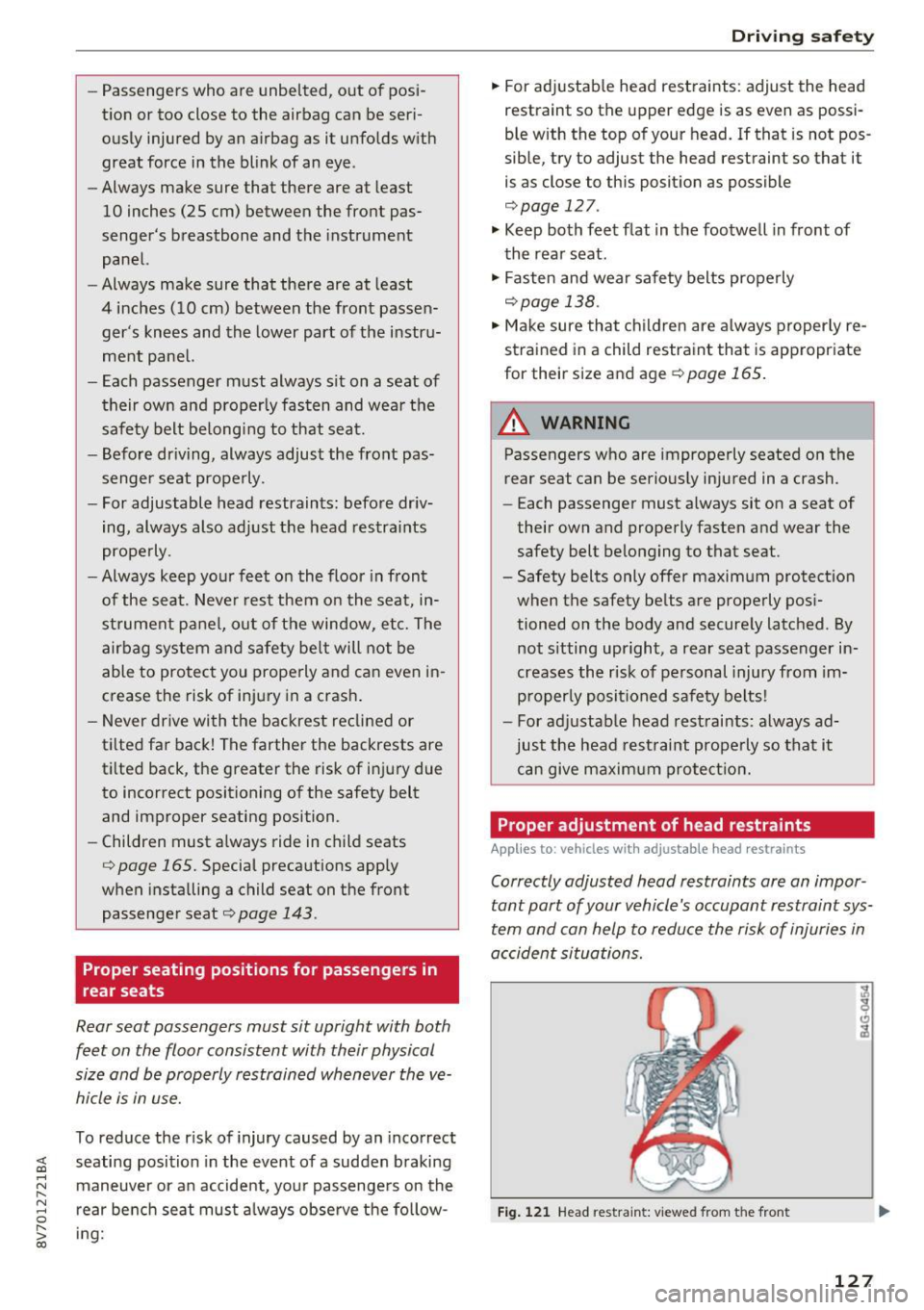
Fig. 121 Head restraint: viewed from the front
127
Page 129 of 272
<( co .... N ,.__
N .... 0 ,.__
> co
A WARNING
Improper seating positions increase the risk
of serious personal injury and death whenever
a vehicle is being used.
- Always make sure that all vehicle occupants
stay in a proper seating position and are
properly restrained whenever the vehicle is
being used.
Driver's and front
passenger's footwell
Important safety instructions
Applies to: veh icles with knee airbags
A WARNING
Always make sure that the knee airbag can in
flate without interference. Objects between
yourself and the airbag can increase the risk
of injury in an accident by interfering with the
way the airbag deploys or by being pushed in
to you as the airbag deploys.
- No persons (children) or animals should ride in the footwell in front of the passenger
seat. If the airbag deploys, this can result in
serious or fatal injuries .
- No objects of any kind should be carried in
the footwell area in front of the driver's or passenger's seat. Bulky objects (shopping
bags, for example) can hamper or prevent
proper deployment of the airbag. Small ob
jects can be thrown through the vehicle if
the airbag deploys and injure you or your
passengers.
Pedal area
Pedals
The pedals must always be free to move and
must never be interfered with by a floor mat or
any other object.
Make sure that all pedals move freely without in
terference and that nothing prevents them from
returning to their original positions.
Only use floor mats that leave the pedal area free
and can be secured with floor mat fasteners.
Driving safety
If a brake circuit fails, increased brake pedal trav
el is required to bring the vehicle to a full stop.
A WARNING
-Pedals that cannot move freely can cause loss
of vehicle control and increase the risk of seri
ous injury.
- Never place any objects in the driver's foot well. An object could get into the pedal area
and interfere with pedal function. In case of
sudden braking or an accident, you would
not be able to brake or accelerate!
- Always make sure that nothing can fall or
move into the driver's footwell.
Floor mats on the driver side
Always use floor mats that can be securely at tached to the floor mat fasteners and do not in
terfere with the free movement of the pedals.
.. Make sure that the floor mats are properly se
cured and cannot move and interfere with the
pedals¢ .&,.
Use only floor mats that leave the pedal area un
obstructed and that are firmly secured so that
they cannot slip out of position. You can obtain
suitable floor mats from your authorized Audi Dealer.
Floor mat fasteners are installed in your Audi.
Floor mats used in your vehicle must be attached
to these fasteners. Properly securing the floor mats will prevent them from sliding into posi
tions that could interfere with the pedals or im
pair safe operation of your vehicle in other ways.
A WARNING ~
Pedals that cannot move freely can result in a
loss of vehicle control and increase the risk of
serious personal injury.
-Always make sure that floor mats are prop
erly secured.
- Never place or install floor mats or other floor coverings in the vehicle that cannot be
properly secured in place to prevent them
from slipping and interfering with the ped-
als or the ability to control the vehicle.
Ill>
129
Page 130 of 272
Driving safety
-Never place or install floor mats or other
floor coverings on top of already installed
floor mats. Additional floor mats and other
coverings will reduce the size of the pedal
area and interfere with the pedals .
- Always properly reinstall and secure floor
mats that have been taken out for cleaning.
- Always make sure that objects cannot fall
into the driver footwell while the vehicle is
moving . Objects can become trapped under
the brake pedal and accelerator pedal caus ing a loss of veh icle control.
Storing cargo correctly
Loading the luggage compartment
All luggage and other objects must be properly
stowed and secured in the luggage compart
ment.
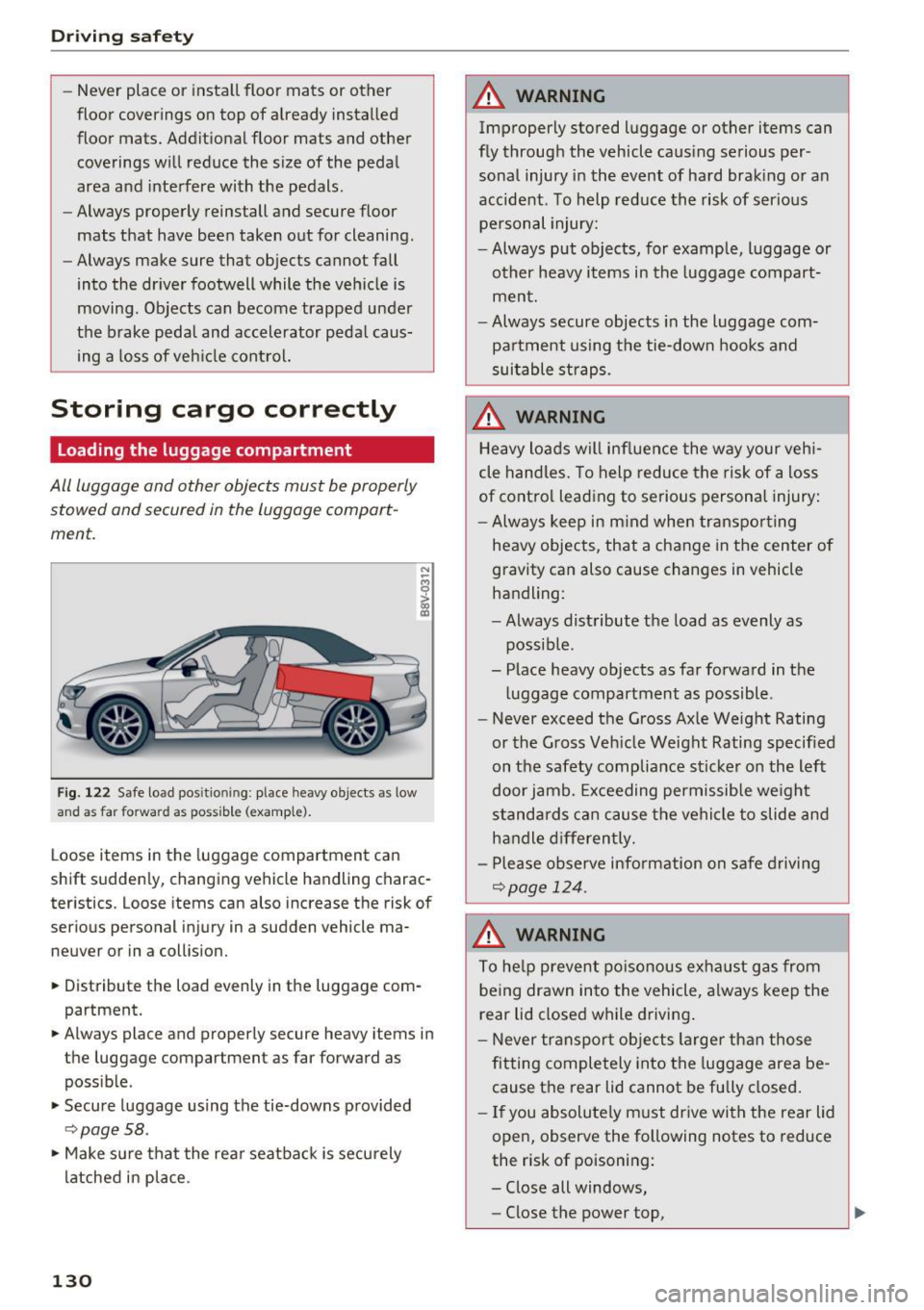
Fig. 122 Safe load positio nin g: place heavy objects as low
and as far forward as possible (example).
N ;;:; 0
> ill
Loose items in the luggage compartment can
shift suddenly, changing vehicle handling charac
teristics . Loose items can also increase the risk of
serious personal injury in a sudden vehicle ma
neuver or in a collision.
.,. Distribute the load evenly in the luggage com
partment .
.,. Always place and properly secure heavy items in
the luggage compartment as far forward as
possible .
.,. Secure luggage using the tie-downs provided
~ page 58.
.,. Make sure that the rear seatback is securely
latched in place .
130
A WARNING
Improperly stored luggage or other items can
fly through the vehicle caus ing serious per
sonal injury in the event of hard braking or an
accident. To help reduce the risk of serious
personal injury:
- Always put objects, for example, luggage or
other heavy items in the luggage compart
ment.
-Always secure objects in the luggage com
partment using the tie-down hooks and
suitable straps .
A WARNING
Heavy loads will influence the way your vehi
cle handles. To help reduce the risk of a loss
of control leading to serious personal injury:
- Always keep in m ind when transporting
heavy objects, that a change in the center of
gravity can also cause changes in vehicle
handling:
- Always distribute the load as evenly as
possible.
- Place heavy objects as far forward in the
luggage compartment as possible .
- Never exceed the Gross Axle Weight Rating
or the Gross Veh icle Weight Rating specified
on the safety compliance sticker on the left
door jamb. Exceeding permissible we ight
standards can cause the vehicle to slide and
handle differently.
- Please observe information on safe driving
~page 124.
A WARNING
To help prevent poisonous exhaust gas from
being drawn into the vehicle, always keep the
rear lid closed while driving .
- Never transport objects larger than those
fitting completely into the luggage area be
cause the rear lid cannot be fully closed.
- If you absolutely must dr ive with the rear lid
open, observe the following notes to reduce
the risk of poisoning:
- Close all windows,
- Close the power top,
Page 131 of 272
<( co .... N ,.__
N .... 0 ,.__
> co
-Open all air outlets in the instrument pan
el,
- Switch off the air recirculation,
- Set the fresh air fan to the highest speed.
& WARNING -
Always make sure that the doors, all win
dows, the power top and the rear lid are se
curely closed and locked to reduce the risk of
injury when the vehicle is not being used.
- After closing the rear lid, always make sure
that it is properly closed and locked.
- Never leave your vehicle unattended espe
cially with the rear lid left open. A child
could crawl into the vehicle through the lug
gage compartment and close the rear lid be
coming trapped and unable to get out. Be
ing trapped in a veh icle can lead to serious
personal injury.
- Never let children play in or around the vehi
cle.
- Never let passengers r ide in the luggage
compartment. Vehicle occupants must al
ways be properly restrained in one of the ve
hicle's seating positions.
(!) Tips
- Air c irculation helps to reduce window fog
ging . Stale air escapes to the outside
through vents in the trim panel. Be sure to
keep these slots free and open.
- The t ire pressure must correspond to the
l oad. The tire pressure is shown on the tire
pressure label. The tire pressure label is lo
cated on the driver's side B-pillar. The tire
pressure label lists the recommended cold
tire inflation pressures for the vehicle at its
maximum capacity weight and the tires that
were on your vehicle at the t ime it was man
ufactured. For recommended tire pressures
for normal load conditions, please see chap
ter
c> page 214.
Driving safety
Tie-downs
The luggage compartment is equipped with four
tie-downs to secure luggage and other items .
Use the tie-downs to secure your cargo properly
c> page 130, Loading the luggage compartment.
In a collision, the laws of physics mean that even
smaller items that are loose in the veh icle will
become heavy missiles th at can cause serious in
jury. Items in the vehicle possess energy which
vary w ith vehicle speed and the we ight of the
item . Vehicle speed is the most significant factor.
For example, in a frontal collision at a speed of
30 mph (48 km/h), the forces acting on a 10-lb
(4 .5 kg) object are about 20 times the normal
we ight of the item. This means that the we ight
of the item would sudden ly be about
200 lbs. (90 kg). You can imagine the injuries
that a 200 lbs. (90 kg) item flying freely through
the passenger compartment cou ld cause in a col
lision like this .
& WARNING
----
Weak, damaged or improper straps used to
secure items to tie-downs can fail during hard
braking or in a collision and cause serious per
sonal injury.
- Always use suitable mounting straps and
properly secure items to the tie-downs in
the luggage compartment to help prevent
items from shifting or flying forward as dan
gerous missiles.
- When the rear seat backrest is folded down,
always use suitable mounting straps and properly secure items to the tie-downs in
the luggage compartment to help prevent
items from flying forward as dangerous
missi les into the passenger compartment.
- Never attach a child safety seat tether strap
to a tie-down.
131
Page 134 of 272
Driving safety
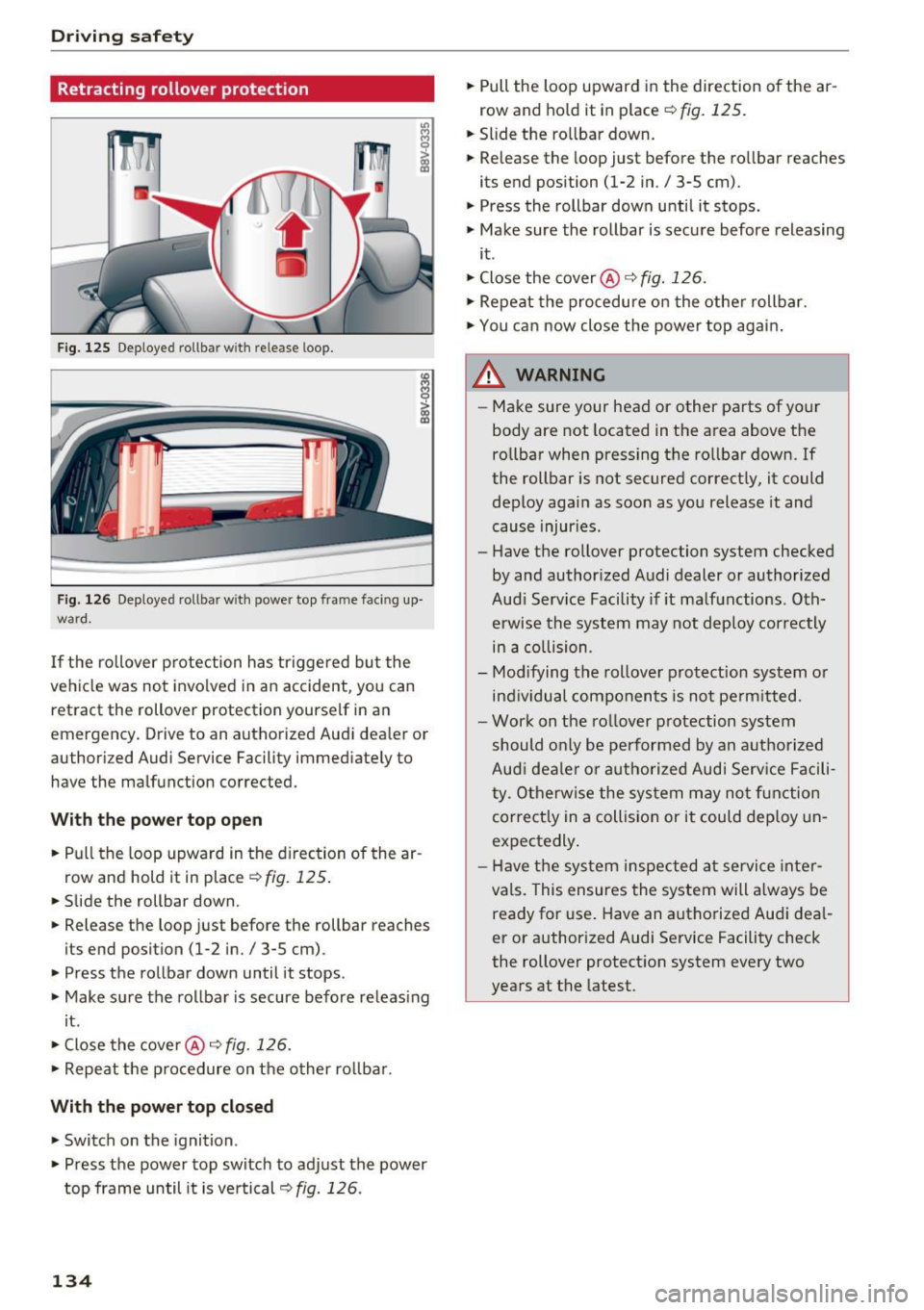
Retracting rollover protection
Fig. 12 5 Deployed rollbar w ith re lease loop.
--------
F ig. 126 Deployed rollbar w ith power top frame facing up
ward.
If the ro llover p rotection h as triggered bu t the
ve hicle was no t invo lved in an accident, you can
retract the rollover protection yourself in an
emergency . Drive to an authorized Aud i dea ler or
author ized Audi Service Facility immediately to
have the malfunction corrected.
With the power top open
• Pull the loop upward in the d irection of the ar
row and hold it in place~
fig. 125 .
• Slide the rollbar down.
• Release the loop just before the rollbar reaches
its end position (1-2 in./ 3-5 cm).
• Press the ro llbar down until it stops .
• Make su re the rollbar is secure before re leas ing
it.
• Close the cover@ 9
fig. 126.
• Repe at the p rocedure on t he other ro llba r.
With the power top closed
• Switch on the ignition .
• Press the power top switch to adjust the power
top frame until it is ve rtical 9
fig. 126 .
134
• Pull the loop upward in the direction o f the ar
row and ho ld it in p lace
9fig. 125.
• Slide the ro llbar down.
• Release the loop just before the ro llbar reaches
its end position (1-2 in./ 3-5 cm).
• Press the rollbar down until it stops.
• Make sure the rollbar is secure before releasing
it .
• Close the cover @'*
fig. 126.
• Repeat the procedu re on the othe r rollbar.
• You can now close the powe r top agai n.
A WARNING
-
-Make sure your head or other parts of yo ur
body are not located in the a rea above the
rollbar when pressing the ro llbar down. If
the rollbar is not secured correct ly, it could
deploy again as soon as you release it and
cause injur ies.
- Have the rollover protection system checked
by and author ized Audi dealer or authorized
Aud i Serv ice Facility if it malfunctions. O th
erwis e the syst em may not deploy correctly
in a collision.
- Mod ifying the rollover pro tection system or
in dividual componen ts is not pe rm itted.
- Work on the ro llover p rotection system
should only be performed by an a uthorized
Aud i dea le r o r auth o riz e d Audi Serv ice Facili
ty. Otherwise the system m ay no t fu n ction
correctly in a collision or it could deploy un
expectedly .
- H ave t he sys tem inspected a t service inte r
vals. This ensures the system will always be ready for use . Have an autho rized Aud i dea l
er or author ized Audi Service Facility check
the rollover protect ion system every two
years at the latest.
Page 138 of 272
Safety belts
_& WARNING
Not wearing safety belts or wearing them im
properly increases the risk of serious personal
injury and death . Safety belts can work only
when used correctly.
-Always fasten your safety belts correctly be fore driving off and make sure all passen
gers are correctly restrained.
- For maximum protection, safety belts must
always be positioned properly on the body.
- Never strap more than one person, includ
ing small children, into any belt.
- Never place a safety belt over a child sitting
on your lap.
- Always keep feet in the footwell in front of
the seat while the vehicle is being driven.
- Never let any person ride with their feet on
the instrument panel or sticking out the
window or on the seat.
- Never
remove a safety belt while the vehicle
is moving . Doing so will increase your risk of
being injured or killed .
- Never wear belts twisted.
- Never wear belts
over rigid or breakable ob-
jects in or on your clothing, such as eye
glasses, pens, keys, etc., as these may cause
injury.
- Never allow safety belts to become dam
aged by being caught in door or seat hard
ware .
- Do not wear the shoulder part of the belt
under your arm or otherwise out of position.
- Several layers of heavy clothing may inter
fere with correct positioning of belts and re
duce the overall effectiveness of the system.
- Always keep belt buckles free of anything
that may prevent the buckle from latching
securely .
- Never use comfort clips or devices that cre
ate slack in the shoulder belt. However, spe
cial clips may be required for the proper use
of some child restraint systems.
- Torn or frayed safety belts can tear, and
damaged belt hardware can break in an acci
dent . Inspect belts regularly.
If webbing,
bindings, buckles, or retractors are dam-
138
aged, have belts replaced by an authorized
Audi dealer or qualified workshop.
- Safety belts that have been worn and loaded
in an accident must be replaced with the
correct replacement safety belt by an au
thorized Audi dealer. Replacement may be
necessary
even if damage cannot be clearly
seen . Anchorages that were loaded must al
so be inspected.
- Never
remove, modify , disassemble, or try
to repair the safety belts yourself .
-Always keep the belts clean. Dirty belts may not work properly and can impair the func
tion of the inertia reel¢
table Internal
cleaning on page 226.
Safety belts
Fastening safety belts
Safety first -everybody buckle up!
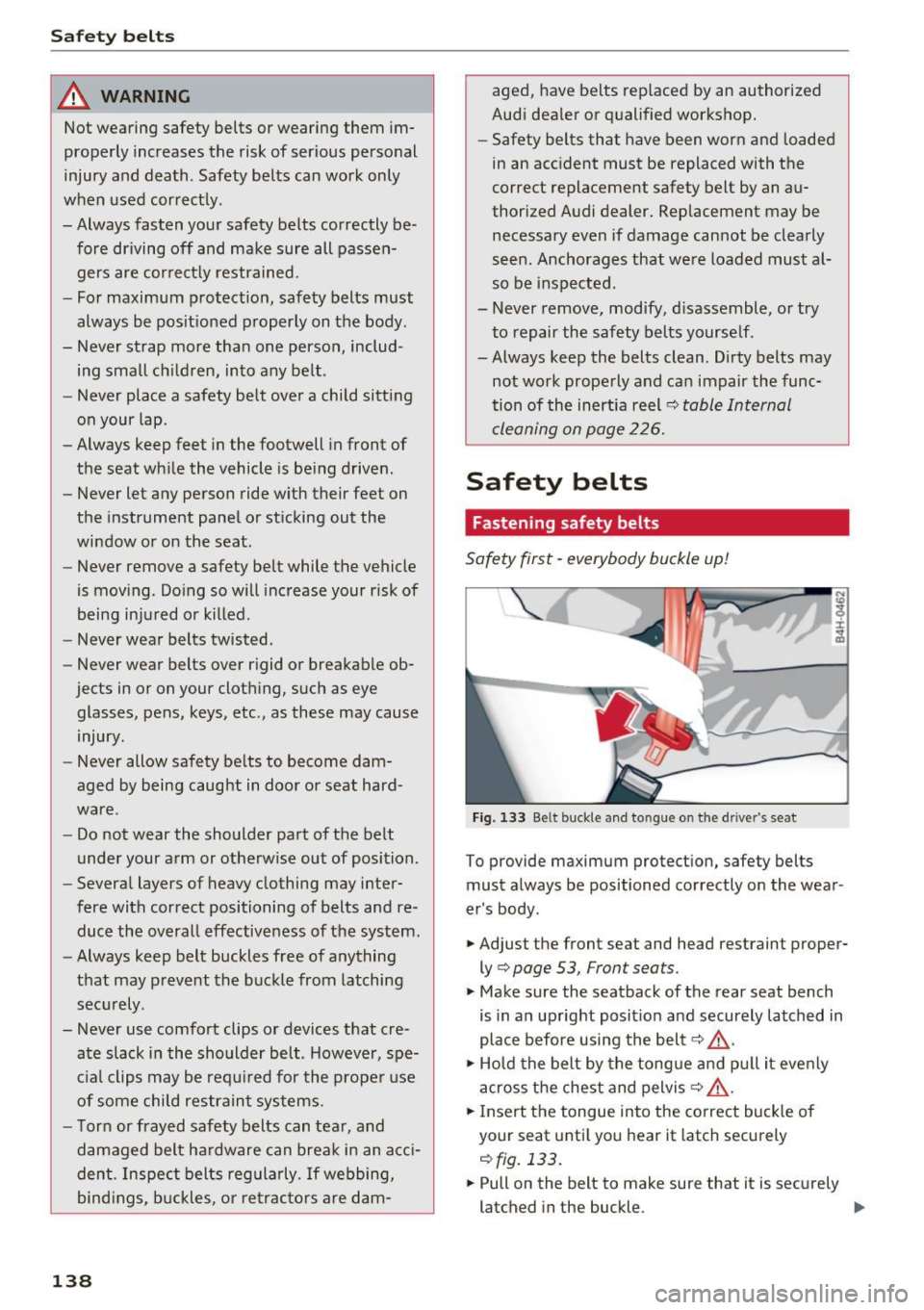
Fig. 133 Be lt buckle and tongue on the driver's seat
To provide maximum protection, safety belts
must always be positioned correctly on the wear
er's body .
.. Adjust the front seat and head restraint proper
ly¢
page 53, Front seats.
.. Make sure the seatback of the rear seat bench
is in an upright position and securely latched in
place before using the belt
q ,&. .
.. Hold the belt by the tongue and pull it evenly
across the chest and pelvis¢,&..
.. Insert the tongue into the correct buckle of
your seat until you hear it latch securely
¢fig. 133.
.. Pull on the belt to make sure that it is securely
latched in the buckle. .,,._
Page 139 of 272
<( co ..... N
" N ..... 0 r--. > 00
Automatic safety belt r etractors
Every safety be lt is equ ipped wi th an automatic
be lt retractor on the shoulder belt. Th is feature
l ocks the belt when the belt is p ulled out fast,
during hard braking and in an accident. The belt
may also lock when you drive up or down a steep
h ill or through a sharp curve. During normal driv
ing the belt lets you move freely .
Safety be lt pret en sioner s
The safety belts are equipped with a belt preten
sioner that helps to tighten the safety belt and
remove slack when the pretensioner is activated
c:> page 141. The function of the pretensioner is
monitored by a warning light
c:> page 17.
Con vertible loc king retractor
Every safety belt exc ept the one on the driver
seat is equipped with a convertible locking retrac
tor that
mu st be used when the safety belt is
used to attach a child seat. Be sure to read the
important information about this featu re
c:> page 176.
A WARNING
Improperly posit ioned safety be lts ca n cause
ser ious injury in an accident ¢
page 139,
Safety belt position.
-Safety belts offer optimum protection only
when the seatback is upr ight and belts are
prope rly pos itioned on the body.
- Never a ttac h the safety belt to the buckle
for ano ther sea t. Att aching the bel t to the
wrong buck le w ill reduce safety belt effec
tiveness and can cause serious persona l in
jury .
- A passenger who is no t properly restrained
can be se riously in jured by the safety be lt it
self when it moves from the stronger parts of the body into cr itical areas like the abdo
men .
- Always lock the convert ible lock ing retractor
when you are secur ing a child seat in the ve
hicle
c:> page 177.
Safet y bel ts
(D Tips
For information on safety belt pretensioners,
refer to
r=:; page 141 .
Safety belt position
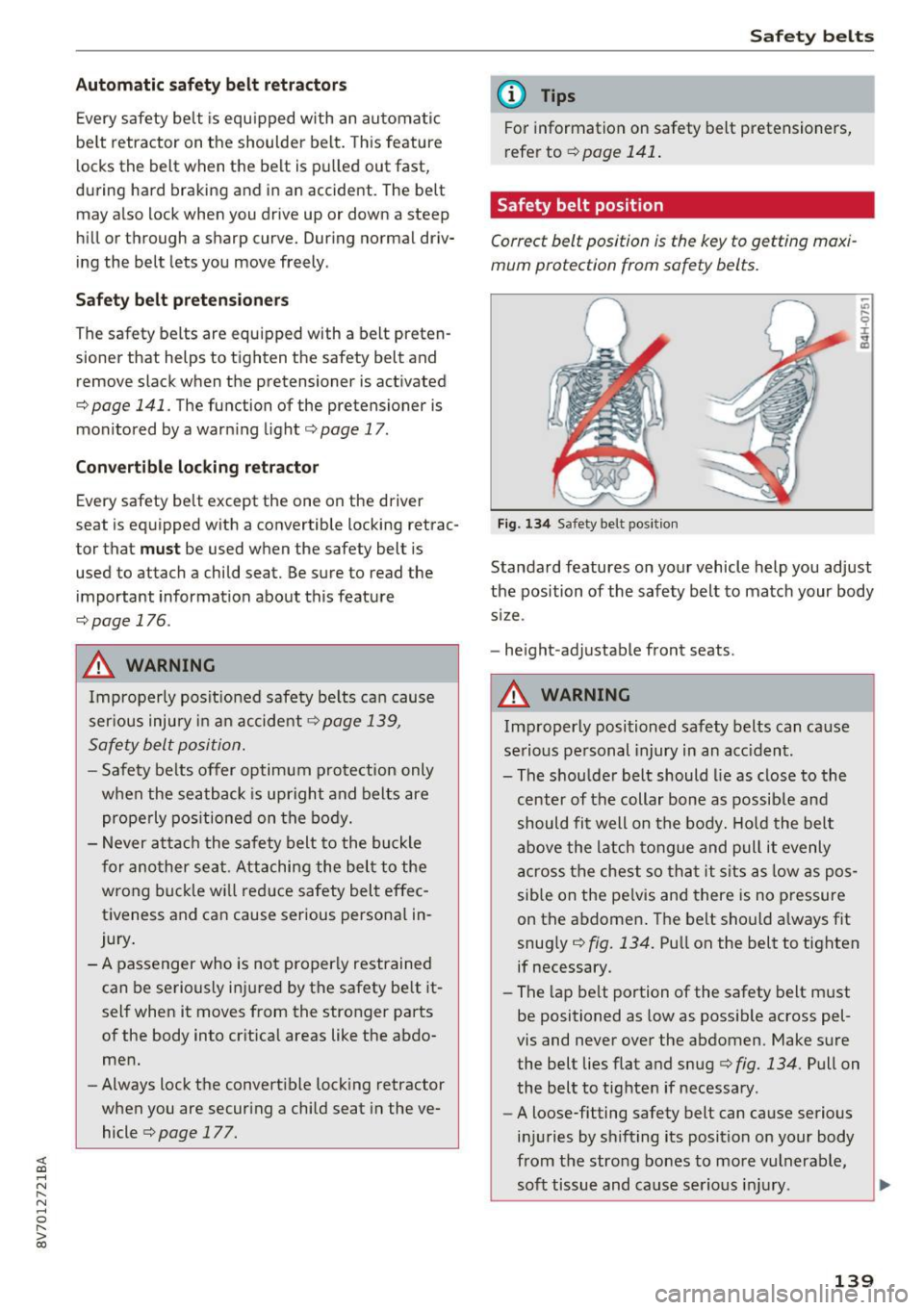
Correct belt position is the key to getting maxi
mum protection from safety belts.
F ig. 134 Safety be lt pos it ion
Standard features on your vehicle help you adjust
the position of the safety belt to match your body s iz e.
- he ight -adjustable front seats .
A WARNING
'"' -Improperly posi tioned safety belts can cause
se rious pe rsonal injury in an acc ident.
- The s hou lder belt should lie as close to the
center of the collar bone as possib le and
should fit well on the body . Ho ld the belt
above the latch tongue and pull it evenly
a cross the chest so tha t it sits as low as pos
sible on the pe lvis and there is no p ressure
on the abdomen . The belt should a lways fit
snug ly
r=:; fig. 134. Pu ll on the belt to tighten
if necessary.
- The lap be lt portion of the safety belt must
be positioned as low as possible across pel
vis and never over the abdomen . Make s ure
the belt lies flat and snug
c:> fig. 134. Pull on
the bel t to tighten if necessary .
- A loose-fitting safety belt can cause serious
in ju ries by s hifting its position on your body
from the stro ng bones to more vulnerable,
soft tissue and cause se rious i nju ry .
~
139
Page 140 of 272
Safe ty belts
-Always read and heed all WARNINGS and
other important information
r::;, page 13 7.
Pregnant women must also be correctly
restrained
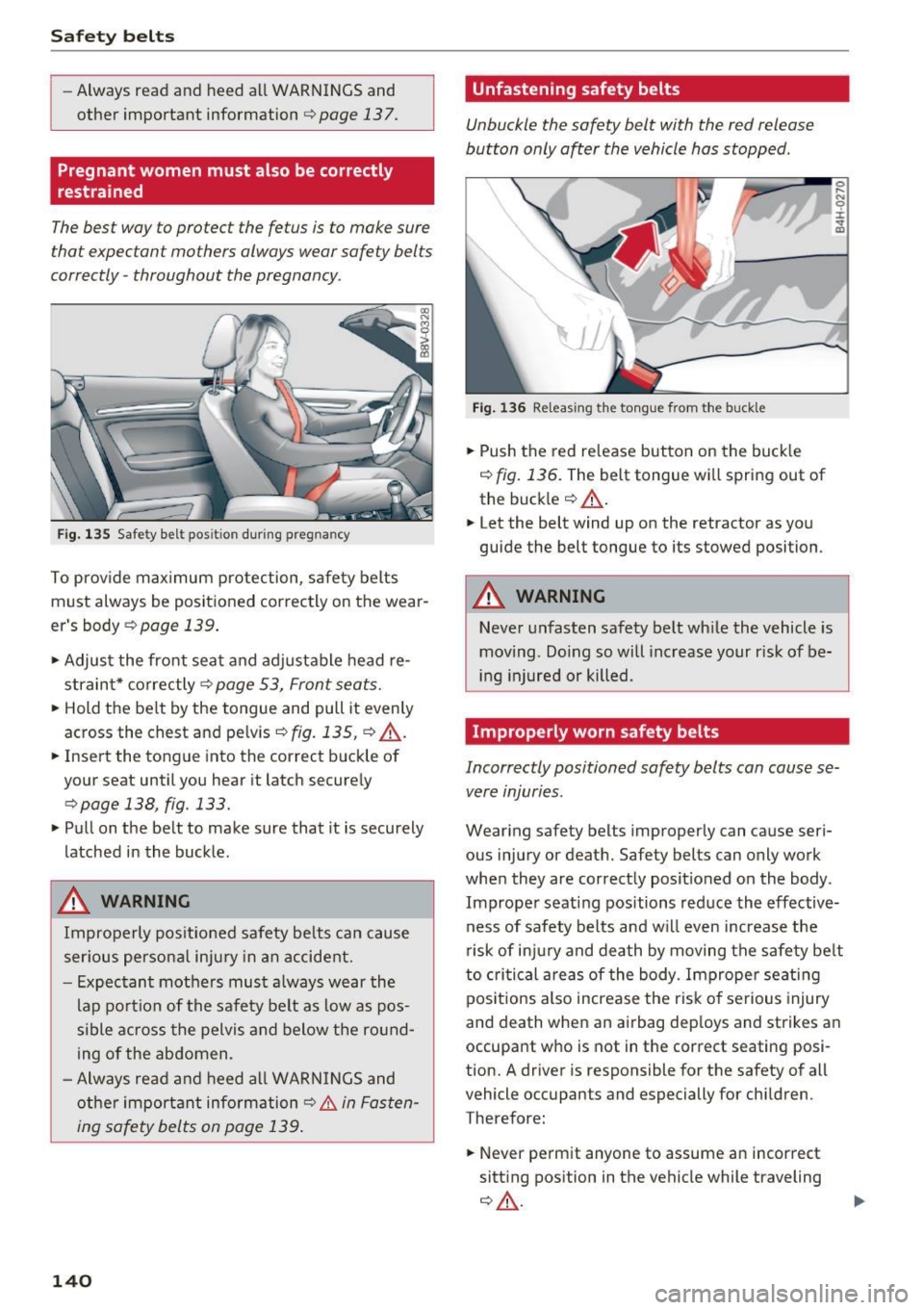
The best way to protect the fetus is to make sure
t hat expec tan t mothers always wear safety bel ts
correctly -throughout the pregnancy .
Fig . 135 Safety belt pos ition dur ing preg nan cy
To prov ide max imum protection, safety belts
must always be positioned correctly on the wear
er 's body
,:::;, page 139.
• Adjust the front sea t and adjustable head re
straint * correctly
r::;, page 53, Front seats.
• Hold the belt by the tongue and pull it even ly
across the chest and pe lvis
r::;, fig. 135, r::;, A .
• Insert the tongue into the correct b uckle of
your seat until you hear it latch securely
r::;, page 138, fig . 133.
• Pull on the belt to make sure that it is securely
latched in the buckle.
A WARNING
Improperly pos itioned safety be lts can cause
ser ious persona l inju ry in an accident.
- Expectan t mothe rs must a lways wear the
lap po rtion of the safe ty belt as low as pos
sible across the pelvis and below the ro und
ing of the abdomen.
- Always rea d and heed a ll WARN INGS and
othe r important information
r::;, .&. in Fasten
ing safety belts on page 139 .
140
Unfastening safety belts
Unbuckle the safety belt with the red release
button only ofter the vehicle hos stopped .
.,,
Fig. 136 Releasing the tongue from the buckle
• Push the red re lease button on the buck le
r::;, fig. 136. The belt tongue wi ll spring out of
the buck le
r::;, A .
• Let the belt wind up on the retractor as you
guide the belt tongue to its stowed position .
A WARNING
Never unfasten safety belt while the vehicle is
moving . Do ing so will increase your r isk of be
ing inj ured or killed .
Improperly worn safety belts
0 ,-. N 0 :i: .. m
Incorrectly positioned safety belts con cause se
vere injuries.
Wear ing safety belts improperly can cause seri
ous injury or deat h. Safety belts can only work
whe n they are correct ly posit ioned on the body .
Imprope r seating positions red uce the effective
ness of safety belts and w ill even increase the
risk of inj ury and death by moving the safety belt
to c rit ic al areas of the body . Imprope r seating
pos itions also increase the ris k of serious injury
and death when an airbag dep loys and strikes a n
occupant who is not in the correct seating posi
tion. A driver is responsible for the safety of all
vehicle occupants and especially for chi ldren .
Therefore:
• Never permit anyone to assume an incorrect
sitt ing position in the vehicle while traveling
¢ A -
Page 169 of 272
<( co .... N r--N .... 0 r--> co
@ Tips
The chi ld seats listed in categories A to C have
been statically tested by Audi only for the Ad
vanced Airbag function .
Important safety instructions for using
child safety seats
Correct use of child safety seats substantially re
duces the risk of injury in an accident!
As the driver, you are responsible for the safety
of everybody in the vehicle, especially children:
~ Always use the right child safety seat for each
child and a lways use it properly~
page 171.
~ Always carefully follow the child safety seat
manufacturer's instructions on how to route
the safety belt properly through the child safe
ty seat .
~ When using the vehicle safety be lt to install a
child safety seat , you must first activate the
convertible locking retractor on the safety be lt
to prevent the child safety seat from moving
~ page 176.
~ Push the child safety seat down w ith your full
weight to get the safety be lt rea lly t ight so that
the seat cannot move forward or sideways more than one inch (2.5 cm).
~ Secure unused safety belts on the rear seat
~ page 171.
Always remember: Even though your vehicle is
equipped with an Advanced Airbag sys tem, all
children, especially those 12 years and younger,
should always ride in the back seat properly re
stra ined for their age and size.
_&, WARNING
Not using a ch ild safety seat , using the wrong
child sa fety seat or improperly installing a
child restraint increases the risk of serious
personal injury and death.
- All vehicle occupants and especia lly children
must be restrained properly whenever riding
in a vehicle . An unrestrained or improperly
restrained child could be injured by striking
the interior or by being ejected from the ve hicle during a sudden maneuver or impact.
Ch ild safety
An unrestrained or improperly restrained
child is also at greater r isk of injury or death
through contact with an inf lating airbag.
- Commercially available child safety seats
are required to comply with U.S . Federal
Motor Vehicle Safety Standard (FMVSS) 213
(in Canada CMVSS 213) .
- When buying a child restra int, select one
that fits your child and the vehicle.
- Only use child restraint systems that fully
contact the flat portion of the seat cush
ion . The child restraint must not tip or
lean to either side. Audi does not recom
mend using child safety seats that rest on
legs or tube-like frames. They do not pro
vide adequate contact with the seat.
- Always heed all lega l requirements per
ta ining to the installation and use of child
safety seats and carefully follow the in
structions provided by the manufacturer
of the seat you are using .
- Never allow children under 57 inches
(1.45 meters) to wear a normal safety belt .
They must always be restrained by a proper
child restraint system. Otherwise, they
could sustain injuries to the abdomen and
neck areas during sudden braking mane u
vers or accidents.
- Never let more than one child occupy a chi ld
safety seat .
- Never let babies or o lder children ride in a
veh icle while sitting on the lap of another
passenger.
- Holding a child in your arms is never a sub
stitute for a child restraint system .
- The strongest person cou ld not ho ld the
ch ild with the forces that exist in an acci
dent . The child will strike the interior of
the vehicle and can also be struck by the passenger.
- The child and the passenger can also in
jure each other in an accident.
- Never install rear-fac ing child safety seats
or infant car riers on the front passenger
seat. A child w ill be seriously injured and
can be killed when the passenger a irbag in
flates -even with an Advanced Airbag Sys
tem .
169
Page 171 of 272
<( co .... N
" N ..... 0
" > 00
Secure unused safety belts on the rear seat
-------~
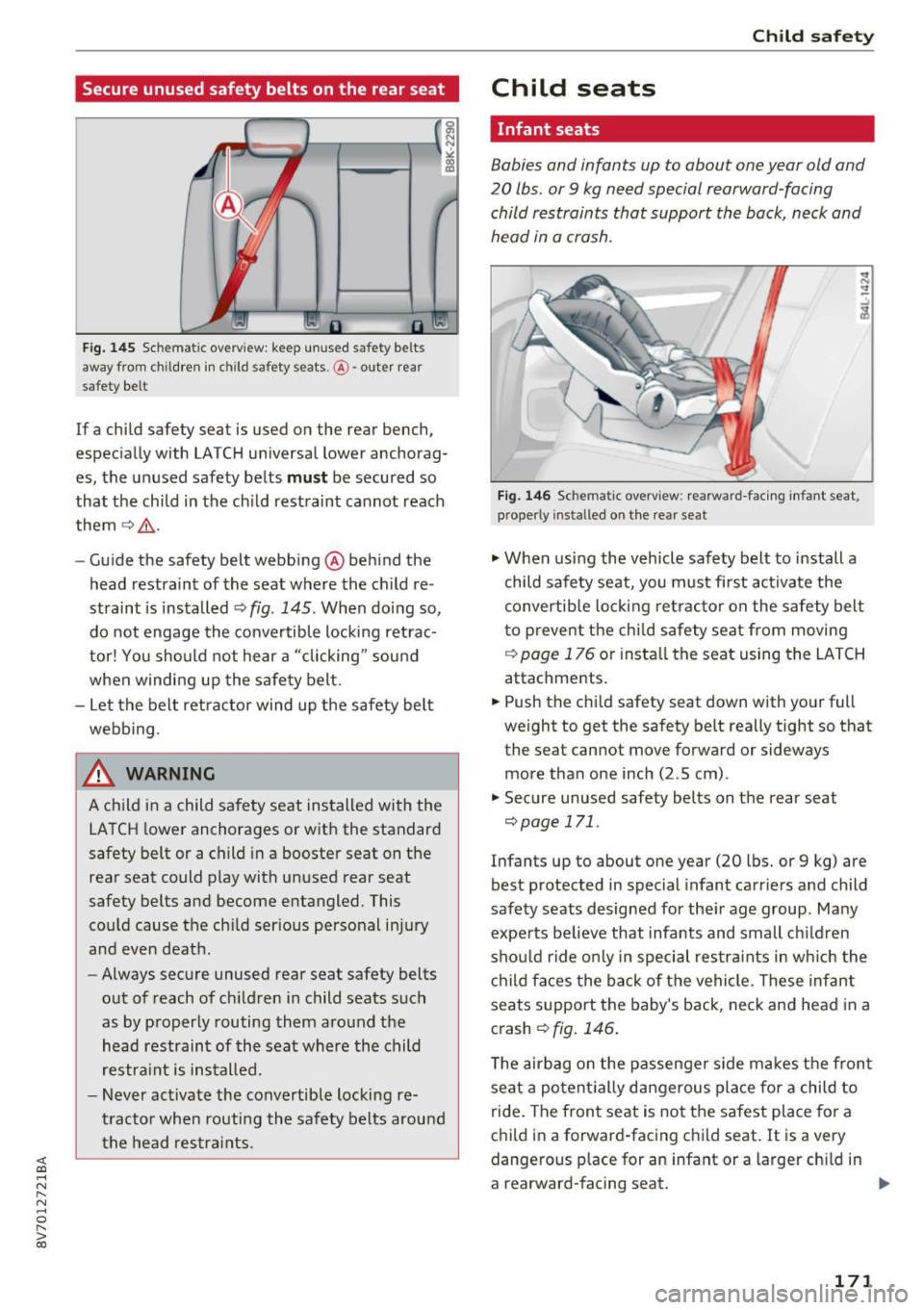
Fig. 1 45 Schematic overv iew : keep unused safety belts
away from ch ildre n in ch ild safety seats .@ -outer rear
safety belt
::!
If a child safety seat is used on the rear bench,
especially with LATCH universal lower anchorag
es, the unused safety belts
mu st be secured so
that the child in the ch ild restraint cannot reach
them
9 &, .
-Guide the safety belt webb ing @ behind the
head restraint of the seat where the child re
straint is installed
<=:> fig. 145. When do ing so,
do not engage the convertible locking ret rac
tor! You sho uld not hear a "clicking" sound
when winding up the safety belt.
- Let the belt retractor wind up the safety be lt
webbing .
_& WARNING
A child in a child safety seat installed with the
LA TCH lower anchorages or wit h the standard
safety belt or a child in a booster seat on the
rear seat could play with unused rear seat
safety belts and become entangled. This
cou ld cause the ch ild ser ious personal in jury
and even death .
- Always secure unused rear seat safety belts
out of reach of ch ildren in child seats such
as by properly routing them around the
head restraint of the seat where the child
restra int is ins tal led.
- Never act ivate the convertible locki ng re
t racto r when routing the safety belts around
the head restra ints.
Ch ild sa fety
Child seats
Infant seats
Babies and infants up to about one year old and
20 lbs. or
9 kg need special rearward-facing
child restraints that support the back, neck and
head in a crash.
F ig . 14 6 Schematic overv iew: rearward -fac ing infant seat,
p roperly insta lled on the rea r seat
.,. When using the vehicle safety belt to install a
child safety seat, you must first activate the
convertib le loc king re tractor on the safety belt
to p revent the chi ld safety seat from moving
9 page 176 or insta ll the seat using the LATCH
attachments.
... Push the child safety seat down with your full
weight to get the safety belt really tight so that
the seat cannot move forward or sideways
more than one inch (2.5 cm) .
.,. Secure unused safety belts on the rear seat
<=:>page 171.
Infants up to about one year (20 lbs. or 9 kg) are
best protected in special infant carr iers and child
safety seats designed for the ir age group. Many
experts be lieve that infants and small ch ildren
sho uld ride o nly in special res tra ints in wh ich the
ch ild faces the back of the vehicle. These infant
seats support the baby's back, neck and head in a
c rash
r:::;, fig. 146 .
The airbag on the passenger s ide makes the fron t
seat a potent ially dangerous place for a child to
ride . The front seat is not the safest place for a
c h ild in a forward-facing child seat. It is a very
dangerous p lace for an infant or a larger child in
a rearward-facing seat.
171