light AUDI A3 SEDAN 2017 Owners Manual
[x] Cancel search | Manufacturer: AUDI, Model Year: 2017, Model line: A3 SEDAN, Model: AUDI A3 SEDAN 2017Pages: 400, PDF Size: 67.32 MB
Page 243 of 400
CXl CXl .... N r--N .... 0 N > 00
System settings
Setting the date and
time
You can set the clock time manually or using the
CPS*.
.,. Select : I MENU I button> Settings> left control
button >
MMI settings> Date & time .
.,. Or: select : IMENUI button> Vehicle > left con-
trol button >
Vehicle settings> Date & time.
Automatic setting
When this function is switched on g, the time
and date are automatically set.
Time
Requirement: the Automatic setting must be
switched
off .
Press the control knob. You can set the Time
manually by turning and pressing the control
knob.
Date
Requirement: the Automatic setting must be
switched
off.
Press the control knob . You can set the Date
manually by turning and press ing the cont rol
knob.
Time zone
When selecting the appropriate time zone, a
sampling of countr ies in this zone will be listed .
Automatic time zone*
When this function is switched on g, the time
will automatically adjust to the corresponding
time zone.
Automatic daylight saving time*
When this function is switched on g, the time
will automatically switch to daylight saving time .
Time format
If you select 24h, the clock will disp lay, for ex
ample ,
13:00 . If you se lect AM/PM , the clock
will disp lay, for example,
1:00 PM .
System settings
Date format
If you select DD.MM .YYYY , the date display will
show, for example,
31.08.2017. If you select
MM/DD/YYYY , the date display will show, for ex
ample,
08/31/2017. If you select YYYY-MM
DD ,
the date display will show, for example,
2017-08-31 .
MMI settings
.,. Select: !MENUI button> Settings> left control
button >
MMI settings .
Language
You can change the display language as well as
the language for the voice guidance* and voice
recognition system*.
T he number of languages available depends on
the market.
Measurement units
The following units can be selected:
-Speed (mph or km/h)
- Distance (miles or kilometers)
-Temperature (°For 0
()
-Fuel consumption (L/100km, mpg (US), mpg
(UK) or km/l)
- Volume (liters , gallons)
Tool tips
When this function is switched on g, your MMI
shows you tips for input. The frequency of how
often it displays decreases with time.
Speech dialog system
Applies to : vehicles wi th voice recog nitio n system
Depend ing on vehicle equipment, the following
functions may be ava ilable:
Command display : when this function is switch
ed on
g, the MMI will show you the possible
commands for voice input in the respective
menu.
Short dialog : when this function is switched on
g, a shorter form of the prompts is used .
Command during voice output*: this function is
switched on at the factory . When this function is
II>-
241
Page 249 of 400
CXl CXl .... N ,.__
N .... 0 N > 00
Driving safety
Basics
Safe driving habits
Please remember -safety first!
This chapter contains important information,
tips, instructions and warnings that you need to
read and observe for your own safety, the safety
of your passengers and others . We have summar
ized here what you need to know about safety
belts, airbags, child restraints as well as child
safety. Your safety is for us
priority number 1. Al
ways observe the information and warnings in
this section - for your own safety as well as that
of your passengers.
The information in this section applies to all
model versions of your vehicle. Some of the fea
tures descr ibed in this sections may be standard
equipment on some models, or may be optional
equipment on others. If you are not sure, ask
your authorized Audi dealer.
A WARNING
- Always make sure that you follow the in
structions and heed the WARNINGS in this
Manual. It is in your interest and in the in
terest of your passengers .
-
-Always keep the complete Owner's Litera
ture in your Audi when you lend or sell your
vehicle so that this important information
will always be available to the driver and
passengers.
- Always keep the Owner's literature handy so
that you can find it easily if you have ques
tions.
Safety equipment
The safety features are part of the occupant re
straint system and work together to help reduce the risk of injury in a wide variety of accident sit
uations.
Your safety and the safety of your passengers
should not be left to chance. Advances in tech
nology have made a var iety of features available
to help reduce the risk of injury in an accident.
Driving safety
The following is a list of just a few of the safety
features in your Audi:
- sophisticated safety belts for driver and all pas
senger seat ing pos itions,
- safety belt pretensioners,
- safety belt height adjustment systems for the
front seats*,
- front airbags,
- knee airbags for the front seats*
- side airbags in the front seats and outer rear seats*,
- side curtain airbags with ejection mitigation features*,
- special LATCH anchorages for child restraints,
- head restraints for each seating position,
- adjustable steering column.
- pre sense* (preventat ive passenger protection)
These individual safety features, can work to gether as a system to help protect you and your
passengers in a wide range of accidents . These
features cannot work as a system if they are not
always correctly adjusted and correctly used.
Safety is everybody's responsibility!
Important things to do before driving
Safety is everybody 's job! Vehicle and occupant
safety always depends on the informed and care
ful driver .
For your safety and the safety of your passen
gers,
before driving always:
.,. Make sure that all lights and signals are operat
ing correctly .
.,. Make sure that the tire pressure is correct.
.,. Make sure that all windows are clean and afford
good visibility to the outside .
.,. Secure all luggage and other items carefully
¢ page 66, ¢ page 65.
.,. Make sure that nothing can interfere with the
pedals.
.,. Adjust front seat, head restraint and mirrors correctly for your height .
.,. Instruct passengers to adjust the head re
straints according to their height .
247
Page 250 of 400
Driving safety
• Make sure to use the right child restraint cor
rectly to protect children
c::> page 292, Child
saf ety .
• Sit properly in your seat and make sure that
your passengers do the same
c::> page 61, Fron t
seats .
• Fasten your safety belt and wear it properly . Al
so instruct your passengers to fasten their safe
ty belts properly
c::> page 258 .
What impairs driving safety?
Safe driving is directly related to the condition of
the vehicle, the driver as well as the driver 's abili
ty to concentrate on the road without being dis
tracted .
The driver is responsible for the safety of the ve
hicle and all of its occupants. If your ability to
drive is impaired, safety risks for everybody in the
veh icle increase and you also become a hazard to
everyone else on the road
c::> ,&. . Therefore :
• Do not let yourself be distracted by passengers
or by using a cellular telephone .
• NEVER drive when your driv ing ability is im
pa ired (by med ications, alcohol, drugs, etc .).
• Observ e all traffic laws, rules of the road and
speed limits and plain common sense .
• ALWAYS adjust your speed to road, traffic and
weather conditions .
• Take frequent breaks on long trips . Do not drive
for more than two hours at a stretch .
• Do NOT drive when you are tired, under pres
sure or when you are stressed .
.&, WARNING
Impaired driving safety increases the risk of
serious personal injury and death whenever a
vehicle is being used.
248
.
Correct passenger
seating positions
Proper seating position for the driver
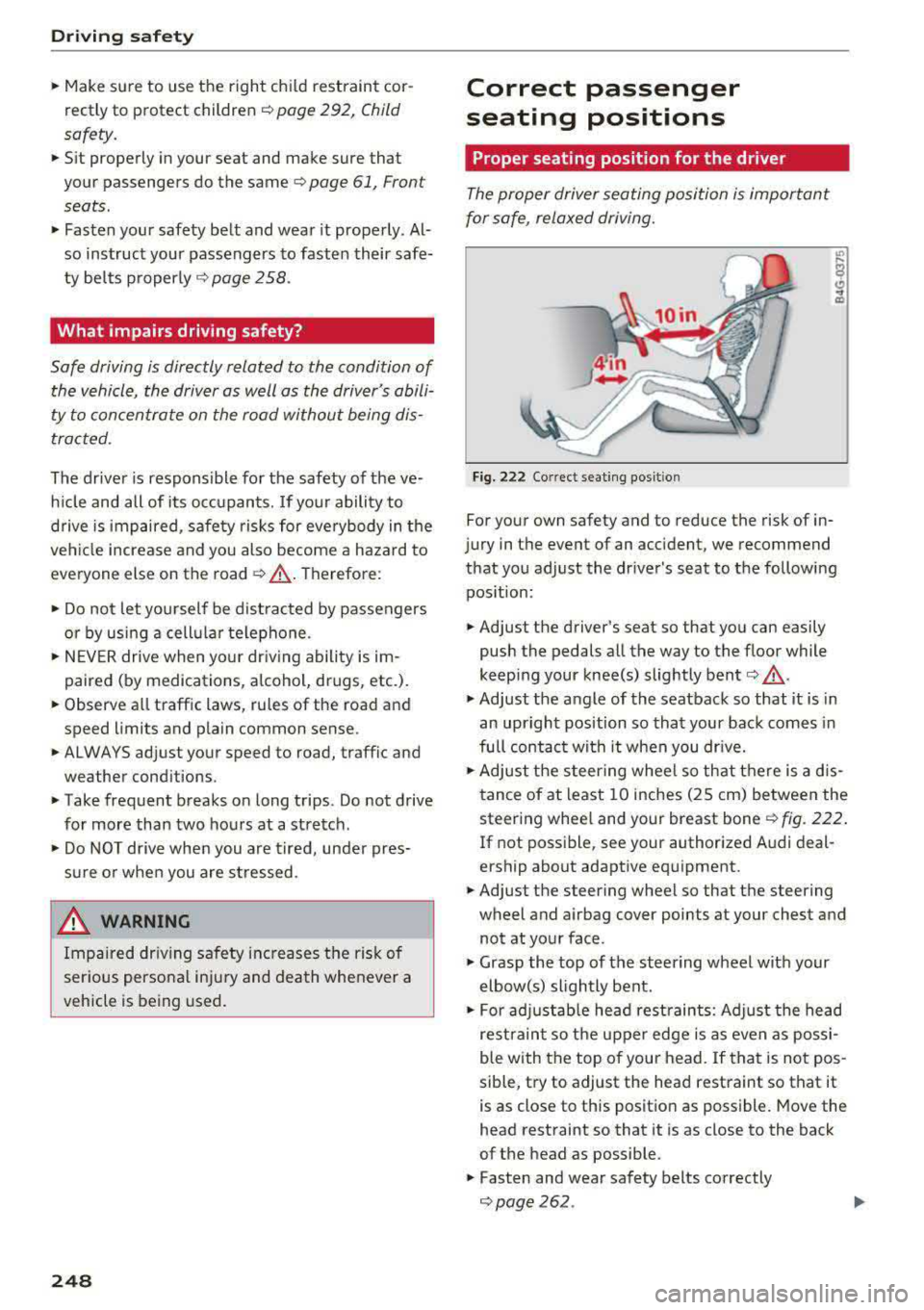
The proper driver seating position is important
for safe, relaxed driving.
Fig. 222 Correct seating pos it ion
For your own safety and to reduce the risk of in
jury in the event of an ac cident, we recommend
that you adjust the driver's seat to the following position :
• Adjust the driver's seat so that you can easily
push the pedals all the way to the floo r while
keeping your knee(s) slightly bent
c:> .&_ .
• Adjust the angle of the seatback so that it is in
an upright position so that your back comes in
full contact with it when you dr ive.
• Adjust the steering wheel so that there is a d is
tance of at least 10 inches (25 cm) between the
steering wheel and your breast bone
r::!) fig. 222.
If not possible, see your authorized Audi deal
e rship about adaptive equipment.
• Adjust the steering wheel so that the steering
wheel and airbag cover points at your chest and
not at your face .
• Grasp the top of the steering wheel with your
elbow(s) slightly bent.
• For adjustable head restraints: Adjust the head
restraint so the upper edge is as even as possi
ble with the top of your head. If that is not pos
sible, try to adjust the head restraint so that it
is as close to this position as possible. Move the
head restraint so that it is as close to the back
of the head as possible .
• Fasten and wear safety belts correctly
c::> page 262 . .,.
Page 260 of 400
Safety belt s
Safety belts
General notes
Always wear safety belts!
Wearing safety belts correctly saves lives!
This chapter explains why safety be lts are neces
sary, how they work and how to adjust and wear
them correctly .
.. Read all the information that follows and heed
all of the instructions and WARNINGS.
&_ WARNING
Not wearing safety belts or wearing them im
properly increases the risk of serious personal
injury and death.
- Safety belts are the s ingle most effective
means ava ilable to reduce the risk of serious
injury and death in automobile acc idents.
For your protect ion and that of your passe n
gers, always co rre ctly wea r safety be lts
when the vehicle is moving.
- Pregnant wome n, injured, o r physically im
paired persons mus t also use safety be lts.
L ik e all vehicle occ upants, they are mo re
likely to be serio usly injured i f they do not
wea r safety be lts. The best way to protect a
fetus is to protect the mother
-throughout
the ent ire pregnancy .
Number of seats
Applies to: veh icles w ithout power top: Your Audi
has a total of five seating positions: two in the
front and three in the rear . Each seating position
has a safety belt .
App lies to: veh icles w ith powe r top: Your Audi
has a total of four seating positions: two in the
front and two in the rear . Each seat ing pos ition
has a safety belt .
&_ WARNING
Not wearing safety belts or wearing them im
properly in creases the risk of ser io us personal
injury and dea th.
258
- Never strap more than one person, includ
ing sma ll children, into any belt. It is espe
cially dangerous to place a safety be lt over a
child sitting on your lap .
- Never let more people r ide in the vehicle
than there are safety be lts available.
- Be sure everyone riding in the vehicle is
proper ly restrained with a separate safety
be lt o r ch ild restraint .
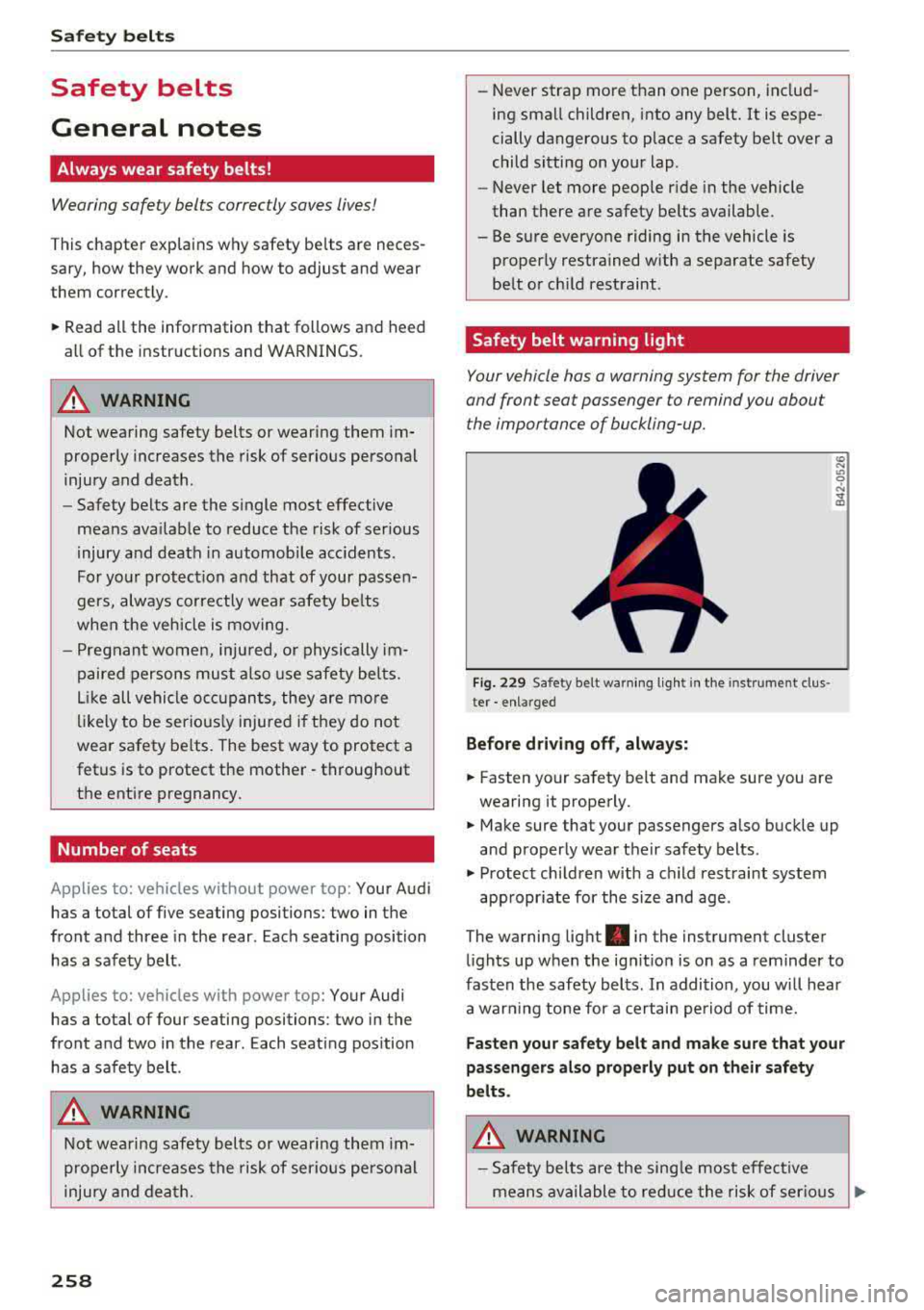
Safety belt warning light
Your vehicle has a warning system for the driver
and front seat passenger to remind you about the importance of buckling-up.
Fi g. 229 Safety belt warn ing lig ht in th e in st rument clus
ter -enlarged
Befor e dri ving off, alway s:
.. Fasten your safety belt and make sure you are
wearing it properly .
and properly wear t heir safety belts .
.. Protect children with a ch ild rest raint system
app ropr iate for the size and age .
The warning light . in the instrument cluster
li ghts up when the ig nition is o n as a rem inder to
fasten the safety belts . In addition, you wi ll hear
a war ning tone for a certain period of time.
Fasten your safety bel t and make sure that your
passengers al so prop erly put on th eir safety
belts .
&_ WARNING
-
-Safety belts are the sing le most effective
means available to red uce the risk of ser io us
.,,.
Page 261 of 400
injury and death in automobile accidents.
For your protection and that of your passen
gers, always correctly wear safety belts
when the vehicle is moving .
- Failure to pay attention to the warn ing light
that come on, could lead to personal injury.
Why use safety belts?
Frontal collisions and the law of physics
Frontal crashes create very strong forces for peo
ple riding in vehicles .
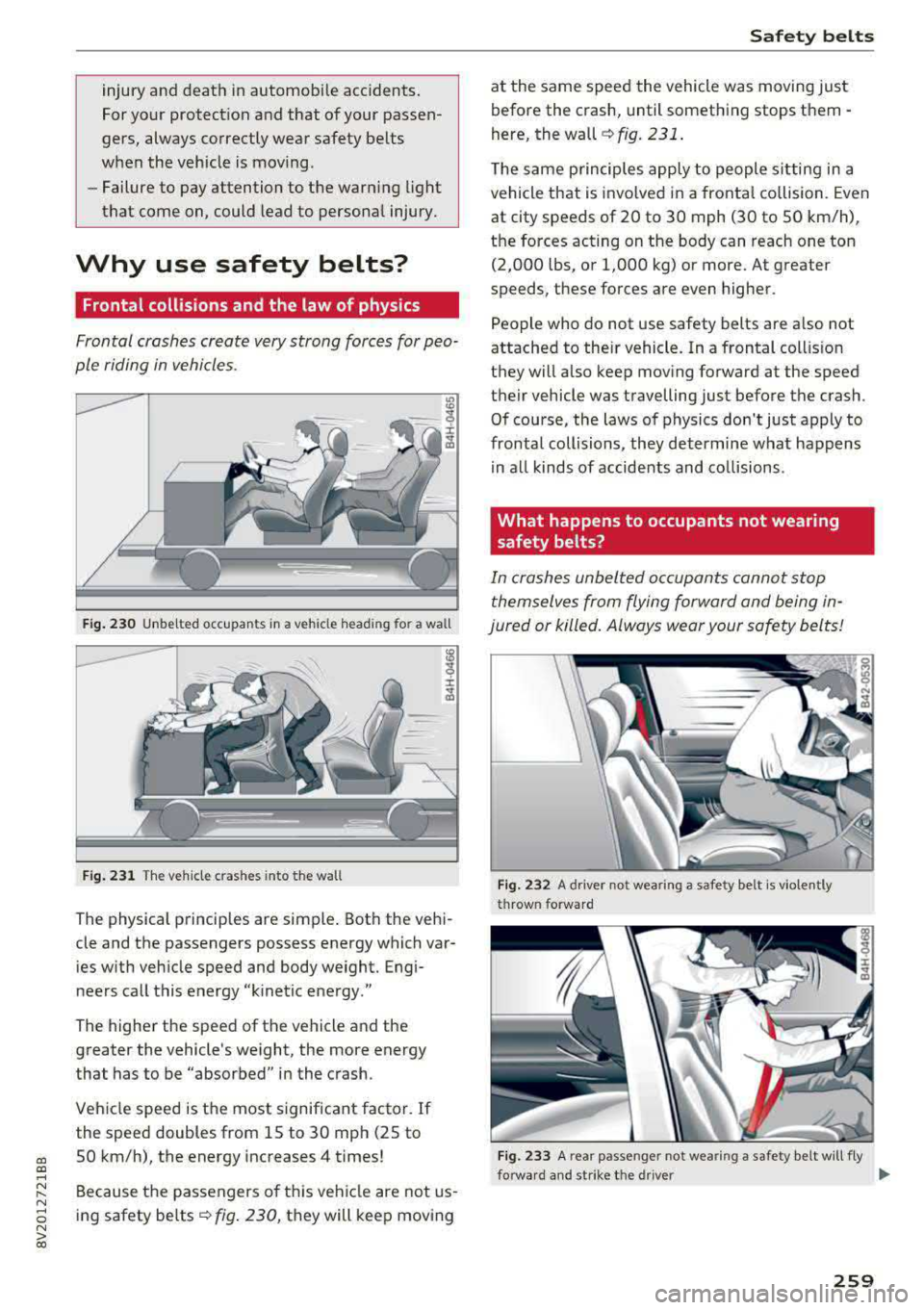
Fig . 230 Unbe lted occupants in a veh icle head ing fo r a wall
Fig . 23 1 The ve hicle c rashes into the wa ll
The physical principles are simple . Both the vehi
cle and the passengers possess energy which var
ies with vehicle speed and body we ight. Engi
neers call this energy "k inetic energy ."
The higher the speed of the vehicle and the
greater the vehicle's weight, the more energy
that has to be "absorbed" in the crash.
Vehicle speed is the most significant facto r. If
the speed doubles from 15 to 30 mph (25 to
a, 50 km/h), the energy increases 4 times! a, .....
~ Because the passengers of t his veh icle are not us-
"' 8 ing safety belts ~ fig. 230, they will keep mov ing N > 00
Safet y bel ts
at the same speed the vehicle was moving just
before the crash, until something stops them -
here, the wall
~ fig. 231 .
The same p rinciples apply to people s itting in a
vehicle that is invo lved in a fronta l co llision. Even
at city speeds of 20 to 30 mph (30 to SO km/h),
the forces acting on the body can reach one ton (2,000 lbs, or 1,000 kg) or more. At greater
speeds, these forces are even higher.
People who do not use safety belts are a lso not
attached to the ir vehicle . In a frontal coll is ion
they will also keep mov ing forward at the speed
their vehicle was travelling just before the crash .
Of course, the laws of physics don't just apply to
frontal collisions , they determine wha t happens
in a ll kinds of accidents and co llisions .
What happens to occupants not wearing
safety belts?
In crashes unbelted oc cupants cannot stop
themselves from flying forward and being in
jured or killed. Always wear your safety belts!
Fi g. 232 A driver not wear ing a safe ty belt is violen tly
throw n forward
F ig. 233 A re ar passe nge r not we aring a safety be lt w ill fly
forward and strike t he driver
Ill-
259
Page 264 of 400
Safe ty belts
Safety belts
Fastening safety belts
Safety fir st -everybody bu ckle up!
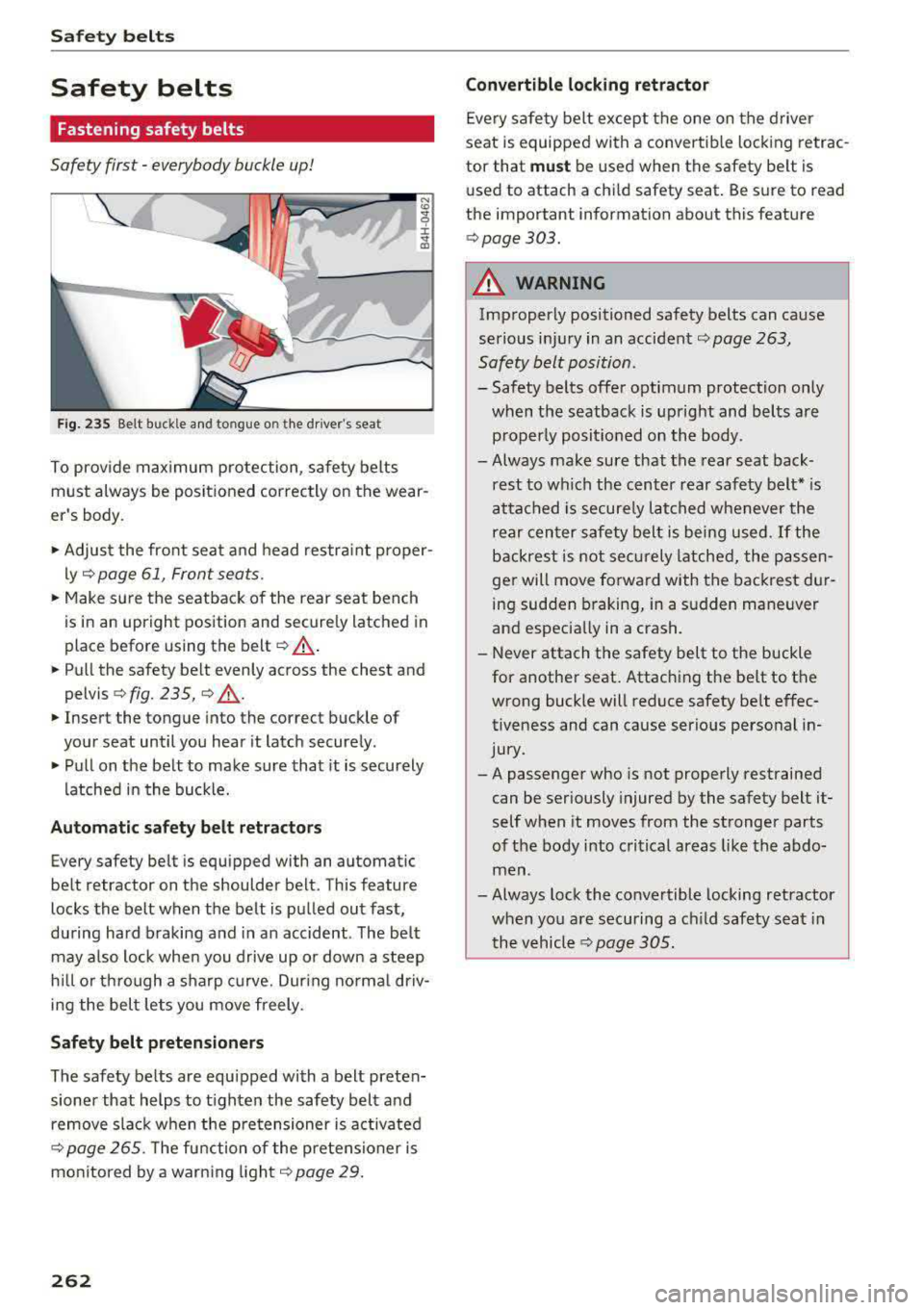
Fig. 235 Belt buckle an d tongue o n the driver's seat
To prov ide max imum protection, safety belts
must always be positioned correctly on the wear
er's body .
• Adjust the front seat and head restra int proper
ly ¢
page 61 , Front seats .
• Make sure the seatback of the rear seat bench
is in an upright position and secure ly latched in
place before us ing the
belt ¢,&. .
• Pull the safety belt evenly across the chest and
pelv is
¢fig. 235, ¢ ,&. .
• Insert the tongue into the correct buckle of
your seat until you hear it latch securely .
• Pull on the belt to make sure that it is securely
latched in the buck le.
Autom ati c safet y belt retr actors
Every safety belt is equipped with an automatic
belt retractor on the shoulder belt . This feature
locks the belt when the belt is pulled out fast,
during hard braking and in an accident . The belt
may a lso lock when you drive up or down a steep
h ill or th rough a sharp curve. Dur ing no rmal driv
ing the bel t lets you move freely.
Safe ty belt pret ension ers
The safety belts are equipped with a belt preten
sioner that helps to t ighten the safety belt and
remove slack when the pre tensioner is activated
¢ page 265. T he fu nction of the pretensioner is
monitored by a warning light ¢
page 29.
262
Convertibl e lock ing r etractor
Every safety belt except the one on the driver
seat is equipped with a convertib le lock ing retrac
tor that
mu st be used when the safety belt is
used to attach a child safety seat . Be sure to read
the important information about thi s feature
¢ page 303.
A WARNING
Improperly positioned safety belts can cause
serious injury in an accident ¢
page 263,
Safety belt position .
- Safety belts offer optimum protection only
when the seatback is upright and belts are properly posit ioned on the body .
- Always make sure that the rear seat back
rest to which the center rear safety belt* is
attached is securely latched whenever the
rear center safety belt is being used.
If the
backrest is not sec urely latched, the passen
ger will move forward with the back rest du r
ing sudden braking, in a sudden maneuver
and especia lly in a crash.
- Never attach the safety belt to the buckle for another seat. Attaching the belt to the
wrong buckle will reduce safety be lt effec
tiveness and can cause serio us personal in
jury.
-A passenger who is not properly restrained
can be seriously injured by the safety belt it
self when it moves from the stronger parts
of the body into critical areas like the abdo
men .
-Always lock the convertible locking retractor
when you are securing a c hild safety seat in
the vehicl e
¢page 305.
Page 271 of 400
CXl CXl .... N ,.__
N .... 0 N > 00
about children and Advanced Airbags
c::>page292 .
Even though yo ur vehicle is equipped with an Ad
vanced Airbag System, make certain that all chil
dren, especially those
12 years and younger, a l
ways ride in the back seat properly restrained for
their age and size. The airbag on the passenger
side makes the front seat a potentially dangerous
place for a child to ride. The front seat is not the
safest place for a child in a forward-facing child
safety seat .
It can be a very dangerous place for
a n infant or a child in a rearward-fac ing seat.
The Advanced Airbag System in your veh icle has
been certified to comply with the requirements
of United States Federal Motor Vehicle Safety
Standa rd (FMVSS)
208, as well as Canada Motor
Veh icle Safety Standa rd (CMVSS)
208 as applica
b le a t the time your veh icle was m an ufact ured.
Accord ing to requirements, the front Advanced
Airbag System on the passenger side has been
certified for "suppression" for infants of about
12 month old and younger and for "low risk de
ployment" for children aged 3 to 6 years old (as
defined in the standard) .
The
PASSENGER AIR BAG O FF light in the instru
ment panel tells you when the front Advanced
Airbag on the passenger side has been turned
off
by the electronic control unit.
Each time yo u switch on the ignition, the
PAS ·
S ENGER AIR BAG OFF
light will come on for a
few seconds and:
- will stay on if the front passenger seat is not
occupied,
- will stay on if the electrical capacitance meas
ured by the capac itive passenger detection sys
tem for the front passenger seat equals the combined capacitance of an infant up to about
one year of age and one of the rearward-facing
or forward-facing child restraints listed in Fed
era l Moto r Vehicle Safety Standard
208 w it h
which the Advanced Airbag System in your veh i
cl e was certified . Fo r a listing of the child
re
strain ts th at were used to ce rtify you r vehicle's
compliance with the U.S. Safety Standard
c::>page295 .
Airbag sys tem
-wi ll stay on if there is a small child or c hild re
straint on the front passenger seat,
- will go
off if the front passenge r seat is occu
pied by an adult as registered by the capac itive
passenger detection system
c::, page 2 79, Mon
itoring the Advanced Airbag System.
T he PASSENGER AIR BAG OFF lig ht comes on
when e lectrica l capacitance registered on the
front passenger seat is equal to or less t han the
combined capacitance of a typical
1 year-old in
fant and one of the rearward-facing or forward
facing child restraints listed in Federal Motor
Ve
hicle Safety Standard 208 w ith which the Ad
vanced Airbag System in your vehicle was certi
fied.
If the total e lectr ica l capacitance reg istered on
t h e front passenger seat is more than that of a
typ ical 1 year-old ch ild but less than the weight
of a sma ll adult, the front airbag on the passen
ger side can deploy (the
PASSENGER AIR BAG
OFF
light does not come on).
If the PASSENGER AIR BAG OFF light does not
come on, the front airbag on the passenger side
has not been turned off by the electron ic con trol
u ni t and can dep loy if the control unit senses an
impact that meets the cond itions s tored in its
memory .
For example , th e airbag may deplo y if:
- a small ch ild that is heav ier than a typ ical 1
year-o ld child is on the front passenger seat
(regardless of whethe r the child is in one of the
child safety seats listed
c::, page 295), o r
- a child who has outgrown c hild rest raints is on
the front passenge r seat.
If the front passenger airbag is turned off, the
PASSENGER AIR BAG OFF light comes on in the
inst rument cluste r and stays on .
If the front passenger airbag deploys, the Feder
al Standard requires the airbag to meet the " low
risk" deployment cr iteria to reduce the r isk of
in
jury through interact ion w ith the airbag . "Low
r isk" dep loymen t occurs in those crashes tha t
t ak e place at lowe r decelerations as defined in
the e lectronic cont rol unit
c::, page 2 79, PASSEN -
GER AIR BAG OFF light.
Ill>
269
Page 272 of 400
Airbag syste m
Always remember, a child safety seat or infant
carrier installed on the front seat may be struck
and knocked out of position by the rapidly inflat
ing passenger's airbag in a frontal collision. The
airbag could greatly reduce the effectiveness of
the child restraint and
even seriously injure the
child dur ing inflation.
For this reason, and because the back seat is the
safest place for children - when properly restrain
ed according to the ir age and size -we strongly
recommend that children always sit in the back
seat ¢ page 292, Child safety.
A WARNING
A child in a rearward-facing chi ld safety seat
installed on the front passenger seat w ill be
seriously injured and can be killed if the front
airbag inflates -
even with an Advanced Airbag
System.
- The inflating airbag will hit the child safety
seat or infant carrier with great force and
will smash the chi ld safety seat and child
against the backrest, center armrest, door
or roof.
- Always install rear-facing child safety seats
on the rear seat.
- If you must install a rearward facing chi ld
safety seat on the front passenger seat be cause of exceptional circumstances and the
PA SSENGER AIR BAG OFF light does not
come on and stay on, immed iately install
the rear-fac ing ch ild safety seat in a rear
seat ing pos ition and have the airbag system
inspected by your Audi dealer.
- Forward-facing ch ild safety seats installed
on the front passenger's seat may interfere
with the deployment of the airbag and ca use serio us personal injury to the child .
A WARNING
If, in exceptional circumstances, you must in
stall a forward-facing chi ld restraint on the
front passenger's seat:
- Always make sure the forward -facing seat
has been designed and ce rtified by its man
u facturer for use on a front seat with a pas
senger front and side a irbag.
270
- Never put the fo rward-facing child restraint
up against or
very near the instrument pan
el.
- Always move the front passenger seat to
the highest posit ion in the up and down ad
justment range and move it back to the rearmost posit ion in the seat's fore and aft
ad justment range, as far away from the a ir
bag as poss ible, before install ing the for
ward-facing chi ld restraint.
- Always make sure that the safety be lt upper
anchorage is behind the ch ild rest raint and
not next to o r in front of the child rest raint
so that the safety be lt will be properly posi
tioned.
- Ma ke sure that the
PASSENGER AIR BAG
OFF
light comes on and stays on a ll the time
wheneve r the ignit ion is switched on .
A WARNING
-
To reduce the risk of serious injury, make sure
that the
PASSENGER AIR BAG OFF light will
be d isp layed whenever a ch ild restraint is in
stalled on the front passenge r seat and the
ignition is switched on.
- If the
PASSENGER AIR BAG OFF light does
not stay on, perform the checks described
¢ page 2 79, Monitoring the Advanced Air
bag System .
-Take the child restraint off the front passen
ger seat and install it properly at one
of the
rear seat positions if the
PASSENGER AIR
BAG OFF
light does not stay on.
- Have the airbag system inspected by your
Aud i dea le r i mmediately.
- Always carefully follow instructions from child restraint manufacture rs when instal
ling child restra ints.
A WARNING
If, in exceptional ci rcumstances, you must in
stall a forward or rearward-fac ing child re
stra int on the front passenger's seat:
- Improper installat ion of child restr aints can
reduce the ir effectiveness or
even preven t
them from provi ding any pro te ct ion .
Page 275 of 400
CXl CXl .... N ,.__
N .... 0 N > 00
(CMVSS) 208 as ap plic able at the time your vehi
cle was manufactured.
The front Advanced Airbag System supp lements
the safety belts to prov ide additional pro te ction
for the driver's and front passenger 's heads and
upper bodies in frontal crashes . The airbags in
flate only in fronta l impacts when the veh icle de
celerat ion is high enough.
The front Advanced Airbag System for the front
seat occupants is not a substitute for your safety be lts. Rather, it is part of the overa ll occupant re
stra int system in your vehicle. A lways remember
that the airbag system can only help to protect
you, if you are sitting upr ight, wear ing your safe
ty belt and wear ing it properly. This is why you
and your passengers must always be properly re
stra ined, not jus t because the law requ ires yo u to
be.
The Advanced Airbag System in your ve hicle has
been ce rtified to meet the
"low r isk" requi re
men ts for 3 and 6 yea r-o ld children o n the pas
senger side and very sma ll adul ts on the drive r
side . The low r isk dep loymen t cr iteria are inten d
ed to help reduce the risk of injury through inter
action with the front airbag that can occur, for
examp le, by being too close to the steering wheel
and instrument pane l when the airbag inflates .
I n addition, the system has been certified to
comp ly with the "supp ression" requirements of
the Safety Standard, to turn off the front a irbag
for infants 12 months old and younger who are
restrained on the front passenger seat in child re
stra ints that are listed in the Standard
c::> page 295, Child restraints and Advanced front
airbag system.
"Suppress ion" requ ires the front a irbag on the
passenger side to be turned off if:
- a ch ild up to about one year of age is restrained
on the front passenger seat in one of the rear
facing or forward-fac ing infant restra ints listed
in Federal Motor Vehicle Safety Standard 208
with wh ic h the Advanced Ai rbag System in your
vehicle was ce rt ified. For a listi ng of the ch ild
restra ints tha t were used to certify your veh i
cl e's compl iance wi th the US Safe ty St andard
c::> page 295,
Airb ag sys tem
-When a pe rson is detected on the front passen
ger seat that has an elect rical capacitance that
is more than the total e lectr ica l capacitance of
a child that is about
1 year o ld restrained in one
of the rear-fac ing or forward-facing infant re
straints (listed in Federa l Motor Vehicle Safety
Standard 208 with which the Advanced Airbag
System in you r vehicle was cert ified), t he front
ai rbag on the passenger side may or may no t
dep loy.
T he
PASSENGER AIR BAG OFF lig ht comes o n
whe n the elect ronic control unit detects a tota l
elect rical capacitance on the front passe nger sea t
t h at re quires the front airbag to be turned off. If
t h e
PASSENGER AIR BAG OFF ligh t does not
come on, the front airbag on the passenger side
has not been turned off by the contro l unit and
can deploy if the contro l unit senses an impact
that meets the cond itions stored in its memory.
If the total e lectr ica l capacitance registered on
the front passenger seat is more than that of a
typ ica l 1 year -old, b ut less than the weight of a
small adult, the front a irbag on the passenger
s ide may deploy (the
PASSENGER AIR BAG OF F
light does not come on) .
For e xample , the airbag may deploy if :
-a small ch ild that is heav ier than a typ ica l 1
yea r-old child is on the front passenger seat
(regard less of whether the child is in one of the
child safety seats listed
c::> page 295),
- a child who has outgrown c hild restraints is on
the front passenger seat .
If the front passenge r a irbag is t urned off, the
PASSENGER AIR BAG OFF light in the center of
the instr ument pane l will come on and stay on .
If the front passenge r a ir bag deploys, the Feder
al S tanda rd requi res t he ai rbag to meet the " low
risk" deployment criteria to he lp red uce the r isk
of i njury through interaction with the airbag .
" Low risk" deployment occurs in those crashes
that take p lace at lower decelerations as defined
in the electronic contro l unit ¢
page 279.
Alway s remember : Even though yo ur vehicle is
equipped with Advanced Airbags, the safest place
for children is properly restrained on the back
..,.
273
Page 276 of 400
Airbag syste m
seat. Please be sure to read the important infor
mation in the sections that follow and be sure to
heed all of the WARNINGS.
A WARNING
To reduce the risk of injury when an airbag in
flates, always wear safety belts properly.
- If you are unrestrained, leaning forward, sit ting s ideways or out of position in any way,
your risk of injury is much h igher.
- You will also receive serious injuries and could even be killed if you are up aga inst the
airbag or too close to it when it inflates -
even with an Advanced Airbag
c::> page 267 .
A WARNING
A child in a rearward-facing chi ld safety seat
installed on the front passenge r seat w ill be
ser iously injured and can be killed i f the front
airbag inflates
-even w ith an Advanced Ai rbag
System.
-Although the Advanced A irbag System in
yo ur vehicle is designed to tu rn off the front
airbag when a rearwa rd -facing child re
straint has been insta lled on the front pas
senger seat, nobody can absolutely guaran
tee that deployment is impossible in all con
ceivable s ituations that may happen during
the useful life of your vehicle .
- The inflating a irbag w ill hit the child safety
seat or infant carrier with great force and
will smash the chi ld safety seat and child
against the backrest, center armrest , door,
o r roof .
- Always install rearward -facing ch ild re
straints on the rear seat .
- If you must install a rearward fac ing ch ild
safety seat on the front passenger seat be
cause of exceptiona l circumstances and the
PASSENGER AIR BAG OFF light does not
come on and s tay on, immed iate ly install
the rear-fac ing ch ild safety seat in a rear
seating position and have the airbag system
inspected by your Audi dealer.
274
A WARNING ,_
If, in exceptional circumstances, you must in
stall a forward-facing child restraint on the
front passenger's seat:
- Always make sure the forward-facing seat
has been des igned and certified by its man
ufacturer for use on a front seat with a pas
senger front and side airbag.
- Never put the forwa rd-facing child restraint
up against or very nea r the instrument pan
el.
- Always move the front passenge r seat to
the highest posit ion in the up and down ad
justmen t range and move it back to the
rearmost posit io n in the seat's fo re and aft
adjustment range, as far away from the a ir
bag as poss ible, before install ing the for
ward-facing chi ld restraint.
- Always make sure that the safety be lt upper
anchorage is behind the chi ld rest raint and
not next to o r in front of the c hild restraint
so that the safety be lt will be p roper ly posi
tioned.
- Always make sure that there is noth ing on
the front passenger seat that will cause the
capacitive passenger detection system in
the seat to signal to the Airbag System that
the seat is occup ied by a person when it is
no t, or to signal that it is occupied by some
one who is heavier than the person ac tually
si tting on the sea t. T he presence of addi
tional objects could cause the passenger
front airbag to be turned on when it should
be
off, or could cause the airbag to work in a
way that is d ifferent from the way it wou ld
have worked without the object on the seat.
- Make sure that the
PASSENGER AIR BAG
OFF
li ght comes on and stays on all the time
whenever the ign it ion is switched on.
Advanced Airbag System components
T he front passenger seat in your veh icle has a lot
of ve ry important parts of the Advanced A irbag
System i n it. These parts incl ude the capacitive
passenger detection system, wir ing , b rackets,
and more. The control uni t moni tors the system
on the front passenge r seat when t he ignit ion is
..,.