change wheel AUDI A3 SEDAN 2018 User Guide
[x] Cancel search | Manufacturer: AUDI, Model Year: 2018, Model line: A3 SEDAN, Model: AUDI A3 SEDAN 2018Pages: 404, PDF Size: 62.3 MB
Page 282 of 404
Airbag syste m
A WARNING
A child in a rearward-facing child seat instal
led o n the front passenger seat will be ser i
ously injured and can be k ille d if the front air
bag in flate s - even with an Advanced Airbag
System.
- The inflating a irbag w ill hit the child seat or
infant carrier w ith great force and will
smash the ch ild seat and child against the
backrest, cente r arm rest, door or roof.
- Always install rear-facing child seats on the
rea r seat.
- If you must install a rearward fac ing ch ild
seat on the front passenger seat because of
exceptional c ircumstances and the
PASSEN
GER AIR BAG OFF
light does not come on
and stay on, immediately insta ll the rear
facing child seat in a rear seating position and have the airbag system inspected by
your Audi dealer.
A WARNING
-
-
Objects between you and the a irbag w ill in
crease the risk of in jury in a crash by interfer
ing w ith the way the airbag unfolds or by be
ing pushed into you as the a irbag inflates.
- Never hold th ings in your hands or on your
lap when the vehicle is in use .
- Never transport items on or in the area of
the fron t passenger seat . Objects could
move into the area of the front airbags du r
ing bra king or other sudden maneuve rs and
become dangerous projec tiles that c an
ca use serious pe rsonal injury if the a irbags
inflate.
- Never pl ace or attach accessor ies or o ther
objects (such as cup ho lders, te lephone
brackets, large, heavy or bulky objects) on
the doors, over or nea r the area marked
"AIRBAG" on the steering wheel, instru
ment pane l, seat backrests or between
those areas and yourself. These objects could cause injury in a crash, especially
when the airbags infla te.
- Never recline the front passenger's seat to
transport objects . Items can also move into
the a rea of the side airbag o r the front a ir-
280
bag du ring brak ing o r in a sudden maneu
ver. Objects near the airbags can become pro jecti les and cause injury, part icularly
when the seat is reclined .
- Never p lace or transport objects on the
front passenger seat. Objects on the front passenger seat could cause the capacitive
sensor in the seat to signal to ai rbag system
that the seat is occ upied by a person when it
in fact is no t, or that the pe rson on the seat
is he avie r th an he or she act ually is. The
change in electric capacitan ce beca use of
such objects can cause the passenge r front
airbag to be turne d on when it should be
off, or can cause the airbag to work in a way
that is different from the way it would have
wo rked without objects on the seat.
- Always make sure that there is noth ing on
the front passenger seat that will cause the
capacitive passenger detection system in
the sea t to signal to the Airbag System that
the seat is occup ied by a person when it is
not, or to signal that it is occupied by some
one who is heavier th an the person actu ally
si tting on the sea t. The presence of an o b
ject could ca use the passenger front air bag
to be turned on when it should be off, or
could cause the airbag to work in a way that is diffe rent from the way it would have
worked without the object on the seat.
A WARNING
The fine dust created when airbags deploy can
cause breathing prob lems for people with a
h istory of asthma or othe r breath ing cond i
tions .
- To reduce the r isk of breathing p roblems ,
those wi th asthma o r other respiratory con
ditions sho uld get fresh a ir rig ht away by
getting out of the vehi cle or opening win
dows or doors.
- If you are in a co llision in which airbags de
ploy, w ash yo ur hands and f ace with m ild
soap and water be fore eating.
- Be ca refu l not to get the dust into your eyes,
or into any cuts or scratches.
- If the residue sho uld get into your eyes,
flush them w ith wate r.
Page 286 of 404
Airbag syste m
seat into its rearmost position in the seat's
fore and aft adjustment range, as far away
from the airbag as possible. The backrest must be adjusted to an upright posit ion .
Make sure that the
P A SSEN GER AIR BAG
OFF
light comes on and stays on all the t ime
whenever the ignition is sw itched on.
A WARNING
- If the PASSENGER AIR BAG OFF light does
not go o ut w hen an ad ult is sitting on the
front passenger seat after taking the steps
described above, make sure the adu lt is
properly seated and restrained at one of the
rear seating positions .
- Have the airbag system inspected by your
Audi dealer before transporting anyone on
the front passenger seat .
(D Tips
If the capacitive passenge r detection system
determines that the front passenger seat is
empty, the fronta l airbag on the passenger
side w ill be turned off, and the
PA SSE NGER
AIR BAG OFF light will stay on.
Repair , care and disposal of the airbags
Parts of the a irbag system are installed at many
d ifferent places on your Aud i. Install ing , remov
ing, servic ing or repa iring a part in an area of the
ve hicle can damage a pa rt of an airbag system
and p revent that system from working properly
in a co llision .
There are some important th ings you have to
know to make sure that the effect iveness of the
system w ill not be impaired and th at discarded
components do not cause injury or pollute the
environment .
A WARNING
Improper care, servicing and repair proce
dures can increase the r isk of personal injury
and death by preventing an airbag from de
ploying when needed or dep loying an airbag
unexpectedly:
284
-
- Never cover, obstruct, or change the steer
ing wheel horn pad or airbag cover or the in
strument panel or modify them in any way.
- Never attach any objects such as cup ho lders
or telephone mountings to the surfaces cov
ering the a irbag un its .
- For cleaning the horn pad or instrument panel, use only a soft, dry cloth or one mois
tened w it h plai n water . Solvents or cleaners
could damage the airbag cover or change
the st iffness or strength of the material so
that the ai rbag cannot deploy and p rotect
p roperly.
- Never repair, ad just, o r change any parts of
the airbag system.
- All work on the steer ing wheel, inst rument
pa nel, front seats o r electr ica l system ( in
cl uding the insta llation of a udio eq uipment,
cell ular te lephones and CB radios, etc.)
m ust be performed by a qualified techn ician
who has the training and specia l equipment
necessary.
- For any work on the airbag system, we
strong ly recommend that you see yo ur a u
thorized A udi dealer or qualified workshop .
- Never modify the front b umper or parts of
the vehicle body.
-Always make sure that the side airbag can inf late wit hout interference:
- Never install seat covers or replacement upholstery ove r the front seatbacks that
have not bee n specifica lly approved by
A udi .
- Never use additional seat c ushi ons that
cover the areas where the side airbags in
flate.
- Damage to the orig inal seat cove rs or to
t h e seam in the area of the s ide a irbag
module mus t always be repai red immedi
ate ly by an authorized Aud i dealer.
- The airba g sys tem can deploy o nly on ce. Af
t er an airbag has been dep loyed, i t m ust be
replaced with new replaceme nt parts de
signed and approved especia lly for your
Aud i mode l version . Rep lacement of com
plete airbag systems or airbag components
must be performed by qua lified workshops
only . Make sure t hat any airbag service
Page 287 of 404
LL co .... N
" N .... 0 N > co
action is entered in your Audi Warranty &
Maintenance booklet under
AIRBAG RE
PLACEMENT RECORD.
- Applies to plug-in hybrid* vehicles: In the
event of a collision where the airbags de
ploy, the electrical connection to the high
voltage battery is automatically disconnect
ed. This prevents a short c ircuit.
@) For the sake of the environment
Undeployed airbag modules and pretension
ers might be classified as Perchlorate Materi
al - special handling may apply, see
www.dtsc.ca.gov/hazardouswaste/perchlo
rate. When the vehicle or parts of the re
straint system including airbag modules and
safety belts with pretensioners are scrapped,
all applicable laws and regulations must be
observed. Your authorized Audi dealer is fa
miliar with these requirements and we recom
mend that you have your dealer perform this
service for you.
Other things that can affect Advanced
Airbag performance
Changing the vehicle's suspension system can
change the way that the Advanced Airbag System
performs in a crash. For example, using tire-rim
combinations not approved by Audi, lowering the
vehicle, changing the stiffness of the suspension, including the springs , suspension struts, shock
absorbers etc. can change the forces that are
measured by the airbag sensors and sent to the
electronic control unit . Some suspension changes
can, for example, increase the force levels meas
ured by the sensors and make the airbag system
deploy in crashes in which it would not deploy if
the changes had not been made. Other kinds of
changes may reduce the force levels measured by
the sensors and prevent the airbag from deploy
ing when it should.
A WARNING
Changing the vehicle's suspension including
use of unapproved tire-rim combinations can
change Advanced Airbag performance and in-
.
Airbag system
crease the risk of serious personal injury in a
crash.
- Never install suspension components that
do not have the same performance charac
teristics as the components originally instal led on your vehicle.
- Never use tire-rim combinations that have
not been approved by Audi.
Knee airbags
Description of knee airbags
Applies to: vehicles with knee airbags
The knee airbag system can provide supplemen
tal protection to properly restrained front seat
occupants.
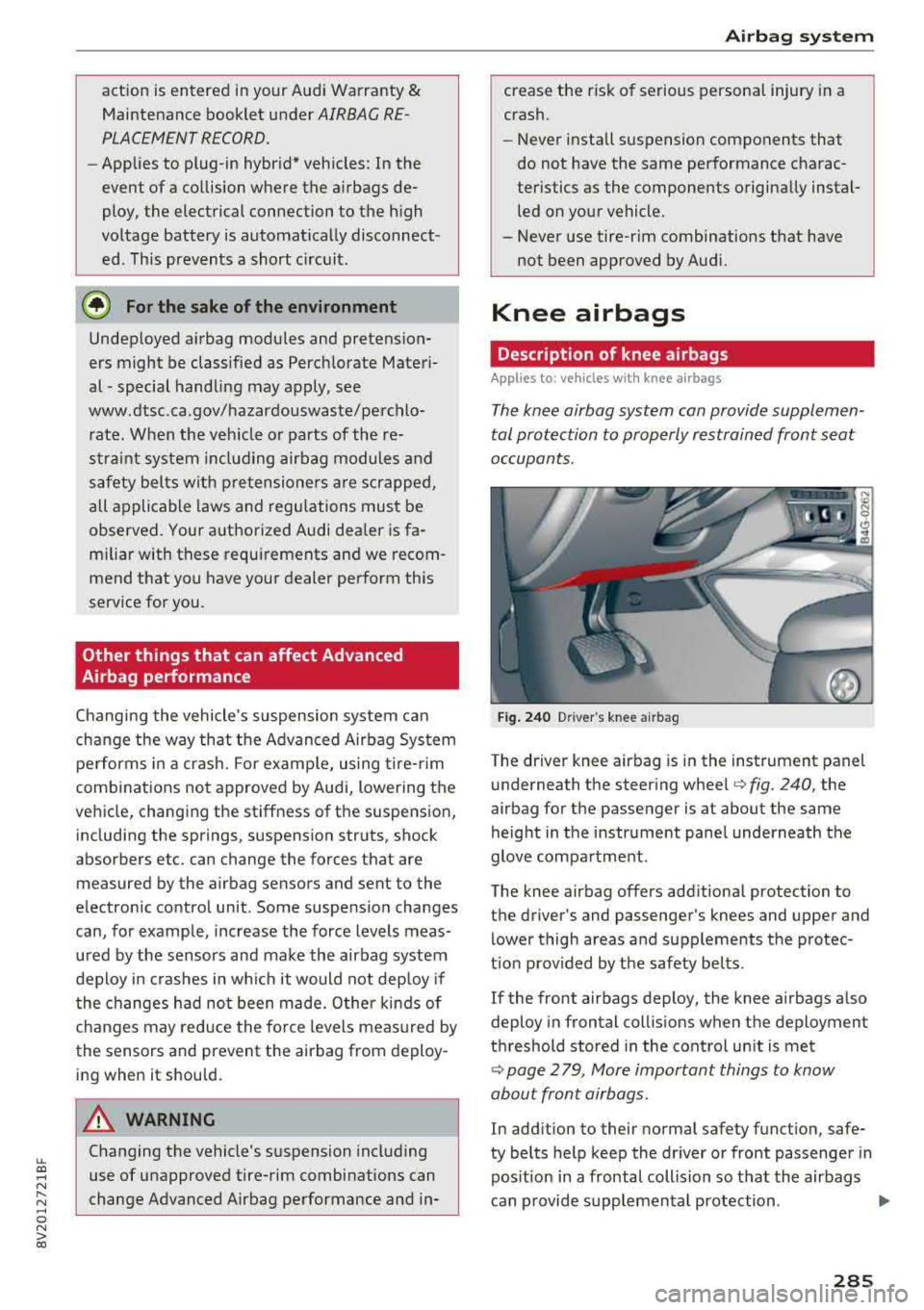
Fig. 240 Driver 's knee airbag
The driver knee airbag is in the instrument panel
underneath the steering
wheel¢ fig. 240, the
airbag for the passenger is at about the same
height in the instrument panel underneath the
glove compartment.
The knee airbag offers additional protection to
the driver's and passenger's knees and upper and
lower thigh areas and supplements the protec
t ion provided by the safety belts.
If the front airbags deploy, the knee airbags also
deploy in frontal collisions when the deployment
threshold stored in the control unit is met
¢ page 2 79, More important things to know
about front airbags .
In addition to their normal safety function, safe
ty belts help keep the driver or front passenger in
posit ion in a frontal collision so that the airbags
can provide supplemental protection .
..,.
285
Page 337 of 404
u. a, ... N
" N ... 0 N > a:,
Production options weight
means the combined weight of
those installed regular production
options weighing over 5 lbs.
(2.3 kg) in excess of those stand
ard items which they replace, not
previously considered in curb
weight or accessory we ight, in
c luding heavy duty brakes, ride
levelers, roof rack, heavy duty
battery, and special trim .
Radial ply tire
means a pneumatic tire in which
the ply cords that extend to the beads are laid at substantially
90 degrees to the centerline of
the tread.
Recommended inflation
pressure
see ¢ page 333, Cold tire infla
tion pressure .
Reinforced tire
means a tire designed to operate
at higher loads and at h igher in
flat ion pressures than the corre
sponding standard tire. Rein
forced t ires may be identified as
"XL " "xl" "EXT RA LOA D" or "RF" , , ,
on the sidewall.
Wheels
Rim
means a metal support for a tire
or a tire and tube assembly upon
which the tire beads are seated .
Rim diameter
means nominal diameter of the
bead seat. If you change your
whee l size, you will have to pur
chase new tires to match the new
rim diameter .
Rim size designation
means rim diameter and width .
Rim width
means nominal distance between
rim flanges .
Sidewall
means that portion of a ti re be
tween the tread and bead.
Speed rating (letter code)
means the speed at which a tire is
designed to be driven for extend
ed periods of time . The rat ings
range from
93 mph (150 km/h)
to
186 mph (298 km/h) ¢ table
on page 331.
You may no t find
this info rmat ion on all tires be
cause it is not required by law.
T he speed rating letter code,
where applicable, is molded on
the tire sidewall and indicates t he
11>
335
Page 344 of 404
Wheels
-The tire must flex more if the
tire pressure is too low or if
the vehicle speed or load are
too high. This heats the tire up
too much. This increases the
risk of an accident because it
can cause the tire to burst and
result in loss of vehicle con
trol.
-Incorrect tire pressure in creases tire wear and has a
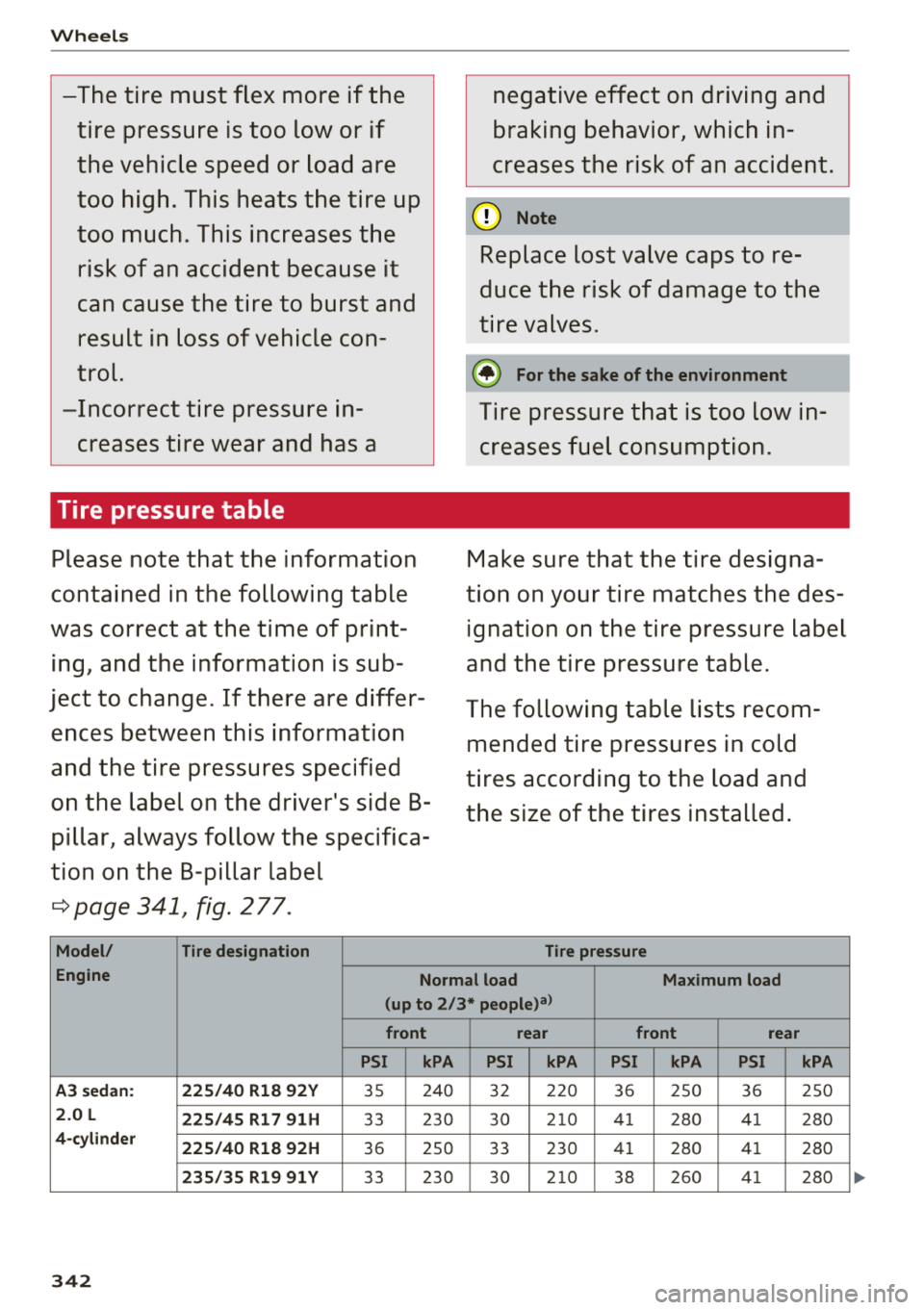
Tire pressure table
Please note that the information
contained in the following table
was correct at the time of print
ing, and the information is sub
ject to change. If there are differ
ences between this information
and the tire pressures specified
on the label on the driver's side B
pillar, always follow the specifica
tion on the B-pillar label
c> page 341 , fig. 2 77.
Model/ Tire designation
negative effect on driving and
braking behavior, which in
creases the risk of an accident.
@ Note
Replace lost valve caps to re
duce the risk of damage to the
tire valves.
@ For the sake of the environment
Tire pressure that is too low in creases fuel consumption.
Make sure that the tire designa
tion on your tire matches the des
ignation on the tire pressure label
and the tire pressure table.
The following table lists recom mended tire pressures in cold
tires according to the load and
the size of the tires installed.
Tire pressure
Engine Normal load Maximum load
(up to 2/3*
people)al
front rear front rear
PSI kPA PSI kPA PSI kPA PSI kPA
A3 sedan: 225/40 R18 92Y 35 240 32 220 36 250 36 250
2.0 L
225/45 R17 91H 33 230 30 210 41 280 41
280
4-cylinder
225/40 R18 92H 36 250 33 230 41
280 41 280
235/35 R19 91 Y 33 230 30 210 38 260 41 280
342
Page 351 of 404
u. 00 .-< N l' N .-< 0 N > 00
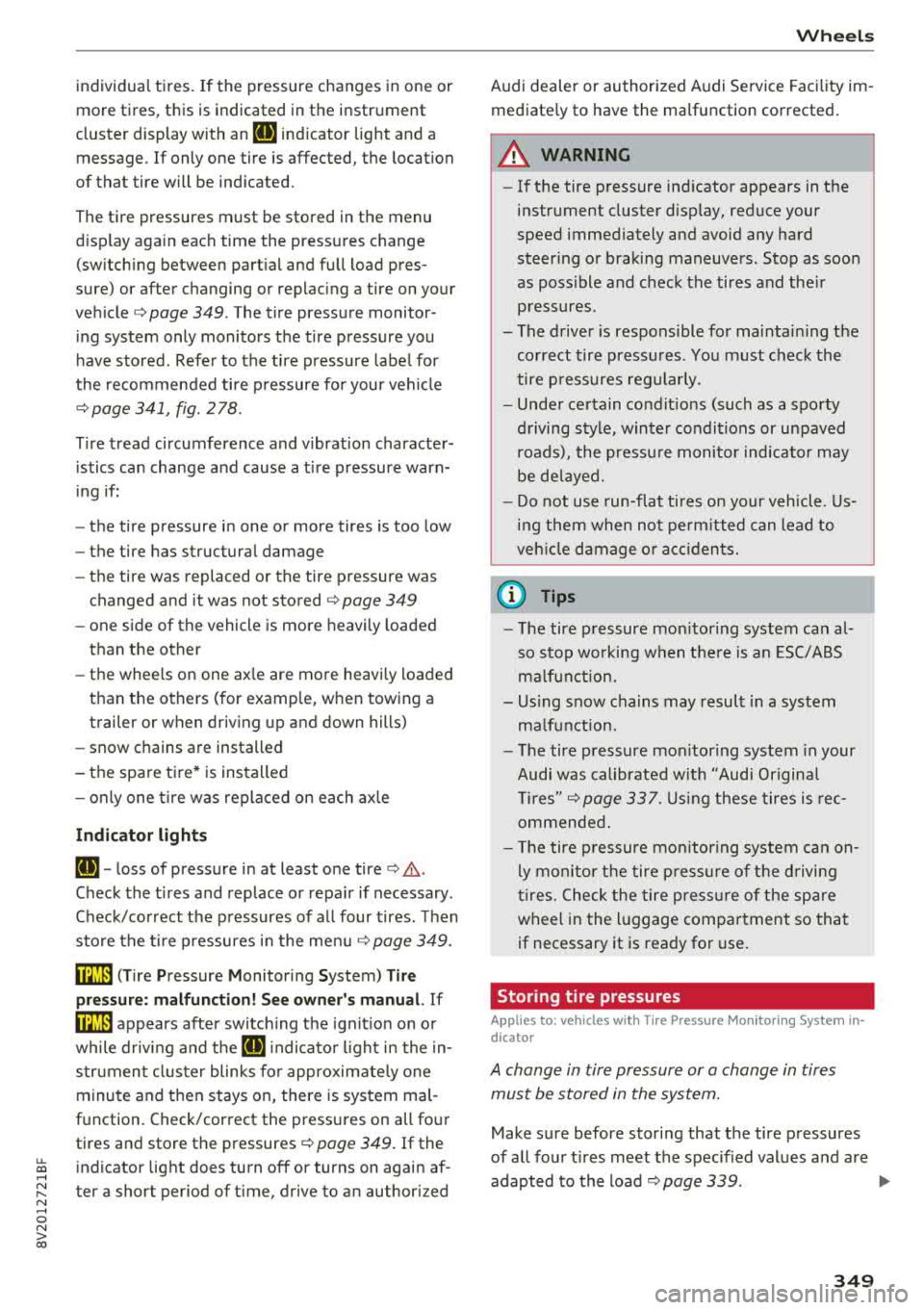
individual tires. If the pressure changes in one or
more tires, this is indicated in the instrument
cluster display with an
RE ind icator light and a
message . If only one tire is affected, the location
of that tire w ill be ind icated.
The tire pressures must be stored in the menu
d isp lay aga in each time the press ures c hange
(sw itching between part ial and fu ll load p res
sure) or after changing or replac ing a tire on your
ve hicle
r=>page 349 . The t ire pressure monitor
in g sys tem only monito rs t he tire pressure you
have stored . Refe r to the ti re p ressure labe l for
the recommended ti re p ressure for you r veh icle
r=>page 341, fig. 278.
Tire tread circumference and v ibrat ion character
i stics can change a nd cause a t ire pressure warn
in g if:
- the tire pressure i n one or more tires is too low
- the tire has structura l damage
- the tire was replaced o r the tire p ressure was
changed and it was not stored
r=> page 349
- one si de of the vehicle is more heavily loaded
than the other
- th e whee ls on one ax le are mo re heavi ly loaded
t h an the others (for examp le, w hen tow ing a
trailer or when driv ing up and down hills)
- snow c hains a re installed
- the spare t ire* is ins talle d
- on ly one tire w as replaced on each ax le
Indicator lights
RE -loss of pressu re in at least one tire r=> ,&. .
Check the ti res and rep lace o r repa ir if necessary .
C heck/ co rrect t he p ressures of a ll four tires. Then
s to re t he ti re p ressures i n the men u
r=> page 349 .
mm (Ti re Pressure Monitori ng System) Tire
pressure: malfunction! See owner's manual. If
mm appears after switching t he ign it io n on o r
while driving and the
RE i ndicato r light in the in
s trumen t cluster blinks fo r approxim ately one
minu te and t hen stays o n, there is system ma l
f u nction. Check/cor rect the pressu res on all fo ur
tires an d sto re t he p ressures
r=> page 349. If the
ind icator light does turn
off or turns on again af
ter a short per iod of t ime, drive to an author ized
Wheels
Audi dealer or author ized A udi Se rvice Fac ility im
med iate ly to have the ma lfu nction co rrected.
A WARNING
--
- If the tire p ressure ind icator appears in the
instr ument cluster disp lay, reduce your
speed immediately and avoid any hard
steer ing o r braking maneuvers . Stop as soon
as poss ible and check the tires and the ir
p ressures.
- The drive r is responsible fo r maintain ing the
correct tire press ures . You must check the
tire p ressures regularly.
- Unde r ce rtain condit ions (such as a sporty
d riving s tyle, win ter condi tions or unpaved
roads), the pressu re moni tor indicator may
be de layed.
- Do not use run -flat tires on your vehicle. Us
ing them when no t pe rm itted can lead to
veh icle d amage o r acc id en ts .
(D Tips
- The tire p ressure mon itoring system can al
so s top working w hen
th ere is a n ESC/ ABS
m alfunc tion.
- Us ing snow chains may resul t in a system
m alfu nction.
- The tire p ressure mon itoring system in your
Audi was calibrat ed with "Audi Original
Ti res"
r=>page 33 7. Usi ng these tires is rec
ommende d.
- The tire p ressure mon itoring system can on
ly moni to r the tire p res sure o f the d riving
t ires. Check the tir e press ure o f the spare
wheel in the l uggage compa rtment so tha t
if necessary it is ready for use .
Storing tire pressures
Applies to: vehicles wit h Tir e Pressure Monito rin g Syste m in·
dicator
A change in tire pr essure or a change in tires
must be stored in the system.
Make su re before stori ng that the tire p ressures
of all fo ur tir es meet the specified val ues and a re
adapted to the load
r=> pag e 339. .,,.
349
Page 352 of 404
Wheels
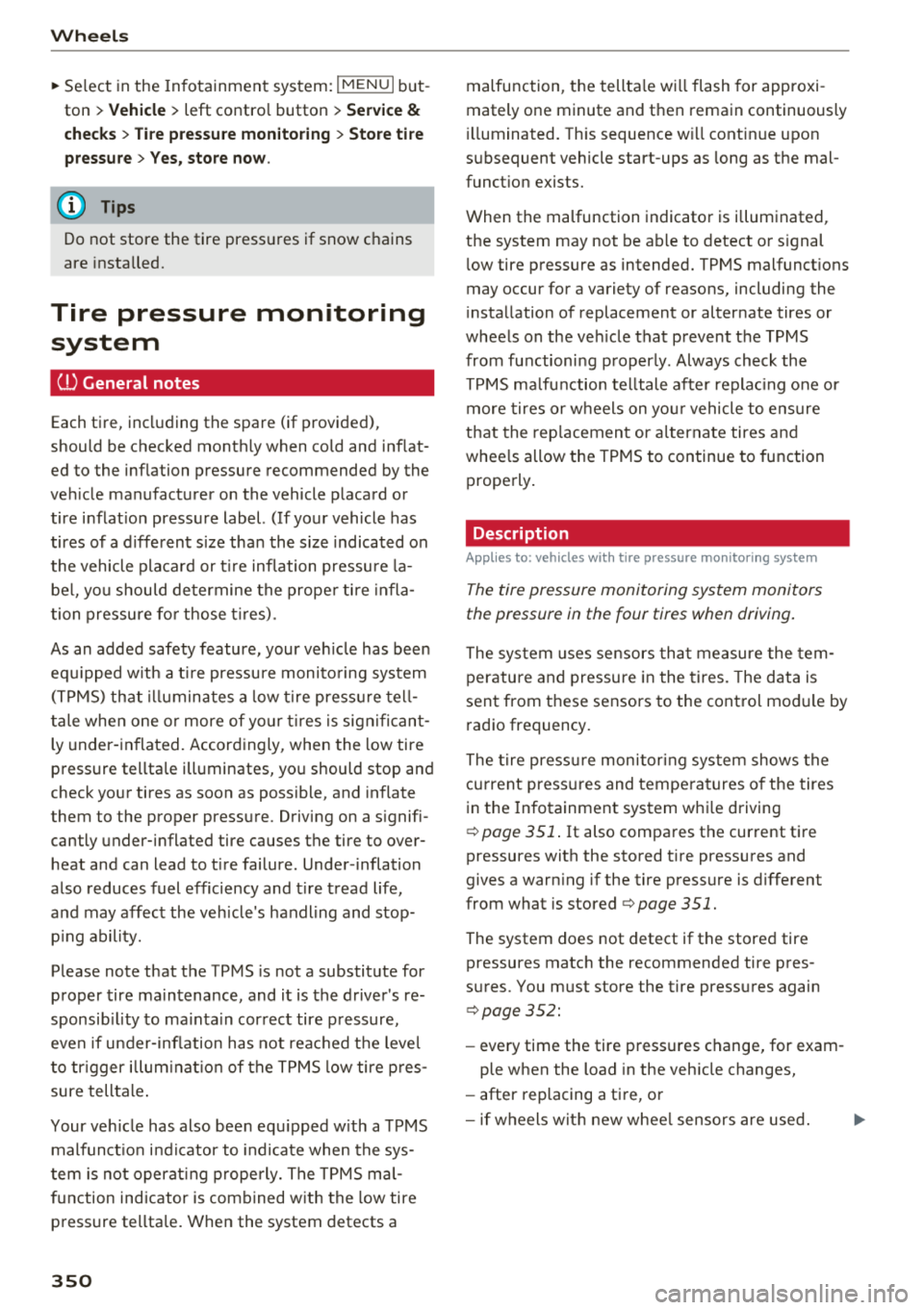
~ Select in the Infotainment system: IMENUI but
ton
> Vehicle > left control button > Service &
checks > Tire pressure monitoring > Store tire
pressure> Yes, store now.
(D Tips
Do not store the tire pressures if snow chains
are installed.
Tire pressure monitoring
system
(.L) General notes
Each tire, including the spare (if provided),
should be checked monthly when cold and inflat
ed to the inflation pressure recommended by the
vehicle manufacturer on the vehicle placard or
tire inflation pressure label. (If your vehicle has
tires of a different size than the size indicated on
the vehicle placard or t ire inflation pressure la
bel, you should determine the proper tire infla
tion pressure for those tires).
As an added safety feature, your vehicle has been
equ ipped w ith a t ire pressure monitoring system
(TPMS) that illuminates a low tire pressure tell
tale when one or more of your tires is significant
ly under-inflated. Accordingly, when the low tire
pressure telltale illuminates, you should stop and
check your tires as soon as possible, and inflate
them to the proper pressure. Driving on a signifi
cantly under-inflated tire causes the tire to over heat and can lead to tire failure . Under -inflation
also reduces fuel efficiency and tire tread life,
and may affect the vehicle's handling and stop
p in g ability.
Please note that the TPMS is not a substitute for
proper tire maintenance, and it is the driver's re
sponsibility to maintain correct tire pressure,
even if under-inflation has not reached the leve l
to trigger illuminat ion of the TPMS low tire pres
sure telltale .
Your vehicle has also been equipped with a TPMS
malfunct ion indicator to indicate when the sys
tem is not operating properly. The TPMS mal
function indicator is combined with the low tire
pressure telltale. When the system detects a
350
malfunction, the telltale will flash for approxi
mately one minute and then remain continuously
illuminated. This sequence will continue upon
subsequent vehicle start-ups as long as the mal
function exists.
When the malfunction indicator is illuminated,
the system may not be able to detect or signal
low tire pressure as intended. TPMS malfunctions
may occur for a variety of reasons, including the
installation of replacement or alternate tires or
wheels on the vehicle that prevent the TPMS
from functioning properly. Always check the
TPMS malfunction tel ltale after replac ing one or
more tires or wheels on your vehicle to ensure
that the replacement or alternate tires and
wheels allow the TPMS to continue to function
properly.
Description
Applies to: vehicles with tire pressure monitoring system
The tire pressure monitoring system monitors
the pressure in the four tires when driving.
The system uses sensors that measure the tema
perature and pressure in the tires. The data is
sent from these sensors to the control module by
radio frequency .
The tire pressure monitoring system shows the
current pressures and temperatures of the tires
in the Infotainment system while driving
¢ page 351. It also compares the current tire
pressures with the stored tire pressures and
gives a warning if the tire pressure is different
from what is stored
¢ page 351.
The system does not detect if the stored tire
pressures match the recommended tire pres
sures . You must store the tire pressures again
¢ page 352:
- every time the tire pressures change, for exam
ple when the load in the vehicle changes,
- after replacing a tire, or
- if wheels with new wheel sensors are used.
Page 353 of 404
u. 00 .-< N l' N .-< 0 N > 00
A WARNING
-The tire pressure monitoring system assists
the driver in monitoring tire pressures . The
driver is responsible for having the tires in
flated to the correct pressure.
- Do not change the tire pressure when the
temperature of the tire is extremely high.
This could result in serious damage to the
tire and even cause the tire to burst, in
creasing the risk of an accident.
- A tire with low pressure flexes more. This
heats the tire up too much. This could cause
the tread to separate and even cause the
tire to burst, increasing the risk of an acci
dent.
- The tire pressure monitoring system does
not warn about damage or defects in the
tire construction that could cause the tire to burst, for example . Inspect your tires regu
larly .
(D Tips
-If tires are replaced, the sensors/valves do
not need to be removed or replaced. Just re
placed the valve stem and, if necessary, the
valve and the wheel electronics. If you have
questions, see an authorized Audi dealer or
authorized Audi Service Facility .
- An incorrect display or a malfunction in the
tire pressure monitoring system can occur
after using the tire mobility kit . Have the
sensors replaced by an authorized Audi
dealer or authorized Audi Service Facility.
- For an explanation on conformity with the
FCC regulations in the United States and the
Industry Canada regulations, see
r=;,page 386.
Displaying tire pressures/temperatures
Applies to: vehicles with tire pressure mo nito ring system
Requirement: you must be driving the vehicle.
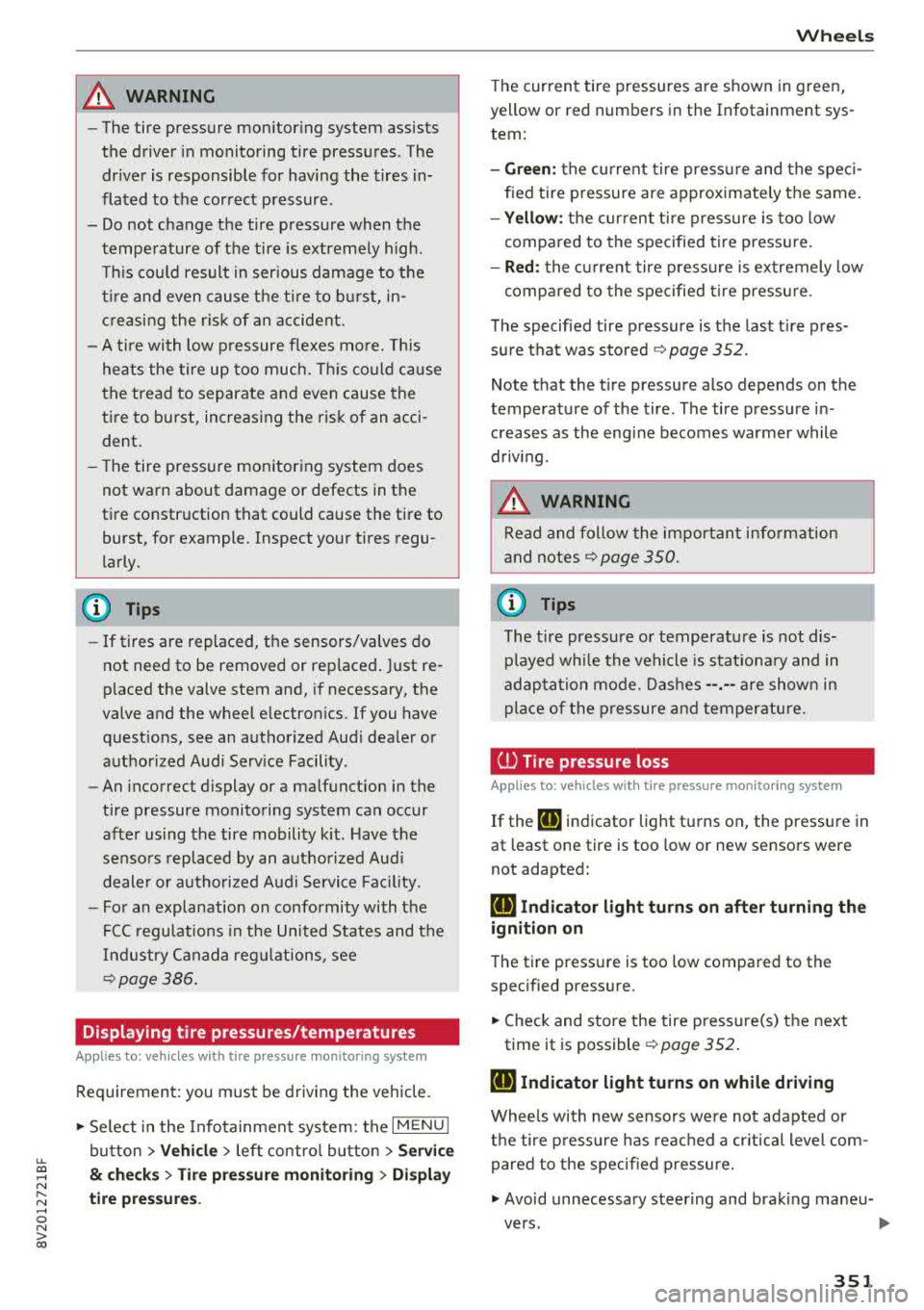
"'Select in the Infotainment system: the I MENU I
button > Vehicle > left control button > Service
& checks > Tire pressure monitoring > Display
tire pressures.
Wheels
The current tire pressures are shown in green,
yellow or red numbers in the Infotainment sys
tem:
- Green: the current tire pressure and the speci
fied tire pressure are approximately the same.
- Yellow: the current tire pressure is too low
compared to the specified tire pressure.
-Red: the current tire pressure is extremely low
compared to the specified tire pressure .
The specified tire pressure is the last tire pres
sure that was stored
r=;, page 352.
Note that the tire pressure also depends on the
temperature of the tire. The tire pressure in
creases as the engine becomes warmer while
driving.
A WARNING
Read and follow the important information
and notes
"*page 350.
(D Tips
The tire pressure or temperature is not dis
played while the vehicle is stationary and in
adaptation mode. Dashes--.-- are shown in
place of the pressure and temperature.
ill Tire pressure loss
Applies to: vehicles with tire press ure mo nito ring system
-
If the [tE indicator light turns on, the pressure in
at least one tire is too low or new sensors were
not adapted:
RE Indicator light turns on after turning the
ignition on
The tire pressure is too low compared to the
specified pressure .
.,. Check and store the tire pressure(s) the next
time it is possible
"*page 352.
RE Indicator light turns on while driving
Wheels with new sensors were not adapted or
the tire pressure has reached a critical level com
pared to the specified pressure.
"'Avoid unnecessary steering and braking maneu-
vers.
..,_
351
Page 354 of 404
Wheels
~ Adapt your driving style to the situation.
~ Stop as soon as possible and check the tire(s) .
~ If it is possible to continue driving, see an au-
thorized Audi dea ler or authorized Audi Service
Facility immediately and have your tire(s) re
paired or replaced.
A WARNING
Read and follow the important information
and
notes ~ page 350.
Storing new tire pressures
App lies to: ve hicles w ith tire press ure m on itoring system
Correctly stored tire pressure specifications are
necessary for reliable tire pressure monitoring.
-
It is always necessary to store the tire pressures
when the tire pressures are modified, for exam ple due to a change in load. or when new sensors
are installed .
~ Before storing the tire pressures, make sure the
tire pressures of all four tires meet the speci
fied values and are adapted to the load
~ page 341, fig . 2 78 . Only correct and store
the pressure in tires whose temperature is ap
prox imat ely the same as the ambient tempera
ture .
If the temperature of the tire is higher
than the ambient air temperature, the tire
pressure must be increased approximate ly
3 .0 PSI (0 .2 bar) above the va lue on the sticker .
~ Switch the ignition on.
~ Select in the Infotainment system: IMENUI but
ton
> Vehicle > left control button > Service &
checks > Tire pressure monitoring > Store tire
pressure > Yes, store now .
After storing the
tire pressu res, the t ire pressu re monitoring sys
tem measures the current pressures wh ile driv
in g and stores them as the new specified pres
sures.
~ If the changed tire pressures are not displayed
in the Infotainment system, drive the vehicle
for approximate ly 10 minutes so that the sen
sor signal from the wheels is received again.
During this adaptation phase, --.-- is displayed
for the pressure and temperature and the tire
pressure mon itor ing system is only partially
ava ilable. It only provides a warning if one or
352 more
tire pressures is below the minimum per
mitted specified pressure.
If the
[I] ind icator light turns on and the mes
sage
Tire pressure : wheel change detected .
Please check all tires and store pressures in
MMI also appears, the system has detected that
the position of the sensors has changed because
of a tire rotation, or that new sensors were in
stalled. Store the new tire pressures.
A WARNING
Read and follow the important information
and notes
~pag e 350.
Malfunctions
Applies to: vehicles with t ire pressure mo nitori ng syste m
If the tire pressure monitoring system is not
available, t he
mm in dicator light appears in the
instr umen t cluste r display along with the mes
sage
Tire pressure : malfun ction! See owner's
manual.
-
If the ffim ind icator light appears after switch
in g the ignitio n on or wh ile dr iving and the
[IJ in
dicator light also blinks for approximately one
minute and then stays on, there is a system ma l
function . The fo llowing are examples of situa
tions that could cause a malfunction:
- If the message appears at the end of the adap
tation phase, the system may not detect one or
several of the whee l sensors necessary for pres
sure monitoring. This may res ult from one or
more whee ls being installed without wheel sen
sors or with incompatible wheel sensors.
- A wheel sensor or another component has
fa iled.
- Using snow chains can affect the function of
the system because of the shielding effect of
the chains.
- The tire pressure monitoring system is not
avai lab le due to a ma lfunction.
- Transmitters with the same frequency, such as
headphones or remote-controlled devices, may
cause a temporary system malfunct ion due to
the strong electromagnetic field.
.,.
Page 365 of 404
u. 00 .-< N l' N .-< 0 N > 00
A WARNING
-Read and follow the manufacturer's safety
precautions o n the compressor and in th e
in structions on t he bottle of sealant .
- If a tire pressure of 29 ps i (200 kPA) cannot
r e ached after inflating for 6 minutes, then
the tire is too severely damaged . Do not
continue d riving.
- If the t ire cannot be repaired with the tire
sealant, see an authorized Audi dealer or au
tho rized Aud i Serv ice Facility for ass istance.
(D Tips
Do not operate the compressor for more than
six m inutes continuously, or it can overheat.
Once the compressor has coo led, you can con
tinue to use it.
Completing
Applies to: vehicles with tire mobility kit
.,. Affix the st icke r that says "max . S O mph (max .
80 km/h)" that is provided with the tire mobili
ty kit within the driver's field of vision .
.,. Stop the vehicle after driving for about 10 mi
nutes and check the tire pressure.
.,. If the t ire pressure is lower than 19 ps i (130
kPA), then the tire is too severely damaged. Do
not cont inue driving.
A WARNING
Pay attent ion to the following after repair ing
the ti re:
- Do not drive faster than SO mph (80 km/h) .
- Avoid hard acceleration, brak ing sharp ly,
and fast cornering.
- The veh icle may become more diff icult to
control.
- If the t ire is too severely damaged, see an
authorized Audi dealer or authorized Aud i
Service Facility for assistance .
@ For the sake of the environment
You can give the used t ire sealant bottle to an
author ized Audi dealer or authorized Audi
Serv ice Facility for disposal.
Em ergenc y ass is tanc e
(D Tips
Remember to obtain a new bott le of sealant
from an authorized A udi dealer or authorized
Audi Service Fac ility after repairing a tire.
Replacing wheels
Before changing a wheel
Observe the following precautions for your own
and your passenger's safety when changing a wheel.
.,. After you experience a t ire failure, pull the car
we ll away from moving traffic and try to reach
level grou nd befo re yo u stop ¢&, .
.,. All passengers should leave the car and move
t o a safe location ( for ins tance, behind the
gua rdrail) ¢&, .
.,. Engage the pa rking brake to prevent your vehi
cle from rolling unintentiona lly ¢
_A .
.,. Move selector le ver to position P ¢ _A .
... Jfyou are towing a trai ler, unhitch the trailer
from your vehicle.
.,. Take the jack ~ page 360 and the sp a re tire
ca:;, page 369 out of the luggage compartment .
A WARNING
You or you r passengers could be injure d while
ch anging a whee l if you do no t follow these
safety precaut ions :
- If you have a fla t tire, move a safe dis tance
off the road. Turn off the eng ine, turn the
emergency flashers on and use other warn
ing devices to alert other motorists.
- Make sure that passenge rs wait in a safe
p lace away from the vehicle and well away
from the road and traffic.
- To help preven t the vehicle from moving
suddenly and possib ly slipping off the jack,
always fully set the park ing brake and bloc k
the front and back of the wheel diagonally
opposite the wheel being changed. When
one front wheel is lifted off the ground,
p lacing the Au toma tic Transmission in P
(Park) will
not prevent the vehicle from
mov ing.
363