fuel AUDI A3 SEDAN 2018 User Guide
[x] Cancel search | Manufacturer: AUDI, Model Year: 2018, Model line: A3 SEDAN, Model: AUDI A3 SEDAN 2018Pages: 404, PDF Size: 62.3 MB
Page 71 of 404
Warm and cold
Automatic climate control system
Applies to: ve hicles with a utomat ic climate contro l system
Pressing AUTO button and setting the temperature to 72 °F (22 °C) is recommended.
LL co .... N
" N
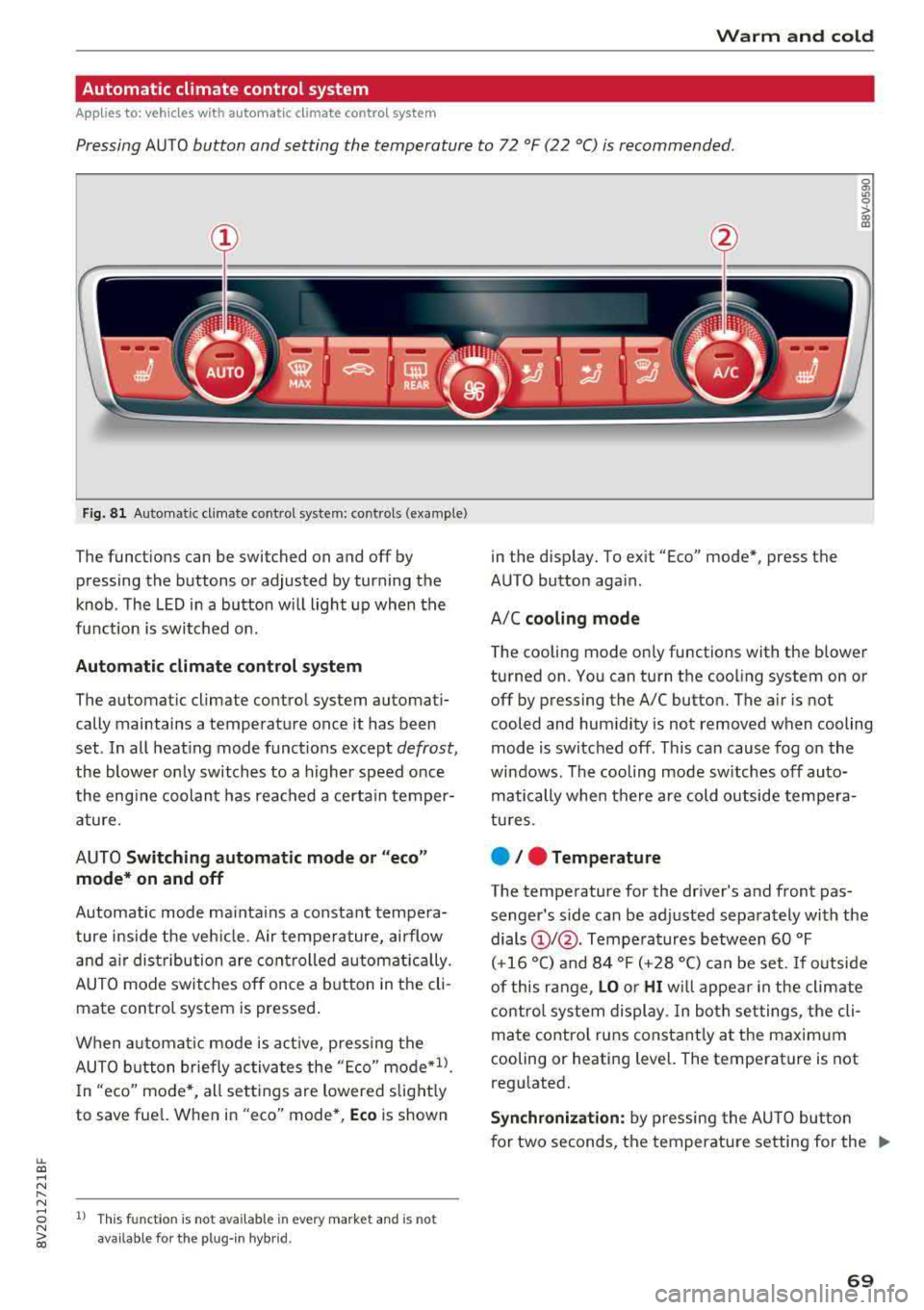
Fig. 8 1 Automatic climate control system: controls (example)
The funct ions can be switched on and off by
pressing the buttons or adjusted by turning the
knob. The LED in a button w ill light up when the
f u nction is switched on.
Automatic climate cont rol system
The automat ic climate control system automati
cally maintains a temperature once it has been
set . In all heat ing mode funct ions except
defrost,
the blower on ly switches to a higher speed once
the eng ine coolant has reached a certain temper
ature.
AUTO
Switching aut omatic mode or "ec o"
mode * on and off
Automatic mode ma inta ins a constant tempera
ture ins ide the veh icle. Air tempe rature, airflow
and a ir distribution are controlled a utomatically.
AUTO mode switches off once a b utton in the cli
mate control system is pressed.
When a utomat ic mode is act ive, pressing the
AUTO b utton briefly activa tes the
" E co" mode*1l.
In "eco" mode *, all sett ings are lowered slight ly
to save fuel. When in
"eco" mode*, Eco is shown
8 1l This fu nct ion is not available in every market and is not N ii'i available for the plug- in hybr id.
in the display. To ex it "Eco" mode*, press the
AUTO button aga in.
A/C
cooling mod e
The cooling mode on ly functions with the blower
turned on. You can turn the cooling system on or
off by pressing the A/C button. The air is not
cooled and humidity is not removed when cooling
mode is switched off. This can cause fog on the
windows . The cooling mode sw itches off auto
matically when there are cold outside tempera
tu res.
e / e Temperature
The temperature for the driver's and front pas
senger's s ide can be adjusted separately with the
dials
(D I@ . Tempera tures between 60 °F
(+16 °() and 84 °F (+28 °() ca n be set. If outside
of this range,
LO or HI w ill appea r in the climate
contro l system display. In both settings, the cli
mate contro l runs constant ly at the maxim um
cooling or heating level. The temperature is not
regulated.
S ynchr oniza tion : by pressing the AU TO butto n
for two seconds, the temperature setting for the
..,.
69
Page 75 of 404
u. 00 ... N l' N ... 0 N > 00
-Avoid dr iving throu gh salt wat er, because
th is can ca use corros io n.
Economical and environmentally-friendly
driving
The amount of fue l cons umption, t he e nvir on
men tal impac t an d the wea r to the engine,
b rak es and t ires depen ds mos tly on yo ur dr iv ing
s tyle. W it h an anticipatory and econom ic dr iv ing
s tyle, f uel consum ption can be re du ced by ap
p roximate ly 1 0-15% . The followi ng tips will help
you conse rve the environment and you r money at
the same time .
Anticipatory driving
A vehicle uses the mos t fu el when a ccele ra tin g.
W hen yo u dr ive wi th a ntici pat ion, you do not
need to brake as ofte n an d so yo u acceler ate less .
W hen possi ble, let your vehi cle coast w it h a
gear
engaged ,
for example when you notice that the
next tra ffic light is red . This p roduces an engine
b raking effect, wh ich helps to protect the brakes
a n d tires a nd reduces t he emissions a nd f uel con
sumpt io n to zero (fuel shut-off dur ing decelera
tion) .
Shift efficiently
Upshift ing earlier is an effective way to save fue l.
Staying in a gear too long uses fue l unnecessari
l y .
Press down on the acce le rato r peda l slowly and
avoid "k ic k-dow n".
Avoid full acceleration
You s hould rare ly tr ave l a t t he m axim um ve hicle
speed . High speeds cause a d isp roportionately
h ig h inc rease in fuel consumption, emissions an d
traffic no ise . Slower driving saves fuel.
Reduce idling time
T h e St art /S top system * he lps t o redu ce the i dlin g
time autom atically . In vehicles wi tho ut the Start /
Sto p system, it is eff ic ient to sw itch t he engine
off w hen stopped at ra ilroad cross ings a nd long
red lights . Depending on t he ve rsion of the en
g ine, stopping the eng ine for as litt le as five sec
onds once it has reached ope rat ing tempe rature
Driving
st ill saves mo re fue l th an leav ing t he en gine run
ning -even when taking into acco unt the amount
of ext ra fuel t hat is use d to restart t he e ngi ne.
It tak es a ve ry long time in idl e to warm the en
gine up to o peratin g tem perature . Wear an d
emissions are especially high in the warm -up
phase. The refore, you s hould begin drivi ng im
med iate ly after starting the eng ine. Avoid h igh
RPMs wh ile doing this.
Have maintenance performed regularly
By hav ing maintenance pe rformed reg ularly o n
yo ur vehicle, you can help to reduce fue l con
s u mption before you even sta rt to drive. The
maintenance cond ition of your vehicle not on ly
affects traffic safety and long-term va lue b ut al
so impacts
fuel consumption . A poorly ma in
ta ined engi ne ca n lead to fue l co nsump tion that
i s 1 0% hig her th an no rmal.
Avoid short trips
The eng ine and emissions contro l system must
r each their optima l
operating temperature to ef
fec tively reduce consump tion and emissions .
A cold engine uses a disp roportionately high
amount of fue l. The e ngine reac hes operat ing
temperat ure and cons umption no rma lizes on ly
after app roxima tely 2 .5 m iles (4 km).
Check the tire pressure
To save f ue l, ma ke sure the ti res are always i n
f lated to t he correct press ure
c> page 339. The
fuel consumpt io n can increase by 5% if the pres
s ur e is on ly 0 .5 bar too low . Due to t he increased
r oll ing resis tance, low tire pressures w ill also
l ead to greate r tire
wear an d will affect dr iving
behav ior.
Do not d rive on
winter tires year- ro und , as this
will consume u p to 10% more f uel.
Eliminate unnecessary weight
S ince eve ry pou nd of ext ra weight inc reases fuel
consumption, a quick inspect io n of the luggage
compartment may be wo rth it to avoid un neces-
sary we ight .
..,.
73
Page 76 of 404
Driving
When not being used, a roof rack should be re
moved to decrease the wind resistance of the ve
hicle. This will save you approximately 12% fuel
at speeds from 62
-75 mph (100 -120 km/h).
Save energy
The engine drives the generator, which generates
electricity; the fuel consumption also increases
with the demand for electricity. Therefore, switch
electrical equipment
off when you no longer
need it. Examples of equipment that uses a lot of
energy are air blowers at a high setting, the rear
window defogger and seat heating* .
(D Note
-Do not leave engine idling unattended after
starting. If warning lights should come on
to indicate improper operation, they would
go unheeded. Extended idling also produces
heat, which could result in overheating or
other damage to the vehicle or other prop erty.
- Have your vehicle maintained properly and
in accordance with the service recommenda
tions in your Warranty
& Maintenance book
let . Lack of proper maintenance as well as
improper use of the vehicle will impair the
function of the emission control system and
could lead to damage.
- Do not alter or remove any component of
the Emission Control System unless ap
proved by the manufacturer.
- Do not alter or remove any device, such as
heat shields, switches, ignition wires,
valves, which are designed to protect your
vehicle's Emission Control System and other
important vehicle components.
@ Tips
The consumpt ion estimates as published by
ENVIRONMENTAL PROTECTION AGENCY
(EPA) and Transport Canada may not corre
spond to your actual consumption on the
road, which will vary depending upon vehicle
load and speed, road and weather conditions,
trip length, etc.
74
Steering
Adjusting the steering wheel position
The steering wheel position is fully adjustable up
and down and forward and back.
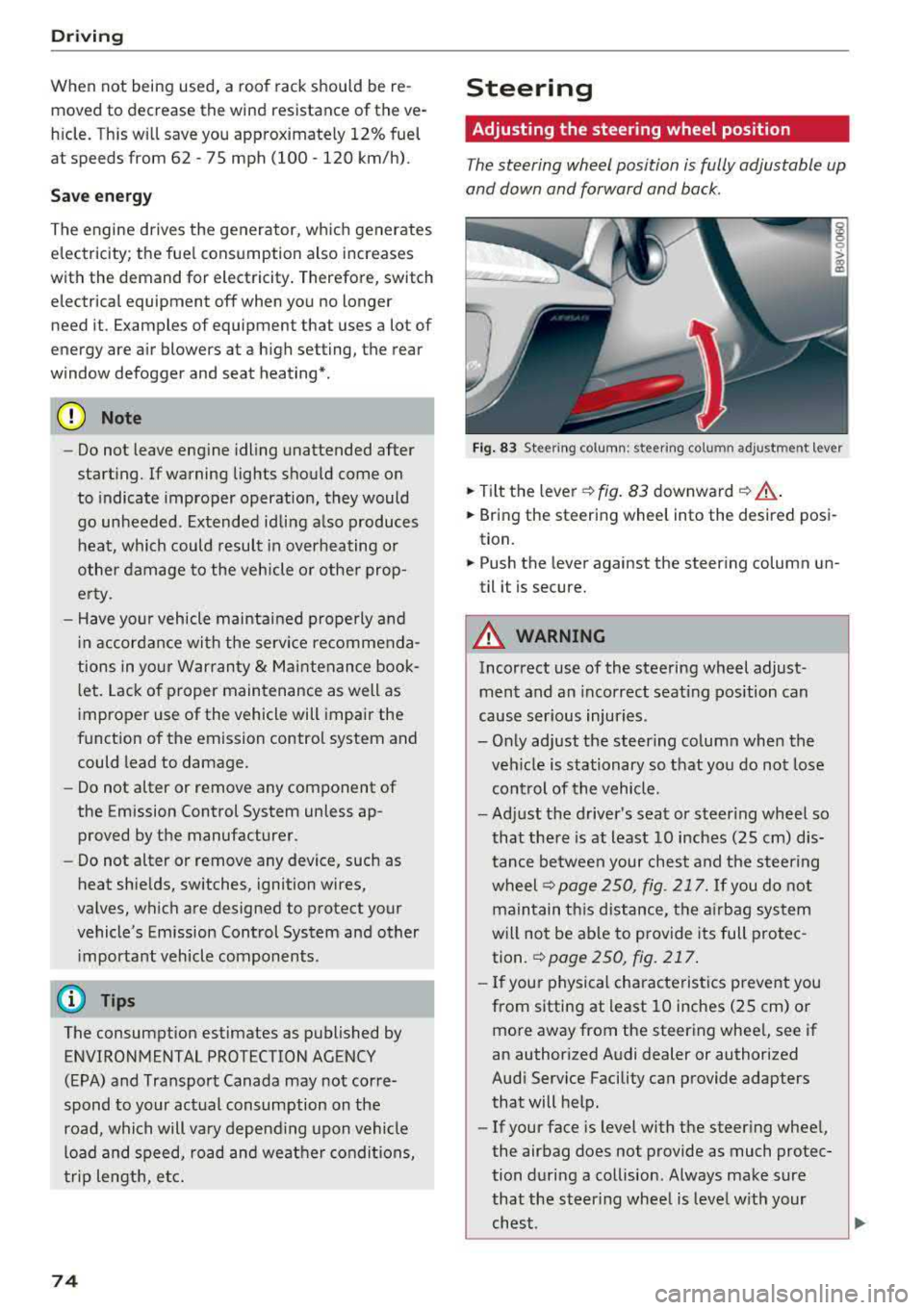
Fig . 83 Steering column : steering column adjustment lever
.. Tilt the lever -c> fig. 83 downward¢ ,&..
.. Bring the steering wheel into the desired posi
tion.
.. Push the lever against the steering column un
til it is secure.
A WARNING
Incorrect use of the steering wheel adjust
ment and an incorrect seating position can
cause serious injuries.
- Only adjust the steering column when the veh icle is stationary so that you do not lose
control of the vehicle.
-
-Adjust the driver's seat or steer ing wheel so
that there is at least 10 inches
(25 cm) dis
tance between your chest and the steering
wheelr::!>page250, fig. 217. If you do not
maintain this distance, the airbag system
will not be able to provide its full protec tion.
c:> page 250, fig. 217.
- If your physical characteristics prevent you
from sitting at least 10 inches
(25 cm) or
more away from the steering wheel, see if
an authorized Audi dealer or authorized
Audi Service Facility can provide adapters that will help.
- If your face is level with the steering wheel,
the airbag does not provide as much protec
tion during a collision. Always make sure
that the steering wheel is level with your
chest.
Page 81 of 404
LL co .... N
" N .... 0 N > co
Starting the engine
when there is a
malfunction
Applies to: vehicles with conven ience key
It may not be possible to start the engine under
certain circumstances, for example, if the bat
tery in the vehicle key is drained, if interference is
affecting the key or if there is o system mo/func
tion.
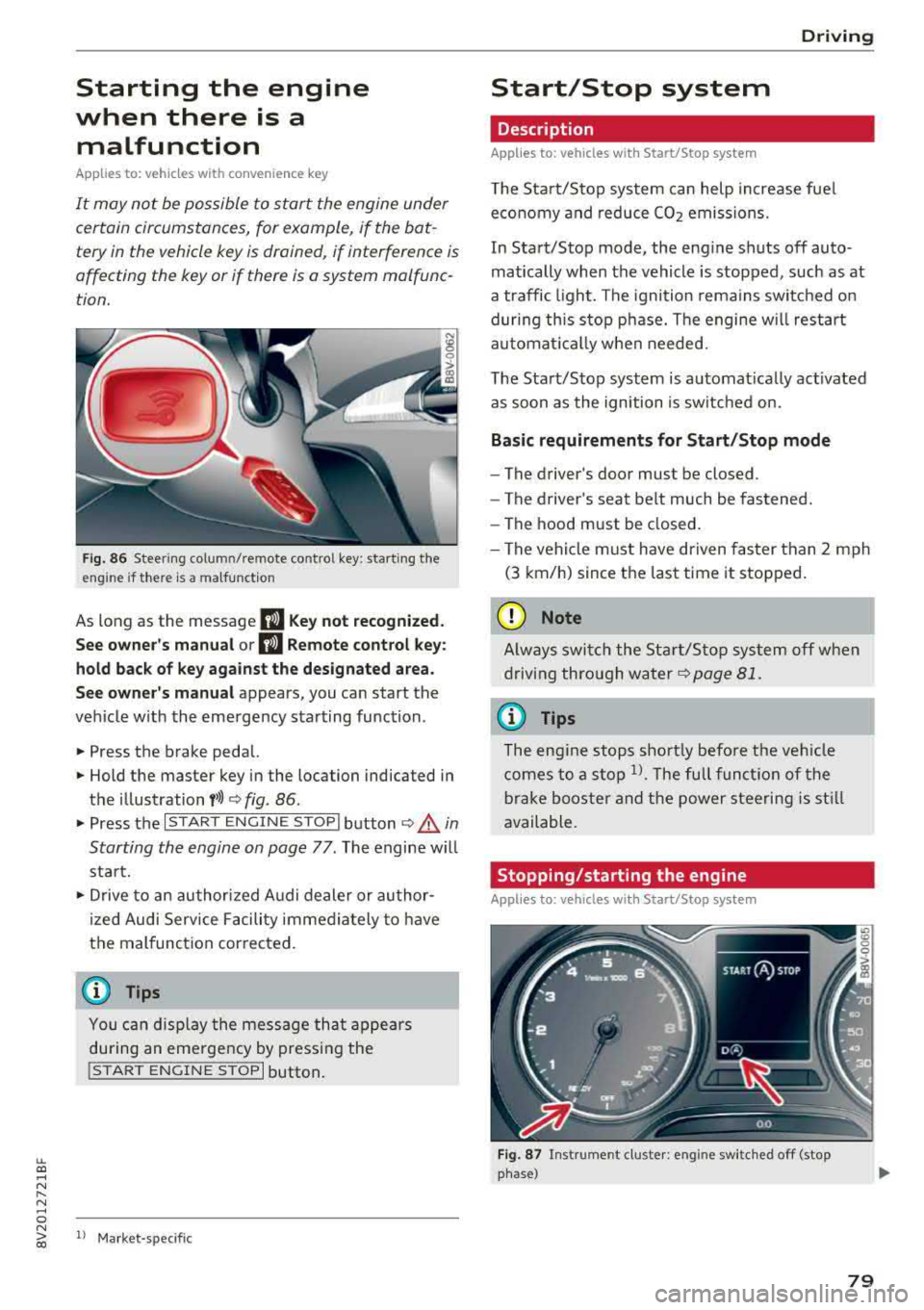
Fig. 86 Steering col umn/remote co ntro l key: starting the
eng ine if there is
a malfunction
As long as the message II Key not recognized.
See owner's manual or
II Remote control key:
hold back of key against the designated area.
See owner's manual
appears, you can start the
vehicle with the emergency starting function .
.. Press the brake pedal.
.. Hold the master key in the location indicated in
the illustration
y>l) c> fig. 86.
.. Press the I START ENGINE STOPI button c> .& in
Starting the engine on page
77 . The engine will
start.
.,. Drive to an authorized Audi dealer or author
ized Audi Service Facility immediately to have
the malfunction corrected.
@ Tips
You can display the message that appears
during an emergency by pressing the
!START ENGINE STOPI button.
l) Market -spe cific
Driving
Start/Stop system
Description
Applies to: vehicles wit h Start/Stop system
The Start/Stop system can help increase fuel
economy and reduce CO2 emissions.
In Start/Stop mode, the engine shuts off auto
matically when the vehicle is stopped, such as at
a traffic light. The ignition remains switched on
during this stop phase. The engine w ill restart
automat ically when needed.
The Start/Stop system is automatically activated
as soon as the ignition is switched on.
Basic requirements for Start/Stop mode
-The driver's door must be closed .
- The driver's seat belt much be fastened.
- The hood must be closed.
- The vehicle must have driven faster than
2 mph
(3 km/h) since the last time it stopped.
(D Note
Always switch the Start/Stop system off when
driving through water
c> page 81.
(D Tips
The engine stops shortly before the vehicle
comes to a stop
ll. The full function of the
brake booster and the power steering is still
available.
Stopping/starting the engine
Applies to: vehicles with Start/Stop system
Fig. 87 Instrument cluster: eng ine switched off (stop
phase)
79
Page 85 of 404
selector lever position is engaged. As soon as
you press the accelerator pedal, the parking brake releases automatically and your vehicle
starts to move
¢ page 83.
(D Tips
- Occasional noises when the parking brake is
set and re leased are normal and are not a
cause for concern.
- The parking brake goes through a self-test
cycle at regular intervals when the vehicle is
stopped. Any noises associated with this are normal.
- If there is a power failure, the parking brake will not set if it is released, and it will not
release if it is
set¢&. See an authorized
Audi dealer or authorized Audi Service Fa
cility for assistance .
Starting from a stop
Various convenience and safety functions may be
available when the vehicle begins driving, de
pending on vehicle equipment.
Starting on hills with the parking brake set
Requirement: the driver's door must be closed.
~ To start driving comfortably when on a hill, set
the parking brake and begin driving as usual.
The braking force of the parking brake does not release automatically until the wheels build up
enough driving force .
Starting on hills with hill hold assist
Hill hold assist makes it easier to start on hills.
Requirement: the driver's door must be closed
and the engine must be running.
~ To activate hill hold assist, press and hold the
brake pedal for several seconds. The vehicle
must be in an uphill direction of travel.
After releasing the brake pedal, the braking pow
er is maintained for a brief
moment ¢.&. to pre
vent the vehicle from rolling back when starting.
::li During this time, you can eas ily beg in to move .-<
~ your vehicle.
N .-< 0 N > 00
Driving
A WARNING ,-
Applies to: ve hicles with h ill ho ld assist
- If you do not begin driving immediately or
the engine stalls after releasing the brake
pedal, your veh icle may begin to roll back
ward. Press the brake pedal or set the park
ing brake immediately.
- The intelligent technology of hill hold assist
cannot overcome the limitations imposed by
natural physical laws. The increased comfort
offered by hill hold assist should not cause
you to take safety risks.
- Hill hold assist cannot hold the vehicle in
place on all hills (for example, if the ground
is slippery or icy).
- To reduce the risk of an accident, always
make sure the vehicle is situated safely
while stationary.
Automatic transmission
Introduction
Applies to: vehicles with automatic transmiss ions
T he automatic transmission is controlled elec
tronically . Upshifting and downshifting occur au
tomatically.
When a
moderate driving style is used, the
transm ission selects the most economica l dr iv ing
mode. The transmission upshifts at a lower RPM
and downshifts at a higher RPM to improve fuel
efficiency.
In the "S" selector lever position, the transm is
sion switches to a sporty mode after a kick-down
or when the driver uses a
sporty driving style
characterized by quick accelerator pedal move
ments, heavy acce leration, frequent changes in
speed and traveling at the maximum speed.
If desired, the driver can also select the gears
manually (tiptronic mode) ¢ page 88, Manual
shifting (tiptronic mode).
The S tronic is a dual-clutch transmission. Power
is transferred using two clutches that work inde
pendently from one another. They replace the
torque converter used in conventional automatic
.,.
83
Page 95 of 404
u. 00 ... N l' N ... 0 N > 00
injuries. When the vehicle enters drive ready
mode, the status message
e-no"' ~... ap
pears briefly in the instrument cluster display
and the needle in the power meter points to
READY ¢ page 9 5.
-Make sure that the selector lever is in the P
position and the ignition is switched off
when leaving the vehicle.
@ Note
-The high-voltage system can be damaged if
the vehicle underbody comes into contact
with the ground . Immediately drive your ve
hicle to an authorized repair facility and
have it inspected.
- The electric drive motor can become very
hot during operation . Do not stop the vehi
cle if there is oil, fuel residue or other flam
mable substances under or next to the vehi
cle.
Special considerations for the high-voltage
battery
Applies to: vehicles with plug-in hybrid drive
Please first read and note the introductory infor
mation and heed the warnings
¢page 92.
All batteries age with use and over time. There
are things you should know about the care of the
high voltage battery that will help it keep giving
you good service and reliability over time. Please
read and keep the following information in mind
while you enjoy the performance and economy of
your vehicle.
- Be sure to charge the high voltage battery be
fore leaving the vehicle parked and unused for a longer period of time. Ideally the high-voltage
battery should have a charge level between
40 % and 60 % when parked for a long t ime .
- If the battery charge level is below 3 %, never
park the vehicle for more than 21 days without
charging the high-voltage battery. Should you
have to park the vehicle for a long time, make
sure that the charge level is sufficient to help
prevent the battery from aging prematurely.
- Frequent and consecutive charging of the high
voltage battery when the charge level is above
e-tron
98 % can also decrease the capacity of the
high-voltage battery. Make sure the charge lev
el is be low 98 % when you start the charging
process.
- Should the vehicle be parked for longer than
2 days at temperatures below -13 °F ( -25 °C),
the high-voltage battery could free ze and not
be able to provide energy to the electric motor.
The battery will start working again, once it
warms up . The battery can be warmed up when
the outside temperature rises or when the vehi
cle is garaged appropriately. The battery will al
so warm up when being used (sw itching on the
air conditioner, the heater or by driving the ve
hicle) . Should you have to park your vehicle at
very low temperatures for longer than 1 day,
make sure that the high-voltage battery does
not freeze by parking the vehicle in a garage
that is heated or protected from the outside
temperature.
- The high-voltage battery can be damaged and
the capacity can be decreased when the vehicle
is parked for longer than 24 hours when the
ambient temperature is higher than 118 °F
(48 °C). Always make sure that the h igh-volt
age battery is not exposed to temperatures
above 118 °F (48 °C) for a long time.
- Never park the veh icle in areas that are lik ely to
be flooded, such as beaches or river banks, and
never drive the vehicle in WA TER, on flooded
roads or through water that is higher than the
bottom of the vehicle body. The high-voltage
battery, along with other vehicle components,
can be damaged severely if the high-voltage battery is exposed to open water especially for
a longer time. However, you can drive through
water on roads under certain conditions
~ page 72.
Failure to heed any of these requirements can
age the battery prematurely and lead to a perma
nent decrease of the high-vo ltage battery's ca
pacity.
(D Tips
Always make sure that the high-voltage bat
tery is not exposed to extremely low and high
temperatures as well as to water espec ially
for a longer time. Failure to protect and care
93
Page 98 of 404
e-tron
For additional information, see ¢ page 17, Trip
computer (Audi virtual cockpit).
~ Applies to: vehicles with analog instrument
cluster: Open the
Tachometer display by turn
ing the left thumbwheel on the multifunction
steering wheel.
When opening the driver's door, the charge level is shown in the instrument cluster when the igni
tion is switched on, or the charge level and the
remaining charge time for the high -voltage bat
tery is displayed when charging .
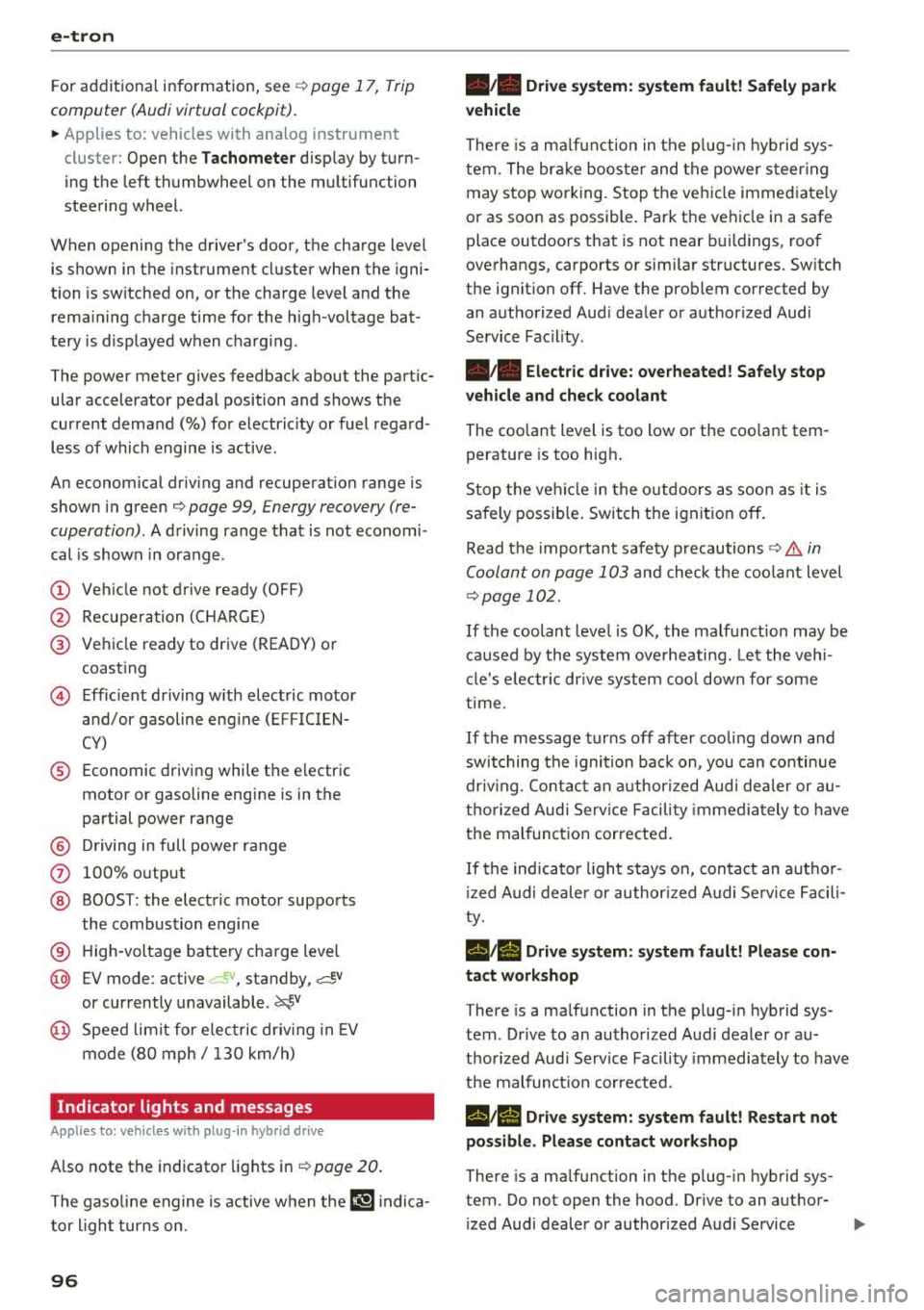
The power meter gives feedback about the partic ular accelerator pedal position and shows the
current demand
(%) for electricity or fuel regard
less of which engine is active.
An economical driving and recuperation range is
shown in green
¢ page 99, Energy recovery (re
cuperation) .
A driving range that is not economi
cal is shown in orange .
(D Vehicle not drive ready (OFF)
@ Recuperation (CHARGE)
@ Vehicle ready to drive (READY) or
coasting
© Efficient driving with electric motor
and/or gasoline engine (EFFICIEN
CY)
® Economic driving while the electric
motor or gasoline engine is in the
partial power range
@ Driving in full power range
0 100% output
@ BOOST: the electric motor supports
the combustion engine
® High-voltage battery charge level
@ EV mode: active a=,v, standby, a=,v
or currently unavailable. ~v
@ Speed limit for electric driving in EV
mode (80 mph/ 130 km/h)
Indicator lights and messages
Applies to: vehicles with plug -in hybr id drive
Also note the indicator lights in¢ page 20.
The gasoline engine is active when the II'§] indica
tor light turns on.
96
•• Drive system: system fault! Safely park
vehicle
There is a malfunction in the plug-in hybrid sys
tem. The brake booster and the power steering
may stop working. Stop the vehicle immediately
or as soon as possible. Park the vehicle in a safe place outdoors that is not near buildings, roof
overhangs, carports or similar structures. Switch
the ignition off. Have the problem corrected by
an authorized Audi dealer or authorized Audi
Service Facility.
•• Electric drive: overheated! Safely stop
vehicle and check coolant
The coolant level is too low or the coolant tem
perature is too high.
Stop the vehicle in the outdoors as soon as it is
safely possible. Switch the ignition off.
Read the important safety
precautions ¢.& in
Coolant on page 103
and check the coolant level
¢page 102.
If the coolant level is OK, the malfunction may be
caused by the system overheating. Let the vehi
cle's electric drive system cool down for some
time .
If the message turns off after cooling down and
switching the ignition back on, you can continue
driving. Contact an authorized Audi dealer or au
thorized Audi Service Facility immediately to have
the malfunction corrected.
If the indicator light stays on, contact an author
ized Audi dealer or authorized Audi Service Facili
ty.
lltll Drive system: system fault! Please con
tact workshop
There is a malfunction in the plug-in hybrid sys
tem . Drive to an authorized Audi dealer or au
thorized Audi Service Facility immediately to have
the malfunction corrected.
1/1111 Drive system: system fault! Restart not
possible. Please contact workshop
There is a malfunction in the plug-in hybrid sys
tem. Do not open the hood. Drive to an author- ized Audi dealer or authorized Audi Service
.,,_
Page 99 of 404
LL co ..... N
" N ..... 0 N > co
Faci lity immedi ately to have t he m alfunc tion cor
rected .
IIJII Battery temperature too low . Vehicle
cannot be started. See owner's manual
Th e outside tempe rature is too low . The vehicle
can no longe r st art at tempe ra tur es below - 18 °F
(- 28 °C). Con ta ct an a utho riz e d Audi d ealer o r au
thor ized A udi Se rvice Fac ility.
POWER LIMIT Warning! Limited performance
If t he indicator lig ht turns on and th is message
appears , th ere may be a n engine co ntro l ma l
f u nction. The
[3B* in d icator light in t he instr u
men t clus ter also tur ns on . The engine ou tput is
r educed . Dr ive to a n au thor ized Audi dealer or
a uthor ized Audi Se rvice Facili ty i mme diate ly to
ha ve the m alfunct ion co rre cted.
II e-tron mode: EV currently unavailable
This message appea rs whe n the 1.,,..1 button is
p ressed and the con ditions for elect ric d rive
mode a re not met.
Ill Vehicle sound: malfunction! Pedestrians
cannot hear vehicle . Please contact Service
The vehicle sou nd is no longer f unctio ning. D rive
e xtremely care fully, since ot he rs may not hea r
your veh icle. Dr ive to an author ized Audi dealer
or author ized Audi Se rvice Facility immed iate ly to
have the ma lf u nction corrected .
Range display
Applies to: ve hicles with plug-in hybrid drive
Fig. 99 Instr ume nt cluste r: ra nge disp lay
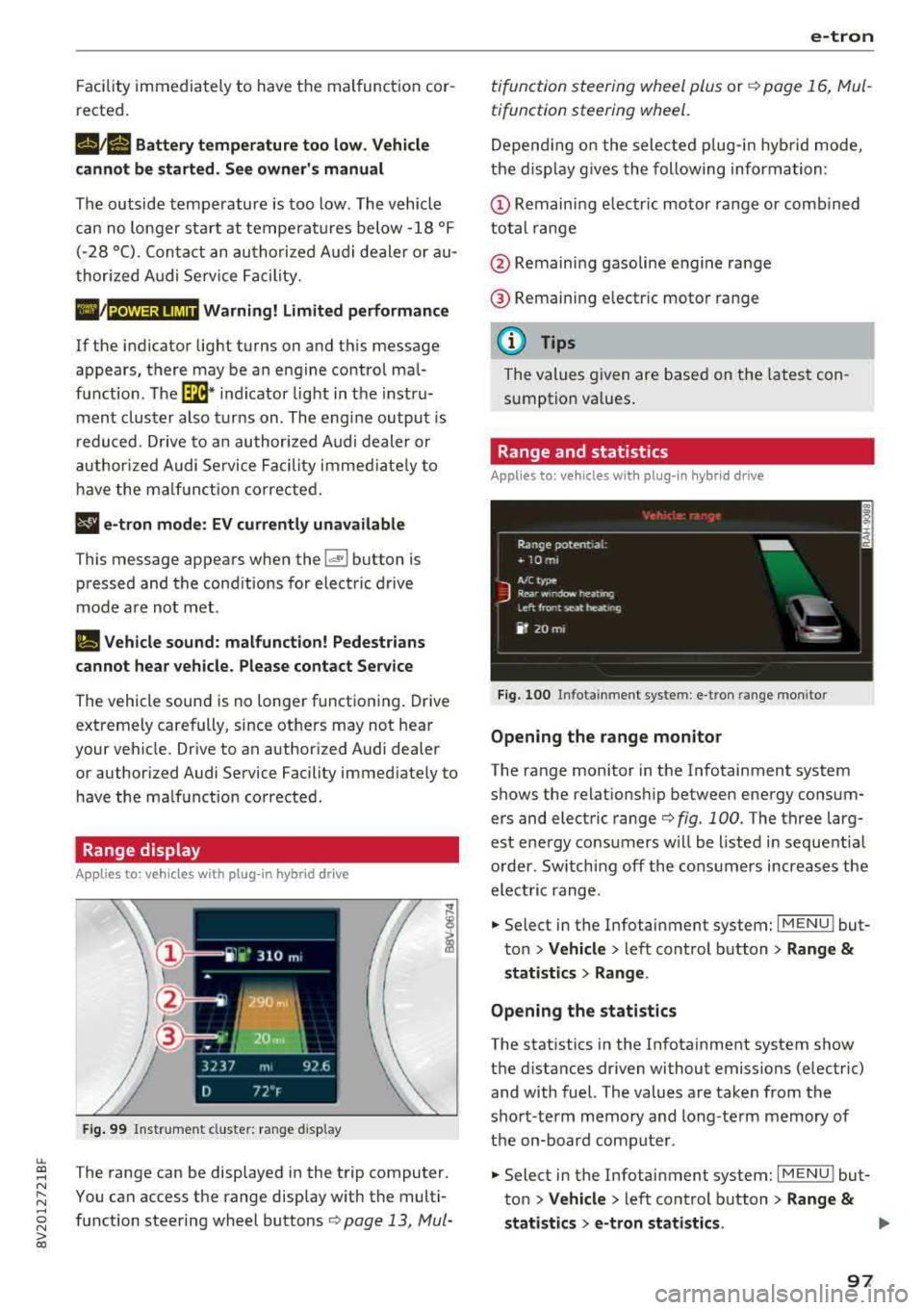
The range can be disp layed in the trip computer .
You can access t he range disp lay w ith the multi
fu nction steeri ng wheel buttons
c:;> page 13 , Mui-
e-tron
ti function s teeri ng whee l plus or r:::;> page 1 6, M ul
tifunction steering wheel.
D epen ding on t he sele cte d plug -in hy brid mo de,
t he disp la y g ives the foll owing informa tion:
(D Remaini ng e lec tric m otor range or comb ined
total range
@ Remaini ng gasoline eng ine range
® R emaini ng e lectr ic moto r ra nge
(D Tips
The va lues given are b ase d on t he lates t con
sum ption va lues .
Range and statistics
Applies to: vehicles with plug-in hybrid drive
Fig. 100 In fotainmen t system : e -tro n range mo nitor
Opening the range monitor
The range monitor in the Infotainment system
shows the relat ions hip between ene rgy co nsum
ers and elect ric range
c:;> fig. 100 . The three larg
est ene rgy consu mers w ill be l ist ed in sequent ia l
o rder. Sw itching off the cons umers increases the
elect ric range .
.. Select in the Infotai nment system: I MENU ! but
t o n
> Vehicle > left con trol button > Range &
statist ics > Range .
Opening the statistics
The stat istics in the In fotainment system show
t h e d ista nces dr iven without emissions (electric)
and with fuel. The values are taken from the
sho rt-term memory and long-te rm m emory of
the on-board comp ute r.
.. Select in the Infotai nment system: I MENU ! but
ton
> Vehicle > left con trol b utton > Range &
statistics > e-tron statistics . IJ,,
97
Page 101 of 404
u. 00 ... N l' N ... 0 N > 00
(D Tips
It may be necessary for the gasoline engine to
r u n longer for technical reasons, such as
when condensation accumu lates in the en
gine. Driving exclusively in electric mode is
not possible in this phase.
Plug-in hybrid functions
Applies to: vehicles with plug-in hybrid drive
The funct ions descr ibed below act ivate automati
cally depending on the driv ing sty le.
Full-throttle acceleration (boost)
The boost funct ion is act ivated by pressing the
accelerator pedal farther down (kick-down). The
vehicle is powered by both the gasoline engine
and the electric motor when in full accelerat io n.
Boost is only availab le for a sho rt time , because it
uses a large amou nt of energy. Ava ilability de
pends on the high-voltage battery charge level.
Coasting
The gasoline engine switches off and disengages
at speeds up to approximate ly 112 mph
(180 km/h) if the accelerator pedal is not p ress-
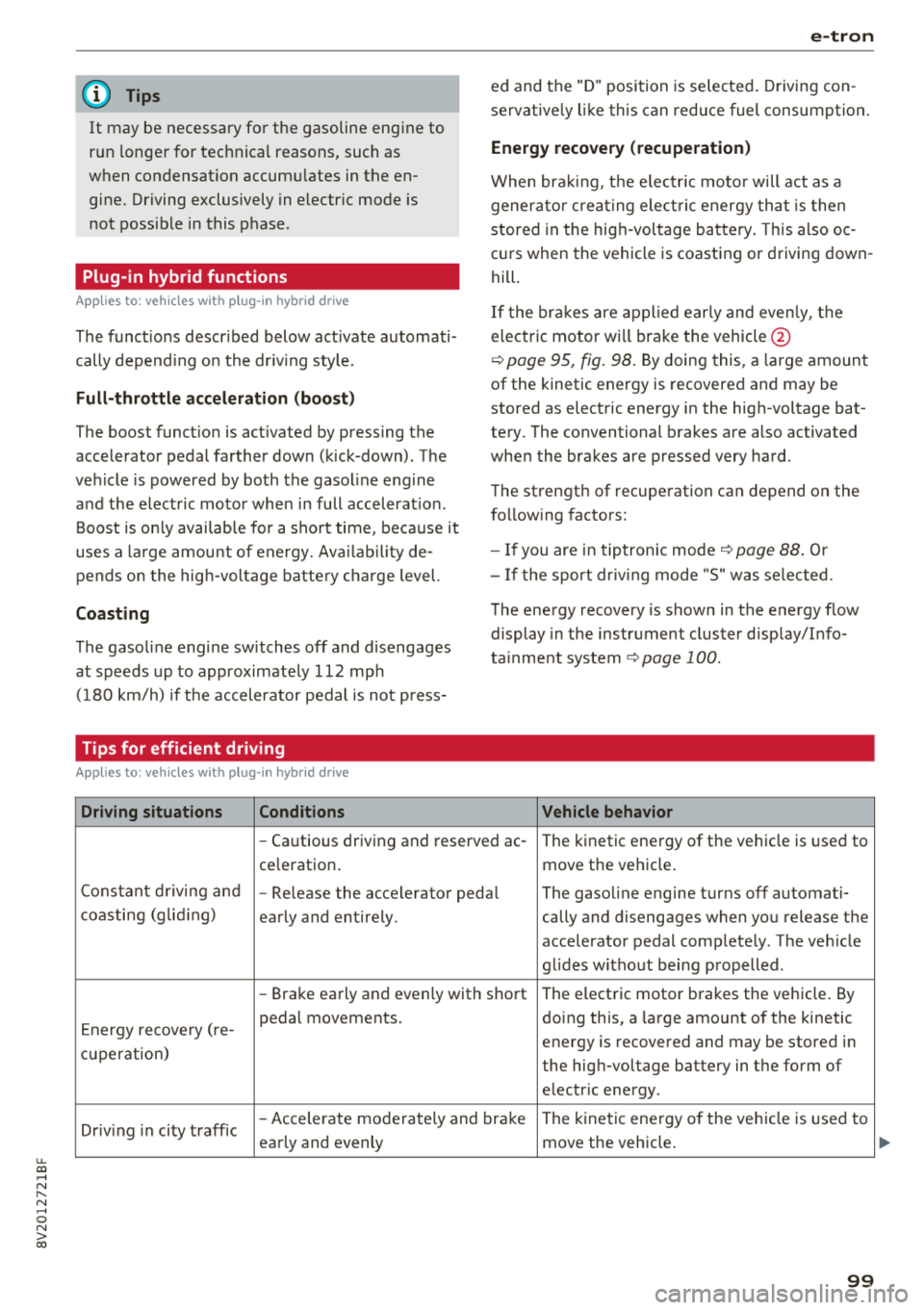
Tips for efficient driving
Applies to: vehicles with plug-in hybrid drive
Driving situations Conditions
e-tron
ed and the "D" position is selected. Driving con
servative ly like this can reduce fuel consumption .
Energy recovery (recuperation)
When braking, t he e lectr ic moto r will act as a
generato r creat ing elect ric energy that is then
stored in the hig h-voltage battery. This also o c
curs when the vehicle is coasting or driving down
hill .
If the brakes are applied early and evenly, the
electric motor w ill brake the vehicle @
¢
page 95, fig. 98. By doing this, a large amount
of the kinetic energy is recovered and may be
stored as electric energy in the high-voltage bat
tery . The conventional brakes are also activated
when the brakes are pressed very hard.
The strength of recuperation can depend on the
following factors:
- If you are in tiptronic mode ¢
page 88. Or
- I f the sport dr iv ing mode "S" was se lected.
The energy recovery is shown in the energy flow
display in the instrument cluster display/Info
ta inment system
¢ page 100.
Vehicle behavior
-Cautious driving and reserved ac- The kinetic energy of the ve hicle is used to
ce leration . move the vehicle.
Constant driving and
-Re lease the accelerator pedal The gasoline engine turns off automati-
coasting (gliding)
early and entirely. cally and disengages when you release the
accelerator pedal completely . The veh icle
glides w ithout being propelled .
-Brake early and evenly with short The electric motor brakes the vehicle. By
E nergy recove ry ( re- pedal movements.
doing this, a large amount of the kinetic
energy is recovered and may be stored in
cu perat ion)
the high-voltage battery in the form of
electr ic energy .
Driv ing in city traffic
-Accelerate moderately and brake The kinetic energy o f the ve hicle is used to
early and evenly move the vehicle.
99
...
Page 102 of 404
e-tron
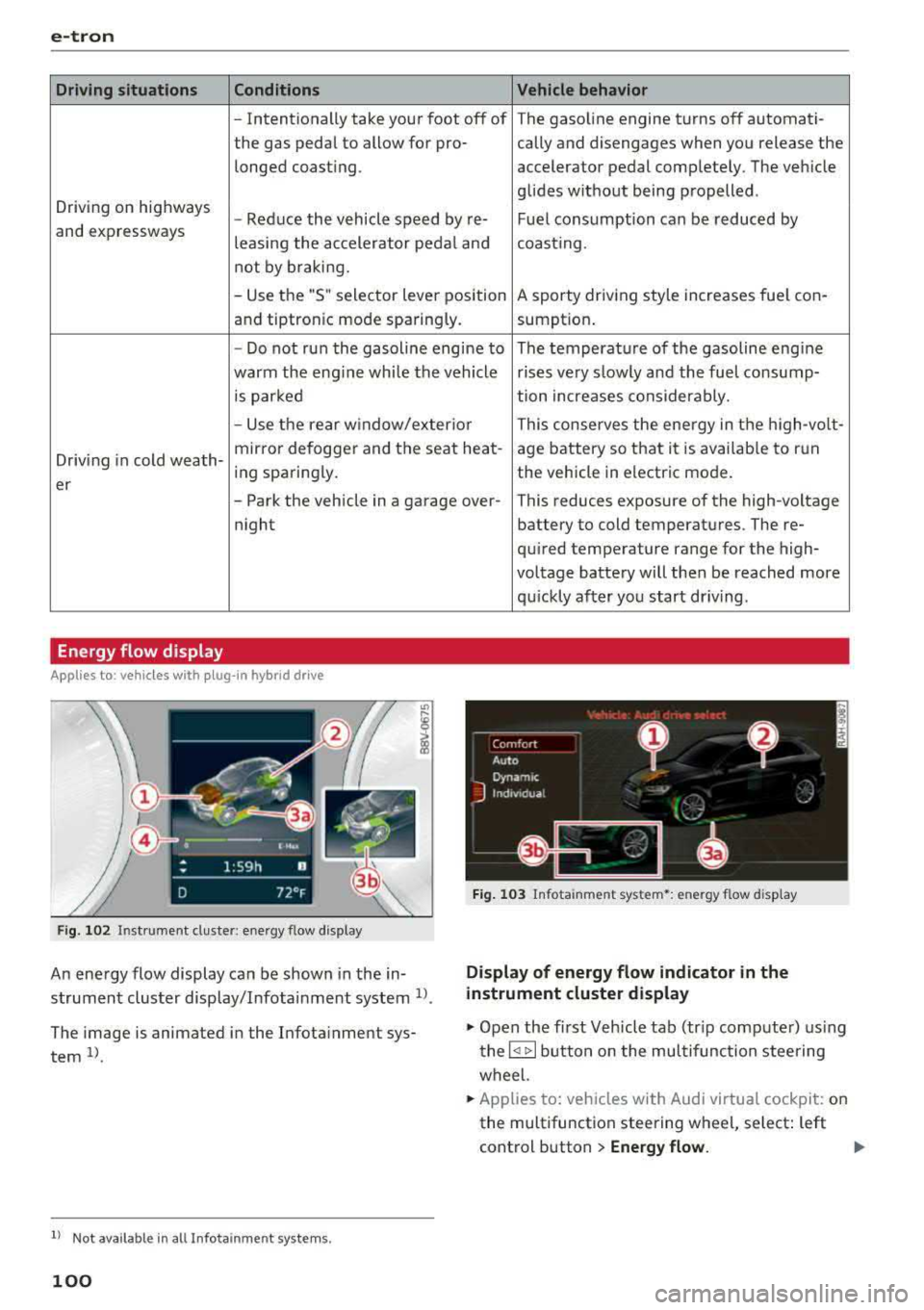
Driving situations Conditions Vehicle behavior
-Intentionally take your foot off of The gasoline engine turns off automati-
the gas pedal to allow for pro- cally and disengages when you release the longed coasting. accelerator pedal completely. The veh icle
Driving on highways glides without being propelled
.
- Reduce the vehicle speed by re-Fuel consumption can be reduced by
and expressways
leasing the accelerator pedal and coasting.
not by braking.
- Use the "S" selector lever position A sporty driving style increases fue l con-
and tiptron ic mode sparingly.
sumption.
- Do not run the gasoline engine to The temperature of the gasoline engine
warm the engine while the vehicle rises very s lowly and the fuel consump-
is parked tion increases considerably.
- Use the rear window/exterior This conserves the energy in the high-volt-
Driving in cold weath- mirror defogger and the seat heat-
age battery so that it is availab le to run
ing sparing ly. the vehicle in electric mode.
er
- Park the vehicle in a garage over-This reduces exposure of the high-voltage
n ight battery to cold temperatures. The re-
quired temperature range for the high-
voltage battery will then be reached more quickly after you start dr iving.
Energy flow display
Applies to : vehicles with plug-in hybrid drive
Fig. 102 Inst rument duster: energy flow display
An energy flow display can be shown in the in
strument cluster display/Infotainment system
1>.
The image is animated in the Infota inment sys
tem
1> .
l l Not available in all Infota inme nt syste ms.
100
Fig. 103 Infota inment system•: energy flow disp lay
Display of energy flow indicator in the
instrument cluster display
.,. Open the first Veh icle tab (tr ip compute r) using
the
l q 1> I button on the multifunction steering
wheel.
.,. Applies to: vehicles with Audi virtual cockpit: on
the multifunction steering wheel, select: left
control button
> Energy flow.