Arm AUDI A4 2008 B8 / 4.G Owner's Manual
[x] Cancel search | Manufacturer: AUDI, Model Year: 2008, Model line: A4, Model: AUDI A4 2008 B8 / 4.GPages: 342, PDF Size: 13.14 MB
Page 188 of 342
Safe driving 186Safe drivingGeneral notesSafety is the first priority
Your safety is our first priority.This chapter contains important information, tips, sugges-
tions and warnings that you should read and observe for
your own safety and the safety of your passengers.
WARNING
•
The information in this chapter is important for the driver of
the vehicle and all passengers. The other chapters in this manual
(and, where applicable, in the other literature supplied with the
vehicle) contain further important notes which you should read
and observe for your own safety and that of your passengers.
•
Ensure that the complete vehicle wallet is always in the vehicle.
This is especially important when you lend or sell the vehicle to
others.
Safety features
The safety features listed here are part of the vehicle's
occupant restraint system. They work together to help
reduce the risk of injury in a wide variety of accident situ-
ations.Your safety and the safety of your passengers should not be left to
chance. In the event of an accident, the safety features incorporated
in your vehicle are capable of reducing the risk of injury. These are
just a few of the safety features in your Audi:•
Optimised three-point seat belts for all seats,
•
Belt force limiters for the front seats,
•
Belt pre-tensioners for the front seats,
•
Head restraints for all seats,
•
Optimised protection against injuries of the cervical vertebrae,
•
Front airbags,
•
Side airbags in the front seat backrests and on the outer rear
seats*,
•
Head-protection airbags (sideguard system),
•
“ISOFIX” mountings* for “ISOFIX” child safety seats on the rear
seats,
•
Height-adjustable head restraints on the seats,
•
Adjustable steering column.
These individual safety features are harmonised to provide you and
your passengers with the best possible protection in accident situ-
ations. However, they can only be effective if you and your passen-
gers sit in the correct position and adjust and use the safety equip-
ment properly.
For these reasons, this chapter explains why these safety features
are so important, how they can protect you, what you need to
remember when using them, and how you and your passengers can
gain the most benefit from them. There are also a number of impor-
tant safety warnings which you and your passengers should always
observe in order to minimise the risk of injury.
Safety is everyone's responsibility!
document_0900452a81b1b9de.book Seite 186 Donnerstag, 26. Juli 2007 9:16 09
Page 190 of 342
Safe driving 188Correct sitting positionsCorrect sitting position for driver
The correct driving position is important for safe and
fatigue-free driving.For your own safety, and to reduce the risk of injury in the
event of an accident, we recommend the following driving
position.
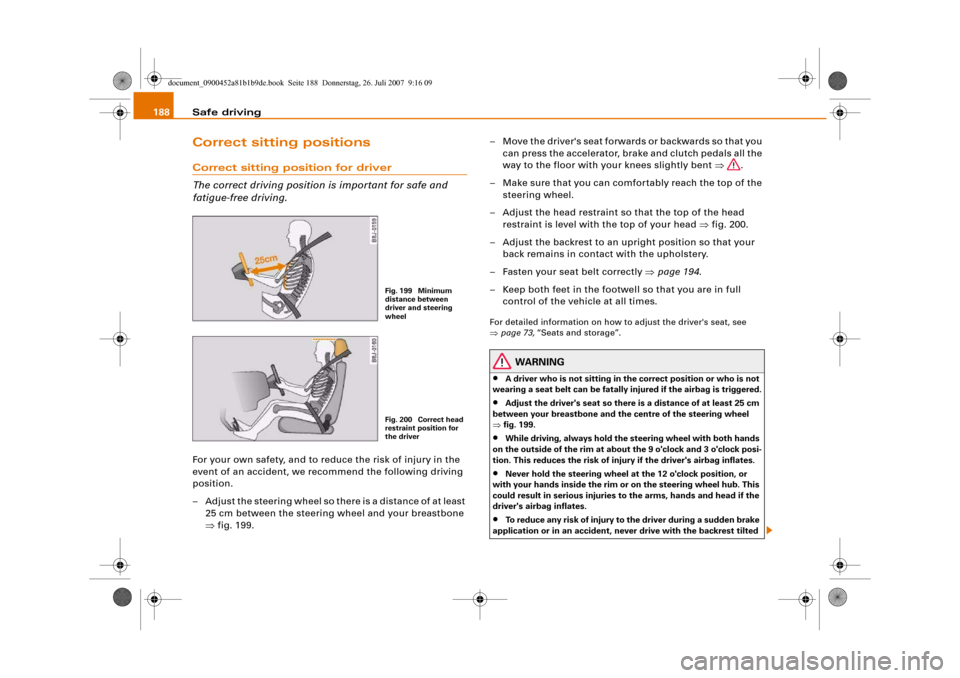
– Adjust the steering wheel so there is a distance of at least
25 cm between the steering wheel and your breastbone
⇒fig. 199.– Move the driver's seat forwards or backwards so that you
can press the accelerator, brake and clutch pedals all the
way to the floor with your knees slightly bent ⇒.
– Make sure that you can comfortably reach the top of the
steering wheel.
– Adjust the head restraint so that the top of the head
restraint is level with the top of your head ⇒fig. 200.
– Adjust the backrest to an upright position so that your
back remains in contact with the upholstery.
– Fasten your seat belt correctly ⇒page 194.
– Keep both feet in the footwell so that you are in full
control of the vehicle at all times.
For detailed information on how to adjust the driver's seat, see
⇒page 73, “Seats and storage”.
WARNING
•
A driver who is not sitting in the correct position or who is not
wearing a seat belt can be fatally injured if the airbag is triggered.
•
Adjust the driver's seat so there is a distance of at least 25 cm
between your breastbone and the centre of the steering wheel
⇒fig. 199.
•
While driving, always hold the steering wheel with both hands
on the outside of the rim at about the 9 o'clock and 3 o'clock posi-
tion. This reduces the risk of injury if the driver's airbag inflates.
•
Never hold the steering wheel at the 12 o'clock position, or
with your hands inside the rim or on the steering wheel hub. This
could result in serious injuries to the arms, hands and head if the
driver's airbag inflates.
•
To reduce any risk of injury to the driver during a sudden brake
application or in an accident, never drive with the backrest tilted
Fig. 199 Minimum
distance between
driver and steering
wheelFig. 200 Correct head
restraint position for
the driver
document_0900452a81b1b9de.book Seite 188 Donnerstag, 26. Juli 2007 9:16 09
Page 210 of 342
Airbag system 208second). The airbag releases a fine dust when it inflates. This is quite
normal and does not mean there is a fire in the vehicle.Important safety notes on the head-protection airbags
There are a number of safety points concerning the airbag
system which you should remember. This will help to
reduce the risk of injury in an accident.
WARNING
•
It is important to ensure that the area around the openings for
the head-protection airbags remains unobstructed at all times, so
that the airbags can inflate properly if needed.
•
The built-in coat hooks should only be used for lightweight
clothing. Do not leave any heavy or sharp-edged objects in the
pockets. When using the coat hooks, do not hang the clothes on
coat hangers.
•
The space between the passengers and the head-protection
airbags must never be occupied by children, other passengers or
pets. Passengers should never lean out or put a hand or arm out of
the window while the vehicle is in motion.
•
Do not move the sun visors out to cover the side windows if
there is anything attached to them (such as pens or a remote
control for the garage door). These objects could cause injury if the
head-protection airbag is triggered.
•
The sensors for the airbags are located in the front doors. You
must therefore not make any modifications to the doors or door
trim (e.g. retrofitting loudspeakers), as this could impair the func-
tion of the side airbags. Any damage to the front doors could lead
to faults in the system. Repairs or any other work on the front
doors must therefore always be carried out by a qualified work-
shop.
•
Where sun blinds are fitted on the rear doors, these must not
obstruct or impair the airbags in any way.
•
If unsuitable accessories are installed near the head-protection
airbag, the protection afforded by the airbag can be seriously
impaired if the system is triggered. When the head-protection
airbag opens, parts of these accessories could be thrown into the
vehicle and injure passengers ⇒page 277.
•
Any work involving the head-protection airbags, or removal
and installation of the airbag components for other repairs (such
as repairs to the roof liner), must always be performed by a quali-
fied workshop. Otherwise the airbag system may fail to work
properly.
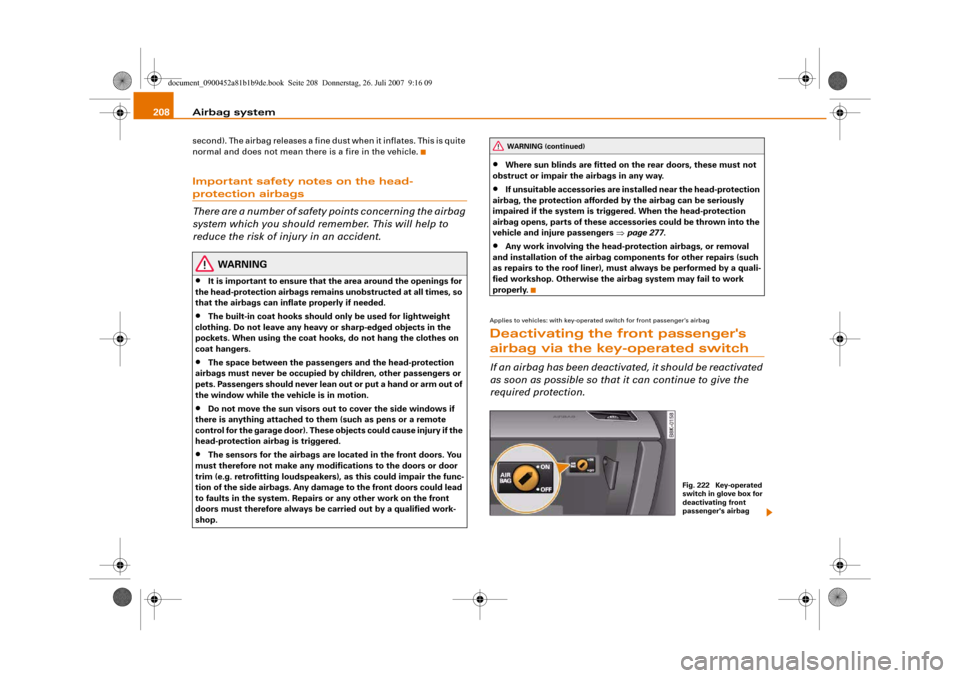
Applies to vehicles: with key-operated switch for front passenger's airbagDeactivating the front passenger's airbag via the key-operated switchIf an airbag has been deactivated, it should be reactivated
as soon as possible so that it can continue to give the
required protection.
WARNING (continued)
Fig. 222 Key-operated
switch in glove box for
deactivating front
passenger's airbag
document_0900452a81b1b9de.book Seite 208 Donnerstag, 26. Juli 2007 9:16 09
Page 213 of 342
Child safety211
Controls
Safety
Driving tips
General maintenance
Self-help
Technical data
•
If children lean forward or are otherwise out of position when
the car is moving, they are at greater risk of injury in an accident.
This is particularly the case if the child is travelling on the front
passenger's seat and the airbag system is triggered in an accident.
There is then a risk of serious or potentially fatal injury.
•
To ensure proper protection, it is important to wear the seat
belts in the correct position ⇒page 197, “How to wear seat belts
properly”. Always check that the belt is properly positioned
according to the instructions provided by the manufacturer of the
child safety seat. Incorrectly worn seat belts can give rise to inju-
ries even in a minor collision.
•
Never install a rearward-facing child safety seat on the front
passenger's seat if the front passenger's airbag has not been deac-
tivated ⇒page 211.
•
Extra caution is advised if you are installing a child safety seat
using the same mounting bolts as the existing car seat belts. The
bolts must be screwed in all the way to the full depth of the
mounting holes and tightened to a torque of 50 Nm. Failure to
observe this precaution could result in potentially fatal injury. We
recommend having the installation performed by a qualified
workshop.
Using a child safety seat on the front passenger's seat
Whenever possible, child safety seats should always be
installed on the rear seat.For safety reasons, we recommend that child safety seats should be
installed on the rear seats whenever possible. However, if you have
to use a child seat on the front passenger's seat when there is no
other alternative, it is most important to note the following warn-
ings:
WARNING
•
Do not use a rearward-facing child safety seat on the front
passenger's seat unless the front passenger's airbag has been
deactivated. The child seat would be directly in the path of the
airbag as it inflates, and the child could sustain serious or fatal
injuries if the airbag were to be deployed.
•
However, if you have no alternative but to use a rearward-
facing child seat on the front passenger's seat, the front
passenger's airbag must be deactivated beforehand by means of
the key-operated switch* ⇒page 208. Failure to observe this
precaution could result in serious or potentially fatal injury.
•
Make sure that the front passenger's airbag is reactivated by
means of the key-operated switch* as soon as the child seat is no
longer needed on the front passenger's seat.
•
When using a child safety seat of the type which faces in the
direction of travel, the front passenger's seat must be moved back
to the rearmost position.
WARNING (continued)
document_0900452a81b1b9de.book Seite 211 Donnerstag, 26. Juli 2007 9:16 09
Page 232 of 342

Your vehicle and the environment 230Anticipate well in advance
A car uses most fuel when accelerating. If you anticipate hazards
and speed changes well in advance, you will need to brake less and
thus accelerate less. Wherever possible, let the car slow down grad-
ually with a gear engaged, for instance when you can see that the
next traffic lights are red. This takes advantage of the engine
braking effect, reducing wear on the brakes and tyres. Emissions
and fuel consumption will drop to zero due to the overrun fuel cut-
off.
Change gear early to save fuel
An effective way of saving fuel is to change up quickly through the
gears. Running the engine at high rpm in the lower gears uses an
unnecessary amount of fuel.
Manual gearbox: Shift up to second gear as soon as possible. If
possible, we recommend shifting up to the next gear at approx.
2,000 rpm.
Automatic gearbox: Press the accelerator slowly and avoid using
the “kick-down” feature.
Avoid driving at high speed
Avoid travelling at top speed. Fuel consumption, exhaust emissions
and noise levels all increase very rapidly at higher speeds. Driving at
moderate speeds will help to save fuel.
Do not let the engine idle for longer than necessary
It is worthwhile switching off the engine when waiting in a traffic
jam, at level crossings or at traffic lights with a long red phase. The
fuel saved after only 30 - 40 seconds is greater than the amount of
fuel needed to restart the engine.
The engine takes a very long time to warm up when it is running at
idling speed. Mechanical wear and pollutant emissions are also
especially high during this initial warm-up phase. It is therefore best
to drive off immediately after starting the engine. Avoid running the
engine at high speed.Regular servicing
Regular servicing can establish a basis for good fuel economy
before you start driving. A well-serviced engine gives you the
benefit of improved fuel efficiency as well as maximum reliability
and an enhanced resale value. A badly tuned engine can consume
up to ten percent more fuel than necessary.
Avoid short trips
The engine and emission control system need to reach their proper
working temperature in order to minimise fuel consumption and
emissions.
A cold engine uses disproportionately more fuel. The engine only
reaches its working temperature after about four kilometres, when
fuel consumption will return to a normal level. This is the reason
why we recommend avoiding short trips wherever possible.
Maintain the correct tyre pressures
Always make sure the tyres are inflated to the correct pressures
⇒page 268 to save fuel. If the tyre pressures are just 0.5 bar too low,
this can increase the fuel consumption by as much as 5 %. Due to
the greater rolling resistance, under-inflation also increases tyre
wear and impairs handling.
Do not use winter tyres all through the year; they will increase fuel
consumption by up to 10 %.
Avoid carrying unnecessary loads
Every kilo of extra weight will increase the fuel consumption, so it is
worth checking the luggage compartment occasionally to make
sure that no unnecessary loads are being transported.
A roof carrier is often left in place for the sake of convenience, even
when it is no longer needed. At a speed of 100-120 km/h your car will
use about 12 % more fuel as a result of the extra wind resistance
caused by the roof carrier - even when it is empty.
document_0900452a81b1b9de.book Seite 230 Donnerstag, 26. Juli 2007 9:16 09
Page 246 of 342
Care of vehicle and cleaning 244Care of vehicle and cleaningGeneral notesRegular care helps to maintain the value of the vehicle.Regular and careful care helps to maintain the value of the vehicle.
This may also be one of the requirements for upholding any
warranty claims in the event of corrosion or paint defects.
Audi dealers and specialist retailers carry stocks of suitable car care
products. Please follow the instructions for use on the packaging.
WARNING
•
Cleaning products and other materials used for car care can
damage health if misused.
•
Car care products can contain toxic substances and must
always be kept in a safe place out of reach of children.For the sake of the environment
•
When purchasing car care products, try to select ones which are
not harmful to the environment.
•
Surplus cleaning materials should not be disposed of together
with ordinary household waste.
Care of exteriorWa s hi ng t he ve hi c l eThe longer substances like insects, bird droppings, resinous tree
sap, road dirt, industrial deposits, tar, soot or road salt and other
aggressive materials remain on the vehicle, the more damage they do to the paintwork. High temperatures (for instance in strong
sunlight) further intensify the corrosive effect.
After the period when salt is put on the roads it is important to have
the underside of the vehicle washed thoroughly.
Automatic car washes
Before going through a car wash, be sure to take the usual precau-
tions such as closing the windows and sunroof. If the vehicle has
special accessories such as spoilers or a roof carrier or two-way
radio aerial, etc., it is advisable to consult the car wash operator.
It is best to use a car wash without revolving bristles if possible.
Washing your car with a high-pressure cleaner
When cleaning the vehicle with a high-pressure cleaner, always
follow the operating instructions for the equipment. This applies
particularly to the operating pressure and the spraying distance. Do
not hold the spray nozzle too close to soft materials, such as rubber
hoses or seals.
Do not use a nozzle that sprays the water out in a direct stream or
one that has a rotating jet for forcing off dirt.
Washing the car by hand
When washing the car by hand, use plenty of water to soften the dirt
first, and rinse off as well as possible.
Then clean the vehicle with a soft sponge, glove or brush, using only
slight pressure. You should start on the roof and work down. Special
car shampoo should only be used for very persistent dirt.
Rinse the sponge or glove thoroughly and often.
Wheels, sills and similar should be cleaned last. Use a second
sponge for this.
document_0900452a81b1b9de.book Seite 244 Donnerstag, 26. Juli 2007 9:16 09
Page 247 of 342
Care of vehicle and cleaning245
Controls
Safety
Driving tips
General maintenance
Self-help
Technical data
WARNING
•
Do not wash the vehicle with the ignition switched on – risk of
accident.
•
Do not clean the underside of the car or inside the wheel arches
without protecting your hands and arms. You may cut yourself on
sharp metal parts.
•
Take care when washing the car during the winter: moisture
and ice on the brakes may affect braking efficiency – this could
cause an accident.Caution
•
Do not wash the vehicle in direct sunlight – otherwise the paint
can be damaged.
•
Do not use insect sponges or abrasive household sponges, etc.
– they can damage the surfaces.
•
The headlights should only be washed with water – do not wipe
them with a dry cloth or sponge. It is best to use soapy water.
•
Never wash tyres with a jet that sprays the water out in a direct
stream. This could damage the tyres – even if the spray is kept at a
distance and only used for a very short time.For the sake of the environment
The car should only be washed in special wash bays. This prevents
oily water from getting into the public drains. In some districts,
washing vehicles anywhere else may be prohibited.Waxing and polishingWaxing
Waxing protects the paintwork. It is time to apply a good coat of wax
when water no longer forms droplets and rolls off the clean paint-
work.Even if a wax solution is used regularly in the car wash, it is advis-
able to protect the paint with a coat of wax at least twice a year.
In the summer, you will find it is much easier to remove dead insects
(which accumulate on the bumper and the front of the bonnet) if the
car has been waxed recently.
Polishing
Polishing is only necessary if the paint has lost its shine, and the
gloss cannot be brought back by putting on wax.
The car must be waxed after polishing if the polish used does not
contain wax compounds to seal the paint.
Caution
Matt painted and plastic parts must not be treated with wax or
polish.Ornamental trim and mouldingsThe metal brightwork on the body is made of aluminium rather than
chrome (for environmental reasons).
Dirt or marks on the trim mouldings should be removed with an
acid-free cleaning agent (do not use a chrome cleaner). Body polish
is also unsuitable for use on trim mouldings. The intensive cleaning
fluids often used before the car goes into a car wash may contain
alkaline substances, which can cause dull or milky patches when
they dry out.
Audi dealers carry stocks of cleaning products which have been
tested for use on your vehicle and are not harmful to the
environment.
document_0900452a81b1b9de.book Seite 245 Donnerstag, 26. Juli 2007 9:16 09
Page 248 of 342
Care of vehicle and cleaning 246Plastic partsPlastic parts will come clean with regular washing. If this is not suffi-
cient, plastic parts should only be treated with a special solvent-free
plastic cleaning agent. Do not use paint cleaners, polishes or wax on
plastic parts.Paint damageMinor damage to the paint, such as scratches or stone chips, should
be touched up without delay before the metal starts to corrode. Suit-
able touch-up brushes or sprays for your car can be obtained from
an Audi dealer.
The number of the original paint finish on the vehicle is given on the
data sticker ⇒page 321.
If corrosion is already visible it must be thoroughly removed by a
qualified workshop.Windows
Clear vision is an essential safety factor.The windscreen must not be cleaned with insect remover or wax,
otherwise the windscreen wipers will not function properly
(juddering).
Traces of rubber, oil, grease or silicone can be removed with a
window cleaning solution or a silicone remover. Wax residue can
only be removed with a special cleaner. Your Audi dealer will be able
to provide you with more detailed information.
The windows should also be cleaned on the inside at regular inter-
vals.
Use a separate cloth or chamois to dry the windows. Cloths used for
waxing and polishing contain residues that will cause smears on the
glass.
WARNING
Do not use water-repellent coatings on the windscreen. In bad visi-
bility conditions such as light rain, low sun or when driving at
night these coatings can cause increased dazzle, which is a
serious safety hazard. Such coatings can also cause the wiper
blades to judder.
Caution
•
Remove snow and ice from windows and mirrors with a plastic
scraper only. To avoid scratches caused by dirt on the glass, the
scraper should only be pushed in one direction and not moved to
and fro.
•
The heating element for the rear window is located on the inner
side of the window. To avoid damaging the heating element, do not
put stickers on the inner side of the window.
•
Never use warm or hot water to remove snow and ice from
windows and mirrors. This could cause the glass to crack!
Rubber seals (weatherstrips)The weatherstrips will remain pliable and last longer if they are
occasionally treated with a suitable care product (for example sili-
cone spray). This will also prevent premature ageing and leaks. The
doors will be easier to open as well. If they are kept pliable, the door
seals will be less likely to freeze up in the winter.WheelsThe wheels require regular attention to preserve their appearance.
It is important to remove road salt and brake dust by washing the
wheels at regular intervals, otherwise the finish will be impaired.
document_0900452a81b1b9de.book Seite 246 Donnerstag, 26. Juli 2007 9:16 09
Page 252 of 342
Care of vehicle and cleaning 250Applies to vehicles: with Alcantara seat coversCleaning AlcantaraRemoving dust and dirt
– Moisten a cloth just a little and wipe down the seat
covers.
Removing stains
– Moisten a cloth with lukewarm water or diluted methyl-
ated spirits.
– Dab at the stain. Start at the outside and work inwards.
– Dry the area you have cleaned with a soft cloth.Do not use leather cleaning products on Alcantara seat covers.
You may use a suitable shampoo on dust and dirt.
Dust and grit in the pores and seams can have an abrasive effect
and damage the surface of the leather. If the car is left standing in
the sun for long periods, the leather should be protected against
direct sunlight to prevent it from fading. However, slight colour vari-
ations will arise in normal use.
Caution
•
Do not use solvents, wax polish, shoe cream, stain removers,
leather cleaning products or any similar products on Alcantara.
•
To avoid damage, stubborn stains should be removed by a qual-
ified workshop.
•
On no account use brushes, hard sponges or similar utensils.
Seat belts
Seat belts should be looked after properly to ensure that
they give the full protection.– Keep the seat belts clean.
– For cleaning, use a mild soap solution.
– Check the condition of the seat belts at regular intervals.Very dirty belts may not retract properly.
Make sure that the inertia reel seat belts are completely dry before
allowing them to retract.
Caution
•
Do not remove the seat belts from the vehicle to clean them.
•
Do not use chemical cleaning agents on the seat belts, as this
can damage the webbing. Ensure that the belts do not come into
contact with corrosive fluids.
•
If you find any damage to the belt webbing, belt fittings, the belt
retractor or the buckle, the belt in question must be replaced by a
qualified workshop.
document_0900452a81b1b9de.book Seite 250 Donnerstag, 26. Juli 2007 9:16 09
Page 255 of 342
Fuel and filling the tank253
Controls
Safety
Driving tips
General maintenance
Self-help
Technical data −Insert the filler nozzle as far as possible into the spare fuel
canister.
−If the spare fuel canister is made of metal, the filler nozzle
must be in contact with the canister during filling. This helps
prevent an electrostatic charge building up.
−Make sure you never spill fuel in the vehicle or in the luggage
compartment. Fuel vapour is explosive. Risk of fatal accident!
Caution
•
If any fuel is spilt onto the vehicle, it should be removed immedi-
ately, as it could otherwise damage the paintwork.
•
Never run the tank completely dry. If there is an irregular fuel
supply, misfiring can occur. As a result unburnt fuel can enter the
exhaust system and cause damage to the catalytic converter(s).
•
When filling the fuel tank after having run it completely dry on a
vehicle with a diesel engine the ignition must be switched on for at
least 30 seconds without starting the engine. When you then start
the engine it may take longer than normal (up to one minute) for the
engine to start firing. This is because air needs to be bled from the
fuel system while starting.For the sake of the environment
Do not try to put in more fuel after the automatic filler nozzle has
switched off; this may cause the fuel to overflow if it becomes warm.
Note
The tank flap is not locked when you lock the vehicle from the
inside.
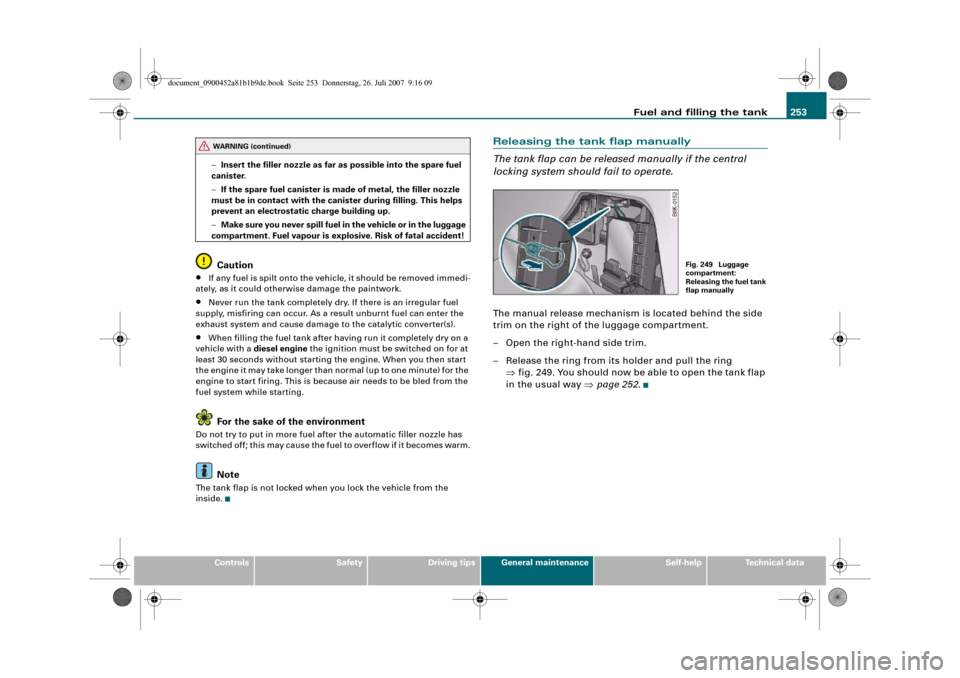
Releasing the tank flap manually
The tank flap can be released manually if the central
locking system should fail to operate.The manual release mechanism is located behind the side
trim on the right of the luggage compartment.
– Open the right-hand side trim.
– Release the ring from its holder and pull the ring
⇒fig. 249. You should now be able to open the tank flap
in the usual way ⇒page 252.
WARNING (continued)
Fig. 249 Luggage
compartment:
Releasing the fuel tank
flap manually
document_0900452a81b1b9de.book Seite 253 Donnerstag, 26. Juli 2007 9:16 09