lock AUDI A4 2008 B8 / 4.G Repair Manual
[x] Cancel search | Manufacturer: AUDI, Model Year: 2008, Model line: A4, Model: AUDI A4 2008 B8 / 4.GPages: 342, PDF Size: 13.14 MB
Page 229 of 342
Intelligent technology227
Controls
Safety
Driving tips
General maintenance
Self-help
Technical data current even when the ignition is off. In some cases there may not
be enough power available to start the engine.
Your vehicle is equipped with an intelligent power management
system to control the distribution of electrical energy. This signifi-
cantly improves reliability when starting the engine, and also
prolongs the life of the battery.
The main functions incorporated in the power management system
are battery diagnosis, residual current management and dynamic
power management.
Battery diagnosis
The battery diagnosis function constantly registers the condition of
the battery. Sensors detect the battery voltage, battery current and
battery temperature. This enables the system to calculate the
current power level and charge condition of the battery.
Residual current management
The residual current management reduces power consumption
while the vehicle is parked. It controls the supply of power to the
various electrical components while the ignition is switched off. The
system takes the battery diagnosis data into consideration.
Depending on the power level of the battery, the individual electrical
components are switched off one after the other to prevent the
battery from losing too much charge and to ensure that the engine
can be started reliably.
Dynamic power management
While the vehicle is moving, this function distributes the available
power to the various electrical components and systems according
to their requirements. The power management ensures that on-
board systems do not consume more electrical power than the
alternator can supply, and thus maintains the maximum possible
battery power level.
Note
•
The power management system is not able to overcome the
given physical limits. Please remember that the power and life of
the battery are limited.
•
A warning message will appear ⇒page 228, “Driver message in
the instrument cluster display” if the battery power has dropped to
a level where reliable starting is impaired.
Points to remember
Starting ability has first priority.Short trips, city traffic and low temperatures all place a heavy load
on the battery. In these conditions a large amount of power is
consumed, but only a small amount is supplied. The situation is also
critical if electrical equipment is in use when the engine is not
running. In this case power is consumed when none is being gener-
ated.
In these situations you will be aware that the power management
system is intervening to control the distribution of electrical power.
When the vehicle is parked for long periods
If you do not drive your vehicle for a period of several days or weeks,
the power management will gradually shut off the on-board
systems one by one, or reduce the amount of current they are using.
This limits the amount of power consumed and helps to ensure reli-
able starting even after a long period.
Please note that certain convenience features, such as the Audi
advanced key*, the remote control key or the electrical seat adjust-
ment may not be available when you unlock the vehicle. These func-
tions will be restored when you switch on the ignition and start the
engine.
document_0900452a81b1b9de.book Seite 227 Donnerstag, 26. Juli 2007 9:16 09
Page 236 of 342
Towing a trailer 234•
The trailer overrun brake must be set correctly. This is important
to ensure that the trailer can be braked correctly, to avoid the vehicle
and trailer “jack-knifing” and to prevent excess braking of the trailer.
•
At low outside temperatures, both the towing vehicle and the
trailer should be fitted with winter tyres.
WARNING
It is essential that you adjust your speed to suit the weather, road
and traffic conditions. Do not let the trailer stabilisation system
tempt you into taking any risks when driving – this can cause acci-
dents.•
The ESP and trailer stabilisation system cannot defy the laws
of physics. This should be kept in mind, particularly on slippery
and wet roads and when towing a trailer with a light load.
•
The trailer stabilisation system is functional, regardless of
whether the trailer has a mechanical overrun brake or not.
•
The trailer stabilisation system is not always able to detect
swaying of trailers with a light load and will therefore not inter-
vene.
•
A trailer can still “jack-knife” on slippery roads with little grip,
even if the towing vehicle is equipped with the trailer stabilisation
system.
•
Trailers with a high centre of gravity may even tip over before
they start to sway sideways.
•
If you are not towing a trailer, but the trailer socket is being
used (e.g. for an illuminated bicycle rack), the trailer stabilisation
system may be activated in extreme driving conditions.
•
Please note the additional information and warnings
⇒page 234.
Notes on towing
Driving with a trailer always requires extra care.Weight distribution
Try to avoid towing a loaded trailer with an unladen vehicle. If this
cannot be avoided, drive extra slowly to allow for the unbalanced
weight distribution.
Speed
The stability of the car and trailer is reduced with increasing speed.
For this reason it is advisable not to drive at the maximum permis-
sible top speed in unfavourable road, weather or wind conditions.
This applies especially on a downhill gradient.
You should always reduce speed immediately if the trailer shows
the slightest sign of swaying. Never try to stop the swaying by accel-
erating further.
Always brake in good time. If the trailer has an overrun brake, apply
the brakes gently at first and then firmly. This will prevent the jerking
that can be caused by the trailer wheels locking. Change down in
good time before going down a steep hill so that you can use the
engine braking effect to slow down the vehicle.
Swaying and pitching can be reduced by stabiliser aids. We recom-
mend having stabiliser aids installed when towing trailers with a
high trailer weight. They can be purchased and installed at an Audi
dealer.
Overheating
When climbing long hills in hot weather with the engine running
fast in low gear, you should keep an eye on the coolant temperature
gauge ⇒page 11. Reduce speed immediately if the needle moves to
the top end of the scale. If the temperature warning lamp
in the
instrument cluster should start flashing, stop the car and let the
engine cool down by running it at idling speed for a few minutes.
document_0900452a81b1b9de.book Seite 234 Donnerstag, 26. Juli 2007 9:16 09
Page 237 of 342
Towing a trailer235
Controls
Safety
Driving tips
General maintenance
Self-help
Technical data
Applies to vehicles: with towing bracketAccessories
Before mounting equipment and accessories (e.g. bicycle
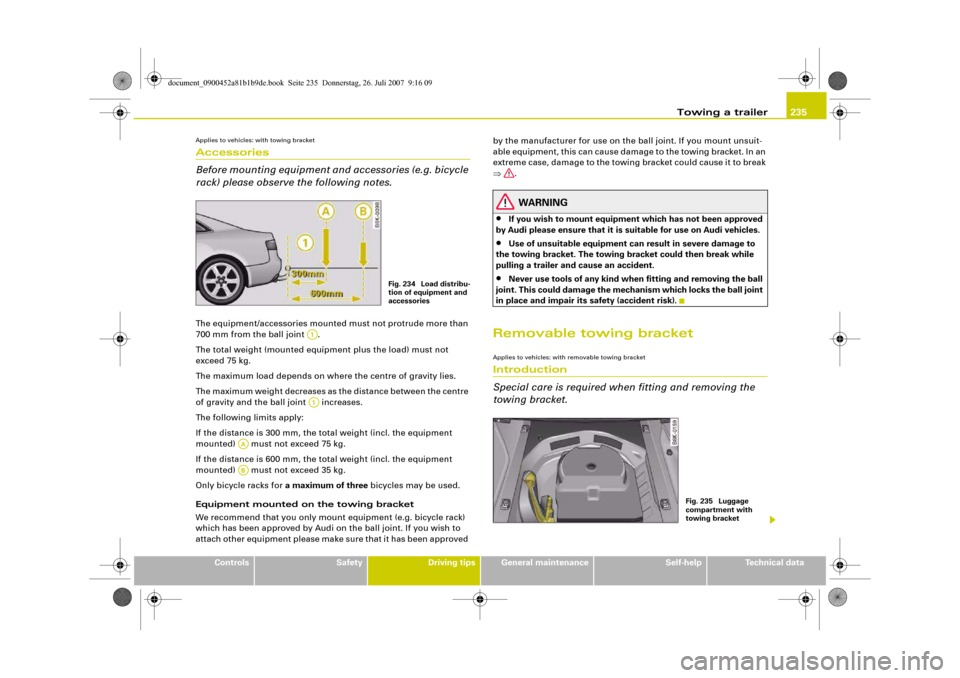
rack) please observe the following notes.The equipment/accessories mounted must not protrude more than
700 mm from the ball joint .
The total weight (mounted equipment plus the load) must not
exceed 75 kg.
The maximum load depends on where the centre of gravity lies.
The maximum weight decreases as the distance between the centre
of gravity and the ball joint increases.
The following limits apply:
If the distance is 300 mm, the total weight (incl. the equipment
mounted) must not exceed 75 kg.
If the distance is 600 mm, the total weight (incl. the equipment
mounted) must not exceed 35 kg.
Only bicycle racks for a maximum of three bicycles may be used.
Equipment mounted on the towing bracket
We recommend that you only mount equipment (e.g. bicycle rack)
which has been approved by Audi on the ball joint. If you wish to
attach other equipment please make sure that it has been approved by the manufacturer for use on the ball joint. If you mount unsuit-
able equipment, this can cause damage to the towing bracket. In an
extreme case, damage to the towing bracket could cause it to break
⇒.
WARNING
•
If you wish to mount equipment which has not been approved
by Audi please ensure that it is suitable for use on Audi vehicles.
•
Use of unsuitable equipment can result in severe damage to
the towing bracket. The towing bracket could then break while
pulling a trailer and cause an accident.
•
Never use tools of any kind when fitting and removing the ball
joint. This could damage the mechanism which locks the ball joint
in place and impair its safety (accident risk).
Removable towing bracketApplies to vehicles: with removable towing bracketIntroduction
Special care is required when fitting and removing the
towing bracket.
Fig. 234 Load distribu-
tion of equipment and
accessories
A1A1
AAAB
Fig. 235 Luggage
compartment with
towing bracket
document_0900452a81b1b9de.book Seite 235 Donnerstag, 26. Juli 2007 9:16 09
Page 238 of 342
Towing a trailer 236The removable ball joint attachment for the towing bracket is
carried under the floor panel on the left-hand side of the luggage
compartment and is secured by a strap.
The ball joint can be fitted and removed by hand.
WARNING
•
Never use tools of any kind when fitting and removing the ball
joint. This could damage the mechanism which locks the ball joint
in place and impair its safety (accident risk).
•
Secure the ball joint again with the strap when you have
finished using it.Note
•
Do not attempt to modify or repair the ball joint or other towing
bracket components.
•
Should you have any difficulties when using the towing bracket,
or suspect that it is not fitted properly, contact a qualified workshop.
•
Before setting off, always check that the ball joint is secured
properly ⇒page 238.
•
Never disengage the ball joint with the caravan / trailer still
hitched or with a bicycle rack or similar accessory still attached.
•
It is advisable to remove the ball joint when you are not towing a
trailer. Fold the socket back to its original position so that the
mounting fixture is properly closed.
•
The ball joint must be removed if you intend to clean the car with
a steam cleaning attachment. Make sure that the mounting fixture
is properly closed.
•
For installation and removal of the ball joint we recommend that
the gloves provided be used.
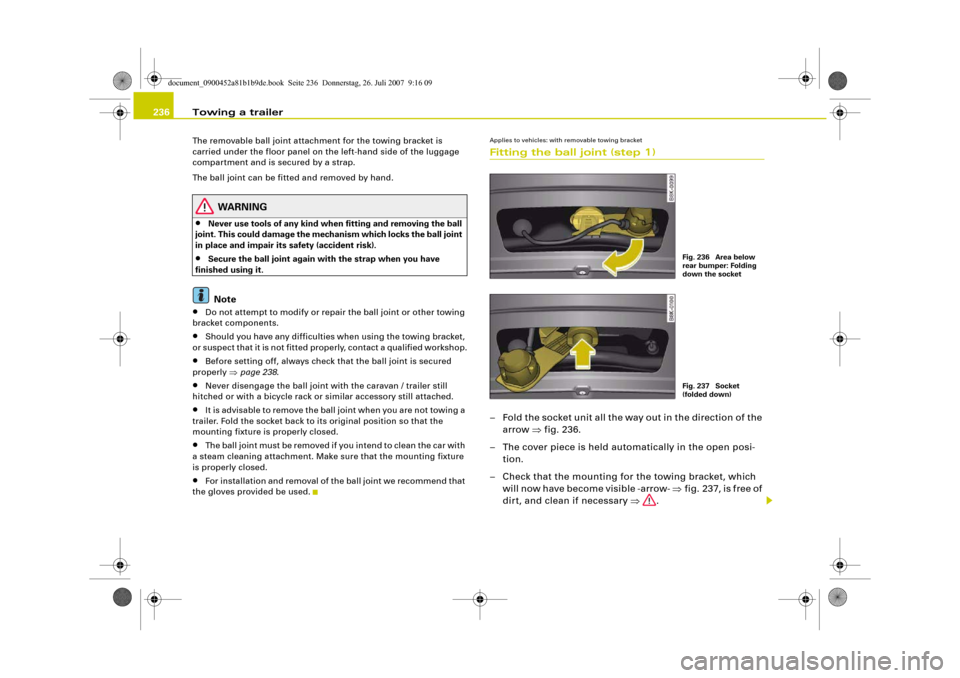
Applies to vehicles: with removable towing bracketFitting the ball joint (step 1)– Fold the socket unit all the way out in the direction of the
arrow ⇒fig. 236.
– The cover piece is held automatically in the open posi-
tion.
– Check that the mounting for the towing bracket, which
will now have become visible -arrow- ⇒fig. 237, is free of
dirt, and clean if necessary ⇒.
Fig. 236 Area below
rear bumper: Folding
down the socketFig. 237 Socket
(folded down)
document_0900452a81b1b9de.book Seite 236 Donnerstag, 26. Juli 2007 9:16 09
Page 239 of 342
Towing a trailer237
Controls
Safety
Driving tips
General maintenance
Self-help
Technical data
– Also check the shaft section of the ball joint and its asso-
ciated mechanical parts to make sure they are clean and
undamaged.Continued ⇒page 237, “Fitting the ball joint (step 2)”.
WARNING
It is important to keep the mounting fixture clean. Otherwise the
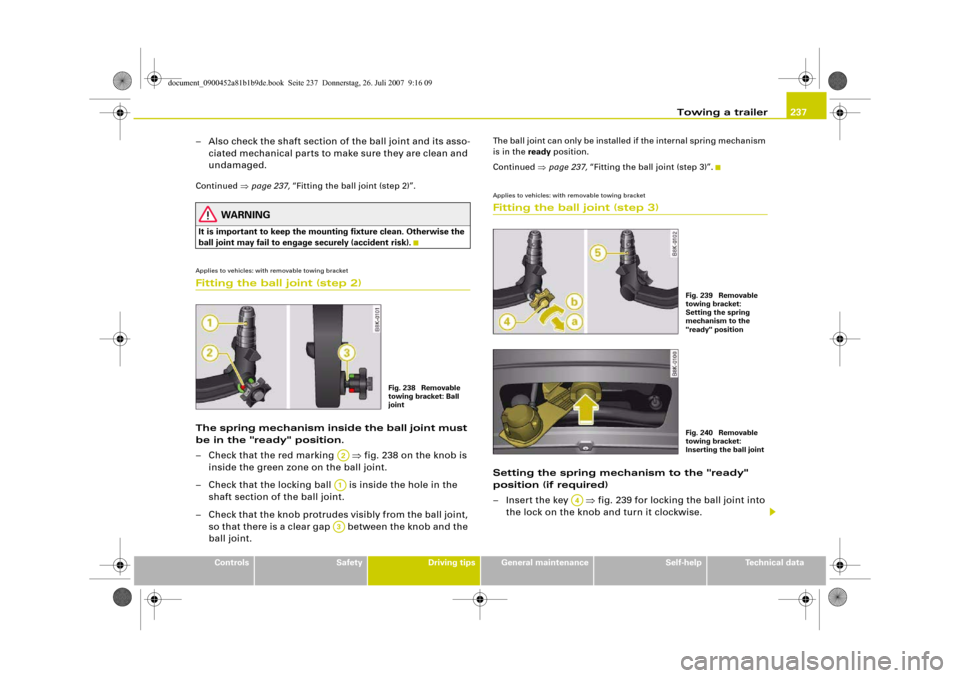
ball joint may fail to engage securely (accident risk).Applies to vehicles: with removable towing bracketFitting the ball joint (step 2)The spring mechanism inside the ball joint must
be in the "ready" position.
– Check that the red marking ⇒fig. 238 on the knob is
inside the green zone on the ball joint.
– Check that the locking ball is inside the hole in the
shaft section of the ball joint.
– Check that the knob protrudes visibly from the ball joint,
so that there is a clear gap between the knob and the
ball joint.
The ball joint can only be installed if the internal spring mechanism
is in the ready position.
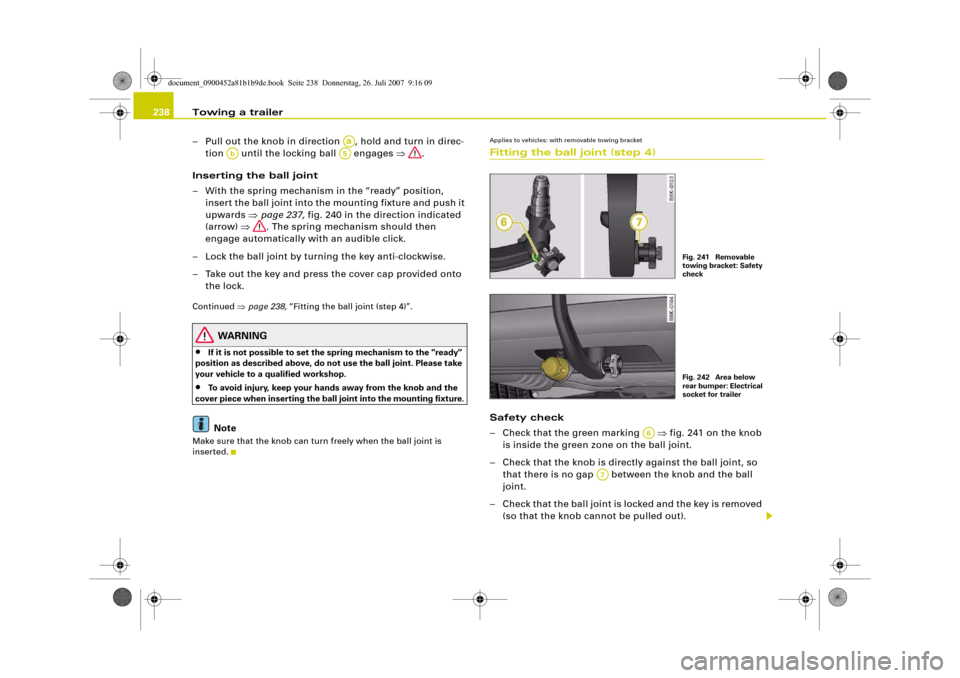
Continued ⇒page 237, “Fitting the ball joint (step 3)”.Applies to vehicles: with removable towing bracketFitting the ball joint (step 3)Setting the spring mechanism to the "ready"
position (if required)
– Insert the key ⇒fig. 239 for locking the ball joint into
the lock on the knob and turn it clockwise.
Fig. 238 Removable
towing bracket: Ball
joint
A2A1A3
Fig. 239 Removable
towing bracket:
Setting the spring
mechanism to the
"ready" positionFig. 240 Removable
towing bracket:
Inserting the ball joint
A4
document_0900452a81b1b9de.book Seite 237 Donnerstag, 26. Juli 2007 9:16 09
Page 240 of 342
Towing a trailer 238
– Pull out the knob in direction , hold and turn in direc-
tion until the locking ball engages ⇒.
Inserting the ball joint
– With the spring mechanism in the “ready” position,
insert the ball joint into the mounting fixture and push it
upwards ⇒page 237, fig. 240 in the direction indicated
(arrow) ⇒. The spring mechanism should then
engage automatically with an audible click.
– Lock the ball joint by turning the key anti-clockwise.
– Take out the key and press the cover cap provided onto
the lock.Continued ⇒page 238, “Fitting the ball joint (step 4)”.
WARNING
•
If it is not possible to set the spring mechanism to the "ready"
position as described above, do not use the ball joint. Please take
your vehicle to a qualified workshop.
•
To avoid injury, keep your hands away from the knob and the
cover piece when inserting the ball joint into the mounting fixture.Note
Make sure that the knob can turn freely when the ball joint is
inserted.
Applies to vehicles: with removable towing bracketFitting the ball joint (step 4)Safety check
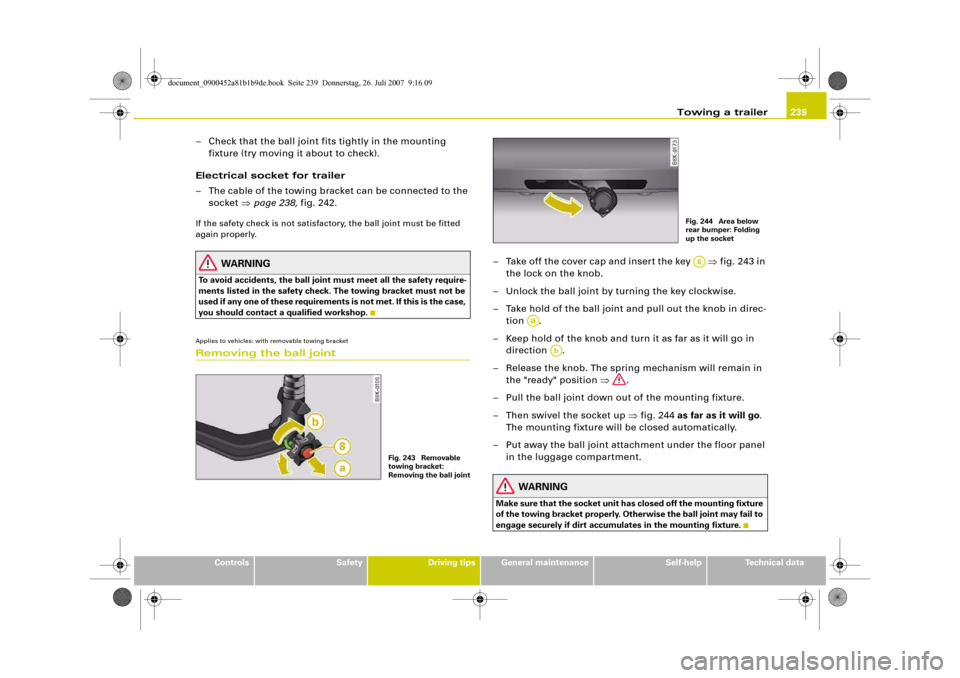
– Check that the green marking ⇒fig. 241 on the knob
is inside the green zone on the ball joint.
– Check that the knob is directly against the ball joint, so
that there is no gap between the knob and the ball
joint.
– Check that the ball joint is locked and the key is removed
(so that the knob cannot be pulled out).
Aa
Ab
A5
Fig. 241 Removable
towing bracket: Safety
checkFig. 242 Area below
rear bumper: Electrical
socket for trailer
A6
A7
document_0900452a81b1b9de.book Seite 238 Donnerstag, 26. Juli 2007 9:16 09
Page 241 of 342
Towing a trailer239
Controls
Safety
Driving tips
General maintenance
Self-help
Technical data
– Check that the ball joint fits tightly in the mounting
fixture (try moving it about to check).
Electrical socket for trailer
– The cable of the towing bracket can be connected to the
socket ⇒page 238, fig. 242.If the safety check is not satisfactory, the ball joint must be fitted
again properly.
WARNING
To avoid accidents, the ball joint must meet all the safety require-
ments listed in the safety check. The towing bracket must not be
used if any one of these requirements is not met. If this is the case,
you should contact a qualified workshop.Applies to vehicles: with removable towing bracketRemoving the ball joint
– Take off the cover cap and insert the key ⇒fig. 243 in
the lock on the knob.
– Unlock the ball joint by turning the key clockwise.
– Take hold of the ball joint and pull out the knob in direc-
tion .
– Keep hold of the knob and turn it as far as it will go in
direction .
– Release the knob. The spring mechanism will remain in
the "ready" position ⇒.
– Pull the ball joint down out of the mounting fixture.
– Then swivel the socket up ⇒fig. 244 as far as it will go.
The mounting fixture will be closed automatically.
– Put away the ball joint attachment under the floor panel
in the luggage compartment.
WARNING
Make sure that the socket unit has closed off the mounting fixture
of the towing bracket properly. Otherwise the ball joint may fail to
engage securely if dirt accumulates in the mounting fixture.
Fig. 243 Removable
towing bracket:
Removing the ball joint
Fig. 244 Area below
rear bumper: Folding
up the socketA8
Aa
Ab
document_0900452a81b1b9de.book Seite 239 Donnerstag, 26. Juli 2007 9:16 09
Page 254 of 342
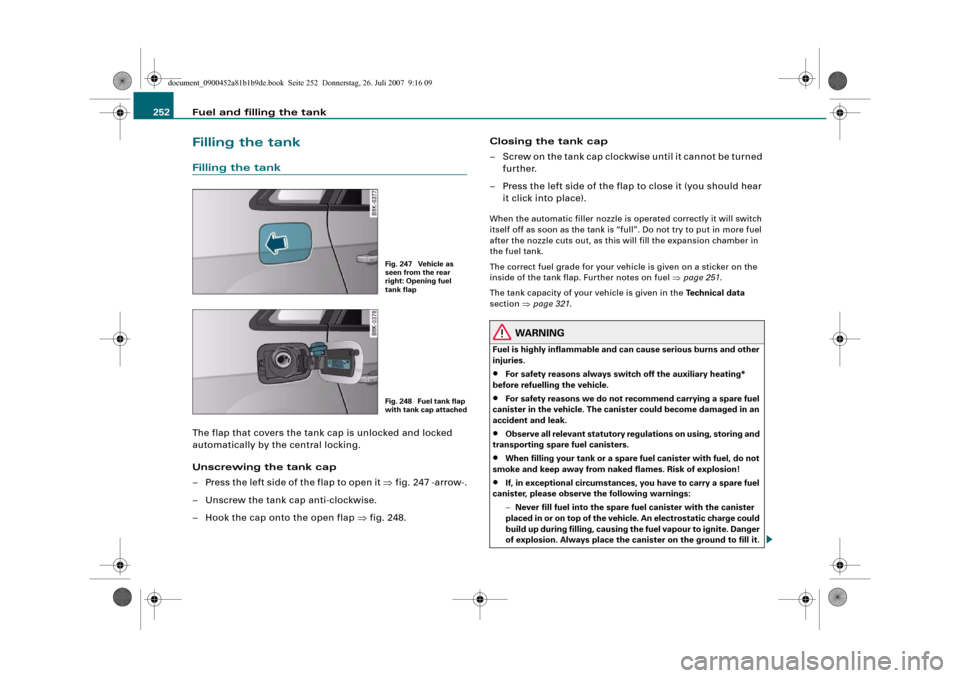
Fuel and filling the tank 252Filling the tankFilling the tankThe flap that covers the tank cap is unlocked and locked
automatically by the central locking.
Unscrewing the tank cap
– Press the left side of the flap to open it ⇒fig. 247 -arrow-.
– Unscrew the tank cap anti-clockwise.
– Hook the cap onto the open flap ⇒fig. 248.Closing the tank cap
– Screw on the tank cap clockwise until it cannot be turned
further.
– Press the left side of the flap to close it (you should hear
it click into place).
When the automatic filler nozzle is operated correctly it will switch
itself off as soon as the tank is “full”. Do not try to put in more fuel
after the nozzle cuts out, as this will fill the expansion chamber in
the fuel tank.
The correct fuel grade for your vehicle is given on a sticker on the
inside of the tank flap. Further notes on fuel ⇒page 251.
The tank capacity of your vehicle is given in the Technical data
section ⇒page 321.
WARNING
Fuel is highly inflammable and can cause serious burns and other
injuries.•
For safety reasons always switch off the auxiliary heating*
before refuelling the vehicle.
•
For safety reasons we do not recommend carrying a spare fuel
canister in the vehicle. The canister could become damaged in an
accident and leak.
•
Observe all relevant statutory regulations on using, storing and
transporting spare fuel canisters.
•
When filling your tank or a spare fuel canister with fuel, do not
smoke and keep away from naked flames. Risk of explosion!
•
If, in exceptional circumstances, you have to carry a spare fuel
canister, please observe the following warnings:
−Never fill fuel into the spare fuel canister with the canister
placed in or on top of the vehicle. An electrostatic charge could
build up during filling, causing the fuel vapour to ignite. Danger
of explosion. Always place the canister on the ground to fill it.
Fig. 247 Vehicle as
seen from the rear
right: Opening fuel
tank flapFig. 248 Fuel tank flap
with tank cap attached
document_0900452a81b1b9de.book Seite 252 Donnerstag, 26. Juli 2007 9:16 09
Page 255 of 342
Fuel and filling the tank253
Controls
Safety
Driving tips
General maintenance
Self-help
Technical data −Insert the filler nozzle as far as possible into the spare fuel
canister.
−If the spare fuel canister is made of metal, the filler nozzle
must be in contact with the canister during filling. This helps
prevent an electrostatic charge building up.
−Make sure you never spill fuel in the vehicle or in the luggage
compartment. Fuel vapour is explosive. Risk of fatal accident!
Caution
•
If any fuel is spilt onto the vehicle, it should be removed immedi-
ately, as it could otherwise damage the paintwork.
•
Never run the tank completely dry. If there is an irregular fuel
supply, misfiring can occur. As a result unburnt fuel can enter the
exhaust system and cause damage to the catalytic converter(s).
•
When filling the fuel tank after having run it completely dry on a
vehicle with a diesel engine the ignition must be switched on for at
least 30 seconds without starting the engine. When you then start
the engine it may take longer than normal (up to one minute) for the
engine to start firing. This is because air needs to be bled from the
fuel system while starting.For the sake of the environment
Do not try to put in more fuel after the automatic filler nozzle has
switched off; this may cause the fuel to overflow if it becomes warm.
Note
The tank flap is not locked when you lock the vehicle from the
inside.
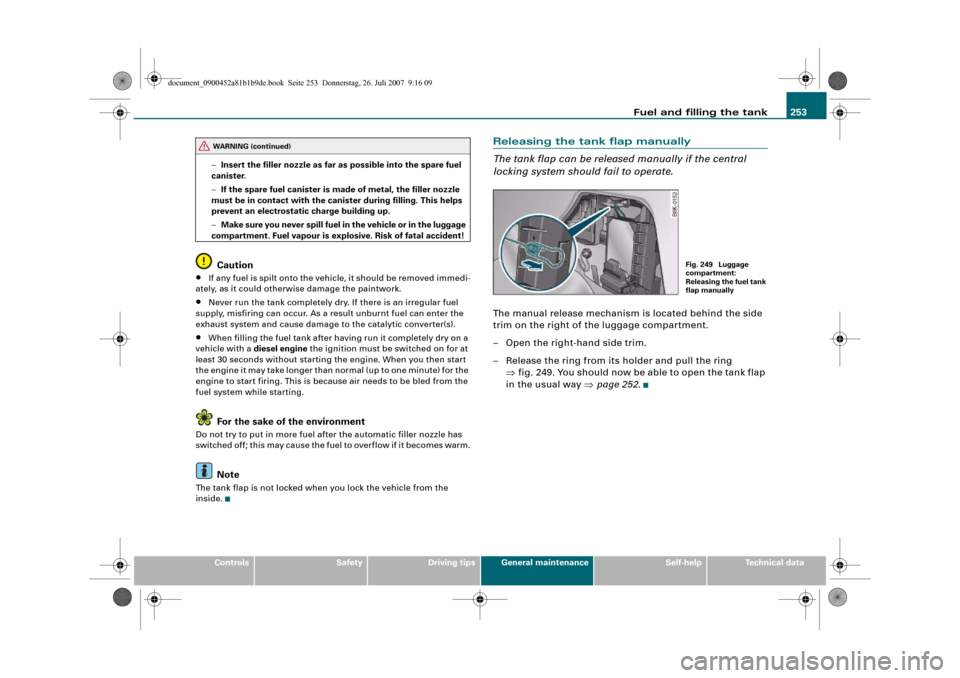
Releasing the tank flap manually
The tank flap can be released manually if the central
locking system should fail to operate.The manual release mechanism is located behind the side
trim on the right of the luggage compartment.
– Open the right-hand side trim.
– Release the ring from its holder and pull the ring
⇒fig. 249. You should now be able to open the tank flap
in the usual way ⇒page 252.
WARNING (continued)
Fig. 249 Luggage
compartment:
Releasing the fuel tank
flap manually
document_0900452a81b1b9de.book Seite 253 Donnerstag, 26. Juli 2007 9:16 09
Page 256 of 342
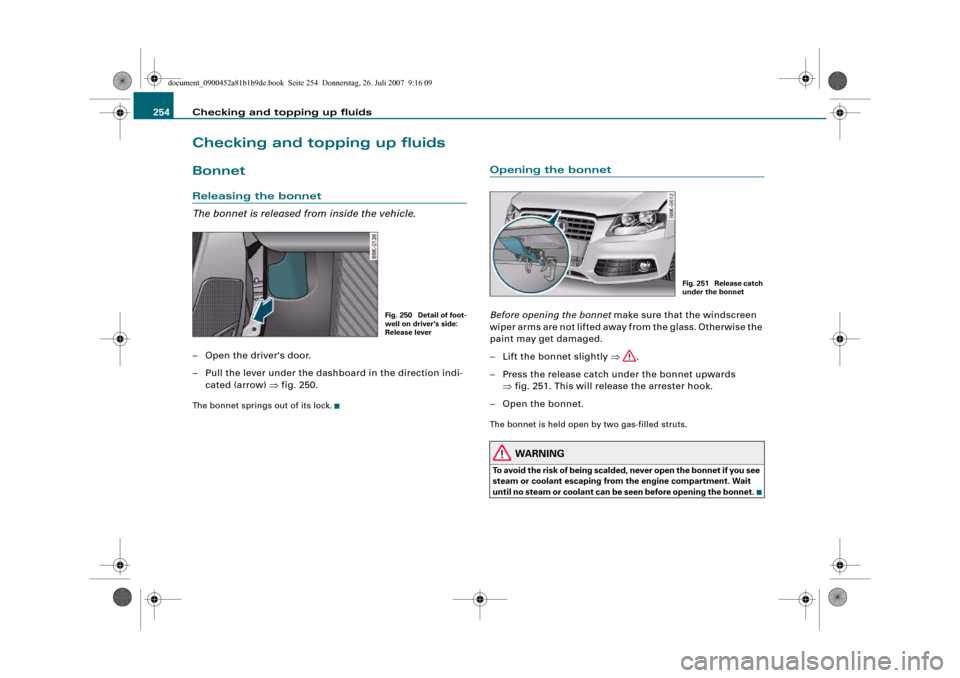
Checking and topping up fluids 254Checking and topping up fluidsBonnetReleasing the bonnet
The bonnet is released from inside the vehicle.– Open the driver's door.
– Pull the lever under the dashboard in the direction indi-
cated (arrow) ⇒fig. 250.The bonnet springs out of its lock.
Opening the bonnetBefore opening the bonnet make sure that the windscreen
wiper arms are not lifted away from the glass. Otherwise the
paint may get damaged.
– Lift the bonnet slightly ⇒.
– Press the release catch under the bonnet upwards
⇒fig. 251. This will release the arrester hook.
– Open the bonnet.The bonnet is held open by two gas-filled struts.
WARNING
To avoid the risk of being scalded, never open the bonnet if you see
steam or coolant escaping from the engine compartment. Wait
until no steam or coolant can be seen before opening the bonnet.
Fig. 250 Detail of foot-
well on driver's side:
Release lever
Fig. 251 Release catch
under the bonnet
document_0900452a81b1b9de.book Seite 254 Donnerstag, 26. Juli 2007 9:16 09