ESP AUDI A4 2018 Owners Manual
[x] Cancel search | Manufacturer: AUDI, Model Year: 2018, Model line: A4, Model: AUDI A4 2018Pages: 403, PDF Size: 66.81 MB
Page 314 of 403
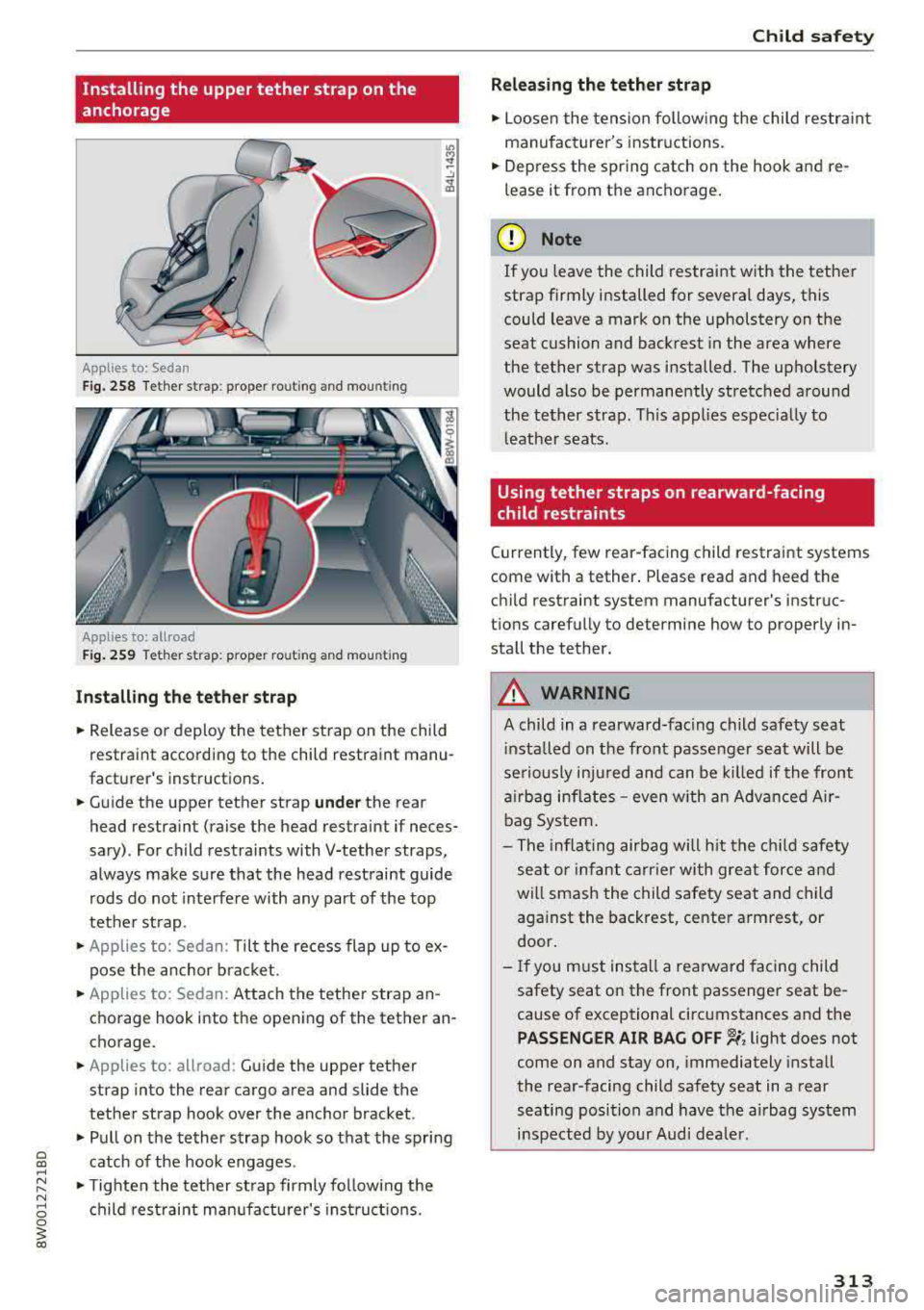
Installing the upper tether strap on the
anchorage
Appliesto:Sedan
Fig. 258 Tether strap: proper routing and mo unting
Applies to: allroad
Fig. 259 Tether strap: pro per rout ing and mount ing
Installing the tether strap
• Release or deploy the tether strap on the child
restraint according to the child restraint manu
facturer's instructions .
• Guide the upper tether strap under the rear
head restraint (raise the head restraint if neces
sa ry) . For child restraints with V-tether straps,
always make sure that the head restraint guide
rods do not interfere with any part of the top
tether strap.
• Applies to: Sedan: Tilt the recess flap up to ex
pose the anchor bracket.
• Applies to: Sedan : Attach the tether strap an
chorage hook into the opening of the tether an
chorage.
• Applies to: allroad: Guide the upper tether
strap into the rear cargo area and slide the
tether strap hook over the anchor bracket .
•Pullon the tether strap hook so that the spring
catch of the hook engages .
• Tighten the tether strap firmly fo llow ing the
child restraint manufacturer's inst ruct ions.
Child safety
Releasing the tether strap
• Loosen the tension following the child restra int
manufacturer's instructions.
• Depress the spring catch on the hook and re
lease it from the anchorage.
(D Note
If you leave the child restraint with the tether
strap firmly installed for several days, this
could leave a mark on the upholstery on the
seat cushion and backrest in the area where
the tether strap was installed . The upholstery
would also be permanently stretched around
the tether strap . T hi s applies espec ially to
le ather seats.
Using tether straps on rearward-facing
child restraints
Currently, few rear-facing child restraint systems
come with a tether. Please read and heed the
child restraint system manufacturer's instruc
tions carefully to determine how to properly in
stall the tether.
_&. WARNING ~
A child in a rearward-facing child safety seat in sta lled on the front passenger seat will be
se riously inju red and can be killed if the front
airbag inflates -even w ith an Advanced Air
bag System.
- The inflating airbag will h it the child safety
seat or infa nt carrier with great force and
will smash the child safety seat and child against the backrest, cente r armrest, or
door.
- If you must install a rearward facing child
safety seat on the front passenger seat be
cause of exceptional circumstances and the
PASSENGER AIR BAG OFF "1; light does not
come on and stay on, immediately install
the rear-facing child safety seat in a rear
seating position and have the a irbag system
i n spected by your Audi dealer.
313
Page 317 of 403
Checking and Filling
fill up at busy gas stations where the seasonal
adjustm ent is more likely to be mad e in time.
0 Note
- Methanol fuels which do not meet these re
quirements may cause corrosion and dam
age to plastic and rubber components in the
fuel system.
- Do not use fuels that fail to meet the speci
fied criteria in this chapter .
- If you are unable to determine whether or
not a particular fuel blend meets the speci
fications, ask your service station or its fuel
supplier.
- Do not use fuel for which the contents can
not be identified.
- Fuel system damage and performance prob
lems resulting from the use of fuels differ
ent from those specified are not the respon
sibility of Audi and are not covered under
the New Vehicle or the Emission Control
System Warranties.
- If you experience a loss of fuel economy or
driveability and performance problems due
to the use of one of these fuel blends, we
recommend that you switch to unblended
fuel.
Gasoline additives
Applies to: vehicles with gasoline engine
A major concern among many auto manufactur
ers is carbon deposit build-up caused by the type
of gasoline you use .
Although gasoline grades differ from one manu
facturer to another, they have certain things in
common. All gasoline grades contain substances
that can cause deposits to collect on vital engine parts, such as fuel injectors and intake valves.
Al
though most gasoline brands include additives to keep engine and fuel systems clean, they are not
equally effective .
Audi recommends using TOP TIER Detergent Gas
oline. For more information on TOP TIER Deter
gent Gasoline, please go to the official website (www.toptiergas .com) .
316
After an extended period of using inadequate
fuels, built-up carbon deposits can rob your
en
gine of peak performance.
([) Note
- Damage or malfunction due to poor fuel
quality is not covered by the Audi New Vehi
cle Limited Warranty.
- Do not add aftermarket fuel additive prod
ucts to your fuel tank.
Diesel fuel
Applies to: vehicles with diesel engine
Always use ULSD (Ultra Low Sulfur Diesel) No. 2.
The ULSD No. 2 meets the ASTM 0975.
Diesel fuel with concentrations of biodiesel high
er than 5
% such as 811,820 or 8100 are strictly
prohibited.
Service station fuel pumps are labeled with the
correct fuel information for easy recognition by
the user. If the diesel fuel pump is not labeled
ask the station operator what fuel is being dis
pensed before filling up your vehicle.
ULSD No. 2 may not be available outside the USA
and Canada. Be sure to check before traveling to
other countries.
ULSD No. 2 can become thicker in very cold tem
peratures, and this can impair the engine's start
ing and running . Depending on the season , gas
stations provide ULSD No. 2 that flows better in
cold temperatures so that you can continue oper
ating your vehicle as usual.
(D Note
- Your vehicle's diesel engine was designed
soley for use with ULSD No. 2. Therefore,
never use gasoline, heating oil, other fuels
or flow improvers. These contain substances
that will severely damage the fuel system
and the engine. Such damage will not be
covered by your New Vehicle Limited War
ranty.
- If you put any amount of incorrect fuel in
the fuel tank, do not start the engine under
.,..
Page 321 of 403
Checking and Filling
This message appears when there is only enough
Ad Blue left to drive the distance indicated in the
instrument cluster . Fill the Ad Blue .
• Refill with at least x qt (l) Ad Blue. No en
gine start in x mi (km). See owner's manual
This message appears when there is only enough
Ad Blue left to drive the distance indicated in the
instr ument cluster. Fill the Ad Blue. Otherwise
the engine will not start again if you stop it once
the d istance indicated has been driven .
• Refill with at least x qt (l) AdBlue. Engine
start not possible . See owner's manual
This message appears when the AdBlue tank is
empty. Fill the AdB lue. Otherwise you will not be
able to start the engine again once you stop it .
The AdBlue must be refilled when the amount in
the tank has reached the minim um level
c::> page 320, Preparation.
Incorrect filling/system malfunction
A message appears if the Ad Blue tank was filled
with a fluid other than AdBlue and the system has detected that the tank was fi lled incorrectly ,
or if there is a system malfunction .
II Ad Blue: malfunction! No engine start in
x mi (km). See owner's manual
This message appears when it is only possible to
drive the d istance ind icated in the instrument
cluster. Drive to the nearest authorized Audi
dealer or authorized Aud i Serv ice Facility to have
the malfun ction corrected. Otherwise the engine
will not start again if you stop it once the dis
tance indicated has been driven .
• Ad Blue: malfunction! No engine start possi
ble. See owner's manual
This message appears if the system has detected
that the tank was filled incorrectly or that there
is a malfunction . Drive immediately to the near
est authorized Aud i dealer or authorized Audi
Service Facility to have the malfunction cor rect
ed. Otherwise you will not be able to start the en
g in e again once you stop it .
320
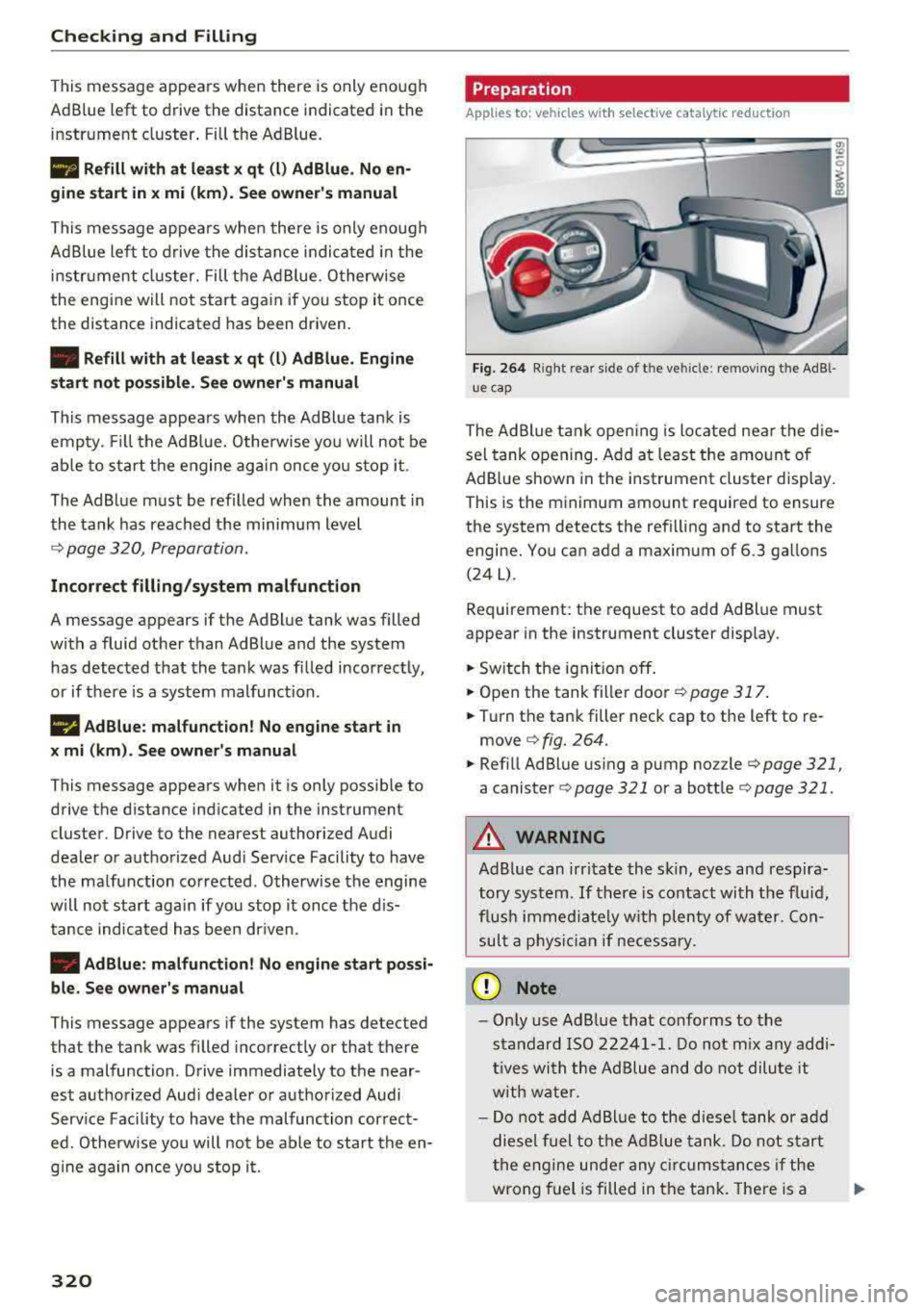
Preparation
App lies to : vehicles with selective cata lyt ic reduct ion
Fig. 264 R ig ht re ar sid e o f th e ve hicle: removing th e Ad B l
ue cap
The Ad Blue tank open ing is located near the die
sel tank opening. Add at least the amount of
Ad Blue shown in the instrument cluster display.
This is the minimum amount required to ensure
the system detects the refilling and to start the
engine. You can add a maximum of 6 .3 gallons
(24
L) .
Requ irement: the request to add Ad Blue must
appear in the instrument cluster display .
.. Switch the ignition off.
.. Open the tank fille r doo r c::> page 317 .
.. Turn the tank filler neck cap to the left to re
move
c::> fig. 264 .
.. Refill Ad Blue using a pump no zzle c::> page 321,
a canister c::> page 321 or a bottle c::>page 321.
A WARNING
AdBlue can irritate the skin, eyes and respira
tory system .
If there is contact with the fluid,
flush immed iately w ith plenty of water . Con
sult a physician if necessary .
(D Note
-Only use Ad Blue that conforms to the
standard ISO 22241-1. Do not mix any addi
ti ves wi th the Ad Blue and do not dilute it
with water .
- Do not add AdBlue to the diesel tank or add
diesel fuel to the Ad Blue tank. Do not start
the engine under any circumstances if the
wrong fuel is filled in the tank. There is a
Page 330 of 403
areas, into open streams or down sewage
drains.
- Recycle used engine oil by taking it to a used
engine oil collection facility in your area, or
contact a service stat ion .
Cooling system
Coolant
The engine coo ling system is filled with a mixture
of purified water and coolant additive at the fac
tory. This coolant must not be not changed.
The coolant level is monitored through
the. in
dicator light
¢ page 30. However , we do recom
mend occasiona lly checking the coolant level
manually.
If you must add coolant, use a mixture of water
and coolant addit ive. Mixing the coolant additive
with distilled water is recommended.
Coolant additive
The coolant additive is made of anti -freezing and
corrosion protection agents. Only use the fol low
ing coolant additives . These additives may be
mixed with each other.
Coolant additive Specification
G13
TL 774 J
G12++ TL
774 G
The amount of coo lant additive that needs to be
mixed with water depends on the climate where
the vehicle will be operated. If the coolant addi
tive percentage is too low, the coolant can freeze
and damage the engine.
Coolant Freeze protec-
additive tion
Warm min . 40% min. -13 °F
regions max .
45% (
- 25 °()
Cold min.
50% max
. -40 °F
regions max.
55% (-40 °()
(D Note
-
Before the start of winter, have an author
ized Audi dealer or authorized Audi Service
Facility check if the coolant additive in your
Checking and Filling
vehicle matches the percentage appropriate
for the climate. This is especia lly important
when driving in colder climates.
- If the appropriate coo lant additive is not
available in an emergency, do not add any
other additive. You could damage the en
gine. If this happens, only use water and re
store the correct mixture ratio with the
specified coolant add itive as soon as poss i
ble .
- Only refill w ith new coolant.
- Radiator sealant must not be mixed with
the coolant.
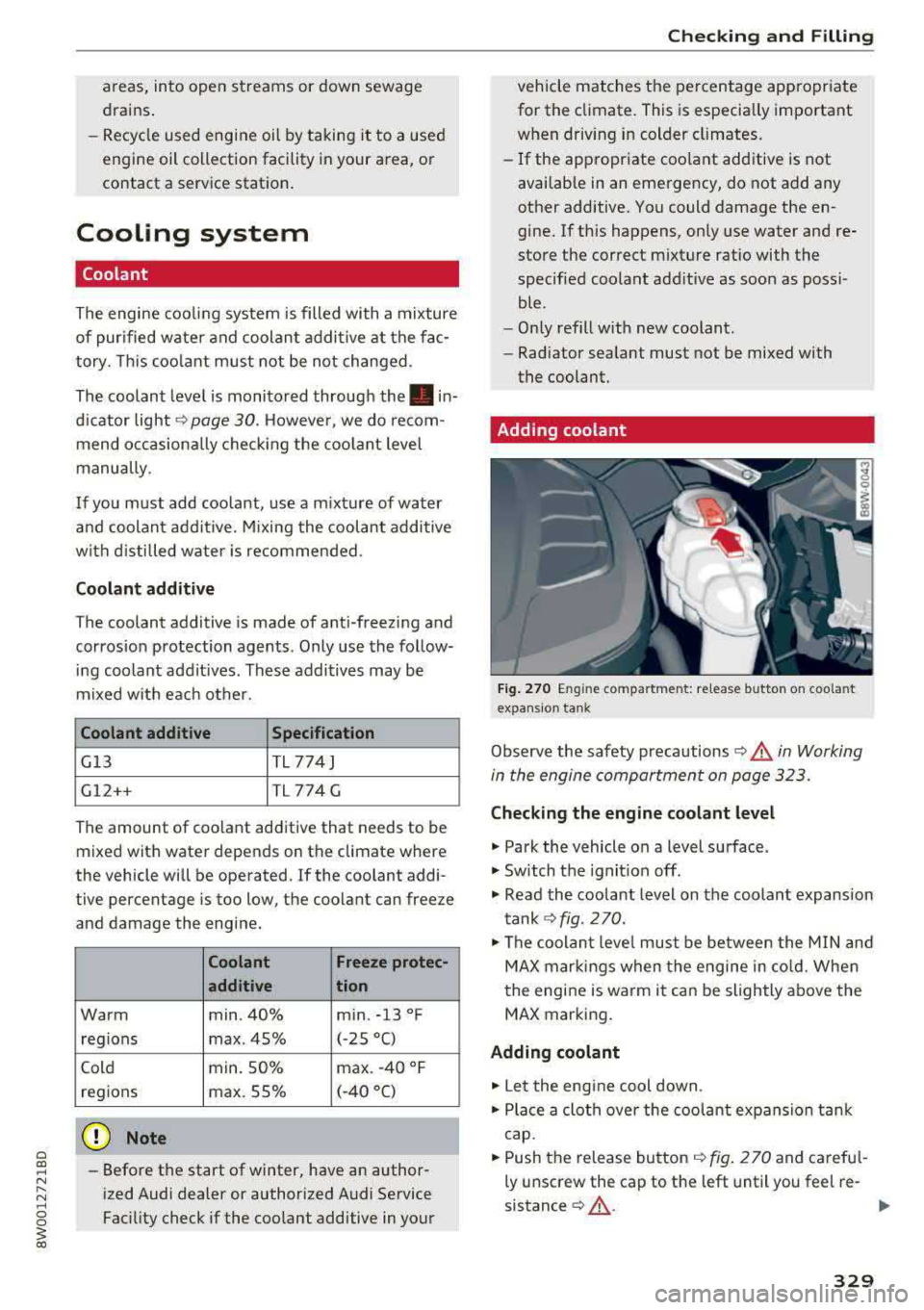
Adding coolant
Fig. 270 E ngine compartment: re lease button on coolant
expansion tank
Observe the safety precautions ¢,&. in Working
in the engine compartment on page 323.
Checking the engine coolant level
.. Park the vehicle on a level surface .
.. Switch the ignition off .
.. Read the coolant level on the coolant expansion
tank
¢ fig. 270.
.. The coolant level must be between the MIN and
MAX markings when the engine in co ld. When
the engine is warm it can be slightly above the
MAX marking.
Adding coolant
.. Let the eng ine cool down .
.. Place a cloth over the coolant expansion tank
cap .
.. Push the release button ¢ fig. 2 70 and carefu l
ly unscrew the cap to the left until you feel re-
sistance¢ ,A. IIJ,-
329
Page 333 of 403
Checking and Filling
Charging the vehicle battery
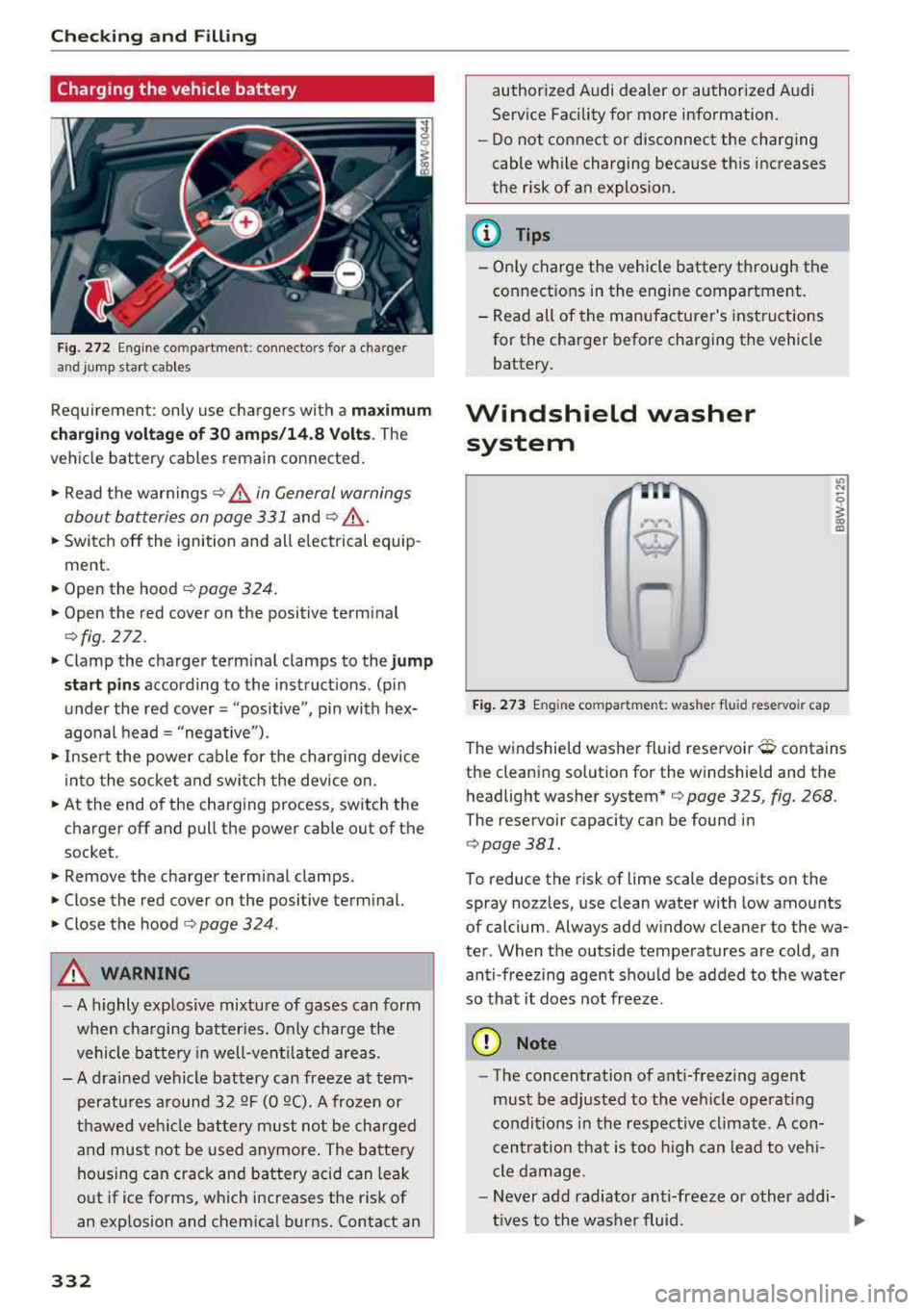
Fig. 272 Engine co mpa rtment : connec tors for a c harger
and jump start cab le s
Req uirement: only use chargers with a m aximum
c hargi ng vo lta ge of 30 amp s/14.8 Volt s.
The
vehicle battery cables remain connected .
.,. Read the warnings c> .&. in General warnings
about batteries on page 331
and c> ,&. .
.,. Switch off the ignition and all electrical equip
ment .
.,. Open the hood 9 page 324 .
.,. Open the red cover on the positive terminal
c>fig. 272 .
.,. Clamp the charger terminal clamps to the jump
s ta rt pin s
according to the instruct ions . (pin
under the red cover = "positive ", p in with hex
agonal head= "negative ") .
.,. Inse rt the powe r cable for the charg ing device
i nto the socke t and switch the dev ice on .
.,. At the end of the charging process , switch the
charger off and pull the power cab le out of the
socket .
.,. Remove the charger terminal clamps.
.,. Close the red cover on the positive terminal.
.,. Close the hood c> page 324 .
A WARNING
-A highly explosive mixtu re of gases can form
when cha rging batter ies. On ly charge the
vehicle batte ry in well-ven tilated areas.
- A drai ned vehicle battery can freeze at tem
peratu res a round 32
QF (0 QC). A froze n or
thawed veh icle bat tery must not be charged
and must not be used anymore. The ba ttery
housing can crac k and battery acid can leak
o ut if ice forms, wh ich increases the r isk of
an exp losion and chemical burns. Contact an
332
author ized Audi dealer or authorized A udi
Service Facility for more information.
- Do not connect or disconnect the charging
cable whi le charging because this increases
the risk of an explos ion.
@ Tips
- Only charge the vehicle battery t hrough the
connect ions in the engine compartme nt.
- Read all of the manufacturer's instructions
for the charger before charging the vehicle
battery.
Windshield washer system
Fi g. 2 7 3 Engine compar tm ent: washer flui d res ervoir cap
The windshield washer fluid reservoir¢ contains
t he cleaning solution for the windshield and th e
headlight washer system *
c> page 325, fig. 268 .
The reservoir capaci ty can be found in
c> page 381.
To reduce the risk of lime scale deposits on the
spray no zzles, use clean water with low amounts
of calcium . Always add w indow cleaner to the wa
ter . When the outside temperatures are cold, an
anti -freezing agent should be added to the water
so that it does not freeze .
(D Note
-The concentration o f ant i-freez ing agent
must be adjusted to the ve hicle operat ing
conditions in the respective climate . A con
cent ration t hat is too high can lead to vehi
cl e damage.
- Never add radiator anti-freeze or other addi
t ives to the washer fluid.
Page 334 of 403
a co .... N ,....
N .... 0 0
3 co
-Do not use a glass cleaner that contains
paint solvents, because this could damage
the paint.
Service interval display
The service interval display detects when your ve
hicle is due for service.
Checking service intervals
You can check the remaining distance or time un
til the next oil change or next inspection in the
Infotainment system .
.,. Select in the Infotainment system: the I MENU I
button >
Vehicle > left control button > Service
& checks > Service intervals.
Resetting the indicator
An authorized Audi dealer or authorized Audi
Service Facility will reset the service interval dis
play after performing service.
If you have changed the oil yourself, you must re
set the oil change interval.
.,. Select in the Infotainment system: the !MENUI
button >
Vehicle > left control button > Service
& checks > Service intervals > Reset oil change
interval.
If an oil change or inspection is due, you can ac
cess it in the Infotainment system. The display
works in two stages:
-Service reminder: after a certain distance is
driven, a message appears in the instrument
cluster display every time the ignition is switch
ed on. The remaining distance and time is dis
played briefly.
- Service due: if your vehicle has reached a serv
ice interval , a message appears briefly after
switching the ignition on.
(D Note
-Only reset the oil change indicator if the oil
was changed.
- Following the service intervals is critical to
maintaining the service life and value of
your vehicle, especially the engine. Even if
Checking and Filling
the mileage on the vehicle is low, do not ex
ceed the time for the next service.
333
Page 337 of 403

Wheel s
® Mud and snow capability
"M/5" or "M+S" indicates the tire
is sui table for driving on mud and
snow.
& indicates a winter tire.
@ Composition of the tire cord
and materials
The number of plies indicates the
number of rubberized fabric lay
ers in the t ire. In general: the
more layers, the more weight a
tire can carry . Tire manufacturers
must also specify the materials
used in the tire. These include
steel, nylon, po lyester and other
materials.
@ Maximum permitted load
This number indicates the maxi
mum load in kilograms and
pounds that the tire can carry .
@Uniform tire quality grade
standards for treadwear,
traction and temperature resist ance
Treadwear, traction and tempera
ture
ranges ¢ page 351.
@ Running direction
The arrows indicate the running
direction of unidirectional t ires .
You must always follow the speci
fied running direction
¢page 366 .
336
@ Maximum permitted
inflation pressure
This number indicates the maxi
mum pressure to which a tire can
be inflated under normal operat
ing condit ions.
Glossary of tire and loading
terminology
Acces sory we ight
means the combined weight (in
excess of those standard items
which may be replaced) of auto matic transmission, power steer
ing, power brakes, power win
dows, power seats, radio, and
heater, to the extent that these
items are available as factory-in
stalled equipment (whether in
stalled or not) .
Aspect ratio
means the ratio of the height to
the width of the tire in percent .
Numbers of 55 or lower indicate a
low sidewall for improved steer
ing response and better overall
handling on dry pavement.
Bead
means the part of the tire that is
made of steel wires, wrapped or
reinforced by ply cords and that is
shaped to fit the r im .
...
Page 342 of 403
for the number of seating posi
tions. Refer to the table ¢
table
on page 346
for the number of
people that correspond to the ve
hicle normal load.
New tires or wheels
Audi recommends having all work on tires or wheels performed by
an author ized Audi dealer or au
thorized Audi Service Facility.
These facilities have the proper
knowledge and are equipped with
the required tools and replace
ment parts.
.,.New tires do not yet have the
optimum gripping properties. Drive carefully and at moderate
speeds for the first 350 miles
(500 km) with new tires.
.,.Use tires of the same construc
tion, size (rolling circumference)
and as close to the same tread
pattern as possible on all four
wheels.
.,.Do not replace tires individually .
At least replace both tires on the
same axle at the same time.
.,.Audi recommends that you use
Audi Original Tires. If you would
~ like to use different tires, please .-<
~ note that the tires may perform .-< 0
~ a:,
Wheels
differently even if they are the
same
size ¢.&,. .
.,. If you would like to equip your
vehicle with a tire/rim combina
tion that is different from what
was installed at the factory, con
sult with an authorized Audi
dealer or authorized Audi Service
Facility before making a pur
chase¢ .&,..
If the spare tire is different from
the regular tires installed on the
vehicle
-for example, if winter
tires or wide tires are installed
-
then only use the spare tire tem
porarily in case of emergency and
drive carefully while it is in use . It
should be replaced with a regular
tire as soon as possible.
On
all wheel drive vehicles, all
four wheels must be equipped
with tires that are the same brand
and have the same construction
and tread pattern so that the
drive system is not damaged by different tire speeds. For this rea
son, in case of emergency, only
use a spare tire that has the same
circumference as the regular
tires.
341
Page 349 of 403
Wheels
are listed on the safety compli
ance sticker on the driver's side B pillar respectively on the front
end of the driver's door.
& WARNING
-
Overloading a vehicle can cause
loss of vehicle control, a crash
or other accident, serious per
sonal injury, and even death.
-Carrying more weight than your vehicle was designed to carry will prevent the vehicle
from handling properly and increase the risk of the loss of
vehicle control.
-The brakes on a vehicle that
has been overloaded may not
be able to stop the vehicle
within a safe distance .
-Tires on a vehicle that has been overloaded can fail sud
denly, including a blowout and
sudden deflation, causing loss of control and a crash .
-Always make sure that the to tal load being transported -
including the weight of a trail
er hitch and the tongue
weight of a loaded trailer -
does not make the vehicle
heavier than the vehicle's
Gross Vehicle Weight Rating.
348
Determining correct load
limit
Use the example below to calcu
late the total weight of the pas
sengers and luggage or other
things that you plan to transport so that you can make sure that
your vehicle will not be overload
ed.
Steps for Determining Correct Load Limit
1. Locate the statement "THE
COMBINED WEIGHT OF OCCU
PANTS AND CARGO SHOULD
NEVER EXCEED XXX KG OR XXX
LBS" on your vehicle's placard
(tire inflation pressure label)
¢ page 344, fig. 277.
2. Determine the combined
weight of the driver and pas sengers that will be riding in
your vehicle.
3. Subtract the combined weight
of the driver and passengers
from
"XXX" kilograms or "XXX"
pounds shown on the stick
er ¢ page 344, fig. 2 77.
4. The resulting figure equals the
available amount of cargo and luggage load capacity . For ex
ample, if the "XXX" amount
equals 1400 lbs. and there will
.,.
Page 352 of 403
a co .... N ,....
N .... 0 0
3 co
Low -profile tires can wear out faster than stand
ard tires.
Summer tires are not su itable for cold weather,
snow or b lack ice. If you are driving in these con
ditions, use winter or all season tires
¢ page 349.
Uniform tire quality grading
-Tread wear
- Traction AA AB C
- T emperature ABC
Qual ity grades can be found where app licable on
the t ire side wa ll between tread shou lde r and
maximum sect ion w idth
¢page 334, fig. 274.
For e xample : Tread wear 200 , Traction AA, Tem
pe rature
A .
All passenger car tires must conform to Federal
Safety Requirements in addition to these grades.
Tread w ear
The tread wear grade is a comparative rating
based on the wear rate of the tire when tested
under controlled conditions on a specified gov
ernment test course.
F or example, a tire graded 150 would wear one
and one ha lf
(1 1/2) times as well on the govern
ment course as a tire graded 100.
The relative performance of tires depends upon
the actual conditions of their use, however, and
may depart significant ly from the norm due to
variations in driving hab its, service practices and
d ifferences i n road characteristics and climate.
Tracti on
The traction grades, from highest to lowest, are
AA, A, Band
C. Those grades represent the tire's
ab ility to stop on wet pavement as measured un
der controlled conditions on specified govern
ment test surfaces of asphalt and concrete . A tire
marked C may have poor traction performance
¢ _& .
Temper ature
The temperature grades are A (the h ighest), B,
and C, representing the tire's resistance to the
Wh eel s
generat ion of heat and its ability to dissipate
heat when tested under controlled conditions on
a specified indoor laboratory test wheel.
Sustained h igh temperature can cause the mate
ria l of the tire to degenerate and reduce tire life,
and excessive temperature can lead to sudden
tire
failure ¢.& .
The grade C corresponds to a level of per form
ance which all passenger car tires must meet un
der the Federal Motor Vehicle Safety Standard
No. 109. Grades Band A represe nt higher levels
of performance on the laboratory test wheel than
the minimum requ ired by law.
A WARNING c,...._ -
The tract ion grade assigned to this t ire is
based on straight-ahead braking traction
tests, and does not include acceleration, co r
nering, hyd roplaning or pea k traction cha rac
terist ics.
A WARNING
The temperature grade for this tire is estab
lished for a tire that is properly inflated and
not overloaded . Excessive speed, underinfla
tion, or excessive loading, either separately or
i n comb inat ion, can cause heat bu ildup and
possib le tire fai lure.
A WARNING
-Temperature grades apply to tires that are
properly inflated and not over or under inflat
ed.
Tire pressure monitoring system
ill General notes
Each tire, including the spare (if provided),
.
should be checked monthly when cold and inflat-
ed to the i nflat io n pressure recommended by the
vehicle manufacturer on the veh icle placard or
t ir e infla tion p ressure labe l. (If your ve hicle has
ti res of a different size t han t he si ze ind icated on
IIJi,-
351