warning AUDI A4 AVANT 2008 Owners Manual
[x] Cancel search | Manufacturer: AUDI, Model Year: 2008, Model line: A4 AVANT, Model: AUDI A4 AVANT 2008Pages: 368, PDF Size: 46.19 MB
Page 172 of 368
___ D_ r
_ i_v _i_n ..;::g :;_ S_ a_ f_ e_, ly'----------------------------------------------------
&, WARNING (continued)
• Passengers must always sit in an upright position and never
lean against or place any part of their body too close to the area
where the airbags are located.
• Passengers who are unbelted, out of position or too close to the
airbag can be seriously injured by an airbag as it unfolds with
great force in the blink of an eye.
• Always make sure that there are at least 10 inches (25 cm)
between the front passenger's breastbone and the instrument
panel.
• Each passenger must always sit on a seat of their own and
properly fasten and wear the safety belt belonging to that seat.
• Before driving, always adjust the front passenger seat and
head restraint properly.
• Always keep your feet on the floor in front of the seat. Never
rest them on the seat, instrument panel, out of the window, etc.
The airbag system and safety belt will not be able to protect you properly and can even increase the risk of injury in a crash.
• Never drive with the backrest reclined or tilted far back! The
farther the backrests are tilted back, the greater the risk of injury due to incorrect positioning of the safety belt and improper
seating position.
• Children must always ride in child safety
seats => page 210.
Special precautions apply when installing a child safety seat on
the front passenger seat
=> page 187. •
Proper seating positions for passengers in
rear seats
Rear seat passengers must sit upright with both feet on
the floor consistent with their physical size and be prop
erly restrained whenever the vehicle is in use.
To reduce the risk of injury caused by an incorrect seating
position in the event of a sudden braking maneuver or an
accident , your passengers on the rear bench seat must
always observe the following :
- Make sure that the seatback is securely latched in the
upright position =>
page 104.
- Adjust the head restraint so that the upper edge is as
even with the top of your head as possible but no lower
than eye level =>
page 171.
-Keep both feet flat in the footwell in front of the rear seat.
- Fasten and wear safety belts properly =>
page 181.
-Make sure that children are always properly restrained in
a child restraint that is appropriate for their size and age
=>
page 210.
& WARNING
Passengers who are improperly seated on the rear seat can be
seriously injured in a crash.
• Each passenger must always sit on a seat of their own and
properly fasten and wear the safety belt belonging to that seat.
• Safety belts only offer maximum protection when the seatback
is securely latched in the upright position and the safety belts are
properly positioned on the body. By not sitting upright, a rear seat
passenger increases the risk of personal injury from improperly
positioned safety belts!
_,.
Page 173 of 368
/b, WARNING (continued)
• Always adjust the head restraint properly so that it can give
maximum protection.
•
Proper adjustment of head restraints
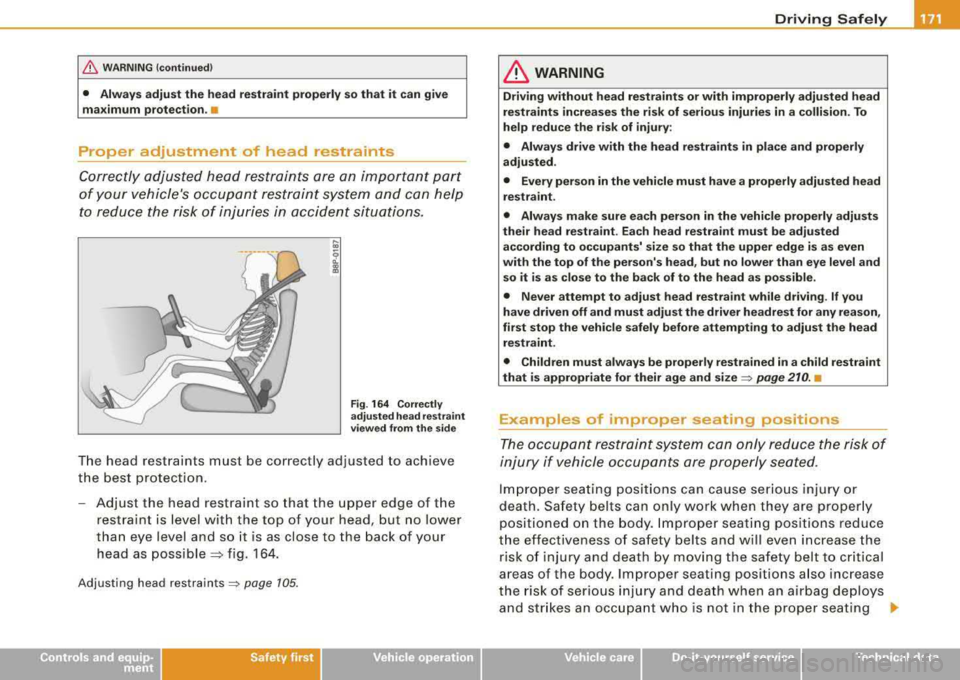
Correctly adjusted head restraints are an important part
of your vehicle's occupant restraint system and can help to reduce the risk of injuries in accident situations.
Fig . 164 Correctly
adjusted head restraint
viewed from the side
The head restraints must be correc tly adjusted to ach ieve
the best protect ion .
- Adjust the head restraint so that the upper edge o f the
restraint is level with the top of your head, but no lower
than eye level and so it is as close to the back of your
head as poss ible
~ fig . 164.
Adjus ting head re straints ~ page 105.
Safety first
Driving Safely
LJ}. WARNING
Driving without head restraints or with improperly adjusted head
restraints increases the risk of serious injuries in a collision. To
help reduce the risk of injury :
• Always drive with the head restraints in place and properly
adjusted .
• Every person in the vehicle must have a properly adjusted head
restraint.
• Always make sure each person in the vehicle properly adjusts
their head restraint . Each head restraint must be adjusted
according to occupants' size so that the upper edge is as even
with the top of the person's head, but no lower than eye level and
so it is as close to the back of to the head as possible.
• Never attempt to adjust head restraint while driving . If you
have driven off and must adjust the driver headrest for any reason,
first stop the vehicle safely before attempting to adjust the head
restraint.
• Children must always be properly restrained in a child restraint
that is appropriate for their age and
size ~ page 210. •
Examples of improper seating positions
The occupant restraint system can only reduce the risk of
injury if vehicle occupants are properly seated .
Improper seating positions can cause serious injury or
death . Safety belts can only work when they are properly
positioned on the body. Improper seating positions reduce
the effectiveness of safety belts and will even increase the r isk of injury and death by moving the safety belt to critical
areas of the body . Improper seating positions also increase
the risk of ser ious injury and death when an airbag deploys
and strikes an occupant who is not in the proper seat ing
.,_
irechnical data
Page 174 of 368
__ .....;;;D;..; r..;. iv.,;..;.; in~ g:...S
.;;;..;; a;.;.f .,;;e .,;.IY !.... ______________________________________________ _
position. A driver is responsible for the safety of all vehicle
occupants and especially for children. Therefore:
- Never allow anyone to assume an incorrect seating posi -
tion when the vehicle is being
used ~& .
The following bulletins list only some sample positions that will
increase the risk of serious injury and death. Our hope is that these
examples will make you more aware of seating positions that are
dangerous.
Therefore, whenever the vehicle is moving:
• never stand up in the vehicle
• never stand on the seats
• never kneel on the seats
• never ride with the seatback reclined
• never lie down on the rear seat
• never lean up against the instrument panel
• never sit on the edge of the seat
• never sit sideways
• never lean out the window
• never put your feet out the window
• never put your feet on the instrument panel
• never rest your feet on the seat cushion or back of the seat
• never ride in the footwell
• never ride in the cargo area
& WARNING
Improper seating positions increase the risk of serious personal
injury and death whenever a vehicle is being used.
• Always make sure that all vehicle occupants stay in a proper
seating position and are properly restrained whenever the vehicle
is being used.
•
Pedal area
Pedals
The pedals must always be free to move and must never
be interfered with by a floor mat or any other object.
Make sure that all pedals move freely without interference and that
nothing prevents them from returning to their original positions.
Only use floor mats that leave the pedal area free and can be
secured with floor mat fasteners.
If a brake circuit fails, increased brake pedal travel is required to
bring the vehicle to a full stop.
& WARNING
Pedals that cannot move freely can cause loss of vehicle control
and increase the risk of serious injury.
• Never place any objects in the driver's footwell. An object could
get into the pedal area and interfere with pedal function. In case
of sudden braking or an accident, you would not be able to brake
or accelerate!
• Always make sure that nothing can fall or move into the
driver's footwell. •
Floor mats on the driver side
Always use floor mats that can be securely attached to
the floor mat fasteners and do not interfere with the free
movement of the pedals.
- Make sure that the floor mats are properly secured and
cannot move and interfere with the
pedals~& . ~
Page 175 of 368
Driving Safely -
--------------=-='------'
Use only floor mats that leave the pedal area unobstructed and that
are firmly secured so that they cannot slip out of position. You can
obtain suitable floor mats from your authorized Audi Dealer.
Floor mat fasteners are installed in your Audi.
Floor mats used in your vehicle must be attached to these fasteners.
Properly securing the floor mats will prevent them from sliding into
positions that could interfere with the pedals or impair safe opera
tion of your vehicle in other ways .
& WARNING
Pedals that cannot move freely can result in a loss of vehicle
control and increase the risk of serious personal injury.
• Always make sure that floor mats are properly secured.
• Never place or install floor mats or other floor coverings in the
vehicle that cannot be properly secured in place to prevent them
from slipping and interfering with the pedals or the ability to
control the vehicle.
• Never place or install floor mats or other floor coverings on top
of already installed floor mats. Additional floor mats and other
coverings will reduce the size of the pedal area and interfere with
the pedals.
• Always properly reinstall and secure floor mats that have been
taken out for cleaning.
• Always make sure that objects cannot fall into the driver foot
well while the vehicle is moving. Objects can become trapped under the brake pedal and accelerator pedal causing a loss of
vehicle control. •
Controls and equip ment Safety first Vehicle operation
Stowing luggage
Loading the luggage compartment
All
luggage and other objects must be properly stowed
and secured in the luggage compartment.
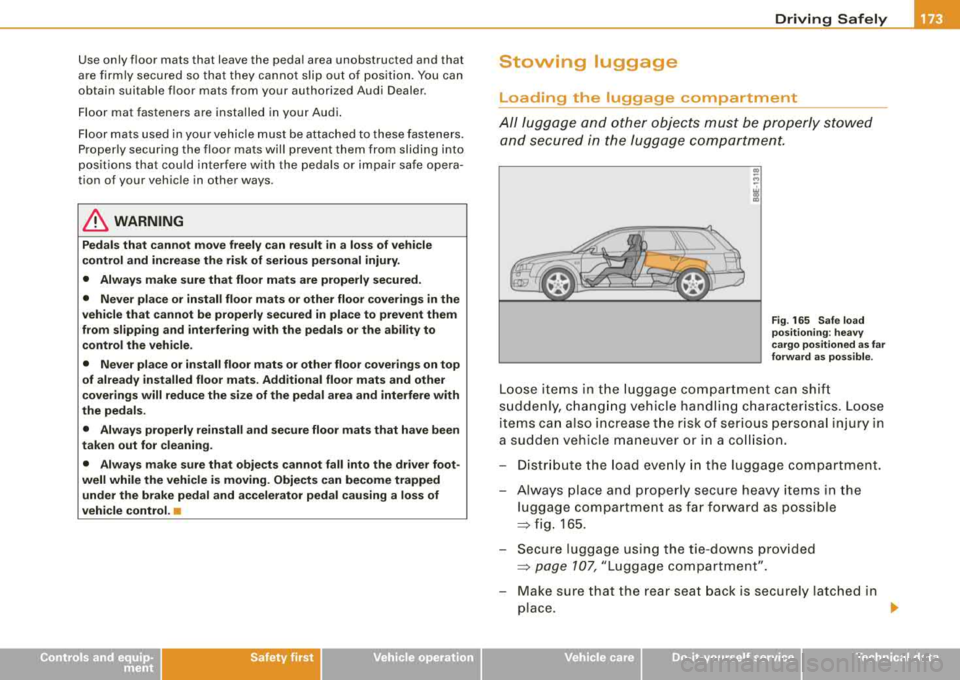
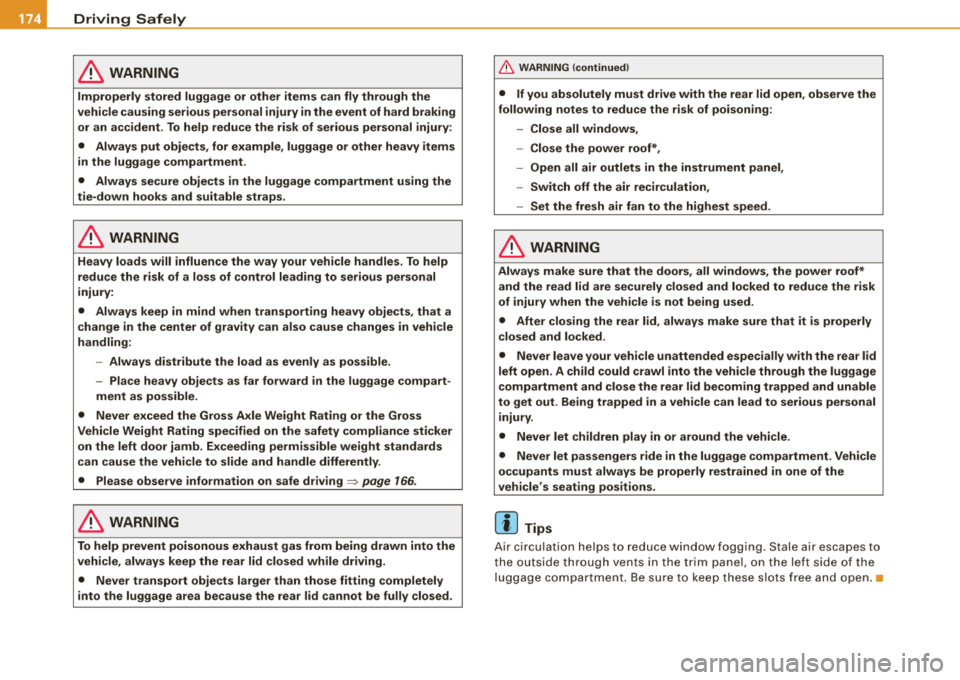
Fig. 165 Safe load
positioning: heavy
cargo positioned as
far
forward as possible.
Loose items in the luggage compartment can shift
suddenly, changing vehicle handling characteristics. Loose
items can also increase the risk of serious personal injury in
a sudden vehicle maneuver or in a collision.
- Distribute the load evenly in the luggage compartment.
- Always place and properly secure heavy items in the
luggage compartment as far forward as possible
=> fig. 165.
- Secure luggage using the tie-downs provided
=> page 107, "Luggage compartment".
- Make sure that the rear seat back is securely latched in
place. .,_
Vehicle care Do-it-yourself service Technical data
Page 176 of 368
___ D_ r
_ i_v _i_n ..;::g :;_ S_ a_ f_ e_, ly'----------------------------------------------------
& WARNING
Improperly stored luggage or other items can fly through the
vehicle causing serious personal injury in the event of hard braking
or an accident. To help reduce the risk of serious personal injury:
• Always put objects, for example, luggage or other heavy items
in the luggage compartment .
• Always secure objects in the luggage compartment using the
tie-down hooks and suitable straps .
& WARNING
Heavy loads will influence the way your vehicle handles. To help
reduce the risk of a loss of control leading to serious personal
injury :
• Always keep in mind when transporting heavy objects, that a
change in the center of gravity can also cause changes in vehicle
handling:
-Always distribute the load as evenly as possible.
- Place heavy objects as far forward in the luggage compart-
ment as possible.
• Never exceed the Gross Axle Weight Rating or the Gross
Vehicle Weight Rating specified on the safety compliance sticker on the left door jamb. Exceeding permissible weight standards
can cause the vehicle to slide and handle differently.
• Please observe information on safe
driving => page 166.
& WARNING
To help prevent poisonous exhaust gas from being drawn into the
vehicle, always keep the rear lid closed while driving.
• Never transport objects larger than those fitting completely
into the luggage area because the rear lid cannot be fully closed.
& WARNING (continued)
• If you absolutely must drive with the rear lid open, observe the
following notes to reduce the risk of poisoning :
- Close all windows,
- Close the power roof*,
- Open all air outlets in the instrument panel,
- Switch off the air recirculation,
- Set the fresh air fan to the highest speed.
& WARNING
Always make sure that the doors, all windows, the power roof*
and the read lid are securely closed and locked to reduce the risk
of injury when the vehicle is not being used.
• After closing the rear lid, always make sure that it is properly
closed and locked.
• Never leave your vehicle unattended especially with the rear lid
left open. A child could crawl into the vehicle through the luggage
compartment and close the rear lid becoming trapped and unable
to get out . Being trapped in a vehicle can lead to serious personal
injury.
• Never let children play in or around the vehicle.
• Never let passengers ride in the luggage compartment . Vehicle
occupants must always be properly restrained in one of the
vehicle's seating positions.
[ i] Tips
Air circulation helps to reduce window fogging. Stale air escapes to
the outside through vents in the trim panel, on the left side of the
luggage compartment. Be sure to keep these slots free and open. •
Page 177 of 368
Driving Safely -
--------------=-='------'
Tie-downs
The luggage compartment is equipped with four tie
downs to secure luggage and other items.
Use the tie -downs to secure your cargo properly => page 173,
"Loading the luggage compartment".
In a collision, the laws of physics mean that even smaller items that
are loose in the vehicle will become heavy missiles that can cause
serious injury. Items in the vehicle possess energy which vary with
vehicle speed and the weight of the item. Vehicle speed is the most
significant factor.
For example, in a frontal collision at a speed of 30 mph (48 km/h),
the forces acting on a 10 lbs. (4,5 kg) object are about 20 times the
normal weight of the item. This means that the weight of the item
would suddenly be about 200 lbs. (90 kg). You can imagine the inju
ries that a 200 lbs . (90 kg) item flying freely through the passenger
compartment could cause in a collision like this.
& WARNING
Weak, damaged or improper straps used to secure items to tie
downs can fail during hard braking or in a collision and cause
serious personal injury.
• Always use suitable mounting straps and properly secure
items to the tie-downs in the luggage compartment to help
prevent items from shifting or flying forward as dangerous
missiles.
• When the rear seat backrest is folded down, always use suit
able mounting straps and properly secure items to the tie-downs
in the luggage compartment to help prevent items from flying
forward as dangerous missiles into the passenger compartment.
• Never attach a child safety seat tether strap to a tie-down.
•
Controls and equip
ment Safety first Vehicle operation
Reporting safety defects
If you believe that your vehicle has a defect which could cause a
crash or could cause injury or death, you should immediately inform
the National Highway Traffic Safety Administration (NHTSAl in addi
tion to notifying Audi of America, Inc. If NHTSA receives similar
complaints, it may open an investigation, and if it finds that a safety
defect exists in a group of vehicles, it may order a recall and remedy
campaign. However, NHTSA cannot become involved in individual
problems between you, your dealer, or Audi of America, Inc.
To contact NHTSA, you may call the Vehicle
Safety Hotline toll-free at 1-888-327-4236 (TTY:
1-800-424-9153);
go to
http://www.safercar.gov;
or write to: Administrator, NHTSA, 400 Seventh
Street, SW., Washington, DC 20590.
You can also obtain other information about
motor vehicle safety from
http://www.safercar.gov. •
Vehicle care Do-it-yourself service Technical data
Page 178 of 368
___ S_a_ f_ e_ t...: y_ b_e_ l_ t _s _______________________________________________ _
Safety belts
General notes
Always wear safety belts!
Wearing safe ty belts correctly saves lives!
T hi s ch apter explain s why s afe ty belts ar e necess ary , h ow
they w ork an d how t o ad just an d wear th em corr ectly.
- Read all the inf ormat ion that follows a nd heed all of the
i ns tru ction s and WARNINGS.
LJ}. WARNING
Not wearing safety belts or wearing them improperly increases
the risk of serious personal injury and death .
• Safety belts are the single most effective means available to
reduce the risk of serious injury and death in automobile acci
dents . For your protection and that of your passengers , always
wear the safety belts properly when the vehicle is moving .
• Pregnant women , injured, or physically impaired persons must
also use safety belts . Like all vehicle o ccupants , they are more
likely to be seriously injured if they do not wear safety belts . The
best way to protect a fetus is to protect the mother - throughout
the entire pregnancy . •
Number of seats
Y o ur Aud i has a total of fi ve seati ng po siti ons: tw o in t he fr ont and
three in t he rear . E ac h seating position has a safety b elt.
LJ}. WARNING
Not wearing safety belts or wearing them improperly increases
the risk of serious personal injury and death.
• Never strap more than one person , including small children,
into any belt . It is especially dangerous to place a safety belt over
a child sitting on your lap.
• Never let more people ride in the vehicle than there are safety
belts available.
• Be sure everyone riding in the vehicle is properly restrained
with a separate safety belt or child restraint . •
Safety belt warning light ~
Your vehicle has a warn ing system for the d river and (on
USA models only) f ront seat passenger to re mind you
a b ou t the i mpor tanc e o f b uckl in g -up.
Fig . 166 Safety belt
warning light in the instrument cluster -
enlarged
.,.
Page 179 of 368
Before driving off, always:
-Fasten your safety belt and make sure you are wearing it
properly.
- Make sure that your passengers also buckle up and prop erly wear their safety belts.
- Protect your children with a child restraint system appro-
priate for the size and age of the children.
The warning light {} in the instrument cluster lights up when the
ignition is switched on as a reminder to fasten the safety belts . In
addition, you will hear a warning sound.
After the ignition is switched on, the warning tone will come on for about 6 seconds a long with a{} warning light in the instrument
cluster if either the driver or (on USA models only) front seat
passenger has not fastened their safety belt. As soon as the driver
and front seat passenger have fastened the safety belt, the warning
tone will stop and the warning light will go out.
I f both the driver and front seat passenger have not buckled -up
within about 24 seconds after the warning tone has stopped, the
warning tone will sound again for about 6 seconds. The warning
tone will sound repeatedly for about 6 seconds at 24 second inter
vals until both the driver and front passenger have buckled-up. The
safety belt warning system is active for about 5 minutes and during
this time the warning light in the instrument cluster will stay on .
Fasten your safety belt now and make sure that your passengers
also properly put on their safety belts.
•
Safety first
Safety belts
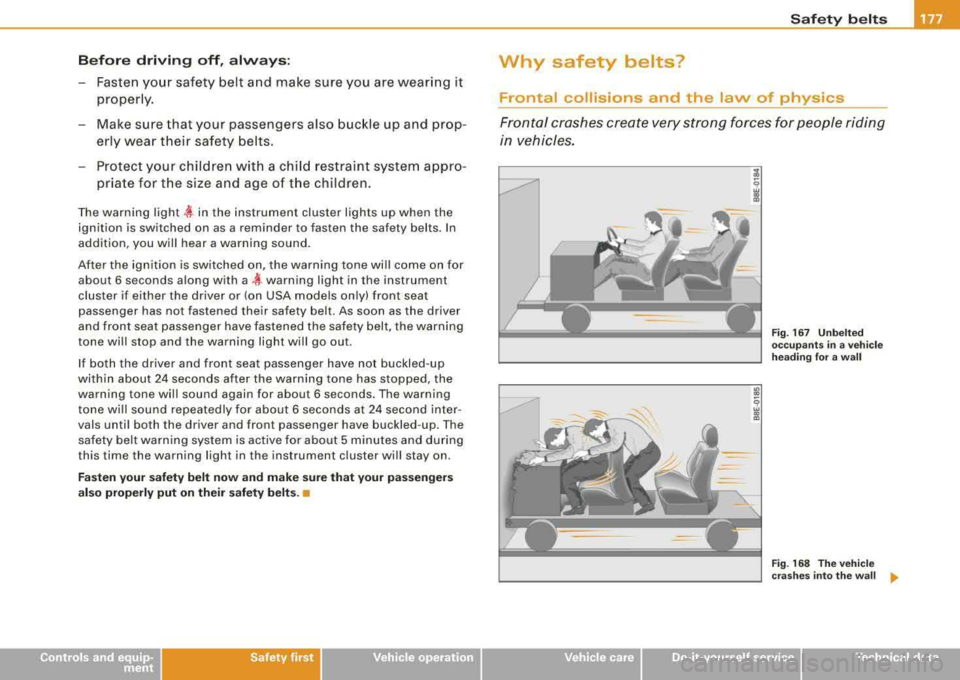
Why safety belts?
Frontal collisions and the law of physics
Frontal crashes create very strong forces for people riding
in vehicles.
"' "' 9 w
"' a,
Fig. 167 Unbelted
occupants in a vehicle
heading for a wall
Fig . 168 The vehicle
crashes into the wall
jlJ>
Technical data
Page 182 of 368
___ S_a_ f_ e_ t...: y_ b_e_ l_ t _s _______________________________________________ _
increases the ability of the supplemental airbags to do their job in a
collision. For this reason, wearing a safety belt is legally required in
most countries including much of the United States and Canada .
Although your Audi is equipped with airbags, you still have to wear
the safety belts provided. Front airbags, for example, are activated
only in some frontal collisions. The front airbags are not activated in
all frontal collisions, in side and rear collisions, in roll overs or in
cases where there is not enough deceleration through impact to the
front of the vehicle. The same goes for the other airbag systems in
your Audi . So, always wear your safety belt and make sure every
body in your vehicle is properly restrained!
•
Important safety instructions about safety
belts
Safety belts must always be correctly positioned across the strongest bones of your body.
-Always wear safety belts as illustrated and described in
this chapter.
- Make sure that your safety belts are always ready for use
and are not damaged.
& WARNING
Not wearing safety belts or wearing them improperly increases
the risk of serious personal injury and death. Safety belts can work
only when used correctly.
• Always fasten your safety belts correctly before driving off and
make sure all passengers are correctly restrained.
• For maximum protection, safety belts must always be posi
tioned properly on the body.
• Never strap more than one person, including small children,
into any belt.
& WARNING (continued)
• Never place a safety belt over a child sitting on your lap.
• Always keep feet in the footwell in front of the seat while the
vehicle is being driven.
• Never let any person ride with their feet on the instrument
panel or sticking out the window or on the seat.
• Never remove a safety belt while the vehicle is moving. Doing
so will increase your risk of being injured or killed.
• Never wear belts twisted.
• Never wear belts over rigid or breakable objects in or on your
clothing, such as eye glasses, pens, keys, etc., as these may cause
injury.
• Never allow safety belts to become damaged by being caught
in door or seat hardware.
• Do not wear the shoulder part of the belt under your arm or
otherwise out of position .
• Several layers of heavy clothing may interfere with correct posi
tioning of belts and reduce the overall effectiveness of the system.
• Always keep belt buckles free of anything that may prevent the
buckle from latching securely.
• Never use comfort clips or devices that create slack in the
shoulder belt. However, special clips may be required for the
proper use of some child restraint systems.
• Torn or frayed safety belts can tear, and damaged belt hard
ware can break in an accident. Inspect belts regularly. If webbing,
bindings, buckles, or retractors are damaged, have belts replaced
by an authorized Audi dealer or qualified workshop.
• Safety belts that have been worn and loaded in an accident
must be replaced with the correct replacement safety belt by an
authorized Audi dealer . Replacement may be necessary even if
damage cannot be clearly seen. Anchorages that were loaded
must also be inspected.
.,_
Page 183 of 368
/b, WARNIN G (conti nued )
• Never remove , modify , di sass emble , or try to repair the safety
belt s yourself .
• Always keep the belt s cl ean . Dirty belt s may not work properly
and can impair the fun ction of the i nertia ree l
=> pag e 265, "S afety
belt s".•
Safety belts
Fastening safety belts
Seat first
-everyb ody buckle up!
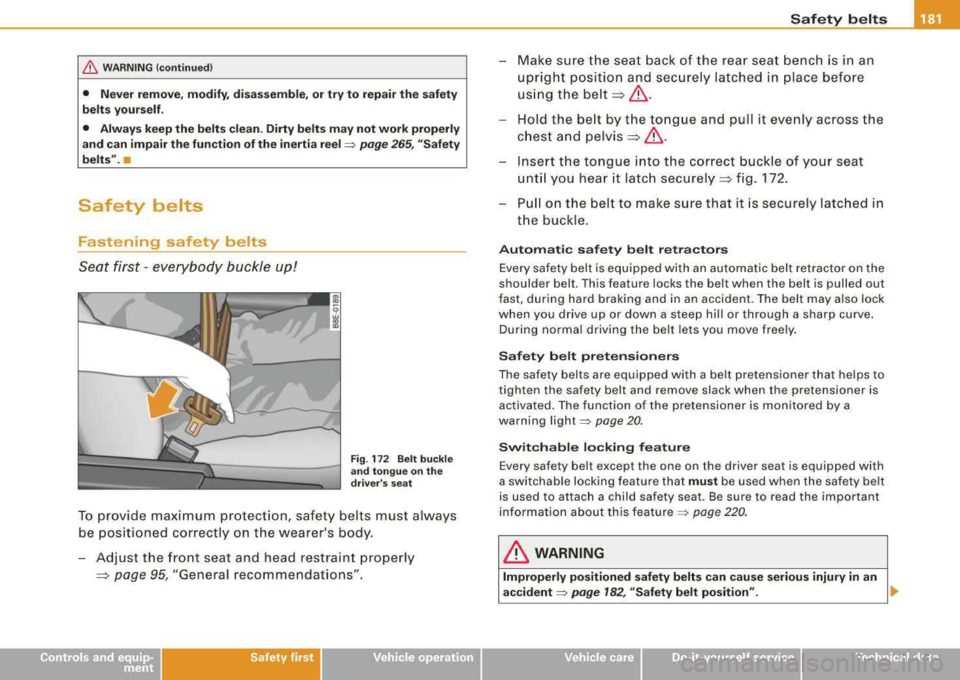
Fig . 17 2 Bel t buckle
an d to n g ue on th e
driver' s se at
To provide maximum protection, safety belts must always
be positioned co rrect ly on the wearer's body.
-Adjust the front seat and head restraint properly
=> page 95, "General recommendat ions".
Safety first
Safety b elts
-Make sure the seat back of the rea r sea t bench is in an
uprig ht p osit ion and sec ure ly la tch ed in place before
us ing the
belt=> &-
-Ho ld the belt by t he to n gue and pull it evenly across the
c h es t an d
pelvis => &-
-Insert t he tongue into the correct buckle of you r seat
unti l you hear it latch
securely => fig. 172.
-Pu ll on the belt to make su re that it is securely latched in
t h e buckle.
Automati c safety b elt r etr ac tors
Every safety belt is equipped with an automatic belt retractor on the
shoulder belt. This feature locks the belt when the belt is pulled out
fast, during hard braking and in an accident. The belt may also lock
when you dr ive up or down a steep hill or through a sharp curve.
Dur ing normal d riving the belt lets you move free ly .
Sa fety belt pretensioners
The safety belts are equip ped with a belt pretensioner tha t he lps to
tighten the safety belt and remove slack when the pretensioner is activated. The function of the pretensioner is monitored by a
warning
light=> page 20.
Sw itchable l ocking featur e
Every safety be lt except the one on the driver seat is equipped with
a switchable locking feature that
mu st be used when the safety be lt
is used to attach a child safety seat . Be sure to read the important
informat ion about this
feature => page 220.
& WARNING
Improperly po sitioned safety belt s can cau se seriou s injury in an
a c cident =>
page 182 , "Safety belt p osition ". ...
irechnical data